1. Introduction
The Ediacaran–Cambrian (E-C) boundary is arguably the most important transition in the geologic timescale. Interestingly, this is the only stratigraphic boundary based on the occurrence of a trace fossil, namely Treptichnus pedum (Brasier, Cowie & Taylor, Reference Brasier, Cowie and Taylor1994; Landing, Reference Landing1994; Peng, Babcock & Cooper, Reference Peng, Babcock, Cooper, Gradstein, Ogg, Schmitz and Ogg2012), an ichnospecies interpreted as produced by priapulids (Vannier et al. Reference Vannier, Calandra, Gaillard and Zylinska2010). Unsurprisingly, investing a trace-fossil taxon with such biostratigraphic pre-eminence has been the focus of criticism (e.g. Babcock et al. Reference Babcock, Peng, Zhu, Xiao and Ahlberg2014; Smith et al. Reference Smith, Macdonald, Petach, Bold and Schrag2016 a). The utility of T. pedum has been criticized based on its ichnotaxonomy, behavioural significance, facies controls and stratigraphic occurrence. The aim of this paper is to critically assess each of these issues in order to evaluate the potential and caveats of using Treptichnus pedum as an indicator of the E-C boundary.
2. A critical assessment of the utility of Treptichnus pedum as a biostratigraphic index
Overall, points of contention have revolved around four main issues (1) ichnotaxonomy, (2) behavioural significance, (3) facies controls and (4) stratigraphic occurrence.
2.a. Ichnotaxonomical aspects
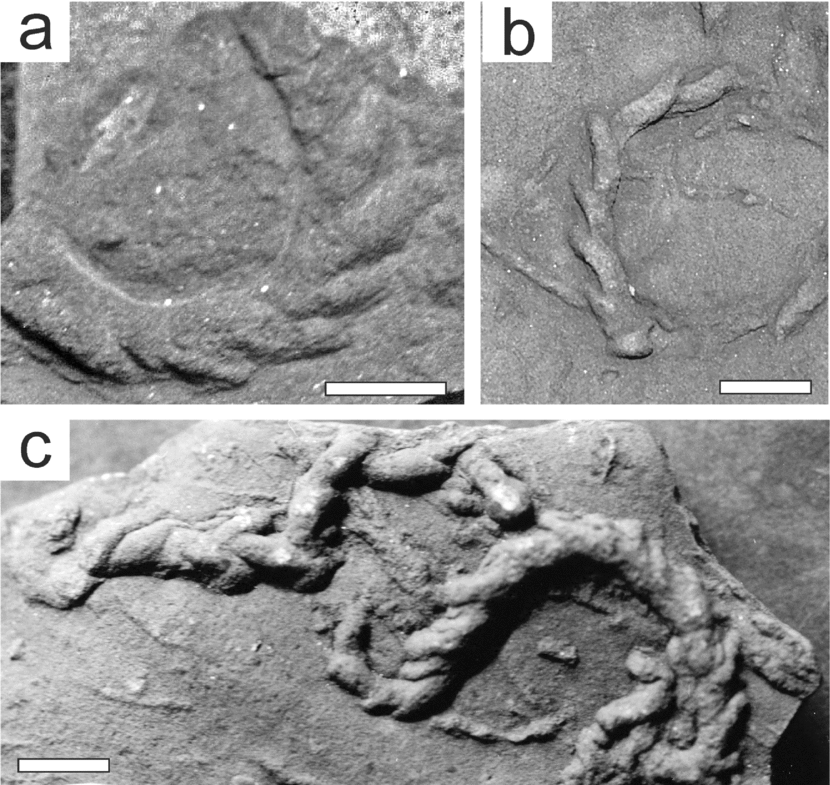
First, from an ichnotaxonomical standpoint, confusion among non-specialists results from the fact that Treptichnus pedum was originally referred to as Phycodes pedum by Seilacher (Reference Seilacher, Schindewolf and Seilacher1955) and, more recently, some authors have placed it in Trichophycus (Geyer & Uchman, Reference Geyer and Uchman1995) or Manykodes (Dzik, Reference Dzik2005). Trichophycus consists of endichnial burrows displaying a flattish U-shaped geometry, typically retrusive spreiten, and striations on the ventral and lateral surface of the burrow (Osgood, Reference Osgood1970; Mángano & Buatois, Reference Mángano and Buatois2011). Also, although Trichophycus may locally display rare vertical bifurcations, it never develops the systematic branching pattern that characterizes Treptichnus pedum. In short, the overall geometry of Treptichnus pedum, which consists of branching burrow systems comprising straight to slightly curved segments (Fig. 1), is clearly different from that shown by Trichophycus (Jensen, Reference Jensen1997; cf. plates 17 and 64 in Seilacher, Reference Seilacher2007).
Morphology of Treptichnus pedum. (a) Specimen from the type locality. Nobulus Shale, lower Cambrian, Salt Range, Pakistan. Specimen housed at the Palaeontological Collection, Geologisches Institut, University of Tübingen, Germany. (b) Klipbak Formations, Brandkop Subgroup, lower Cambrian, near Brandkop, South Africa. Field photograph. (c) Lower Bright Angel Shale, middle Cambrian, Indian Gardens, AZ, USA. Specimen housed at the Palaeontological Collection, Geologisches Institut, University of Tübingen. Scale bars are 1 cm.

The name Manykodes has been suggested by Dzik (Reference Dzik2005) as a genus to place some ichnospecies of Treptichnus, including T. pedum. Unfortunately, this practice is based on the assumption that trace fossils can be understood in the same way as body fossils and that a particular trace fossil can be directly and invariably linked to a producer. However, behavioural convergence rules out establishing a one-to-one relationship between a producer and an ichnotaxon. At least 40 years of ichnotaxonomical work has led to the consensus that nomenclatures of biotaxa and ichnotaxa needs to be kept separate (e.g. Bromley, Reference Bromley1990; Bertling et al. Reference Bertling, Braddy, Bromley, Demathieu, Genise, Mikuláš, Nielsen, Nielsen, Rindsberg, Schlirf and Uchman2006; Buatois & Mángano, Reference Buatois and Mángano2011). Accordingly, the approach by Dzik (Reference Dzik2005) can be accepted neither on theoretical nor on practical bases. Regardless of ichnotaxonomical technicalities and different philosophical approaches to ichnotaxonomy, Treptichnus pedum is a distinct and easily identifiable ichnotaxon (see also Babcock et al. Reference Babcock, Peng, Zhu, Xiao and Ahlberg2014).
2.b. Behavioural significance
There is overwhelming agreement in that T. pedum represents a feeding trace. However, there are four alternative interpretations regarding the trophic type involved: (1) a surface detritus feeder (Jensen, Reference Jensen1997), (2) a deposit feeder (Seilacher, Reference Seilacher, Schindewolf and Seilacher1955), (3) a predator (Vannier et al. Reference Vannier, Calandra, Gaillard and Zylinska2010) and (4) an undermat miner (Seilacher, Reference Seilacher2007). Regardless of the specific mode of feeding, the behaviour involved represents a sophisticated mechanism of exploiting new ecospace by a metazoan-grade animal. The issue of this style of animal–sediment interaction representing evidence of vertical bioturbation or not (Babcock et al. Reference Babcock, Peng, Zhu, Xiao and Ahlberg2014) is merely a semantic problem. Strictly speaking, T. pedum is not a vertical burrow (such as Skolithos or Arenicolites), but a horizontal burrow with inclined branches oriented oblique to the bedding plane. What is really significant here is that T. pedum represents the onset of infaunalization by means of systematically probing within the substrate (Jensen, Reference Jensen1997), and this is a signature of the changes in animal–substrate interactions that is iconic of the Phanerozoic world (MacNaughton & Narbonne, Reference MacNaughton and Narbonne1999; Seilacher, Reference Seilacher1999; Jensen, Reference Jensen2003; Mángano & Buatois, Reference Mángano and Buatois2014, Reference Mángano, Buatois, Mángano and Buatois2016). This level of complexity in burrowing style is unknown in Ediacaran strata (for reviews of Ediacaran ichnofaunas, see Jensen, Droser & Gehling, Reference Jensen, Droser, Gehling, Kaufman and Xiao2006; Buatois & Mángano, Reference Buatois, Mángano, Mángano and Buatois2016).
The issue of behavioural convergence has also been regarded as problematic (Babcock et al. Reference Babcock, Peng, Zhu, Xiao and Ahlberg2014). Although behavioural convergence is definitely a trait of trace fossils, its implications with respect to the position of the E-C boundary are virtually non-existent. Because it is the first appearance of Treptichnus pedum that is relevant for this problem, subsequent occurrences in the stratigraphic record as a result of behavioural convergence, although of interest in other respects, do not seem to have any further implication for arguments on the location of the E-C boundary. For example, incipient T. pedum has been recorded in modern continental deposits, where they are produced by fly larvae of the genus Symplecta (Muñiz-Guinea et al. Reference Muniz-Guinea, Mángano, Buatois, Podeniene, Gamez and Mayoral2014), clearly underscoring the importance of behavioural convergence in ichnology, but obviously lacking any relevance for E-C biostratigraphy.
2.c. Facies controls
The third set of objections, those dealing with facies controls, is more significant (Babcock et al. Reference Babcock, Peng, Zhu, Xiao and Ahlberg2014; Smith et al. Reference Smith, Macdonald, Petach, Bold and Schrag2016 a). These objections are based on the idea that trace fossils show a closer link to sedimentary facies than body fossils. Although this may be regarded as generally correct, this view fails to appreciate that the vast majority of individual ichnotaxa occur in a wide variety of sedimentary facies and environments and it is a trace-fossil assemblage that shows a more direct link to a certain set of environmental conditions (Bromley, Reference Bromley1990; Pemberton, MacEachern & Frey, Reference Pemberton, MacEachern, Frey, Walker and James1992; Buatois & Mángano, Reference Buatois and Mángano2011; MacEachern et al. Reference MacEachern, Bann, Gingras, Zonneveld, Dashtgard, Pemberton, Knaust and Bromley2012). This is precisely the reason why individual ichnotaxa are hardly used as indicators of sedimentary environments and the checklist approach has been abandoned in applied ichnology. Although the issue of facies control in trace-fossil distribution in E-C successions has been raised many times (e.g. Mount & McDonald, Reference Mount and McDonald1992; Mount & Signer, Reference Mount, Signer, Lipps and Signer1992; Lindsay et al. Reference Lindsay, Brasier, Dorjnamjaa, Goldring, Kruse and Wood1996; Babcock et al. Reference Babcock, Peng, Zhu, Xiao and Ahlberg2014; Smith et al. Reference Smith, Macdonald, Petach, Bold and Schrag2016 a), only a handful of ichnological studies have empirically examined this problem in a systematic fashion (e.g. MacNaughton & Narbonne, Reference MacNaughton and Narbonne1999; Buatois, Almond & Germs, Reference Buatois, Almond and Germs2013; Shahkarami, Mángano & Buatois, Reference Shahkarami, Mángano and Buatois2017). The scarcity of studies has resulted in the notion of facies control unfortunately becoming an untested assumption in the E-C boundary literature. Interestingly, the available studies integrating ichnological and sedimentological information within a sequence-stratigraphic framework suggest a more nuanced scenario, where trace-fossil distribution reveals a complex interplay of evolutionary and environmental controls (e.g. Shahkarami, Mángano & Buatois, Reference Shahkarami, Mángano and Buatois2017).
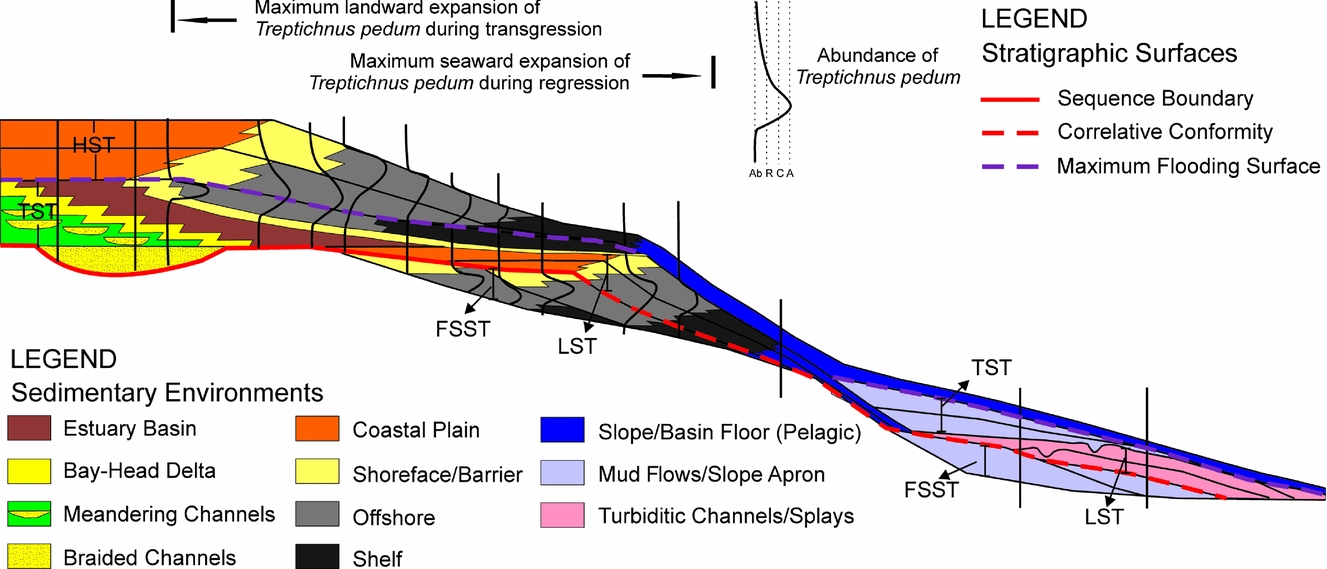
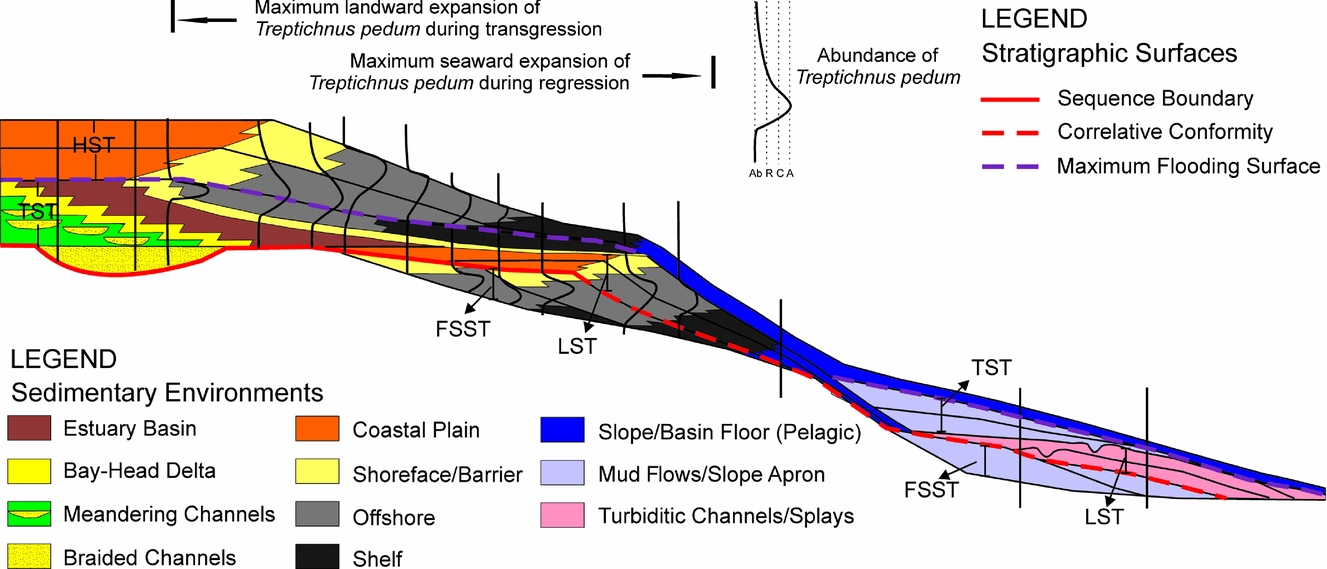
The environmental tolerance and range offset of Treptichnus pedum are key issues that can be assessed using the principles and methods of stratigraphic palaeobiology (Patzkowsky & Holland, Reference Patzkowsky and Holland2012), helping to illuminate this problem (Buatois, Almond & Germs, Reference Buatois, Almond and Germs2013) (Fig. 2). Studies in Namibia and South Africa show that, in contrast to common assumptions, Treptichnus pedum is not only present in the low-energy offshore of wave-dominated marine settings, but it occurs at considerably shallower water in intertidal and shallow-subtidal zones of tide-dominated systems (Geyer & Uchman, Reference Geyer and Uchman1995; Buatois, Almond & Germs, Reference Buatois, Almond and Germs2013). Also, detailed work in the Mackenzie Mountains of western Canada demonstrated its occurrence in mouth bars of deltaic systems and lower shoreface to offshore transition zones of wave-dominated marine settings (MacNaughton & Narbonne, Reference MacNaughton and Narbonne1999). The maximum landward range of T. pedum in wave-dominated systems is probably controlled by the frequency and intensity of storms (Buatois, Almond & Germs, Reference Buatois, Almond and Germs2013). In the case of high intensity and frequency of storms, amalgamated hummocky cross-stratified sandstone is typical, precluding colonization by the T. pedum producer. Under moderate or low intensity and frequency of storms, the presence of T. pedum is promoted by longer colonization windows during fair weather. Treptichnus pedum seems to have high values of peak abundance in the upper-offshore and lower-intertidal sandflats.
Sequence-stratigraphic architecture, and environmental tolerance and range offset of Treptichnus pedum (modified from Buatois, Almond & Germs, Reference Buatois, Almond and Germs2013) A single valley incision is illustrated for simplicity, although compound valleys may occur in some sections spanning the E-C boundary (e.g. Namibia, see Wilson et al. Reference Wilson, Grotzinger, Fischer, Hand, Jensen, Knoll, Abelson, Metz, McLoughlin, Cohen and Tice2012). A wave-dominated regime is depicted for the fully marine segment, but a similar diagram can be produced for a tide-dominated regime by changing the facies belt of the shallow-marine segment. Ab = absent, R = rare, C = common, A = abundant.
The common absence of T. pedum in settings below storm wave base may reflect the seaward boundary of its habitat or a preservational bias resulting from the lack of lithological heterogeneities (Shahkarami, Mángano & Buatois, Reference Shahkarami, Mángano and Buatois2017). The latter is supported by the presence of T. pedum in thin siltstone layers intercalated in a shale succession formed right below storm wave base in the Soltanieh Formation of Iran (Shahkarami, Mángano & Buatois, Reference Shahkarami, Mángano and Buatois2017). These slightly coarser-grained beds were emplaced by storm-generated turbidity currents providing the adequate lithological contrast for preservation of T. pedum, suggesting that the common absence of this ichnospecies in settings below storm wave base may be a taphonomical artefact. A deep-marine occurrence has been documented in Devonian deposits (Neto de Carvalho, Reference Neto de Carvalho2008). Although this may possibly reflect an onshore–offshore pattern, the absence of further recordings prevents the establishment of any trend. In any case, the broad environmental tolerance of this ichnospecies supports evolutionary innovations rather than facies controls as the main mechanism underlying the observed vertical pattern of distribution of T. pedum in E-C successions comprising shallow-marine deposits.
2.d. Stratigraphic distribution
Concerns have been raised with respect to the stratigraphic distribution of T. pedum, regarding both potential occurrences below the boundary and its delayed appearance or absence in others (Babcock et al. Reference Babcock, Peng, Zhu, Xiao and Ahlberg2014). The so-called treptichnids have been documented below the E-C boundary in a number of sections, most notably Namibia (Jensen et al. Reference Jensen, Saylor, Gehling and Germs2000) and Norway (Högström et al. Reference Högström, Jensen, Palacios and Ebbestad2013). In both cases, the authors were cautious enough not to provide an ichnospecific assignment and even left the ichnogeneric assignment uncertain. In addition, recent work by Jensen et al. (Reference Jensen, Högström, Høyberget, Meinhold, Palacios, Taylor, Ebbestad and Agić2017) showed that the structures from Norway may belong in the horizontally corkscrew-shaped ichnogenus Helicolithus. Even assuming that the specimens from Namibia may record the basic morphological plan of Treptichnus, meriting assignment to Treptichnus isp., clearly they do not display the diagnostic features of T. pedum. South African specimens of T. pedum figured by Seilacher (Reference Seilacher2007) as E-C in age occur in Fortunian but not in Ediacaran strata (Buatois et al. Reference Buatois, Almond, Gresse and Germs2007; Almond et al. Reference Almond, Buatois, Gresse and Germs2008). Babcock et al. (Reference Babcock, Peng, Zhu, Xiao and Ahlberg2014) speculated that some Ediacaran examples identified as Treptichnus may represent preservational variants of T. pedum, but this has not been demonstrated so far. In addition, the diagnostic style of branching of T. pedum makes this suggestion unlikely. The occurrence of the ichnospecies T. pedum 4.41 m below the Global Boundary Stratotype Section and Point (GSSP) (Gehling et al., Reference Gehling, Jensen, Droser, Myrow and Narbonne2001) simply represents a problem of confidence intervals (Landing et al. Reference Landing, Geyer, Brasier and Bowring2013).
More problematic is the issue of delayed appearance or absence of T. pedum in certain sections (Babcock et al. Reference Babcock, Peng, Zhu, Xiao and Ahlberg2014), a topic which is directly connected with its environmental range. The delayed appearance of T. pedum may be understood by means of the concept of range offset, which is essentially dictated by the ecological characteristics of taxa and by the stratigraphic architecture, the latter controlling to a large extent the types of sedimentary environments preserved in a stratigraphic section (Patzkowsky & Holland, Reference Patzkowsky and Holland2012). Range offset of T. pedum is typically greater above sequence boundaries (SB) within lowstand systems tracts (LST) and parts of transgressive systems tracts (TST), which explains its delayed appearance in some sections spanning the E-C boundary (Buatois, Almond & Germs, Reference Buatois, Almond and Germs2013). In particular, incision of fluvio-estuarine valleys is detrimental to colonization by the T. pedum producers. In this regard, the fact that the Fortune Head succession (Chapel Island Formation) lacks a valley incision coincident with the E-C boundary (Myrow & Hiscott, Reference Myrow and Hiscott1993) makes it particularly appropriate as the GSSP. A systematic review of the occurrences of T. pedum is beyond the scope of this paper, but a brief overview of the sections where this ichnotaxon occurs significantly above the E-C boundary is discussed in order to assess potential causes.
The sequence-stratigraphic context of the South Australia succession (Uratanna and Parachilna formations) consists of valley incision (SB) and subsequent transgression (Gehling, Reference Gehling2000). The Uratanna Formation (LST–TST) is incised into the underlying Rawnsley Quartzite (HST or highstand systems tract), and passes up into the shallow-marine Parachilna Formation (Daily, Reference Daily1973; Gehling, Reference Gehling2000, fig. 9). The first appearance of T. pedum is more than 200 m above the base of the Uratanna Formation (Jensen et al. Reference Jensen, Gehling and Droser1998). However, the E-C boundary is thought to be broadly coincident with the base of the Uratanna Formation (Gehling, Reference Gehling2000). The absence of this ichnotaxon in the marginal-marine deposits of the lower and middle intervals of the Uratanna Formation most likely reflects the stress associated with brackish-water conditions that may have precluded colonization. Further work on the integration of ichnological, sedimentological and sequence-stratigraphic datasets in this unit is essential to further evaluate the distribution of T. pedum.
Valley incision also occurs in the Nama Group of Namibia (Germs, Reference Germs1972; Wilson et al. Reference Wilson, Grotzinger, Fischer, Hand, Jensen, Knoll, Abelson, Metz, McLoughlin, Cohen and Tice2012). The Nomtsas Formation (LST to TST) is incised into the Spitskopf Member (HST) of the Urusis Formation. However, and in contrast to the Uratanna Formation, the lower interval of the Nomtsas Formation contains two subsequent episodes of valley incision (valley fills 1 and 2 of Wilson et al. Reference Wilson, Grotzinger, Fischer, Hand, Jensen, Knoll, Abelson, Metz, McLoughlin, Cohen and Tice2012), representing a compound valley-fill. The LST deposits of both incised valleys consist of pebble, cobble and boulder conglomerate, which is clearly unsuitable for preservation of T. pedum. Unsurprisingly, this ichnotaxon first occurs within the transgressive fine-grained sandstone of VF2 (Wilson et al. Reference Wilson, Grotzinger, Fischer, Hand, Jensen, Knoll, Abelson, Metz, McLoughlin, Cohen and Tice2012). Historically, the E-C boundary was regarded as roughly coincident with the SB at the base of the Nomtsas Formation (Grotzinger et al. Reference Grotzinger, Bowring, Saylor and Kaufman1995). However, recent recalibration of radiometric dating may indicate that the E-C boundary is placed within the upper part of the Spitskopf Member (Schmitz, Reference Schmitz, Gradstein, Ogg, Schmitz and Ogg2012; for ongoing work on the geochronology of these strata, see Linnemann et al. Reference Linnemann, Ovtcharova, Schaltegger, Vickers-Rich, GÄrtner, Hofmann, Zieger, Krause, Kriesfeld and Smith2017). Interestingly, the upper part of this unit is host to Streptichnus narbonnei, an ichnotaxon as complex in terms of morphology and behavioural significance as T. pedum (Jensen & Runnegar, Reference Jensen and Runnegar2005).
A similar situation is represented by the Vanrhynsdorp Group of South Africa. The Besonderheid Formation is incised into the underlying Gannabos Formation (Buatois et al. Reference Buatois, Almond, Gresse and Germs2007; Almond et al. Reference Almond, Buatois, Gresse and Germs2008). Whereas the Gannabos Formation represents shallow-marine deposits, the lower interval of the Besonderheid Formation records deposition within a fluvio-estuarine valley (LST–TST), rapidly passing upward into distal deltaic deposits (HST) (Buatois, Almond & Germs, Reference Buatois, Almond and Germs2013). The first appearance of T. pedum is in the overlying tidal-flat deposits of the Kalk Gat Formation (Gresse, Reference Gresse1992; Buatois et al. Reference Buatois, Almond, Gresse and Germs2007; Almond et al. Reference Almond, Buatois, Gresse and Germs2008; Buatois, Almond & Germs, Reference Buatois, Almond and Germs2013). Although there is a lack of radiometric dates in this unit, current schemes place the E-C boundary at the SB represented by the base of the Besonderheid Formation. The delayed appearance of T. pedum in the Vanrhynsdorp Group most likely reflects unsuitable environments, initially freshwater to brackish-water conditions and subsequently sub-storm wave base settings that resulted from the rapid sea-level rise. Notably, the complex feeding trace Oldhamia geniculata occurs in the prodeltaic portion of the Besonderheid Formation, providing ichnological evidence of a Cambrian age for this unit (Buatois et al. Reference Buatois, Almond, Gresse and Germs2007; Almond et al. Reference Almond, Buatois, Gresse and Germs2008).
The Soltanieh Formation of Iran represents another example of delayed appearance of T. pedum. This unit consists of five members, from bottom to top: the Lower Dolomite, Lower Shale, Middle Dolomite, Upper Shale and Upper Dolomite members (Hamdi, Brasier & Jiang, Reference Hamdi, Brasier and Jiang1989). The siliciclastic intervals are dominated by shale, with minor occurrences of thin sandstone beds (Hamdi, Brasier & Jiang, Reference Hamdi, Brasier and Jiang1989; Shahkarami, Mángano & Buatois, Reference Shahkarami, Mángano and Buatois2017). The succession displays a large-scale progradational trend. Deposition took place in settings below storm wave base (shelf sensu strictu) for the Lower Shale, and settings ranging from below the storm wave base to below the fair-weather wave base (shelf to upper offshore) for the Upper Shale (Shahkarami, Mángano & Buatois, Reference Shahkarami, Mángano and Buatois2017). The presence of the Anabarites trisulcatus – Protohertzina anabarica zone in the upper interval of the Lower Dolomite Member (Hamdi, Brasier & Jiang, Reference Hamdi, Brasier and Jiang1989) supports a location of the E-C boundary either at the base of the Soltanieh Formation or within the Lower Dolomite Member (Shahkarami, Mángano & Buatois, Reference Shahkarami, Mángano and Buatois2017, in press). However, the first appearance of T. pedum occurs 171 m above the base of the Lower Shale Member. Its appearance coincides with a subtle shallowing event from distal to proximal shelf deposits, characterized by thin siltstone interbeds representing the distal ends of storm-generated turbidites (Shahkarami, Mángano & Buatois, Reference Shahkarami, Mángano and Buatois2017). It has been indicated that the delayed appearance of T. pedum either reflects deep-water conditions unsuitable for colonization or lack of lithologic interfaces therefore preventing trace-fossil preservation (Shahkarami, Mángano & Buatois, Reference Shahkarami, Mángano and Buatois2017).
The Bayangol Formation of western Mongolia displays some similarities with the E-C succession in Iran, most notably the presence of a small shelly fauna below the first appearance of T. pedum. This unit is divided into five informal members, BG2–BG6 (Smith et al. Reference Smith, Macdonald, Petach, Bold and Schrag2016 a). The Bayangol Formation shows a complex facies mosaic, involving both carbonate and siliciclastic rocks, encompassing deposition from slope, shelf (i.e. below storm wave base) to shoreface (i.e. above fair-weather wave base) environments (Smith et al. Reference Smith, Macdonald, Petach, Bold and Schrag2016 a). A diverse ichnofauna, including T. pedum, occurs at the contact between BG3 and BG4 of the Bayangol Formation (Goldring & Jensen, Reference Goldring and Jensen1996; Smith et al. Reference Smith, Macdonald, Petach, Bold and Schrag2016 a). Because of this, the E-C boundary has historically been placed at the contact between these two informal members. However, this is inconsistent with the first occurrence of small shelly fossils c. 250 m below the first appearance of T. pedum and the presence of arthropod trace fossils in BG3, suggesting that the E-C boundary should be lower in the section, probably at the base of the Bayangol Formation (Smith et al. Reference Smith, Macdonald, Petach, Bold and Schrag2016 a). It has been indicated that this delayed appearance of T. pedum in Mongolia underscores its facies dependence (Smith et al. Reference Smith, Macdonald, Petach, Bold and Schrag2016 a, Reference Smith, Macdonald, Petach and Bold2017), but it is unclear which is the environmental tolerance of this ichnotaxon in this mixed carbonate–siliciclastic setting. In addition, it has been noted that T. pedum has only been documented in the Bayangol Formation from a single bed, precluding further discussion on potential controls (Landing & Kruse, Reference Landing and Kruse2017).
In the Meishucun section of eastern Yunnan Province, South China, the Xiaowaitoushan Member is separated from the overlying Meishucun Formation by a karst surface, representing a SB (Zhu, Reference Zhu1997). This formation is subdivided into Lower Phosphate, White Clay, Upper Phosphate and Dahai members (Zhu, Reference Zhu1997; Zhu et al. Reference Zhu, Li, Zhang, Steiner, Qian, Jiang, Zhu, Van Iten, Peng and Li2001). The Xiaowaitoushan Member is dominantly dolomite, whereas the Meishucun Formation consists mostly of phosphorite and tuff (Zhu et al. Reference Zhu, Li, Hou, Pan, Wang, Deng and He2009). In this section the first appearance of Treptichnus pedum occurs in strata near the top of the Lower Phosphate Member (Zhu, Reference Zhu1997). However, as in the case of the Soltanieh and Bayangol formations, small shelly fossils occur below this interval and, therefore, the E-C boundary has been placed at the contact between the Xiaowaitoushan Member and the Meishucun Formation (Zhu, Reference Zhu1997; Qian, Li & Zhu, Reference Qian, Li and Zhu2001). The phosphorites of the Meishucun Formation represents a condensed section, and high-energy conditions have been inferred (Zhu, Reference Zhu1997). Environmental conditions may have been detrimental for the producer of T. pedum. Also, the condensed nature of the Fortunian in the Meishucun section compromises the accuracy of compiling vertical distribution of trace fossils within a sound stratigraphic framework. In sharp contrast to the Fortunian succession in Burin Peninsula, the lack of recurrence in sedimentary facies prevents differentiation between environmental and evolutionary factors.
In addition to Burin Peninsula, the first appearance of Treptichnus pedum is roughly coincident with the base of the Cambrian in other regions of Laurentia, such as the western United States (e.g. Jensen, Droser & Heim, Reference Jensen, Droser, Heim and Corsetti2002; Smith et al. Reference Smith, Macdonald, Petach, Bold and Schrag2016 b), as well as of Baltica, most notably in N Norway (Högström et al. Reference Högström, Jensen, Palacios and Ebbestad2013). Claims of diachronism in the appearance of T. pedum in Gondwana (Babcock et al. Reference Babcock, Peng, Zhu, Xiao and Ahlberg2014) require a precise evaluation of associated facies and sequence-stratigraphic architecture in order to be substantiated.
3. Discussion
Of the four classes of concerns raised with respect to the utility of T. pedum as a biostratigraphic marker, the ichnotaxonomical and behavioural objections are the ones that can easily be regarded as less significant. The ones underscoring facies controls and stratigraphic occurrences are more relevant and directly linked to each other. Ichnological and sedimentological studies framing observations within sequence-stratigraphic architectures are particularly illustrative with respect to the interplay between evolutionary and environmental controls. For example, a detailed analysis of trace-fossil distribution in the E-C succession of the Mackenzie Mountains has shown that evolution was a first-order factor, whereas environmental factors played an important, but second-order control (MacNaughton & Narbonne, Reference MacNaughton and Narbonne1999). In the same vein, a recent study of the E-C succession in Iran outlined the necessity of placing ichnofaunas within a palaeoenvironmental and sequence-stratigraphic framework in order to evaluate their evolutionary and biostratigraphic implications for trace fossils (Shahkarami, Mángano & Buatois, Reference Shahkarami, Mángano and Buatois2017). In other words, the nature of the controls of the first appearance of T. pedum should not be established a priori but as a result of integrated and systematic ichnological, sedimentological and sequence-stratigraphic studies.
Application of concepts and methods of stratigraphic palaeobiology underscored the broad environmental tolerance of T. pedum, supporting its biostratigraphic utility in E-C successions formed under shallow-marine conditions, specifically encompassing environments ranging between right above fair-weather wave base to above storm wave base (Buatois, Almond & Germs, Reference Buatois, Almond and Germs2013). The applicability of T. pedum to biostratigraphic studies in marginal-marine (brackish water) or deep-water successions is limited. However, these limitations are probably shared by most available biostratigraphic tools for the lower Cambrian, such as trilobites and small shelly fossils.
Finally, emphasis on the potential and caveats of T. pedum should not divert our attention from the basic fact that a single tool is never the most adequate strategy to solve geological problems. For example, defining the E-C boundary based not strictly on the occurrence of Treptichnus pedum, but on a Treptichnus pedum Ichnofossil Assemblage Zone (Narbonne, Myrow & Anderson, Reference Narbonne, Myrow and Anderson1987; Landing et al. Reference Landing, Geyer, Brasier and Bowring2013; Laing et al. Reference Laing, Buatois, Mángano and Narbonne2016), will be of help to overcome the problem of those areas where this ichnospecies has not been recognized or occurs significantly above the boundary. In addition, regardless of biostratigraphic conventions, the use of multiple sets of evidence would be conducive to more robust zonations and correlations of E-C successions worldwide. The fact that trace fossils tend to be more abundant in siliciclastics, whereas small shelly fossils are abundant in carbonates, clearly illustrates the complementary nature of these two biostratigraphic tools. In addition, non-biostratigraphic tools, such as carbon isotope chemostratigraphy, will play an increasingly important role (Smith et al. Reference Smith, Macdonald, Petach, Bold and Schrag2016 a, Reference Smith, Macdonald, Petach and Bold2017).
Acknowledgements
Financial support for this study was provided by Natural Sciences and Engineering Research Council (NSERC) Discovery Grants 311726–13. M. Gabriela Mángano and Sören Jensen critically read the manuscript and helped to shape the ideas expressed in this paper. I also thank two anonymous reviewers for useful comments.