Introduction
Preterm birth is defined as a delivery that occurs at less than 37 completed weeks of gestational age. Preterm delivery rates are 12%–13% in the USA and 5%–9% in Europe and other developed countries, Reference Hamilton, Martin and Ventura1,Reference Slattery and Morrison2 which amounts to an annual rate of approximately 15 million preterm deliveries worldwide. Reference Dahlin, Gunnerbeck, Wikström, Cnattingius and Edstedt Bonamy3 Preterm birth is a leading cause of neonatal mortality and a factor contributing to short- and long-term morbidity, such as respiratory and gastrointestinal complications or neurodevelopmental disability. Reference Goldenberg, Culhane, Iams and Romero4 Preterm births may be divided into three categories: extremely preterm births (<28 weeks of gestation), very preterm births (29–31 weeks of gestation), and moderately preterm births (32–36 weeks of gestation). Perinatal complications are correlated with gestational age: the earlier the delivery, the higher the rates of morbidity and mortality. A global report in 2015 showed that complications related to preterm birth accounted for 17.8% of all deaths in children below the age of 5 years. Reference Liu, Oza and Hogan5 Delivery before 28 weeks of gestation is the most important risk factor for neonatal deaths in most developed countries. Reference Howson, Kinney, McDougall and Lawn6
Furthermore, preterm births constitute a public health problem because the infants need to be treated at intensive care units. The costs associated with preterm births in the USA in 2005 (medical, educational, and lost productivity combined) were at least $26.2 billion dollars. During the same year, the average first-year medical costs, including both inpatient and outpatient care, were about 10 times greater for preterm infants (32,325 dollars) than for infants born at term (3325 dollars). Reference Howson, Kinney, McDougall and Lawn6,Reference Behrman and Butler7
Because of its high impact on perinatal morbidity and mortality, considerable effort has been made to determine risk factors for preterm birth. Besides maternal diseases such as diabetes, infection, hypertension, and anomalies of the uterus, external influences, and fetal gender have been investigated as risk factors in various populations. Interestingly, an association was noted between the male gender and preterm birth rates in general, caused by not yet fully understood external influences. This phenomenon has been known for a long time, although geographical differences have not been reported to date. However, the pathomechanism underlying the preponderance of male preterm births is yet unknown. Reference Kanmaz, İnan and Beyan8-Reference Zeitlin, Saurel-Cubizolles and de Mouzon10 This hypothesis and its consequences might be important in the further management of pregnant women with preterm birth labor. Male sex as a risk factor for premature birth could mean a more closely meshed precaution for the pregnant woman in order to decrease the morbidity and mortality rate of preterm-born infants.
Smoking during pregnancy is one of the leading preventable risk factors for an unsuccessful pregnancy outcome. Active and passive maternal smoking has a damaging effect on every trimester of pregnancy. Cigarette smoke contains scores of toxins, which exert a direct effect on placental and fetal cell proliferation and differentiation. Smoking is associated with fetal growth restriction, an increasing risk of stillbirth, placental abruption, preterm births, and sudden infant death syndrome. Despite these detrimental effects, smoking interventions during pregnancy have been crowned with limited success in developed countries. Reference Dahlin, Gunnerbeck, Wikström, Cnattingius and Edstedt Bonamy3,Reference Cnattingius11 Maternal smoking rates of 5%–20% have been reported in Europe and the USA. Reference Curtin and Matthews12 A dose–response relationship was noted between smoking and the risk of preterm birth; the risk appears to increase with decreasing gestational age. Reference Kyrklund-Blomberg, Granath and Cnattingius13 A small number of studies have investigated the association between smoking and extremely preterm birth. Reference Raisanen, Gissler, Saari, Kramer and Heinonen14,Reference Lanting, Buitendijk, Crone, Segaar, Gravenhorst and van Wouwe15
In the following, we analyzed the relationship between maternal smoking and preterm birth.
Do preterm birth rates increase in proportion to the quantity of nicotine consumption?
Are the early weeks of gestation more susceptible to smoking than others or in other words: Is there a higher rate of premature births in the early weeks of gestation due to cigarette consumption?
Furthermore, we investigated the impact of fetal gender on the risk of preterm birth. Is the hypothesis of the previous work also confirmed in our study that male infants have an increased rate of premature birth?
Method
The data analyzed in the present report were obtained from the German Perinatal Survey which was conducted throughout Germany. The patients gave their written informed consent at the time of their admission to the hospital. The database of Schleswig-Holstein comprised of 220,339 singleton pregnancies registered between 2004 and 2017. Based on their smoking status during pregnancy, the women were divided into smokers and nonsmokers, and further subdivided into the following five categories according to their daily smoking habits: (a) nonsmokers; (b) mild smokers: 1–7 cigarettes/day; (c) moderate smokers: 8–14 cigarettes/day; (d) heavy smokers: 15–21 cigarettes/day; and (e) very heavy smokers: ≥22 cigarettes/day. The rate of preterm birth was analyzed for each of the five groups. Preterm births were divided into three categories: extremely preterm birth (<28 weeks of gestation), very preterm birth (28–31 weeks of gestation), and moderately preterm birth (32–36 weeks of gestation).
The second issue addressed in the study was whether fetal gender in combination with smoking has an effect on preterm birth. Again, the women were divided into smokers and nonsmokers, and further subdivided into the abovementioned five categories. Preterm births (≤36 weeks of gestation) subdivided into the male and female fetal gender were analyzed for each of the five groups.
Data are expressed as percent values or absolute numbers as indicated. Comparisons between nonsmokers and the respective smoking group, and their relationship with preterm birth were performed with the t-test. A P-value ≤0.05 was considered to indicate statistical significance. Univariate logistic regression analyses were used to estimate odds ratios (ORs) for the association between the quantity of smoking and preterm birth (< 28/28–31/32–36 weeks of gestation), as well as the association between smoking and fetal gender concerning the risk of preterm birth. Statistical analysis was performed at the data center of the University of Rostock using the SPSS computer program, version 22.0.
Results
The investigation consisted of 220,339 women who delivered preterm infants. Regardless of smoking, moderate preterm births (32–36 weeks of gestation) were the most common of all categories (40.6%). Very preterm births (28–31 weeks of gestation) and extremely preterm births (<28 weeks of gestation) were significantly less frequent (5.1% and 3.4%, respectively).
Of 220,339 women, 190,199 (86.3%) were nonsmokers and 30,140 (13.7%) were smokers. The prevalence of maternal smoking was correlated with preterm births (Fig. 1). The preterm birth rate was lowest in the nonsmoking group (6.8%). Mild smokers (1–7 cigarettes/day) had a higher rate of preterm births (9.1%) than nonsmoking women (p < 0.001, OR 0.73). Moderate smokers (8–14 cigarettes/day) had the same rate of preterm births (9.1%) as mild smokers. A further increase in preterm birth rates (10.9%) was seen among heavy smokers (15–21 cigarettes/day); the rise was significant (P < 0.001, OR 0.82) compared to women who were moderate smokers. The highest rate of preterm deliveries (13.2%) was registered in women who were very heavy smokers (≥22 cigarettes/day). The preterm birth rate in this group was significantly higher than that in women who were heavy smokers (P < 0.05, OR 0.80).
Impact of smoking on preterm delivery. The number of cigarettes smoked daily was divided into five categories: (a) nonsmokers; (b) mild smokers: 1–7 cigarettes/day; (c) moderate smokers: 8–14 cigarettes/day; (d) heavy smokers: 15–21 cigarettes/day; and (e) very heavy smokers: ≥22 cigarettes/day. The rate of preterm births was divided into three categories: extremely preterm birth (<28 weeks of gestation), very preterm birth (28–31 weeks of gestation), and moderately preterm birth (32–36 weeks of gestation). OR, odds ratio.

Figure 1 shows three different categories of preterm births: extremely preterm birth (<28 weeks of gestation), very preterm birth (28–31 weeks of gestation), and moderately preterm birth (32–36 weeks of gestation). The following applied to all nonsmoking and smoking-groups: the lowest rate of preterm deliveries was registered among extremely preterm infants. The preterm birth rate was a little higher among very preterm infants, but nevertheless low. The majority of preterm deliveries belonged to the group of moderately preterm births.
Given the small number of cases, extremely preterm and very preterm births were grouped together. The rates among nonsmokers were as follows: 1% of the infants were extremely and very preterm births and 5.8% were moderate preterm births. Preterm birth rates were similar among mild (1–7 cigarettes/day) and moderate (8–14 cigarettes/day) smokers. Extremely preterm births and very preterm births occurred at a rate of 1.4% among mild smokers and 1.5% among moderate smokers. Moderately preterm births occurred at a rate of 7.7% among mild smokers and 7.6% among moderate smokers.
Heavy smoking (15–21 cigarettes/day) was associated with the following rates: 1.7% extremely and very preterm births and 9.2% moderate preterm births. Among women who were very heavy smokers (≥ 22 cigarettes/day), extremely and very preterm births accounted for 2.9%, and moderately preterm births accounted for 10.3%.
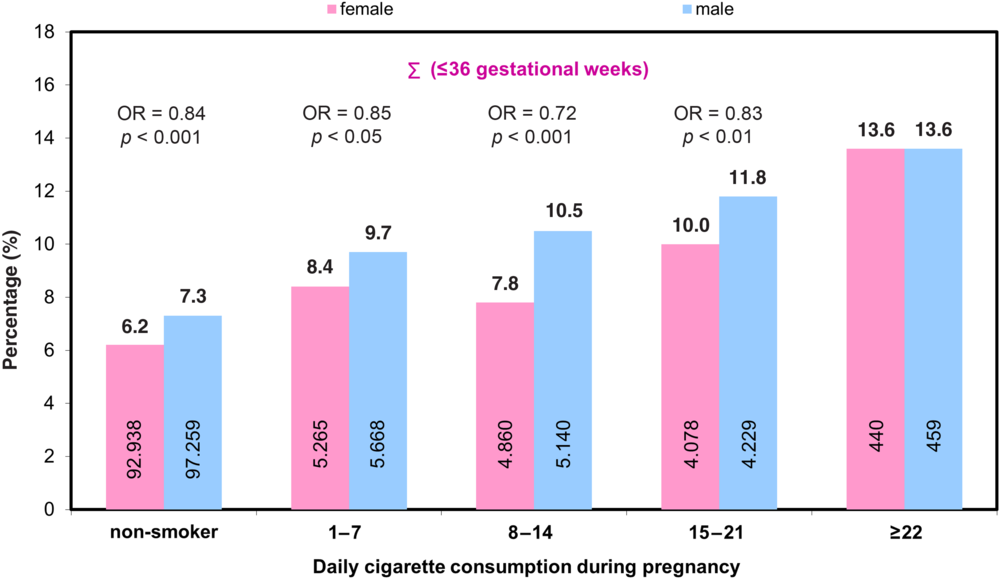
Figure 2 shows the relationship between smoking and fetal gender for all preterm deliveries (≤36 weeks of gestation). Except for very heavy smokers (≥22 cigarettes/day), the majority of preterm infants were male. Nonsmokers had the lowest preterm birth rate compared to all smoking groups. 6.2%girls and 7.3% boys were delivered before the 36th week of gestation; the gender difference was statistically significant (P < 0.001, OR 0.84). Women who were mild smokers (1–7 cigarettes/day) had a higher rate of preterm births (8.4% female vs. 9.7% male) than nonsmokers; again, the difference was statistically significant (P < 0.05, OR 0.85). Women who were moderate smokers (8–14 cigarettes/day) had a similar rate of preterm births (7.8% female vs. 10.5% male) as those who were mild smokers (P < 0.001, OR 0.72). Another increase in preterm birth rates (10% female vs. 11.8% male) was noted among heavy smokers (15–21 cigarettes/day); the gender difference was statistically significant (P < 0.01, OR 0.83). Interestingly, women who were very heavy smokers had the highest rate of preterm births, but no difference was registered between male and female infants (13.6% for both groups).
Impact of fetal gender in combination with maternal smoking on preterm birth. The number of cigarettes smoked daily was divided into five categories: (a) nonsmokers; (b) mild smokers: 1–7 cigarettes/day; (c) moderate smokers: 8–14 cigarettes/day; (d) heavy smokers: 15–21 cigarettes/day; and (e) very heavy smokers: ≥22 cigarettes/day. The rate of preterm births (≤36 weeks of gestation) subdivided into the male and female fetal gender was analyzed for each of the five groups. OR, odds ratio.

Discussion
Substances included in tobacco smoke have highly toxic properties. Their presence in the human organism may affect placental and fetal cell proliferation and differentiation. Thus, cigarette smoking raises the risk of miscarriage, fetal growth restriction, preterm births, and placental abruption. Reference Jauniaux and Burton16 Cigarette smoke induces premature aging of the placenta as well as degenerative changes. The latter are accompanied by a large quantity of collagen in chorionic villi, greater thickness of the subtrophoblastic basement membrane, and reduced vascularization. Premature aging is caused by the increased number of syncytial buds and a higher rate of apoptosis. Both, premature aging and degenerative changes may reduce the functional component of placenta and result in an unsuccessful pregnancy outcome. Reference Ashfaq, Janjua and Nawaz17 A significant loss of trophoblasts and syncytial buds due to apoptosis among smoking women may disrupt their hormonal balance, leading to premature labor and preterm births.
Based on the abovementioned data, we conclude that smoking during pregnancy is a risk factor for preterm birth. In the present study, nearly 14% of women smoked during their pregnancy. The rates of preterm births were directly proportional to the severity of smoking. Nonsmoking women had a preterm delivery rate of 6.8%, whereas women who were very heavy smokers (≥22 cigarettes/day) had a preterm delivery rate of 13.2% The largest increase was noted between nonsmokers and mild smokers (1–7 cigarettes/day), and between moderate (8–14 cigarettes/day) and heavy (15–21 cigarettes/day) smokers. In other words, even a low rate of maternal smoking has a marked effect on preterm birth rates. Very heavy smoking (≥22 cigarettes/day) had a major impact on extremely preterm births (<28 weeks of gestation) and very preterm births (28–31 weeks of gestation).
Fetal gender was also correlated with preterm births. Preterm infants were more frequently boys than girls, with the exception of the infants of very heavy smokers. Although the percentages were not very high, the analysis yielded statistical significance because of the large number of births included in the study.
A number of study groups have addressed the relationship between smoking and preterm birth. A Swedish population-based cohort study analyzed 1,372,274 singleton births between 1999 and 2012. The risk of preterm birth was determined among women who used snuff and smoked. The use of Swedish snuff or smoking during pregnancy was specifically associated with a high risk of extremely preterm birth (<28 weeks of gestation). Maternal smoking during early pregnancy was associated with a higher risk of all categories of preterm birth. The risk was inversely proportional to gestational age, and the association was dose dependent. Reference Dahlin, Gunnerbeck, Wikström, Cnattingius and Edstedt Bonamy3
The abovementioned data are nearly consistent with the findings of the present study. However, among smokers, we noted a higher rate of moderately preterm births (32–36 weeks of gestation) compared to extremely and very preterm births. Among very heavy smokers (≥22 cigarettes/day), we noted a higher rate of extremely and very preterm deliveries. These differences between the Swedish study and ours might be explained by the different numbers of cases. The Swedish study comprised nearly sixfold higher numbers of cases than ours, and yielded a larger number of extremely and very preterm infants.
Another study from the Netherlands consisting of 7098 pregnant women analyzed the effect of active and passive maternal smoking during pregnancy, and the risks of low birth weight and preterm birth. Reference Jaddoe, Troe and Hofman18 Active smoking until pregnancy was apparently not associated with low birth weight and preterm birth. However, ongoing active smoking even in late pregnancy was associated with low birth weight (adjusted OR 1.75 (adjusted OR 1.75; 95% CI 1.20, 2.56) and preterm births (adjusted OR 1.36; 95% CI 1.04, 1.78). These data show that smoking exerts a negative effect when the noxious agents are inhaled during pregnancy. The long-term effects of smoking on the cardiovascular system and the risk of bronchial carcinoma are undisputed, but smoking does not appear to exert a harmful effect on pregnancy when the women cease to smoke at the very start of their pregnancy. Smokers should therefore be encouraged to stop smoking in the first trimester, or better still when planning a pregnancy.
This conclusion has been endorsed by several authors who reported that maternal smoking is an important risk factor for preterm delivery, but the risk can be reduced by the cessation of smoking before or at least in the early weeks of pregnancy. Reference Dahlin, Gunnerbeck, Wikström, Cnattingius and Edstedt Bonamy3,Reference Shah and Bracken19,Reference McCowan, Dekker and Chan20
Furthermore, preterm births constitute an economic problem because the infants must necessarily undergo treatment in neonatal intensive care units.
In a study conducted by a German statutory health insurance, the average costs of medication, hospital treatment, outpatient treatment, and nonmedical remedies during the first 3 years after birth were analyzed for early preterm, late preterm, and full-term births. As expected, higher costs were incurred for preterm infants than for those born at term. The highest costs were registered for the hospital treatment of early preterm births. The differences in costs tended to fall in the second and third years after birth, except for ambulatory treatment costs; the latter were consistently high especially for early preterm births. Reference Jacob, Lehne, Mischker, Klinger, Zickermann and Walker21
Another study from the USA Reference St John, Nelson, Cliver, Bishnoi and Goldenberg22 analyzed the costs of initial hospital care for newborn infants according to gestational age. The retrospective review included all infants born ≤32 weeks of gestation between 1989 and 1992. A cohort of term and near-term infants was selected at random. The total cost of initial care for the US population of neonates was estimated at $10.2 billion annually: 11.9% was spent on infants born between 24 and 26 weeks of gestation and 42.7% were spent on those born at ≥37 weeks’ gestation. Thus, 45.4% of the costs are distributed among those newborns born between 27 and 36 weeks of gestation. Although the costs for an extremely premature newborn are very high, the costs for extremely low gestational age infants are a small component of total neonatal care costs because so few infants are born at these early gestational ages. Reference St John, Nelson, Cliver, Bishnoi and Goldenberg22
Clements et al. Reference Clements, Barfield, Ayadi and Wilber23 have also investigated the costs of preterm infants as a function of gestational age: 14,033 of 76,901 surviving infants received early intervention. The total sum was almost $66 million, with a mean cost per surviving infant of $857. Mean cost per infant was highest for children who were 24–31 weeks’ gestational age ($5393) and higher for infants who were 32–36 weeks’ gestational age ($1578) compared with those who were born at term ($725). Reference Clements, Barfield, Ayadi and Wilber23 Premature newborns have higher treatment costs compared to term-born infants. The cost per surviving infant generally decreased with increasing gestational age.
Considering the abovementioned numbers, the aim should be – not only against the economic background but also with regard to morbidity and mortality – to prolong the pregnancy as far as possible in every phase of preterm birth.
In addition to the risk of premature birth as a result of maternal smoking, the latter had an effect on fetal gender: preterm infants were more often boys than girls.
The greater mortality risk for males during pregnancy and infancy are well known. Male preterm infants have higher rates of neonatal mortality and are more vulnerable to long-term neurological and motor impairment after birth. Reference Verloove-Vanhorick, Veen, Ens-Dokkum, Schreuder, Brand and Ruys24-Reference Stevenson, Verter and Fanaroff26 A study group from the Netherlands analyzed the relationship between gender and disabilities or handicaps at 5 years of age in children born before 32 weeks of gestation. Reference Verloove-Vanhorick, Veen, Ens-Dokkum, Schreuder, Brand and Ruys24 The study comprised 648 infants, of whom 345 were boys. The prevalence of handicaps was three times higher among boys than girls (21% vs. 7%, OR 3.2). Adjustment for gestational age and birth weight (logistic regression analysis) did not alter the results (OR 3.5).
On the basis of large datasets, the numbers of boys among preterm infants versus infants born at term were analyzed in several studies; Reference Zeitlin, Saurel-Cubizolles and de Mouzon10,Reference Astolfi and Zonta27 a predominance of males was noted among preterm births. Several explanations have been proposed for this phenomenon: (a) higher average maternal body weight, which increases the probability of preterm labor, Reference Hall and Carr-Hill28,Reference McGregor, Leff, Orleans and Baron29 (b) greater sensitivity to certain medical complications associated with preterm birth, such as pregnancy-induced hypertension or infection, Reference MacGillivray and Davey30 (c) different biochemical processes in male and female fetuses, which favor preterm labor in the case of male infants. Reference Cooperstock and Campbell31 Placental or chorion trophoblast cells from pregnancies with a male fetus seem to produce more pro-inflammatory TNFα and less anti-inflammatory IL-10 and granulocyte colony-stimulating factor (G-CSF) than cells from pregnancies with a female fetus, more prostaglandin synthase (PTGS-2) and less prostaglandin dehydrogenase (PGDH). These results suggest that in the presence of a male fetus the trophoblast has the potential to generate a more pro-inflammatory environment leading to preterm birth Reference Challis, Newnham, Petraglia, Yeganegi and Bocking32 and (d) boys are more likely conceived at the beginning of the fertile period in contrast to girls, who are conceived in the middle of the cycle. Reference James33,Reference James34
This last mentioned hypothesis was refuted by a French study, which only recruited children after IVF and was thus able to clearly determine the time of conception. The association between preterm birth and the male sex was somewhat less pronounced, but still present. Reference Astolfi and Zonta27
Despite these explanatory approaches concerning gender-specific preterm delivery, the pathomechanism is not really understood. A higher body weight or early conception in the menstrual cycle does not appear to adequately explain the higher rate of preterm delivery at 6 weeks before, or even earlier than, the calculated day of delivery.
A large study from the Netherlands Perinatal Registry consisting of 1,736,615 singleton pregnancies from 1999 to 2010 Reference Peelen, Kazemier and Ravell9 analyzed the gender-related risk of preterm birth. The authors found that male fetuses were at higher risk of preterm birth with intact membranes compared to female fetuses; the peak was noted between 27 and 31 weeks of gestation (relative risk (RR) 1.5; 95% CI 1.4–1.6). Furthermore, male fetuses were associated with a higher risk of premature rupture of membranes between 27 and 37 weeks of gestation (RR 1.2; 95% CI 1.16–1.23). No remarkable gender difference was registered among medically indicated preterm births. Reference Peelen, Kazemier and Ravell9
Zeitlin et al. Reference Zeitlin, Saurel-Cubizolles and de Mouzon10 analyzed one European and three French data sources, as well as data extracted from published articles, to explore the gender distribution of preterm versus term births. Male infants are subject to a higher risk of preterm birth in a wide range of populations, regardless of geographical conditions and over a long period of time. The ORs associated with the male gender were between 1.09 and 1.24 in 21 of the 24 populations. Reference Zeitlin, Saurel-Cubizolles and de Mouzon10
In another investigation, the same study group Reference Zeitlin, Ancel, Larroque and Kaminski35 analyzed the association between fetal gender, mode of onset of labor, and the principal cause of very preterm birth. Two-thousand and six twenty-four very preterm singleton births born at less than 33 weeks’ gestation in 9 French regions in 1997 were included in the study. Spontaneous preterm births were registered for 57% of male fetuses and 50.8% of infants were born prematurely due to medical indications. These data show that male infants have a higher risk of preterm birth resulting from spontaneous labor. Reference Zeitlin, Ancel, Larroque and Kaminski35
In the present study, we focused on smoking and gender-related preterm delivery (≤36 weeks of gestation), but did not differentiate between the weeks of gestation. Nevertheless, our results confirm the previously reported data. A significantly larger number of preterm infants were male among nonsmokers and nearly all smoking groups, except for very heavy smokers (≥22 cigarettes/day). Preterm deliveries were highest in the latter group but the numbers were independent of gender. This might be explained by massive placental alterations, which may raise the number of preterm deliveries regardless of the child’s gender. The placenta itself could be an important, yet not fully investigated parameter, and may well be a factor involved in the fetal gender-related outcome. The beginning of labor is known to be associated with the production of placental corticotropin-releasing hormone and corticotropin-releasing hormone-binding proteins, and inflammatory processes or interactions between these different mechanisms. Reference Kim, Shim and Sung36,Reference Muglia and Katz37 Interestingly, increased levels of inflammatory markers were found more often in the placenta of male infants than female infants. Reference Peelen, Kazemier and Ravell9,Reference Ghidini and Salafia38,Reference Clifton39 Furthermore, the placenta of female fetuses appear to react differently and is possibly more resistant to adverse events. Reference Peelen, Kazemier and Ravell9,Reference Clifton39 The role of placenta and gender must be addressed in future investigations.
Preterm labor leading to preterm delivery is a multifactorial problem. Clinicians should give greater attention to women carrying a male fetus. This additional risk factor should be taken into account when dealing with high-risk pregnant women, and may help in decision-making processes such as tocolysis or antenatal steroid prophylaxis. This approach is further justified by the higher mortality rates noted in male fetuses.
Conclusion
The abovementioned data revealed an association between smoking and fetal gender, and the impact of smoking on perinatal outcome. Smoking during pregnancy and male gender are both risk factors for preterm delivery. Fetal gender should be given greater attention in the multifactorial problem of preterm birth.
Due to the high rate of morbidity in preterm-born infants and the enormous costs for public health, women should be encouraged to cease or at least reduce smoking during pregnancy.
Acknowledgments
We thank Sujata Wagner from Medical Translation Service, A-1230 Vienna, for English editing. Further, we thank Dr. Ole Christan Leuth for the digital image editing.
Financial support
This research received no specific grant from any funding agency, commercial, or not-for-profit sectors.
Conflicts of interest
None.
Ethical standards
All procedures involving human participants were performed in accordance with the ethical standards of the Institutional and/or National Research Committee, as well as the 1964 Helsinki declaration and its later amendments or comparable ethical standards. The data analyzed in the present paper were obtained from the German Perinatal Survey, a mandatory survey conducted throughout Germany. The patients gave their informed consent in written form for data handling in advance, which means during the hospital admission process. The patients gave as well written informed consent for data analysis concerning their individual information, e.g. birth weight, smoking, and fetal gender as evaluated in the present study. The data used were de-identified upon data collection. A specific ethic votum concerning this data analysis was not necessary.