


Introduction
There is a well-established relationship between health and individuals’ socioeconomic status (SES). Increasing attention has been directed towards studying the socioeconomic factors that may lead to various health outcomes and the underlying health inequities, which refer to systematic differences in the health status of different population groups in positive and negative ways (Marmot et al., Reference Marmot, Friel, Bell, Houweling and Taylor2008). A substantial body of research has revealed that at all income levels, health and illness follow a social gradient: the lower the socioeconomic position, the worse the health. Interestingly, this relationship tends to be bidirectional, as socioeconomic variables affect health through poor nutrition, lack of access to health services, and hazardous living and working conditions. Meanwhile, health inequities can also negatively affect economic outcomes, making affected individuals more vulnerable to economic shocks (Emerson and Hatton, Reference Emerson and Hatton2007).
Disability is a complex and dynamic form of health inequality that poses a significant challenge to economic progress, particularly in low- and middle-income countries (LMICs) where individuals with disabilities face greater disadvantages compared to those without disabilities (Hosseinpoor et al., Reference Hosseinpoor, Stewart Williams, Gautam, Posarac, Officer, Verdes and Chatterji2013; Moradi et al., Reference Moradi, Mostafavi, Hajizadeh, Amerzade, Mohammadi Bolbanabad, Alinia and Piroozi2018; Pinilla-Roncancio, Reference Pinilla-Roncancio2018; Pinilla-Roncancio and Alkire, Reference Pinilla-Roncancio and Alkire2021; WHO, 2001).
According to the World Health Organization (WHO), in 2010, over one billion people had at least one form of disability, with 2–4% experiencing significant functional difficulties. Of these individuals with disabilities worldwide, approximately 180–220 million are youth aged 15–24 years (UN-DESA, 2013). Additionally, it was estimated that the affected population would increase by 10 million annually, mainly due to rising road accidents (UN-DESA, 2013; WHO and World Bank, 2011). The latest estimation indicates that around 16% of the global population, roughly 1.3 billion people, lived with a disability as of 2021 (WHO, 2022).
The literature on disability and poverty has grown in the past decade. Sen (2005; Reference Sen2011) elucidates why individuals with disabilities and their families in high-income countries (HICs) are often impoverished or chronically poor, reinforcing the bidirectional communication between health and SES. Sen categorizes disability into two forms: the ‘earning handicap’, which involves challenges in obtaining income, and the ‘conversion handicap’, related to converting income into a dignified life. He notes that people with disabilities often experience both forms. Hosseinpoor et al. (Reference Hosseinpoor, Stewart Williams, Gautam, Posarac, Officer, Verdes and Chatterji2013) demonstrated that disability can lead to socioeconomic disadvantage and vice versa. On the one hand, poverty may hinder access to quality education, limit employment opportunities, or force individuals to accept harsh working conditions. Additionally, inadequate nutrition and worsening health status may contribute to the onset of functional difficulties. On the other hand, having a functional difficulty as a child or adolescent might make attending school challenging, limit work opportunities, reduce income, increase health expenditure, and eventually lead to poverty (Mitra and Yap, Reference Mitra and Yap2022).
In 2008, Filmer found that in 8 out of 12 LMICs, disability in adulthood is associated with a higher probability of being in poverty. Analyzing data from 49 countries, Hosseinpoor et al. (Reference Hosseinpoor, Stewart Williams, Gautam, Posarac, Officer, Verdes and Chatterji2013) demonstrated that wealthy adults experienced less disability than the poor in lower- and higher-income countries. Andrade et al. (Reference Andrade, Duarte, Souza Junior, Torres, Lima-Costa and Andrade2018) revealed that wealth contributes to more than half of the total inequality among people with disabilities in Brazil. The Disability and Development Report 2019 further supports this understanding, indicating that individuals with disabilities are more likely to live in poverty than those without disabilities. This is attributed to societal barriers including discrimination, limited access to education and suitable jobs, insufficient income exclusion from livelihood and social programs, and direct medical treatment costs, particularly in LMICs (Trani et al., 2012; Reference Trani, Kuhlberg, Cannings and Chakkal2016; United Nations, 2019; Üstün et al., Reference Üstün, Chatterji, Bickenbach, Kostanjsek and Schneider2003). However, reported disability prevalence rates are unexpectedly higher in upper-middle- and HICs than in LMICs (United Nations, 2019).
The health of children and older people has garnered significant attention from the global scientific community. However, youth morbidity has not received as much consideration as other age groups, particularly in developing countries. Notably, the literature on disability, poverty, and inequality seldom includes this young population segment (El-Saadani and Metwally, Reference El-Saadani and Metwally2018). This lack of attention could be attributed to the widespread misconception that disabilities are primarily associated with age.
Youth with disabilities are more likely than their peers without disabilities to face deprivation in various aspects of life, including marginalization, exclusion, isolation, abuse, and engaging in risky behaviour (UN-DESA, 2013). Moreover, they tend to experience poorer health and avoidable socioeconomic outcomes compared to their counterparts without disabilities (WHO, 2013). These challenges extend to education, as they are more likely to be deprived of it (El-Saadani and Metwally, Reference El-Saadani and Metwally2019), live in poverty (Filmer, Reference Filmer2008), depend heavily on family members, and grapple with ill-equipped healthcare systems.
The Disability Data Report 2021 emphasized the gap between youth with disabilities and their counterparts through the youth idle rate, which measures the share of youth aged 15–24 years not enrolled in school and not employed. Data from 41 countries worldwide revealed that the youth idle measure favoured youth without disabilities, with higher rates observed in rural areas (Mitra and Yap, Reference Mitra and Yap2021). Furthermore, the report highlighted the heterogeneity among youth with disabilities concerning the severity of disability. In most countries, youth with some difficulty in the age group 15–29 years were found to be significantly worse off than those with no difficulty but better off than those with severe difficulties. For instance, in Pakistan and Indonesia, 64% and 45%, respectively, of youth with some difficulties were multidimensionally poor, compared to 49% and 22% of youth with no difficulty. These estimates rose to 76% and 68% for youth with severe difficulties in the same two countries, respectively (Mitra and Yap, Reference Mitra and Yap2021).
In Egypt, young people are considered a significant human capital segment, constituting a sizable population. Over several decades, youth aged 15–29 years have consistently accounted for over a quarter of the population, as indicated by successive Population Censuses in 1986, 1996, 2006, and 2017. In these censuses, youth represented approximately 27%, 28%, 31%, and 27%, respectively. This ‘youth bulge’ presents a demographic opportunity that could positively shape the country’s future and reduce its economic dependency. Recognizing that youth will continue to constitute a significant portion of Egypt’s population, it becomes essential to develop comprehensive knowledge about disability and inequality within this substantial demographic.
Similar to trends observed in LMICs, youth with disabilities in Egypt are more likely to face deprivation of enabling opportunities. This impacts their daily experiences and, more crucially, has lasting effects on their adult lives.
Health disparities by wealth and parents’ educational level are evident among adults in Egypt. El-Saadani and Metwally (Reference El-Saadani and Metwally2018) reported a descending gradient of disability prevalence by wealth level among youth aged 15–29 years in Egypt. The prevalence of disabilities, regardless of severity, is highest among young people in low-income families and gradually decreases with the rise in family wealth. They found that the odds of having disabilities among the poorest segment are twice those among the wealthiest group. Additionally, disability shows a descending gradient with the level of education of the head of the household. It is highest among youth in households headed by illiterate parents and then gradually declines with increasing levels of education. In households headed by illiterate parents, the likelihood of having a child with a disability is more than three times as large as the likelihood among their counterparts living in households headed by highly educated parents (university or above).
The inequality of distribution of disability and its domains according to various socioeconomic precincts is poorly understood, reflecting a broader dearth of studies in the The Middle East and North Africa (MENA) region, with Egypt no exception. The scarcity and insufficiency of data on individuals with disabilities, on the one hand, and the negligence in studying their living conditions and level of well-being, on the other hand, force each other into a vicious circle. Therefore, it is necessary to analyze the socioeconomic gradient in disabilities by domain among youth to provide valuable information to policymakers, enabling them to identify geographical areas and susceptible groups in terms of their political implications.
Consequently, this research marks the first attempt in Egypt to measure the inequality in the distribution of disabilities nationally and subnationally. It focuses on examining six domains of functional difficulties among young people aged 15–29 years, considering specific socioeconomic characteristics such as wealth quintiles and the education level of the household head. It is important to note that persons with disabilities are not a homogeneous group, and their challenges vary across different types of functional difficulties.
Data
The data source for this study is the ‘Household Observatory Survey’ (HOS), Round 13, conducted in 2016. HOS is a nationally representative survey administered by the Egyptian Cabinet Information and Decision Support Center (IDSC). The survey aimed to provide estimates at the national level and in the six regions of Egypt. It gathered information from 11,592 households, encompassing 49,431 individuals. The study targeted 10,405 young individuals aged 15–29 years, constituting 21% of the total sample.
HOS adopted the Washington Group Short Set (WG-SS) approach in formulating questions to identify and investigate disability domains. Utilizing six questions, the survey specifically examined limitations affecting activity and restrictions on participation. This operational definition aligns with the International Classification of Functioning (ICF framework) (WHO, 2001), which integrates medical and social models into the overarching biopsychosocial model.
The WG-SS has a high positive predictive value with a 100% sensitivity in detecting disability. It is considered gender responsive as it is equally valid for males and females (WHO, 2010). In addition to its conciseness, the WG-SS is well-suited for use in censuses and national surveys (Mitra and Yap, Reference Mitra and Yap2021). It focuses on universal abilities, enabling cross-cultural comparability with other data collected on outcome indicators such as access to education or employment. Furthermore, it is vital to inform policies to equalize opportunities (Mitra and Yap, Reference Mitra and Yap2021).
The WG-SS facilitates the assessment of functional difficulties, identifying individuals experiencing limited participation in their environment due to various challenges. These difficulties encompass seeing, hearing, mobility, self-care, remembering or concentrating, and communication. The WG-SS employs a four-level scale (no difficulty, some difficulty, a lot of difficulty, or totally unable to do it) to gauge the degree of functional difficulty in each of the six domains.
The questionnaire begins with an optional introduction: ‘The next questions ask about difficulties you may have doing certain activities because of a health problem’. Subsequently, it includes questions covering six domains: (1) Do you have difficulty seeing or wearing glasses? (2) Do you have difficulty hearing, even using a hearing aid? (3) Do you have difficulty walking or climbing steps? (4) Do you have difficulty remembering or concentrating? (5) Do you have difficulty with self-care (such as washing all over or dressing)? (6) Do you need help communication?
If an individual reports having some difficulty, having a lot of difficulties, or being totally unable to do it in at least one type, domain, they are considered to have ‘any disability’. According to this definition, the total number of youth (not household heads) reporting any disability was 527, constituting 5.1% (95% confidence interval: 4.6–5.5) of the total sample under study. The prevalence of disabilities by sex is 5.2% for males and 4.9% for females, respectively.
Method
SES for each household was measured based on the wealth index, which was calculated by using household durable goods possession data and housing characteristics. Employing a principal component analysis method, each household’s wealth index was calculated and subsequently divided into five SES quintiles (1 = poorest, 5 = richest). The SES of each individual was determined based on the wealth index of their respective households.
Several measures are being used to assess trends in socioeconomic inequality in health (Gakidou et al., Reference Gakidou, Murray and Frenk2000; O’Donnell et al., Reference O’Donnell, van Doorslaer, Wagstaff and Lindelow2008; Wagstaff et al., Reference Wagstaff, Paci and van Doorslaer1991; WHO, 2013). The concentration index (CI) is commonly used to quantify interindividual differences, especially in the context of social inequalities. It is also helpful to summarize the distribution of functional difficulties across economic status using concentration curves and their associated CIs. It provides a summary measure of the magnitude of relevant socioeconomic inequality in a health variable of interest.
The CI is effectively utilized alongside the concentration curve. These curves illustrate the cumulative percentage of the population, ranked by economic status, on the horizontal (x) axis against the cumulative percentage of the outcome variable on the vertical (y) axis. The CI is twice the area between the concentration curve and the line of equality (45° line). When the concentration curve lies above (below) the 45° line (equality line), it signifies that the outcome variable is concentrated among the most disadvantaged (most privileged) groups. The greater the distance the curve is from the line of equality, the more pronounced the concentration of the outcome variable among the least privileged (most privileged) groups.
The current study has used the CI and concentration curve to compute and illustrate socioeconomic inequalities in disabilities (Wagstaff, Reference Wagstaff2005; Wagstaff & van Doorslaer, Reference Wagstaff and van Doorslaer2004). The CI is written as follows:
 $$C = {2 \over {2\mu }}\;\sum\nolimits_{i = 1}^n {{y_i}} {R_i} - 1$$
where C indicates the CI, n is the total sample size, yi ‘disability status’ is the binary variable and takes two values, ‘0’ denotes a person without functional difficulties, ‘1’ denotes a person with functional difficulties, Ri is the fractional rank for individual i in the socioeconomic distribution, and μ is the mean of the disability variable. Since the outcome variables of interest are binary, normalized the index by multiplying by 1/(1-μ).
In conjunction with the concentration curve, the CI is used to quantify the degree of socioeconomic-related inequality in the outcome variable. The index’s negative (positive) values indicate that the variable of interest is higher, on average, among the deprived (better off). A CI of zero suggests no inequality. Ranging between −1 and +1, the larger the absolute size of the index, the greater the degree of inequality. While ±1 represents the theoretical maximum of a CI, there is no established criterion for determining whether specific values are considered high or low. As Wagstaff and van Doorslaer (Reference Wagstaff and van Doorslaer2004) highlighted, when the variable under consideration is binary, the minimum and maximum possible values of the CI are determined by the mean of the binary variable. Specifically, the minimum value of the CI is equal to μ-1, and the maximum value is equal to 1-μ. Thus, as the mean increases, the range of possible values of the CI shrinks, tending to zero as the mean tends to one and the CI tends to zero. Although previous studies did not establish specific thresholds for the CI, some suggested that values less than 5% indicate equity, values between 5% and 10% imply inequity, and values exceeding 10% indicate high inequity.
The study focuses on two socioeconomic variables: the wealth index for each household and the education level of the head of the household. These variables are employed to explore the socioeconomic gradient in functional difficulties.
Results
The prevalence of functional difficulties is illustrated in Figure 1. In 2016, approximately 5 per 100 Egyptian youth aged 15–29 years had at least one type of functional difficulty. The most common type was related to seeing (2.6%), followed by mobility (1.2%) and communication (1.2%), while the least common type of disability was related to hearing (0.8%).
Prevalence of overall functional difficulties and its domains among youth (aged 15–29 years) in Egypt: HOS (2016).

Simple measures of inequality in functional difficulties by domain according to socioeconomic variables among youth in Egypt
The percentage of youth with functional difficulties at the lowest wealth level is 7%, decreasing to 4.4% at the highest levels of the wealth index (see Table 1). Similarly, in households headed by an illiterate parent, 6% of their youth members are with disabilities, which decreases to approximately 4% among young people with highly educated parents. Simple inequality indicators reveal disparities in the prevalence of disability based on the wealth index and the education of the head of the household. Specifically, the prevalence of functional difficulties among the richest is about three-fifths of the prevalence among the poorest. This ratio remains consistent when comparing the prevalence of functional challenges between youth with less-educated heads of households and those with highly educated heads.
Simple measures of inequality of functional difficulties according to socioeconomic variables among youth (aged 15–29 years) in Egypt: HOS 2016

The results presented in Table 2 reveal a higher prevalence of all domains of difficulties among the poorest youth compared to those with the highest level of wealth. Despite variations in wealth, the most common functional difficulties among youth are seeing, mobility, and communication. Hearing is the least prevalent domain of functional difficulty among the poorest youth, while self-care is the least prevalent among the wealthiest youth (1.2% and 0.5%, respectively).
Simple measures of inequality in functional difficulties by domain according to socioeconomic variables among youth (aged 15–29 years) in Egypt: HOS 2016
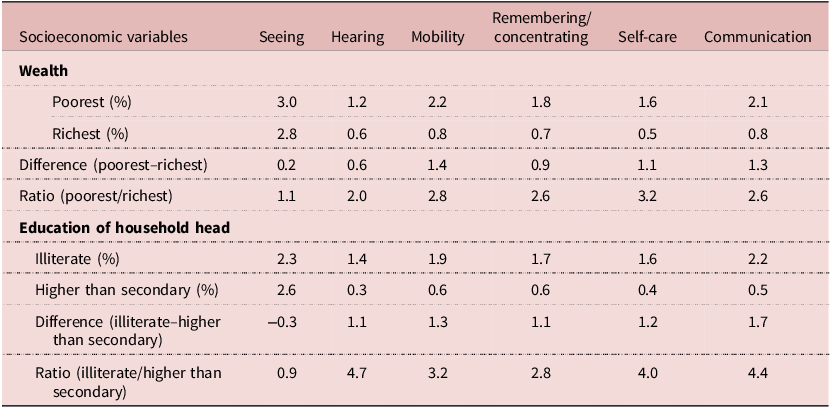
As illustrated in the simple inequality measures in Table 2, the inequality gap is pronounced for self-care difficulty, followed by mobility difficulty. The ratio of the poorest youth experiencing these functional difficulties to their counterparts at the highest wealth levels is 3.2% and 2.8%, respectively. However, a minor ratio is evident in seeing difficulty, at 1.1%.
Furthermore, Table 2 highlights a notable prevalence of all domains of functional difficulties among youth with illiterate household heads compared to those with highly educated heads, except for seeing. The prevalence of functional difficulties among youth with illiterate household heads ranges from 1.4% (hearing) to 2.3% (seeing). In contrast, the prevalence of hearing difficulty decreases to 0.3% among youth with highly educated household heads, while the level of seeing difficulties increases to 2.6%.
The evidence in Table 2 sheds light on inequality in the distribution of all domains of functional difficulties based on the education level of the household head. Inequality was high among youth with less educated household heads, except for seeing. These ratios increase for hearing (4.7%), communication (4.4%), and self-care (4.0%) more than for other functional difficulties.
The gradient in functional difficulties according to socioeconomic variables among youth in Egypt
Table 3 provides the CI of functional difficulties among youth (aged 15–29 years) based on wealth quintiles and household heads’ education, accompanied by Figure 2A and B, illustrating the corresponding concentration curves. The results reveal statistically significant negative values for the CI concerning the educational level of household heads and wealth quintiles. Conventionally, a negative value indicates that the curve lies above the line of equality, signalling the disproportionate concentration of difficulties among the most disadvantaged groups. This implies that youth with functional difficulties are disproportionately concentrated in households headed by less-educated parents and in low-income households. However, both curves tend to approach the diagonal line.
The concentration index of functional difficulties among youth (aged 15–29 years) according to socioeconomic variables: HOS 2016

* p-value <0.05.
(A) The distribution of disability (functional difficulties) across educational level of household head among youth (aged 15–29 years). (B) The distribution of disability (functional difficulties) across wealth quintiles among youth (aged 15–29 years).

The classification of a residential area as rural or urban serves as a proxy for the rural–urban continuum classification. This continuum, particularly in LMICs, is associated with the gradation of socioeconomic levels, environmental development, health, and overall well-being. A higher level of urbanization is generally linked to better well-being indicators.
The study assessed inequality in the distribution of functional difficulties among youth in Egypt based on wealth quintiles and the educational level of household heads, considering regional disparities. The classification of regions in Egypt is often associated with various health and socioeconomic development indicators, with the order being urban governorates, urban Lower, urban Upper, rural Lower, and, finally, rural Upper and the Frontiers.
As noted by El-Saadani and Metwally (Reference El-Saadani and Metwally2018), the prevalence of disability among youth aged 15–29 years follows a similar regional ranking. Rural Lower (6.2%) and urban Lower (5.9%) exhibit the highest levels of disability prevalence, followed by residents in Upper regions and the Frontiers (4.5%) for both urban and rural areas. In contrast, the four urban governorates have the lowest prevalence at 2.7%. These findings align with the results of the Egyptian Labour Market Panel Survey (ELMPS 2018), confirming higher disability prevalence among residents in the Lower governorates (urban and rural) compared to those in the Upper Egypt governorates (Sieverding and Hassan, Reference Sieverding and Hassan2019).
As shown in Table 4, all the estimated CIs are negative. However, they are not statistically significant, except for the CI of functional difficulties according to wealth quintiles in urban Lower and rural Upper and Frontiers and the CI of functional difficulties according to the household head’s level of education in rural Upper and Frontiers. This indicates that youth residing in urban Lower Egypt and rural Upper Egypt are less fortunate than their peers in other regions, experiencing inequality in the distribution of functional difficulties based on socioeconomic characteristics.
The concentration index of functional difficulties according to socioeconomic variables across regions among youth (aged 15–29 years): HOS 2016

* p-value <0.05.
Notably, the magnitude of the inequality in the distribution of functional difficulties among youth, based on the wealth index, was about two times higher in urban Lower Egypt compared to the national level (0.196 vs. 0.091, respectively). However, the volume of inequality in the distribution of functional difficulties among youth in rural Upper Egypt and Frontiers is less than the national level by almost 20%, whether based on the wealth index (0.073 vs. 0.091, respectively) or the educational level of the head of the household (0.117 vs. 0.215, respectively).
The gradient in functional difficulties by domain according to socioeconomic variables among youth in Egypt
Table 5 presents the inequality in functional difficulty distribution based on wealth quintiles and the educational level of the head of the household. Corresponding concentration curves for the six functional difficulties according to wealth quintiles are depicted in Figure 3. Additionally, Figure 4 displays the concentration curve for all domains of disabilities according to the educational level of the household head. The CI suggests the presence of socioeconomic inequalities in all types of functional difficulties except for seeing (Table 5). The remaining five disabilities were concentrated among socioeconomically disadvantaged youth and households headed by illiterates, with results being statistically significant at a 95% confidence interval.
The concentration index of wealth quintiles and education level of the household head among youth (aged 15–29 years) according to the six domains of functional difficulties: HOS 2016

* p-value <.05.
The concentration curve of wealth index according to domains of functional difficulties among youth (15–29): HOS (2016).

The concentration curve of the educational level of a household head according to the domains of functional difficulties among youth (aged 15–29 years): HOS (2016).

Interestingly, self-care difficulty, followed by communication difficulty, ranks as the most functional difficulty regarding the magnitude of inequality, according to the wealth index and the educational level of the head of the household. Mobility difficulty holds the third rank in the magnitude of inequality based on the wealth index but retreats to the fifth rank according to the education of the head of the household.
Discussion
Based on a nationally representative sample, this study aimed to measure the prevalence of different types of disabilities among youth aged 15–29 years in Egypt and investigate the socioeconomic gradient of six disabilities. Earlier studies on the quality of life among individuals with disabilities in Egypt employed regression models to evaluate how disability impacts the accessibility of their rights, particularly concerning education (e.g. El-Saadani and Metwally, Reference El-Saadani and Metwally2019; Rabee, Reference Rabee2019). Unlike these studies, this is the first study providing estimates of CI-related inequalities in the distribution of the burden of functional difficulties among Egyptian youth (aged 15–29 years) at national and subnational levels, considering two significant socioeconomic variables.
The research reveals that the prevalence of disability, as measured by the WG-SS, affects 5.1% of youth in Egypt according to the broad definition of disability. This estimate closely aligns with the estimate obtained from the Egypt Census 2017, which reported a prevalence of 4.9%. This consistency enhances the credibility of the survey estimate.
The most prevalent domains of disabilities among youth in Egypt are seeing, mobility, and difficulty associated with mental functioning (i.e. communication). Notably, hearing difficulties are the least reported. This finding aligns with estimates from ELMPS 2018, where seeing (3.1%) was the most common type of disability among young people aged 15–29 years, while hearing difficulties were the least common (0.9%) (these estimates are calculated by the author from the dataset of ELMPS 2018).
The study, using simple inequality measures, highlighted a substantial gap between youth with and without disabilities concerning the wealth index and the educational level of the head of the household. The results revealed several key points: (1) The most prevalent types of disabilities among youth, based on both the wealth index and the educational level of the head of the household, were seeing, mobility, and communication. Notably, these types were the same across the categories of these two variables. (2) The level of inequality for the six domains of disabilities, as assessed by the wealth index, was found to be less than the level of inequality based on the education of the head of the household, except for the difficulty of seeing. (3) Disabilities that exhibited significant gaps between youth with and without disabilities, as determined by the wealth index, were self-care, mobility, communication, and remembering/concentrating in that order. The simple inequality measure of disabilities, based on the education of the head of the household, was highest among youth facing difficulty in hearing, followed by those with communication difficulties and then self-care. (4) Seeing difficulty had the least gap in the ratio of inequality, regardless of whether it was assessed based on the wealth index or the education of the head of the household.
Numerous studies have employed the CI to assess and illustrate socioeconomic disparities in various disabilities. For example, de Andrade et al. (Reference Andrade, Duarte, Souza Junior, Torres, Lima-Costa and Andrade2018) decomposed the CI to determine the influence of demographic, health, and socioeconomic factors on wealth-related inequalities in basic activities of daily living in Brazil. Similarly, Cai et al. (Reference Cai, Coyte and Zhao2017), Moradi et al. (Reference Moradi, Mostafavi, Hajizadeh, Amerzade, Mohammadi Bolbanabad, Alinia and Piroozi2018), and Li and Tang (Reference Li and Tang2022) have utilized the CI to measure and depict socioeconomic inequalities in different types of disability. Despite variations in the operational definition of disability across these studies, they all reached similar conclusions, highlighting inequalities between individuals with disabilities and their counterparts based on economic indicators such as income, wealth index, or SES.
The results derived from the CI confirm the existence of socioeconomic inequalities in the distribution of disabilities. Consequently, disabilities were found to be concentrated among youth who are economically disadvantaged and those belonging to illiterate heads of households.
Rural areas exhibit the highest concentration of disabilities among youth with the lowest wealth, and these are often found in households headed by individuals with the lowest educational levels. This aligns with findings from other studies, such as those by Prus (Reference Prus2011) and Cai et al. (Reference Cai, Coyte and Zhao2017), which identify unhealthy lifestyles as more common in rural areas, contributing to increased health inequality between urban and rural populations.
Several studies have indicated selective reporting tendencies, where wealthier socioeconomic groups are more likely to report morbidities and disabilities than poorer ones (Murray and Chen, Reference Murray and Chen1992). The relationship between disability and poverty might be underestimated (Filmer, Reference Filmer2008). Wealthier individuals may have higher health expectations, leading to the reporting of poorer health and higher disease prevalence, potentially underestimating the extent of health inequality (Li and Tang, Reference Li and Tang2022). This phenomenon may explain why, despite the high prevalence of persons with disabilities in urban areas, inequality in the distribution of disability is more pronounced in rural Upper Egypt.
A noteworthy finding from the study is the inequality in the distribution of seeing difficulty among youth belonging to highly educated heads of households. This suggests that educated parents, despite their children facing some impairment, remain eager to provide education, making such difficulties more apparent among their children.
While Egypt has expanded its institutional and legislative framework on disability, including nine articles on the rights of persons with disabilities in the 2014 Constitution and the formulation of comprehensive disability law No. 10 in 2018, ensuring equal rights for persons with disabilities (Barsoum et al., Reference Barsoum, Kassab, Orfy, Al-Helewa and Alsawahli2018; NCW, 2020), the study’s results indicate persistent inequality for youth with disabilities compared to their peers. This underscores the need for continued efforts, emphasizing effective enforcement of relevant laws, particularly for economically disadvantaged young individuals with disabilities in rural Upper areas.
Several limitations of the study merit careful consideration : (a) Although the WG-SS has undergone testing in various countries (Miller, Reference Miller and Altman2016), it does not fully account for individuals with mental, psychosocial, and neurological disorders. These individuals may be classified as persons without difficulty, potentially leading to underreporting (Schneider, Reference Schneider and Altman2016). (b) The stigma associated with disabilities remains a barrier to accurate reporting. (c) The analysis relies on household surveys, excluding individuals not in households, such as displaced or institutionalized, potentially missing a population at disproportionate risk of functional difficulties. (d) The data may be affected by mortality bias, as adults with functional problems may face premature mortality (Mitra, Reference Mitra2018). (e) Assessing poverty among persons with disabilities may be underestimated (Filmer, Reference Filmer2008; Mitra and Yap, Reference Mitra and Yap2021). (f) The study relies on self-assessment or reporting, introducing the possibility of systematic reporting bias that could impact estimates of functional difficulties. For instance, slight differences between urban and rural areas for seeing disability may be due to the self-reporting method, where seeing difficulty is more easily noticed compared to other types of disabilities. (g) Due to the small sample size, the study could not measure socioeconomic inequity in both the distribution of severe disability and the double burden of disability. Exploring these additional measures is left for future work when adequate data become available. Despite these limitations, the data provide revealing insights.
Conclusion
Youth with disabilities constitute a heterogeneous group concerned with disability domains, facing disadvantages across all dimensions of quality of life. Despite their significant challenges, this population subgroup is seldom addressed in the literature on inequality. The distribution of disability and its domains in various socioeconomic contexts is poorly understood. Youth with disabilities in Egypt are disproportionately concentrated in poor households and households headed by less educated parents. Inequality in the distribution of disabilities is particularly pronounced among youth facing self-care difficulties, followed by those with communication difficulties and then mobility difficulties. The inequality in disability distribution is especially noteworthy among youth in rural Upper and Frontiers regions, which remain the poorest in Egypt. These regions suffer from a compound developmental gap in education, health, and employment, where services are less available and of poor quality. This underscores that disability is a developmental issue with a bilateral relationship to poverty.
Gaining insights into the factors causing inequality is crucial for developing policies aimed at improving the situation of individuals with disabilities. While some factors, such as education, place of residence, and social protection, can be addressed through policies, others, like sex, cannot. Furthermore, studying the inequality in the distribution of disability among youth aligns with the United Nations Convention on the Rights of Persons with Disabilities (UNCRPD) (United Nations, 2006), ensuring that no one is left behind and contributing to meeting Sustainable Development Goal 10. The results from this study can be utilized to formulate strategies that support the social development needs of youth with disabilities.
Funding statement
This paper is based on a part of working paper no. 1215, which was developed under the Economic Research Forum (ERF) Research Project: Labor Market and Human Development: Youth Vulnerability in the MENA.
Competing interests
The author has no conflicts of interest to declare.
Ethical standard
The author asserts that all procedures contributing to this work comply with the ethical standards of the relevant national and institutional committees on human experimentation and with the Helsinki Declaration of 1975, as revised in 2008.



