Introduction
National and international dementia guidelines recommend straightforward diagnosis of dementia and provision of information about, among other things, the course, prognosis, treatment options, services, and legal and financial issues (Patterson et al., Reference Patterson1999; National Collaborating Centre for Mental Health (UK), 2007; Albert Weale et al., Reference Albert Weale2009; Segal-Gidan et al., Reference Segal-Gidan, Cherry, Jones, Williams, Hewett and Chodosh2011; Galvin and Sadowsky, Reference Galvin and Sadowsky2012; Sorbi et al., Reference Sorbi2012). This should be done in a manner consistent with the patient's preferences, culture, educational level, and abilities. Still, dementia is regularly not diagnosed and when it is, physicians may not disclose. A 2012 review showed that 14%–33% of mild dementia cases and 28%–61% of moderate to severe dementia cases were diagnosed in the primary care setting (van den Dungen et al., Reference Dungen van den2012). Whether disclosure occurs seems to depend much on the individual physician encountered. Of family physicians, 39%–70% reported to disclose regularly (Bamford et al., Reference Bamford, Lamont, Eccles, Robinson, May and Bond2004; Carpenter and Dave, Reference Carpenter and Dave2004; van Hout et al., Reference Hout, van, Vernooij-Dassen, Jansen and Stalman2006). For old-age specialists, this was 38%–96% (Bamford et al., Reference Bamford, Lamont, Eccles, Robinson, May and Bond2004; Carpenter and Dave, Reference Carpenter and Dave2004; van Hout et al., Reference Hout, van, Vernooij-Dassen, Jansen and Stalman2006).
Many physicians fear to harm the relationship with their patients, or to upset them unnecessarily, by disclosing a diagnosis of dementia (Bradford et al., Reference Bradford, Kunik, Schulz, Williams and Singh2009). Underlying this may be the awareness of a progressive neurodegenerative disorder for which a curative treatment is not available (Bradford et al., Reference Bradford, Kunik, Schulz, Williams and Singh2009; Hort et al., Reference Hort2010; Sorbi et al., Reference Sorbi2012). However, deciding for, or “protecting” the patient, may not be in the patient's best interest. When asked, individuals with dementia experience and express the same emotions as persons without this condition and value being involved in planning their own future (Kutzleben, von, et al., Reference Kutzleben, von, Schmid, Halek, Holle and Bartholomeyczik2012). A 2004 review focused on (post hoc) appreciation of disclosure of individuals who were already diagnosed with dementia, which is a very specific group (Bamford et al., Reference Bamford, Lamont, Eccles, Robinson, May and Bond2004). However, from a clinical perspective, it is more valuable to know whether individuals not yet diagnosed with dementia would want to be told the diagnosis.
Our objective was to review the preferences of individuals, without cognitive impairment, regarding disclosure of a hypothetical future diagnosis of dementia. In addition, we assessed rates in favor of disclosure of individuals referred to a memory clinic or already diagnosed with dementia. To provide context, reasons for and against disclosure were assessed. Based on the results, we make recommendations for practice.
Methods
Search strategy
A literature search was performed in Pubmed (Medline), Embase, and Psycinfo from inception up to May 2012. The search strategy was developed after exploring keywords in relevant articles and reviews. The final search combined variations on the keywords “dementia,” “diagnosis,” and “disclosure.” The full search strategy is provided as an appendix (Appendix 1). In addition, reference lists of articles retrieved and of previous reviews on this subject were checked.
Inclusion and exclusion criteria
We only included original empirical studies on preferences regarding disclosure of a diagnosis of dementia. We imposed no restrictions on geography, setting, or studied populations. Articles in languages other than English or Dutch were excluded. Two authors (LK and PD, HM, HvH, respectively) independently assessed the relevance and quality of retrieved studies. Disagreement was resolved through discussion. As studies ranged from predominantly qualitative to more quantitative and because we only used a very specific part of their results, we used a brief, self-developed instrument to assess the quality. Studies were scored on their internal validity (e.g., clear description of respondent characteristics; clear in- and exclusion criteria) and external validity (e.g., sampling strategy; response rate). The full instrument is provided as an appendix (Appendix 2).
Data extraction
From included articles, two authors independently extracted study and respondent characteristics, quantitative data on response rates, and preferences regarding disclosure. Again, disagreement was resolved through discussion. In addition, central arguments in favor of and against disclosure were extracted from articles presenting these. An argument was considered to be a “central argument” if it was encountered frequently across different studies. In addition, we extracted striking or clinically relevant arguments (e.g., “to plan a suicide”).
Data synthesis
We divided the included studies into four subgroups. Three subgroups without cognitive impairment: general population or individuals not selected on cognitive status; relatives of individuals with dementia; and physicians; and one subgroup with cognitive impairment: patients with dementia or patients referred to a memory clinic. Arguments were ordered based on how frequently they occurred.
Statistical analysis
Several studies had a low response rate or did not report the response rate. As selection bias may be present in studies with a low response rate, we performed an overall meta-analysis and a meta-analysis in which only studies with a response rate ≥75% were included. The results of both are provided. Q's and I 2's were calculated to assess statistical heterogeneity. Because there was statistical and methodological heterogeneity between studies and because preferences may differ between study populations and subgroups, a random effects model was chosen for the meta-analysis (DerSimonian and Laird, Reference DerSimonian and Laird1986). We used a Microsoft Excel spreadsheet developed by Neyeloff et al. for the meta-analysis and plots (Neyeloff et al., Reference Neyeloff, Fuchs and Moreira2012). To assess whether rates in favor of disclosure were lower in studies older than 2003 (> 10 years old), we performed a post hoc analyses using a t-test.
Results
Included studies
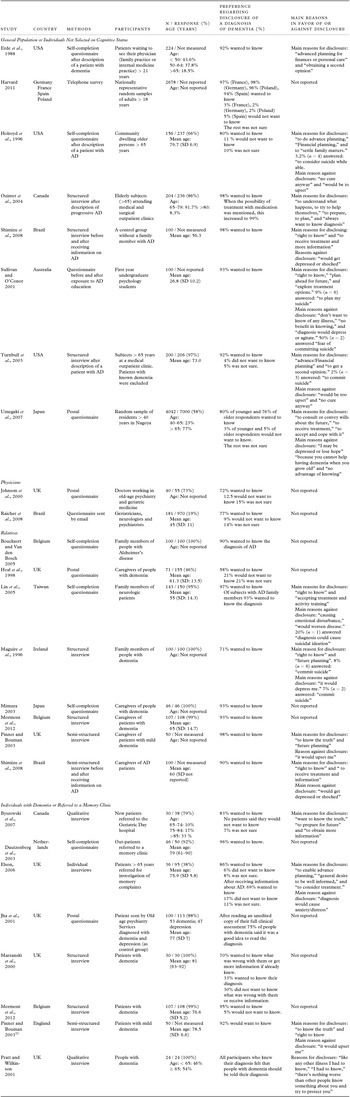
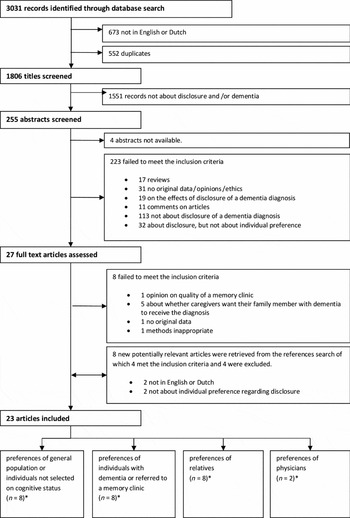
Figure 1 provides a flow chart of the selection process. Of the 23 included articles, most provided semi-quantitative data; two papers concerned qualitative interviews (Byszewski et al., Reference Byszewski, Molnar, Aminzadeh, Eisner, Gardezi and Bassett2007; Pratt and Wilkinson, Reference Pratt and Wilkinson2001). Some studies appear more than once in the results (Table 1) because they examined two subgroups of respondents. The average quality score of the included studies was 6.0 (SD 1.9) on a scale ranging from 1 to 10. The majority of (sub-)studies (17/25) used clear in- and exclusion criteria and (19/25) described respondent subgroups clearly. Most studies (22/25) used a questionnaire or fixed interview schedule, but only 10 studies explicitly described the question about preference regarding disclosure. Most studies (17/25) reported an adequate sampling strategy. Seventeen studies included >100 participants and 13 studies reported a response rate ≥75%. The results of the quality assessment are provided as an appendix (Appendix 2).
Characteristics of included studies and main outcomes

Flowchart of selection process. *Boxes at the bottom add up to more than 23 because three articles describe preferences of two subgroups.

Pooled preferences of individuals without cognitive impairment
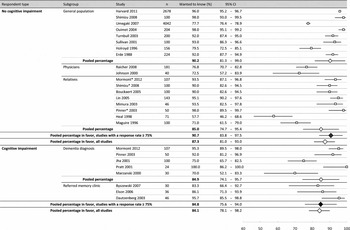
Percentages in favor of disclosure ranged from 57.7% to 98.0% in studies among individuals without cognitive impairment. Pooling these studies (n = 18), we found that 87.3% (95%CI: 81.0%–93.0%) of individuals without cognitive impairment would want to know if diagnosed with dementia. In the subgroup of studies with a response rate ≥75% (n = 7), 90.7% (95%CI: 83.8%–97.5%) would want to know.
Pooled preferences of individuals with cognitive impairment
Percentages in favor of disclosure ranged from 70.0% to 100% in studies among individuals referred to a memory clinic or diagnosed with dementia. Pooling these studies (n = 8), we found that 84.1% (95%CI: 78.1%–90.2%) of this group considered full disclosure of a diagnosis of dementia preferable. In the subgroup of studies with a response rate ≥75% (n = 6), 84.8% (95%CI: 75.6%–94.0%) considered disclosure preferable. Figure 2 provides a forest plot of percentages in favor of disclosure per study; the pooled percentage of studies in individuals without cognitive impairment and the pooled percentage of studies in individuals with dementia or referred to a memory clinic. Table 1 provides an overview of the main characteristics of the included studies.
Meta-analysis of percentages in favor of disclosure. *Articles occur twice because they describe preferences of (two) subgroups. All pooled percentages are based on meta-analysis using a random effects model (DerSimonian & Laird Reference DerSimonian and Laird1986).

Preferences in subgroups
The studies concerning the preferences of individuals without known cognitive impairment (n = 8) showed 76% to 98% in favor of disclosure if they were to develop dementia with a pooled percentage of 90% in favor of disclosure (Erde et al., Reference Erde, Nadal and Scholl1988; Holroyd et al., Reference Holroyd, Snustad and Chalifoux1996; Sullivan and O’Conor, Reference Sullivan and O’Conor2001; Turnbull et al., Reference Turnbull, Wolf and Holroyd2003; Ouimet et al., Reference Ouimet, Dendukuri, Dion, Beizile and Elie2004; Umegaki et al., Reference Umegaki, Onishi, Suzuki, Endo and Iguchi2007; Shimizu et al., Reference Shimizu, Raicher, Takahashi, Caramelli and Nitrini2008; TNS for the Harvard School of Public Health and Alzheimer Europe, 2011; ). Only two articles reported less than 90% in favor of disclosure (Holroyd et al., Reference Holroyd, Snustad and Chalifoux1996; Umegaki et al., Reference Umegaki, Onishi, Suzuki, Endo and Iguchi2007). In these studies, 4% and 11% of population studied, respectively, was against disclosure, with the latter study being of an earlier date (Holroyd et al., Reference Holroyd, Snustad and Chalifoux1996; Umegaki et al., Reference Umegaki, Onishi, Suzuki, Endo and Iguchi2007).
The two studies on the preference of physicians (UK 2000; Brazil 2008) showed that 72% and 77%, respectively, would favor disclosure if they were to develop this condition (Johnson et al., Reference Johnson, Bouman and Pinner2000; Raicher et al., Reference Raicher, Shimizu, Takahashi, Nitrini and Caramelli2008). In these studies, 9% and 13%, respectively, did not want to know and the rest of physicians were unsure.
The studies investigating the preferences of relatives of dementia patients if they were to develop dementia (n = 8) showed that 58% to 98% favored disclosure (Maguire et al., Reference Maguire, Kirby, Coen, Coakley, Lawlor and O’Neill1996; Heal and Husband, Reference Heal and Husband1998; Mimura, Reference Mimura2003; Pinner and Bouman, Reference Pinner and Bouman2003; Lin et al., Reference Lin, Liao, Wang and Liu2005; Shimizu et al., Reference Shimizu, Raicher, Takahashi, Caramelli and Nitrini2008; Mormont et al., Reference Mormont, de and Jamart2012; ). The pooled percentage in favor was 85%. In six of the eight studies, percentages in favor of disclosure were higher than 90%. The two studies with lower percentages (71% and 58% in favor) were older (1996 and 1998, respectively) (Maguire et al., Reference Maguire, Kirby, Coen, Coakley, Lawlor and O’Neill1996; Heal and Husband, Reference Heal and Husband1998). In the study with 58% in favor, 21% did not want to know and 21% was unsure.
The studies concerning the preferences of individuals referred to a memory clinic or already diagnosed with dementia (n = 8) showed 69% to 100% in favor of disclosure, with a pooled percentage in favor of disclosure of 84% (Marzanski, Reference Marzanski2000; Jha et al., Reference Jha, Tabet and Orrell2001; Pratt and Wilkinson, Reference Pratt and Wilkinson2001; Dautzenberg et al., Reference Dautzenberg, van Marum, van Der and Paling2003; Pinner and Bouman, Reference Pinner and Bouman2003; Elson, Reference Elson2006; Byszewski et al., Reference Byszewski, Molnar, Aminzadeh, Eisner, Gardezi and Bassett2007; Mormont et al., Reference Mormont, de and Jamart2012). In the two qualitative studies included in this review, none of the patients believed that the diagnosis should be withheld from the patient, except for two individuals who were unsure.
Not wanting to know or being unsure
Not all studies reported on “not wanting to know.” In the studies that explicitly reported on this (n = 12; one study in two subgroups), the pooled percentage of individuals explicitly stating that they would not want to be informed if they would have dementia was 4.8% (95%CI: 3.3%–6.3%). In studies in individuals without cognitive impairment (n = 8), the pooled percentage against disclosure was 4.8% (95%CI: 3.2%–6.4%) as well. In studies in individuals referred to a memory clinic or diagnosed with dementia (n = 5), it was 4.0% (95%CI: 0.0%–8.6%).
Nine studies reported on being “unsure” about disclosure and in one study no respondents were unsure. The pooled percentage that was unsure was 9.2% (95%CI: 5.0%–13.40%). In studies in individuals without cognitive impairment that reported on this (n = 7), the pooled percentage that was unsure was 11.8% (95%CI: 3.5%–20.0%). In two studies in individuals referred to a memory clinic 7% and 8% of participants were unsure about whether they would want to be informed if diagnosed with dementia. In one study among individuals with dementia, no respondents were unsure, the other four studies in individuals with dementia did not report on this.
Preferences and publication date
A post hoc analysis revealed that overall, the mean percentage in favor of disclosure in studies published less than 10 years ago (2003 or later) was significantly higher compared to studies older than 10 years (91.1% vs. 78.9%, p = 0.03). The same was found in studies with individuals without cognitive impairment (all studies: 91.5% vs. 77.6%, p = 0.01; only studies with a response rate ≥75%: 93.5% vs. 71.0, p = 0.001). In studies in individuals with cognitive impairment, the trend was similar but not statistically significant (all studies: 90.4% vs. 81.7%, p = 0.45; only studies with a response rate ≥75%: 91.3% vs. 81.7%, p = 0.40).
Central arguments in favor of and against disclosure
In 13 articles, respondents were asked for their arguments in favor of or against disclosure. The most frequently encountered arguments are presented here. The possibility to compare arguments between groups was limited due to the different methods used: open questions versus prescribed answer categories and one answer required versus the option to choose more than one answer.
The most frequently expressed arguments by individuals from all subgroups who would want to be told about a diagnosis of dementia were: “to plan the future” (reported in 10 studies), “it's my right to know” (7 studies), “to look for treatment options” (6 studies), and “to obtain more information” (4 studies) or “a second opinion” (2 studies). Notably, specifically individuals with dementia expressed that they wanted “to know the truth” (four studies; three among individuals with dementia). Another argument we encountered was “to plan a suicide.” This weighty argument for wanting to be told was expressed by 2% to 9% of respondents in favor of disclosure in three studies; one among relatives and two among the general population (Maguire et al., Reference Maguire, Kirby, Coen, Coakley, Lawlor and O’Neill1996; Sullivan and O’Conor, Reference Sullivan and O’Conor2001; Turnbull et al., Reference Turnbull, Wolf and Holroyd2003). This argument was never mentioned by individuals referred for evaluation or diagnosed with dementia.
The main arguments against disclosure were: “it would upset or depress me” (10 studies) and “there are no benefits in knowing” (4 studies). A noteworthy argument against disclosure expressed by some respondents in studies performed in Taiwan and Japan was the believe that knowing the diagnosis might exacerbate the symptoms of dementia (Lin et al., Reference Lin, Liao, Wang and Liu2005; Umegaki et al., Reference Umegaki, Onishi, Suzuki, Endo and Iguchi2007). In contrast to favoring disclosure to plan a suicide, “fear of committing suicide” was mentioned by 11% to 50% of individuals who would not want to know, in three studies: one in the general population and two in relatives (Maguire et al., Reference Maguire, Kirby, Coen, Coakley, Lawlor and O’Neill1996; Sullivan and O’Conor, Reference Sullivan and O’Conor2001; Lin et al., Reference Lin, Liao, Wang and Liu2005).
Discussion
This review shows that nine of ten individuals without cognitive impairment would prefer to be informed if diagnosed with dementia in the future. A smaller proportion, but still the vast majority, of individuals referred to a memory clinic or already diagnosed with dementia preferred full disclosure. Only few individuals explicitly stated not wanting to know. Remarkably, in the two studies among physicians a relatively large number preferred not to be informed.
The main arguments in favor of disclosure pertained to autonomy: knowing what is going on, being involved in the planning of future care, looking for treatment options, and getting information were important for many respondents. The main arguments against disclosure were the assumption that knowing the diagnosis would not have any benefit and the fear of getting upset or depressed. A striking argument, both used in favor of and against disclosure, was the possibility to plan suicide, or the fear of committing suicide. The latter was not uncommon as an argument against disclosure. However, in the studies among referred or diagnosed patients, suicide was not mentioned at all. This may reflect that a selected group was referred or diagnosed (see limitations section), or that such notions change over time, possibly related to the progression of cognitive impairment or adaptation to disease.
One argument against disclosure that was reported in studies from Taiwan and Japan was the fear that disclosure could worsen the disease (Lin et al., Reference Lin, Liao, Wang and Liu2005; Umegaki et al., Reference Umegaki, Onishi, Suzuki, Endo and Iguchi2007). Other studies did report fear of getting upset or depressed by disclosure but did not link disclosure to disease progression. Whether this reflects cultural differences in disease perception, or whether this is due to language or to methodological differences between studies, is not clear. We did not find studies specifically designed to assess cultural influences on preferences regarding disclosure. So far, no study has shown an association between demographic characteristics and wanting or not wanting to know (Erde et al., Reference Erde, Nadal and Scholl1988; Holroyd et al., Reference Holroyd, Snustad and Chalifoux1996; Lin et al., Reference Lin, Liao, Wang and Liu2005). Thus, although some cohort effect is likely also present, our finding that more respondents preferred to know in more recent studies is probably mostly explained by the trend toward much greater diagnostic openness over the last decades (Vernooij-Dassen et al., Reference Vernooij-Dassen2005).
Physician behavior and attitude
A discrepancy between patient preferences and physician behavior emerges. Where we found that the majority of individuals wanted to be informed and thus empowered, a review published in 2004 concluded that around 50% of clinicians routinely withheld a dementia diagnosis (Carpenter and Dave, Reference Carpenter and Dave2004). The two studies on physician behavior included in this review that also studied disclosure behavior and other recent studies on this topic report similar results (Johnson et al., Reference Johnson, Bouman and Pinner2000; van Hout et al., Reference Hout, van, Vernooij-Dassen, Jansen and Stalman2006; Raicher et al., Reference Raicher, Shimizu, Takahashi, Nitrini and Caramelli2008; Segers, Reference Segers2009).
It was shown that physicians may encounter a “double taboo” when communicating a diagnosis of dementia: their own barriers to disclosure and the patient's resistance to accept or receive the diagnosis (Kaduszkiewicz et al., Reference Kaduszkiewicz, Bachmann and van den2008). Physician barriers to diagnosis include their attitudes toward dementia but also educational needs and time constraints (Bradford et al., Reference Bradford, Kunik, Schulz, Williams and Singh2009). Physician barriers to disclosure include fear to harm the physician–patient relationship; the assumption that the patient would not understand the diagnosis; fear to harm the patient and diagnostic and therapeutic nihilism.
In this context, it is striking that a relatively large part of physicians would not want to be informed if diagnosed with dementia (Johnson et al., Reference Johnson, Bouman and Pinner2000; Raicher et al., Reference Raicher, Shimizu, Takahashi, Nitrini and Caramelli2008). This may reflect a negatively biased experience with the natural course of dementia resulting from overexposure to the dreadful course that dementia can follow (Phillips et al., Reference Phillips2012; Vroomen et al., Reference Vroomen, Bosmans, van Hout and de Rooij2013). Physicians may not perceive that dementia patients’ self-reported quality of life is, if they have a good social network, comparable to that of older individuals without cognitive impairment (Cooper et al., Reference Cooper, Bebbington and Livingston2011).
Strength and limitations
This systematic review provides insight into preferences regarding disclosure of unselected groups of individuals without cognitive impairment, and of more selected groups of individuals already known with cognitive impairment. The strength of this review lies in the comprehensive search, the thorough methodology used, and in the combination of quantitative data about preferences with qualitative information about arguments for these preferences. A limitation of this review is that we aggregated data from studies with different goals and data collection mechanisms. However, all the included studies reported high percentages in favor of disclosure, supporting the validity of our main conclusions. A limitation present in studies concerning a hypothetical future diagnosis of dementia is that the answers may not represent respondents’ actual reaction if they would in fact develop dementia. We did not find any longitudinal studies measuring preferences before and after disclosure or before and after development of dementia. Therefore, we cannot say whether the lower rate in favor of disclosure among individuals with cognitive impairment is mostly due to the conversion of preference over time or rather to differences between studies (e.g., studied population or methodology). A potential limitation of some of the studies in individuals with dementia is that in the case of more advanced dementia, disease insight and awareness may be limited (Zanetti et al., Reference Zanetti1999). As a result, the validity of a preference regarding disclosure becomes questionable. Moreover, individuals referred for evaluation or already diagnosed with dementia are a selected group that may be more receptive to disclosure. Individuals with dementia who do not seek or avoid diagnostic evaluation may also be more reluctant to disclosure. Finally, notions of and knowledge about dementia may vary considerably among respondents. Some studies tried to deal with this by providing information about dementia to respondents (Erde et al., Reference Erde, Nadal and Scholl1988; Holroyd et al., Reference Holroyd, Snustad and Chalifoux1996; Turnbull et al., Reference Turnbull, Wolf and Holroyd2003; Ouimet et al., Reference Ouimet, Dendukuri, Dion, Beizile and Elie2004; Shimizu et al., Reference Shimizu, Raicher, Takahashi, Caramelli and Nitrini2008). In these studies the content is clearer. However, such studies may not reflect clinical practice where patients and families generally lack such standardized information.
Implications for clinical practice
Based on our findings, we think that physicians need to be willing and able to disclose a diagnosis of dementia. In comparison with other common conditions, patients with dementia are more dependent on their physicians (or family) to initiate the process of diagnosis and disclosure. Apart from the emotional barriers, dementia patients’ help seeking behavior may be hampered by limited disease awareness or impaired cognitive function (Bradford et al., Reference Bradford, Kunik, Schulz, Williams and Singh2009). Willingness to diagnose and disclose requires that physicians appreciate the value of diagnosis for the patient (this review) and relatives, even when diagnosis may not have immediate practical or therapeutic consequences. Being able to diagnose requires that physicians are skilled and confident in the process of diagnosing dementia. Establishing a firm diagnosis of dementia requires more time and effort from physicians than many other conditions. One important but difficult aspect of the diagnostic process is distinguishing dementia from mild cognitive impairment (or mild neurocognitive disorder). The latter condition is prognostically heterogeneous and whether diagnosing this condition is overall beneficial to the patient is subject of debate. Physicians should try to make this distinction early in the diagnostic process by assessing whether cognitive deficits cause a functional decline and thus interfere with independence.
Where physicians need time to gather all the information required for a firm diagnosis, the patient and relatives may also appreciate some time to become receptive to this diagnosis. It was shown that “hints dropped along the way” helped patients to deal with the diagnosis (Byszewski et al., Reference Byszewski, Molnar, Aminzadeh, Eisner, Gardezi and Bassett2007). To be able to provide tailored information and to assess the risk of a possible catastrophic reaction (e.g., wanting to commit suicide), physicians should explore the patient's ideas about the cause of their impairment, the patient's knowledge of dementia, and what a diagnosis of dementia would mean to the patient. Although current evidence refutes that disclosure of a diagnosis of dementia is likely to cause long-term harm, it is clear that the period after disclosure is often very stressful for patients and their close ones (Aminzadeh et al., Reference Aminzadeh, Byszewski, Molnar and Eisner2007; Lecouturier et al., Reference Lecouturier2008; Haw et al., Reference Haw, Harwood and Hawton2009; Robinson et al., Reference Robinson2011; Seyfried et al., Reference Seyfried, Kales, Ignacio, Conwell and Valenstein2011). Thus, disclosure should always be an ongoing process of information provision and support.
Previous studies suggest that numbers of physicians in favor of early diagnosis are increasing and that reluctance to disclose is decreasing (Johnson et al., Reference Johnson, Bouman and Pinner2000; Gely-Nargeot et al., Reference Gely-Nargeot, Derouesne and Selmes2003; Cahill et al., Reference Cahill, Clark, Walsh, O’Connell and Lawlor2006; Raicher et al., Reference Raicher, Shimizu, Takahashi, Nitrini and Caramelli2008; Segers, Reference Segers2009; Tarek et al., Reference Tarek, Segers and Van2009). However, prerequisites for establishing a firm diagnosis of dementia may be missing in daily practice. Family physicians, who play an important role in the initial diagnosis of dementia, were shown to lack knowledge and confidence to diagnose dementia (van Hout et al., Reference Hout, van, Vernooij-Dassen, Bakker, Blom and Grol2000; Koch and Iliffe, Reference Koch and Iliffe2010). In addition, co-morbid conditions, likely to be present in elderly patients, may compete for attention and time (Iliffe et al., Reference Iliffe2009). Similar barriers are likely present in the hospital setting.
To improve the process of diagnosis and disclosure, physicians need to be aware of their own barriers to discuss cognitive impairment and need to learn how to initiate diagnostic assessment and disclosure of a dementia diagnosis. In addition, physicians may benefit from education to learn to communicate about the diagnosis of dementia in a patient (and family)-centered manner and to provide patients with the information and support they need. Some physicians may also benefit from freshening of their knowledge and skills to diagnose dementia (Foy et al., Reference Foy2007a; Lecouturier et al., Reference Lecouturier2008).
In case patients appear reluctant to face disclosure of a dementia diagnosis, we recommend to cautiously explore their arguments against disclosure. Such exploration may help to identify fear of or misunderstandings about dementia. Often, some form of disclosure can hardly be avoided. If someone with dementia is, for example, still driving, this person may be potentially hazardous to himself or other people.
Implications for future research
Although the majority prefers disclosure, empirical evidence on the impact of pro-active diagnosis and disclosure on the wellbeing of patients and relatives is not yet available. In addition, we need to develop and test methods to learn physicians to raise the topic of cognitive impairment, to disclose a diagnosis of dementia, and offer education in a patient-centered manner (Byszewski et al., Reference Byszewski, Molnar, Aminzadeh, Eisner, Gardezi and Bassett2007; Lecouturier et al., Reference Lecouturier2008; Eccles et al., Reference Eccles, Foy, Bamford, Lecouturier, Steen and Whitty2009; Foy et al. Reference Foy2007b). As part of this, we need to gain more insight into understanding of dementia and preferences regarding disclosure of a diagnosis of dementia of populations from different cultural backgrounds.
Conclusion
The vast majority of individuals with and without cognitive impairment both in the community and in specialist settings wants to be told about this diagnosis if they would develop dementia. The main arguments for this preference pertain to autonomy. Patients may benefit most from physicians who inquire openly about what the patient would like to know or fears to face, and who are aware of their own barriers in diagnosing and disclosing dementia.
Conflict of interest
None.
Description of authors’ roles
P. van den Dungen, L. van Kuijk, and H. van Hout designed the study. H. van Hout, H. van Marwijk, and P. van den Dungen supervised the data collection. J. van der Wouden, H. van Marwijk, and P. van den Dungen were responsible for the statistical design of the study and P. van den Dungen carried out the statistical analysis. E. Moll van Charante and H. van der Horst assisted with the statistical design and with writing the article.
Acknowledgements
We thank René Otten, medical information specialist at the VU Amsterdam University Library for his support when designing the search strategy. This study was sponsored by grants from the Stoffels-Hornstra foundation, a Dutch non-profit organization supporting research in cancer, brain diseases, cardiovascular disease, and eye diseases, and the National Programme for Improving Care for Older Persons (ZonMw no. 313080201).
Supplementary material
To view supplementary material for this article, please visit http://dx.doi.org/10.1017/S1041610214000969