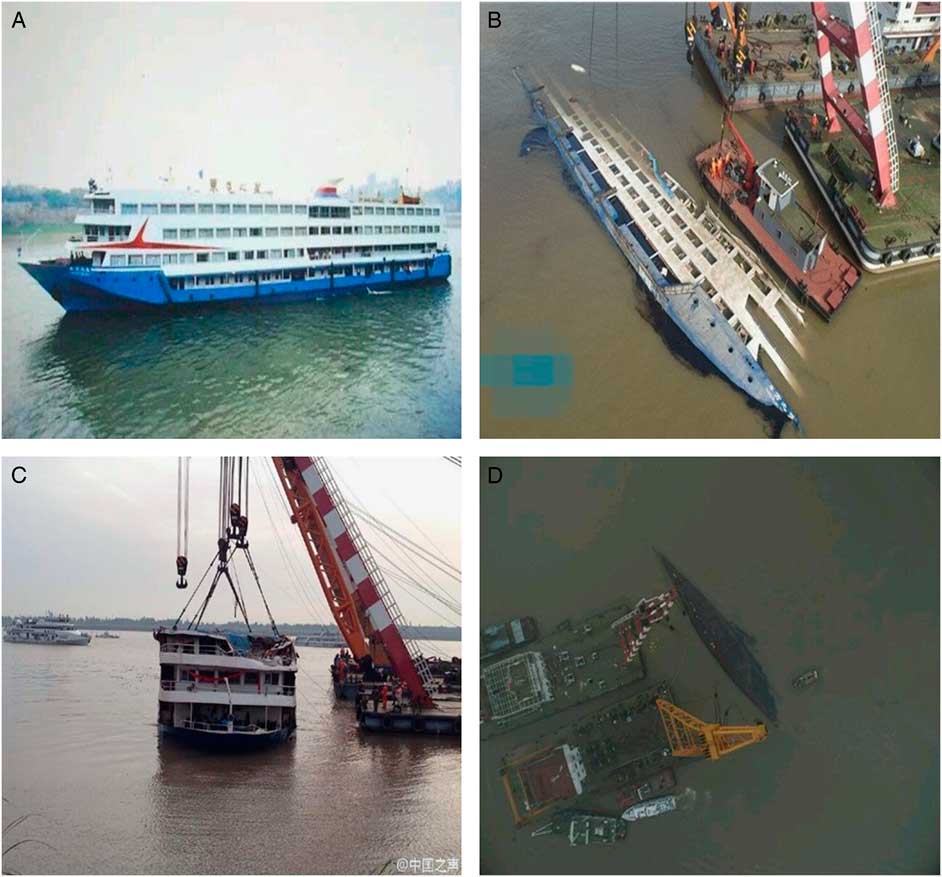
The cruise ship “Oriental Star” sank into Yangtze River in Jianli County at 9:28 pm on June 1, 2015. At that time, only 14 people were rescued. There were 422 passengers on the cruise, and most of them were 50-80 years old. After the accident, about 380 navy divers, together with 110 rescue boats and 6 helicopters, joined in the rescue. The accident occurred in an area where the depth of the water was 50 feet, which along with strong winds and heavy rain hampered the rescue operations (Figure 1).
Disaster in the Area of “Oriental Star” Sinking, Jianli China. A: The photograph of "Oriental Star" before sinking. B,C,D: The salvage of the ship was under way.

The shipwreck occurred in the schistosomiasis epidemic area.Reference Chen, Huang and Xiao 1 Schistosomiasis is a widespread parasitic zoonosis that poses a great threat to humans and animals.Reference Almeida, de Oliveira, Castro and de Bessa 2 - Reference Mohammad 5 Statistically, about 200 million people are infected with schistosomiasis and at least 500,000 people die of schistosomiasis each year.Reference Papamatheakis, Mocumbi, Kim and Mandel 6 , Reference Antwi, Aboah and Sarpong 7
Because of the seasonal changes and open environment, since the 1950sReference Papamatheakis, Mocumbi, Kim and Mandel 6 - Reference Lai, Shao, Yu, Li, Mei and He 9 the shore along Yangtze River has become the primary endemic area for Oncomelania hupensis, which is the intermediate host of Schistosoma japonicum. Considering the epidemicity of schistosomiasis in this area, a questionnaire survey was performed, with the result indicating that schistosome infection rate was 0.5%-3.04%.Reference Lei, Zheng and Zhang 10 Further, another study was also carried out, which showed that 45 people were infected with schistosomiasis out of 60 people who participated in the rescue.Reference Lv and Lin 11 , Reference Chen, Gu and Zeng 12
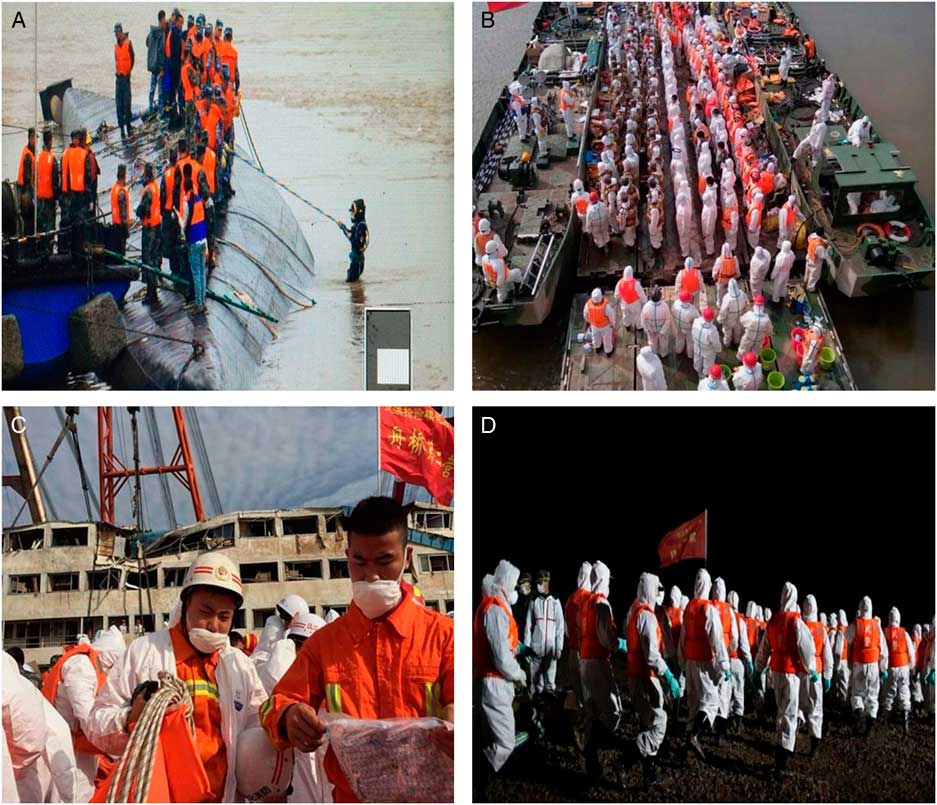
In this accident, more than 9000 people joined in the rescue, among whom there were 200 divers, 700 police personnel, 3900 armed police, 1700 reservists, and 3000 local residents. Besides, 7 medical teams from Hubei and Hunan Provinces also joined in the rescue, including 508 health workers and 123 medical experts. Most of these rescue workers came from areas beyond the Yangtze River region and were engaged in different lines of business. Hence, they were quite vulnerable to schistosomiasis. Therefore, the protection of rescuers should also be given high priority (Figure 2).
Rescue Operations in the Area of “Oriental Star” Sinking, Jianli China. A: A diver was going under water. B,C,D: Images of soldiers and other rescuers at work.

The past 2 decades witnessed numerous disasters, such as “9/11 Attack,” Indian Tsunami in 2004, Sichuan Earthquake in 2008, “4/16 South Korean Sunk Passenger liner,” etc. However, never before had these rescue workers faced the risk for schistosomiasis infection while performing their duties. Therefore, it is critical to carry out a scientific evaluation of the risk for schistosomiasis infection.Reference Zhu, Gao and Huang 13 , Reference Adie, Okon, Arong, Braide and Ekpo 14
The main purpose of this study is to come up with assessment methods for maritime search and rescue, necessary health care for rescue workers, and rescue modes for Centers for Disease Control and Prevention (CDC), so as to be well prepared for disasters and emergencies in a schistosomiasis epidemic area.
METHODS
Study Area
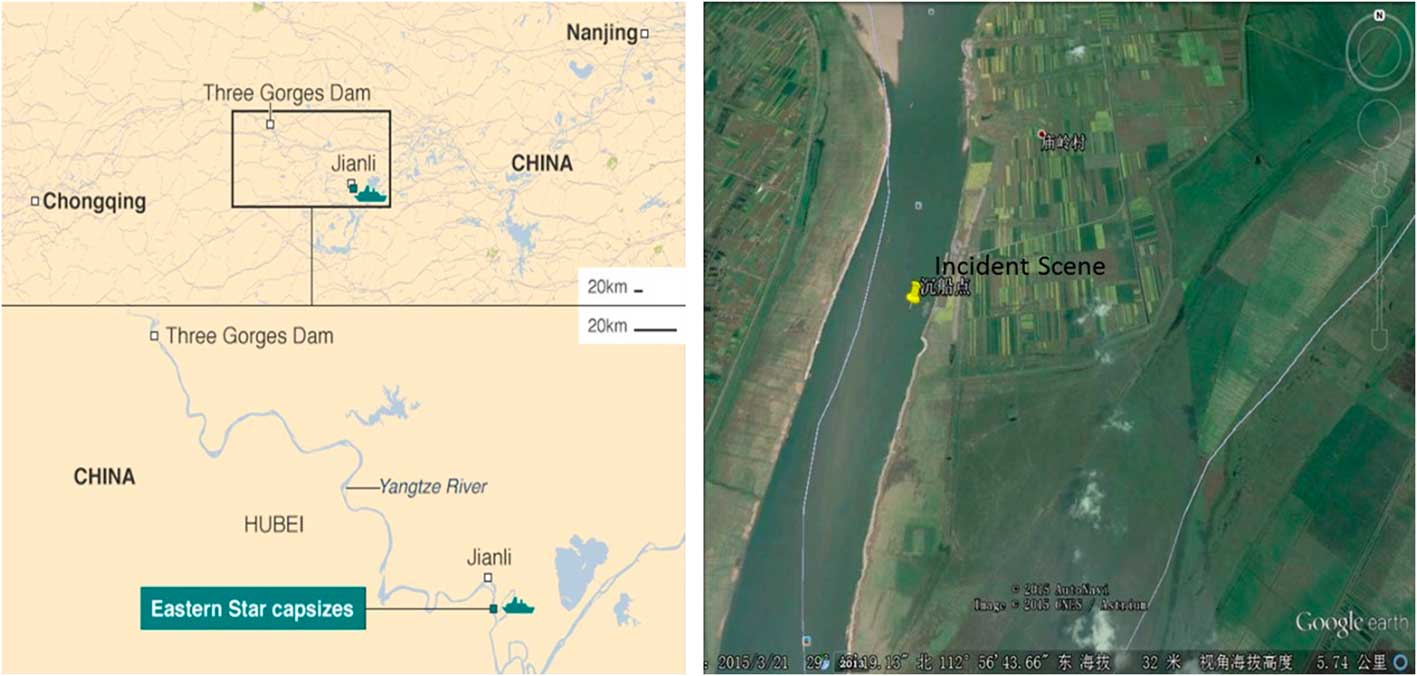
The study was conducted in Jianli section of Yangtze River, where the ship sank (Figure 3). Yangtze River is the third longest in the world, stretching for 6300 km (3915 miles) with its source located in the mountains of Tibet and its end linked to the East China Sea.Reference Wang, Wang and Mou 15 Unfortunately, Jianli section of Yangtze River has always been heavily affected by the epidemic of schistosomiasis in the past decades with high mortality and morbidity (Figure 3).
Map of the Incident Scene in Jianli Section of Hubei Province, China.

Data Collection and Analysis
Mapping of the Locality
The Georeferenced mapping of the locality was performed in March 2015 using a Global Position System (GPS) receiver configured into the schistosomiasis surveillance system. The mapping covered streets, main buildings, and water bodies that contained the disease-bearing mollusk. The disease-bearing mollusk is classified according to proliferative zones of schistosomiasis (Figure 3).
Data Collection
The government of Hubei Province sponsored the project for schistosomiasis control, which specifies the guidelines for effective disease control as well as surveillance of affected villages. Besides, the surveillance of humans, livestock, and disease-bearing snails in each village is also performed annually. Information is collected from the annual surveillance data and the rescue sites. Then we analyze general information such as the surveyed population and period, the schistosoma species, the diagnostic test used, and the number of infected individuals.
Delphi Method
The assessment of risk for infection was performed using the expert elicitation methodology, which helped estimate the probability of events occurring in the disease process. Experts from different fields were asked to analyze, on the basis of their knowledge and experience, the risk for infection with schistosomiasis.
The Delphi method was employed to measure the risk and severity of the incident according to related factors, and there was a comprehensive consensus rating matrix on the predicted risk. During the investigation, 17 experts were interviewed, including managers and experts from schistosomiasis prevention and control institutions at provincial, municipal, and county levels, as well as professors from authoritative universities. These experts expressed their opinions by answering a questionnaire anonymously, and they presented their opinions regarding the risk in plain wording as “very low,” “low,” “medium,” “high,” and “very high.” They used such analysis to judge all kinds of risk factors. During the analysis, the 3-dimensional (3D)-view method was used to evaluate risk. The level of the hazard was scored according to the impacted geographical area, affected population, economic loss, and the influence of social stability and psychological pressure on the public, whereas the possibility and the controllability of schistosomiasis infection were scored according to the local background, previous monitoring results, and previous data.
Risk Analysis
We reevaluated the risk criteria and recalculated the score. The score was analyzed using Sigmaplot software to assess the possibility, harmfulness, and controllability of epidemic diseases, and these 3 indicators were the outcomes obtained after the analysis of information from the evidence matrix. Relative weights from pairwise comparisons of objectives were obtained by calculating the right principal eigenvector of the relevant matrix (eg, matrix of the pairwise comparisons between objectives at 1 level of the hierarchy). Experts chose the matrix multiplication method, which is considered to be accurate for the development of a 4-point scale. The 4-point scale was assessed on the basis of colors such as red, orange, yellow, and green, which represent different grades (red indicates the highest level and green represents the minimum level). The data from the evidence matrix provide a visual representation to facilitate our understanding. We analyzed the importance of the criteria from various stakeholders’ perspectives and conducted additional risk analysis to determine their impacts on the schistosomiasis infection.Reference Chen, Huang and Xiao 1 , Reference Belizario, Erfe, Naig and Chua 16 - Reference McManus, Gray, Ross, Williams, He and Li 18
RESULT
Rescue Personnel Structure
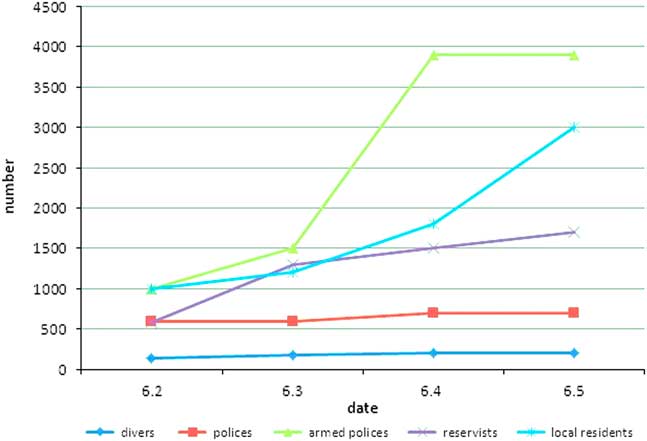
After the accident, the Chinese government made quick arrangements for the local rescuers to perform search and rescue. As time went on, an increasing number of rescuers from adjacent regions also arrived in Jianli County and participated in the rescue. According to the latest statistics, more than 9000 people were involved in the rescue, among whom there were 200 divers, 700 police personnel, 3900 armed police, 1700 reservists, and 3000 local residents. Besides, Hubei and Hunan provinces had mobilized 7 medical teams to join in the rescue activity, including 508 health workers and 123 medical experts. Figure 4 shows the constantly changing number of various rescuers.
The Changing Trend in the Number of Various Rescuers.

Investigation on Schistosomiasis Risk in Jianli County
In the upper reaches of the Jianli section is Miaoling Village of Rongcheng Town. In 2014, the total snail habitat area in Miaoling Village was 20,000 m2, and snails were distributed outside the embankment with no infected snail detected. The schistosomiasis infection rate of humans was 1.18%, and that of cattle was 0%.
The search and rescue region includes 5 towns, namely Rongcheng Town, Shangchewan Town, Zhuhe Town, Shanzhouzhen Town, and so on. In 2014, the snail habitat area of these 5 towns outside the embankment was 47,810,000 m2, with no infected snails detected. The schistosomiasis infection rate of humans in these 5 towns was between 0.38% and 0.50%.
Schistosomiasis Infection Risk Classes
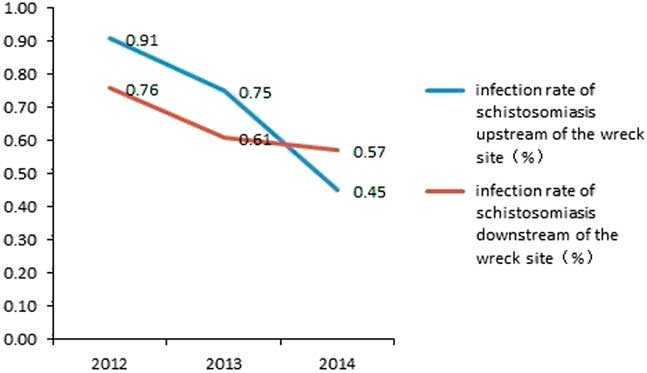
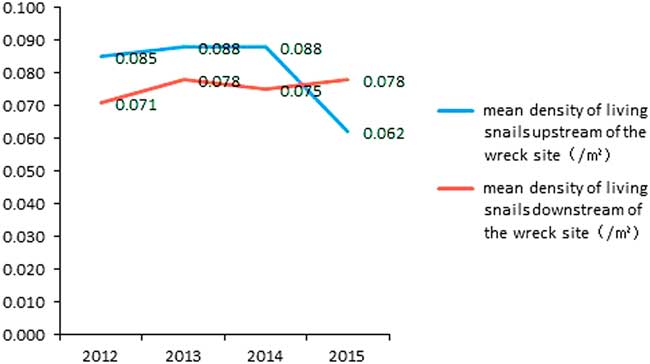
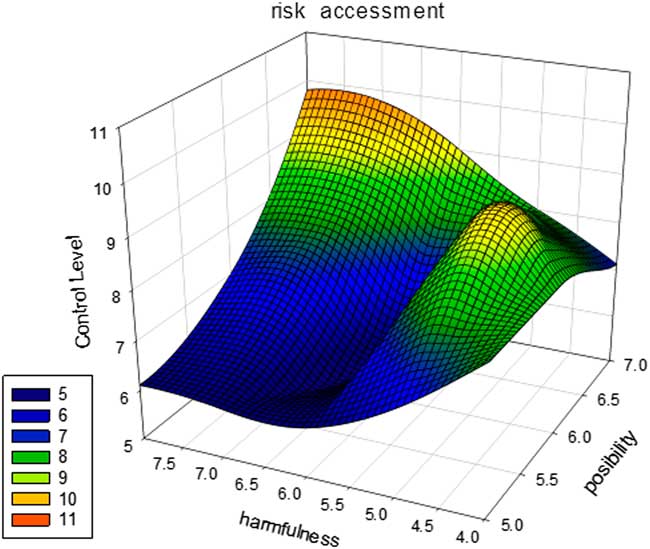
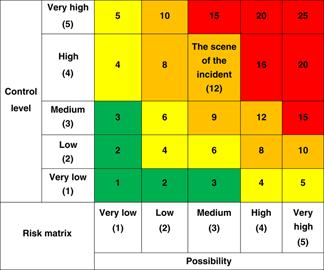
The evaluation result has been put forward, which shows that the infection rate was Medium and the controllability of infection was Poor. The details are shown in Table 1 (Figures 5-7).
The Situation of Schistosomiasis Infection in the Watershed.

The Epidemic Status of the Snail in the Watershed.

3-Dimensional Graphics Results of Risk Assessment.

Control Level and Possibility Result Matrix

3-Dimensional Graphics of Expert-Object Matrix
A total of 17 experts answered regarding the possible schistosomiasis infection rate, the potential hazard, and the controllability of infection, which have all been analyzed and mapped using SigmaPlot software.
The results are as follows:
The 3D graphics show that the possibility of and the harmfulness risk for schistosomiasis infection are Medium (6), whereas the controllability of schistosomiasis infection is Poor (7).
DISCUSSION
The social, economic, and biological factors, together with a variety of hosts and the external environment, constitute a complicated outbreak and transmission process of schistosomiasis. The area where the cruise ship sank is the schistosomiasis epidemic area with a high risk for mortality and morbidity. Besides, the transmission throughout Yangtze River comes to a peak during spring and early summer. Also, the infection in April coincides with the annual rainy reason; spring is favorable for Oncomelania snails as the water level rises and water temperature increases in the lake. The initial peak of schistosomiasis transmission is from May to early July when the highest number of snails are infected. The shipwreck took place in June during consecutive rainy days, which may contribute to the occurrence of Schistosomiasis japonica. When the water level reaches its maximum, the snails begin their seasonal reproduction, the density of cercariae increases, and acute transmission may occur. The transmission may rise to quite a high level within a short period.
Jianli County in Hubei province is one of the major schistosome endemic areas in China because of the large population of Oncomelania snails, which are intermediate hosts of S. japonicum. In the event of a sudden shipwreck, it is virtually impossible to execute effective schistosomiasis control as there is a lack of preparedness in terms of adequate sanitary measures, epidemic preventive measures, or medical interventions to deal with such an emergencyReference Wang, Wang and Mou 15 , Reference Ceccarelli, D’Ettorre and Riccardo 19 within a short period of time. Meanwhile, participating in the rescue means that the staff will come into contact with water repeatedly. The shortage of protective equipment and medicine can greatly increase the risk for schistosomiasis infection. Moreover, many local residents rush to the accident site to serve as volunteers though they lack appropriate personal protective equipment and knowledge. Therefore, it is difficult to guarantee that these rescuers and local residents will not be infected with schistosomiasis during such a period.
Hubei Province is a long-established schistosomiasis endemic area, especially the Jianli section where the density of Oncomelania snails is the highest. During the rescue period, the water level of Yangtze River was rising rapidly after several consecutive rainy days, which would lead to the spread of Oncomelania snails. Meanwhile, people who were relocated because of the rescue have a higher chance of being exposed to a contaminated environment.Reference Xu, Li and Huang 20 - Reference Geleta, Alemu, Getie, Mekonnen and Erko 23 In addition, the increasing population mobility (eg, relief workers) may also carry the disease to other places.Reference Dabo, Diarra and Machault 24 For the Jianli section, the epidemic risk is quite high. To prevent the outbreak of schistosomiasis, the relevant logistic service should be arranged appropriately and all remains should be cleared up carefully. Meanwhile, priority should be given to those areas at a higher risk for schistosomiasis transmission. Also, health-care education should be carried out immediately.
According to our investigation and study, we put forward the following suggestions.
First, it is necessary to take protective measures to protect participants as much as possible.Reference Bin 25 , Reference Qu, Dai and Xing 26 All volunteers and rescuers should wear waterproof gloves in case they come into contact with the contaminated water.Reference Othman and Soliman 27 , Reference Liu, Liu, Hu, Cao and Chen 28 Previous research indicates that taking praziquantel is an effective way to prevent schistosomiasis.
Second, we should register all participants taking part in the rescue so as to provide early preventative medication and treatment.Reference Ramamoorthi, Graef and Dent 29 , Reference Ochodo, Gopalakrishna and Spek 30
Third, to avoid secondary disasters arising during the rescue process, we should be cautious of other vectors such as flies that could spread the disease.Reference Wami, Nausch and Midzi 31
Fourth, we may resort to landfills or use niclosamide to kill cercaria and snails in search and rescue regions.Reference Zhu, Gao and Huang 13
Fifth, we should provide preventive treatment to wading personnel. According to the principle of “Early Discovery, Early Diagnosis and Early Treatment,” we should provide preventive treatment to people who come into contact with contaminated water to prevent acute schistosomiasis infection. Those contacting contaminated water must take praziquantel for 4 weeks.
Last but not least, we should develop health education measures, such as setting up warning signs and guard posts in search and rescue regions as well as spreading knowledge on schistosomiasis prevention and control to local residents and rescuers, to improve their awareness of self-protection.Reference Li, Dong and Liu 32