


Introduction
Approximately 1.3% of the population of England are formally recognised as autistic (NHS Digital, 2024). Studies highlighting under-recognition of autism in females (Lockwood Estrin et al., Reference Lockwood Estrin, Milner, Spain, Happé and Colvert2021) and people from minoritised ethnicities (Mandell et al., Reference Mandell, Wiggins, Carpenter, Daniels, DiGuiseppi, Durkin, Giarelli, Morrier, Nicholas, Pinto-Martin, Shattuck, Thomas, Yeargin-Allsopp and Kirby2009), along with broader barriers to identification and professional assessment reported by autistic people and their families (Crane et al., Reference Crane, Batty, Adeyinka, Goddard, Henry and Hill2018), suggest the true proportion of autistic people in the population may be higher. Formal assessment can take place in childhood, but autism is often not recognised until adulthood (Russell et al., Reference Russell, Stapley, Newlove-Delgado, Salmon, White, Warren, Pearson and Ford2022), and for some this can be later in life (Stagg and Belcher, Reference Stagg and Belcher2019).
Most mental health difficulties begin by early adulthood (Solmi et al., Reference Solmi, Radua, Olivola, Croce, Soardo, Salazar de Pablo, Il Shin, Kirkbride, Jones, Kim, Kim, Carvalho, Seeman, Correll and Fusar-Poli2022) and autistic people are known to be disproportionately affected compared with the general population (Lai et al., Reference Lai, Kassee, Besney, Bonato, Hull, Mandy, Szatmari and Ameis2019), with studies estimating that up to 90% of primary school-age autistic children (Salazar et al., Reference Salazar, Baird, Chandler, Tseng, O’Sullivan, Howlin, Pickles and Simonoff2015) and 62% of autistic adolescents (Hollocks et al., Reference Hollocks, Leno, Chandler, White, Yorke, Charman, Pickles, Baird and Simonoff2023) meet criteria for a mental health condition. This suggests that Child and Adolescent Mental Health Services (CAMHS) are likely to receive referrals for autistic children and young people (CYP), both professionally assessed as autistic and unassessed, requiring support with difficulties such as anxiety and low mood. The short- and long-term outcomes of unaddressed childhood mental health disorders are well documented, including increased risk of school drop-out (Clayborne et al., Reference Clayborne, Varin and Colman2019), unemployment in adulthood (Clayborne et al., Reference Clayborne, Varin and Colman2019; Morales-Muñoz et al., Reference Morales-Muñoz, Mallikarjun, Chandan, Thayakaran, Upthegrove and Marwaha2023) and substance misuse (Morales-Muñoz et al., Reference Morales-Muñoz, Mallikarjun, Chandan, Thayakaran, Upthegrove and Marwaha2023), highlighting the importance of effective early intervention.
Over the past decade, significant reforms to English CAMHS, initiated by the government’s Future in Mind framework (Department of Health, 2015) and subsequent green paper (Department of Health & Department for Education, 2017), have included growing provision of brief (6–8 sessions), evidence-based low-intensity interventions delivered by two new practitioner roles: Children’s Wellbeing Practitioners (CWPs) and Education Mental Health Practitioners (EMHPs) (for a full overview of these roles, see Ludlow et al., Reference Ludlow, Hurn and Lansdell2020). Consistent with guidance from the National Institute for Health and Care Excellence (2022, 2023), service pathways have been restructured so that most CYP with mild-to-moderate anxiety, low mood, or behavioural concerns are initially offered interventions grounded in cognitive behavioural therapy (CBT) principles, delivered predominantly by these practitioners, and referred to as low-intensity CBT (LICBT). EMHPs are typically based in school settings and CWPs in community CAMHS settings, with both roles requiring completion of a one-year training course primarily focused on LICBT delivery.
While there is some evidence for CBT effectiveness in autistic CYP, findings are mixed and long-term outcomes are less clear (Sharma et al., Reference Sharma, Hucker, Matthews, Grohmann and Laws2021). Outcomes may depend on the extent to which interventions are adapted to autistic CYP’s preferences and needs (Wood et al., Reference Wood, Kendall, Wood, Kerns, Seltzer, Small, Lewin and Storch2020), and recent literature has also highlighted the importance of ensuring intervention approaches are neurodiversity-affirming and developed with attention to autistic perspectives and priorities (Cullingham et al., Reference Cullingham, Rennard, Creswell, Milton, Buckle, Godber, Gordon, Larkin and Green2024; Onwumere and Patten, Reference Onwumere and Patten2024), with some qualitative accounts raising concerns about the appropriateness of standard CBT for autistic CYP (Ashworth et al., Reference Ashworth, Bray, Hanlon, Stanway, Pavlopoulou, Moore, Donaghy, Coen and Firth2025). Much of the CBT evidence derives from adapted or specialist programmes delivered at higher intensity within clinical trial or specialist service contexts. In contrast, LICBT interventions are typically brief, structured guided self-help approaches designed to increase intervention scalability and accessibility. LICBT is not well-represented in the evidence base for autistic CYP, and studies examining the effectiveness of LICBT interventions often exclude autistic CYP from participating (e.g. Pass et al., Reference Pass, Lejuez and Reynolds2018; Thirlwall et al., Reference Thirlwall, Cooper, Karalus, Voysey, Willetts and Creswell2013; Waite et al., Reference Waite, Sutton, Percy, Clark, Maratchi, Jeavons, Shipp and Violato2025). As a result, little is currently known about the effectiveness or suitability of LICBT specifically for this population. Emerging evidence from studies involving autistic adults suggests potential for adapted LICBT approaches (Russell et al., Reference Russell, Gaunt, Cooper, Barton, Horwood, Kessler, Metcalfe, Ensum, Ingham, Parr, Rai and Wiles2020; Trimmer et al., Reference Trimmer, Heintz and Williams2024), although this work remains limited and is not yet directly transferable to CYP services. Similarly, consideration to outcomes for autistic CYP in implementation reports of CWP and EMHP workforces has been limited (e.g. Ellins et al., Reference Ellins, Hocking, Al-Haboubi, Newbould, Fenton, Daniel, Stockwell, Leach, Sidhu, Bousfield, McKenna, Saunders, O’Neill and Mays2024; Mundy et al., Reference Mundy, Moore, Soan, Anderson, Albajara Saenz, Baser, Burn, Fenton, McKenna, O’Neill, Platt, Ford, Ellins and Mays2025; Wood et al., Reference Wood, Marshall, Shaw, Hooper, Turnbull and Loadesin press), although practitioner concerns have been mentioned regarding the effectiveness and suitability of standardised LICBT interventions for this group (Ellins et al., Reference Ellins, Hocking, Al-Haboubi, Newbould, Fenton, Daniel, Stockwell, Leach, Sidhu, Bousfield, McKenna, Saunders, O’Neill and Mays2024).
Given the high rates of mental health challenges among autistic populations and the growing offer of LICBT across English CAMHS, it is likely that EMHPs and CWPs commonly encounter autistic CYP in their roles. However, little is currently known about how they might support the needs of this group in their clinical practice. Evidence for anxiety treatment suggests that the benefits of CBT for autistic CYP are greater when intervention format and content are adapted to account for CYP interests and their behavioural, social and systemic needs (Wood et al., Reference Wood, Kendall, Wood, Kerns, Seltzer, Small, Lewin and Storch2020). The National Institute for Health and Care Excellence (2013) also recommend adapting therapy for autistic CYP, for example by involving parents/carers, simplifying cognitive aspects, incorporating emotion recognition training and increasing use of visual and written information. Such adaptations do appear to be regularly implemented by practitioners delivering full CBT (Walters et al., Reference Walters, Loades and Russell2016); however, therapists also report low confidence in using their knowledge to help autistic clients (Cooper et al., Reference Cooper, Loades and Russell2018). It is currently unknown whether these findings would extend to LICBT practitioners working with autistic CYP. As CWPs and EMHPs play a central role in LICBT provision for CYP, understanding their experiences may offer important insights into how these approaches are currently implemented with autistic CYP.
Research aims
The current study explores how LICBT practitioners in England work with autistic children and adolescents. An exploratory qualitative approach was used due to lack of existing research in this area. Practitioners’ experiences were considered across their work with autistic CYP regardless of whether those CYP were formally recognised as autistic, due to the documented issues around autism identification and assessment in England, and in recognition that not all autistic people may wish to seek out professional assessment (Friedman et al., Reference Friedman, Paltoglou and Sorte2024). The study aims to answer the following research questions:
-
(1) What are EMHPs’ and CWPs’ experiences of supporting autistic CYP?
-
(2) What prepares or supports EMHPs/CWPs in working with autistic CYP?
Method
A qualitative design with semi-structured interviews was used to collect in-depth data while allowing flexible exploration of individual participants’ reflections.
Ethical considerations
Ethical approval was granted by the University of Bath Social Sciences Research Ethics Committee (ref. 4575-5114). All participants gave informed consent and were provided a debrief sheet after interview, including details for accessing support if needed.
Participants
Eight EMHPs and five CWPs took part, including one senior CWP and one senior EMHP. Participants were required to be working in England, to have successfully completed the relevant core training course for their current CWP/EMHP role, and to have supported at least one autistic CYP as a CWP/EMHP (including indirectly, such as parent-led intervention). ‘Autistic’ was defined as any CYP who (1) had been professionally assessed as autistic, (2) was on the waitlist for autism assessment, or (3) self-identified as autistic.
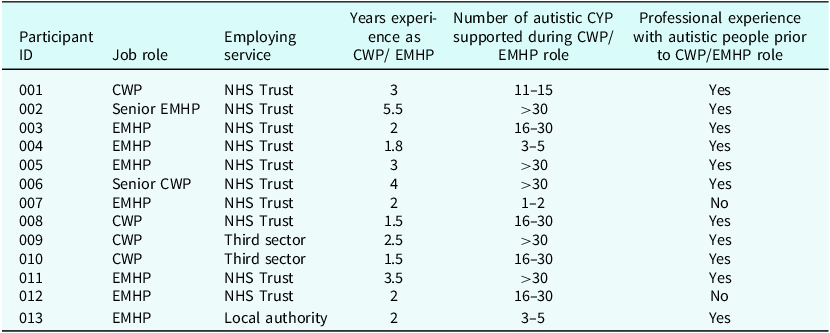
The study aimed to capture the views of practitioners across a diversity of personal and professional characteristics. Ten participants (77%) were of White British ethnicity, one was Black British African, one Black British Caribbean and one British Bangladeshi. Twelve participants (92%) were female and one male. Participant ages ranged between 23 and 42 years (M = 28.08, SD = 4.97), with most being younger than 30 (n = 10, 77%). This demographic profile appears broadly consistent with available workforce census data suggesting that CWP and wider psychological practitioner workforces are predominantly female, relatively young and largely of White ethnicities (>90% female and >60% aged under 35 among CWPs, Gohal et al., Reference Gohal, Goforth and Gallop2023; 86% female and 79% White across psychological practitioner workforces, NHS England, 2025b). Eleven participants self-identified as neither autistic nor neurodivergent, one as non-autistic neurodivergent and one chose not to disclose. Participants were working across nine different counties within five English geographical regions, with the majority (n = 11, 85%) based in the south. Self-reported professional characteristics are summarised in Table 1. Based on Malterud et al.’s (Reference Malterud, Siersma and Guassora2016) framework, a final sample size of 13 participants was felt to hold sufficient information power to address the study’s aims. This was informed by factors such as the relatively focused sample of CWP/EMHP practitioners, researcher familiarity with the practitioner context, and richness of participant accounts.
Participant professional characteristics at time of interview

Table 1. Long description
A table titled ‘Participant professional characteristics at time of interview’ with 13 rows and 5 columns. The columns are labeled ‘Participant ID’, ‘Job role’, ‘Employing service’, ‘Years experience as CWP/EMHP’, ‘Number of autistic CYP supported during CWP/EMHP role’, and ‘Professional experience with autistic people prior to CWP/EMHP role’. Each row lists details for individual participants. For example, Row 1: Participant ID 001, Job role CWP, Employing service NHS Trust, Years experience as CWP/EMHP 3, Number of autistic CYP supported during CWP/EMHP role 11-15, Professional experience with autistic people prior to CWP/EMHP role Yes. Row 2: Participant ID 002, Job role Senior EMHP, Employing service NHS Trust, Years experience as CWP/EMHP 5.5, Number of autistic CYP supported during CWP/EMHP role >30, Professional experience with autistic people prior to CWP/EMHP role Yes. This pattern continues for all 13 participants, detailing their respective professional characteristics.
Recruitment
Study advertisements were circulated on LinkedIn and via emails forwarded by training providers to alumni mailing lists. While all providers of CWP and EMHP training courses in England were contacted to share the study, some declined due to organisational policies and others did not respond, meaning the extent of email circulation is unknown. Interested practitioners could respond by accessing the study link and were directed to a QuestionPro form to view the information sheet and researcher contact details, and to complete a brief survey expressing interest to participate. Alternatively, practitioners could email the research team to express interest or with any queries. Interested practitioners were subsequently sent a separate QuestionPro survey including a consent form and demographics questionnaire that enquired about personal (e.g. age, ethnicity, neurodivergence) and professional (e.g. job role, service context, experience with autistic clients) characteristics.
Participants were offered a shopping voucher (£25) as compensation. To address the potential for monetary remuneration attracting non-genuine participants (Roehl and Harland, Reference Roehl and Harland2022), expressions of interest were screened and flagged internally as suspicious where indicators outlined by Woolfall (Reference Woolfall2023) were present. These included unusual email addresses (e.g. containing strings of numbers), brief and non-personalised messages, blank email subject lines, clustered expressions of interest submitted within a short time frame, and vague questionnaire responses. Such indicators were interpreted using researcher judgement, rather than applied as a binary checklist, with responses flagged where multiple indicators collectively raised concerns about authenticity. Respondents flagged as suspicious were not prioritised for further contact regarding participation but were included in generic email updates to all prospective participants.
Initially, all practitioners expressing interest who were deemed eligible and likely to be genuine were invited to participate. This was determined by screening information within expressions of interest and demographics questionnaires against the study’s eligibility criteria, and by assessing authenticity of prospective participant responses using Woolfall’s (Reference Woolfall2023) criteria. As responses to study advertisements continued to be received, high levels of interest in the study (n = 78 expressions of interest; n = 36 consent/demographics forms completed) meant purposive sampling methods could subsequently be employed. This involved iteratively reviewing the developing sample and demographic questionnaire responses to identify and invite practitioners with characteristics under-represented in the current sample to interview, e.g. practitioners employed by non-NHS services and those with no prior professional experience with autistic people before their CWP/EMHP role. Of the 36 practitioners completing consent and demographics questionnaires, 19 were EMHPs (including three senior EMHPs), 14 were CWPs (including two senior CWPs), and one did not specify role; 28 worked in NHS services, seven in third sector organisations and one in a local authority service. Most respondents (n = 29) reported prior professional experience with autistic people.
Procedure
Interviews were conducted virtually using Microsoft (MS) Teams between July and October 2024, with 12 interviews conducted by the primary researcher (AC) and one conducted by a research assistant (PR). The mean interview duration was 53 minutes and interviews were dual recorded using both the MS Teams audiovisual record function (with automated transcription) and a physical dictaphone. A semi-structured interview topic guide was used (see Supplementary material), with interviewers taking a flexible approach to question order and using additional prompts as appropriate.
Data analysis
Data analysis followed Braun and Clarke’s (Reference Braun and Clarke2022) reflexive thematic analysis. Analysis was primarily inductive, in that codes and themes were developed from participants’ accounts rather than organised according to a pre-existing coding framework or theoretical model. However, in line with the underlying assumptions of reflexive thematic analysis, analysis was also considered to be interpretive and inevitably shaped by the study aims, topic guide and the primary researcher’s interpretive lens.
Each interview was first transcribed verbatim into MS Word, with MS Teams automated transcripts used as an initial guide and corrected in full against audio recordings. All subsequent phases of analysis were completed by the first author and followed the process described by Braun and Clarke (Reference Braun and Clarke2022). Initial familiarisation with the data (phase 1) involved revisiting interview recordings and reading through written transcripts. Data were then coded systematically (phase 2) using the comments function on MS Word, drawing on both semantic and latent approaches to provide a descriptive and interpretive account of the data. Coding focused largely on participants’ explicit descriptions and reported experiences, with interpretive engagement deepening as analysis developed to attend to implicit meanings, assumptions and contextual influences within and across accounts. Codes were iteratively refined throughout the analytic process. Codes were exported into MS Excel to support the grouping of codes into themes (phase 3) through a process of noticing patterns and capturing shared ideas across codes. These themes were further developed and reorganised (phase 4) until settled themes were established that were felt to well represent meaning in the data. The final themes were refined, named and defined (phase 5) to outline their core concepts before the full analysis was written up (phase 6). Analysis was an iterative process, meaning that these phases did not follow a strict linear progression, but rather the researcher moved between different phases as needed to promote deeper understanding, interpretation and identification of patterns in the data.
Researcher positionality
Data analysis and interpretation were approached from a contextualist, critical-realist stance, recognising that participants’ accounts reflect both their lived realities as practitioners and their subjective interpretations of those experiences. Knowledge was treated as co-constructed between researcher and participants, shaped by the researcher’s own professional background and interpretive lens. Given the study’s focus on practitioners’ experiences of supporting autistic CYP, particular attention was paid to how the primary researcher’s professional training, clinical experiences and assumptions regarding therapeutic practice may have shaped interpretation of the data. The primary researcher (AC) is a White British female who was working clinically in UK public health services as a clinical psychologist in training throughout the study. AC had previous experience in a CWP role delivering LICBT interventions to CYP, including some work with autistic clients. A reflexive journal was kept throughout the study to note decision-making processes, reflections on the research and help consider ways in which analysis was shaped by subjective views and experiences. Reflexive discussion with research supervisors supported consideration of developing interpretations, analytic assumptions and methodological decisions. All coding and theme development remained the responsibility of the first author.
Results
Data analysis generated two themes with seven subthemes, as shown in Fig. 1.
Thematic map of generated themes and subthemes.

Figure 1. Long description
A figure titled ‘Thematic map of generated themes and subthemes’ displaying two themes and seven subthemes. The first theme ‘Delivering LICBT on Unstable Foundations’ includes the subthemes ‘Feeling Underprepared’, ‘Suitability of LICBT is Unclear’ and ‘Attending to Autism-Specific Needs is Key’. The second theme ‘Navigating Organisational Challenges’ includes the subthemes ‘Service-Level Pressures’, ‘Inconsistent Role Expectations’, ‘Moral Impact on Practitioners’ and ‘Practitioners Taking Action’.
Theme 1: Delivering LICBT on Unstable Foundations
Participants reflected on the complexities of supporting autistic CYP using LICBT interventions. They highlighted perceived training gaps, challenges determining clinical fit of interventions, and an underlying requirement for the systems around CYP to accommodate their autism-specific needs for LICBT to be successful.
1.1 Feeling Under-prepared
Participants frequently discussed feeling under-prepared to provide LICBT interventions to autistic CYP, citing limitations in their core training as key reasons for this. Autism content was described as a ‘bolt on’ (P002) to their practitioner training, with limited time dedicated to considering the needs of this client group. This was striking, considering many participants reported high proportions of autistic CYP on their caseloads, with estimates that they comprise ‘at least around 50%’ (P004), ‘like 60%’ (P010), or even ‘the majority’ (P003, P012) of referrals to LICBT services. The taught content was further described as overly theoretical, focusing predominantly on identifying autistic characteristics, rather than providing actionable strategies for delivering LICBT to this client group. As one participant put it, ‘it was kind of like being shown the bike and not shown how to ride it’ (P002). This reported discrepancy between training and clinical practice in the proportion of time allocated to autistic clients was interpreted as reflecting an underlying perception that those designing training may not be fully aware of the realities of practitioners’ clinical responsibilities and caseloads.
Without structured guidance on applying learning to practice, practitioners can feel resigned to ‘trial and error’ (P003, P005, P008) approaches where ‘a lot of the time it’s kind of guessing work’ (P005). Supervision was consistently described as a helpful support to guide practitioners’ work with autistic clients, but its usefulness was seen as dependent on the supervisors’ own competence and not sufficient to compensate for the described training gaps. While suggestions around adapting the environment and communication were offered by some trainers, participants consistently expressed a need for more ‘concrete strategies’ (P005) specific to LICBT work, with some suggesting these be embedded within standard intervention training:
It should have been taught parallel that this is what the intervention looks like for neurotypical children. This is what it looks like for neurodiverse children – P002
Participants recognised that greater experience with autistic clients brings greater skills and confidence over time, but this was not always viewed as sufficient for their learning and left some questioning the ethics of this approach:
The first kind of couple of cases I had, they were autistic young people and again I felt like they were examples of where I learnt an awful lot but is that almost at the cost of them not having perhaps the best support that they could have had if, I’d like I’ve known that before – P011
1.2 Suitability of LICBT is Unclear
Participants expressed mixed views on the appropriateness and effectiveness of LICBT for autistic CYP, with some feeling the interventions are equally as helpful for autistic as non-autistic individuals, while others doubted whether the model aligns with the needs of this group:
It sounds bad, but I think actually that that person maybe not having low intensity CBT and the fact that they would actually be more suited to a different approach … I’ll still do tell them to try it. Just give it a go. But yeah, it’s – it doesn’t work – P007
Fundamental characteristics of LICBT, such as its time-limited and manualised nature, were suggested to be misaligned with common features of autism, as it ‘takes a lot longer to build that relationship’ (P009) with these CYP, and their difficulties may present differently from their non-autistic peers. Furthermore, autistic CYP’s referred difficulties were reported to often not map neatly onto any specific intervention, with families commonly requesting support for difficulties such as emotionally based school avoidance (EBSA), emotion regulation and maintaining social relationships. This led some participants to call for ‘separate manuals’ (P008) for LICBT interventions that are better tailored to the needs and clinical presentations of this group. One also wished to be ‘allowed to practise specific interventions or strategies’ targeting core features of autism such as ‘social communications’ (P013).
As a result of these challenges, some questioned the clinical safety of LICBT for autistic CYP, particularly in the case of graded exposure and interventions for behaviours that challenge:
This client had quite a lot of sensory needs … and there’s a lot of anxiety which came with in relation to the senses … it’s almost like we can’t necessarily expose that person to different kind of textures or whatever which they don’t like, as potentially that’s going to cause more harm – P007
The difficulties highlighted by practitioners in assessing LICBT suitability for autistic clients raise questions about how appropriately these interventions are being applied for this population. Participants’ responses suggest a risk that practitioners may, in some cases, be inadvertently targeting core features of autism, rather than the difficulties their interventions are designed to address. These concerns are reinforced by participants’ reported struggles distinguishing ‘the boundaries between what is anxiety and what is autistic – what are autistic traits’ (P010).
1.3 Attending to Autism-Specific Needs is Key
Recognition and accommodation of CYP’s autism-specific needs across the systems that support them (practitioners, families, schools) were described as foundational to LICBT success. Practitioners aim to improve accessibility, acceptability and effectiveness of interventions by routinely adapting their practice for autistic CYP. A wide range of adaptations were mentioned, largely including adjustments to communication style, physical environment and maximising predictability:
I made sure I didn’t wear perfume that day or I got to school a little bit early just to make sure there was nothing different in the room. And also noise as well so I made sure that we definitely had that quiet room that we normally get allocated – P012
Participants also highlighted the critical role of family and school systems. As one explained, ‘often there’s needed to be a lot of sort of adult support to help them engage with those skills’ (P011). Where adults around the child have a good understanding of their needs in relation to their autism, this can elevate the success of an intervention. However, several participants also described situations where school or family dynamics limited the effectiveness of LICBT and, at times, created practical barriers to delivering these interventions:
You can do your work, but say if they’re going to school every day, for example, and the school aren’t very understanding of their difficulties … with the best will in the world, you can’t change that for them … and it works the same for family I think, so do their family at home understand their needs? … Are they less understanding and maybe causing distress because of things that they’re doing? – P003
In some cases, these contextual difficulties became so prominent that they overshadowed the LICBT itself; ‘they tend to keep bringing it back up … but we can’t focus on it because I can’t support you with that’ (P009). This has additional implications for accurately evaluating LICBT’s effectiveness with autistic CYP, as systemic stressors or unmet needs beyond the reach of the intervention may impact measured outcomes.
Theme 2: Navigating Organisational Challenges
Organisational factors were seen by participants as central to shaping their work with autistic CYP. Practitioners discussed challenges adapting to the needs of these clients within a service model that prioritises efficiency and standardisation. Trying to navigate this work alongside unclear and inconsistent guidance as to the boundaries of their responsibilities left several participants feeling fatigued, confused and, at times, ethically uneasy.
2.1 Service-Level Pressures
While practitioners want – and are encouraged – to provide person-centred care that meets the needs of autistic CYP, many identified service-level challenges to doing so. Individualised adaptations often require additional time, planning and resources that are not always readily available:
They say like, you know, ‘bring their hobbies into it’, and it’s like, well, that might then include like another two hours of prep in my week to try and incorporate all those things which I don’t have time to do … the reality behind it isn’t really so logical for us – P009
This appeared to be a source of frustration, as the extra time required ‘doesn’t really get factored into our caseload’ (P009). Perceived lack of control and demanding workloads are recognised risk factors for occupational burnout (Shoman et al., Reference Shoman, El May, Marca, Wild, Bianchi, Bugge, Caglayan, Cheptea, Gnesi, Godderis, Kiran, McElvenny, Mediouni, Mehlum, Mijakoski, Minov, Van Der Molen, Nena, Otelea and Guseva Canu2021). Some participants described fatigue and possible disenchantment with their role in relation to these issues; one expressed feeling ‘demotivated, a bit fed up, like just tired because I’m working in a role that doesn’t always feel like the role I applied for’ (P006).
These constraints were seen as stemming from how LICBT services are commissioned and evaluated. Participants described a culture of performance metrics and standardisation that can overshadow individual autistic clients’ needs:
It can be quite numbers-driven sometimes … I think that kind of thing makes it harder because it doesn’t acknowledge kind of the adaptations that you need to make, perhaps to make the intervention fit for an autistic young person – P003
Gaps in broader service provision for autistic CYP, including long assessment waitlists, lack of both pre- and post-assessment support, and overstretched schools were cited as further sources of pressure. Practitioners and LICBT services can feel obligated to fill these gaps despite not necessarily having the capacity or expertise to do so:
When I raise things like this, you know, it’s like ‘oh, just, you know, it’s either us or no one else’. And I think that’s the pressure we have in our team. So there’s no other places to signpost – P008
2.2 Inconsistent Role Expectations
The perceived requirement to take on additional responsibilities for autistic clients beyond LICBT increased uncertainty for some participants about the limits of their role. Guidance about ‘what we are and are not doing’ (P009) for autistic CYP appeared to differ across different organisations, with services generally described as ‘more flexible on it’ (P004), whereas some training courses asserted policies or recommendations against trainee and/or qualified practitioners working with autistic CYP:
When I went to uni to do my training year, um, it was a stipulation that you couldn’t work with any young people if they had an autism diagnosis. And then you kind of pass the training year and my service has the stance of we shouldn’t kind of discount people just because of their diagnosis, like we need to be a service for everyone – P003
This can leave the boundaries of CWP and EMHP roles open to individual interpretation. Some participants aligned with stricter limits on what they should provide for these CYP, expressing that ‘we’re not supposed to be trained in that’ (P010), while others saw their role as needing to expand and more flexibly accommodate these clients: ‘there is no such thing as the perfect EMHP case … you can’t go “well they’re a bit too complex, can’t work with them”. You just have to evolve and adapt’ (P002).
2.3 Moral Impact on Practitioners
Working within a system perceived as under-serving autistic CYP led some participants to experience moral and ethical discomfort. Several questioned the origins of policies to exclude autistic CYP by some training providers and services, arguing that this creates ‘a sense of othering’ by ‘making a judgement of an entire population of people’ (P004). Participants indicated tensions between these organisational approaches and their own values of wanting to help people and to deliver accessible, equitable and meaningful support. For some, this discomfort was further exacerbated by what they perceived as tokenistic, minimal coverage of autism in their core training: ‘it just didn’t feel like they cared very much … It felt like the autism training the reason that that was given was to tick a box’ (P010).
The broader service landscape adds another layer of ethical concern for practitioners. Delays and gaps in service provision mean practitioners can be faced with dilemmas over whether to offer an intervention that doesn’t seem like the right fit, send families away without support, or try to fill the gaps to meet autistic CYP’s needs despite not always having the expertise or structures in place to facilitate this. Both offering and not offering intervention were described as uncomfortable options, with one participant sharing that ‘I would really worry outside of my sessions like I really don’t feel like I’m helping them’ (P003), while another expressed ‘I find it quite anxiety provoking sometimes … saying to somebody that I’m not best placed to support with something … particularly when there’s not always a clear alternative for actually who is the best place to go to’ (P011).
The weight of these moral and ethical considerations left some participants with a sense of powerlessness and hopelessness, feeling that ‘[I’m] doing the best that I can, but it really needs like a big, big amount of change for things to get better for these families and young people’ (P008).
2.4 Practitioners Taking Action
In response to the described structural shortcomings and ethical concerns, many participants had taken independent steps to address systemic gaps and build their knowledge and confidence for working with autistic clients. This was often driven by personal morals, professional commitment and a sense of reward from the work, with practitioners motivated by their own values around inclusivity, person-centredness and personal growth:
It’s about maybe me wanting to give the best support that I can and if I’ve identified [autism] as an area of weakness … I will actively go out my way to seek the support to yeah, reduce that – P008
Practitioners with prior experience with autistic individuals draw on skills and resources from these roles in their CWP/EMHP work as a way of ‘filling in the gaps from where maybe I don’t feel like the training was there’ (P010). This includes applying broad knowledge about adaptations, as well as specific tools such as emotional literacy support assistant (ELSA) worksheets and Social Stories. Several participants also described seeking new learning about autism through digital platforms such as FutureNHS, Instagram, Facebook and LinkedIn. As one stated, ‘my algorithm on social media, they know my job because I’ll be getting all this verified content and I’m like “oh, that’s helpful!”’ (P001). This learning is often then disseminated more widely among practitioners, with word-of-mouth emphasised as a key source of information. While well-intentioned, applying strategies from informal sources such as social media carries clinical risks, including therapist drift (Waller and Turner, Reference Waller and Turner2016) and unevidenced strategies.
Driven by a sense of responsibility toward their autistic clients, some participants discussed actions at personal cost to counter gaps in their skillsets and in healthcare systems. These commonly included unpaid time attending training and doing independent reading outside of working hours:
It was in the evening, so it wasn’t as part of my role, but then a few people from work joined me to do it and then we then as a group fed back to the team about key points that we’ve learned – P010
Discussion
Participants described strong commitment to supporting the autistic CYP commonly referred to them but highlighted notable uncertainty and systemic challenges surrounding this work. Many felt under-prepared by their core training, which offered limited autism content without guidance on specific LICBT adaptations. As a result, practitioners can feel left to make complex clinical decisions without a clear evidence base, often questioning the appropriateness and effectiveness of LICBT interventions for this population. They noted that when adjustments were not made to accommodate autistic CYP’s wider needs – whether by family, school or practitioners themselves – intervention was less likely to succeed. Furthermore, service-level constraints appear to limit how well both practitioners and CYP’s wider systems can support their needs relating to their autism. Practitioners cited inflexible protocols, time pressures and limited control over aspects of how they operate as barriers to providing person-centred care, noting that the LICBT service model can at times feel directly incompatible with the needs of autistic CYP. Alongside this, the wider service provision for autistic youth was described as minimal, leaving many families with no alternative routes for support if LICBT is not the right fit. Practitioners discussed the personal emotional impact of navigating these systemic constraints along with their ethical discomfort when feeling unable to offer meaningful support to an already under-served population. In response, many independently sought learning through informal channels, sometimes going beyond their paid roles to try to bridge gaps in provision.
Despite LICBT services being grounded in a strong ethos of evidence-based intervention, these findings suggest that research efforts into LICBT have not kept pace with the realities of its clinical application and the extent to which autistic CYP are seen by CWPs and EMHPs. Existing CBT trials for autistic CYP with mental health needs predominantly focus on high intensity, often group interventions (Sharma et al., Reference Sharma, Hucker, Matthews, Grohmann and Laws2021), with limited attention to how these findings might translate to low-intensity approaches. CWP and EMHP implementation research (e.g. Ellins et al., Reference Ellins, Hocking, Al-Haboubi, Newbould, Fenton, Daniel, Stockwell, Leach, Sidhu, Bousfield, McKenna, Saunders, O’Neill and Mays2024; Mundy et al., Reference Mundy, Moore, Soan, Anderson, Albajara Saenz, Baser, Burn, Fenton, McKenna, O’Neill, Platt, Ford, Ellins and Mays2025; Wood et al., Reference Wood, Marshall, Shaw, Hooper, Turnbull and Loadesin press) has likewise not fully captured the nuances of working with autistic clients. This lack of evidence may help explain the gaps in training, supervision and resources emphasised by participants for working with autistic CYP. Without robust evidence-informed guidance, the LICBT workforce is being tasked with delivering structured, protocol-led interventions to a client group for whom these interventions were not designed or evaluated, raising questions about clinical suitability and safety of this work.
These challenges are compounded by gaps in broader service provision for autistic CYP. Autism-specific services in England are typically commissioned to provide professional assessment, with limited post-assessment support, potentially leaving young people’s needs unaddressed before and after assessment. Furthermore, these services are stretched beyond capacity, with recent NHS data indicating that CYP wait around 18 months on average for a first appointment (NHS England, 2025a). Participants in the current study report that autistic CYP are commonly referred to them with additional needs beyond mental health difficulties, which may reflect these gaps in specialist autism provision, with families seeking support through alternative channels like LICBT services that may not always be appropriate to meet their needs. Research with parents of autistic CYP accessing UK CAMHS highlights similar systemic shortcomings, with parents reporting being offered inappropriate interventions, being denied support and practitioners lacking adequate autism expertise (Ashworth et al., Reference Ashworth, Bray, Hanlon, Stanway, Pavlopoulou, Moore, Donaghy, Coen and Firth2025). These experiences echo CWPs’ and EMHPs’ reported dilemma of whether to offer interventions that do not feel like the right fit, leave families unsupported, or drift beyond their intended roles to pick up responsibilities that they are neither trained for nor fit within their commissioned purpose. This situation risks both under-serving autistic CYP and increasing wait times for all CYP awaiting low-intensity intervention if practitioners divert time and capacity to fill systemic gaps.
The emotional strain and ethical discomfort described by participants in the face of these systemic limitations is consistent with existing literature documenting burnout (Westwood et al., Reference Westwood, Morison, Allt and Holmes2017), moral distress (Cook, Reference Cook2024) and associated high staff turnover (Centre for Outcomes Research and Effectiveness, 2013) among LICBT practitioners. The current study offers important new insights into how the specific challenges of supporting autistic CYP (and the high proportions of these clients among some caseloads) may contribute to these outcomes for EMHPs and CWPs. Similar to insights from autistic adults (Brede et al., Reference Brede, Cage, Trott, Palmer, Smith, Serpell, Mandy and Russell2022), participants described relying on their own resourcefulness to compensate for gaps in their training and in the evidence base when supporting autistic clients. While this speaks to the commitment of the workforce, it also suggests a precarious reliance on individual goodwill to compensate for systemic gaps, which is unlikely to be sustainable for some practitioners over time. Moreover, not all practitioners may have the capacity, resources or willingness to step beyond their formal roles in this way, potentially resulting in some autistic CYP receiving support that is poorly aligned to their needs. This is a commonly reported barrier to accessing mental healthcare for autistic individuals (Adams and Young, Reference Adams and Young2021).
Limitations
While this study provides valuable insights into the experiences of CWPs and EMHPs supporting autistic CYP, several limitations must be acknowledged. The self-selecting nature of the sample means participants with a pre-existing interest in autism or greater experience with autistic clients may have been more likely to want to take part and may be over-represented relative to practitioners with less interest or experience. Efforts were made to capture practitioner perspectives across diverse demographic and professional characteristics, with purposive sampling methods able to be employed due to the high levels of interest received in the study. However, the sample was still restricted to practitioners who were motivated to engage with the topic. Recruitment reach was also uneven, with disproportionate engagement from southern regions of England. While participants ultimately represented nine counties across five regions, there may be aspects of practitioner experiences in northern or central regions that are not well-captured in the data.
Furthermore, this study collected data at a specific point in time and may not fully reflect the impact of recent or ongoing workforce policy and training developments on practitioner perspectives. CWP and EMHP roles are relatively new and have been evolving rapidly, with recent developments including the introduction of formal course accreditation (The British Psychological Society, 2025) and practitioner registration (Health Education England, 2021), and the emergence of supervisor and senior practitioner training pathways (Kell and Self, Reference Kell and Self2024). Such developments are likely to influence practitioners’ experiences of training, clinical work and support in their roles, including in relation to autistic clients. The findings presented here reflect the context of CWPs and EMHPs practising in 2024 and may not capture variations across different cohorts or over time.
Additionally, the study adopted a broad definition of ‘autistic CYP’, encompassing those professionally assessed, those awaiting assessment and those self-identifying as autistic. This definition intended to account for clinical realities and known challenges of delayed autism recognition, but it also means it cannot be assumed that all experiences discussed relate to CYP who would meet formal autism assessment criteria.
Finally, this study was designed to explore practitioners’ experiences of supporting autistic CYP and the participant sample was predominantly non-autistic. The findings therefore reflect practitioners’ understandings of supporting autistic CYP rather than autistic CYPs’ own experiences of receiving support, and may also not fully capture the perspectives of autistic practitioners. Reflecting the study’s focus on practitioner experiences, the researcher positionality statement emphasises those aspects of the primary researcher’s background considered most salient to the interpretation of practitioners’ accounts, namely their professional training and clinical experience. Although researcher neurotype is not disclosed, the potential relevance of this aspect of identity was considered during the study as part of researcher reflexivity. Nonetheless, its absence from the positionality statement, alongside lack of formal consultation with autistic people during the study, could be considered a limitation, as both may have contributed additional perspectives to the interpretation and implications of the findings.
Clinical implications
Findings highlight some key implications for clinical practice. The additional time and resource often required to effectively support autistic CYP within LICBT frameworks should be accounted for in practitioner work plans. Strengthened collaboration between LICBT services and specialist neurodevelopmental CAMHS would provide specialist advice, support and signposting where autistic CYP’s needs extend beyond what LICBT can provide. At a training level, autism-specific learning should be implemented consistently and include clearly defined practitioner responsibilities, so that level of expertise and clinical decision-making do not become dependent on individuals’ initiative, interest or personal time investment. A train-the-trainer approach (Nexø et al., Reference Nexø, Kingod, Eshøj, Kjærulff, Nørgaard and Andersen2024) may help ensure validity, consistency and sustainability of autism knowledge across services. Transparency within core training about the current evidence base for autistic CYP, its limitations, and the rationales underpinning recommendations may also better equip practitioners to make informed, confident decisions and to communicate these effectively with families, schools and other professionals. Taken together, these steps may help reduce practitioner uncertainty, strengthen confidence, and promote more equitable and effective support for autistic CYP within LICBT contexts.
Future directions
Future research should build on these findings by exploring the experiences of autistic CYP and their parents/carers of accessing LICBT pathways. Their perspectives could provide crucial insights into how interventions are received, adapted and experienced in practice, as well as what could be needed to better support this group in the future. Focused exploration of autistic practitioner perspectives could also offer further valuable insights to inform LICBT service provision for autistic CYP.
Importantly, trials of LICBT interventions with autistic CYP are also needed to empirically evaluate their effectiveness and acceptability for this population. Ideally, these would include interventions specifically designed or adapted for autistic youth and co-produced with autistic people. Such evidence is essential to inform training, policy and service design that better meet the mental health needs of autistic CYP. At a broader system level, autistic young people and their families would benefit from evaluation of current pathways to care, informed by lived experience perspectives, to identify shortfalls in existing provision and opportunities to move toward more accessible and holistic co-designed support for this group.
Conclusions
This study highlights practical and ethical challenges that may be faced by CWPs and EMHPs when supporting autistic CYP within LICBT frameworks. Findings suggest a need for greater alignment between the LICBT model and the realities of practice to support intervention that is both effective for autistic young people and sustainable for the workforce. Strengthening the evidence base for LICBT intervention with autistic youth, enhancing autism-specific practitioner training and fostering closer integration between service pathways may support movement toward these goals.
Key practice points
-
(1) LICBT protocols may benefit from thoughtful adaptation when working with autistic CYP. Adjusting practitioner job plans may help accommodate the additional time and resource sometimes required to appropriately support autistic CYP.
-
(2) Findings suggest collaboration between CYP LICBT services and specialist neurodevelopmental CAMHS may support the provision of advice and signposting for autistic CYP whose needs extend beyond the scope of LICBT.
-
(3) Participants suggested a need for consistent autism-specific training for CWPs and EMHPs to support evidence-informed adaptation of LICBT for autistic youth and clarify practitioner responsibilities. Explicit acknowledgement within training of recommendation rationales and current evidence limitations may support practitioner confidence in their work with autistic CYP.
Supplementary material
To view supplementary material for this article, please visit https://doi.org/10.1017/S1754470X26100919
Data availability statement
The interview topic guide is provided in the Supplementary material. Raw interview transcripts are not publicly available as participants did not consent to full transcripts being shared with third parties. Supporting analytic materials are available from the corresponding author upon reasonable request.
Acknowledgements
The authors would like to thank all participants for their valuable contributions and insights. The authors acknowledge the use of automated live transcription in Microsoft Teams as an initial guide for interview transcription. All transcripts were manually corrected in full by the research team prior to analysis.
Author contributions
Amethyst Cunningham: Conceptualization-Lead, Data curation-Lead, Formal analysis-Lead, Investigation-Lead, Methodology-Lead, Project administration-Lead, Visualization-Lead, Writing - original draft-Lead, Writing - review&editing-Lead; Prerana Shashank Rao: Data curation-Supporting, Investigation-Supporting, Project administration-Supporting, Writing - review&editing-Supporting; Maria Elizabeth Loades: Conceptualization-Supporting, Supervision-Supporting, Writing - review&editing-Supporting; Ailsa Russell: Conceptualization-Supporting, Methodology-Supporting, Project administration-Supporting, Supervision-Lead, Writing - review&editing-Lead.
Financial support
This study was completed as part of A.C.’s Doctorate in Clinical Psychology at the University of Bath, with attached funding support. A.R. is in receipt of grants from the National Institute for Health Research. Dr Maria Loades (Advanced Fellowship, 302929) is funded by the National Institute for Health Research (NIHR) for this research project. The views expressed in this publication are those of the author(s) and not necessarily those of the NIHR, NHS or the UK Department of Health and Social Care.
Competing interests
Ailsa Russell is a Guest Editor of this special issue for the Cognitive Behaviour Therapist. She was not involved in the review or editorial process for this paper, on which she is listed as an author. All other authors declare no conflicts of interest.
Ethical standards
Ethical approval was granted by University of Bath Social Sciences Research Ethics Committee (ref. 4575-5114). All participants gave informed consent and were provided a debrief sheet after interview including details for accessing support if needed. This study has been conducted in accordance with the Ethical Principles of Psychologists and Code of Conduct as set out by the British Association for Behavioural and Cognitive Psychotherapies (BABCP) and British Psychological Society (BPS).


 Open access


Comments
No Comments have been published for this article.