Depression in youth is a serious public health concern. Although both preclinical symptoms and clinical diagnosis show their sharpest increase during adolescence (Brendgen, Wanner, Morin, & Vitaro, Reference Brendgen, Wanner, Morin and Vitaro2005; Cole et al., Reference Cole, Tram, Martin, Hoffman, Ruiz and Jacquez2002; Ge, Lorenz, Conger, Elder, & Simons, Reference Ge, Lorenz, Conger, Elder and Simons1994), between 10% and 20% of preadolescent children show depressive symptoms (Achenbach, Reference Achenbach1991) and up to 3% of children suffer from clinical levels of depression (Anderson, Williams, McGee, & Silva, Reference Anderson, Williams, McGee and Silva1987). The prognosis for pradolescent children suffering from high levels of depression symptoms is typically poor, with a significant proportion continuing to show severe symptoms into adolescence and beyond (Dunn & Goodyer, Reference Dunn and Goodyer2006). Quantitative genetic research such as twin studies indicates that depressive symptoms in children are partly explained by genetic factors. Estimates of genetic effects vary widely, however, ranging from 15% to 80% (Happonen et al., Reference Happonen, Pulkkinen, Kaprio, Van der Meere, Viken and Rose2002; Rice, Reference Rice2009). Part of the large variability of genetic effect estimates may stem from gender differences, since girls may be more vulnerable to the genetic transmission of depression than boys (Lau & Eley, Reference Lau, Eley, Abela and Hankin2008). Another important source of variability may arise because genetic effects on depressive symptoms may interact with environmental influences: a phenomenon called gene–environment interaction (Shanahan & Hofer, Reference Shanahan and Hofer2005). Genetically informed quantitative studies have shown that stressful life events such as parental divorce or job loss, illness, or the death of a close friend foster the expression of genetic vulnerability to depressive symptoms among adolescents, in line with a diathesis-stress mechanism of psychopathology (Silberg, Rutter, Neale, & Eaves, Reference Silberg, Rutter, Neale and Eaves2001). These latter findings also concord with molecular studies showing that a history of maltreatment or victimization by peers interacts with specific measured susceptibility genes such as serotonin transporter linked polymorphic region gene and brain-derived neurotrophic factor to predict increased depressive symptoms in children and adolescents (Benjet, Thompson, & Gotlib, Reference Benjet, Thompson and Gotlib2010; Kaufman et al., Reference Kaufman, Yang, Douglas-Palumberi, Grasso, Lipschitz and Houshyar2006).
In contrast to gene–environment interaction involving negative environmental experiences in predicting depression, the interaction of genetic risk with positive environments has rarely been studied. However, findings from nongenetically informative studies with children and adults have repeatedly shown that in particular social support from others can offset the effect of risk factors associated with depression (Taylor, Reference Taylor, Friedman and Silver2007). To our knowledge, only one research group has examined the interaction between social support and genetic risk on depression symptoms in youth. In that study, genetic risk was assessed based on specific measured genes. Thus, Kaufman and colleagues (2004) tested whether social support mitigated the risk associated with the short allele of the serotonin transporter linked polymorphic region gene and maltreatment for self-rated depression symptoms in a sample of 5- to 15-year-olds. Social support was based on youngsters' self-reports and included support received from mothers or other adults. In line with gene–environment interaction, the short/short genotype was associated with an increase in maltreated children's depression scores, and subsequent analyses with an extended sample revealed that this increase was even greater for children who also had the methionine allele of the brain-derived neurotrophic factor (Kaufman et al., Reference Kaufman, Yang, Douglas-Palumberi, Grasso, Lipschitz and Houshyar2006). However, the presence of positive social support reduced the risk associated with maltreatment and the genetic risk profile, such that maltreated youth with this profile had only minimal increases in their depression scores.
Although encouraging, the findings reported by Kaufman and colleagues (2006) only speak to support from adults as a potential buffer against the genetic risk for depression. Already in middle childhood, however, experiences with peers have been found to play a significant role in the development of depression (Garber, Reference Garber and Masten2007). Whereas at the beginning of middle childhood group-related peer experiences such as popularity are believed to be of major importance to children's emotional well-being, close dyadic relationships with friends take center stage starting at around age 8–10 years (Sullivan, Reference Sullivan1953). According to Sullivan (Reference Sullivan1953), close friendships provide unique benefits that are qualitatively different from other close relationships, including those with parents. Friends offer reciprocal validation of each other's developing sense of self, prevent feelings of loneliness (Parker & Asher, Reference Parker and Asher1993), and are an important source of emotional security outside the family (Furman & Buhrmester, Reference Furman and Buhrmester1985). Moreover, friends can mitigate the negative effects of stressful experiences such as parental divorce (Sund, Larsson, & Wichstrom, Reference Sund, Larsson and Wichstrom2003) or maltreatment by parents or other children (Bolger, Patterson, & Kupersmidt, Reference Bolger, Patterson and Kupersmidt1998; Hodges & Perry, Reference Hodges and Perry1999). Youngsters without friends have been found to have a lower self-esteem, to be lonelier, and to show more depression symptoms concurrently and subsequently than youngsters who have at least one reciprocal friend (Ladd, Reference Ladd1990; Nangle, Erdley, Newman, Mason, & Carpenter, Reference Nangle, Erdley, Newman, Mason and Carpenter2003).
In light of these positive effects of friendship, it is conceivable that having at least one close friend mitigates genetic risk of depression symptoms in preadolescent children. Should this turn out to be the case, such a finding would beg another question, namely, whether the protective effect of friendship is cumulative or an “all or nothing” phenomenon. In other words, does the moderating effect of having friends on genetic risk of depression symptoms strengthen as the number of friends increases? The few existing studies addressing this question provide somewhat equivocal evidence of a protective effect of friendship quantity on depression symptoms. Thus, Erdley, Nangle, Newman, and Carpenter (Reference Erdley, Nangle, Newman and Carpenter2001) found that the number of reciprocal best friends, which were operationalized as reciprocal nominations among the top three friends, was uniquely related to lower levels of depression in third- through sixth-grade boys but not in girls. Demir and Urberg (Reference Demir and Urberg2004) reported no significant correlation between the number of reciprocal friends and depression symptoms in youth of either sex, however. Equivocal results have also emerged in regard to the link between friendship quantity and internalizing problems related to depression, such as loneliness, with some studies reporting positive results for boys (Erdley et al., Reference Erdley, Nangle, Newman and Carpenter2001; Parker & Seal, Reference Parker and Seal1996) and others reporting null findings (Kingery & Erdley, Reference Kingery and Erdley2007). To make matters even more complicated, the number of friends count included zero (i.e., children without reciprocal friends) in all of these studies, which makes drawing a definite conclusion about the protective effect of having more than one friend somewhat difficult. Therefore, the question of whether more friends provide more protection against depression symptoms, provided a child has at least one friend, still remains unresolved.
Finally, another dimension of friendship to be considered with regard to a possible protection against depression symptoms in genetically vulnerably youth is friendship quality. Having a close friend or even several friends may not in all cases serve as a protective factor against genetic vulnerability for depression. Even close friendships can vary considerably with respect to the companionship, security, and affective or instrumental support they provide or in the degree of conflict between the two friends (Erdley et al., Reference Erdley, Nangle, Newman and Carpenter2001). Evidence suggests that a lower friendship quality predicts increased depression even when controlling for friendship quantity or social status in the peer group (Demir & Urberg, Reference Demir and Urberg2004; Erdley et al., Reference Erdley, Nangle, Newman and Carpenter2001; La Greca & Harrison, Reference La Greca and Harrison2005; Nangle et al., Reference Nangle, Erdley, Newman, Mason and Carpenter2003; Oldenburg & Kerns, Reference Oldenburg and Kerns1997). Reanalyzing several questionnaire measures of friendship quality, Furman (Reference Furman, Bukowski, Newcomb and Hartup1996) showed that these measures yield two global factors, positive friendship quality and negative friendship quality, which are only marginally correlated. Several studies have shown that it is in particular a high level of positive friendship features that predicts decreased depression symptoms in children and adolescents (Demir & Urberg, Reference Demir and Urberg2004; Prinstein, Reference Prinstein2007; Schmidt & Bagwell, Reference Schmidt and Bagwell2007). Based on these findings, it can be expected that friendships high in positive qualities are more conducive to buffering genetically vulnerable children from depression than are friendships low in positive features. In contrast, existing evidence suggests that friendship conflict seems to play little, if any, unique role in explaining depression symptoms in youth (Adams & Laursen, Reference Adams and Laursen2007; Demir & Urberg, Reference Demir and Urberg2004; Hodges, Boivin, Vitaro, & Bukowski, Reference Hodges, Boivin, Vitaro and Bukowski1999; Schmidt & Bagwell, Reference Schmidt and Bagwell2007). It is nevertheless possible, however, that a high level of friendship conflict can exacerbate the expression of a genetic vulnerability for depression, in line with a diathesis–stress mechanism. Whether such interactive effects between genetic risk for depression and friendship quality exist, still remains to be seen.
The Present Study
The first objective of the present study was to test whether the effect of genetic risk for depressive behavior is reduced in preadolescent children who have at least one close friend compared to children without close friends. Because friendships are defined as voluntary and reciprocal relationships between two individuals, reciprocity of the friendship nomination is a basic tenet of identifying close friendships in the peer relations literature (Furman, Reference Furman, Bukowski, Newcomb and Hartup1996). In accordance with the majority of research linking friendship participation with internalizing problems in elementary school-aged children (e.g., Demir & Urberg, Reference Demir and Urberg2004; Erdley et al., Reference Erdley, Nangle, Newman and Carpenter2001; Kingery & Erdley, Reference Kingery and Erdley2007), the presence or absence of close friendships was thus assessed based on the reciprocity of the friendship nomination between each child and his/her nominated close friend. The second objective was to examine whether the hypothesized interactive effect of genetic risk and friendship participation on depression symptoms is cumulative. We aimed to test whether, among children who have at least one close friend, the effect of genetic risk on depression is more strongly reduced the more friends a child has. The third objective was to examine whether, among children who have a reciprocal very best friend, a high friendship quality would further moderate the effect of genetic risk on depression. It was expected that the effect of genetic risk on depression is reduced when friendships are characterized by many positive features. In contrast, we anticipated that a high level of conflict with the friend might exacerbate the effect of genetic risk on depression.
A fourth objective was to investigate whether the additive and/or interactive effects of genetic risk and friendship on depression symptoms differed for girls and boys. Because girls are more vulnerable to the genetic transmission of depression than boys (Lau & Eley, Reference Lau, Eley, Abela and Hankin2008), genetic risk effects on depression symptoms may be stronger for girls. In addition, theorists have emphasized gender-linked interpersonal processes in depression that may be relevant for the additive and interactive effect of friendship (Hankin & Abramson, Reference Hankin and Abramson2001). Thus, females rely more on social relationships as a source of self-definition (Rose & Rudolph, Reference Rose and Rudolph2006). Girls also engage in more intimate self-disclosure with their friends, and their friendships are characterized by more emotional provisions such as affection, nurturance, and mutual validation (Rose & Rudolph, Reference Rose and Rudolph2006). Therefore, genetic risk for depression symptoms may be reduced more strongly for girls who have at least one close friend than for boys with at least one close friend, compared to their friendless counterparts. By the same token, because boys' friendships tend to be more group based whereas girls generally prefer more intimate dyadic or small group friendships (Eder & Hallinan, Reference Eder and Hallinan1978), having more than one close friend may further mitigate genetic risk for depression symptoms in boys but not necessarily in girls. This expectation was also based on the scarce existing literature reviewed above, which links friendship quantity with fewer internalizing problems mostly in boys. In regard to sex moderation of the expected effect of friendship quality, one would expect stronger effects in females than in males given girls' greater emphasis of intimate disclosure and nurturance within dyadic friendships. However, previous research reports equivocal findings regarding the link between friendship quality and depression, with some only finding significant results in boys (Demir & Urberg, Reference Demir and Urberg2004; Erdley et al., Reference Erdley, Nangle, Newman and Carpenter2001) and others only in girls (Schmidt & Bagwell, Reference Schmidt and Bagwell2007). As such, no specific predictions were made.
The study objectives were addressed using a quantitative genetic design based on data from monozygotic (MZ) and dizygotic (DZ) twin pairs reared together. Since the specific genes at play in the etiology of depression symptoms are still largely unknown, twin designs provide an ideal framework to study the interplay between genetic and environmental risks (see description of the analytical procedure below). Empirical evidence suggests that the nature of twins' peer relations (e.g., the number of friends and friendship features) does not differ from that of nontwin children (Koch, Reference Koch1966; Thorpe, Reference Thorpe2003). Moreover, twin samples and singleton samples do not differ with respect to social–psychological adjustment, including depression symptoms, during childhood (Moilanen, Reference Moilanen1999).
Method
Sample
The 294 twin pairs (MZ males = 85, MZ females = 83, DZ males = 62, DZ females = 64) participating in this study were part of a population-based sample of 448 MZ and same-sex DZ twin pairs from the greater Montreal area who were recruited at birth between November 1995 and July 1998. Zygosity was assessed at 18 months based on physical resemblance via the Zygosity Questionnaire for Young Twins (Goldsmith, Reference Goldsmith1991). A DNA sample was evaluated with respect to 8 to 10 highly polymorphous genetic markers. The comparison of zygosity based on the similarity of these genetic markers with zygosity based on physical resemblance revealed a 94% correspondence rate. Eighty-seven percent of the families were of European descent, 3% were of African descent, 3% were of Asian descent, and 1% were Native Americans. The remaining families did not provide ethnicity information. The demographic characteristics of the twin families were comparable to those of a sample of single births representative of the urban centers in the province of Quebec. At the time of their child(ren)'s birth, 95% of parents lived together, 44% of the twins were the firstborn children, 66% of mothers and 60% of fathers were between 25 and 34 years old, 17% of mothers and 14% of fathers had not finished high school, 28% of mothers and 27% of fathers held a university degree, 83% of the parents held an employment, 10% of the families received social welfare or unemployment insurance, and 30% of the families had an annual income of less than $30,000.
The sample was followed longitudinally at 5, 18, 30, 48, and 60 months focusing on a variety of child-related and family-related characteristics. New data collections were completed when the children were in kindergarten, Grade 1, and Grades 3 and 4. The present paper describes findings from the Grade 4 data collection (mean age = 10.04 years, SD = 0.26). Attrition in the sample was approximately 6% per year, such that 294 twin pairs participated in Grade 4. In 209 (70.5%) of these twin pairs, the two twins did not attend the same classroom. The twin pairs in the final study sample did not differ from those who were lost through attrition in regard to family status, parental education, or parents' age, although family revenue was higher in the remaining study sample. Moreover, a comparison in regard to mother-rated anxious behavior assessed in prior annual waves (ages 18 to 48 months) revealed no significant differences between those who were included in the present study and those who were excluded.
Measures
Depressive symptoms
Teacher ratings and sociometric peer nominations were used to assess the target children's (i.e., twins') depressive symptoms. We focussed on depressive behavior symptoms observable by others because depressed preadolescent children may be less likely than older adolescents to report subjective depression symptoms even when they clearly appear depressed to others (Hammen & Rudolph, Reference Hammen, Rudolph, Mash and Barkley1996). Moreover, in the age group studied here, depression is typically manifested through observable behaviors related to peer interactions in school (Kendall, Cantwell, & Kazdin, Reference Kendall, Cantwell and Kazdin1989). Teachers rated children's depressive symptoms using seven items of the Emotional Disorder Scale of the Ontario Child Health Study (Offord, Boyle, & Racine, Reference Offord, Boyle and Racine1989), such as “seems unhappy or sad,” “is not as happy as other children,” “lacks energy, seems tired,” “has difficulties enjoying him- or herself,” and “shows little interest in activities involving other children.” Teacher-rated depressive behavior correlates reasonably well (r = .38) with young children's self-rated depressed mood (Reynolds, Anderson, & Bartell, Reference Reynolds, Anderson and Bartell1985). Ratings for each item ranged from 0 to 2 (0 = does not apply, 1 = applies sometimes, and 2 = applies often). The items were embedded in a larger questionnaire on child adjustment in school. For each child, individual item scores were added to compute scale scores (Cronbach α = 0.84, M = 3.51, SD = 2.99).
For the sociometric peer nominations, a roster with the names of all children in a given class was handed out to all participating children in the classroom. The children were then asked to nominate up to three classmates who best fit a specific behavioral descriptor. Two behavioral descriptors were used (“is often sad” and “is often unhappy”). Although only two items were used owing to time constraints, even single-item peer nomination assessments tend to be highly reliable because the scoring is generated on the basis of multiple respondents (Hodges, Malone, & Perry, Reference Hodges, Malone and Perry1997; Perry, Kusel, & Perry, Reference Perry, Kusel and Perry1988). For each behavioral descriptor, the total number of received nominations was calculated for each child in the class and z standardized within classroom to account for differences in classroom size. The z-standardized individual item scores were then averaged for each child and again z standardized within each classroom (Cronbach α = 0.86, M = 0.00, SD = 0.90).
Teacher-rated and peer-nominated depressive symptom scores were moderately well correlated (r = .35, p < .001) and were therefore combined by first z standardizing and then averaging both measures. Since global depressive symptoms scores were positively skewed, a logarithmic transformation was applied.
Friendship nominations
During the sociometric nomination procedure, children were asked to nominate up to three best friends in the classroom (excluding the cotwin, when he/she was in the same class). They were also asked to indicate who, among their nominated friends, was their very best friend. Limiting friendship nominations to the classroom does not seem to overly restrict selection of friends because the vast majority of elementary school children select a best friend from among their classmates even when they can nominate a friend from outside the classroom (Parker & Asher, Reference Parker and Asher1993). Moreover, classroom composition remained stable throughout the year, and students spent all day together. A participant was considered to have a reciprocal friend when the peer the participant had nominated had in turn rated the participant as one of his/her three best friends. Of the participating twins, 85% had at least one reciprocal close friend in the class (M = 1.64, SD = 0.99, range = 0–3); and for 83%, the very best friendship nomination was reciprocal (i.e., the very best friend in return named the nominating twin among his or her three best friends). These percentages were similar to those reported in research with singletons (Parker & Asher, Reference Parker and Asher1993). Among those with at least one reciprocal friend, the mean number of reciprocal friends was 1.93 (SD = 0.78).
Friendship quality
Participating twins evaluated the quality of the relationship with their very best friend using an adapted short version of the Friendship Qualities Scale (Bukowski, Hoza, & Boivin, Reference Bukowski, Hoza and Boivin1994). The Friendship Qualities Scale has been specifically developed for use with preadolescent and early adolescent youth and has been validated extensively in that age group. Five items were used to assess positive aspects of friendship quality (e.g., “My friend and I do lots of fun things together” or “When I'm having trouble understanding something, I ask my friend for help or advice”), and three items were used to assess negative aspects of friendship quality (e.g., “My friend and I are often angry with each other” or “My friend and I fight a lot”). Responses were given on a 5-point Likert type scale ranging from 0 (not at all true) to 4 (very true). A global scale of positive friendship features and a global scale of friendship conflict were computed for each participant by averaging the respective individual item scores (M = 2.66, SD = 0.92, min = 0, max = 4, α = 0.81, for positive friendship features, and M = 0.49, SD = 0.73, min = 0, max = 4, α = 0.72, for friendship conflict). Similar to findings in previous studies (e.g., Brendgen, Markiewicz, Doyle, & Bukowski, Reference Brendgen, Markiewicz, Doyle and Bukowski2001; Furman, Reference Furman, Bukowski, Newcomb and Hartup1996; Schmidt & Bagwell, Reference Schmidt and Bagwell2007), positive friendship features and friendship conflict were only weakly and not significantly correlated (r = –.08, p = .10) and were thus examined separately in subsequent analyses.
Procedure
All instruments were administered in either English or French, depending on the language spoken by the children and the teachers. Instruments that were administered in French but were originally written in English were first translated into French and then translated back into English. Bilingual judges verified the semantic similarity between the backtranslated items and the original items. Children's verbal assent as well as active written consent from the parents of all children in the classroom was obtained. Data collection took place in the spring to ensure that the children knew each other and took approximately 45 min per class. Teachers completed the behavior questionnaires for the twin(s) in their class in a separate room. The instruments were approved by the Institutional Review Board.
Results
Estimation of genetic and environmental effects on depressive symptoms
The twin design makes it possible to assess the relative role of genetic factors and environmental factors associated with a given phenotype (Falconer, Reference Falconer1989). The relative strength of additive genetic factors on individual differences is approximately twice the MZ and same-sex DZ correlation difference. The relative strength of shared environmental factors that affect twins within a pair in a similar way can be estimated by subtracting the MZ correlation from twice the DZ correlation. Nonshared environmental factors that uniquely affect each twin in a pair are approximated by the extent to which the MZ correlation is less than 1.0. The MZ correlation of depressive behavior (r = .57) was considerably larger than the DZ correlation (r = .38), suggesting a substantial contribution of genetic factors, whereas shared environmental influences may play only a small role. The overall magnitude of the MZ correlation was still well below 1.0, however, indicating a significant contribution of nonshared environmental factors as well. To obtain a more formal estimation of the genetic and environmental parameters, structural equation modeling using a maximum likelihood fit function was performed with Mplus (Muthén & Muthén, Reference Muthén and Muthén1998–2004). Specifically, a two-group model was fitted to the data where within-twin pair correlations of the latent genetic factor (A) were fixed to 1.0 for MZ twins and to 0.5 for DZ twins. Within-twin pair correlations of the latent shared environmental factor (C) were fixed to 1.0 for both MZ and DZ twins, and within-twin pair correlations of the latent nonshared environmental factor (E) were fixed to 0.0 for both MZ and DZ twins. The estimated coefficients a, c, and e, which were fixed to be equal across the two members of a twin pair and across MZ and DZ twins, are the factor loadings that provide information about the relative contribution of the latent factors A, C, and E to the total variance V T, with V T = a 2 + c 2 + e 2, with measurement error included in e 2 (Neale & Cardon, Reference Neale and Cardon1992). This model fit the data well, χ2 (2) = 1.80, p = .41. Because the intraclass correlations did not suggest a dominance genetic effect D for the two study variables (Neale & Cardon, Reference Neale and Cardon1992), D effects were not estimated. The results revealed that the genetic factor A explained 48% of the variance of depressive symptoms (a = 0.70, confidence interval [CI] = 0.13/0.88), and the nonshared environmental E explained 41% of the variance (e = 0.64, CI = 0.54/0.73). The shared environmental factor C explained the remaining 11% of the variance, but this effect was not statistically significant (c = 0.34, CI = 0.00/0.71).
Calculation of genetic risk for depressive symptoms
When data are collected on twins, an ordinal score of each child's genetic risk for depressive behavior can be estimated as a function of his or her cotwin's level of depressive symptoms and the pair's zygosity (Andrieu & Goldstein, Reference Andrieu and Goldstein1998). This method has been used in several studies to test gene–environment interactions with an epidemiological twin design (Brendgen et al., Reference Brendgen, Boivin, Vitaro, Dionne, Girard and Pérusse2008; Jaffee et al., Reference Jaffee, Caspi, Moffitt, Dodge, Rutter and Taylor2005; Wichers et al., Reference Wichers, Schrijvers, Geschwind, Jacobs, Myin-Germeys and Thiery2009). One twin from each twin pair was selected as the “target twin” and the second twin as the “cotwin.” Each twin pair was represented in the data set twice, with each twin serving as “the target twin” and as the other twin's “cotwin.” The ordinal score of genetic risk for depressive symptoms was computed as a function of (a) zygosity and (b) the presence or absence of depressive symptoms in the cotwin. To this end, the Depressive Symptoms Scale was dichotomized using the 75th percentile as the cutoff. A similar cutoff has been used in other research (Brendgen, Vitaro, Turgeon, & Poulin, Reference Brendgen, Vitaro, Turgeon and Poulin2002). Children whose depressive symptoms score was at or above the 75th percentile value of the sample distribution were considered as depressed. Children whose depressive symptoms score was below the 75th percentile value of the sample distribution were considered as nondepressed. The presence or absence of depressive symptoms in the cotwin was then combined with information on the pair's zygosity into an index of genetic risk for depressive symptoms. Thus, the target twin's genetic risk for depressive symptoms was considered to be highest when he/she was part of an MZ pair, who share 100% of their genes, and when depressive symptoms were present in the cotwin (15%). The target twin's genetic risk for depressive symptoms was somewhat lower when he/she was part of a DZ pair, who share on average only 50% of their genes, and when depressive symptoms were present in the cotwin (10%). The target twin's genetic risk for depressive symptoms was even lower when he/she was part of a DZ pair and when the cotwin was not depressed (32%). The target twin's genetic risk for depressive symptoms was lowest when he/she was part of an MZ pair and when the cotwin was not depressed (43%).
For the logic of the genetic risk index, it was important to ensure that zygosity differences in friendship participation (i.e., having at least one reciprocal friend or not), in the number of reciprocal friends, or in friendship quality could not account for any difference among the genetic risk groups in regard to depression symptoms. MZ and DZ twins did not differ in their probability of having at least one close friend, based on a test of equality of thresholds in a saturated model for a dichotomous phenotype (threshold MZ = –1.05, threshold DZ = –0.90; p = 0.29). Moreover, MZ twins' greater genetic similarity did not seem to make them more concordant for friendship participation than are DZ twins. The pairwise concordance calculates the proportion of pairs in which both twins have at least one close reciprocal friend with the formula C/(C + D), where C is the number of concordant pairs and D is the number of discordant pairs (i.e., pairs in which only one twin had a close reciprocal friend). The pairwise concordance for MZ twins was 80% (i.e., 76%/76% + 18%), and the pairwise concordance for DZ twins was 73% (i.e., 69%/69% + 26%). Among those with at least one reciprocal friend, there were no differences between MZ and DZ twins in regard to the number of reciprocal friends (mean MZ = 1.94; mean DZ = 2.00; p = .52) or in regard to the positive or negative aspects of friendship quality with the best reciprocal friend (mean MZ = 2.66; mean DZ = 2.71; p = .56 for positive aspects of friendship quality; and mean MZ = 0.49; mean DZ = 0.42; p = .27 for friendship conflict). Moreover, MZ twins were not more similar than DZ twins with respect to the number of reciprocal friends (MZ r = .30; DZ r = .22; p = .54). MZ twins were somewhat, albeit not significantly, more similar than DZ twins with respect to the positive aspects of friendship quality with the best reciprocal friend (MZ r = .15; DZ r = –.01; p = .39) but not with respect to friendship conflict (MZ r = .02; DZ r = .03; p = .95).
It was also important to ensure that zygosity differences in depression symptoms could not account for any effect of genetic risk on the outcome. A test of equality of means in a saturated model for a continuous phenotype revealed that MZ and DZ twins did not differ in regard to depressive symptoms (mean MZ = 0.03, mean DZ = –0.02; p = .58). Finally, a multilevel regression controlling for the interdependence of twin data (see further details below) revealed no association between genetic risk for depression and friendship participation (β = –0.06, p = .21). For those with at least one reciprocal friend, a multilevel regression controlling for the interdependence of twin data revealed only a very weak and nonsignificant association between genetic risk for depression and the number of reciprocal friends (β = –0.07, p = .06). For those with a reciprocal very best friend, there was a significant, albeit modest negative association between genetic risk for depression and positive friendship features (β = –0.15, p < .05) but no significant association between genetic risk for depression and friendship conflict (β = –0.05, p = .44). These latter findings were important because finding statistical support for an interaction between genetic risk for depression symptoms and quantitative or qualitative aspects of friendship in subsequent analyses would be more difficult if these variables were strongly correlated.
Main analyses
Using multilevel regression analyses with the Mplus Version 6 software package (Muthén & Muthén, Reference Muthén and Muthén1998–2010), we next examined the additive and interactive effects of friendship (friendship participation, number of reciprocal friends, and friendship quality with the very best reciprocal friend, respectively) and genetic risk on depressive symptoms. We also examined whether these effects differed between girls and boys. These analyses were performed using multilevel regression analysis. In a two-level model, a hierarchy consists of lower-level observations (i.e., Level 1 unit of analysis) nested within higher-level observations (i.e., Level 2 unit of analysis). In the context of the present study, each individual child is nested within a twin pair. The Level 1 unit of analysis represents each individual child, whereas the Level 2 unit of analysis represents each individual twin pair. The Level 1 variance estimates describe the degree to which twins within a pair differ from each other (i.e., within-pair variance), whereas the Level 2 variance indicates the degree to which twin pairs differ from one another (i.e., between-pair variance) with respect to the dependent variable. Due to the genetic structure of the data, both the within-pair (i.e., Level 1) variance and the between-pair (i.e., Level 2) variance may differ between MZ and DZ twins. Therefore, separate estimates for Level 1 and Level 2 variances in MZ twins and DZ twins, respectively, were included in the multilevel model.
Predictors were included in multilevel analyses as fixed effects. The fixed-effect estimates provide information about the unique link between each predictor (i.e., sex, genetic risk for depressive symptoms, and friendship participation/number of friends/positive and negative features of friendship quality) and the dependent variable (i.e., depressive symptoms). A series of consecutive models of increasing complexity were estimated where each subsequent model was compared to the preceding one to evaluate whether the inclusion of additional predictors provided a better fit to the data. Goodness of fit for each model was evaluated based on the –2 log likelihood estimate and a likelihood ratio test was used to evaluate the difference in fit between subsequent models. For each model, the fixed effects of the predictor variables, the Level 1 and Level 2 variance parameters, the model fit (i.e., –2 log likelihood), and the likelihood ratio are provided. To account for occasional missing data, all models were estimated using multiple imputations (Asparouhov & Muthén, Reference Asparouhov and Muthén2010b). Likelihood ratio difference tests were based on multiple imputation procedures described by Asparouhov and Muthén (Reference Asparouhov and Muthén2010a).
Links among genetic risk, friendship participation, and depression symptoms
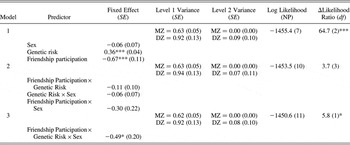
In the first series of model tests, we examined whether having at least one close friend interacts with genetic risk in predicting depression symptoms in children and, if yes, whether this interaction is the same for girls and boys. Table 1 presents the results from this first series of multilevel analyses. In the first model, one Level 2 predictor (i.e., sex of the twin dyad, which was necessarily the same for the two members of the twin pair) and two Level 1 (i.e., child-specific) predictors (genetic risk and friendship participation) were included. Only two of the three predictors were significantly associated with depressive symptoms, however. Children with greater genetic risk had more depressive symptoms (β = 0.36, p < .001), and children who had a least one reciprocal close friend had fewer depressive symptoms (β = –0.67, p < .001). In the second model, three two-way interaction terms were included: Genetic Risk × Sex, Genetic Risk × Friendship Participation, and Friendship Participation × Sex. None of these interactions were significant. However, results from the third model showed a significant three-way interaction (β = –0.49, p < .05), indicating that the interaction between genetic risk and friendship participation significantly differed for girls and boys. Further probing revealed that genetic risk significantly interacted with friendship participation in predicting depressive symptoms in girls (β = –0.37, p < .05), but not in boys (β = 0.12, p = .38). A breakdown of the significant two-way interaction in girls with friendship participation as the moderator showed that the effect of genetic risk on depressive symptoms was considerably weaker for girls who had at least one reciprocal close friend (β = 0.27, p < .001) than for girls without reciprocal close friends (β = 0.64, p < .001). A breakdown of the same interaction with genetic risk as the moderator revealed that the difference in depressive symptoms between girls without reciprocal friends and those with at least one reciprocal close friend became greater with increasing genetic risk for depression. For girls at lowest genetic risk, the effect of friendship participation on depression symptoms was β = –0.47, p < .05, whereas it was β = –1.52, p < .001 for girls who were at highest genetic risk for depressive symptoms. For boys, only main effects emerged, such that boys with greater genetic risk had more depressive symptoms (β = 0.29, p < .01), and boys who had a least one reciprocal close friend had fewer depressive symptoms (β = –0.53, p < .001).
Multilevel analyses assessing the effects of genetic risk and reciprocal friendship participation (none/at least one) on depression

Note: The first model is compared to an unconditional model. NP, Number of parameters; MZ, monozygotic; DZ, dizygotic.
*p < .05. ***p < .001.
Links among genetic risk, number of reciprocal close friends, and depression symptoms
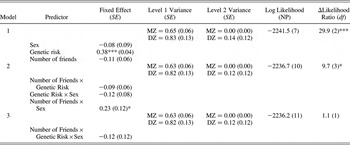
In the second series of model tests, we focused only on those children with at least one reciprocal friend (n = 250 twin pairs) and examined whether the number of reciprocal friends interacts with genetic risk in predicting depression symptoms. These analyses thus addressed the question of whether the additive and interactive effects of friendship observed in the previous set of analyses are cumulative or an “all or nothing” phenomenon. Potential differences between girls and boys in this regard were also tested. Table 2 presents the results from this second series of multilevel analyses. In the first model, one Level 2 predictor (i.e., sex of the twin dyad) and two Level 1 (i.e., child-specific) predictors (i.e., genetic risk and number of reciprocal friends) were included. Only one of the three predictors was significantly associated with depressive symptoms, however. Children with greater genetic risk had more depressive symptoms (β = 0.38, p < .001). Neither child sex nor the number of reciprocal friends had a significant additional main effect on children's depressive symptoms. However, results from the second model showed a significant two-way interaction between the number of reciprocal friends and child sex (β = 0.23, p = .05). A breakdown of this interaction revealed that the number of reciprocal friends was negatively related to depression symptoms in boys (β = –0.24, p < .01), but not in girls (β = –0.01, p = .95). Thus, among boys who had at least one reciprocal close friend, having more friends was related to fewer depression symptoms. This association was independent of children's genetic vulnerability for depression symptoms, because no significant two-way interactions, Genetic Risk × Number of Reciprocal Friends or Genetic Risk × Sex, nor any three-way interaction, Genetic Risk × Number of Reciprocal Friends × Sex (tested in the third model), were found.
Multilevel analyses assessing the effects of genetic risk and number of reciprocal friends on depression symptoms

Note: The first model is compared to an unconditional model. NP, Number of parameters; MZ, monozygotic; DZ, dizygotic.
*p < .05. ***p < .001.
Links among genetic risk, friendship quality, and depression symptoms
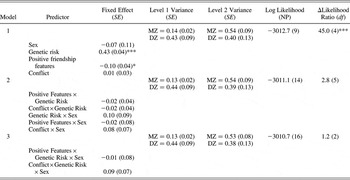
In the third series of model tests, we focused only on children whose very best friendship nomination was reciprocal (i.e., the very best friend in return named the nominating twin among his or her three best friends; n = 243 twin pairs). These analyses examined whether having a high level of positive friendship features and/or a low level of conflict with a close reciprocal friend would interact with genetic risk in predicting depression symptoms in children. Potential differences between girls and boys in this regard were also tested. Table 3 presents the results from this third series of multilevel analyses. In the first model, one Level 2 predictor (i.e., sex of the twin dyad) and three Level 1 (i.e., child-specific) predictors (i.e., genetic risk, positive friendship features, and friendship conflict) were included. Results showed that children with greater genetic risk had more depressive symptoms (β = 0.43, p < .001). In addition, a higher level of positive friendship features was related to fewer depression symptoms (β = –0.10, p < .05), whereas the level of friendship conflict was unrelated to children's level of depression. Subsequent steps in Models 2 and 3 revealed no two-way or three-way interactions among child sex, genetic risk, and positive or negative friendship quality.
Multilevel analyses assessing the effects of genetic risk and friendship quality on depression symptoms

Note: The first model is compared to an unconditional model. NP, Number of parameters; MZ, monozygotic; DZ, dizygotic.
*p < .05. ***p < .001.
Discussion
This study examined (a) whether the effect of genetic risk for depressive behavior is reduced in children who have at least one close friend compared to children without close friends; (b) whether, among children who have at least one close friend, the effect of genetic risk on depression is more strongly reduced the more friends a child has; (c) whether, among children who have a reciprocal very best friend, friendship quality moderates the effect of genetic risk on depression; and (d) whether the additive and/or interactive effects of genetic risk and friendship differ for girls and boys.
Preliminary analyses confirmed previous findings that genetic effects account for a significant proportion of the variance of depressive behavior symptoms in children (Happonen et al., Reference Happonen, Pulkkinen, Kaprio, Van der Meere, Viken and Rose2002; Scourfield et al., Reference Scourfield, Rice, Thapar, Harold, Martin and McGuffin2003), with the remaining variance mostly explained by nonshared environmental factors. However, the expression of genetic vulnerability for depressive symptoms was significantly reduced for girls who had at least one reciprocal close friend. A similar conclusion can be drawn from the alternative breakdown of this interaction: the beneficial effect of having at least one close friend in terms of reduced depression symptoms was much more pronounced for girls at highest genetic risk for depression than for girls at lowest genetic risk. For boys, only moderate main effects of, but no interaction between, genetic vulnerability and friendship participation were found. One possible explanation for this gender-specific interaction between genetic vulnerability and friendship participation is that girls tend to rely more on social relationships as a source of self-definition and self-validation, and their friendships are also characterized by greater intimacy, self-disclosure, empathy, and emotional support (Rose & Rudolph, Reference Rose and Rudolph2006). Girls at genetic risk for depressive symptoms may thus not only receive more emotional provisions from their close friends than boys but also derive more benefits from these provisions for their emotional well-being. The above interpretation is in line with the view that the presence of friends protects against or diminishes the effect of genetic risk. An alternative interpretation could be that the lack of friendship exacerbates genetic risk for depressive symptoms in girls. Perhaps because of their greater reliance on relationships as a source of self-definition, females also show greater interpersonal dependency and care more about having close dyadic friendships (Benenson & Benarroch, Reference Benenson and Benarroch1998). Girls also worry more than boys about loneliness and the loss of relationships (Henrich, Blatt, Kuperminc, Zohar, & Leadbeater, Reference Henrich, Blatt, Kuperminc, Zohar and Leadbeater2001). Peer relationship problems, especially the lack or loss of friendships, have been found to be more strongly linked to depression in girls than in boys (Hankin, Mermelstein, & Roesch, Reference Hankin, Mermelstein and Roesch2007; Rudolph, Reference Rudolph2002). Part of this greater emotional reactivity may be because girls are more likely than boys to respond to interpersonal stress in ways that exacerbate depression, such as with rumination or self-blame (Rose & Rudolph, Reference Rose and Rudolph2006). This negative response tendency is especially pronounced in children who are genetically vulnerable to depression (Beck, Reference Beck2008).
The lack of interaction between genetic risk and friendship participation in boys does not mean that they do not benefit from having close reciprocal friends. Having at least one versus no close friend was significantly associated with fewer depression symptoms in boys, regardless of their genetic risk. This beneficial effect of friendship participation was smaller than the effect observed in girls, however, and comparable to the effect of friendship participation in girls who were at lowest genetic risk for depression symptoms. It is possible that boys may simply need more than one close friend to effectively ward off depression symptoms, whereas already a single friend may be sufficient for girls. Thus, in boys with at least one friend, levels of depression decreased further as the number of friends increased, even when controlling for genetic risk. Such a cumulative effect of friendship was not observed in girls. This finding is in line with reports by Erdley and colleagues (2001) that a greater number of friends is related to fewer depression symptoms in boys but not in girls. Girls' greater orientation toward intimate dyadic (and often exclusive) friendship relations compared to boys' greater orientation toward group-based friendships (Eder & Hallinan, Reference Eder and Hallinan1978) may at least partially explain this sex-specific pattern.
Beyond mere friendship participation or the sheer number of friends, friendship quality also played a significant role in explaining children's depression symptoms, or lack thereof. In line with findings from other studies (Demir & Urberg, Reference Demir and Urberg2004; Prinstein, Reference Prinstein2007; Schmidt & Bagwell, Reference Schmidt and Bagwell2007), a high level of positive friendship features was related to fewer depression symptoms in our sample. This finding not only applied to both girls and boys, but, contrary to expectations, it was also true independently of children's genetic vulnerability for depression. Thus, although a high level of positive friendship quality does not seem to suppress the effect of genetic risk on depression symptoms (via an interaction effect), it nevertheless helps to counterbalance at least somewhat the effect of genetic risk (via main effects in opposite directions). In contrast, friendship conflict did not play a unique role in explaining interindividual differences in depression symptoms, a finding that is in line with those reported in other studies (Adams & Laursen, Reference Adams and Laursen2007; Demir & Urberg, Reference Demir and Urberg2004; Hodges et al., Reference Hodges, Boivin, Vitaro and Bukowski1999; Schmidt & Bagwell, Reference Schmidt and Bagwell2007). In addition, contrary to our expectations, a high level of friendship conflict did not exacerbate the expression of a genetic vulnerability for depression. Although the full range of response options were represented, the general level of conflict in the very close reciprocal friendships studied here may have been too low to trigger or promote a diathesis for depression. Nevertheless, evidence suggests that even reciprocal best relationships are sometimes characterized by a very high amount of negativity (Crick & Nelson, Reference Crick and Nelson2002). Further research with genetically informed samples is needed to examine a potential gene–environment interaction in the link between friendship conflict and depression in children.
In contrast to the significant interaction (in girls) between genetic risk for depression symptoms and friendship participation, no significant association was found between the two variables. There was also no significant association between genetic risk for depression symptoms and the number of close friends. The absence of a correlation between genetic risk for depression symptoms and friendedness indicated independence between the main predictors of interest, thus increasing statistical power to detect a significant interaction. From a theoretical perspective, the lack of a correlation between genetic risk for depression symptoms and friendship quantity indicates that genetic vulnerability for depressive behavior did not decrease children's likelihood of having one or more close reciprocal friend(s). Although causality between two variables can ultimately only be determined with an experimental design, the lack of a gene–environmental correlation (rGE) nevertheless suggests the absence of heritable “child effects” on their environment, in this case friendship quantity (Moffitt, Reference Moffitt2005; Pike & Plomin, Reference Pike and Plomin1997; Scarr & McCartney, Reference Scarr and McCartney1983). This finding is in line with results from studies with singleton samples that even depressed youngsters can establish close reciprocated friendships (Brendgen et al., Reference Brendgen, Vitaro, Turgeon and Poulin2002; Prinstein, Reference Prinstein2007). It is also in line with findings that genetic risk for depression does not noticeably increase the odds of experiencing negative life events, including relationship problems with friends, in preadolescent children (Rice, Harold, & Thapar, Reference Rice, Harold and Thapar2003).
Nevertheless, although youth who are at genetic risk for depressive behavior can establish close friendships just like other children, their friendships seem to offer less consistent support. Children with a strong heritable disposition for depression symptoms in our sample were less likely to have a very high-quality relationship with their reciprocal very best friend than children without such a genetic vulnerability, as evidenced by the significant correlation between genetic risk and perceived positive friendship quality. This rGE might indicate evocative or active “child effects” on their social environment, which arise when genetically influenced individual characteristics provoke a specific reaction from the social environment (in the case of evocative rGE) or when individuals select or shape their environment based on their genetically influenced personal characteristics (in the case of active rGE; Pike & Plomin, Reference Pike and Plomin1997; Scarr & McCartney, Reference Scarr and McCartney1983). The present rGE linking genetic vulnerability for depression to friendship quality is in line with findings from nongenetically informed studies that depression predicts a decline in friendship quality and an increased risk of friendship dissolution over time (Prinstein, Cheah, Borelli, Simon, & Aikins, Reference Prinstein, Cheah, Borelli, Simon and Aikins2005; Rudolph, Ladd, & Dinella, Reference Rudolph, Ladd and Dinella2007). Moreover, there is evidence that depressed individuals may select to affiliate with others who are equally unhappy (Simon, Aikins, & Prinstein, Reference Simon, Aikins and Prinstein2008) and who may ultimately reinforce their depressive thoughts and behavior. Although friends seem to play a significant part in buffering especially genetically vulnerable children from depression problems, the protective effect of close friends for these youths may thus be less consistent than the one enjoyed by other children. Therefore, preventive interventions may need to put particular emphasis on the development of social skills that enable at-risk children not only to form close friendship bonds but also to maintain those bonds over time.
Strengths, limitations, and conclusions
This study is the first to assess whether close friendships can mitigate genetic risk for depression symptoms in children as well as potential sex differences in this context. An important strength of the study is that the presence or absence of close friendships was assessed based on the reciprocity of the friendship nomination. Moreover, the use of teacher and peer evaluations to assess children's depression symptoms not only eliminated potential problems of shared source variance with the friendship variable but also provided information about children's depression symptoms from multiple perspectives.
Despite these strengths, our study also has several limitations. One limitation is the relatively small sample size. However, attrition analysis suggested that the final sample was not overly biased with respect to the study variables, and statistical power was obviously sufficient to detect significant interaction effects. Nevertheless, future studies need to replicate the present findings with larger samples. Another limitation is the absence of data on children's self-reported depression. The focus of this study was on gathering information about behavior symptoms as observable by others because, compared to adolescents, depressed preadolescent children may be less likely to report subjective depression symptoms but may still show depressed appearance (Hammen & Rudolph, Reference Hammen, Rudolph, Mash and Barkley1996). In addition, depression in the age group studied here is very often manifested through observable behaviors related to peer interactions in school (Kendall et al., Reference Kendall, Cantwell and Kazdin1989). Although external sources are typically considered better informants about children's overt behavioral symptoms, it will be important to include self-reports of depression symptoms in future studies because children are likely to be better reporters of additional affective or cognitive symptoms of depression.
In a related vein, it is important to note that the present results may not necessarily generalize to other age groups. Not only are there developmental differences in the behavioral, affective, cognitive, and physiological manifestation of depression symptoms over the course of childhood and adolescence, but many of the intra- and interpersonal correlates of depression also vary across development (Garber, Reference Garber and Masten2007; Kazdin, Reference Kazdin1990). Although current evidence does not suggest that the relative influence of genetic factors on depression varies between childhood and adolescence (Rice, Reference Rice2009), the role of friends in mitigating (as a moderator) or counterbalancing (as a main effect) the effect of genetic risk on depression may vary with age. In line with Sullivan's theory (1953), empirical evidence shows a linear increase in cooperative behavior and emotional support between friends from the beginning of elementary school through early and midadolescence (Berndt & Perry, Reference Berndt and Perry1986). The relatively less supportive friendships of younger children may thus be less effective in protecting genetically vulnerable youth at the beginning of middle childhood than was found in the present preadolescent sample. In contrast, the intensely close friendships of early and midadolescents may provide even greater protection against depression symptoms for genetically vulnerable youth than was found in the present sample, and this protective effect might then also extend to adolescent boys. Still, the protective effect of friendship observed in the present study may be limited to the juvenile period and not generalize to older adolescents or adults. Our measure of depression focused heavily on behavioral symptoms, such as social withdrawal, that are observable to others. Such behavior constitutes a principal symptom of depression in childhood but not necessarily later in life (Kendall et al., Reference Kendall, Cantwell and Kazdin1989). Friendships may be particularly effective in protecting against these overt behavioral symptoms of depression but not necessarily against (typically self-reported) internal cognitive or affective symptoms that tend to be most characteristic of older adolescents and adults. It is also important to keep in mind that the present results are based on a normative sample with a limited range of depressive symptoms and may not generalize to the same extent to clinically depressed children. In their case, close friendships are likely helpful but perhaps not quite as effective in counteracting genetic risk.
The latter point also refers to another limitation, namely, that the present paper only focused on quantitative and qualitative aspects of friendship. However, friends' behavioral characteristics may also play an important role for children's emotional well-being (Hartup, Reference Hartup1996). Both affiliation with depressive friends and affiliation with aggressive friends have been related to increased depression symptoms (Brendgen, Lamarche, Wanner, & Vitaro, Reference Brendgen, Lamarche, Wanner and Vitaro2010; Mrug, Hoza, & Bukowski, Reference Mrug, Hoza and Bukowski2004; Prinstein, Reference Prinstein2007). It is thus likely that these behavioral characteristics of children's friends also significantly contribute to mitigating (or exacerbating) genetic vulnerability for depression symptoms, possibly through the quality of the friendship they provide. While addressing these issues exceeded the scope of this study, future research should examine potential interactions of friends' characteristics with genetic vulnerability in predicting differences in depression, as well as potential mediating effects of friendship quality in this context.
Notwithstanding these limitations, our study provides important evidence of the role of close friendships in mitigating (for girls) or counterbalancing (for boys and girls) genetic risk for depression symptoms in children. The present results thus add to findings from other studies that social support from parents or other adults can mitigate the effect of genetic risk for depression symptoms (Kaufman et al., Reference Kaufman, Yang, Douglas-Palumberi, Houshyar, Lipschitz and Krystal2004, Reference Kaufman, Yang, Douglas-Palumberi, Grasso, Lipschitz and Houshyar2006). Together, these findings emphasize the importance of teaching social interactional skills that promote positive relations with others to help prevent the development of depressive behavior in children.