Introduction
Cyclophilin (CYP), a polygenic family, plays an important role in a series of biological processes complementary to the function of peptidyl-prolyl cis/trans isomerase (PPIase), such as participation in the stress response, metabolic regulation and plant growth and development (Trivedi et al., Reference Trivedi, Yadav, Vaid and Tuteja2012; Tong et al., Reference Tong, Wang, Zhu and Ding2017). CYP is divided into two types: single-domain and multi-domain. The single-domain CYP has a highly conservative PPIase domain, which catalyses the cis–trans isomerization of proline residues in the folds of proline-rich proteins. Additionally, the multi-domain has WD [a tandem repeat with terminal tryptophan (W) and aspartic acid (D), about 40 amino acids in length], CCD [carotenoid cleavage dioxygenase], RP [RNA-binding protein], RRM [RNA recognition motif], ZF [zinc finger] and TPR [tetratricopeptide repeat] domains in addition to the PPIase domain, which are involved in protein–protein or protein–nucleic acid interactions.
In 1990, cDNAs encoding CYP were isolated from Lycopersicum esculentum, Zea mays and Brassica napus for the first time, and the proteins were expressed in Escherichia coli (Gasser et al., Reference Gasser, Gunning, Budelier and Brown1990). Additionally, 31 CYP genes were found in Arabidopsis thaliana, and the functions of 17 of these CYP genes were analysed (Sirpiö et al., Reference Sirpiö, Khrouchtchova, Allahverdiyeva, Hansson, Fristedt and Vener2008). The PPIase activity of the chloroplast matrix AtCYP20-3 protein is regulated by redox, and it is also a key hub involved in cysteine biosynthesis and the external stress response (Dominguez-Solis et al., Reference Dominguez-Solis, He, Lima, Ting, Buchanan and Luan2008). A total of 29 CYP genes are present in the rice genome; OsCYP21-4 located in the Golgi apparatus is involved in the high salt response, reactive oxygen species (ROS) stress response and abscisic acid signal response, and the overexpression of OsCYP21-4 can enhance plant tolerance to NaCl and H2O2 (Lee et al., Reference Lee, Park, Yoon, Kim, Ahn and Luan2015). The OsCYP proteins distributed in the cytoplasm, chloroplast, mitochondria and secretory cavity of rice have been thoroughly analysed and are related to growth, development and stress, including low temperature, high temperature, drought and high salt, and improve the stress tolerance of plants when overexpressed (Ruan et al., Reference Ruan, Ma, Wang, Fu, Xin and Liu2011; Kumari et al., Reference Kumari, Joshi, Singh, Roy, Tripathi, Singh, Singla-Pareek and Pareek2015; Lee et al., Reference Lee, Lee, Won, Park, Lim, Kim, Ahn and Cho2016; Yoon et al., Reference Yoon, Lee, Park, Lyu, Chong, Liu, Kim, Ahn and Cho2016). Wheat CYP TaCYP-1 has PPIase activity, and its overexpression can enhance the heat resistance of E. coli (Kaur et al., Reference Kaur, Singh, Dutta, Kaur, Singh, Pareek and Singh2016). It also interacts with the calcium regulatory protein CaM in a Ca2+-dependent manner (Yu et al., Reference Yu, Cao, Dong, Bi, Zhang and Xu2016; ). The cytoplasmic CYP RcCYP1 of castor bean has high PPIase activity and also plays the role of a molecular chaperone in the process of protein folding (Giavalisco et al., Reference Giavalisco, Kapitza, Kolasa, Buhtz and Kehr2006). CsCYP-1 regulates transcription by binding to the TPR domain redox protein transcription activator and RNA polymerase II in citrus (Campos et al., Reference Campos, Sforça, Ambrosio, Domingues, Souza, Barbosa, Leme, Perez, Whittaker, Murakami, Zeri and Benedetti2013). The expression of the StCYP gene in potato was significantly increased by various stresses, such as high temperature, low temperature, drought and wounding (Godoy et al., Reference Godoy, Lazzaro, Casalongué and Segundob2000). Furthermore, the CYP LpCYP of Lupinus luteus was activated by various biotic and abiotic stress conditions, e.g. wounding, heat shock, elevated salt concentration and low temperature treatment, and its content in the hypocotyl was higher than that in the leaves (Nuc et al., Reference Nuc, Nuc and Słomski2001). Various biological and abiotic stresses can increase the expression of plant CYPs, which indicates that CYPs can facilitate the adaptation of plants to the environment in the process of evolution.
Algae, or thallophytes, as primitive plants, have different basic structures and functions from those of higher plants. Various alkaline algae have been found on soda saline–alkali soil in the Songnen Plain, and the growth tolerance to carbonate of alkaline Chlorella (Chlorella sp. X1) was previously explored (Qiao et al., Reference Qiao, Takano and Liu2015). The current research group cloned the CsCYP1A gene of alkaline Chlorella and verified that it has PPIase activity (Liao et al., Reference Liao, He, Zhang, Ma, Wang, Luo and Guan2017). In order to reveal the functional characteristics of CsCYP1A gene in salt and alkali resistance, this study investigated the growth characteristics of CsCYP1A overexpressing rice to saline–alkali stress and determined the physiological indexes of transgenic rice. It was found that CsCYP1A could improve rice tolerance to saline–alkali stress and was achieved by participating in the reactive oxygen scavenging pathway. The current study provides an experimental basis for the participatory mechanisms of CsCYP in the growth of rice to stress, offers a foundation for the breeding of rice with salt–alkali resistance and provides genetic resources for the utilization of soda saline–alkali land in the Songnen Plain.
Materials and methods
Materials
The homogeneous cDNA library of Chlorella sp. X1 was constructed and maintained by the laboratory. Longjing11 was provided by the Northeast Institute of Geography and Agricultural Ecology of the Chinese Academy of Sciences. The E. coli (JM109), Saccharomyces cerevisiae, INVScI (Invitrogen) (Carlsbad, California, America), Agrobacterium tumefaciens EHA105, pMD18-T-CsCYP1A and pYES2 vectors were preserved in the laboratory. The plant overexpression vector pCXUN was provided indirectly by Wang Guoliang of Hunan Agricultural University.
High-fidelity EX-Taq DNA polymerase and reverse transcription reagents were purchased from Takara (Beijing, China). All restriction enzymes, T4-DNA ligase and gel recovery reagents were obtained from Fermentas (Canada). TRIzol reagent was purchased from Invitrogen. A plasmid extraction reagent was purchased from Kangwei (Beijing, China). Polymerase chain reaction (PCR) DIG Labelling Mix and CDP-Star were purchased from Roche. The DIG-labelled CsCYP1A probe (491 bp) was obtained by PCR amplification: 10 ng/μl pMD18-T-CsCYP1A plasmid was used as the template, and the primers used were as follows: qPrimer-F: 5′-agccaagtttgctgacgaga-3′; qPrimer-R: 5′-cagctcatagagccctgcaa-3′.
Expression characteristics of CsCYP1A response to NaCl, NaHCO3 and sorbitol stress
The clone of the algae cells kept on the Bold's Basal Medium (BBM) solid plate was inoculated into sterilized BBM liquid medium and cultured under 12 h/12 h (light/dark) at 22°C. When the Chlorella liquid had grown to the logarithmic phase, 200 mm NaCl, 300 mm NaHCO3 and 400 mm sorbitol were added. The results were recorded at 3, 6, 12, 24 and 48 h, while the untreated control was assessed at 0 h.
The total RNA of the Chlorella cells above was extracted using TRIzol. Five micrograms of total RNA from each sample was utilized for a 0.012 g/ml formaldehyde denaturation agarose gel electrophoresis (50 V/cm) for about 5 h, and the quality of the RNA samples was detected by using a gel electrophoresis imager. Following Northern blotting, the DIG-labelled CsCYP1A probe was utilized for hybridization. Subsequently, the sample was processed using the CDP-Star chromogenic agent and placed on an ImageQuant LAS 4000 imaging analyzer to detect the signal.
Construction of plant expression vector and Agrobacterium-mediated genetic transformation of rice
The full-length cloned primers (CsCYP1A-F/R) were designed by using the known CsCYP1A sequence. The PCR products were cloned using DNA as the template. The PCR products were recovered and ligated into the pMD18-T vector and transformed into E. coli JM109. The strain containing the pMD18-T-CsCYP1A recombinant plasmid was obtained. The plasmid was then extracted and identified by double enzyme digestion. The size of the band was correct, and the nucleotide sequence in the NCBI was the same as the sample sequence. The construction of the vector was completed as pMD18-T-CsCYP1A. Using 10 ng/μl pMD18-T-CsCYP1A plasmid DNA as the template, the full-length open-reading frame (ORF) sequence of the CsCYP1A gene was obtained via PCR amplification with specific primers (unCsCYP1A-F: 5′atgggtgccggtgcaagc3′, unCsCYP1A-R: 5′tcatagagccctgcaaactg3′). The PCR product was fused to the pCXUN vector and digested by the XcmI enzyme. After that, the connection product was transformed, and PCR was utilized to identify the positive colonies screened by kanamycin (Kana), and the correct pCXUN-CsCYP1A identified by BamHI enzyme digestion was transformed into A. tumefaciens EHA105 by electroporation.
Hulled and sterilized Longjing11 seeds were cultured on the N6D callus induction medium containing 2 mg/l 2,4-D in 30°C light incubators for 3 weeks. Natural split embryogenic calli sub-cultured for 1 week were utilized for infection. The A. tumefaciens containing pCXUN-CsCYP1A was cultured in 5 ml yeast extract peptone medium containing 50 mg/l Kana and 50 mg/l Hyg at 25°C/250 × g for 20–36 h. When the absorbance of the culture solution at OD600 reached 0.5–0.8, acetosyringone (As) at a final concentration of 20 mmol/l was added, and then the subcultured rice calli were infected with A. tumefaciens suspension (Upadhyaya et al., Reference Upadhyaya, Surin and Ramm2000; Toki et al., Reference Toki, Hara, Ono, Onodera, Tagiri, Oka and Tanaka2006). The transgenic seedlings of the T0 generation were obtained by hygromycin selection, differentiation and root and seedling refinement. The transgenic seedlings were transplanted into a flowerpot containing field soil, and T1 generation seeds were collected.
Molecular identification of overexpressed rice
The leaf DNA (10 ng/μl) of the transgenic T1 lines was used as a template and non-transgenic (NT), which was not transgenic, was used as a control and detected by PCR with specific primers (UbiT-F: 5′-tttagccctgccttcatacg-3′; unCsCYP1A-R: 5′-tcatagagccctgcaaactg-3′). The seeds of the transgenic lines were then harvested. After germination under 50 mg/l Hyg, the seeds of the T3 generation were harvested by transplanting and planting. The leaves of the seeded CsCYP1A rice (T3-#1, #2 and #3) and NT were immersed in 50 mg/l Hyg solution at the five-leaf stage, and resistance analysis was carried out. The total RNA of the rice (T3-#1, #2 and #3) and NT was extracted using a TRIzol kit, and the overexpression of transgenic rice was analysed by Northern blot.
NaCl and NaHCO3 tolerance growth characteristics of CsCYP1A overexpressed rice
The seeds of the transgenic lines T3-#1, #2, #3 and NT were sterilized with 0.8824 mol/l H2O2 for 30 min, washed with distilled water and incubated at 30°C in an incubator. Uniform seeds were selected and moved into the seedling plate, cultivated to the four-leaf stage and irrigated with 1/8 Murashige and Skoog (MS) medium, and transplanted into 10-cm-diameter flowerpots. Once they had reached the five-leaf stage, they were treated with 0, 125, 150 and 175 mm NaCl, and the growth phenotype was investigated after 14 days (each treatment was repeated three times). The changes in the physiological indexes of plant height, fresh weight and chlorophyll content of the transgenic lines and NT lines were compared. The leaves of the transformed CsCYP1A overexpressed lines T3-#1, #2, #3 and NT were obtained, to which 100 g/kg trichloroacetic acid and some silica were added. The leaves were ground until they were homogenized and centrifuged at 4000 rpm for 10 min. The resulting supernatant was used as the extract. After the addition of 6 g/kg thiobarbituric acid (TBA) to the supernatant, the mixture was reacted in a boiling water bath for 15 min, cooled rapidly and then centrifuged. The concentration of malondialdehyde (MDA) in the supernatant was determined at OD450, OD532 and OD600, and the content of CsCYP1A in the overexpression lines and NT was computed. To determine the NaHCO3 tolerance of the CsCYP1A overexpressed lines, 25 seeds of the transgenic lines T3-#1, #2 and #3 and NT were cultured as above. The seedlings were treated by irrigating with 1/8 MS solution containing 0, 100, 125 and 150 mmol/l NaHCO3, and the growth phenotype was investigated after 7 days. The difference in the physiological indexes of fresh weight, MDA, chlorophyll content and ascorbate peroxidase (APX) enzyme activity (μmol/min/mg) of the CsCYP1A overexpressed lines and NT were compared. Meanwhile, 0.2 g material was ground in liquid nitrogen and homogenized in 6 ml extraction buffer (50 nmol/l Na2HPO4–NaH2PO4 buffer, 1 mmol/l EDTA, 1 mmol/l ascorbic acid and 10 g/kg insoluble polyvinylpyrrolidone). After centrifugation at 4°C/12 000 × g for 6 min, the supernatant was centrifuged at 4°C/26 900 × g for 15 min. The enzyme activity of the supernatant was determined. The enzyme extract containing 50 μg protein was added to 1 ml enzyme reaction solution (50 nmol/l Na2HPO4–NaH2PO4 buffer, 1 mmol/l ascorbic acid and 2.5 mmol/l H2O2). The absorbance of the mixture at OD290 was read on the spectrophotometer every 15 s in 3 min, and the content of ascorbic acid from the protein per milligram and per minute was calculated. The results confirmed that there was enzyme activity (Sato et al., Reference Sato, Murakami, Funatsuki, Matsuba, Saruyama and Tanida2001).
Statistical analysis
The experiments were arranged in a completely randomized design with three replicates for each treatment. All data were analysed using the SPSS analytical software package version 20.0 (IBM Corporation, Armonk, NY, USA). One-way analysis of variance and Duncan's test were used to assess significantly different expression levels. A probability level of P < 0.05 was considered significant.
Results
Expression of the CsCYP1A gene to stress
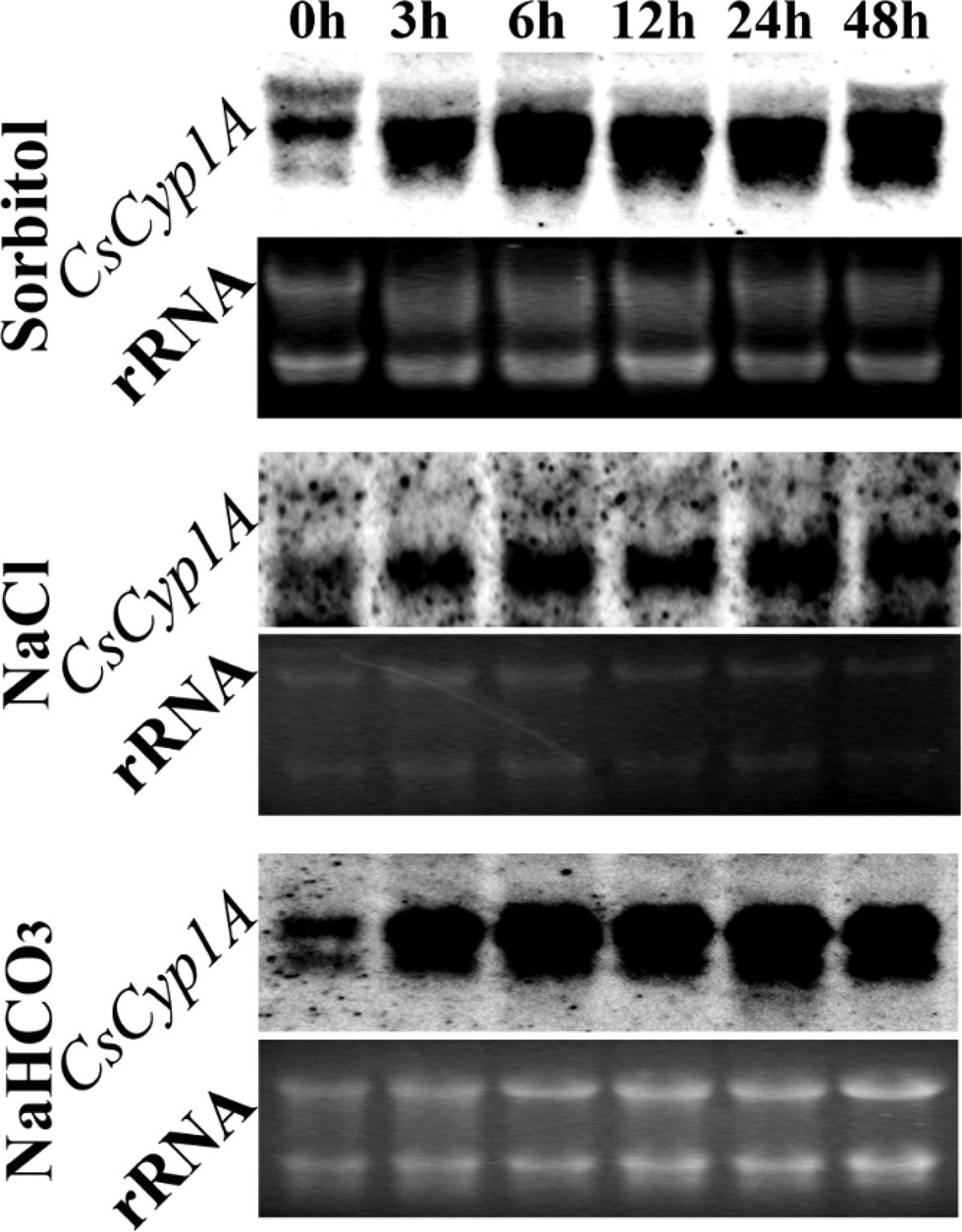
To study the relationship between the CsCYP1A gene in Chlorella and abiotic stress, Northern blot was utilized to analyse the expression of the CsCYP1A gene response to drought and saline–alkali stress. The results showed that the expression level of CsCYP1A under the conditions of drought (sorbitol), salt (NaCl) and alkali (NaHCO3) stress was significantly higher than that of the control group (Fig. 1). Under sorbitol stress, the expression level of CsCYP1A remained high, reaching the highest level at 6 h and maintaining the same high level of expression after 12 h. Under NaCl stress, the expression of CsCYP1A was increased with prolonged processing time and reached the maximum expression at 24 h. Under NaHCO3 stress, the expression of CsCYP1A peaked after 6 h, remaining relatively high with the extension of time. Thus, the results indicated that the expression of CsCYP1A was stable in response to drought (sorbitol), salt (NaCl) and alkali (NaHCO3).
Transcriptional expression analysis of the CsCYP1A gene response to drought (sorbitol), salt (NaCl) and alkali (NaHCO3) stress. Chlorella sp. X1 cells were treated with 400 mm sorbitol, 200 mm NaCl and 100 mm NaHCO3 stress.

Detection of transgenic lines from rice callus infected by A. tumefaciens
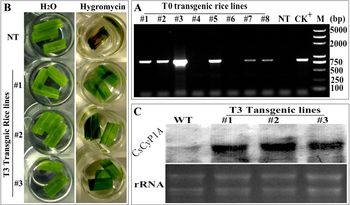
To obtain transgenic CsCYP1A overexpressed rice, the full-length DNA sequence of the ORF was cloned by PCR with the specific primer unCsCYP1A F/R and ligated with the pCXUN vector and digested by XcmI. The pCXUN-CsCYP1A plant expression vector was constructed and transformed into A. tumefaciens EHA105 by electroporation. The callus induced by the rice embryos was infected with suspended A. tumefaciens solution. The bands of the Hyg gene in the T0 generation lines (T0-#1, #2, #3, #5, #7 and #8) were detected by PCR, indicating that the genes had been integrated into their genomic DNA (Fig. 2). The leaves of the NT and T3 transgenic lines (T3-#1, #2 and #3) differed significantly when soaked in Hyg solution. NT was damaged significantly by Hyg and became withered, whereas the transgenic lines were not impaired by Hyg, and the screening markers of the transgenic lines were clear. Furthermore, hybridization signals were detected in the transgenic lines (T3-#1, #2 and #3) by Northern blot, whereas NT had a slightly weaker hybridization signal and a weaker expression signal than the transgenic lines. This might be due to the expression of the CYP gene in rice, indicating the integration of genes into the genomic DNA and the stable inheritance of integrated transgenes in the transgenic lines. Based on these results, three independent overexpression lines were identified. The T3 generation plants overexpressing CsCYP1A were analysed by Northern blot. The results showed that all three transgenic rice lines (T3-#1, #2 and #3) had an obvious hybrid band signal, while NT had a slight weak hybrid signal, which may also be related to the expression of the CYP gene in the L11 rice itself, which was very weak in comparison with that of the transgenic lines. It was thus confirmed that the T3 generation lines (T3-#1, #2 and #3) were overexpressed and could be used to analyse stress tolerance.
(Colour online) Detection and analysis of transgenic rice. (A) PCR detection of T0 transgenic rice lines, #1–8 are transgenic lines, CK+ is a positive control, NT is a non-transgenic L11 control. (B) Leaf phenotypes of CsCYP1A overexpressed lines (T3-#1, #2 and #3) and control lines to 50 mg/l Hyg stress. (C) Northern blot signal of the overexpressed lines (T3-#1, #2 and #3) and control lines.

Overexpression of the CsCYP1A gene enhances rice resistance to NaCl stress
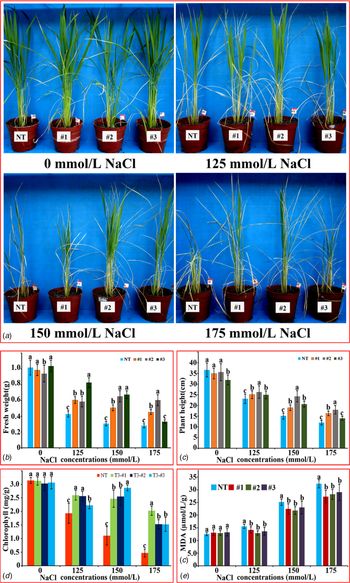
The NT and CsCYP1A overexpression lines showed different tolerances to different concentrations of 1/8 MS culture medium containing solution (0, 125, 150 and 175 mmol/l NaCl) at the five-leaf stage, and the leaf growth phenotype changed significantly after 14 days (Fig. 3). The seedlings in only 1/8 MS culture medium solution (0 mmol/l NaCl) grew vigorously, and the leaves became curled subject to 125 mmol/l NaCl treatment. There was no apparent difference between the NT and CsCYP1A overexpression lines in terms of the phenotype. However, for 150 and 175 mmol/l NaCl treatment, the death rate of the NT seedlings was significantly higher than that of the overexpression CsCYP1A lines, and the plant height also differed. The fresh weight and chlorophyll content of the NT shoots were significantly lower than those of the overexpression CsCYP1A lines. In contrast, the content of MDA in the leaves of the NT seedlings was higher than that of the overexpressed CsCYP1A lines.
(Colour online) Characteristics of CsCYP1A overexpressed rice seedlings against NaCl stress. (A) Growth phenotypes of T3 lines (#1, #2 and #3) and NT at the five-leaf stage to 0, 125, 150 and 175 mm NaCl stress for 14 days; and (B, C, D and E) are fresh weight, plant height, chlorophyll content and MDA content of the upper part of the stressed plants.

Overexpression of the CsCYP1A gene enhances rice resistance to NaHCO3 stress
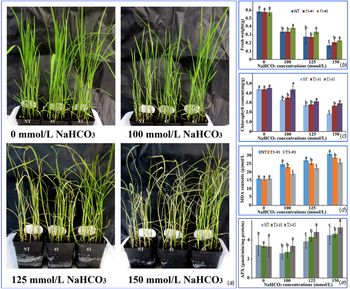
The 1/8 MS culture medium containing solution (0, 100, 125 and 150 mmol/l NaHCO3) was utilized to treat the CsCYP1A overexpressed lines of T3-#1, #2 and #3 and the NT seedlings at the five-leaf stage. For the high concentration treatment, the leaves of the NT seedlings showed dehydration injury symptoms after 7 days, whereas the CsCYP1A overexpressed lines showed greater resistance (Fig. 4). The seedlings grew vigorously in only 1/8 MS culture medium solution (0 mmol/l NaHCO3), whereas the seedlings grown to 100 mmol/l NaHCO3 stress grew slowly and the leaves were slightly yellow. Under treatment with 125 mmol/l NaHCO3, the yellowing was severe, and the leaf damage of the CsCYP1A overexpressed lines was lower than that of NT. Under the 150 mmol/l NaHCO3 treatment, the leaf damage was more severe, with the NT leaves showing significant whitening, while the CsCYP1A overexpressed lines remained green. Although the fresh weight decreased with increased treatment, the biomass of the CsCYP1A overexpressed lines was greater than that of NT, and the content of chlorophyll detected was significantly higher than that of NT. As expected, the MDA content was significantly higher in the NT plants, while the activity of APX was increased in the CsCYP1A overexpressed lines. Thus, the CsCYP1A overexpressed lines revealed increased resistance to the high pH induced by NaHCO3. The overexpression of CsCYP1A may have possibly increased the capability to eliminate ROS damage.
(Colour online) Growth characteristics of CsCYP1A overexpressed rice response to NaHCO3 stress. (A) Growth phenotype of CsCYP1A transgenic rice lines (T3-#1 and #3) and NT to 0, 100, 125 and 150 mm NaHCO3 stress; (B) fresh weight; (C) chlorophyll content; (D) MDA content and (E) detection and analysis of APX activity.

Discussion
As a polygenic family, plant CYP not only possesses cis/trans isomerase activity, but also has many different structures, functions, and localizations. cDNAs encoding CYP protein have been isolated from tomato, maize and rape and have been expressed in E. coli, and CYP genes have subsequently been found in Arabidopsis and rice. Among these, 31 CYP genes have been found in Arabidopsis, 17 of which have been analysed, while 29 CYP genes have been detected in rice, but only seven genes have been reported (Lu et al., Reference Lu, Lu, Fan, Zhu, Li, Zhao, Feng, Zhao, Guo, Li, Huang and Han2010). Chlorella JB6, which grows on the soda saline–alkali land in the Songnen Plain, has been confirmed to be resistant to carbonate and alkali (Qiao et al., Reference Qiao, Takano and Liu2015). The expression and mRNA accumulation of plant CYPs can be induced in response to various biological and abiotic stresses, indicating that they play important roles in the evolutionary process of the adaptation of plants to the environment (Wang and Tan, Reference Wang and Tan2008; Mainali et al., Reference Mainali, Chapman and Dhaubhadel2014). In this study, a Northern blot assay was utilized to detect the expression level of the CsCYP1A gene. This gene was upregulated significantly to drought, NaCl and NaHCO3 stress, indicating that it may be involved in the growth and metabolism of carbonate-resistant Chlorella. To further study the relationship between the CsCYP1A gene and stress, the CsCYP1A gene was cloned into the plant expression vector pCXUN driven by the ubiquitin promoter and transformed into A. tumefaciens mediated by rice callus. Through Hyg screening, Northern blot analysis showed that the T3-#1, #2 and #3 lines were transgenic CsCYP1A overexpression lines. OsCYP19-4 regulates the activity of protein phosphatase and significantly enhances plant tolerance to low temperature, playing an important role in auxin conduction and cold resistance by interacting with AtRCN1 (Lee et al., Reference Lee, Lee, Won, Park, Lim, Kim, Ahn and Cho2016). However, the CsCYP1A overexpression lines differ from the OsCYP19-4 overexpression lines, and the CsCYP1A gene can enhance resistance to NaCl and NaHCO3 in rice. Under different concentrations of NaCl and NaHCO3, the plant height, fresh weight and chlorophyll content were higher than those of the NT lines. The increase in the content of oxidoreductase in plants helps scavenge ROS to prevent oxidative damage (Suzuki et al., Reference Suzuki, Koussevitzky, Mittler and Miller2012).
Under high NaCl stress, the activity of oxidase was increased and lipid peroxidation was decreased, while the chlorophyll content was higher than that of the wild type in the OsCYP2 overexpression plants. The main reason for the decrease in chlorophyll content in the stress process was due to the increase in the content of active oxygen and hydrogen peroxide, which damages the functioning of the chlorophyll protein complex (Jiang et al., Reference Jiang, Yang, Jiang and Chen1994). Under NaCl and NaHCO3 stresses, the MDA content of the CsCYP1A overexpression lines was lower than that of NT. Adversity stimulation can affect the intracellular ROS level and can be utilized as a signal to influence other signalling pathways in the stress response. This is considered to be at the core of the plant stress response network (Baxter et al., Reference Baxter, Mittler and Suzuki2014). The CsCYP1A gene of Chlorella may be utilized to regulate the activity of ROS to reduce the damage induced by saline–alkali stress. The current study provides an experimental basis for the mechanisms by which CsCYP involved in the growth of algae to stress, providing a foundation for salt–alkaline resistance in rice breeding and offering genetic resources for the utilization of soda saline–alkali land in the Songnen Plain.
Acknowledgements
We acknowledge LetPub (www.letpub.com) for its linguistic assistance during the preparation of this manuscript.
Financial support
Financial support was provided by The Natural Science Foundation of Heilongjiang Province of China (C2017009); the National Key Research and Development Program of China (2016YFC0501203); the Fundamental Research Funds for the Central Universities (2572016EAJ6) and Heilongjiang Postdoctoral Scientific Research Developmental Fund (LBH-Q15004).
Conflict of interest
None.
Ethical standards
Not applicable.