Introduction
The ability to codeswitch, or draw on lexical items and phrases from multiple languages, has been termed the “defining behavior” of bilinguals (Green & Wei, Reference Green and Wei2014, p. 499) and is a locus of research in both psycholinguistics and sociolinguistics. Both fields have established that environment and topic may influence bilinguals’ language choice. Additionally, Blom and Gumperz (Reference Blom, Gumperz, Gumperz and Hymes1972) introduce the distinction between situational codeswitching, when language choice is determined by the rights and obligations of the social situation, and metaphorical codeswitching, in social situations where language choice is not constrained and speakers may codeswitch depending on the topic of the conversation. In psycholinguistics, research shows that bilinguals’ languages are always at least partially activated, which facilitates switching between them but also makes it remarkable that errors are rare. The Adaptive Control Hypothesis (Green & Abutalebi, Reference Green and Abutalebi2013) proposes that bilinguals develop language control to manage their languages and that the qualities of a bilingual environment determine demands on control.
Sociolinguistic research tends to focus on metaphorical codeswitching, with the goal of determining linguistic constraints and social motivations of codeswitching. Structural theories of codeswitching are varied and debated; however, it is generally accepted that codeswitching entails the insertion of lone lexical items or multi-word phrases from a second language into otherwise monolingual speech. Research shows that bilinguals use codeswitching as a performative discourse strategy that can mark and shape bicultural identity (Poplack, Reference Poplack1980). Yet at the same time codeswitching, particularly among US Latinos, has carried a social stigma with the perception that the practice is indicative of language loss or deficiency (Toribio, Reference Toribio2002). These attitudes are perpetuated by the conflation of codeswitching with the term “Spanglish” which has been poorly defined in the Urban Dictionary as “not quite English, not quite Spanish” and described by Spanish professor Roberto González as a variety spoken by “poor Hispanics, many barely literate in either language” (as quoted in Zentella, Reference Zentella, Guzzardo Tamargo, Mazak and Parafita Couto2016). Low prestige may preclude speakers from codeswitching in some communities; however, in others, codeswitching is indicative of belonging to a higher social class (Pérez Casas, Reference Pérez Casas, Guzzardo Tamargo, Mazak and Parafita Couto2016). Clearly then, codeswitching is neither homogeneous nor categorical but rather highly contextual, indexing different degrees of bilingualism and bilingual environments.
We follow Gullberg, Indefrey and Muysken's (Reference Gullberg, Indefrey, Muysken, Bullock and Toribio2009) distinction between codeswitching and language switching: codeswitching refers specifically to “internally generated… switches produced spontaneously by a multilingual speaker” (p. 21) whereas language switching refers to switches that are externally generated, by an experimental task, for the purposes of measuring phenomena such as switching costs. While the latter is very much a psycholinguistic research interest, it is not entirely disconnected from the former, since language switching tasks aim to tap the same mechanisms that are used in more naturalistic contexts (that is, in codeswitching). Nevertheless, the distinction between codeswitching and language switching is essential for understanding the various methodologies – and, thus, results – from research in this area. In the current work, we focus on codeswitching, albeit codeswitching that is produced in a laboratory task (autobiographical memory narratives).
Self-reported codeswitching
To create a psychometric measure of self-reported codeswitching, Rodriguez-Fornells, Krämer, Lorenzo-Seva, Festman and Münte (Reference Rodriguez-Fornells, Krämer, Lorenzo-Seva, Festman and Münte2012) designed and validated a questionnaire, the Bilingual Switching Questionnaire (BSWQ), that targets four aspects of codeswitching behaviors in Catalonia, Spain: (1) switches to L1, (2) switches to L2, (3) contextual switches (i.e., switching due to a change in topic or environment), and (4) unintended switches. Importantly, the questions that comprise both (1) and (2) focus on switching at the word-level; for example, Q4: “When I cannot recall a word in Catalan, I tend to immediately produce it in Spanish”. 582 Spanish/Catalan participants completed the BSWQ and a language background questionnaire that included questions on age of onset, self-reported proficiency, and self-reported frequency of use of each language. They also completed executive function tests. An exploratory factor analysis confirmed that the questionnaire items loaded onto four factors that represented the four codeswitching behaviors, as expected. In addition, individuals with an earlier L1 age of onset, greater self-reported L1 proficiency, and more frequent use of L1 in daily life tended to report more frequent switches to L1 and less frequent switches to L2. The same pattern held for earlier L2 ages of onset, self-reported proficiency, and frequency of use, and switches to L2. However, the total switching score and the contextual switching score did not significantly correlate with any language background measure. The unintended switching score was negatively correlated with L1 proficiency, indicating a tendency for lower-L1 proficiency individuals to report higher frequency of unintended switches. As for executive function, they found that better performance on those tasks was associated with higher frequency of L2 switching, but generally not L1 switching. However, these relationships were only found for tasks that used linguistic stimuli (Stroop and verbal fluency, not the flanker task). In addition, higher scores on unintended switching were associated with poorer performance on the stop-signal task and the verbal fluency task. These relationships generally did not change when bilinguals were separated into different groups according to language dominance. Overall, this study demonstrated the internal validity of the BSWQ and its external validity when compared to other language-experience and non-linguistic factors.
In a study whose broader aim was to investigate the relationships between comprehension and production in the L1 and L2 (Litcofsky, Tanner & van Hell, Reference Litcofsky, Tanner and van Hell2016), Spanish–English bilingual students in the US completed objective language tests (picture-naming and lexical decision) in both languages, non-linguistic cognitive measures (working memory capacity, executive function), and self-reported their language experience and codeswitching practices. Codeswitching practices were measured via Rodriguez-Fornells et al.’s (Reference Rodriguez-Fornells, Krämer, Lorenzo-Seva, Festman and Münte2012) BSWQ. Results most relevant for the current work include that none of the scores on BSWQ subscales (L1 Switch, L2 Switch, Contextual Switch, Unintended Switch) correlated with any of the language tests. However, higher L1 Switch scores were associated with less frequent L2 use and later L2 age of onset. Similarly, higher L2 Switch scores were associated with more frequent L2 use. Lastly, higher scores for Unintended Switches were associated with greater working memory capacity, but no BSWQ scores were associated with executive function performance. Additionally, scores for Contextual Switches were not correlated with any language-experience factor or cognitive measure. The authors did not include a total BSWQ score in their analyses. In sum, this study found that self-reported codeswitching practices were related to language use factors (frequency of use and age of onset), not language skill factors (test scores). Importantly for the current work, though, the language tests were only lexical (production and comprehension), not grammatical.
Valdés Kroff and Fernández-Duque's (Reference Valdés Kroff, Fernández-Duque, Bellamy, Child, González, Muntendam and Parafita Couto2017) study on experimentally induced Spanish–English codeswitching in the US also measured participant self-reported codeswitching via a language history questionnaire. Results of the questionnaire showed that participants rated themselves significantly higher on frequency of codeswitching than exposure to codeswitching by others. The authors hypothesize that this disparity is due to the social stigma of Spanish–English codeswitching in the US, or, it could be that the participants do not belong to a codeswitching speech community. Using a referential communication task involving the co-creation of maps, experimenters were instructed to codeswitch as “naturally and frequently as possible” (p. 220) while maintaining a balance between the amount of Spanish and English used in the completion of the task. A positive correlation was found between the amount of English participants used in tasks and participants’ self-reported use of codeswitching. This suggests that self-report may be an accurate measure of codeswitching, at least in the direction of English insertions into otherwise Spanish speech in the US.
To reach large numbers of multilinguals around the world, Dewaele and Wei (Reference Dewaele and Wei2014a, Reference Dewaele and Wei2014b) have used internet-based questionnaires to measure relationships between self-reported rates of codeswitching, attitudes toward codeswitching, sociobiographical factors, and personality. They report higher self-reported rate of codeswitching for individuals who had multilingual childhoods and work environments, earlier age of L2 onset, advanced proficiency in multiple languages, and who were women. In addition, higher scores for extraversion and cognitive empathy were also related to higher self-reported rates of codeswitching. Their methods suited their purpose of studying trends in multilingual codeswitching that supersede constraints of specific bilingual environments, but it remains important to also conduct slightly smaller studies, in person, situated within a national and/or local context. Additionally, across studies and geographical regions, there remains a need to compare self-reported codeswitching practices with codeswitching in oral production.
Codeswitching and proficiency
The link between codeswitching and proficiency has long been established (Poplack, Reference Poplack1980; Silva-Corvalán, Reference Silva-Corvalán and Elías-Olivares1983), yet the way in which proficiency influences codeswitching is still an emerging area of study. First, proficiency may affect the structure of codeswitches (Muysken, Reference Muysken2000; Poplack, Reference Poplack1980). In particular, Muysken (Reference Muysken2000) argues for three types of codeswitching patterns: insertion, alternation, and congruent lexicalization, and notes that bilinguals with higher proficiency tend to produce alternational patterns, and speakers with lower proficiency tend to produce insertional patterns. This has been tested across several language pairs, including Tsou–Mandarin Chinese, Taiwanese–Mandarin Chinese, and Welsh–English and Spanish–English (Deuchar, Muysken & Wang, Reference Deuchar, Muysken and Wang2007; Lipski, Reference Lipski2009, Reference Lipski2014). Furthermore, in his study of low-fluency Spanish–English bilinguals, Lipski (Reference Lipski2014) posits that low-fluency bilinguals also exhibit a ‘ragged’ type of codeswitching akin to congruent lexicalization where switches do not necessarily conform to constituent boundaries and could be involuntary.
Second, and particularly relevant to the current study, proficiency may affect the frequency of codeswitching. Torres and Potowski (Reference Torres, Potowski, Tamargo, Mazak and Couto2016) studied codeswitching in the MexiRican community of Chicago and examined how Spanish proficiency impacts codeswitching into English in semi-structured sociolinguistic-style interviews. Overall, they found an inverse relationship between Spanish proficiency and amount of English used in interviews; that is, as Spanish proficiency decreases, percentage of English words increases. Additionally, their results show that region of origin may also influence English insertions. The mean proficiency scores for first-generation Mexican and Puerto Rican participants were identical; however, Puerto Ricans produced ten times the amount of English speech as Mexicans.
Valdés Kroff and Fernández-Duque (Reference Valdés Kroff, Fernández-Duque, Bellamy, Child, González, Muntendam and Parafita Couto2017) also examined the link between proficiency and frequency of codeswitching, but, as aforementioned, in their study codeswitching was experimentally induced through a referential communication task. Proficiency in both Spanish and English was measured via vocabulary and grammar tests, and results showed a positive correlation between the amount of English used in tasks and a participant's English vocabulary proficiency, suggesting that “fluency in English affects a bilingual's propensity to switch into English” (p. 225). The current study seeks to complement the aforementioned findings by examining how proficiency in both Spanish and English affect uninduced codeswitching in semi-structured sociolinguistic-style interviews.
Codeswitching and executive function
Since managing two languages entails cognitive demands, researchers have proposed that practice in doing so may affect one's overall ability to manage attention and respond to complex stimuli – that is, domain-general executive function (see Bialystok, Reference Bialystok2017, for a review). The most concentrated practice in managing languages would occur when relatively frequent switches happen within a relatively short period of time, as in some codeswitching situations. At the same time, it is also likely that different types of codeswitching require different management and therefore have distinct effects on executive function. Green and Wei (Reference Green and Wei2016) suggest that when a switch is made due to contextual factors, one language schema is selected while the other is deselected, therefore not requiring large cognitive effort to make the switch. They term this competitive control. In contrast, in cooperative control, the two language schemas can both be selected. Cooperative control is further divided into coupled control and open control. In the former, selection passes from one schema to another relatively quickly, allowing for intrasentential codeswitches. In the latter, both language schemas are simultaneously activated, so that items from either one can equally easily enter planning, yielding dense intrasentential codeswitching. While coupled control would implicate demands on domain-general executive function, open control would not. Although the distinction between coupled and open control is mostly a psycholinguistic one (whether the two grammars compete or work in harmony), it may be that coupled control is operating in situations where there is clearly a matrix language, such as with insertion and alternation, whereas open control facilitates denser codeswitching. Thus, either coupled control or open control could be at work in metaphorical codeswitching, but only practice with coupled control would potentially yield enhanced executive function.
However, results of studies that attempt to link codeswitching with enhanced executive function to date have been conflicting: on one hand, some studies have found evidence that more frequent codeswitching is associated with increased executive function in young adults (e.g., Hofweber, Marinis & Treffers-Daller, Reference Hofweber, Marinis and Treffers-Daller2016; Verreyt, Woumans, Vandelanotte, Szmalec & Duyck, Reference Verreyt, Woumans, Vandelanotte, Szmalec and Duyck2016), while others have found mixed results or no evidence of such a relationship (e.g., Jylkkä, Soveri, Wahlström, Lehtonen, Rodriguez-Fornells & Laine, Reference Jylkkä, Soveri, Wahlström, Lehtonen, Rodriguez-Fornells and Laine2017; Keijzer & Schmid, Reference Keijzer and Schmid2016; Soveri, Rodriguez-Fornells & Laine, Reference Soveri, Rodriguez-Fornells and Laine2011). Moreover, Jylkkä et al. (Reference Jylkkä, Soveri, Wahlström, Lehtonen, Rodriguez-Fornells and Laine2017) found that certain types of codeswitching were related to poorer executive function for older adults.
Importantly for the current work, Soveri et al. (Reference Soveri, Rodriguez-Fornells and Laine2011) and Jylkkä et al. (Reference Jylkkä, Soveri, Wahlström, Lehtonen, Rodriguez-Fornells and Laine2017) used a version of Rodriguez-Fornells et al.’s (Reference Rodriguez-Fornells, Krämer, Lorenzo-Seva, Festman and Münte2012) Bilingual Switching Questionnaire (BSWQ) as their measure of codeswitching practices. In the first study, Soveri et al. tested multiple subcomponents of executive function in Finnish–Swedish bilingual adults (age 30–75, all early simultaneous bilinguals) in relation to various language-experience factors, such as age of onset and frequency of use, in addition to self-reported codeswitching practices. They found that bilinguals who reported more frequent codeswitching (focusing on single-word insertions, due to the phrasing of the BSWQ) also had lower mixing costs, a top-down component of executive function. However, when Jylkkä et al. (Reference Jylkkä, Soveri, Wahlström, Lehtonen, Rodriguez-Fornells and Laine2017) replicated this study with a similar population, they did not find the same relationship between codeswitching and executive function. Instead, in their older adult group, higher scores on the Contextual Switches subscale of the BSWQ were associated with a greater switching cost (i.e., poorer executive function) and higher scores on the Unintended Switches subscale were associated with greater error rates in an n-back task. The authors conclude that the test-retest reliability of the task used to measure switching and mixing costs may be inadequate, leading to such disparate results within the same population.
While the two previous studies investigated codeswitching and executive function in early simultaneous bilinguals, Hofweber et al.’s (Reference Hofweber, Marinis and Treffers-Daller2016) study is also relevant for the current work due to its focus on immigrant bilinguals (1st-generation German speakers in the UK) and heritage bilinguals (5th-generation German speakers in South Africa). Participants completed a frequency judgment task of codeswitched utterances, in which they stated how frequently they heard similar utterances when conversing with a German–English bilingual friend. They also completed a flanker task as a measure of executive function. The authors found that bilinguals who were more likely to accept dense codeswitching (who tended to be the heritage bilinguals) also exhibited better executive function in the most challenging conditions of the flanker task. In contrast, though, Keijzer and Schmid (Reference Keijzer and Schmid2016) also investigated codeswitching and executive function in immigrant bilinguals (Dutch speakers in Australia), all older adults. Unlike most studies of bilingual executive function, they included an oral task: namely, a semi-structured sociolinguistic interview. From that task, the researchers calculated the rate of codeswitches from Dutch to English. However, correlations between this codeswitching index and executive function tasks (Simon task and Stroop task in Dutch) were not significant, seeming to contradict Hofweber et al.’s findings.
In sum, these studies differ in their bilingual contexts, ranging from immigrants and heritage speakers (Hofweber et al., Reference Hofweber, Marinis and Treffers-Daller2016; Keijzer & Schmid, Reference Keijzer and Schmid2016) to naturalistic bilinguals (Soveri et al., Reference Soveri, Rodriguez-Fornells and Laine2011; Jylkkä et al., Reference Jylkkä, Soveri, Wahlström, Lehtonen, Rodriguez-Fornells and Laine2017). It is highly likely that not only the societal status and prestige of L2 and bilingualism varied from context to context, but also the language background of participants (age of onset, relative proficiency in each language, relative use of each language) varied as a result of the different contexts, thus hindering generalization across studies. Notably for the present study, there is also little consistency across studies in how codeswitching practices are operationalized. Most studies used some form of self-report, whether that report was a questionnaire (BSWQ) or just one question. Hofweber et al.’s frequency judgment task is also a type of self-report, since it depends on participants’ accurate recall and reporting of the bilingual practices of their speech community. Although the BSWQ begins with a brief informative text that stresses that codeswitching is a normal part of many bilingual environments, that may not be sufficient to counter negative perceptions of the practice, depending on how ingrained such attitudes are in an individual or society. The same attitudes may also influence ratings on Hofweber et al.’s task, although the authors avoided the word “judgment” in their task, to minimize potential attitudinal effects. In sum, it remains unclear whether relationships between self-reported codeswitching and executive function are accurate indices of relationships between actual oral production of codeswitching and executive function.
Current study
While sociolinguists generally interview participants and record oral data for analysis, psycholinguists may be more limited in time if codeswitching habits are merely one predictor in a larger study on a topic such as bilingualism and executive function. As previously mentioned, to offer a laboratory measure of codeswitching practices, Rodriguez-Fornells et al. (Reference Rodriguez-Fornells, Krämer, Lorenzo-Seva, Festman and Münte2012) developed the BSWQ as a self-report measure and evaluated its reliability and validity with Spanish–Catalan bilinguals. That questionnaire has now also been used by other researchers (Jyllkkä et al., Reference Jylkkä, Soveri, Wahlström, Lehtonen, Rodriguez-Fornells and Laine2017, Litcofsky et al., Reference Litcofsky, Tanner and van Hell2016; Soveri et al., Reference Soveri, Rodriguez-Fornells and Laine2011). However, in all cases, analyses of the BSWQ have been limited to comparisons to other cognitive measures and have not included actual production of codeswitching, even though negative associations of codeswitching can lead to its under-reporting (Toribio, Reference Toribio2002). Here, we extend the population tested to Spanish–English bilinguals in the US, a minority-language context rather than an officially multilingual one as in the case of Spanish and Catalan in Spain. Crucially, we compare participants’ self-reported codeswitching practices to their actual codeswitches in oral production of narratives. Due to the phrasing of the L1 and L2 Switch subscales of the questionnaire, which targets word-level switches, we focus specifically on one-word insertions as well as overall amount of codeswitching in the narratives. Specifically, we asked the following research questions:
1. What is the relationship between self-reported codeswitching practices and internally generated codeswitching in an oral production task?
2. How do language proficiency and non-linguistic executive function relate to self-reported codeswitching practices and orally produced codeswitching?
For the first research question, we did not form a directional hypothesis. On one hand, negative language ideologies of “Spanglish” and codeswitching in the United States (Zentella, Reference Zentella, Guzzardo Tamargo, Mazak and Parafita Couto2016) might lead participants to under-report their own codeswitching. On the other hand, the only study that we are aware of that has directly compared self-reported and orally produced codeswitches (Valdés Kroff & Fernández-Duque, Reference Valdés Kroff, Fernández-Duque, Bellamy, Child, González, Muntendam and Parafita Couto2017), did find a positive relationship between the two. For proficiency, it has been established that codeswitching is not a result of deficiency in either language (Poplack, Reference Poplack1980; Silva-Corvalán, Reference Silva-Corvalán and Elías-Olivares1983), so we did not expect to find a negative correlation between proficiency and frequency of codeswitches, where lower proficiency would lead to an increase in codeswitching. We did not form a directional hypothesis regarding a relationship between proficiency and self-reported codeswitching, since that would depend on the participant's perception of their own habits.
Finally, for executive function, we expected to find a positive relationship between self-reported codeswitching and executive function, based on Hofweber et al.’s (Reference Hofweber, Marinis and Treffers-Daller2016) results with heritage German speakers, a similar population to ours. At the same time, Keijzer and Schmid's (Reference Keijzer and Schmid2016) study of older Dutch speakers in Australia, also a population similar to ours, found no relationship between internally generated, orally produced codeswitching with executive function, hindering formation of a directional hypothesis for that part of our research question.
Method
Participants
Seventy-nine participants (56 women) completed the Spanish session of the study (see “Procedure” below for more information on the two sessions). All were bilinguals who spoke Spanish as a native or heritage language and also spoke English, recruited from the college (n = 16) or nearby communities in southeastern Pennsylvania (n = 63). Thirty-eight participants reported ethnolinguistic origins from the Caribbean (Cuba, Dominican Republic, Puerto Rico), 21 from South America (Argentina, Colombia, Ecuador, Peru, Venezuela, Uruguay) and 19 from Central America (Costa Rica, Honduras, Mexico). Participants ranged in age (14–66 years, M = 35.14, SD = 15.05), years of education (10–24, M = 15.92, SD = 3.07)Footnote 1 and L2 age of onset (1–40 years, M = 9.59, SD = 7.51). Forty-seven participants self-reported Spanish as their dominant language and 32 participants reported English as their dominant language. Participants also varied in their frequency of use of each language, reporting a mean 42.6% use of Spanish daily (range 1–100%, SD = 22.20) and a mean 56.8% use of English daily (range 0–99%, SD = 22.0). One participant did not complete the BSWQ and one marked two responses on item #4 of the BSWQ; we calculated scores of Switch to English, Contextual Switches, and Unintended Switches for the latter participant but not Switch to Spanish or BSWQ Total. A further four participants were missing English grammaticality judgement test (GJT) scores due to technical error (n = 3) or attrition (n = 1). Twelve participants were missing Attentional Network Task (ANT) scores due to accuracy rates below 50%, suggesting that they had not understood instructions.
Materials
Bilingual Switching Questionnaire (BSWQ, Rodriguez-Fornells et al., Reference Rodriguez-Fornells, Krämer, Lorenzo-Seva, Festman and Münte2012)
As in the original version used in Catalonia, this questionnaire began with a brief paragraph that presented codeswitching and mixing as natural bilingual phenomena. Participants then completed 12 questions to report their use of codeswitching; for each item, they picked a frequency on a 5-point scale from “never” to “always”. Participants completed the BSWQ in their preferred language (Spanish or English).
Autobiographical memory task
The oral production of codeswitching comes from this task. While the primary purpose of this task was to provide data on bilingual autobiographical memory, we also planned to analyze oral bilingual phenomena, such as codeswitching, through this task. Via Paradigm stimulus presentation software, participants saw one of two possible sequences of cue words, presented in three blocks of six words each (i.e., eighteen cue words per sequence; order was randomized within blocks). For each word, they thought of a memory of a specific event that had happened in their life and narrated it to a bilingual researcher (the first or third author) while being audio recorded. They had unlimited time both for retrieving a memory and for retelling it. After narrating each memory, the participant stated whether the event originally occurred in English or Spanish or both. The researcher spoke primarily in the target language and offered emotional reactions to the narratives (e.g., ¡Qué chévere! “How cool!”), prompted for additional detail if the narrative was very limited in scope, and clarified the cue word when necessary. In the latter case, the researcher occasionally switched to English to translate the word. In this way, the data collection procedure addressed issues that have been raised regarding studying codeswitching in a laboratory context (Valdés Kroff & Fernández-Duque, Reference Valdés Kroff, Fernández-Duque, Bellamy, Child, González, Muntendam and Parafita Couto2017). Namely, the autobiographical memory task provides a discourse context, researchers provide an interactional exchange of information, and the task is conducted orally.
Although it is not a common codeswitching task, this task is similar to a traditional sociolinguistic interview in that participants tell stories from their own lives that are not directly related to language or bilingualism. As such, it falls in the category of “free speech in ‘code-switch mode’” tasks in which participants “speak freely over a given topic” (Gullberg, Indefrey & Muysken, Reference Gullberg, Indefrey, Muysken, Bullock and Toribio2009, p. 34). In our case, we did not specifically direct participants to codeswitch because we did not know if they were all regular codeswitchers in everyday conversations; nevertheless, the task provided a context in which participants might engage in codeswitching if it was customary for them to do so. In this aspect as well, our task is similar to a sociolinguistic interview and contrasts with experimental approaches that aim to trigger specific types of codeswitching (as would be the case in confederate scripting), to measure participants’ ease of switching (e.g., by tracking eye movements or response times in a receptive task), or to elicit evaluations of codeswitching, as in an acceptability judgment task (see Gullberg et al., Reference Gullberg, Indefrey, Muysken, Bullock and Toribio2009, and van Hell, Fernandez, Kootstra, Litcofsky & Ting, Reference van Hell, Fernandez, Kootstra, Litcofsky and Ting2018, for more information on those types of codeswitching tasks).
This paper includes results from the Spanish autobiographical memory task only, in which instructions and cue words were given in Spanish, to implicitly establish Spanish as the primary language of the conversation towards which the participant would converge.Footnote 2 Unlike many psycholinguistic studies on language switching, we did not mix languages within the cues because we wanted participants’ codeswitching to be naturalistic, not dictated by the task or induced by the interlocutor. Participants were not told to only speak in Spanish nor were they aware of any research interest in codeswitching. If a participant asked for clarification as to how to speak, the researcher reminded them that the cues would be in Spanish but added that they could speak however they preferred. One participant spoke entirely in English in response to the Spanish cue words and thus was excluded from present analyses, as their oral production was qualitatively distinct from that of other participants.
Grammaticality judgment tests (GJTs) in English and Spanish
To provide more objective measures of proficiency (instead of relying solely on self-reported proficiency), participants completed a grammaticality judgment test (GJT) in each language. In each GJT, participants heard a sentence while also seeing it written on the computer screen (presented via Paradigm software) and decided whether it sounded acceptable to them. We opted for bimodal presentation (aural and written) so that, on the one hand, the written form could lessen the memory load of a purely auditory test while, on the other hand, the aural form could aid heritage speakers who might be less accustomed to written Spanish. English stimuli (from Ellis, Reference Ellis2005) were recorded by a native English speaker from Florida and Spanish stimuli (from Bowles, Reference Bowles2011) were recorded by a Spanish–Cantonese–English trilingual from Colombia. We chose to use these stimuli because Ellis and Bowles had used them with similar populations (English learners and Spanish heritage speakers, respectively); however, unlike Ellis and Bowles, our research interest was not to specify whether participants’ language knowledge was explicit or implicit. For that reason, there was no time limit for responding. Each GJT included 68 sentences, presented in randomized order, half of which were grammatical and half were not.
Attentional Network Task (ANT)
This task measures executive function, hypothesized to be enhanced in bilinguals, possibly due to codeswitching practices (e.g., Bialystok, Reference Bialystok2017). Participants saw a row of arrows on the computer screen (also via Paradigm software) in which arrows were pointing in the same direction (congruent trials) or in opposing directions (incongruent trials). They pressed a key on the keyboard according to the direction the middle arrow was pointing and the computer recorded their reaction time. The ANT also included trials that measured the alerting and orienting attentional networks, but those are not analyzed here since they are less likely to be affected by bilingual experience or codeswitching practices.
Language Experience and Proficiency Questionnaire (LEAP-Q, Marian, Blumenfeld & Kaushanskaya, Reference Marian, Blumenfeld and Kaushanskaya2007)
This questionnaire supplemented the BSWQ in collecting additional background information from participants, including their current age, educational experience, age of onset of each language, and frequency of use of each language. Participants completed the LEAP-Q in their preferred language (English or Spanish).
Procedure
Participants completed two sessions on two different days, with the order of sessions counterbalanced across participants. In the Spanish session, participants completed the ANT, the Spanish GJT, the Spanish autobiographical memory task, the LEAP-Q and the BSWQ (in that order). In the English session, participants completed the English GJT and the English autobiographical memory task (not reported here), as well as other tasks outside of the scope of this report. Since both the LEAP-Q and BSWQ were administered at the end of the Spanish session, participants were not primed to be thinking about their language choice or codeswitching during the autobiographical memory task any more than any participant who knows they are taking part in a study on bilingualism. Moreover, since participants engaged in casual conversation with the bilingual researcher during the informed consent process and between tasks, we aimed for them to be somewhat comfortable with their interlocutor by the time they began the autobiographical memory task, despite not sharing an ethnolinguistic background.
Coding and analyses
Following Rodriguez-Fornells et al. (Reference Rodriguez-Fornells, Krämer, Lorenzo-Seva, Festman and Münte2012), each response on the BSWQ received a numerical score of 1–5 (item #7 was reverse-coded). Items were then summed to give scores for each of the subscales Switch to Spanish, Switch to English, Contextual Switches, and Unintended Switches, as well as a total score (BSWQ total). Thus, the minimum score on each subscale was 3 and the maximum was 15; similarly, the minimum total score was 12 and the maximum was 60. Narratives produced during the Spanish autobiographical memory task were transcribed and coded using NVivo software for different types of codeswitches into English: one-word intrasentential codeswitches, multi-word intrasentential codeswitches, intersentential codeswitches, and discourse markers. Since the BSWQ Switch to English subscale focuses on lexical retrieval and codeswitching at the word-level, we focus on one-word intrasentential codeswitches in the narratives, as well as the total amount of English produced by participants. To see if the BSWQ also corresponds to other types of codeswitching, we also include multi-word intrasentential switches and intersentential switches. Since participants spoke for varying amounts of time, thus differing in their opportunity to codeswitch, we calculated four ratios for analyses. First, the Narratives One-word Intrasentential Ratio is the number of English single-word insertions divided by the total number of words in either language. Second, the Narratives Overall Ratio is the total number of English words divided by the total number of words in either language. Similar to the One-word Ratio, the Narratives Multi-word Intrasentential Ratio is the number of words in English multi-word intrasentential switches divided by the total number of words in either language and the Narratives Intersentential Ratio is the number of words in English intersentential switches divided by the same.Footnote 3 Given that Spanish was the primary language of the task, these ratios aim to quantify the extent to which English is used by participants, whether it be lone word or multi-word insertions. Other authors have used similar measures: for example, Vickers and Goble (Reference Vickers and Goble2011) calculated the percentage of English words in Spanish-language medical consultations; Raichlan, Walters and Altman (Reference Raichlan, Walters and Altman2018) used a ratio of utterances that contained codeswitches out of the total number of utterances in Russian–Hebrew bilingual children's speech; and Torres and Potowski (Reference Torres, Potowski, Tamargo, Mazak and Couto2016) calculated the total number of English words compared to total number of words uttered in Spanish-language oral interviews. Since our goal was primarily to compare self-reported to actual codeswitching practices, our measures differ from other measures of codeswitching, such as burstiness (which would measure codeswitching density) and M-Index (which would classify a corpus as relatively monolingual or bilingual) (Guzman, Bullock & Toribio, Reference Guzman, Bullock, Toribio, Forcada, Liu, Du and Liu2017).
For both GJTs, correct responses received one point each and incorrect responses received zero points (maximum score on each GJT = 68). We then calculated d-prime (d’) scores to account for whether participants tended to accept or reject sentences (Macmillan & Creelman, Reference Macmillan and Cleerman2005; Wickens, Reference Wickens2001). Finally, for the ANT, reaction times (RTs) from incorrect responses were discarded. Since the distribution of RTs is skewed, the remaining RTs were log-transformed (Baayen, Reference Baayen2008) and trimmed to within 2.5 SDs of each individual's mean RT. The ANT congruency effect is the difference in RT to congruent versus incongruent trials; a lower score indicates better executive function. We focused on the congruency effect rather than the orienting and alerting attentional networks that the ANT also measures, since the congruency effect is what is most likely to vary with bilingualism (e.g., Bialystok, Reference Bialystok2017; Costa, Hernández & Sebastián-Gallés, Reference Costa, Hernández and Sebastián-Gallés2008). Additionally, the congruency effect is most similar to the non-linguistic executive function measure used by Rodriguez-Fornells et al. (Reference Rodriguez-Fornells, Krämer, Lorenzo-Seva, Festman and Münte2012) (the flanker test), thus facilitating comparison of results.
Descriptive and inferential statistics were conducted using R, version 3.4.2. Spearman's correlations with p-values were calculated using the rcorr function of the Hmisc package (Harrell & Dupont, Reference Harrell and Dupont2014), using pairwise complete observations and alpha = .050. As noted by an anonymous reviewer, switching from Spanish to English may serve a different purpose for English-dominant versus Spanish-dominant bilinguals. To investigate this in our data, we also analyzed the relationships of language and cognitive factors with codeswitching practices (BSWQ and Narratives Ratios) in English-dominant and Spanish-dominant bilinguals separately. In those correlations, we set alpha to .017Footnote 4 to account for multiple comparisons.
Results
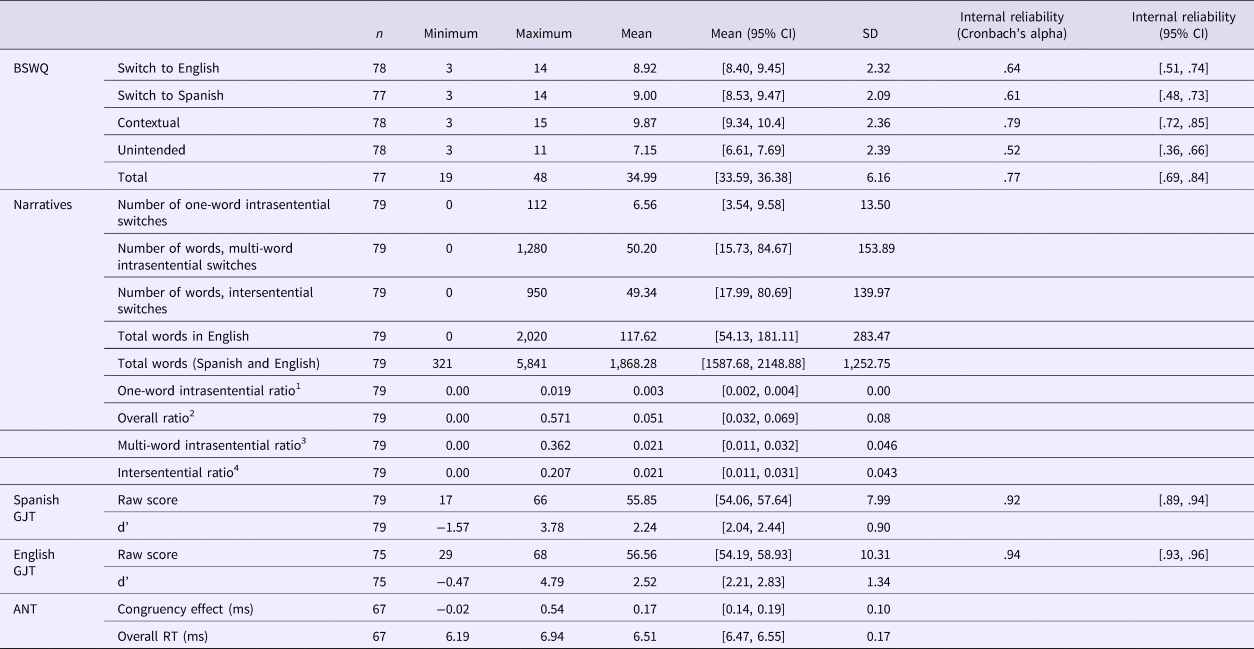
Table 1 summarizes descriptive statistics for codeswitching (self-reported on the BSWQ and orally produced during the narratives) and for the additional variables of proficiency (Spanish and English GJTs), additional language-experience factors, and executive function (ANT). The mean scores on the BSWQ, as well as internal reliabilities, are similar to those reported by Rodriguez-Fornells et al. (Reference Rodriguez-Fornells, Krämer, Lorenzo-Seva, Festman and Münte2012) in Catalonia, although the scores for the Switch to English subscale and Contextual Switches subscales are visually slightly higher in the current study. Additionally, the internal reliability for both GJTs was high.
Descriptive statistics of self-reported codeswitches (BSWQ), oral production of codeswitches (autobiographical narratives), proficiency (GJTs) and executive function (ANT).

Note. CI = confidence interval; BSWQ = Bilingual Switching Questionnaire, GJT = grammaticality judgment test, ANT = Attentional Network Task, ANT congruency effect = difference in RT to congruent versus incongruent trials, RT = reaction time. 1One-word intrasentential ratio was calculated by dividing the number of one-word intrasentential insertions by the total number of words spoken. 2Overall ratio was calculated by dividing the total number of English words by the total number of words spoken. 3Multi-word intrasentential ratio was calculated by dividing the number of words in multi-word intrasentential insertions by the total number of words spoken. 4Intersential ratio was calculated by dividing the number of words in intersentential switches by the total number of words spoken.
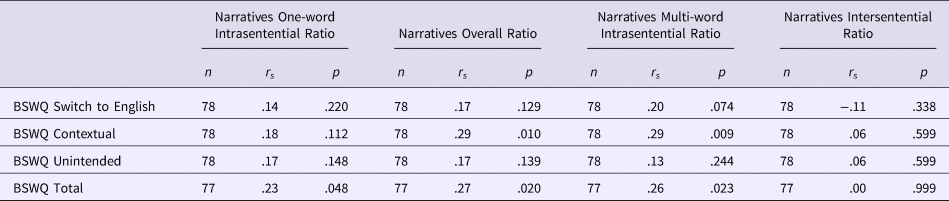
Visual inspection of scatterplots between variables of interest suggested possible curvilinear relationships, so we calculated correlations using Spearman's rank coefficient rather than Pearson's to allow for the possibility of non-linear relationships between variables. Table 2 reports the correlations between self-reported codeswitching (from the BSWQ) and codeswitching in the narratives. Correlations between the Switch to English subscale and both One-word and Overall Ratio scores were small and non-significant. However, the correlations between the BSWQ Total and the ratios from the narratives were small to medium in size and statistically significant (Overall Ratio) or approaching significant (One-word Ratio). In both cases, the correlation coefficients were positive, indicating that participants who reported more codeswitching also produced more codeswitches in narratives than those who reported less. Additionally, we found a medium-sized significant correlation between the Contextual Switches subscale and the Overall Ratio from the narratives, indicating that participants who reported that they switched languages depending on contextual factors also utilized more codeswitching in their oral production of autobiographical narratives, possibly because different cue words may draw on memories that had occurred in different contexts. The correlations between Contextual Switches and One-word Ratio, as well as between Unintended Switches and both ratios from the narratives, were small and non-significant. This is to be expected, as contextual switches are less likely to be limited to one-word insertions, and because we are not able to distinguish intended from unintended switches in the narratives.
Spearman's correlations between BSWQ and oral production of codeswitches in autobiographical narratives.

Note. BSWQ = Bilingual Switching Questionnaire.
As for the Multi-word Intrasentential and the Intersentential ratios, the former's relationships with BSWQ subscales was very similar to what we see with the Overall ratio. That is, there were significant positive relationships with the Contextual and Total subscales of the BSWQ such that participants who reported more frequent codeswitching on those scales also used more multi-word intrasentential codeswitches in their speech. Additionally, the positive correlation between the Multi-word Intrasentential Ratio and the Switch to English subscale approached significance, which was not the case for the Overall Ratio. Finally, the Intersentential Ratio did not significantly correlate with any BSWQ subscale. Thus, the Overall Ratio seems to be driven by multi-word intrasentential codeswitches, whereas intersentential codeswitching is a distinct phenomenon.
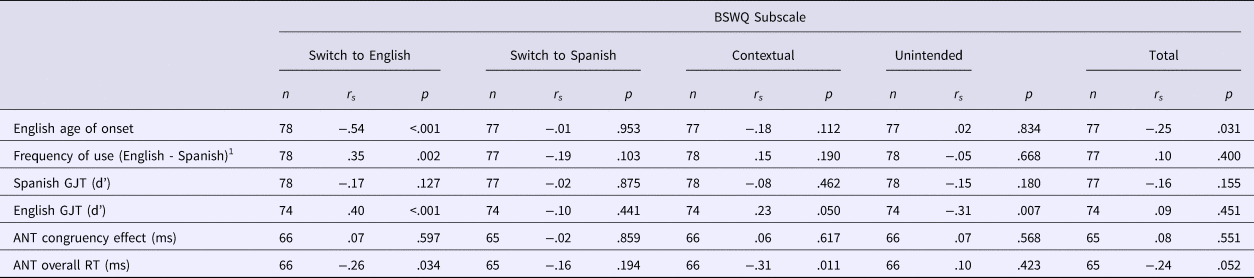
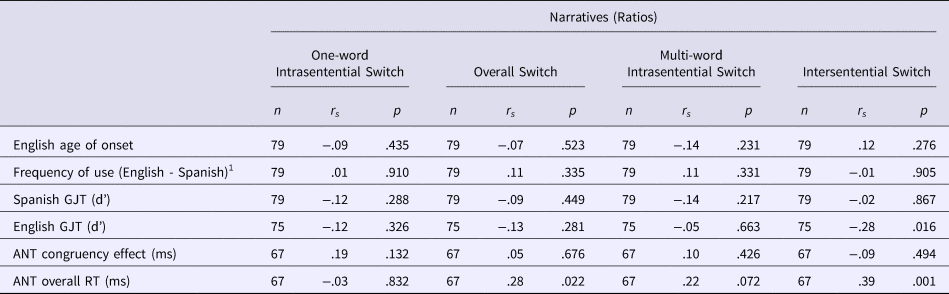
Tables 3 and 4 report the Spearman's rank coefficients for correlations between the two measures of codeswitching (BSWQ in Table 3 and ratios from narratives in Table 4) with proficiency and executive function. Since proficiency tends to be strongly related to other language background factors, we also include correlations with age of onset and frequency of use in these tables. All correlations between codeswitching and the Spanish GJT were small and non-significant. However, the correlation between BSWQ Switch to English and various measures of English-language background were significant after adjusting for multiple comparisons, and of medium to large size. Namely, higher self-reported switching to English was associated with earlier age of onset, more frequent use of English, and higher scores on the English GJT. In addition, higher scores on the English GJT were also associated with lower self-reported unintended switching (medium size, significant). The BSWQ Total score was not significantly correlated with other language-experience factors after correcting for multiple comparisons. As for codeswitching in the narratives, the only significant correlation between any Narratives Ratio and language-experience factor was a negative relationship between English GJT score and Intersentential Switch.
Spearman's correlations: codeswitching (BSWQ subscales) with language factors: age of onset, frequency of use, proficiency (GJTs) and the cognitive factor, executive function (ANT). Both language groups (English-dominant and Spanish-dominant combined).

Note. BSWQ = Bilingual Switching Questionnaire, GJT = grammaticality judgment test, ANT = Attentional Network Task, ANT congruency effect = difference in RT to congruent versus incongruent trials, RT = reaction time. 1Relative frequency of use of the two languages was calculated by subtracting the participant's self-reported % daily use of Spanish from the % daily use of English. Thus, positive scores reflect more use of English than Spanish, negative scores reflect more use of Spanish than English, and scores close to zero are equivalent use of the two languages in daily life.
Spearman's correlations: codeswitching (ratios from narratives) with language factors: age of onset, frequency of use, proficiency (GJTs) and the cognitive factor, executive function (ANT). Both language groups (English-dominant and Spanish-dominant combined).

Note. GJT = grammaticality judgment test, ANT = Attentional Network Task, ANT congruency effect = difference in RT to congruent versus incongruent trials, RT = reaction time RT = reaction time. 1Relative frequency of use of the two languages was calculated by subtracting the participant's self-reported % daily use of Spanish from the % daily use of English. Thus, positive scores reflect more use of English than Spanish, negative scores reflect more use of Spanish than English, and scores close to zero are equivalent use of the two languages in daily life.
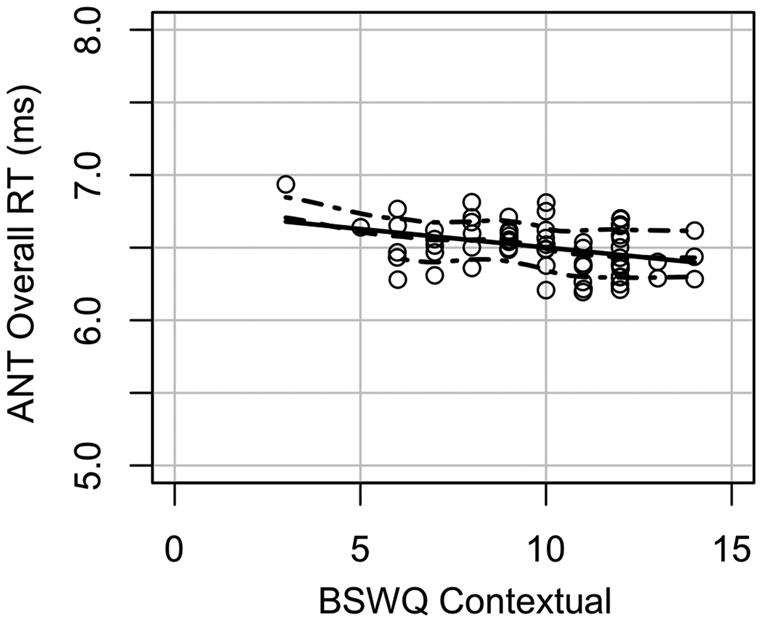
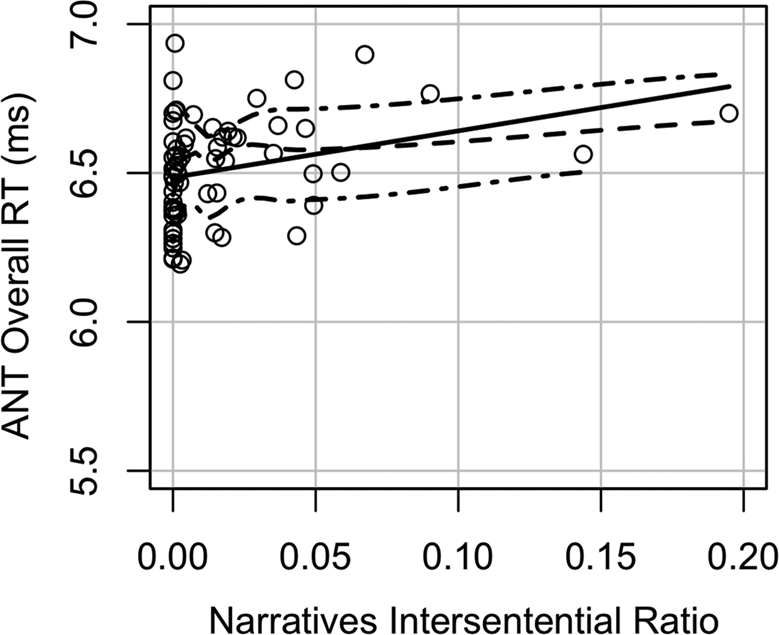
For executive function, all correlations between the ANT congruency effect and codeswitching (both self-reported and ratios from the narratives) were small and non-significant. After correcting for multiple comparisons, participants’ overall reaction time on the ANT (averaging across congruent and incongruent trials) was significantly negatively correlated with BSWQ Contextual scores but positively correlated with the Intersentential ratios from narratives. This would seem to indicate that individuals who were able to complete the ANT faster (i.e., smaller RTs) were likely to self-report more codeswitching based on context, but actually produced less codeswitching in their narratives, at least intersententially, than those who were slower on the ANT (i.e., larger RTs). However, visual inspection of the relevant scatterplots (Figures 1 and 2) revealed that both results should be interpreted with caution. For BSWQ Contextual scores, the visual trend of smaller RTs (faster responses) associated with higher self-reported contextual codeswitching is minimal. In Figure 2, the upward trend of increased ANT reaction time concomitant with increased intersentential switching seems to be based on relatively few data points; most of the ratio scores are clustered near zero.
Scatterplot of BSWQ Contextual and ANT Overall RT, log-transformed and trimmed. Solid line = regression line, dashed line = Loess line, dot-dash line = smoothed conditional spread.

Scatterplot of Narratives Intersentential Ratio and ANT Overall RT, log-transformed and trimmed. Solid line = regression line, dashed line = Loess line, dot-dash line = smoothed conditional spread.

Correlations between language and cognitive factors with the BSWQ and Narratives Ratios by language-dominance group, are reported in the online Supplementary Information, Tables S1-S4 (Supplementary Materials). In terms of language experience, we found that the patterns for English-dominant bilinguals slightly differed from those of the whole group: there was still a negative relationship between proficiency and BSWQ Unintended scores, but in this case the relevant measure of proficiency was the Spanish GJT, not English. Additionally, in this group we found a positive relationship between BSWQ Contextual scores and English age of onset that was not significant in the whole-group analysis. There were no significant correlations between language-experience factors and ratios from the narratives in the English-dominant group.
In the Spanish-dominant group, we again observed a significant negative correlation between BSWQ Switch to English and English age of onset, as was seen in the whole-group analysis. There was no significant correlation between language-experience factors and ratios from the narratives in the Spanish-dominant group, either.
In terms of executive function, the significant relationship between BSWQ Contextual and ANT overall reaction time from the whole-group analysis was not observed in either language-dominance group. However, the relationship between the Intersentential Switch ratio and ANT overall reaction time, first observed in the whole-group analysis, remained significant for both English- and Spanish-dominant bilinguals separately. Finally, for Spanish-dominant bilinguals only, the Overall Switch ratio was also significantly, positively correlated with ANT overall RT.
Discussion
Our evaluation of measures of codeswitching had multiple objectives. First, we wanted to extend a self-report questionnaire to a new population of bilinguals: Spanish–English bilinguals in the US, as compared to Spanish–Catalan bilinguals in Spain (Rodriguez-Fornells et al., Reference Rodriguez-Fornells, Krämer, Lorenzo-Seva, Festman and Münte2012).Footnote 5 Changing the participant population not only changes the languages at play and the participants’ culture in broad terms, but also cultural expectations and valuation of bilingualism and codeswitching in particular. Catalonia is an officially bilingual region whereas Spanish is a minority language in the US, often associated with immigration and related stereotypes. It is notable, therefore, that the internal reliability of the BSWQ is comparable in the US and in Spain, as are the average scores on most subscales. Thus, it seems likely that the BSWQ will perform similarly in a variety of bilingual settings, no doubt aided by the questionnaire's introductory paragraph that positions codeswitching as a normal bilingual phenomenon.
Our second objective was to compare self-reported codeswitching practices on the BSWQ with actual codeswitches produced in the autobiographical narratives. We found that our participants were accurate in their self-report, but more so when they were reporting on multiple types of codeswitching rather than specifically switching from Spanish to English at the word level. Since the former scale draws on responses to 12 items while the latter draws on only 3 items, it is perhaps not surprising that the former is a more robust measure. Additionally, BSWQ subscales are associated with at least one type of codeswitching that their questions do not directly address, either multi-word intrasentential or intersentential codeswitching (depending on the BSWQ subscale). From a psycholinguistics perspective, this finding is promising for future studies that may wish to rely on a questionnaire such as the BSWQ to quantify codeswitching practices when it is not possible, due to limited time or other resources, to include an oral production task. From a sociolinguistics perspective, however, it is somewhat surprising that self-reported codeswitching did correlate with actual codeswitching, given the societal stigma of codeswitching in the United States in general (Zentella, Reference Zentella, Guzzardo Tamargo, Mazak and Parafita Couto2016) and the negative valuation of Spanish that is influenced by English (Zentella, Reference Zentella, Guzzardo Tamargo, Mazak and Parafita Couto2016 for the US in general; Shenk, Reference Shenk2017 for Puerto Ricans in Pennsylvania in particular). To that point, we emphasize that even the larger correlation coefficient (r s = .27) only represents approximately 7% shared variance between the two variables (BSWQ Total and Narratives Overall Ratio), leaving room for societal judgments to still play a role. That is, it is hard to say that participants’ self-reports were equivalent to their actual codeswitching; instead, what we can say is that people who codeswitched more also reported being more frequent codeswitchers. There may still be slight under-reporting at play, so if future research designs demand precise measurements of codeswitching, the most reliable measure is still a naturalistic oral production task. At the same time, although our autobiographical memory task was naturalistic in that participants spoke freely about events from their own lives (topics they were knowledgeable of) and interlocutors were proficient in both English and Spanish, it was still somewhat artificial in that it used cue words to prompt narratives and interlocutors were not of Latinx origin. Furthermore, we recognize that the observer's paradox (Labov, Reference Labov1972) could also influence speech in this type of task. Although we aimed to establish rapport with participants before beginning the autobiographical memory task, it is possible that their oral production of codeswitches would be even more frequent with individuals who they already know or who share similar backgrounds. Likewise, their self-reported codeswitching might also increase if the questionnaire were administered in a less formal setting.
Although we also compared self-report rate of contextual and unintended codeswitches to oral production, our interpretation of these comparisons is more limited since the oral production task did not distinguish whether codeswitching was contextually driven or whether it was intentional. That is, although participants related memories from different domains of life (e.g., events that occurred at work or at home), domain was not controlled for in the experiment and thus would introduce more between-subject variability if we attempted to examine whether more codeswitching occurred when a narrative came from a different context than the previous one. Regarding intentions behind codeswitching in the narratives, participants sometimes announced their switches; for example, “te lo voy a decir en inglés” (“I'm going to tell you this in English”, Participant 90) or “I'm gonna Spanglish it on you” (Participant 96). Such examples seem to indicate intentional codeswitching, but not necessarily that other codeswitching was unintentional. Finally, although participants also produced narratives in English, there is even less codeswitching in those narratives, so we did not attempt to compare those codeswitching ratios to the BSWQ Switch to Spanish subscale. Thus, it remains an open question how the remaining BSWQ subscales could be empirically validated with orally produced codeswitching.
Our third and final objective was to compare both measures of codeswitching to other linguistic and non-linguistic tasks. Regarding proficiency, our results showed that participants with higher English proficiency may also perceive more frequent use of English in their own bilingual speech. Although English proficiency did not affect the overall codeswitching production, when looking at codeswitching typology we found a meaningful correlation between English proficiency and intersentential switches, such that participants with lower English proficiency produced more intersentential codeswitches. This result is in line with previous findings where less fluent bilinguals tend to favor switching between sentences (Poplack, Reference Poplack1980). Furthermore, the correlation likely is driven by Spanish-dominant participants, given both the direction of the switch and the fact that when speakers are separated by language dominance the Spanish-dominant group approaches significance (neither group's correlation is independently significant). Conversely, Spanish proficiency was not related to actual production of codeswitching, showing that the type of codeswitching produced by participants was most likely not motivated by insufficient knowledge of Spanish. These findings contrast with studies that have found a relationship between bilingual proficiency and production of both intrasentential and single-word codeswitches (Nortier, Reference Nortier1990; Poplack, Reference Poplack1980; Torres & Potowski, Reference Torres, Potowski, Tamargo, Mazak and Couto2016; Valdés Kroff & Fernández-Duque, Reference Valdés Kroff, Fernández-Duque, Bellamy, Child, González, Muntendam and Parafita Couto2017). Although this study only found a meaningful correlation between proficiency and frequency of intersentential codeswitches, when taking a closer look at individual participants, results are consistent with previous findings with regard to intrasentential codeswitching as well. Participants who scored high on both the Spanish and English GJTs still produced intrasentential switches that adhere to constituent boundaries, similar to highly proficient bilinguals in previous studies (Lipski, Reference Lipski2014; Nortier, Reference Nortier1990; Poplack, Reference Poplack1980). In sum, results of the current study are in line with others that have not shown a relationship between proficiency and frequency of codeswitching, but rather focus on the relationship between codeswitching and typology (Deuchar et al., Reference Deuchar, Muysken and Wang2007; Muysken, Reference Muysken2000).
It is interesting to note the role of English overall in the results of the BSWQ Switch to English subscale. We found positive correlations with this subscale with regard to both English proficiency and frequency of use, and a negative correlation with the English age of onset. It is possible that participants who are more proficient in English and self-report more frequent use of English are more conscious of the role English plays in their lives. Likewise, if English onset is more recent, it is possible that participants are more cognizant of their bilingual repertoire because it is not a skill they have always been able to access. In this case, participants might perceive more frequent codeswitching to English because it would be a marked choice. It is unsurprising then, that when groups are isolated by language dominance, the Spanish-dominant group's correlation remains meaningful. Finally, although participants with higher proficiency self-reported more frequent use of English, and those with a later onset of English self-reported more switches to English, in practice they do not actually produce more switches, at least in this semi-structured environment. Similar relationships between self-reported codeswitching, age of onset, proficiency, and frequency of use were attested in Rodriguez-Fornells et al. (Reference Rodriguez-Fornells, Krämer, Lorenzo-Seva, Festman and Münte2012).
We did not find any meaningful correlations for the BSWQ Switch to Spanish subscale. For this subscale, age of onset was not an applicable factor since all participants learned Spanish from birth. It is possible that because participants learned Spanish from birth, their perception of their switches to Spanish is an unmarked phenomenon and does not depend on their proficiency or frequency of language use. As for the BSWQ Unintended Switches subscale, a negative correlation between self-reported unintended switches and English proficiency indicates that participants with higher English proficiency self-report more intentional codeswitches. A similar pattern was found when looking at the English-dominant group: English-dominant participants with higher Spanish proficiency reported more intentional codeswitches. This suggests that for speakers with higher English proficiency and those who consider themselves to be English-dominant, switches serve a performative function. This notion is supported by qualitative data where participants announce they are going to codeswitch, as previously mentioned. Likewise, participants with higher English proficiency and who self-report as English-dominant may also have more communicative competence, as they are more aware of the role codeswitching may play in enhancing communication in different situations or when discussing different topics. Codeswitching in this case, therefore, is a communicative choice and was perhaps motivated by other factors that merit further analyses, including topic, context and interlocutors, memory of the event, or other biographical or discursive factors.
Regarding executive function, we did not obtain meaningful correlations between the ANT congruency effect and either codeswitching measure, a null result similar to that reported by Rodriguez-Fornells et al. (Reference Rodriguez-Fornells, Krämer, Lorenzo-Seva, Festman and Münte2012) for the flanker task and Soveri et al. (Reference Soveri, Rodriguez-Fornells and Laine2011) for both the flanker and Simon tasks. At the same time, we did find relationships between overall reaction time (RT) on the ANT and both codeswitching measures, and the correlation with rate of intersentential switching was also present when analyzing language-dominance groups separately. Comparisons of monolingual/bilingual executive function performance have also found a relationship between bilingualism and overall RT on executive function tasks, attributing the advantage in those cases to possible enhanced monitoring skills (Hernández, Costa, Fuentes, Vivas & Sebastián-Gallés, Reference Hernández, Costa, Fuentes, Vivas and Sebastián-Gallés2010; Nair, Biedermann & Nickels, Reference Nair, Biedermann and Nickels2016). When comparing frequent to less frequent codeswitchers, Verreyt et al. (Reference Verreyt, Woumans, Vandelanotte, Szmalec and Duyck2016) also found a positive relationship between codeswitching practices and RT on congruent and incongruent stimuli, as well as the congruency effect for the flanker task. Other studies that reported significant relationships between codeswitching practices and executive function only reported on measures of congruency effect (e.g., Hofweber et al., Reference Hofweber, Marinis and Treffers-Daller2016), thus limiting comparisons on this measure.
In our results, interpretation of the two significant correlations with ANT reaction time is limited, despite their medium size. The size of the correlation coefficient seems to come from fitting a near-horizontal line closely (in the case of BSWQ Contextual scores) or fitting a positive slope closely, but with few data points (in the case of the Intersentential ratio). Since multiple factors likely contribute to executive function, such as age at testing and socioeconomic status, our results may be indicative of a lack of relationship between codeswitching and executive function (e.g., Jylkkä et al., Reference Jylkkä, Soveri, Wahlström, Lehtonen, Rodriguez-Fornells and Laine2017) or it may be that future analyses with a larger sample size and more nuanced statistics (e.g., mixed-effects models that also take into account participants’ socioeconomic status, level of education, and other relevant factors), would yield additional insight (van Heuven & Coderre, Reference van Heuven and Coderre2015). We have not yet undertaken such analyses, since our research interest here was to compare the codeswitching measures to executive function performance, not to definitively answer what effect codeswitching practices might have on executive function. Our current results do point toward a possible relationship between higher rate of contextual codeswitching (self-reported) and enhanced executive function performance, which suggests that contextual switches may be highly controlled processes, and thus higher rates of these switches would be associated with superior domain-general monitoring. Such a relationship provides an interesting contrast to Jylkkä et al.’s (Reference Jylkkä, Soveri, Wahlström, Lehtonen, Rodriguez-Fornells and Laine2017) finding of increased contextual switching associated with a greater switching cost (i.e., poorer executive function). Moreover, Soveri et al. (Reference Soveri, Rodriguez-Fornells and Laine2011) found that self-reported contextual switching and overall switching were not significant predictors of flanker or Simon effects; however, they did not report analyses with overall RT on the flanker and Simon tasks, which is where we found suggestion of an effect. Clearly, both the specific subcomponents of executive function and the specific type of codeswitching need to be taken into account in further investigating this question. As noted in the introduction, differences in bilingual environments may also play a role in explaining divergent results across studies. For our purposes, we note that the relationships between executive function and self-reported codeswitching seem to be similar to those between executive function and orally produced codeswitching (that is, no strong evidence of a relationship), at least for our Spanish–English bilinguals in the US.
Conclusion
In sum, this study provides valuable evidence that self-reported measures of codeswitching can be useful and reliable in some research contexts, even in qualitatively different bilingual environments (Spain versus the US). Our findings also contribute further evidence that self-reported measures of codeswitching can be accurate measurements of codeswitching in the direction of English insertions into otherwise Spanish speech, in particular in a semi-structured research setting where codeswitching is elicited but not induced by the researcher. We also show that codeswitching is not indicative of proficiency deficiencies, although self-report may be influenced by proficiency. This suggests a link between proficiency and cognizance of codeswitching; however, oral production of codeswitching is influenced by other factors, which could be explored in future studies. Finally, we find that both self-reported codeswitching and orally produced codeswitching showed similar relationships with executive function; namely, little conclusive evidence of a strong relationship between the two.
Acknowledgements
This study was supported by a Language Learning Small Research Grant to JGC, the American Philosophical Society's Franklin Research Grant to JGC, and Franklin and Marshall College's Hackman Summer Scholar Program. We would like to thank Julianna Lynch and Bendjhi Villiers for their help with data collection and Guadalupe Barba, Xavier Molina, and Wilfredo Seda for their assistance with participant recruitment.
Supplementary Material
For supplementary material accompanying this paper, visit https://doi.org/10.1017/S1366728919000129