Introduction
Intestinal parasitic infections pose a significant global public health challenge, particularly in regions with inadequate sanitation infrastructure (Fauziah et al. Reference Fauziah, Aviani, Agrianfanny and Fatimah2022). Approximately 3.5 billion people worldwide are estimated to be affected by various parasitic diseases, resulting in around 450 million annual cases. Among geohelminthiasis, Strongyloides stercoralis infection affects approximately 600 million individuals globally (Buonfrate et al. Reference Buonfrate, Bisanzio, Giorli, Odermatt, Fürst, Greenaway, French, Reithinger, Gobbi, Montresor and Bisoffi2020). Its distribution is highly heterogeneous, with a predominance in tropical and subtropical areas. Epidemiological data remain scarce due to a limited number of studies, and the low sensitivity of diagnostic methods normally used (de Souza et al. Reference de Souza, Oliveira, Araújo, Souza, Silva, da Cruz, Sampaio, Dos Santos, Teixeira and Soares2020; Schär et al. Reference Schär, Trostdorf, Giardina, Khieu, Muth, Marti, Vounatsou and Odermatt2013) which lead to an underestimated prevalence (Bosqui et al. Reference Bosqui, Pereira, Lucas, Dalavedo, Santos, Freire, Luis, Murad, Custódio, Almeida, Costa, Pavanelli and Costa2014). Countries such as São Tomé and Príncipe (20.7%), Myanmar (19.2%), Colombia (18.4%), and Sierra Leone (17%) report the highest prevalences in the general population (Buonfrate et al. Reference Buonfrate, Bisanzio, Giorli, Odermatt, Fürst, Greenaway, French, Reithinger, Gobbi, Montresor and Bisoffi2020).
S. stercoralis infection begins when filariform larvae (infective stage), present in the soil, penetrate the host’s skin or mucous membranes. After several transformations, they reach the gastrointestinal tract, lodging in the lamina propria of the duodenum and proximal jejunum, where they develop into parthenogenetic females (Bosqui et al. Reference Bosqui, Pereira, Lucas, Dalavedo, Santos, Freire, Luis, Murad, Custódio, Almeida, Costa, Pavanelli and Costa2014; Silva et al. Reference Silva, Inês, Souza, Dias, Guimarães, Menezes, Barbosa, Alves, Teixeira and Soares2016). S. stercoralis has the ability to exacerbate the infection through internal autoinfection, potentially leading to hyperinfection and/or disseminated disease (Yeh et al. Reference Yeh, Aggarwal, Carrig, Azeem, Nguyen, Devries, Destache, Nguyen and Velagapudi2023), especially in immunocompromised patients(Levenhagen et al. Reference Levenhagen, Conte and Costa-Cruz2016). Various conditions that compromise immune function are identified as risk factors for severe strongyloidiasis, including glucocorticoid therapy, co-infection with HTLV-1, organ transplantation, and alcohol use disorder (AUD) (Krolewiecki and Nutman Reference Krolewiecki and Nutman2019; Levenhagen et al. Reference Levenhagen, Conte and Costa-Cruz2016; Marcos et al. Reference Marcos, Terashima, Canales and Gotuzzo2011).
AUD is characterised by a pattern of alcohol consumption that, in addition to causing social and occupational impairment, is associated with multiple adverse health outcomes, including pancreatitis, liver diseases, diabetes, cardiovascular disorders, dementia, and several types of cancer (Pillai et al. Reference Pillai, Pillai, Illankovan, Kumarasamy, Reddy, Gowtham, Dhanasekaran and Subramaniyan2024). Globally, AUD is one of the most severe and prevalent psychiatric disorders, affecting millions of individuals (Carr et al. Reference Carr, Kilian, Llamosas-Falcón, Zhu, Lasserre, Puka and Probst2024; Shield et al. Reference Shield, Manthey, Rylett, Probst, Wettlaufer, Parry and Rehm2020; Subramaniyan et al. Reference Subramaniyan, Chakravarthi, Jegasothy, Seng, Fuloria, Fuloria, Hazarika and Das2021). Alcohol consumption is the seventh leading risk factor for premature mortality (Khamis et al. Reference Khamis, Salleh, Ab Karim, Mohd Rom, Janasekaran, Idris and Abd Rashid2022) and an estimated 283 million adults worldwide are affected by AUD (Glantz et al. Reference Glantz, Bharat, Degenhardt, Sampson, Scott, Lim, Al-Hamzawi, Alonso, Andrade, Cardoso, De Girolamo, Gureje, He, Hinkov, Karam, Karam, Kovess-Masfety, Lasebikan, Lee, Levinson, McGrath, Medina-Mora, Mihaescu-Pintia, Mneimneh, Moskalewicz, Navarro-Mateu, Posada-Villa, Rapsey, Stagnaro, Tachimori, Have, Tintle, Torres, Williams, Ziv and Kessler2020), representing a major public health challenge.
It has been hypothesised that increased cortisol levels, common in chronic alcohol users, indirectly contribute to S. stercoralis autoinfection. This occurs because its metabolites resemble ecdysone, a parasite hormone that regulates the fertility of parthenogenetic S. stercoralis females and induces the transformation of rhabditiform into infective filariform larvae, promoting autoinfection (Marcos et al. Reference Marcos, Terashima, Canales and Gotuzzo2011; Silva et al. Reference Silva, Inês, Souza, Dias, Guimarães, Menezes, Barbosa, Alves, Teixeira and Soares2016). Silva et al. (2015) demonstrated that the number of larvae excreted in the faeces of alcoholic patients is directly proportional to circulating cortisol concentrations. Also, immune response dysregulation, characterised by increased production of TNF-α and other inflammatory cytokines, can modulate the Th2 response, which is responsible for controlling S. stercoralis infection, thereby contributing to its worsening in individuals with AUD (Carvalho and Da Fonseca Porto Reference Carvalho and Da Fonseca Porto2004; Crews et al. Reference Crews, Bechara, Brown, Guidot, Mandrekar, Oak, Qin, Szabo, Wheeler and Zou2006; Mandrekar et al. Reference Mandrekar, Catalano, Dolganiuc, Kodys and Szabo2004a).
The recommended treatment for S. stercoralis infection is two consecutive daily doses of ivermectin at 200 μg/kg of body weight (Sengthong et al. Reference Sengthong, Pinlaor, Yingklang, Haonon, Jantawong, Pinlaor, Sithithaworn and Hongsrichan2024). In high-risk groups, such as individuals with alcoholism, who often present with a higher parasite burden, therapeutic monitoring is essential to ensure parasitological cure (Silva et al. Reference Silva, Inês, Souza, Souza, Dias, Oliveira, Guimarães, Menezes, Barbosa, Alves, Teixeira and Soares2019). This study presents a meta-analysis of previous research with the aim of investigating the prevalence and risk of having S. stercoralis infection in individuals with AUD.
Material and methods
The search strategy, eligibility criteria, and statistical approaches for this systematic review and meta-analysis were predefined in accordance with the Preferred Reporting Items for Systematic Reviews and Meta-Analyses (PRISMA) 2020 guidelines (Page et al. Reference Page MJ, McKenzie, Bossuyt, Boutron, Hoffmann, Mulrow, Shamseer, Tetzlaff, Akl, Brennan, Chou, Glanville, Grimshaw, Hróbjartsson, Lalu, Li, Loder, Mayo-Wilson, McDonald, McGuinness, Stewart, Thomas, Tricco, Welch, Whiting and Moher2021).
Eligibility criteria
A systematic literature review was conducted including all observational studies investigating S. stercoralis infection prevalence in individuals with AUD, comparing or not with a non-alcoholic group, using parasitological (e.g., Baermann-Moraes, agar culture) and/or molecular methods (e.g., PCR) for S. stercoralis diagnosis. Studies including participants of any age group, sex, or geographical location were considered eligible.
The following were excluded: (a) reviews, case reports, and studies published exclusively as monographs, dissertations, theses, or conference abstracts; (b) studies where participants were included based solely on serological results; (c) studies with insufficient prevalence data. Additionally, studies published in languages other than English, Portuguese, or Spanish, as well as those that did not explicitly focus on individuals with AUD as the target population, were excluded.
Search strategy and data extraction
A systematic search was performed in PubMed, Embase, and LILACS databases for studies published from their inception up to May 2025. The search strategy used was: (‘alcoholism’ OR ‘alcoholic’ OR ‘alcohol use disorder’ OR ‘alcohol-dependent’) AND (‘Strongyloides stercoralis’ OR ‘strongyloidiasis’). Previous systematic reviews and meta-analyses, as well as the references of selected studies, were also manually examined for additional relevant studies.
Two researchers (G.J.R.M. and M.R.M.S.) independently screened the results using Zotero reference management software (Corporation for Digital Scholarship, Vienna, VA, United States), and data extraction was performed using Microsoft Excel (Microsoft Corp., Redmond, WA, United States). Discrepancies were resolved with the participation of the senior author (N.M.S.). This systematic review was prospectively registered on the International Prospective Register of Systematic Reviews (PROSPERO) on 15 May 2025 (registration number CRD420251053592).
Quality assessment
Methodological quality assessment was independently performed by the same reviewers using the Joanna Briggs Institute (JBI) Critical Appraisal Checklist for prevalence studies (‘JBI Critical Appraisal Tools | JBI’ 2022) (Supplementary Table S1). Subsequently, the assessors discussed and reached a consensus on the final evaluations. In cases where no consensus was reached, the senior author was consulted. Each item on the checklist was evaluated for all studies and classified as ‘yes’, ‘no’, ‘unclear’, or ‘not applicable’. The adherence rate was calculated by dividing the number of criteria met in each study by the total number of checklist items.
The overall risk of bias was categorised based on the following cut-off points:
-
• ≥70% ‘yes’ responses: low risk of bias;
-
• 50–69% ‘yes’ responses: moderate risk of bias;
-
• <50% ‘yes’ responses: high risk of bias.
Statistical analysis
Proportions of S. stercoralis infection were analysed using two approaches. For prevalence estimation, pooled proportions were calculated using the Probit Logit (PLOGIT) transformation. To compare infection prevalence between alcoholic and non-alcoholic groups, odds ratios (ORs) were used. Both analyses included 95% confidence intervals (95% CI), with p <0.05 considered statistically significant. Heterogeneity among studies was assessed using Cochran’s Q test and the I2 statistic, with p <0.10 and I2 >25% considered indicative of significant heterogeneity. All analyses were conducted using a random-effects model with restricted maximum likelihood (REML) estimation. Statistical analyses were performed in R software (version 4.2.1, R Foundation for Statistical Computing, Vienna, Austria).
Leave-one-out sensitivity analyses were performed to evaluate the impact of individual studies on the pooled estimates. This method involves sequentially excluding one study at a time and recalculating the pooled data with the remaining studies. A study was considered influential if its exclusion changed the statistical significance of the pooled effect (from significant to non-significant or vice versa), indicating its dominance in the analysis.
Results
Study selection and baseline characteristics
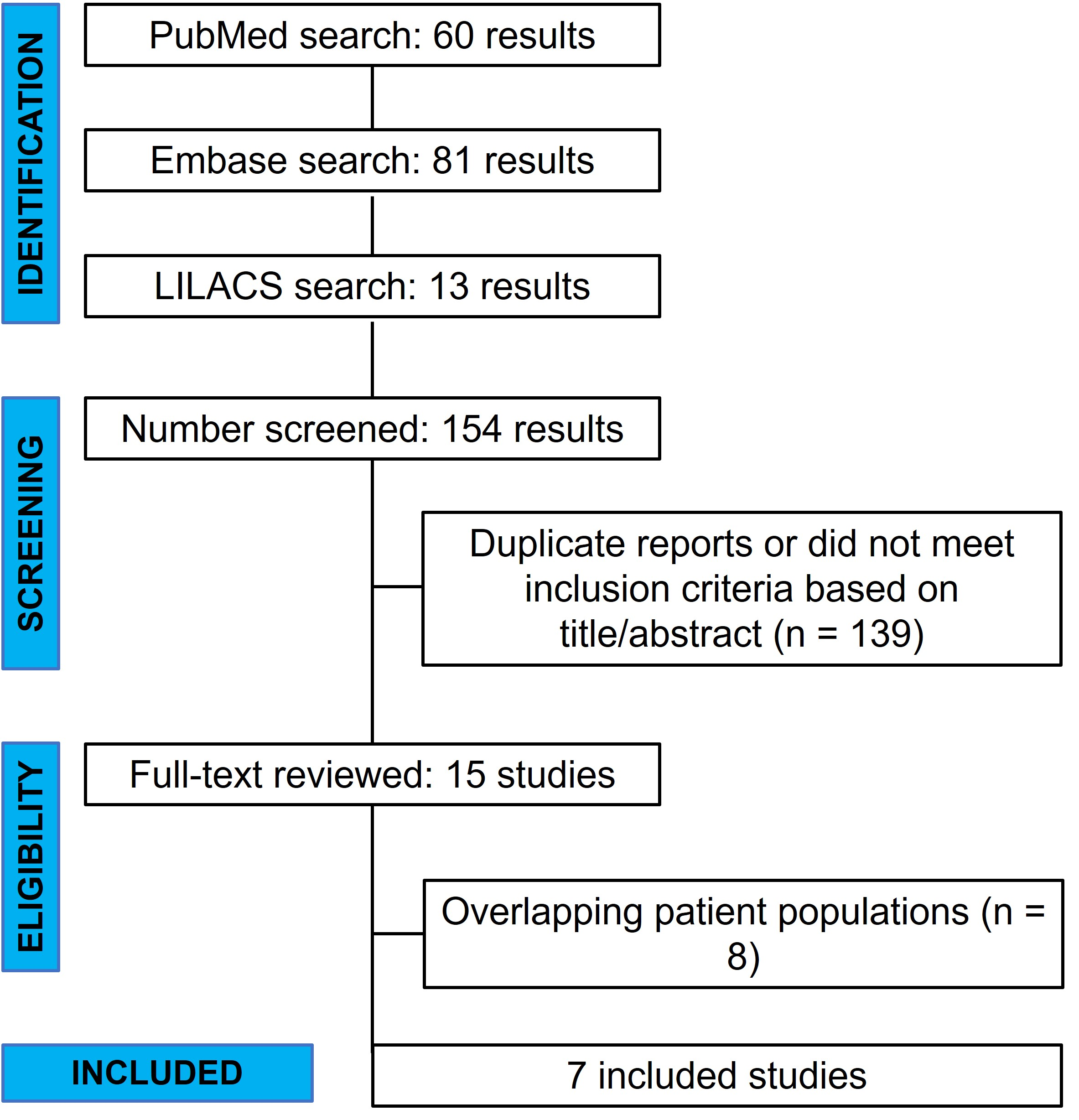
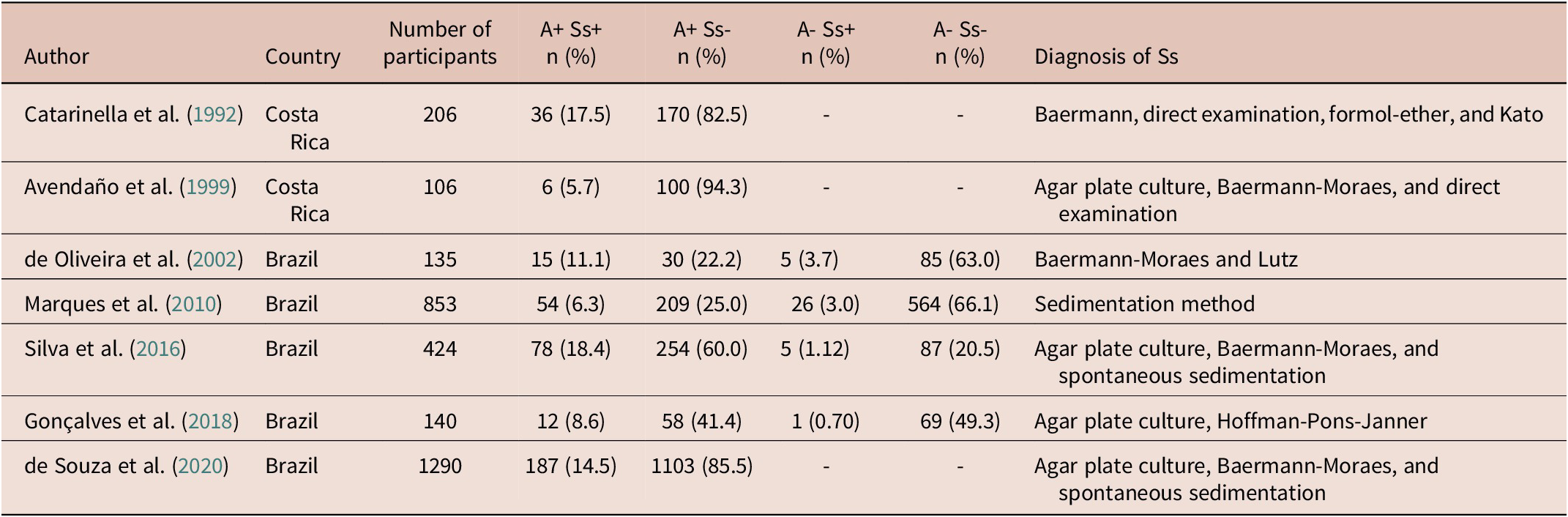
Our systematic search, as detailed in the PRISMA flow diagram (Figure 1), initially identified 154 records from electronic databases. After removing duplicate records and excluding studies that did not meet the inclusion criteria based on their titles and abstracts, 15 studies remained for full-text assessment. Following this rigorous evaluation, 8 studies were excluded due to overlapping patient populations, ensuring that each included study contributed unique data. In the end, 7 studies met all eligibility criteria and were included in this meta-analysis. Of these, 6 were used to assess the prevalence of S. stercoralis infection in alcoholic patients, while 4 were included in the comparison of the risk of having infection between alcoholic and non-alcoholic groups. The characteristics of these studies are summarised in Table 1.
PRISMA flow diagram of study selection.

Main characteristics of the included studies in the meta-analysis. Details of the studies evaluating the prevalence of Strongyloides stercoralis infection in alcoholic (A+) and non-alcoholic (A–) individuals. Data include country of origin, number of participants, infection status (Ss+ or Ss–), and diagnostic methods employed.

Prevalence
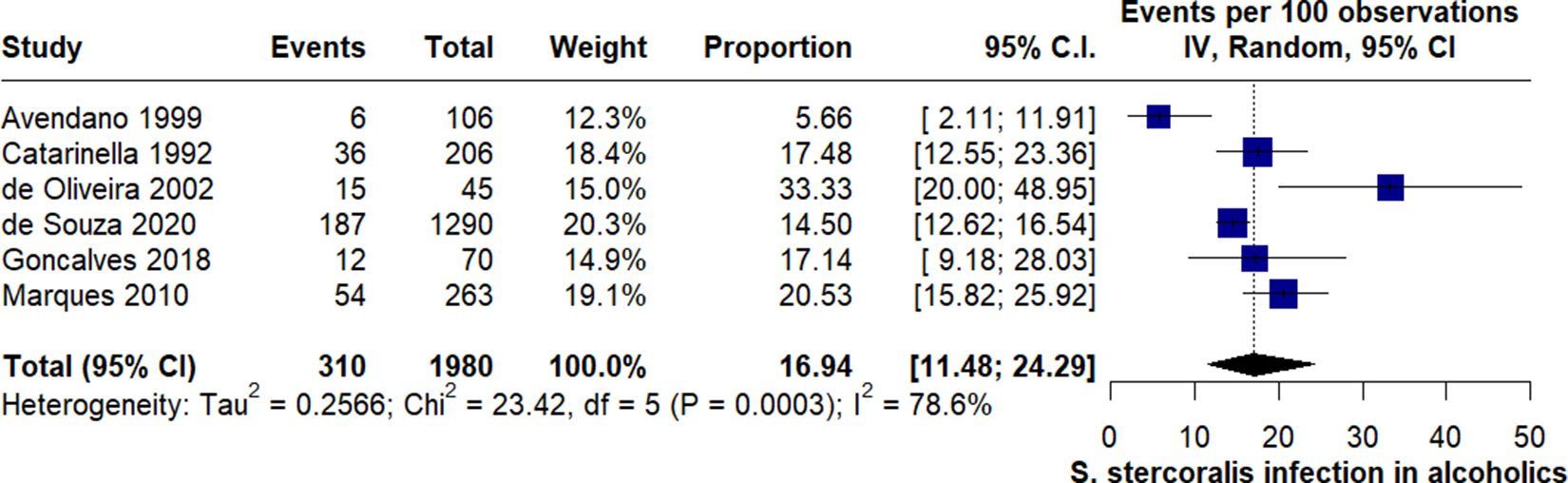
The meta-analysis revealed a pooled prevalence of S. stercoralis infection in alcoholic patients of 16.9% (95% CI: 11.48–24.29) based on the random-effects model (Figure 2). Substantial heterogeneity was observed among the included studies (Chi2 = 23.42, I2 = 78.6%, p = 0.0003). Studies conducted in Costa Rica (n = 2) reported prevalence rates ranging from 5.66% to 17.48%, whereas those from Brazil (n = 4) showed higher values, ranging from 14.50% to 33.33%.
Meta-analysis of the prevalence of Strongyloides stercoralis infection in alcoholic patients.

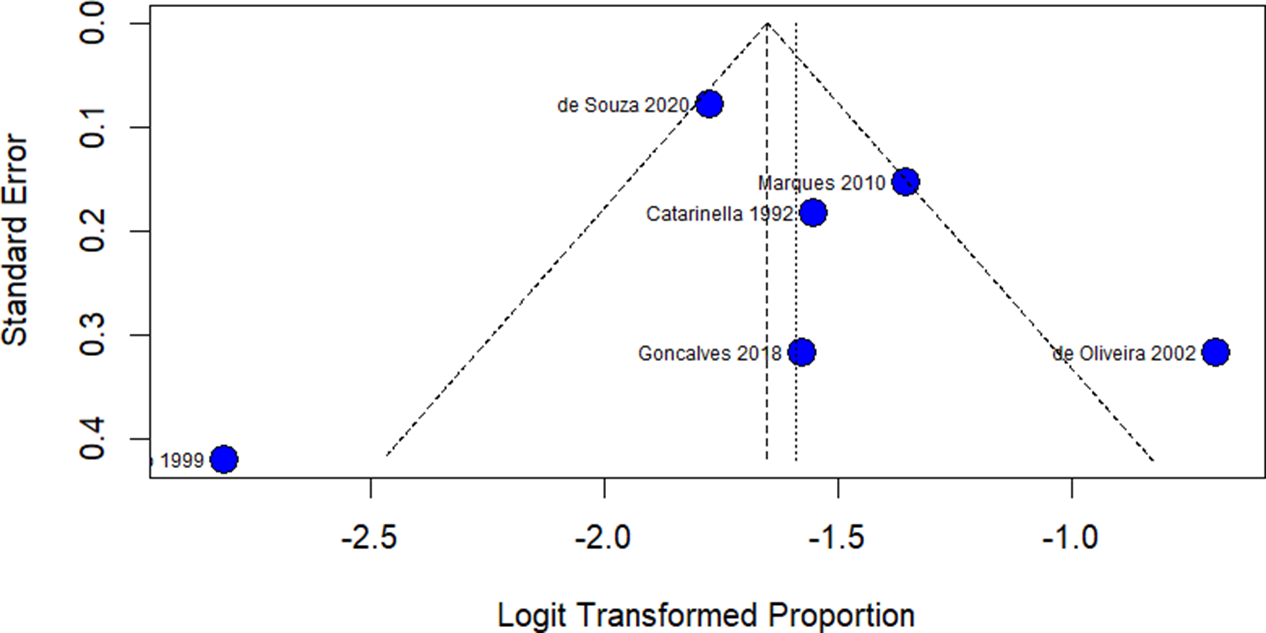
The analysis of the funnel plot (Figure 3) indicated moderate asymmetry, suggesting potential publication bias or underlying heterogeneity among the studies. Specifically, Oliveira et al. (Reference de Oliveira, Ribeiro, Mendes, Oliveira and Costa-Cruz2002) exhibited a considerably higher proportion, while Avendaño (1999) was positioned in the far lower left, indicating lower precision and a possible small-study effect.
Funnel plot assessing publication bias.

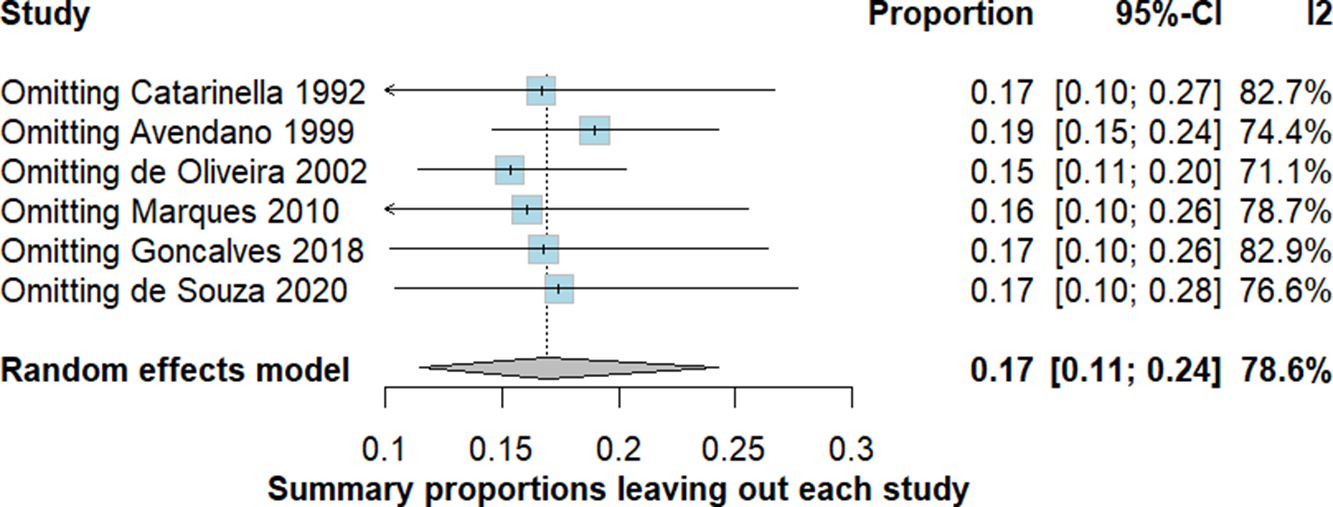
The leave-one-out sensitivity analysis (Figure 4) demonstrated the robustness of our findings. The pooled proportion remained stable at approximately 17% (95% CI [0.11; 0.24]), regardless of which study was individually excluded. The heterogeneity (I2) ranged from 71.1% to 82.9%, reinforcing that no single study disproportionately influenced the overall variability in the data.
Leave-one-out sensitivity analysis for prevalence estimates.

Alcoholics versus non-alcoholic individuals
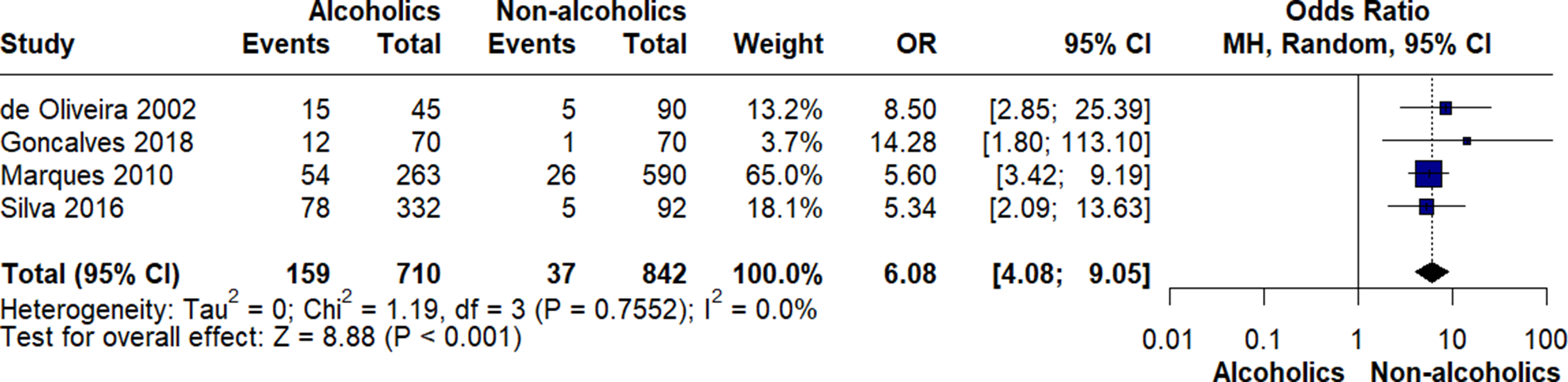
Figure 5 presents the forest plot of the meta-analysis evaluating the association between alcohol consumption and S. stercoralis infection. Four studies were included, comprising a total of 710 alcoholic patients and 842 non-alcoholic controls. The pooled odds ratio (OR) was 6.08 [95% CI: 4.08–9.05], indicating that individuals with AUD have a significantly higher likelihood of infection compared to non-alcoholic individuals. The individual ORs across the studies ranged from 5.34 to 14.28, with all confidence intervals excluding 1.
Meta-analysis of the association between alcohol consumption and Strongyloides stercoralis infection.

Heterogeneity analysis showed a non-significant Chi2 (p = 0.7552) and an I2 of 0.0%, suggesting low variability among the included studies. The test for overall effect yielded a Z-score of 8.88 (p <0.001), confirming statistical significance. The forest plot visually depicts consistent results across studies, with the pooled estimate strongly favouring the alcoholic group.
Discussion
This meta-analysis findings revealed a S. stercoralis infection combined prevalence of 16.9% among alcoholic patients, in addition to a 6.08 times higher risk of having infection compared to non-alcoholic individuals. These results support the hypothesis that chronic alcoholism constitutes a significant risk factor for having strongyloidiasis, possibly due to a combination of environmental factors and altered organic functions, mainly the immune response.
The susceptibility of alcoholic individuals to S. stercoralis infection is primarily determined by environmental exposure, frequently associated with poor hygiene habits and unfavourable socioeconomic conditions (Silva et al. Reference Silva, Inês, Souza, Dias, Guimarães, Menezes, Barbosa, Alves, Teixeira and Soares2016; Teixeira et al. Reference Teixeira, Pacheco, Souza, Silva, Inês and Soares2016; Zago-Gomes et al. Reference Zago-Gomes, Aikawa, Perazzio, Gonçalves and Pereira2002). De Souza et al. observed that, although most alcoholic patients in their study lived in urban areas with access to basic sanitation, low income and low educational levels were still prevalent factors among infected individuals (de Souza et al. Reference de Souza, Oliveira, Araújo, Souza, Silva, da Cruz, Sampaio, Dos Santos, Teixeira and Soares2020).
The presence of an autoinfection cycle is a key factor for the persistence and exacerbation of S. stercoralis infection in susceptible hosts, such as chronic alcoholics (Lok Reference Lok2014). Excessive alcohol consumption increases endogenous corticosteroid levels. Its metabolites resemble the parasite’s ecdysteroid hormones, stimulating the transformation of non-infective rhabditiform into infective filariform larvae (Badrick et al. Reference Badrick, Bobak, Britton, Kirschbaum, Marmot and Kumari2008; de Jesus Inês et al. Reference de Jesus Inês E, de Souza, Galvão, Aquino Teixeira and Soares2017), which favours the autoinfection cycle. It also increases the fecundity of parthenogenetic females. Corroborating this mechanism (Silva et al. Reference Silva, Inês, Souza, Dias, Guimarães, Menezes, Barbosa, Alves, Teixeira and Soares2016) demonstrated that elevated endogenous cortisol levels in alcoholic patients infected with S. stercoralis were associated with a high parasite load. Similarly, (de Souza et al. Reference de Souza, Oliveira, Araújo, Souza, Silva, da Cruz, Sampaio, Dos Santos, Teixeira and Soares2020) also observed that individuals with higher alcohol consumption exhibited a greater parasite load. Marques et al. (Reference Marques, da Penha Zago-Gomes, Gonçalves and Pereira2010) found a positive correlation between daily ethanol ingestion and the frequency of Strongyloides larvae in the stools of alcoholic patients.
Immunosuppression in alcoholic patients is another critical factor. Chronic alcoholism affects both innate and adaptive immunity (Barr et al. Reference Barr, Helms, Grant and Messaoudi2016; Molina et al. Reference Molina, Happel, Zhang, Kolls and Nelson2010; Szabo and Mandrekar Reference Szabo and Mandrekar2009). Although the Th2 response, crucial against helminths like S. stercoralis, does not appear to be universally impaired by ethanol consumption (Krolewiecki et al. Reference Krolewiecki, Leon, Scott, Nolan, Schad and Abraham2001), dysfunction of T cells, macrophages, and altered cytokine production can compromise the immune response against the parasite (Galioto et al. Reference Galioto, Hess, Nolan, Schad, Lee and Abraham2006; Montes et al. Reference Montes, Sanchez, Verdonck, Lake, Gonzalez, Lopez, Terashima, Nolan, Lewis, Gotuzzo and White2009; Padigel et al. Reference Padigel, Lee, Nolan, Schad and Abraham2006). Reduced antigen-presenting cell activity and impaired B cell proliferation are also observed (Chang et al. Reference Chang, Wang and Norman2002; Mandrekar et al. Reference Mandrekar, Catalano, Dolganiuc, Kodys and Szabo2004b).
Additionally, chronic alcohol consumption can compromise intestinal motility by affecting vagal function and damaging contractile proteins of the small intestine (Addolorato et al. Reference Addolorato, Montalto, Capristo, Certo, Fedeli, Gentiloni, Stefanini and Gasbarrini1997; Wegener et al. Reference Wegener, Schaffstein, Dilger, Coenen, Wedmann and Schmidt1991). This dysfunction results in delayed gastrointestinal transit, which allows rhabditiform larvae to remain longer in the intestinal lumen, favouring their maturation into infective filariform larvae and thus intensifying the parasite’s autoinfection cycle (Krolewiecki and Nutman Reference Krolewiecki and Nutman2019).
This study revealed a strong association between S. stercoralis infection and alcoholic individuals. Alcoholic patients represent a high-risk population that frequently has limited access to healthcare and may present asymptomatic infections (Marcos et al. Reference Marcos, Terashima, DuPont and Gotuzzo2008; Weng et al. Reference Weng, Meng, Peng, Lin, F-Y and Chen2024). Therefore, diagnostic screening for S. stercoralis should be incorporated into routine clinical evaluation for these patients, to prevent severe forms of the disease, which have a high mortality rate (Mendes et al. Reference Mendes, Minori, Ueta, Miguel and Allegretti2017; Vasquez-Rios et al. Reference Vasquez-Rios, Pineda-Reyes, Pineda-Reyes, Marin, Ruiz and Terashima2019).
The assessment of publication bias using the funnel plot revealed a relatively symmetrical distribution of the included studies, suggesting a low influence of bias on the overall findings. However, the presence of a study positioned in the far lower left of the plot raises the possibility of bias related to sample size, as smaller studies with weak effects tend to be underrepresented in published literature. Nevertheless, the overall distribution of studies supports the robustness of meta-analysis. Additionally, the leave-one-out sensitivity analysis reinforced the stability of the meta-analysis estimates. Studies of individual exclusion resulted in combined proportions ranging between 15% and 19%, with overlapping confidence intervals and an overall estimate of 17% (95% CI: 11–24%). This consistency indicates that no single study exerted a disproportionate influence on the results.
Heterogeneity (I2) values were high, ranging between 71.1% and 82.9%, which indicates moderate to high variability among the included studies. A possible explanation lies in geographical differences. Studies conducted in Brazil reported rates exceeding 20% (de Souza et al. Reference de Souza, Oliveira, Araújo, Souza, Silva, da Cruz, Sampaio, Dos Santos, Teixeira and Soares2020; Marques et al. Reference Marques, da Penha Zago-Gomes, Gonçalves and Pereira2010), while those from Costa Rica showed lower prevalences (Avendaño et al. Reference Avendaño, Hernández, Jímenez, Avila and Castro1999; Catarinella et al. Reference Catarinella, Monge, León and Núñez1992). These discrepancies possibly reflect variations in environmental factors, socioeconomic conditions, and diagnostic methodologies. For example, the study by Catarinella et al. in Costa Rica used methods such as Baermann, which detected 97.2% of cases, while other methods had much lower sensitivity (Catarinella et al. Reference Catarinella, Monge, León and Núñez1992). Silva et al. used agar plate culture and Baermann-Moraes, considered more sensitive (Oliveira et al. Reference Oliveira, de Souza, Souza, Barreto, Ribeiro, Sampaio, Araújo, Dos Santos, Teixeira and Soares2022; Silva et al. Reference Silva, Inês, Souza, Dias, Guimarães, Menezes, Barbosa, Alves, Teixeira and Soares2016). Additionally, methodological divergences, such as population characteristics and data collection techniques, may have contributed to the observed variability. These factors highlight the importance of considering the epidemiological context when interpreting the findings of this meta-analysis.
Finally, the results indicated a significantly higher risk of S. stercoralis infection among alcoholic individuals compared to non-alcoholic controls. The pooled odds ratio indicated that alcoholics have more than a six-fold higher chance of infection, OR = 6.08 (95% CI: 4.08–9.05). The individual ORs across the studies ranged from 5.34 to 14.28, with all confidence intervals excluding the null value, which provides strong statistical evidence for the association. The absence of heterogeneity (I2 = 0.0; p = 0.7552) suggests high consistency among the studies, further reinforcing the reliability of the findings.
Conclusion
Based on the meta-analysis, AUD is a significant risk factor for S. stercoralis infection. The analysis, which evaluated 1,980 individuals, found a combined prevalence of 16.9%. Furthermore, a comparison of infection risk between 1,552 individuals with and without AUD revealed a 6.08 times greater risk of infection. However, due to the substantial heterogeneity between studies (Figure 2), these findings should be interpreted with caution and are primarily applicable to the countries and regions represented in the analysis. In light of these results, targeted screening and preventive measures for populations with AUD are recommended to mitigate the impact of strongyloidiasis and to support the development of integrated healthcare approaches aimed at improving early diagnosis.
Supplementary material
The supplementary material for this article can be found at http://doi.org/10.1017/S0022149X25100953.
Author contribution
G.J.R.M. conceptualised the study and designed the protocol; G.J.R.M. and M.R.M.S. performed data extraction; G.J.R.M., N.M.S., and J.N.S. analysed the data and interpreted the results; C.P.A. and J.L.S.S. made adjustments to the text formatting. All authors were involved in drafting and critically revising the manuscript. All authors read and approved the version of the manuscript to be submitted for publication.
Financial support
This study was supported by Universal/FAPESB (protocol number 0018/2023), the Coordination for the Improvement of Higher Education Personnel (CAPES), and the National Council for Scientific and Technological Development (CNPq) (protocol number 307493/2021-0).
Competing interests
None.
Ethical approval
Not required.