Introduction
The world's demand for fertilizer-based nutrients for crop production continues to increase and sources estimate growth at 1.8% per year from 2014 to 2018 (FAO, 2015). In the USA, the most commonly used fertility inputs are chemically-based fertilizers (National Academy of Sciences, 2010). Sustainable farming practices require utilizing locally available materials to produce on-farm organic-based fertilizers (Alvarenga et al., Reference Alvarenga, Mourinha, Farto, Santos, Palma, Sengo, Morais and Cunha-Queda2015). Animal-based manure, compost and green manure cover crops, often utilized in organic systems, can reduce the need for synthetic fertilizer and hence reduce the energy involved in fertilizer production (National Academy of Sciences, 2010). Organic wastes such as animal manures, plant debris and industry by-products of several kinds have been used as amendments to increase soil fertility and overall soil quality while reducing the need for synthetic fertilizers (Diacono and Montemurro, Reference Diacono and Montemurro2010).
Nitrogen (N) is the primary plant macronutrient that is most often limiting to efficient and profitable crop production (Barker and Bryson, Reference Barker, Bryson, Barker and Pilbeam2006). In organic systems, replacing N removed by crops and lost by other processes must be achieved either by growing legumes to fix N from the atmosphere and/or by addition of N–containing organic materials (Fageria, Reference Fageria2016). Composts and manures can provide a valuable source of organic matter but predicting the rate of N release to plants is not easy (Evanylo et al., Reference Evanylo, Sherony, Spargo, Starner, Brosius and Haering2008).
Arthropods are known to possess high amounts of N in their bodies. For example, Studier and Sevick (Reference Studier and Sevick1992) analyzed the nutritional content of 360 insect species and reported that, for Coleoptera, N accounts for an average of 16% of total dry body weight. Insect pest mass trapping, a sustainable Integrated Pest Management (IPM) practice involving capture of large numbers of insects with reduced or no insecticide applications, is a viable control practice for certain agricultural pests. In Missouri, a mass trapping system was developed to control Japanese beetle, Popillia japonica (Coleoptera: Scarabaeidae) in organic systems. This mass trapping system has proven effective when implemented in blueberry and elderberry orchards (Piñero and Dudenhoeffer, Reference Piñero and Dudenhoeffer2018). Using this IPM system, by deploying 15 mass trapping devices at each of two farms (<1.4 Ha total area), several hundred kilograms of Japanese beetle carcasses have been collected on a yearly basis (Piñero and Dudenhoeffer, Reference Piñero and Dudenhoeffer2018). Given the high N content of insects, composting Japanese beetle carcasses could represent a positive way of utilizing such large amounts of this biomass generated on-farms.
The goal of this study was threefold: (1) to develop a composting system to convert insect biomass into compost that could be used as soil amendment by small-scale farmers, (2) to quantify the nutrient content of Japanese beetle-based compost and vermicompost, and (3) to compare the effects of Japanese beetle-based compost and vermicompost on lettuce growth under greenhouse conditions. Applications of this work are in the context of organic food/crop production using readily-available, low-cost (or no cost) materials.
Materials and methods
Source of composting materials
Japanese beetles were obtained from 28 June to 8 August 2014, using a mass trapping system (see below) at the Lincoln University George Washington Carver and Alan T. Busby farms, located in Jefferson City, Missouri, USA. Approximately 1.7 million beetles (=178 kg of biomass) were collected over the summer of 2014. All beetles were stored in a walk-in freezer at −4°C until the initiation of this study.
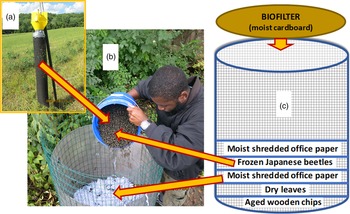
The mass trapping system (Piñero and Dudenhoeffer, Reference Piñero and Dudenhoeffer2018; Fig. 1A) consisted of a 1.2 m long mesh sock attached to a yellow vane funnel (Trécé Inc., Adair, Oklahoma, USA.) and baited with a dual lure containing the P. japonica sex pheromone and floral-based volatiles (Great Lakes IPM, Vestaburg, Michigan, USA). The mesh sock was constructed using aluminum-based New York Wire Screen Wire (Saint Gobain ADFORS Grand Island, New York, USA) and it was folded in half lengthwise to form a cylinder (length: 1.2 m; circumference: 60 cm). The side and bottom edges were creased once and stapled along the seam.
Diagram showing (A) mass trapping system developed for captures of adult Japanese beetles, Popillia japonica, on farms (Piñero and Dudenhoeffer, Reference Piñero and Dudenhoeffer2018), (B) view of a representative compost bin being prepared and (C) representation of the compost bin (only the initial five layers are shown). Layers were repeated until the bin was full. Once the final layer was completed, a final layer consisting of dry leaves was added and they were capped with moist pieces of cardboard that served as a biofilter. The compost bin is not drawn to scale.

Composting bins
Four compost bins were constructed using rings (height: 1.5 m, diameter: 1 m) made with welded fencing wire (14 gauge, 5 cm pullout). Upon ring completion, one layer of landscape fabric was secured around each ring to retain heat and moisture. Rings were then placed on wooden shipping pallets whose surfaces were covered with a layer of landscape fabric to ensure sufficient aeration. Starting on 20 October 2014, Japanese beetles were composted outdoors using the alternating layer method (Rynk and Sailus, Reference Rynk and Sailus1992; Epstein, Reference Epstein1997), adjusted to fit our research purposes. The layers consisted of aged wood chips, dry leaves, frozen Japanese beetles and moist shredded office paper (Fig. 1B and C). The first layer consisted of 5 kg of aged wood chips evenly spread inside the ring's floor. Then, 3 kg of dry leaves was added atop the wood chips. Leaves were collected from the surrounding trees in the area. The third layer (8 cm in thickness) consisted of moistened shredded paper, prepared by filling one bucket with 10 L of water and then shredded paper was added until the water in the bucket just covered the paper. The fourth layer was 4 kg of frozen Japanese beetles. The fifth layer was moist shredded paper. Steps 1–5 were repeated until the bin was full. It took six sets of layers to fill the compost bin. Once the final layer was added the bin was topped off with two buckets of leaves. Those leaves were capped with moist pieces of cardboard that served as a bio-filter. During composting, the biofiltration process reduces the presence of odorous compounds and air pollutants (Haug, Reference Haug1993). Additional moisture (15 L of water per bin) was added on 30 October, after core temperatures were decreasing. With this approach, the primary nitrogen source was the frozen Japanese beetles which, based on samples submitted for chemical analyses (see details below), had an average nitrate content of 0.5 ppm and an average ammonium content of 1219 ppm (Table 1). Overall, 28 kg of frozen Japanese beetles and 180 kg of carbon sources were used to make each compost pile and the estimated initial C/N ratio of each bin was approximately 9:1.
Nutrient content of Japanese beetle carcasses, immature compost (sampled on 11 December 2014) as well as finalized Japanese beetle-based compost and vermicompost mixes used for the two greenhouse experiments

Values represent averages of four samples.
Composting process
Materials in the four bins were composted outdoors for a period of 7 weeks (20 October–11 December 2014). During the first week, the temperatures of the compost piles continually increased until reaching a peak (the highest core temperature recorded was 70°C); temperatures greater than 55°C persisted for nearly 2 weeks, until 4 November (Fig. 2). After that period, temperatures of the compost pile gradually decreased until stabilizing (by 11 November). Mean ambient temperature averaged 10.8°C (range: −2.2 to 22.8°C) during the main composting period (20 October–11 November 2014). On 11 December 2014, the compost was considered to be immature, containing high amounts of ammonium and high pH (8.35; Table 1). Consequently, the material was sieved to remove pieces larger than 2 cm and mixed with additional carbon sources consisting of sphagnum peat moss (Premier Tech Ltd., Québec, Canada), and moist shredded office paper, at equal ratios (1:1:1) to support continuous composting. The resulting Japanese beetle-based compost mix (pH: 6.09) was placed in plastic containers inside the greenhouse (Dickinson Research Center, Lincoln University) and kept between 23 and 26°C for two additional months.
Mean temperature measured daily at the core of a representative compost bin. Mean ambient temperature averaged 10.8°C (range:−2.2 to 22.8°C) during the same time period.

Vermicompost production
One vermicomposting bed was constructed by means of a rectangular frame (length: 3 m, width: 1.2 m; height: 0.3 m) made of pine boards. The frame was positioned on top of a tarp placed on a greenhouse bench to prevent worms from exiting the bed. The frame was divided into three compartments using additional pieces of pine board. Approximately 1000 composting earthworms [Eisenia fetida (Savigny 1826)] (Haplotaxida: Lumbricidae), purchased from Uncle Jim's Worm Farm (Spring Grove, Pennsylvania, USA), were placed in the first compartment containing ca. 50 kg of Japanese beetle-based compost mix. Every 7 days, approximately 50 kg of new compost mix was placed in the adjacent compartment and the closest pine board was removed to allow worms movement toward the new section. Active migration of worms from the worm-digested compost compartment to the adjacent area was observed. After 1 month, the resulting vermicomposting product was harvested, sieved and all worms were removed. Compost that was not exposed to worms was aged in the greenhouse under identical conditions. Four independent samples of compost and vermicompost, along with two samples of frozen Japanese beetle carcass and immature compost (collected on 11 December 2014), and mixed with sphagnum peat moss and moist shredded office paper at (1:1:1 ratios) were submitted to the University of Missouri Soil and Plant Testing Lab (Columbia, Missouri, USA) for analyses of compost characteristics (e.g. pH, soluble salts) and nutrient content.
Lettuce potting studies
Two fully replicated studies were conducted simultaneously at the greenhouse from 12 May to 26 June 2015, using organic lettuce (Summer Crisp cv. Concept) purchased from Johnny's Selected Seeds (Winslow, Maine, USA). Both experiments were conducted using 3.78 L pots (diameter: 28 cm) that contained 2 kg of the growth media described below.
The first experiment aimed at comparing lettuce growth as influenced by synthetic N fertilizer and varying proportions of Japanese-beetle-based compost mixed with commercial germination mix (Berger BM2, Quebec, Canada) containing fine peat moss, fine perlite, fine vermiculite, dolomitic, calcitic limestone and non-ionic wetting agent. Four dosages of 20-0-0 fertilizer (Mg: 8%, S: 11%, B: 0.05%, Cu: 0.05%, Fe: 0.5%, Zn: 0.1%, Mo: 0.001%; Grasshopper Specialty Ag Products, Mount Vernon, Texas, USA) were evaluated: 0 ppm (=potting media alone as control), 50, 100 and 150 ppm. The amounts of N fertilizer chosen are within recommended ranges applied to field-grown lettuce (Bottoms et al., Reference Bottoms, Smith, Cahn and Hartz2012) including the Midwestern USA (Egel et al., Reference Egel, Foster, Maynard, Weinzierl, Babadoost, O'Malley, Nair, Rivard, Cloyd, Kenelly, Hutchison, Piñero, Welty, Doohan and Miller2015) and also within ranges recommended in irrigation water on a ‘constant feed’ basis for lettuce production in soil-less media (Mahlangu et al., Reference Mahlangu, Maboko, Sivakumar, Soundy and Jifon2016).
Each concentration of 20-0-0 fertilizer was also evaluated using compost at 15 and 30% mixture with germination mix. Distilled water was provided once a week for the initial 2 weeks at a rate of 200 mL per plant, and twice a week at a rate of 400 mL per plant until harvest. Fertilizer was applied to the corresponding treatments four times (on 15, 21 and 28 May, and on 4 June). On 26 June 2015, all plants were harvested. Parameters evaluated were fresh and dry shoot weight, and leaf area (expressed in mm2). Leaf area values were recorded using a LI-3100C Area Meter (LI-COR Biosciences, Lincoln, Nebraska, USA). Dry weight was determined after drying shoots in a thermo-ventilated oven at 65°C to constant weight. Treatments were arranged in a randomized block design with four replications per treatment.
For the second experiment, conducted simultaneously as experiment 1 in a different area of the greenhouse, five treatments were compared: (1) potting media alone (control), (2) Japanese beetle-based compost mixed at 15% with potting media (vol:vol), (3) vermicompost mixed at 15% (vol:vol), (4) compost mixed at 30% (vol:vol) and (5) vermicompost mixed at 30% (vol:vol). No synthetic fertilizers were used for this experiment. Experimental conditions were as described for the first experiment. All treatments were arranged in a randomized block design with four replications per treatment.
Statistical analysis
For the first experiment, preliminary analyses involving two-way ANOVAs with replicate as a random factor were used to compare the effects of percentage of Japanese beetle-based compost (0, 15, 30%) and fertilizer application rate (0, 50, 100 and 150 ppm) in the potting media mix on fresh and dry lettuce shoot weight and leaf area. The preliminary analyses revealed significant effects of the two fixed effect factors (see below), but no significant interactions, on any of the response variables. Outcomes of ANOVAs for fresh weight: % material = df2, 18; F = 310.11; P < 0.001; fertilizer rate = df3, 18; F = 12.29; P < 0.001; % material × fertilizer rate = df6, 18; F = 0.96; P = 0.48. Outcomes for leaf area: % material = df2, 18; F = 15.19; P < 0.01; fertilizer rate = df3, 18; F = 12.44; P < 0.01; % material × fertilizer rate = df6, 18; F = 0.54; P = 0.77. Outcomes for dry weight: % material = df2, 18; F = 9.61; P = 0.01; fertilizer rate = df3, 18; F = 10.01; P < 0.01; % material × fertilizer rate = df6, 18; F = 0.52; P = 0.79.
These analyses were followed by one-way analyses to test, separately for each of the three percentages of Japanese beetle-based compost in the potting media mix, the effects of fertilizer concentration on fresh and dry weight, and leaf area. These are the results shown in Figure 3. Data were subject to square-root (X + 0.5) transformation. Data analyses for the second experiment were also conducted using one-way ANOVAs. All statistical analyses were conducted using STATISTICA software (StatSoft, 2001).
Lettuce growth parameters (A) mean shoot fresh weight, (B) leaf area of fresh lettuce leaves and (C) mean shoot dry weight recorded in greenhouse experiment 1. This experiment was aimed at quantifying the effects of varying proportions of compost and vermicompost mixed with commercial germination mix and four dosages of 20-0-0 fertilizer: 0, 50, 100 and 150 ppm.

Results
Nutrient value of compost and vermicompost
Results of chemical analyses conducted on Japanese beetle carcasses and the two types of Japanese beetle-based composts that were evaluated in the greenhouse studies are provided in Table 1. Adult Japanese beetle carcasses were rich in the macronutrients nitrogen, phosphorus and potassium, and in micronutrients such as calcium, phosphorus, magnesium, manganese, copper, zinc and iron. Interestingly, ammonium-N levels (1219 ppm) were high relative to nitrate-N (0.5 ppm) in non-composted Japanese beetle carcasses, while this situation was reversed with aged Japanese beetle compost (5.22 and 779 ppm for ammonium-N and nitrate-N, respectively) and vermicompost (2.62 and 87.7 ppm for ammonium-N and nitrate-N, respectively) that were used for the greenhouse experiments. Overall, the Japanese beetle vermicompost had considerably lower levels of nitrate-N than Japanese beetle-based compost, though this was not reflected in total nitrogen levels of the two composts (0.53 and 0.51, on average, for Japanese beetle compost and vermicompost, respectively). Average nitrate amounts of the Japanese beetle compost averaged 779 ppm (range: 143–1443), which are much higher than those of the vermicompost. Total nitrogen levels of the two resulting (i.e. not immature) Japanese beetle-based composts were 0.53 and 0.51%. Phosphorus and potassium levels of the Japanese beetle composts were lower than those recorded for the immature Japanese beetle compost.
Lettuce potting studies in the greenhouse
The first experiment compared the effects of various N-based fertilizer concentrations in association with various proportions of Japanese beetle-based compost mixed with potting media on lettuce growth parameters. In the absence of any compost, the addition of 20-0-0 fertilizer, regardless of the concentration, significantly increased fresh shoot weight (ANOVA F 3,12 = 18.1, P < 0.001) and dry weight (ANOVA F 3,12 = 7.2, P = 0.005), as well as leaf area (ANOVA F 3,12 = 5.3, P = 0.015) (Fig. 3A and B). A similar pattern was found when Japanese beetle compost was mixed at 15% with potting media (ANOVA F 3,12 = 7.9, P = 0.003; F 3,12 = 4.2, P = 0.029, for fresh weight and leaf area, respectively) (Fig. 3A and B). In contrast, for dry weight, no significant differences among treatments were noted (ANOVA F 3,12 = 0.7, P = 0.559) (Fig. 3C).
When the amount of Japanese beetle-based compost was increased to 30%, the low and intermediate concentrations of fertilizer did not significantly stimulate plant growth and only the highest fertilizer concentration (150 ppm N) was different from the compost mix that lacked fertilizer (ANOVA F 3,12 = 3.5, P = 0.049; F 3,12 = 3.9, P = 0.044, for fresh weight and leaf area, respectively) (Fig. 3A and B). No significant differences among fertilizer concentrations were noted for dry weight when the amount of Japanese beetle-based was evaluated at 30% (ANOVA F 3,12 = 0.5, P = 0.672) (Fig. 3C).
The second experiment compared the effects of Japanese beetle-based compost and vermicompost at two proportions (15 and 30%) on plant growth parameters against potting media alone (control), in the absence of any synthetic fertilizers. Lettuce shoot fresh weight (ANOVA, F 4,15 = 19.4, P < 0.001) (Fig. 4A), leaf area (ANOVA, F 4,15 = 6.9, P = 0.002) (Fig. 4B) and shoot dry weight (ANOVA, F 4,15 = 4.2, P = 0.018) (Fig. 4C) were significantly influenced by treatment. The mean fresh weight of lettuce shoots was significantly greater for the Japanese beetle-based compost and vermicompost treatments than for the germination mix alone. While increasing the amount of vermicompost from 15 to 30% did not result in further increase in mean lettuce fresh shoot weight, plants grown with compost at 30% were significantly heavier than compost 15% mixture (Fig. 4). Regardless of the amount, the addition of either, Japanese beetle-based compost or vermicompost significantly increased plant leaf area (Fig. 4B) and mean plant dry weight (Fig. 4C), compared with germination mix alone.
Lettuce growth parameters (A) mean shoot fresh weight, (B) leaf area of fresh lettuce leaves and (C) mean shoot dry weight recorded in greenhouse experiment 2. This experiment compared the effects of Japanese beetle-based compost and vermicompost at two proportions (15 and 30%) on plant growth parameters against potting media alone (control), in the absence of any synthetic fertilizers.

Discussion
In central Missouri, the mass trapping system developed by Piñero and Dudenhoeffer (Reference Piñero and Dudenhoeffer2018) captured an average of 275 kg of adult Japanese beetles per year (2014–2016 data) when captures across two berry farms are combined. This quantity of beetles trapped per year is enough to make 1375 kg of compost. Composting locally available biomass, such as weed and crop residues, has been investigated as a useful means to supplement the nutrient needs of crops, especially under organic production systems (Das et al., Reference Das, Baiswar, Patel, Munda, Ghosh, Ngachan, Panwar and Chandra2010). The present study evaluated the process of making insect-based compost, documented the high nutritional value of the resulting composted materials and also showed that the individual addition of Japanese beetle-based compost and Japanese beetle-based vermicompost increased lettuce biomass to an extent that was comparable to the addition of synthetic N-based fertilizer. Overall, our results indicate that the particular insect-based compost and vermicompost that were generated in this study had statistically significant positive effects on crop productivity, comparable with that of synthetic N-based fertilizers.
References suggest that the carbon-to-nitrogen ratio of compost should be approximately 20:1 to ensure short-term nitrogen mineralization (Gaskell and Smith, Reference Gaskell and Smith2007). In this study, each compost pile that was prepared incorporated approximately 28 kg of frozen Japanese beetles and 180 kg of carbon sources in the form of dry leaves, moist shredded paper and wooden mulch, for an estimated initial C/N ratio of 9:1. Immature compost (collected on 11 December, 2014, approximately 2 months after initiating the compost process) had a C/N ratio of 10:1 (Table 1), which was increased to circa 20:1 after the immature compost was mixed with shredded paper and sphagnum peat moss. Chemical analyses of the aged Japanese beetle-based compost and vermicompost mixes that were evaluated in the greenhouse study indicated a C/N ratio of 19.22 and 17.25, respectively (Table 1), which approach the favorable ratio of 20/1 (Gaskell and Smith, Reference Gaskell and Smith2007).
The first greenhouse experiment revealed that when Japanese beetle compost was mixed at 15% with potting media the effects of N fertilizer on mean fresh shoot weight was significantly higher. However, when the amount of compost in the mix was increased to 30%, plant biomass was statistically comparable with that recorded when the low and intermediate rates of N-based fertilizer were evaluated. Application of 150 ppm of fertilizer resulted in significantly higher fresh weight than the 0 ppm (control) treatment. The second experiment revealed an excellent performance of Japanese beetle-based compost and vermicompost treatments in the absence of synthetic N fertilizer. These results indicate that insect-based compost and vermicompost can support the organic production of lettuce. In a field-scale study concerning organic lettuce production, Brito et al. (Reference Brito, Monteiro, Mourão and Coutinho2014) documented that compost addition contributed to an average yield raise of 63% when applied at the rate of 15 t ha−1 and doubled lettuce yield for the highest application rate (30 t ha−1) when compared with control plots.
Sources agree that much of total N content in compost is not readily available, but it can be mineralized and subsequently taken up by plants or immobilized, denitrified and/or leached. Amlinger et al. (Reference Amlinger, Götz, Dreher, Geszti and Weissteiner2003) discussed that the availability of N in compost is predominantly dependent on multiple parameters such as C/N ratio of the raw material, composting conditions (mainly aeration, agitation) and time of application, among others. Insects contain varying amounts of chitin, which contribute to the N content of the insect bodies (Ozimek et al., Reference Ozimek, Sauer, Kozikowski, Ryan, JØrgensen and Jelen1985; Majtan et al., Reference Majtan, Bilikova, Markovic, Grof, Kogan and Simuth2007). In the present study, the N content of fresh, frozen Japanese beetles was 10.8% and the resulting N content of the aged Japanese beetle-based compost and vermicompost mixes used in the greenhouse studies was 0.5%, which are comparable with reported levels for other composts in various geographical areas (El-Sayed, Reference El-Sayed2015; Al-Batainaa et al., Reference Al-Batainaa, Young and Ranieri2016; Illera-Vives et al., Reference Illera-Vives, Seoane Labandeira, Iglesias Loureiro and López-Mosquera2017; Bess Dicklow and McKeag, Reference Bess Dicklow and McKeag2018).
The nitrate content of the Japanese beetle-based compost was considered to be high (average value of 779 ppm). This can be explained by the heterogeneity of the samples submitted. It is conceivable that some of the samples that were used for the analyses had larger fragments of Japanese beetle body parts. After vermicomposting, samples seemed to have been more homogenous. In addition, the amount of ammonium was reduced by more than half (i.e. from 5.22 to 2.62 ppm; Table 1) due to the action of earthworms. Both types of Japanese beetle compost are comparable with other composts as a source of plant nutrients (Bess Dicklow and McKeag, Reference Bess Dicklow and McKeag2018). Many plants readily utilize nitrate-N, which was the majority of the N form contained in both composts in this study. The pH of both composts ranged from 6.09 to 7.00; most micronutrients are readily available in this range. The EC levels are comparable yet on the lower range, depending on the source of raw materials, to those reported for other composts (El-Sayed, Reference El-Sayed2015; Illera-Vives et al., Reference Illera-Vives, Seoane Labandeira, Iglesias Loureiro and López-Mosquera2017; Bess Dicklow and McKeag, Reference Bess Dicklow and McKeag2018).
As shown in the present study, using insects as a source of nitrogen and other elements can result in soil amendments that can benefit small-scale farming. Using on-farm resources for composting can improve nutrient recycling and eliminate transport costs of bringing in raw materials or compost from commercial suppliers (DeLuca and DeLuca, Reference DeLuca and DeLuca1997). In some areas of the world characterized by highly leached acidic soils, low availability of nitrogen and phosphorus greatly limit crop production (Das et al., Reference Das, Baiswar, Patel, Munda, Ghosh, Ngachan, Panwar and Chandra2010). As a result, efforts to produce compost using readily-available plant biomass such as grass and weed mixtures have been made (e.g. Das et al., Reference Das, Baiswar, Patel, Munda, Ghosh, Ngachan, Panwar and Chandra2010). In this study, phosphorus and potassium levels of the Japanese beetle compost and vermicompost are lower than commonly found in compost based on manure or yard waste (Amlinger et al., Reference Amlinger, Götz, Dreher, Geszti and Weissteiner2003).
In summary, Japanese beetle biomass can be easily composted and vermicomposted, resulting in high-quality soil amendments. The individual addition of both Japanese beetle-based compost and Japanese beetle-based vermicompost increased the yield of lettuce during the course of the greenhouse studies. These results indicate that Japanese beetles, and potentially other insect species, can be used as a viable nutrient source for crop production. Finding value in Japanese beetle biomass may meet the needs of growers challenged with growing plants using organic fertilizers. In non-organic systems, use of insect-based compost may reduce the need for synthetic fertilizers, hence reducing the indirect energy use associated with fertilizer production and farmer costs. Japanese beetle-based compost and vermicompost have the potential to support small-scale farmers involved in organic, low input and/or integrated production systems.
Acknowledgements
We would like to thank Jacob Wilson, Grato Ndunguru, Isabel Jacome, Jason Miller, Austen Dudenhoeffer, Kaitlyn Kliethermes and Danielle Newman for their assistance and to three anonymous reviewers for their constructive criticism to an earlier draft of this manuscript. This work was supported by the USDA National Institute of Food and Agriculture (NIFA), Evans-Allen research project accession no. 233899.