

1. Introduction
Many developing countries have adopted widening access to education as a major policy goal as it is widely accepted that investing in girls' education has extensive externalities for improving economic and social development. Lawrence Summers, former Chief Economist of the World Bank, argued that educating girls has a higher rate of return than any other investment in the developing world (Summers, Reference Summers1994). In addition to shaping individuals' economic well-being, education also has important implications for their non-pecuniary outcomes (Oreopoulos & Salvanes, Reference Oreopoulos and Salvanes2011). The relationship between female education and demographic outcomes is an important one bearing significant policy implications in developing countries.
It is well-documented that female educational attainment is negatively correlated with fertility, but without accounting for the problem of endogeneity of education this relationship may not be causal. Some recent studies have exploited credibly exogenous changes in schooling resulting from education reforms to estimate the causal effect of female education on fertility, but the findings are not consistent (Black et al., Reference Black, Devereux and Salvanes2008; Lavy & Zablotsky, Reference Lavy and Zablotsky2015; McCrary & Royer, Reference McCrary and Royer2011; Monstad et al., Reference Monstad, Propper and Salvanes2008; Osili & Long, Reference Osili and Long2008). Moreover, much of the research on the causal role of education in fertility outcomes has focused on developed countries, with more limited attention paid to sub-Saharan countries where fertility rates are highest. Women in sub-Saharan Africa, on average, have five children during their reproductive lifespan, compared to a global average of 2.5 children (United Nations, 2015). Thus, investigating the relationship between female education and reproductive behaviors has important implications for policies that focus on reducing fertility rates to lower levels in sub-Saharan countries.
Investigating the effect of female education on fertility is crucial for understanding the non-pecuniary effects of education, considering the complex relationship between fertility and women's overall wellbeing. For example, the reduction in fertility in developing countries is associated with gender equality and women's empowerment in the household (Cleland et al., Reference Cleland, Bernstein, Ezeh, Faundes, Glasier and Innis2006; Upadhyay et al., Reference Upadhyay, Gipson, Withers, Lewis, Ciaraldi, Fraser, M. J. and N.2014). An increase in fertility may limit women's opportunities to pursue activities outside of the household, decreasing their overall status and voice within the household. Additionally, previous studies show that increased family size has negative impacts on marriage stability, women's health, and child quality, although the relationship is not uniform across different settings (Barham et al., Reference Barham, Champion and Foster2021; Booth & Kee, Reference Booth and Kee2009; Cáceres-Delpiano & Simonsen, Reference Cáceres-Delpiano and Simonsen2012; Li et al., Reference Li, Zhang and Zhu2008).
This paper investigates the extent to which female education affects fertility in Malawi, a small lower-income country in southeastern Africa.Footnote 1 Even though the average number of children born alive over a woman's reproductive lifetime decreased from 6.7 to 5.7 between 1992 and 2010, Malawi continues to register high rates of childbearing and population growth. In the period of 1966–2017, Malawi's population more than quadrupled to 17.4 million. The population will increase to 26 million in 2030 even if the fertility rate declines to 4.6 by 2020 (Population Reference Bureau, 2012). Continued population growth will challenge the country's sustainability of development to meet the Millennium Development Goals, despite the government's ongoing efforts to advance economic growth.
Previous studies have demonstrated an inverse relationship between female education and the number of children using data from sub-Saharan African countries (Ainsworth et al., Reference Ainsworth, Beegle and Nyamete1996; Kravdal, Reference Kravdal2002). It is not clear, however, whether this relationship is causal because the omission of unobserved confounding variables such as cognitive ability that is associated with both education and fertility behaviors may lead to biased estimates of the impact of female education. To circumvent the problem of endogeneity of education, this paper exploits an exogenous increase in education generated by the Universal Primary Education (UPE) policy in Malawi to examine the impact of female education on fertility and other demographic-related behaviors. The UPE policy is a nationwide program designed to increase educational attainment through eliminating fees of primary school throughout the country, which intends to make a significant change in the educational opportunities available to Malawian school-age children. Using the UPE policy in Malawi as an instrumental variable for education, the paper presents new evidence on the relationship between female educational attainment and fertility and additionally examines some potential mechanisms through which female education may affect fertility outcomes.
Utilizing a fuzzy regression discontinuity design and drawing on data from the Demographic and Health Surveys (DHS) and the Population and Housing Census (PHC) of Malawi, the paper presents evidence that the policy of removing primary school fees has an economically meaningful impact on educational attainment for rural women but almost no effect on urban females. The policy increased rural women's years of completed schooling by nearly 0.42 years. The results also reveal that the educational gains are associated with an increase in the probability of completing primary schooling and some years of secondary schooling. Furthermore, the paper documents that an additional year of female education decreases the number of children ever born and the number of living children by 0.39 and 0.34, respectively. The balance test results support the validity of the estimation strategy since the UPE policy is not correlated with predetermined characteristics of women in the control and treatment group. The robustness tests, such as placebo experiments, corroborate the baseline findings. Furthermore, using the rich set of information provided by the DHS, the paper conducts a detailed analysis of the potential mechanisms driving the reduction in fertility observed after the reform. The mechanism analysis suggests that female education influences fertility by changing women's desired number of children, delaying women's age at first marriage and age at first birth. Additionally, the study uncovers suggestive evidence suggesting that women with higher education levels tend to marry spouses with higher educational attainments. However, the study does not find a significant impact of female education on women's labor market involvement, their occupational choices, or the use of modern contraceptive method.
This paper makes two main contributions to the literature. First, it provides new evidence on the causal impact of female education on fertility in Malawi, which adds to the studies on the fertility effect of education in the context of a developing country with high birth rates. While there is a growing body of literature examining the causal effect of education on fertility outcomes, only a limited number of studies focus on lower-income sub-Saharan African countries using credible estimation strategies (Keats, Reference Keats2018; Osili & Long, Reference Osili and Long2008; Zanin et al., Reference Zanin, Radice and Marra2015). Following the methodology of Keats (Reference Keats2018) and Behrman (Reference Behrman2015), the current paper uses the fuzzy regression discontinuity design to show that higher levels of female education have a negative effect on completed number of births at mid-30s for women in rural Malawi. This finding extends previous research that has shown that increased female education reduces women's early fertility.
Second, the paper contributes to the literature on the demographic effects of education by shedding light on the potential mechanisms through which female education influences fertility. Specifically, the study finds that the reduction in fertility is likely to be driven by a decrease in women's desired number of children and the postponement of marriage and motherhood. In contrast to previous empirical studies (Cygan-Rehm & Maeder, Reference Cygan-Rehm and Maeder2013; Keats, Reference Keats2018), the paper reveals that education does not affect women's labor market participation and their propensity of having high-paid jobs in the context of Malawi, highlighting the importance of country-specific factors in shaping the mechanisms underlying the relationship between education and fertility. Furthermore, the study suggests that the opportunity cost channel associated with female education plays a limited role in reducing fertility in rural areas where agriculture is the dominant industry employing the majority of female workers.
The paper is organized as follows. Section 2 reviews the literature. Section 3 provides the background of the Malawi UPE program. Section 4 describes the data. Section 5 introduces the empirical strategy. Section 6 presents the results. Section 7 concludes the paper.
2. Literature review
Economics literature has identified several potential channels via which female schooling could influence fertility behaviors. Higher female education leads to higher earnings, which should be positively related to fertility because women with higher incomes can afford more children. However, higher female schooling may lead to a decrease in fertility for several reasons. First, increased women's earnings induced by higher education increases the opportunity cost of time-intensive activities, like childbearing and childrearing. As a result, women might substitute away from time-intensive activities to devote more time to labor market participation (Becker, Reference Becker1981; Willis, Reference Willis1973). Second, parents with higher education tend to invest more children's human capital, which increases the cost of rearing children. The trade-off between quality and quantity leads parents to choose to have fewer but better-quality children (Becker & Lewis, Reference Becker and Lewis1973).Footnote 2 Third, declines in child mortality associated with higher female education may reduce the number of births needed to achieve a given family size (Lam & Duryea, Reference Lam and Duryea1999). Fourth, education may also reduce fertility by increasing women's knowledge about contraception and by making better use of contraceptive devices (Grossman, Reference Grossman1972; Rosenzweig & Schultz, Reference Rosenzweig and Schultz1989). Furthermore, education may directly lower fertility through the “incarceration effect,” which indicates schooling and marriage are incompatible events, thus keeping girls in school reduces their likelihood of marrying and giving birth at a young age (Black et al., Reference Black, Devereux and Salvanes2008). Finally, education may increase women's bargaining power and change their traditional role and status within the family, which enhances women's involvement in fertility decision-making (Mason, Reference Mason1986; Thomas, Reference Thomas1990).
The major challenge in examining the causal effect of female education on fertility is that the unobserved factors could affect both schooling choices and decision to have children. Some studies utilize plausible exogenous changes in education caused by the expansion of schooling or age-at-entry policies to circumvent the endogeneity problem. However, the results of those studies using data from industrialized countries are relatively mixed. For instance, while Black et al. (Reference Black, Devereux and Salvanes2008) find that compulsory schooling laws decrease the incidence of teenage motherhood in the US and Norway, Monstad et al. (Reference Monstad, Propper and Salvanes2008) find no evidence that more education results in decreased completed fertility, although education postpones the age at first birth in Norway. Their findings are consistent with Geruso and Royer (Reference Geruso and Royer2018) who use data from the UK and find that female education lowers teen fertility rates but has no impact on completed fertility by age 45. In contrast, McCrary and Royer (Reference McCrary and Royer2011) find no effect of female education on the timing of first birth exploiting data from Texas and California and using the school entry policy as an instrument for education. Other studies that have employed compulsory schooling reforms as an instrument have found mixed results: Cygan-Rehm and Maeder (Reference Cygan-Rehm and Maeder2013) find that education reduces completed fertility in Germany, while Fort et al. (Reference Fort, Schneeweis and Winter-Ebmer2016) find a positive effect of female education on fertility in Continental Europe and a negative effect in England. Lavy and Zablotsky (Reference Lavy and Zablotsky2015) take advantage of the lifting of travel restriction on Israeli Arabs and find that increased female schooling decreases the completed fertility.
In the setting of sub-Saharan Africa, there are only a few studies using quasi-experimental strategies to explicitly investigate the causal effect of education on fertility. The results of these studies generally suggest a negative relationship between female education and fertility-related outcomes. For instance, exploiting the differences in program exposure by district and birth cohort caused by the introduction of UPE in Nigeria, Osili and Long (Reference Osili and Long2008) find that one additional year of female education decreases women's birth at age 25 by 0.26 births. Keats (Reference Keats2018) draws on the primary school fees elimination policy in 1997 in Uganda and finds that women with more schooling delay the timing of first marriage and first birth, and reduce their total number of children by 0.24 at age 25. In the context of Malawi, Zanin et al. (Reference Zanin, Radice and Marra2015) apply a two-stage generalized additive model to deal with the endogeneity problem and find that the impact of education on fertility exhibits an inverted U-shape. Behrman (Reference Behrman2015) exploits the same education policy used in the current paper and finds that increased female education has a negative impact on women's desired family size in Malawi. Compared to the study of Behrman (Reference Behrman2015), the current study mainly focuses on the effect of female education on realized fertility and additionally investigates the potential channels underlying the relationship, such as the timing of the first birth and of the first marriage, labor market participation, and changes in occupation.
3. Background
3.1 Malawi Universal Primary Education (UPE) program
Primary school enrollment in Malawi has been steadily increasing since Malawi gained independence in 1964. In 1994, after the first multi-party election, the new government introduced the UPE program to increase the primary education enrollment by eliminating the tuition and fees of primary school for all grades.Footnote 3
Before the introduction of the UPE policy, tuition and fees acted as a prominent barrier to education in Malawi for disadvantaged groups such as poor children, girls, and rural residents. In 1993, tuition and fees of primary education averaged 29 kwachas and accounted for 15.5% of the household total cost of primary education, and school uniforms accounted for 60.3% of that cost (Chimombo, Reference Chimombo1999).Footnote 4 Besides abolishing tuition fees, uniforms were made optional and the government paid for basic textbooks and exercise books fees.Footnote 5 Although the cost of attending primary school is low compared to the reported per capita GDP of $120 in 1994, it still represents a considerable cost for the average family given the inequitable distribution of income.Footnote 6 Compared to UPE policies of other sub-Saharan Africa countries, Malawi's UPE policy provides completely free education. Some other countries, such as Uganda, implemented UPE policy in 1997 but still charged other costs including uniforms, textbooks, and exam fees.
The elimination of primary school fees resulted in a significant response. The primary school gross enrollment rate increased from 83.4% in 1993/1994 to 134% in 1994/95 and the primary school net enrollment rate increased from 71.4% to 95% (Chimombo, Reference Chimombo2009).Footnote 7 As the primary school gross enrollment rate is the ratio of the number of children of any age that are enrolled in primary school divided by the number of children of primary school age, it could be bigger than 100%.Footnote 8 Furthermore, the enrollment of the second to last grade (standard 7) and final grade (standard 8) of primary schooling increased by 47 and 76%, respectively, during the same period (UNICEF, 2009).Footnote 9
The UPE program was implemented after the election of a new government, which is a result of the first democratic election since independence. The policy was implemented in September 1994, around four months after the election. The promise of the abolition of primary school fees as a means of increasing access to education was high on the agenda of most political parties during the 1994 general election. Once in power, the party that won the election immediately fulfilled its pledge.Footnote 10 In order to guarantee that the benefits of this education policy spread to primary school-aged children, the Ministry of Education launched a mass media campaign to ensure that the public was aware of the policy. To accommodate the influx of new students, the government recruited and trained 20,000 new teachers and significantly increased budgetary allocation to the education sector to build schools and pay teachers' salaries. Education spending rose from 13% of the total government budget in 1994/95 to 20% in 1997/98 (Kattan, Reference Kattan2006).
3.2 Malawi education system
Malawi's education system operates on an 8-4-4 system and is made up of eight years of primary schooling (referred to as standard 1 to standard 8), four years of secondary schooling (referred to as form 1 to form 4), and four years of university education. Although primary education became free in 1994, it was not compulsory in law. At the end of primary school, students sit for the Primary School Leaving Certificate Examination (PLSCE), which determines their eligibility for entry into secondary school. Participation in secondary school remains limited and the gross enrollment ratio of secondary school in Malawi is only 36.9% of secondary-school-aged youth according to the Malawi Demographic and Health Survey (2015).
Therefore, primary education is the highest level of schooling attained for most people in Malawi.
The official age of entry into primary school is 6 years old, and the school calendar runs from October to July. A student who progresses through school on time and without any interruptions would be expected to finish primary school at age 14. However, delayed school entry is very common in Malawi, which results in many students who are enrolled behind the appropriate grade for age (Grant, Reference Grant2015). Malawi National Statistics Office in 2003 reported that 65% of primary school students were overage for their grade. Kadzamira and Chibwana (Reference Kadzamira and Chibwana2000) found that, in rural areas, the mean age of standard 1 pupils was 7.2 for girls and 7.5 for boys in 1997. The late entry implies that students are more likely to finish their primary education at age around 15 instead of 14 and that girls who were aged 15 or younger in 1994 should be exposed to the UPE reform, while girls who were 16 or older in 1994 were not likely to be exposed to the education policy.
4. Data
This paper uses data from two sources to examine the relationship between female education and fertility outcomes. The primary data source is the recent three waves (2004, 2010, and 2015) of DHS of Malawi. The DHS of Malawi is a nationally representative survey and provides cross-sectional information on a variety of topics about reproductive-aged (15–49) women's lives, including their socioeconomic and demographic characteristics. The DHS also contains a detailed fertility history of respondents, which helps determine women's number of births at any given age.
The second data source is the 2008 PHC undertaken by the National Statistical Office of Malawi. The 2008 PHC is the fifth in a series of decennial censuses that have been conducted in Malawi since the country attained its independence in 1964.Footnote 11 Similar to the DHS, the PHC contains individual pre-determined characteristics and information on schooling attainment and women's fertility. The key advantage of the census data is its large sample size. However, a limitation of the PHC is the lack of information on birthdays of the respondents' children, which makes it impossible to determine the age at which mothers gave birth to their offspring. Therefore, the PHC cannot be utilized for the analysis of the impact of female education on the timing of birth, although it can be employed to analyze the impact of education on total fertility. As the DHS provides more detailed information of the respondent, the paper uses the DHS in the main analysis and reports the estimation results employing the data from PHC in the appendix as a robustness check.
To examine the effect of the education policy, I divide women into the treatment group and control group according to woman's age in 1994. Women aged 15 or younger in 1994 would be affected by the policy. Women aged 16 or older in 1994 would not be affected because they were too old to attend primary school. However, some individuals aged 16 in 1994 could also be affected by the policy because grade repetitions are common in the primary school system of Malawi. To reduce the measurement error in the treatment, I exclude individuals aged 16 in 1994 (pivotal cohort) in the baseline analysis. I include individuals born 6 years before and after the pivotal cohort in the estimation sample. (The selection of the years of cohorts will be discussed below.) The treatment group includes women aged 10–15, and the control group includes women aged 17–22 when the education reform became effective in 1994. Individuals in the study sample were born between 1972 and 1984.Footnote 12 In the section of robustness check, I test the sensitivity of the baseline estimates by including the individuals aged 16 in 1994 and by excluding individuals aged 15 and 16 in 1994 in the analysis.
The independent variable of interest is education, which is measured as years of completed schooling by combining information on educational level attended and the grade attained. The outcome variable is measured as the number of children ever born to each female respondent. Another alternative measure of fertility is the number of living children to the respondent. The above two fertility measures are both reported in the data from the DHS and PHC.
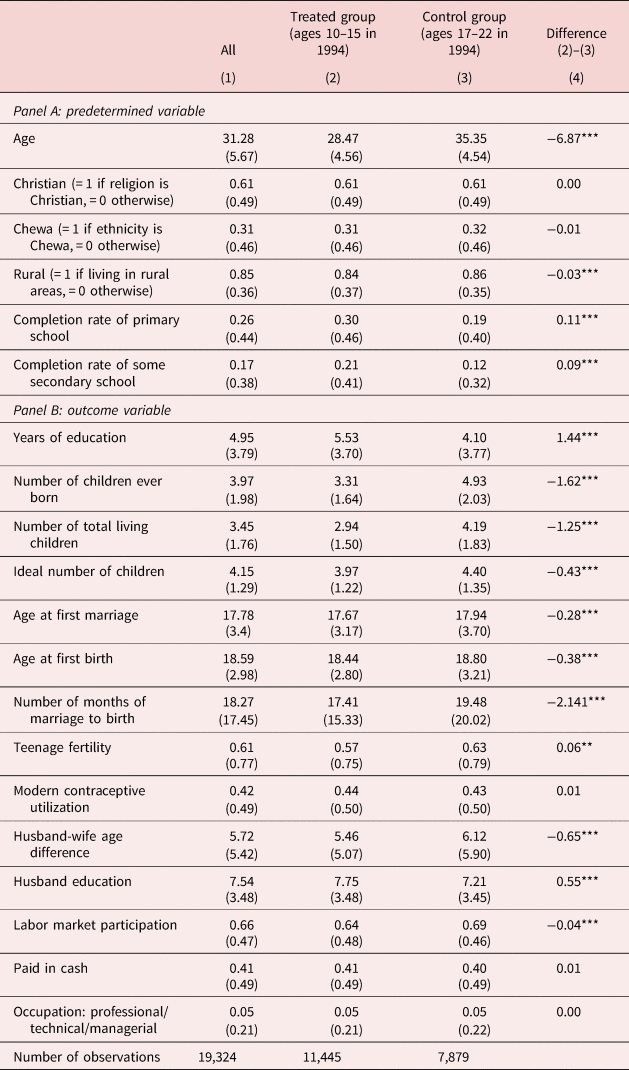
Table 1 provides summary statistics of key variables of the DHS by exposure to the 1994 UPE policy. As shown in the table, women in the treatment group are 7 years younger than their counterparts in the control group. The average years of education of females in the analysis is about 5 years. Women exposed to the reform have more years of education, higher primary school completion rate, and a higher rate of completing some secondary school compared to women not exposed to the reform. The t-tests in column (4) show that the two groups are similar regarding ethnicity and religion. Approximately 85% of women in the survey live in rural areas. The descriptive statistics of the data of the PHC are presented in Table A.1 in the appendix.
Summary statistics of the DHS

Notes: Standard deviations are reported in parentheses. ***, **, and * indicate significance at the 1, 5, and 10% levels.
5. Empirical strategy
The relationship between fertility and female schooling is analyzed using the following basic regression model:

where Y i stands for the fertility outcome of woman i, Schooling i refers to individual i's educational attainment which is measured by years of completed education. The vector X i includes individual characteristics including age in 1994, religion, and ethnicity. The error term $\epsilon _i$ represents unobserved individual attributes which are likely to be correlated with both the individual's years of schooling and fertility. The regression controls for district fixed effects γ r, survey year fixed effects σ t. District fixed effects filter out observed and unobserved characteristics that are shared by all individuals in a given district of residence. Standard errors are clustered at the district-by-birth cohort level. β 1 is the coefficient of interest, which captures the effect of education on individuals' number of children.
Simple OLS estimation of equation (1) would result in biased estimates of the coefficient β 1 if schooling is not exogenously determined. To address the problem of endogeneity of education, the study exploits the exogenous variation in the educational attainment induced by the primary school fees elimination in Malawi in 1994 and applies an instrumental variable (IV) strategy to estimate the causal fertility effect of education.
The effect of education on fertility is estimated using a two-stage least squares (2SLS) estimation strategy. The first-stage equation estimates the following relationship:

where Z is the reform-related instrumental variable (=1 if the woman aged 15 or younger in 1994; =0 otherwise). The term 16-Age1994 represents respondents' age distance to the pivotal cohort, who were aged 16 in 1994. The two interaction terms control for the linear trends in education attainment at the birth cohort level. The predicted value of Schooling i from equation (2) is then used to estimate the second stage:

In equation (3), λ 1 identifies the local average treatment effects (LATE) of female education, which is the effect of education on fertility among women whose educational attainment was altered due to their exposure to the reform.Footnote 13
Including more cohorts around the pivotal cohort in the estimation could allow me to estimate the model with a larger sample size, but utilizing the variation obtained from cohorts that are relatively far from the pivotal cohort may lead to biased results. On the other hand, shortening the bandwidth may produce imprecise estimates of the treatment effect because of smaller sample size. In the main analysis, I use a bandwidth of 6 years near the cutoff, which is obtained from the first-stage regression by using the optimal bandwidth selection method developed by Imbens and Kalyanaraman (Reference Imbens and Kalyanaraman2012).Footnote 14 The estimates barely change with different bandwidths, which is shown in the section of robustness analysis.
The estimation approach is consistent with a fuzzy regression discontinuity design, which provides estimates that are as credible as those from randomized experiments under relatively weak assumptions (Lee & Card, Reference Lee and Card2008). Women who were born close to the pivotal cohort would be expected to be similar in observed and unobserved characteristics other than their exposure to the UPE policy. Therefore, any discontinuities in the outcome of interest at the threshold can be attributed to the causal effects of the changes in schooling. Although the exclusion restriction is not testable directly, an implication is that women near the threshold should be similar in terms of their predetermined characteristics. To validate this assumption, I examine whether the UPE policy is significantly associated with the women's characteristics including ethnicity (Chewa, Lomwe, Yao, Tumbuka, and Ngoni) and religion (Christian, CCAP,Footnote 15 and Muslim). Table A.2 shows that most coefficients of the UPE policy are not statistically significant, which suggests that the control variables are smoothly distributed across the discontinuity.Footnote 16
6. Results
6.1 The effect of the UPE policy on female schooling
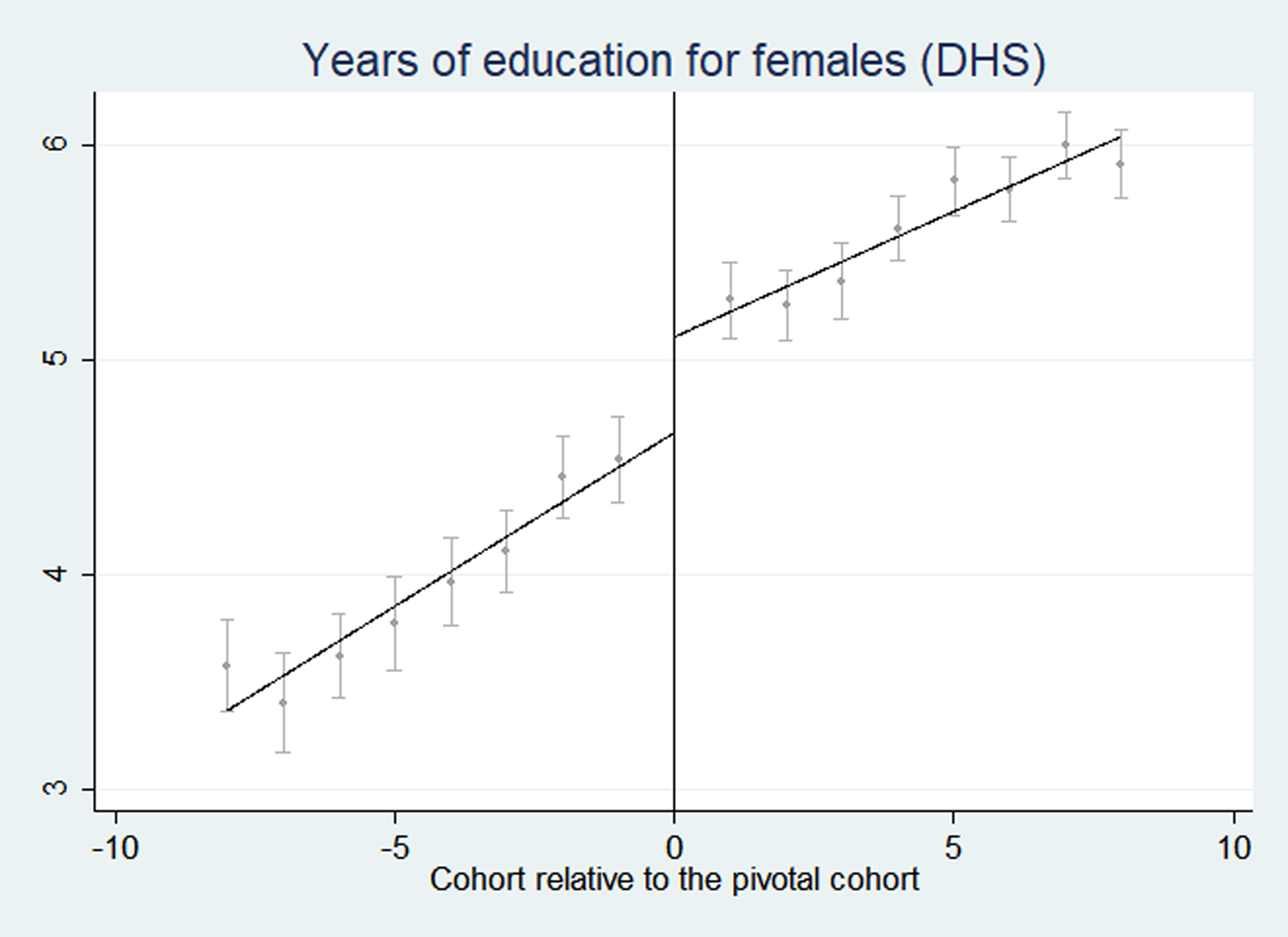
I start the empirical analysis by examining whether the education reform has any influence on women's educational attainment. Figure 1 provides a graphical presentation of the average number of years of education for birth cohorts before and after the pivotal cohort using data of the DHS. Figure 1, with a 95% confidence interval bar, reveals a distinct discontinuity in average years of schooling between the control and treatment cohorts at the threshold. This indicates the effectiveness of the UPE policy in enhancing women's educational attainment.
Female years of education.

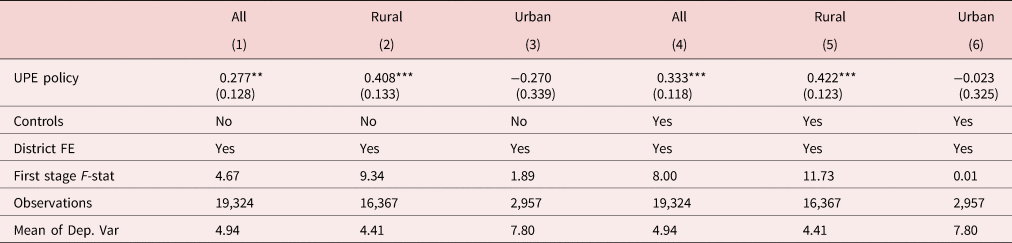
Table 2 displays the estimates of the impact of the UPE policy on educational achievement based on data of the DHS for the pooled sample, and for the urban and rural females, respectively. All specifications control for district fixed effects and survey year dummies, while only columns (4)–(6) control for women's covariates. For the purpose of comparison, columns (1)–(3) report the estimates without individual controls. Column (4) of Table 2 shows that the UPE policy has a significant positive impact on women's years of schooling for the full sample. The policy leads women's educational attainment to increase by 0.33 years. However, columns (5)–(6) indicate that the effects of the education policy are heterogeneous across rural and urban women. Column (5) shows that the UPE policy increases educational attainment by 0.42 years (10% increase) for women living in rural areas, after controlling for covariates. The first-stage F-statistics is above the rule-of-thumb threshold of ten. Columns (6) of Table 2 presents that women living in urban areas are not significantly affected by the UPE policy, probably because school fees are not a constraining factor for women living in urban areas who have better financial resources. The estimate is consistent with Fig. A.1, which shows that there is no significant jump in educational attainment at the cutoff for urban women. The impact of UPE policy on women's schooling attainment is confirmed by a similar analysis using data of the PHC with a larger sample size (see Table A.3). In the following study, the paper restricts the study sample to females living in rural areas.
First stage results: the impact of the UPE policy on female schooling attainment

Notes: Standard errors are clustered at the district-by-birth cohort level and reported in parentheses. UPE policy = 1 if the person was born between 1979 and 1984, it is zero if the year of birth is between 1972 and 1977. The 1978 cohort is excluded because the extent to which those born in 1978 were affected by the UPE policy is uncertain. Individual controls include religion, ethnicity. Each specification controls for district fixed effects and year of survey fixed effects. ***, **, and * indicate significance at the 1, 5, and 10% levels.
Figures A.2 and A.3 show that the introduction of UPE policy not only increased rural women's propensity of completing primary education but also improved the propensity of completing some secondary education, which suggests that the primary school fees elimination policy affects women's educational achievement beyond the primary schooling level even though school fees are only eliminated for primary schooling. Columns (1) and (2) of Table A.4 show that the UPE policy increased rural women's probability of completing primary schooling by 4 percentage points (27% increase), and improved their probability of having attended secondary education by 3.8 percentage points (48% increase) using the DHS, which is consistent with the results shown in columns (3) and (4) using the PHC. By and large, estimates using both datasets suggest that the reform has a favorable effect on women's education in rural areas.
I use a similar specification to test whether the UPE policy affects male educational attainment. The results in Table A.5 show that the relationship between the exposure to the UPE policy and men's years of schooling is not statistically significant. In Malawi, parental preference for educating their sons over daughters was quite pronounced if a family can only afford education for some of their children, which indicates that girls are more likely to drop out of school in comparison to boys due to financial reasons. The policy of eliminating primary school fees significantly reduced parents' financial burden of educating their children, thus probably made girls benefit more from the policy.
6.2 The effect of education on women's fertility
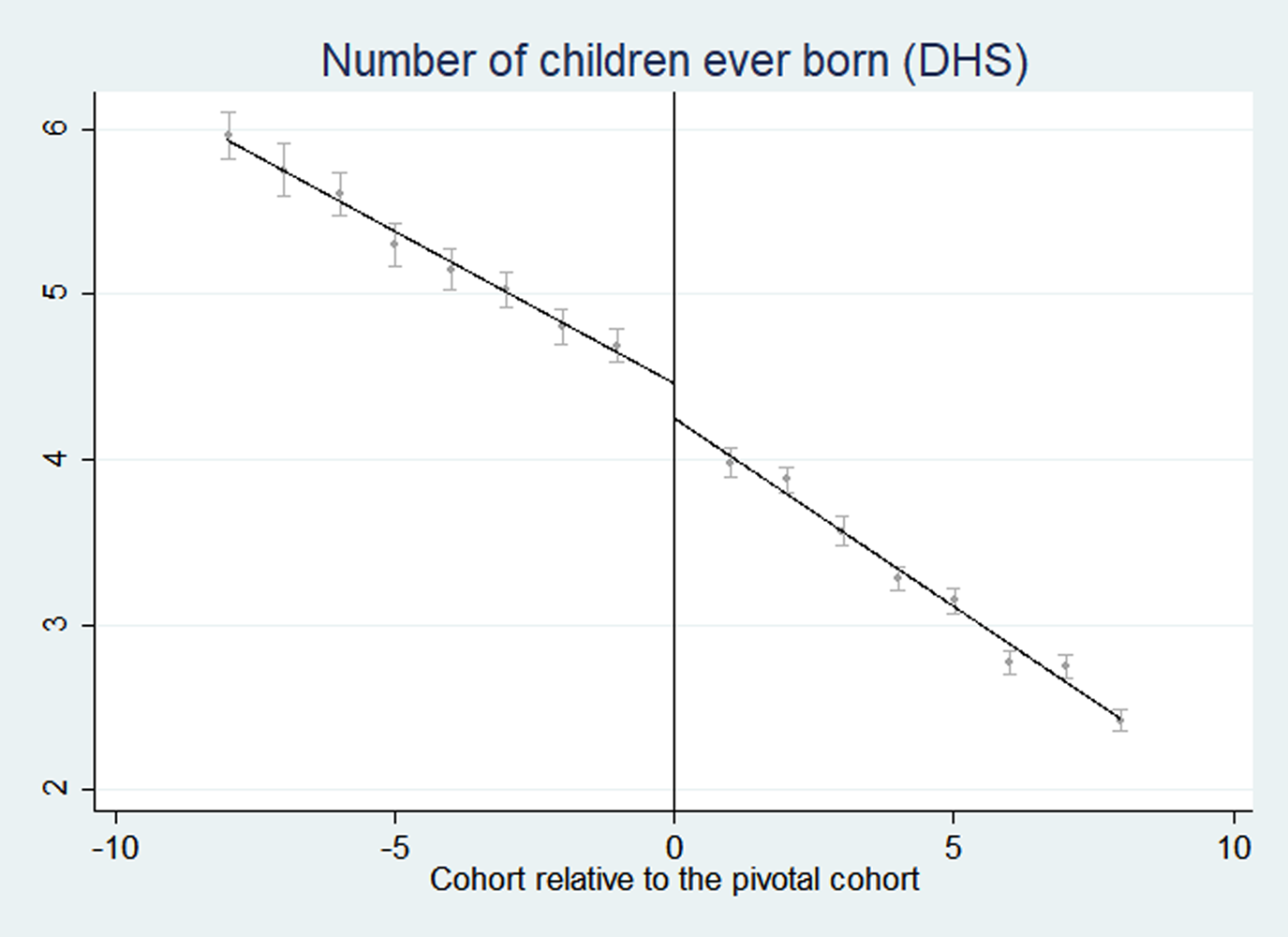
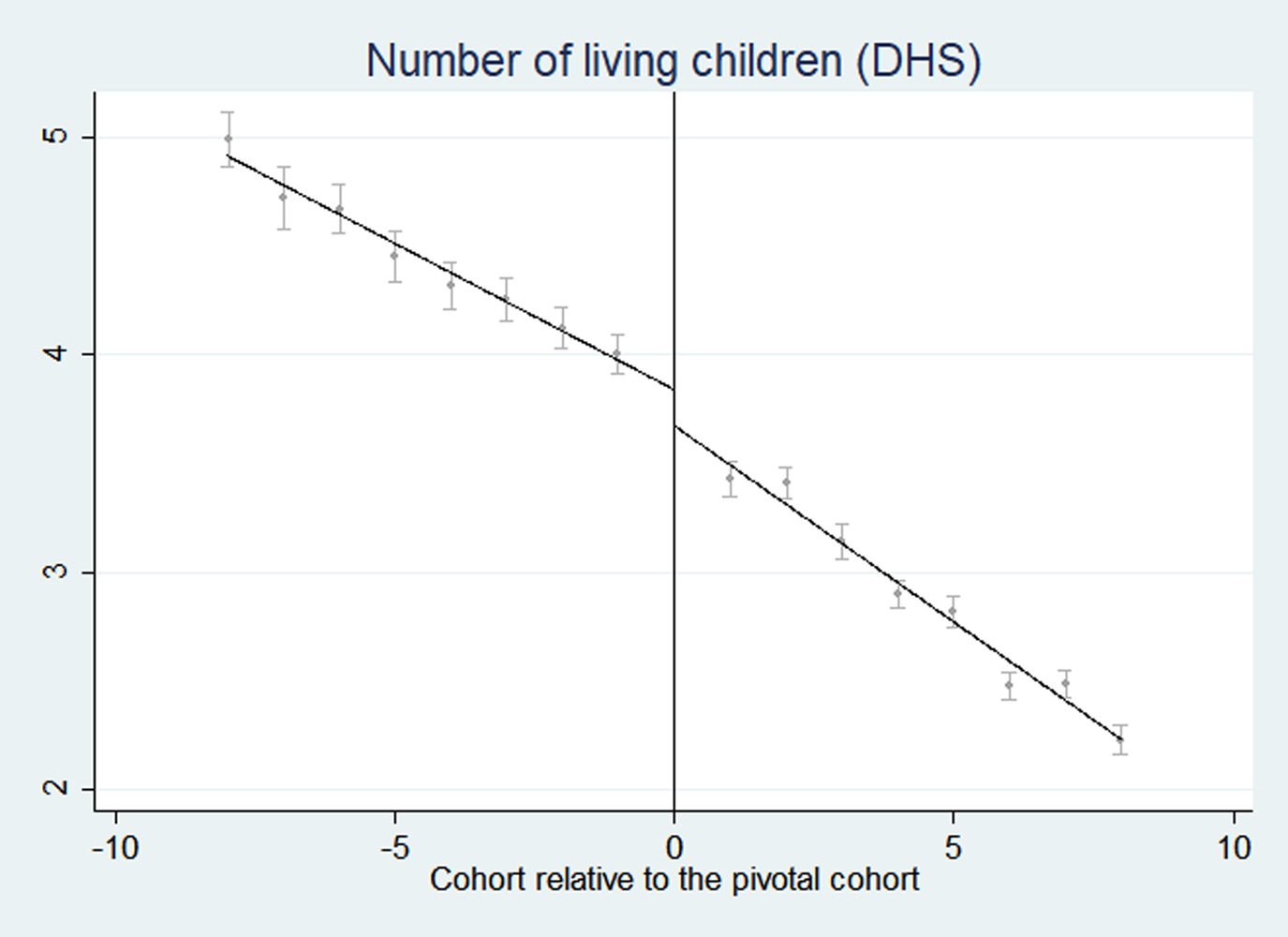
This section turns to the discussion of the causal effect of female education on fertility outcomes. As shown in Figs 2 and 3, there is a discontinuous decrease in the number of children ever born and the number of living children at the threshold, which coincides with the jump in women's educational attainment. However, this jump in fertility disappears for women in urban areas, as shown in Figs A.4 and A.5 in the appendix.
Number of children ever born.

Number of living children.

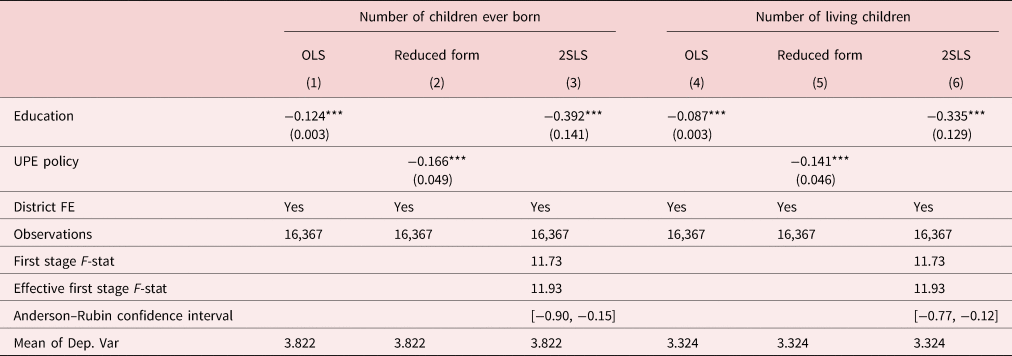
Table 3 reports the estimated coefficients of education on fertility outcomes using the DHS. For the purpose of comparison, I present the OLS estimates in columns (1) and (4). The OLS estimates show a negative and statistically significant associated relationship between female education and fertility. Specifically, one additional year of female education is associated with 0.12 fewer children ever born and 0.09 fewer living children, which corresponds to a reduction of 3.2% and 2.6% at the mean, respectively.
Impact of female education on fertility

Notes: Education refers to the respondent's years of schooling. UPE policy = 1 if the person was born between 1979 and 1984, it is zero if the year of birth is between 1972 and 1977. The 1978 cohort is excluded because the extent to which those born in 1978 were affected by the UPE policy is uncertain. Standard errors are clustered at the district-by-birth cohort level and reported in parentheses. Individual controls include religion, ethnicity. Each specification controls for district fixed effects and year of survey fixed effects. ***, **, and * indicate significance at the 1, 5, and 10% levels.
The 2SLS estimates are presented in columns (3) and (6). One additional year of schooling leads to 0.39 fewer children ever born and 0.34 fewer living children. Both of these estimates are statistically different from zero at the 1% level. These results show that the magnitude of OLS estimates is smaller than that of 2SLS estimates, which indicates that there are likely some unobserved factors positively correlated with both education and fertility, leading to bias toward 0 in OLS estimates. An alternative explanation is that 2SLS estimates capture the LATE of female education, which is the effect of education on fertility for women who changed their educational attainment because they have been affected by the reform (compliers). The marginal effect of education for compliers is likely to be larger since the primary effect of the UPE policy is at the bottom of the schooling distribution.
One concern is that the reform may have influenced the women's fertility decision through indirect channels, such as the effect on women's peers, not solely through women's education. To address this concern, I also present the results of a reduced-form analysis, which does not rely on the assumption that the reform only affects fertility through the woman's education. Columns (2) and (5) of Table 3 report the reduced-form estimates of the effects of the UPE policy on fertility. The estimates indicate that individuals impacted by the policy exhibit lower fertility rates. This finding aligns with the analysis provided by the 2SLS estimate, which suggests that the increase in female schooling, as a consequence of the UPE policy caused a decline in fertility. Specifically, the UPE policy decreases women's number of children ever born by 0.17 and the number of living children by 0.14. Furthermore, I conduct a parallel analysis using data from the PHC. As shown in Table A.6, one additional year of education decreases women's number of children ever born and living children by 0.50 and 0.34, respectively, which is in line with the baseline results obtained using the DHS data.
As a robustness check for the instrument's relevance, I report the effective first-stage F-statistic proposed by Olea and Pflueger (Reference Olea and Pflueger2013). The effective F-statistic is 11.93, which falls below the critical value cutoff of 23.1, indicating caution regarding the strength and credibility of the instrumental variable. This cutoff corresponds to a test of IV relative bias of no more than 10% with a significance level of 5%. Interestingly, when I conduct the test using data from the PHC with a larger sample size, as shown in Table A.6, the effective F-statistic improves to 24.04. This is slightly above the critical value of 23.1, suggesting a more robust instrument in this larger dataset. The estimates derived from both datasets are similar in magnitude, which indicates that the effect captured by the IV is stable and consistent. Furthermore, following the recommendation by Andrews et al. (Reference Andrews, Stock and Sun2019), I have also relied on identification-robust Anderson–Rubin confidence intervals for the analysis. In the case of a single instrument, the Anderson–Rubin confidence intervals are efficient regardless of the instrument's strength. The findings from this approach are encouraging: the zero value lies outside the 95% confidence intervals in both datasets, supporting the interpretation of statistically significant findings.
6.3 Robustness checks
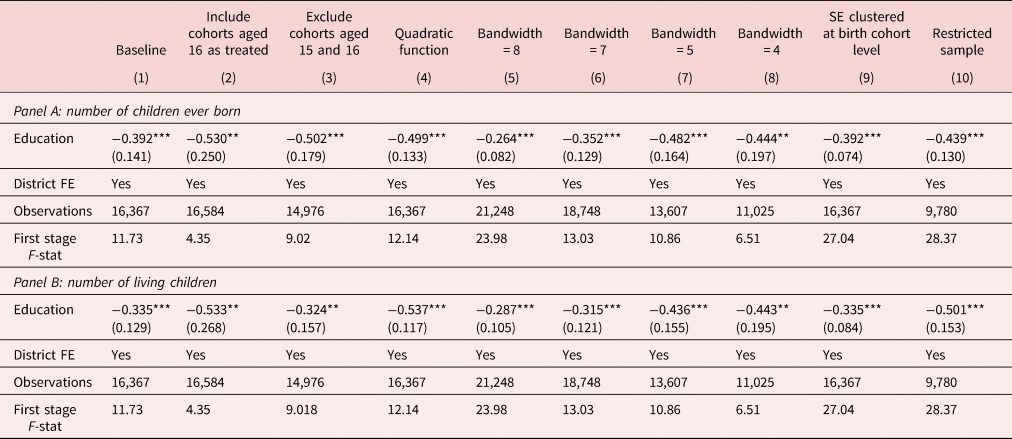
To evaluate the robustness of the baseline results, I conduct a set of sensitivity analyses. First, I investigate whether the result is robust to the inclusion of the pivotal cohort in the regression by assigning the pivotal cohort as the control group. The other alternative specification to reduce the measurement error in the treatment is to exclude both cohorts aged 15 and 16 in 1994. Columns (2) and (3) of Table 4 show that the estimated coefficients of these two specifications are similar to the baseline estimates.
Impact of female education on fertility in various specifications

Notes: Education refers to the respondent's years of schooling. In column (10), restricted sample denotes the subset of individuals who have never migrated. Standard errors are clustered at the district-by-birth cohort level and reported in parentheses. Individual controls include religion, ethnicity. Each specification controls for district fixed effects and year of survey fixed effects. ***, **, and * indicate significance at the 1, 5, and 10% levels.
Second, I further examine whether the results are sensitive to the change in the order of the polynomial function of birth cohorts. In the baseline analysis I control for the piece-wise linear polynomial function of birth cohorts, but the treatment and the control group might differ in their unobserved characteristics, which are not captured by the linear cohort trends. Allowing for a quadratic polynomial function of the birth cohort is one way to increase the flexibility of this control variable. Column (4) of Table 4 shows that the results obtained from this exercise are in line with those obtained from the baseline specification.
Third, as mentioned in the section of empirical strategy, the choice of bandwidths of the pre- and post-reform cohorts introduces a trade-off between efficiency and bias. To test whether the estimates are sensitive to the choice of bandwidths, I try different bandwidths varying from 8 to 4 before and after the pivotal cohort. Columns (5)–(8) of Table 4 show that the estimates are statistically significant and that the magnitudes of the coefficients are in line with the baseline findings. It is worth noting that the first-stage F-statistics are smaller than 10 when the bandwidth is 4. This is not surprising because the smaller sample size as a result of narrower bandwidths would lead the coefficient to be less precisely estimated although a narrower bandwidth can minimize the bias associated with secular time trends. In general, the estimates of the effect of education on fertility outcomes are stable for different bandwidths. Standard errors are clustered at the district-by-birth cohort level in the main specification. As a robustness check, I estimate the standard errors clustered at the birth cohort level. Column (9) of Table 4 shows that the significance of the estimates barely changes compared to the baseline results. Additionally, the estimates are consistent with the baseline findings when I perform the above robustness checks employing data from the PHC (see Table A.7).
Fourth, one concern related to the empirical methodology is that the DHS does not record the location of the place of birth, which may cause biases in estimates due to migration. Fortunately, the DHS records the number of years the respondent has lived in the village, town, or city where she was interviewed. To alleviate the concern caused by migration, I restrict the sample to the individuals who have never migrated. Column (10) of Table 4 shows that the estimates are quantitatively similar to the baseline results, which indicates that migration may not be a serious problem in the analysis.
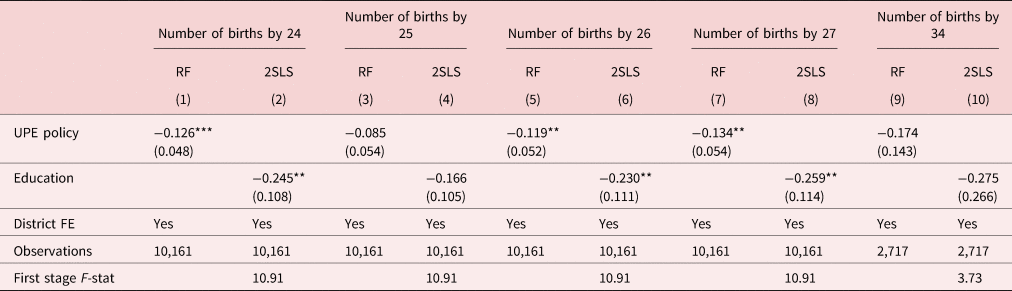
Fifth, to ensure that the baseline estimates are not driven by a particular wave of the data, I estimate the effect of education for each wave of the DHS separately. As shown in Table 5, although some coefficients are not estimated precisely most likely because of the smaller sample size, the sign and magnitude of the estimates are consistent with the baseline estimates shown in Table 3. Additionally, I examine whether the fertility effect of education is robust to alternative measures of fertility. Specifically, I replace the outcome variable with women's number of births by age 24–27. To do that, I only use the recent two waves of the DHS (2010 and 2015).Footnote 17 The study sample includes women aged between 27 and 37 in 2010, and women aged between 32 and 42 in 2015. Table 6 shows that female education has a negative impact on women's overall fertility between the ages of 24 and 27, with the exception of the estimate for the number of births at age 25, which is not statistically significant. The estimated effect size is similar to those found in previous studies, such as Osili and Long (Reference Osili and Long2008) and Keats (Reference Keats2018), which show evidence of a reduction of 0.2–0.3 births for each additional year of education in Nigeria and Uganda.
Impact of female education on fertility using three waves of DHS separately

Notes: Education refers to the respondent's years of schooling. Standard errors are clustered at the district-by-birth cohort level and reported in parentheses. Individual controls include religion, ethnicity. Each specification controls for district fixed effects and year of survey fixed effects. ***, **, and * indicate significance at the 1, 5, and 10% levels.
Impact of female education on alternative fertility measures

Notes: RF is short for “reduced form.” Education refers to the respondent's years of schooling. UPE policy = 1 if the person was born between 1979 and 1984, it is zero if the year of birth is between 1972 and 1977. The 1978 cohort is excluded because the extent to which those born in 1978 were affected by the UPE policy is uncertain. Standard errors are clustered at the district-by-birth cohort level and reported in parentheses. Individual controls include religion, ethnicity. Each specification controls for district fixed effects and year of survey fixed effects. ***, **, and * indicate significance at the 1, 5, and 10% levels.
Lastly, one may argue that early fertility is less indicative of women's completed fertility over the life cycle. To alleviate this concern, I examine whether female education affects women's total fertility at age 34 by restricting the study sample to women aged between 34 and 40 in the 2015 DHS. In this case, I can only include three cohorts before and after the pivotal cohort in the study sample. Column (10) of Table 6 shows that one additional year of female education decreases women's number of births by 0.28, which is similar in magnitude to the estimates of education on total fertility at the age between 24 and 27, although the coefficient is not estimated precisely due to the smaller sample size.
6.4 Placebo tests
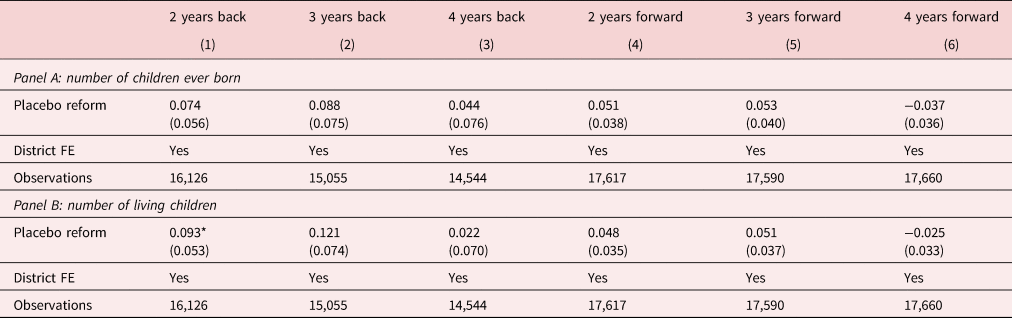
The validity of the identification strategy relies on the assumption that the education policy only affects fertility through its effect on individuals' educational attainment. One potential concern is that the reform exposure variable may pick up some structural changes or unspecified time trends instead of the true treatment effect of the UPE. To address this concern, I create placebo reforms by moving the year of the reform two, three, and four years back and forward in comparison to the actual year, while keeping the number of cohorts before and after the pivotal cohorts consistent with the baseline analysis. The placebo reforms should have non-significant impacts on fertility. As reported in Table 7, the estimate of each placebo reform is generally small in magnitude and statistically insignificant, which provides supportive evidence that the main results are due to the implementation of the UPE policy as opposed to other unobserved societal changes. The pattern of the estimates barely changes using the data from the PHC (see Table A.8).
Placebo test

Notes: The estimates presented in Table 7 are derived from a reduced-form specification. This approach is used to assess the impact of the policy by shifting the year of the reform both backwards and forwards, while keeping the number of cohorts before and after the pivotal cohorts consistent with the baseline analysis. In the placebo tests conducted in columns (1)–(3), the treated cohorts identified in the baseline analysis are not excluded. Each column represents a different hypothetical scenario, with the year of the reform moved backward and forward by 2, 3, and 4 years, respectively. These different scenarios may have led to variations in the available data, causing the number of observations to differ for each placebo test. Standard errors are clustered at the district-by-birth cohort level and reported in parentheses. Individual controls include religion, ethnicity. Each specification controls for district fixed effects and year of survey fixed effects. ***, **, and * indicate significance at the 1, 5, and 10% levels.
6.5 Potential mechanisms
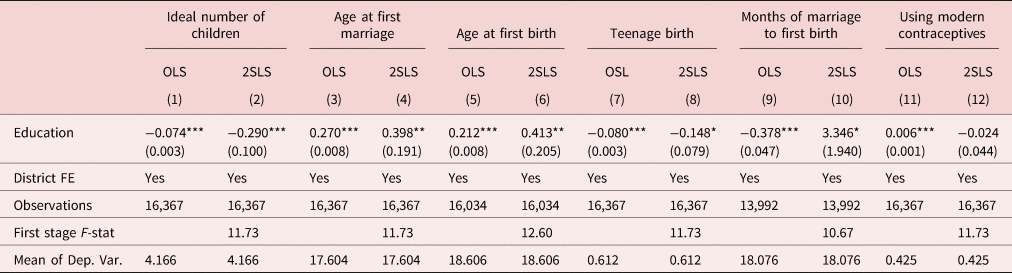
The analysis has provided consistent evidence that female education has a negative effect on women's number of children. In this section, I analyze the potential channels underlying the relationship between female education and fertility. As discussed in the literature review, education may have a negative impact on fertility in multiple ways including labor force participation (Becker, Reference Becker1981; Willis, Reference Willis1973), positive assortative marriage matching (Behrman & Rosenzweig, Reference Behrman and Rosenzweig2002), quality–quantity tradeoff (Becker & Lewis, Reference Becker and Lewis1973), knowledge and use of modern contraceptive methods (Grossman, Reference Grossman1972; Rosenzweig & Schultz, Reference Rosenzweig and Schultz1989), and postponement of the timing of the first birth and marriage (Black et al., Reference Black, Devereux and Salvanes2008). While it is not possible to test all of these possible mechanisms, the rich set of information provided by the DHS allows me to test some of those pathways underlying the fertility effect of female education, such as fertility preferences, age at first marriage and first birth, modern contraceptive use, husband's characteristics, and females' labor force participation and occupation. To examine these potential mechanisms, I estimate 2SLS equations similar to equation (3), in which the outcome variable is replaced by these intermediate variables.
Column (2) of Table 8 shows that higher female education significantly decreases women's desired number of children. Specifically, each year of female education reduces the ideal number of children by 0.29. One potential explanation is that increased female education may shift women's fertility preference toward improving the quality of their offspring, which makes women prefer a smaller family size.Footnote 18 Also, women with higher educational attainment encounter higher opportunity cost of childbearing, yielding lower desired fertility.
Impact of female education on reproductive behaviors

Notes: Education refers to the respondent's years of schooling. Standard errors are clustered at the district-by-birth cohort level and reported in parentheses. Individual controls include religion, ethnicity. Each specification controls for district fixed effects and year of survey fixed effects. ***, **, and * indicate significance at the 1, 5, and 10% levels.
Columns (4) and (6) of Table 8 show that each year of education postpones women's age at first marriage and age at first birth by 0.40 and 0.41 years, which suggests that female education could also decrease fertility by postponing the timing of marriage and childbirth. These findings can be partly explained by the “incarceration effect” of education because keeping girls in school prevents them from getting married and giving birth (Black et al., Reference Black, Devereux and Salvanes2008). Furthermore, the impact of female education on teenage births is examined. As shown in column (8), the finding suggests that increasing the duration of female education by one year leads to a significant reduction of 0.15 in the number of children at age 18. Moreover, column (10) indicates that increased female education postpones the first birth within marriage. One additional year of female education increases the interval between marriage and the first birth by 3.35 months. Previous studies also suggest that female schooling reduces fertility by improving their knowledge about modern contraceptive use (Rosenzweig & Schultz, Reference Rosenzweig and Schultz1989). However, as shown in column (12), female education has no impact on the likelihood of modern contraceptive use.
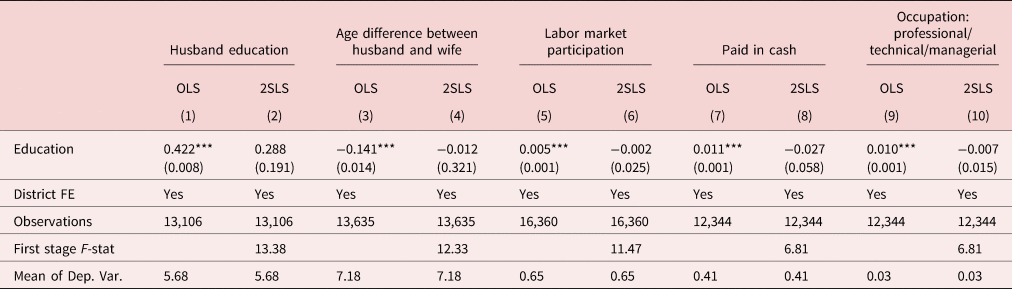
The current study further explores the impact of women's education on the characteristics of their husbands. In line with theories of positive assortative mating, one might anticipate that women with higher educational levels are often paired with spouses who are similarly well-educated, potentially influencing preferences for child quality over quantity. Column (2) of Table 9 shows that better educated women are likely to marry better educated husbands. Specifically, a one-year increase in female education is positively correlated with 0.29 years of husband education while this coefficient is estimated with some imprecision. Additionally, column (4) reveals that female education does not significantly alter the age gap between spouses. Turning to the implications of female education on labor market outcomes, the classic economic model of fertility implies that education increases the opportunity cost of women's time by increasing women's expected labor market participation and wage, prompting them to have fewer children (Becker, Reference Becker1981). The OLS estimates in columns (5), (7), and (9) of Table 9 tentatively support this hypothesis, indicating an association between higher female education and increased labor force participation, cash wages, and the likelihood of women holding professional, technical, and managerial positions. However, these effects are not observed in the 2SLS estimates in columns (6), (8), and (10), which account for the endogeneity of education.Footnote 19
Impact of female education on assortative mating and labor market participation

Notes: Education refers to the respondent's years of schooling. Standard errors are clustered at the district-by-birth cohort level and reported in parentheses. Individual controls include religion, ethnicity. Each specification controls for district fixed effects, and year of survey fixed effects. ***, **, and * indicate significance at the 1, 5, and 10% levels.
The PHC dataset also includes detailed information about husbands' education and age, as well as variables related to the labor market. Applying the same analytical methods to the PHC data as used with the DHS data, the findings in Table A.9 suggest that female education has a significant influence on both increasing husbands' educational level and narrowing the age gap between spouses. This finding aligns with the concept of positive assortative mating, though it should be noted that these results are more suggestive than conclusive when considering the insights gleaned from both the PHC and DHS datasets. However, similar to the findings from the DHS data, the PHC data do not demonstrate a significant impact of female education on women's labor market participation, cash wage earnings, or their representation in professional, technical, and managerial roles.
One potential explanation for why increased education plays a restricted role in influencing women's labor market participation is that there are few employment options outside of agriculture in Malawi and the majority of rural women who are working are just self-employed in agriculture sector. The labor force participation channel may be limited if the low modern wage employment hinders the absorption of educated young women into the labor market.
The negligible effect of education on labor market outcome in Malawi may also be partially attributed to the declining quality of education. After the implementation of the UPE policy in 1994, the Malawian government recruited a great number of unqualified primary school teachers to keep up with the expansion of primary education (Al-Samarrai & Zaman, Reference Al-Samarrai and Zaman2007). From the 1993/1994 to 1994/1995 academic years, the average student–teacher ratio declined from 68 to 62, but the ratio of students to qualified teachers increased from 82 to 108 over the same period. The employment of unqualified teachers is anticipated to adversely affect the quality of education, which would potentially explain why an increase in the duration of schooling in Malawi has not corresponded with improvements in labor market outcomes.
Summarizing the above evidence, the findings suggest that female education has no significant effect on women's labor force participation and occupation, indicating that the reduction in fertility is not likely caused by an increase in women's opportunity cost of childbearing and childrearing. This result is consistent with the study by Lavy and Zablotsky (Reference Lavy and Zablotsky2015) on Israeli-Arab women, where women's labor force participation does not play a significant role in explaining the relationship between female education and fertility.
7. Conclusions
This study uses an exogenous variation in education caused by the UPE policy in Malawi to examine the extent to which female education impacts fertility. The empirical strategy identifies the LATE of female education on fertility, which is the effect of schooling for those women who obtained higher educational attainment due to the UPE policy.
The results show that the UPE policy positively affects rural women's educational attainment and that increased female education has a negative impact on fertility. Specifically, the education policy increases rural women's schooling attainment by 0.42 years. An additional year of female schooling decreases women's number of children ever born and number of living children by 0.39 and 0.34, respectively. A variety of specification and placebo tests reveal the robustness of the findings. The results are consistent with the causal findings of previous studies using data from sub-Saharan countries (Behrman, Reference Behrman2015; Keats, Reference Keats2018; Osili & Long, Reference Osili and Long2008; Zanin et al., Reference Zanin, Radice and Marra2015). Compared to previous studies, the current paper also finds that higher female education appears to lower women's completed number of births at their mid-30s. The results of the paper suggest that promoting female education might be an effective policy to decrease fertility in Malawi.
Additionally, using the rich set of information in the DHS, the study investigates possible mechanisms by which education might affect fertility. The results indicate that increased female education decreases women's desired number of children, postpones their marriage age and maternal age. Moreover, the study finds suggestive evidence that female education improves husbands' educational level and shortens the age gap between spouses, which lends support to the theory of positive assortative mating. However, there is no evidence that female education influences women's labor market participation and occupation, which suggests that education plays a limited role in reducing fertility through the channel of increasing opportunity cost of women's time in an agriculture-based economy. Furthermore, the study does not observe a notable impact of education on the use of modern contraceptive methods. These findings add to the limited literature on the causal impact of education on fertility outcomes in low-income sub-Saharan African countries and provide valuable insights for policymakers seeking to promote educational interventions aimed at reducing population growth rates.
Supplementary material
The supplementary material for this article can be found at https://doi.org/10.1017/dem.2024.3.
Competing interest
None.