Introduction
In Hokkaido in the early twentieth century, agriculture served as a powerful point of symbolic contact and dialogue between competing visions of modernity and corresponding everyday life. Differing notions of progress invested the ‘culture’ of agriculture with meanings that were particularly urgent and compelling. The rationalization of agricultural methods and the establishment of big farms in Hokkaido worked by tenant farmers served the dual purpose of colonizing and modernizing Japan's northern frontier from the 1870s.Footnote 1 Meanwhile, anarchists in Japan gave progressive meaning to the everyday cooperative practices of ordinary farmers.Footnote 2 They identified ‘cooperative living’, ranging from the micro-level of everyday life, to the transnational scale of interdependence between peoples of different ethnicities, races and cultural backgrounds, as the means to achieve progressive, democratic and less hierarchical society on a global scale. The notion of progress and evolution predicated on ‘sōgo fujo’ (mutual aid)Footnote 3 emphasized cooperative human relations over social Darwinist competition, and spontaneous free associations of peoples, rather than state governance, as foundations for the advancement of human life. It was based on the premise that the nurturing and attainment of unique individual talents and cultural expressions were essential for cooperative human society.
The long familiar cooperative ethic and practices found in agrarian communities throughout Japan were foundational to the anarchist argument for the ‘naturalness’ of cooperative living.Footnote 4 Early twentieth-century anarchists like Itō Noe identified the cooperative practices that she observed in her own rural home region and across Japan, to be ‘the reality of anarchism in Japan’. Itō saw in those everyday practices a global significance for human progress. She concluded that anarchism has been, and continues to exist, in everyday practice. It was therefore this ‘reality’ that ‘we should consciously work on’.Footnote 5
In response to these ideas, the celebrity writer and anarchist, Arishima Takeo, famously ‘liberated’ (kaihō) his tenant farmers. Arishima dissolved the tenant farm in Niseko, Hokkaido, which he had inherited from his father, and gave the farmers the land in 1922. They were made the new cooperative owners of the Cooperative Living Farm of Kaributo (Kaributo Kyōsei Nōdan), often referred to in the region as Arishima Farm.Footnote 6 ‘Sōgo fujo’ (mutual aid) was the guiding principle of the community founded on anarchistic ideas.
While historians have examined Japanese rural life against the larger meta-narrative of Japan's passage to a modernized nation state, they have overlooked the ideas and thoughts of the farmers themselves about historical progress and their role in that progress.Footnote 7 Focusing on the Cooperative Living Farm in the 1920s and early 1930s, this paper argues that members liberated from tenancy adopted a notion and corresponding practices of progress, distinct from Western modernity, as liberal capitalism. Indeed, the farmers perceived themselves to be liberated from the ideology of Western modernity promoted by the state. Rather, they consciously put into practice a notion of cooperative social and cultural progress inspired by Japanese anarchism, achieving what they themselves called their own ‘great revolution’ (daikaikaku) of everyday life.
Members of the farm, made famous in a period of escalating conflict between tenant farmers and landowners throughout Japan, saw themselves as standing at the heart of progress. That is, they conceived themselves as qualitatively transcending the pastFootnote 8 that was represented by the capitalist order of big farms worked by tenant farmers that characterized Hokkaido's landscape. It was this historical consciousness of living and working in a new era better than ever before that made them modern.Footnote 9 The farm thus serves as a case study of the practice of modern progress in everyday life amongst the most unlikely subjects and site of the modern as social experience, ordinary agricultural labourers in rural Asia in the early twentieth century.
The existing view of this famous site of tenant-farmer liberation is that of a ‘futile utopian project’ that foundered with Arishima's suicide in 1923. A frequently used sourcebook for college courses in Japanese history epitomized this view in 1997 by stating that Arishima's suicide ‘effectively sealed the fate of this noble but poorly executed experiment’.Footnote 10 This paper argues that in fact the farm community thrived in the decades following Arishima's death. Its success was due to its very commitment to its founding anarchist thought which demanded Arishima's own absence from the farm. Arishima's conviction that intellectuals like himself had to withdraw and give up pretensions of leadership in anarchist progress,Footnote 11 was played out in his complete retirement from involvement in the farm's affairs after the liberation.
By studying the farm as both a part of and a response to the modern condition, this paper departs from the prevailing understanding of anarchist expressions as anti-modern and separatist. In this very important sense, the farm was quite unlike the nomadic, self-peripheralized fugitive communities that fled the state as examined in James C. Scott's important anarchist history of Southeast Asia, The Art of Not Being Governed.Footnote 12 Scott's identification of more or less isolated and remote spheres antithetical to modern thinking and to civilizational progress as ‘anarchist’ are illuminating, but it also helps to further the very Western modern conceptual framework that has labelled anarchism anti-rational and anti-modern in the first place. These spheres as identified by Scott are construed in a way that their history never asks the reader to transcend bifurcated conceptual categories that bind the state-anarchy opposition to other familiar bifurcating categories: civilized/non-civilized, modern/non-modern, rational/irrational.
This paper views modernities as multiple, spontaneously-formed and ideologically informed imaginations and practices of time and space.Footnote 13 Revealing the modern cooperatist meanings that the community gave to its everyday practices and spatial surroundings, the paper offers a commentary on historical time itself. Whilst the Marxist theorist Louis Althusser has expressed the notion of multiple temporalities, those temporalities are determined first and foremost by the mode of production to which they belong, within a larger comprehensive ‘structure’ or ‘social totality’ as defined by Marx.Footnote 14 For Althusser, the coexistence of these temporalities are ‘fixed in the last instance by the level or instance of the economy’.Footnote 15 The very Marxism that inspired Althusser's theoretical contribution is thus the very construct that limits his analysis to a hierarchical and teleological ordering of time and place according to the historical order of differing modes of economic production.Footnote 16
Although the present paper offers a concrete historical case of ‘different localized presents,’ to use Althusser's words, each with its own temporality, it departs from Althusser's moulding of time and the local by unifying Marxist structures. The paper avoids reading the farm's activities according to structures determined by ‘the mode of production’ largely within a national space. Rather, it emphasizes simultaneously existing, local imaginations and ideas of, and corresponding lived experiences of, modernity free of Marxist determinism. The farm, founded as it was according to an anarchist imagination of progress, fails to clearly belong to any one category of temporality as fixed to the level of the economy proposed in Marxist thought. Marx's theories may be useful for the study of history, but they are less helpful for understanding human activities that were ideologically informed by different visions of the future.
Within the historiography of modern Japanese agriculture, this paper joins the contemporary effort to complicate the simplified and often misleading conception of rural Japan as the bastion of ultra conservatism and traditionalism in the early twentieth century.Footnote 17 The identification of the agrarian sector as the source of political support for fascism in Japan has been firmly ingrained in our earlier historiography on Japan.Footnote 18 Yet the cooperative farmers in this case virtually overturned the ‘culture’ of agriculture in Hokkaido as an expression of Japan's colonial modernity.
The farm explicitly demonstrated ideas that circulated among agricultural cooperatives, by word of mouth and in the media at the time. Because it was a radical embodiment of what others were thinking about and hoping for, it was representative of a broader culture. It was similar in this sense to the way that the atypical Soviet industrial city, Magnitogorsk, chronicled by historian Stephen Kotkin embodied ‘Stalinist civilization’.Footnote 19 Due to their sense of themselves as revolutionary, Cooperative Living Farm members constructed and preserved revolutionary spaces, posed for commemorative photographs, held festivals, and built lasting monuments to their status as standing at the forefront of progress. The farm thus offers the historian a unique source of physical evidence that was representative of a larger body of farmers’ thought on cooperative progress in the early twentieth century.
Because the written word was largely absent in members’ daily lives, this paper relies on archival documents, interviews with the only surviving former members of the farm and visits to the former site of the farm to shed crucial light on puzzling spaces and odd artefacts of this farm and its event of liberation from tenancy. A window hidden at the back of a shrine, a hexagonal worship stone, a ‘liberation monument,’ a meeting house, and other objects and spaces, have survived. They remain in place today on the same sites where the farm successfully functioned for 25 years. These surviving spaces and artefacts, along with other items from the farm preserved in an archive and museum founded by former farm members themselves, serve as evidence of their conscious embrace of civilizational progress predicated on mutual aid.
Fear and Trembling: The Silence of LiberationFootnote 20
From now on the aspect of world civilization shall change to an entirely new direction, although we can by no means expect a ‘golden age,’ as the outcome of this great occasion. May the ‘state’ recede to its limited sphere and on its place humanity and proper dignity of personality stand out as the leading power of progress. Footnote 21
Overflowing with joy and excitement, the newly liberated farmers bounced down the stone steps of Iyateru Shrine and ran down the steep hill. They had just been given the news of their liberation. This is how Niseko chō-shi, the local town history published in 1982, described the farmers’ reaction to their liberation. The history has helped to establish the image of the liberation as a celebratory event.Footnote 22 However, eyewitness accounts and interviews with former members agree that the farmers in fact responded to the news of liberation from tenancy with a glum and pervasive silence.Footnote 23 The farmers had never had direct contact with Arishima their landlord and were entirely unfamiliar with his ideas. They feared liberation from the familiarity of their existing lives as tenant farmers.
According to the farmers’ own accounts of their liberation, farm manager Yoshikawa Ginnojō gathered the tenant farmers together at the shrine. The hall buzzed with talk. A rumour had circulated beforehand that the landlord Arishima was going to end the tenancy obligations of the agricultural labourers, but none of them knew what this would mean. The noise of their conversation stopped when Yoshikawa walked in with Arishima. They noted that Arishima was dressed in a black suit and ‘strikingly white starched shirt’, a sophistication indicating his distance from the gritty world of farming that they knew. Some of the farmers had never seen their landlord this close before Yoshikawa introduced him to them.
Arishima outlined in his speech to the farmers the basic cooperatist ideas that he had in mind for the future of the farm. His speech clearly conveyed the idea that the founding of their farm as a cooperatively owned enterprise was a significant step for modern progress. According to his speech, the farmers were to carry the farm beyond capitalism as the old and backward system that surrounded them. The speech was full of radical anarchist ideas, but, emblematic of Japanese anarchism at large during this period, it did not promote the expropriation of property or overthrow of the existing system through revolutionary violence. Instead, it gave the farmers the full weight of responsibility for making their revolutionary community work as a self-sufficient farming enterprise.
In the speech, Arishima also announced to the tenants that he had arranged for the estate to be handed over to them free of charge.Footnote 24 This would not mean that the land would be divided into parcels of individual ownership, but that it would be owned cooperatively by everyone. A relationship of coexistence with and in the surrounding natural environment was the basis for this arrangement. He told the farmers that anyone capable of thinking knows that the elements of nature, air, water and soil, were the basis of all production. As such, it belongs to no one and thus should be used for the benefit of all humankind. He related to the farmers the idea that the future would be led by the idea of sōgo fujo (mutual aid) and cooperative unity, which would be the foundational idea of the new community. He delivered his wish that they would naturally work to influence the outside (capitalist) world. This would be the only time Arishima directly expressed his vision of the farm's development to the farmers. Yet his talk would form an intellectual inspiration for their subsequent actions in many spheres of their everyday life.
With Arishima's talk, the farmers lost utterance. They could only look down at their feet in silence. After the speech, the farmers were treated to free sake, a luxury that they would normally have relished. Arishima did not stay to celebrate with them, but silently walked away and disappeared. They would never see him again. Less than a year later, Arishima would commit suicide. Uncharacteristically, despite the free sake, no one got drunk at the event of his own ‘liberation’.Footnote 25 Even sake did not soothe them from the nervous beginning of their new life as liberated cooperative farmers.
Arishima gave his tenants the farm without their requesting it, and they were left to accomplish for themselves a new community founded after anarchist ideals without his participation. They had no clear idea what liberation entailed, nor how they were to realize their future together. Liberation may have guaranteed their freedom, but freedom also meant the end of cultural protections. After all, the farmers would no longer be protected by their economic and psychological dependency within the landlord-tenant system, and were thrown out to battle the harsh conditions in the hinterland of Hokkaido on their own. They could no longer appeal to the power and resources of the landlord to secure their welfare, nor could they blame any failures on him. Many wondered whether their own liberation would be a blessing or a curse. The overwhelming responsibility for their own well being suddenly placed on their shoulders was more frightening than the tenant labour system they were in. One farmer gruffly asked, ‘What's the difference?’Footnote 26 The radical first act of the Cooperative Living Farm had begun not with a shot, but with silence and the dreadful fear of liberation.
Out of the anxiety of liberation, farmers drew on a store of knowledge and social practices of mutual aid to deliver themselves from the dreadful emptiness of the future that liberation implied. The problem was to be solved socially, through appeals to mutual aid. This would offer them a new, yet quite familiar form of cultural protection.
The Cooperative Living Farm at the forefront of progress
With their liberation, the farm members themselves came to view cooperative living as lying at the forefront of progress from the early years of the founding of the farm. This view was enforced by the excitement over the farm by those around them, from tenant farmers, to the prefectural cooperative, to intellectuals and local media. In turn, the farm represented the progressiveness of anarchist thought for like-minded observers. The understanding of the farm members of the progressive meaning of the farm in the wider world developed partly in relation to public discussion, conveyed to members through a flurry of local talk and reports in the media.
Of course, many were sceptical about the possibilities for its success, particularly following Arishima's suicide. Even the farm's legal advisor and representative, Arishima's longtime friend Morimoto Kokichi, supported this view. In an interview with Tokyo Asahi Shimbun in the month following Arishima's death, Morimoto told the public that the project was likely doomed given their ‘tenant brains’ and the constant government interference and legal obstacles.Footnote 27 Morimoto believed that tenant farmers were psychologically enslaved by their habits of landlord dependency.
However, within a few years, major national newspapers and journals like Tokyo Asahi Shimbun, Yomiuri Shimbun, and Cultural Living and local newspapers lent credibility to widespread rumours circulating across the region about the progressiveness of the farm.Footnote 28 The liberation was reported with particular enthusiasm by newspapers in Hokkaido, which underwent less scrutiny by censors than the major papers.Footnote 29 One paper recorded Morimoto's amazement at seeing the farm's success during his visit to Niseko in 1926. The article enthusiastically described the revolutionary new environment of the farm. ‘Members were filled with a dynamic energy’, the article enthused.Footnote 30 The former tenant community had been entirely transformed, it said, overflowing with vitality and the spirit of the future. The article further raved that this community had formed ‘completely according to Arishima's ideal’. The article quoted Morimoto, who now stated that the farm was ‘the greatest achievement of the past fifty years in Hokkaido’.Footnote 31
These local reports emphatically linked the liberation with progress. Even Otaru shimbun, the leading paper of Hokkaido's financial capital, described the liberation as ‘a gift from God’ (kami no tawamono), and echoed anarchist ideas from Arishima's liberation speech. The article criticized the lack of morality amongst capitalists and the privileged classes who sought to maintain private ownership of natural resources, and predicted that the liberation would have a considerable impact on the rest of society.Footnote 32
The significance of the liberation grew in the context of nationwide discontent among rural farmers over the conditions of tenancy. Between 1917 and 1942, almost 50 per cent of the farmland in Japan was under tenancy.Footnote 33 From 1923 to 1931, between 1,500 and 3,500 tenancy disputes were recorded every year across Japan. Over 24,000 disputes involving hundreds of thousands of tenant farmers took place in Japan during the first decade of the Cooperative Living Farm's existence. The disputes led to a sharp rise in tenant-farmers’ unions, with 350,000 members in the later Taisho period.Footnote 34 Almost no village in the nation would be untouched by this movement. In the 22 years between 1920 and 1941, every hamlet in Japan had been involved at some time in the tenant farmer movement.Footnote 35 Economic conditions of small farmers on Hokkaido in particular were worsening at this time. Tiny subsistence farms of .5 chō (1.25 acres) or less in Hokkaido sharply increased between 1928 and 1935, indicating a rise in the number of poor tenant farmers in the territory.Footnote 36
In this context of heightened unrest and worsening conditions for the small farmer in Hokkaido, rumours about the Cooperative Living Farm's liberation spread rapidly. People were talking about the liberation even before the event actually took place. Hokkaido landlords closely followed reports and rumours about the liberation in the year leading up to it. Landlords in Hokkaido, along with the government and elite intellectuals who supported the state's project of colonization through land commodification and the employment of labour, generally opposed the Arishima liberation. Morimoto received dozens of threatening letters from landlords across Hokkaido.
News of the liberation spread amongst the farmers in regions neighbouring Niseko and beyond. Some local towns in Hokkaido invited Arishima to discuss his thoughts on the liberation and hundreds of local people from rural communities attended his talks. A local Arishima ‘fan club’ was also formed.Footnote 37 The considerable interest in the liberation indicated the degree to which an audience extending well beyond the Cooperative Living Farm shared the understanding of moral progress via cooperation beyond capitalism. Farm members’ awareness of larger tenant dissatisfaction across the country,Footnote 38 and the meanings given by the wider public to their liberation as a progressive cooperatist turn, served to shape their identity as a progressive community.
Talk about the farm led numerous families to apply to enter the Cooperative Living Farm. Only three years after liberation, the farm's membership jumped from 67 households to over 100,Footnote 39 and many more families were denied membership. The Kiriyama family who had been living in the Niseko area was just one of many families who applied to enter the farm after it was established, entering it in 1927 after extensive preparation and investment of resources. Entry into the community required a costly sacrifice, for it asked new members to purchase their share of stock in the farm. Kiriyama Katsuo, who entered with his family as a boy, recalls that his family ‘masani hadaka ikkan’,Footnote 40 and ‘notarekomu yōnishite haiittekita’,Footnote 41 that is, they ‘crawled to the farm in desperate straits’, and entered ‘naked without a single possession’. For the Kiriyama family and the dozens of other families who were granted membership, becoming a farm member was worth giving up all their material possessions.
Despite that, newcomers to the farm found little immediate material improvement in their lives during its first decade. The farm was laden with a tremendous debt from the first year of its founding, which was left entirely for the farmers to pay off when Arishima died.Footnote 42 Takayama Ryoji, a former local schoolteacher in Niseko who researched the fiscal aspect of the farm, calculated that members’ monthly repayments of their loan were approximately the same as the amount that tenant farmers were paying in rent.Footnote 43 Material conditions on the farm continued to be visibly similar to other farms of the time. A decade after the Cooperative Living Farm's establishment, many of the farmers continued to live in primitive kusabuki or straw huts that were characteristic of the housing used by Hokkaido settlers during Meiji. The straw huts were not effective against the arctic temperatures on Hokkaido. Kiriyama Katsuo recalls that at times of strong wind, the interior of the homes was dusted with snow, and other members recalled that they often woke to a snowy blanket covering their bed. Chickens often lived inside the homes with their families and chased around the cats and dogs, which were the other typical co-residents at that time.Footnote 44
Although entering the farm entailed prohibitive expenses and material life on the farm was little better than before, people still continued to try to gain membership. The sudden end of tenancy was something entirely new and dynamic for those who heard about it. Kiriyama Katsuo recalls that soon after moving to the farm, he often heard his father, Tokiji, exclaim that he felt as if they had ‘takarano yamanidemo noboritsumeta kibun!’ (climbed atop a mountain of jewels).Footnote 45 I suggest that the desire to join the farm was based on dreams of progress, liberty and equality represented by the farm's motto ‘Mutual Aid’. Prohibitive material difficulties and risks of cooperative ownership aside, farm members old and new felt that it was the moral promise of cooperative life that had set them at the forefront of progress.
The handbook of anarchist progress
Many revolutionary societies have had their own version of the ‘little red book’, such as that of the Chinese Cultural Revolution, viewed as a symbolic and material representation of the ideas of the new society. These booklets serve to pinpoint in an easily consumable fashion the essential concepts of the community. Their possession indicates one's membership in the community. By the eighth year of the farm's founding, membership had risen by more than 50 per cent and the farm was populated by many who had never experienced its heady first years. At this time, members felt that they needed to prepare a handbook that could express the ideals, values and history of the farm, as well as provide an informal contract that would bind all members to the terms of cooperative living and working. A number of original members of the farm decided on its content and put the handbook together.
The Cooperative Living Handbook outlined a short history of the farm, the ideas of cooperatist progress as its founding tenets, listed rules concerning the General Meetings and other shared activities, and an informal contract.Footnote 46 One booklet was given to each family, and every member was familiar with its content. The booklet encompassed the basic ideals of the farm as an ethical and advanced anarchist community. It is the only written document we have from that period that explicitly demonstrates the members’ ideas about themselves and their farm. Highlighting a large photograph of Arishima on the cover, the handbook served two purposes. It provided members with the farm's foundational ideas of liberation from capitalism as a function of progress, and it gave them the farm rules and contractual obligations and benefits of being a member. Along with Arishima, the anarchists Kropotkin and Lev Tolstoi were specifically mentioned as formulators of the ideas on which the community was based.Footnote 47 Most members were unlikely to have been further acquainted with the ideas of anarchism. However, they perfectly understood that the founding ideas of the farm linked their everyday activities to a wider universe of civilizational progress through mutual aid beyond Japan, represented by the Russian anarchists.
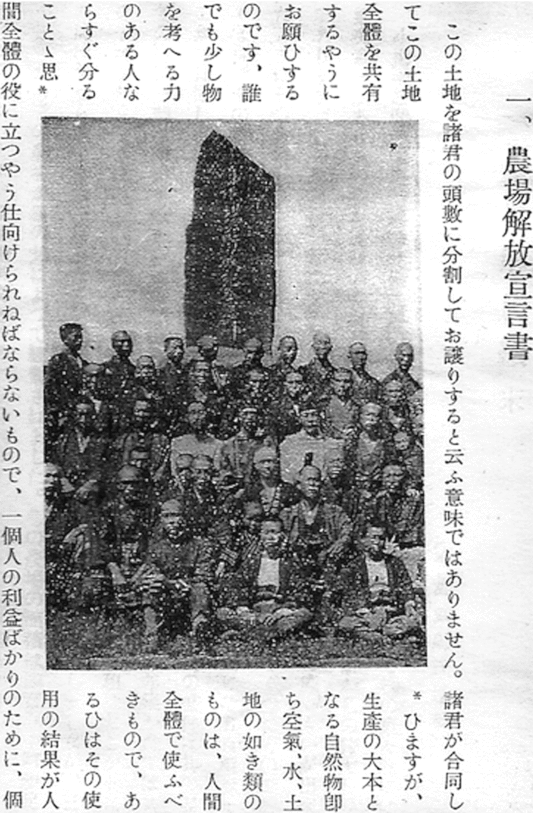
Arishima's liberation speech served as the anchoring centerpiece of the cooperative handbook. The speech physically framed a photograph of the farm members themselves. In the photographs, the members are seated around their liberation monument.Footnote 48 The words taken from the speech articulated the farm's commonsense, anti-capitalist orientation, ‘Anyone knows that the source of all production, land, water, air. . . should not be owned privately but should be shared and used for the mutual benefit of all human beings.’Footnote 49 The layout of the page symbolically indicated that the identity of the community was centered on the cooperatist ethic of shared cultivation and utilization of natural resources (Figure 1).
Photograph in the Cooperative Living Farm Handbook. Members are seated around the liberation monument, wrapped by Arishima's liberation speech.
Source: Archives of the Arishima Takeo Museum in Niseko, Japan, (ATM) 8-7-90.

The handbook repeated the speech, along with the motto ‘Mutual Aid’, on yet another page, emphasizing the centrality of these ideas, and the memorial power of that moment of the farmers’ liberation from capitalist modernity for the community. The handbook's descriptions of the community's history also served as a source of pride and inspiration.
The handbook was a must for everyday life. Its informal constitution was a resource for members of rules of Annual Meetings, and details of benefits such as interest-free loans and other essential points of practical knowledge. It provided for the participation of all members in the affairs and decision making of the farm, and included a provision for women who wished to join in the general deliberations and who chose to represent their family at the meetings.
Members themselves created the handbook, with its photographs and fashionable design, and all members approved its contents by assembly vote. They made it representative of themselves and it became a widely treasured artefact of their daily lives, available to look at over and over again.
‘The great agricultural revolution’
The farm's adoption of some of the latest agricultural technologies strongly moulded its progressive self-image. Its tremendous technological transformation physically defined the spatial contours of revolutionary change. The community's vigorous pursuit of technological advancement entirely changed the farm's spatial configuration and appearance, and concretized the liberation as a revolutionary transformation. Consistent with anarchist ideas, this was a revolution towards a new kind of modern that both embraced Japanese production and consumption preferences for rice and departed from the Western agricultural modern. While this period saw a considerable nationwide rise in investment in agricultural implements and machinery for rice production, the material benefits of technology and its resulting improvements in land productivity on the many tenant farms in Hokkaido were hardly returned to the farmer.Footnote 50
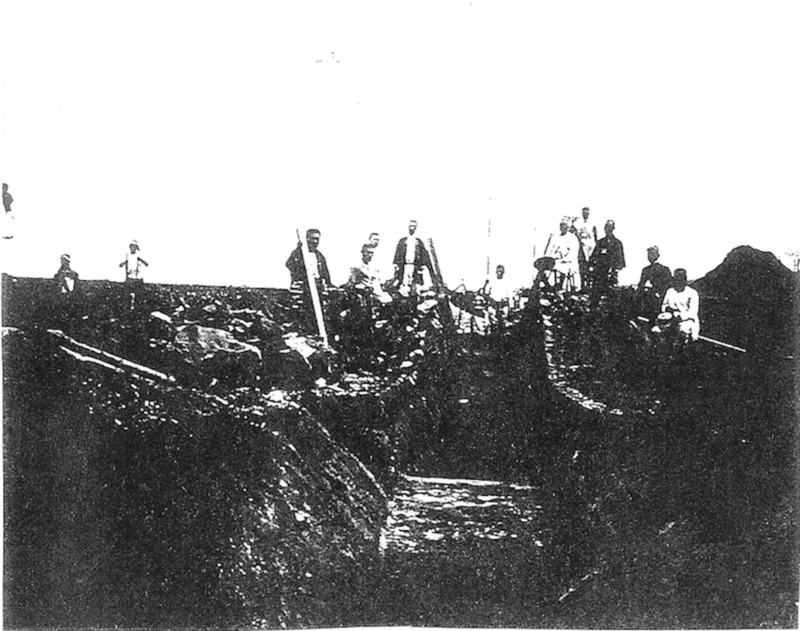
A year before the liberation, Arishima had initiated a massive project to transform the fields into paddies for rice cultivation. Members recall their pioneering project to adopt rice cultivation as the start of a ‘great agricultural revolution’ (Nōgyō-daikaikaku).Footnote 51 The long term project transformed the face of the farm by converting dry fields into rice paddies through the construction of a dam and irrigation system. The farmers experimented with some of the latest technological advancements in order to pipe in water for the paddies.Footnote 52 They applied new techniques for temperature moderation of the icy water tapped from the adjacent mountain. Negotiations were held with neighbouring farmers about the land project,Footnote 53 blueprints were laid out, pipes were extended like nets across their fields, and a dam was constructed to hold the water (Figure 2).Footnote 54
Cooperative Living Farm Members Working on their Irrigation Construction Project.
Source: ATM Photo Section, 2-1-3-8.
Local initiatives to promote technological advancement in irrigation and rice production across Japan have been documented by other scholars.Footnote 55 However, historians have not examined what meanings the farmers held for their own development. In this case, members of the farm gave the meanings of cooperatist progress formulated by Japanese anarchists.
Of course, the conversion to rice also promised material progress. Arishima had planned that the farm would raise its profits by growing rice, helping to discourage members from reverting to tenancy. The stability in the value of rice at the founding of the farm made it particularly attractive. Rice cultivation also set the farm apart from surrounding farms. Cold weather rice cultivation in Hokkaido was still at an experimental stage. In early Meiji, the Hokkaido Colonization Office had emphasized the importation of large scale farming with agricultural technology from the West that centered around livestock and crops like potatoes and corn. By the Taishō and early Showa period (1912–1935), experimental rice cultivation was making inroads as a new and promising agricultural development in Hokkaido.Footnote 56 No other farm in the region surrounding the Cooperative Living Farm, however, had yet experimented with it. In particular, the conversion to rice cultivation necessitated considerable investment afforded only by large scale landowners. Moreover, consumption of Japanese-style white rice in the early twentieth century represented a better material life.Footnote 57 Rice became an important part of the Cooperative Living Farm's progressive identity.Footnote 58
The farm grew rice not simply for subsistence, but in order to market it. Cooperative ownership encouraged entrepreneurship and profit-seeking activities for the survival of the farm and the material well-being of its members. Within a decade or so, bags of their rice decorated with large red labels of ‘Arishima mai’ (Arishima Rice) Footnote 59 were found in stores across the region. The commercial success of the rice helped convince members of the progressiveness of their existence as a new, modern community of cooperative living. A former member recalled many years later that the taste of their white rice was a memorable experience.Footnote 60 The shiny white rice was thus the taste of liberation and progress. This was consistent with anarchist thought in Japan, which sought not to form self-contained communities, but an infinite variety of societies, associations and cultures that interdependently relied on and improved one another in a modern way.
Although members of the farm embraced new technologies as tools aiding in the betterment of life, technology did not serve as a defining measure of human progress. Science and technology were seen as a partner in their creation of a cooperatist community. The cooperatist approach to technological advancement was demonstrated by members’ common purchase of a polisher for white rice. The polisher was one of the most advanced pieces of equipment for rice processing at the time. It became the pride of the community, representing the new cooperative ethic of sharing in the development and fruits of their collective labour. The introduction of the machinery to the farm created quite a stir. Some members cried out when they caught sight of the machine glistening in the sun, and many reached out just to touch their new purchase.Footnote 61 The polisher signified the members’ accomplishments as pioneers in cooperative community making. The technology was cooperatively acquired for the good of everyone through their shared cultivation of the surrounding nature. Members also established facilities for education in new technologies and techniques of farming and household skills. They formed an ongoing workshop devoted to the study and development of agricultural methods.Footnote 62 Advancement of knowledge and technology was urgent in the co-survival conditions of post-liberation.
The way in which the farm members coordinated the mutual cultivation of rice were reminiscent of familiar ways of cooperative living found on farms in villages across Japan. The farmers had a way to make the most difficult and labour-intensive period of the year the most fun and eagerly anticipated by the farmers, as recalled by Kiriyama. Taue, or rice sowing as a product of the technological changes introduced by the new irrigation system, was understood to be a time of festive labour for the community. Perhaps this was because it was also one of the most intensive moments for community making. Kiriyama himself clearly identified this time of year with cooperative living.Footnote 63
Annual rice cultivation and harvesting were organized as farm-wide cooperative events. All members of the farm moved in a consecutive procession from one household plot to the next. The farm was divided into four sectors. Every household of a particular sector, men, women, and children, gathered together at one sector's household, and finished planting that plot in its entirety before moving on to the next household plot. This consecutive collective process of rice planting was carried out until each family's plot had been planted. Taue was accompanied by a taue chorus, in which members kept the planting in time to their own rhythmic singing. After a family's plot was completed, everyone gathered together at their home, where the family hosted a feast.Footnote 64 Harvesting was conducted in a similar fashion. These organized moments in the annual cycle of the farm reinforced members’ consciousness of their collective investment in the farm.
When a family experienced an illness or death, the tragedy was liable to affect the entire progress of taue. The usual recourse was to put that household's share of land as the first to be cultivated in the taue course. The farm joke was that ‘If you want your plot to be done the quickest, then you should prepare a tragedy’.Footnote 65 When a member was in need, community members could not rely on a landlord or the state to provide for them, but on one another.
The farm did not limit itself to the familiarity of rice farming. In 1926, faced with a precipitous drop in rice prices, the farm decided to adopt dairy farming. Members sent two representatives to the Utsunomiya livestock farm in Hokkaido to study its pioneering dairy business and to get advice.Footnote 66 The farm's experiment in the dairy business reveals the farm's confidence to study new things and its capacity to take risks far beyond Arishima's original plan for the farm.
At the time, Kurosawa Torizō was in charge of Utsunomiya Farm. Kurosawa was an important figure in the history of Japanese cooperatives. He founded the Hokkaido Cooperative of Dairy Producers that became Yukijirushi (Snow Brand Dairy), the largest and most recognized dairy brand in Japan. He was the protégé of the conservationist Tanaka Shōzo, leader of the Ashiō Copper Riots, and had been imprisoned for his association with the riots that had strong ties with Japanese anarchists and socialists. The Cooperative Living Farm's ties with Kurosawa indicate the presence of a broader network between Hokkaido cooperatives with anarchist undertones, which is further highlighted in a later section.
The farm's turn to rice cultivation in a sense was a ‘return’ to time-tested practices of rice growing and its corresponding community life. However, the community's revolutionary modern simultaneously incorporated the embrace of the familiar with innovation and openness to new approaches and enterprises on Hokkaido's pioneering landscape.
Cooperative democracy
All households were responsible for participating in democratic deliberation and consensus making on the day-to-day running and working of the farm for co-survival. Arishima had organized liberation based on the notion of ‘kyōyū’, which is usually interpreted as ‘shared ownership of land and resources’, suggesting the shared possession of exclusive rights to own and use the land. However, Arishima had intended ‘kyōyū’ to mean ‘co-holding of land’. This referred to the natural right to mutually participate in the cultivation, but not ownership, of natural resources.
While the land was cooperatively held and used, each household was allotted its personal plot of farmland and personal yard space. Each household was responsible for tending to its own assigned fields throughout the year, as well as deciding on what crops (fruits, vegetables) and smaller livestock that it wished to grow or raise in its personal yard space to supplement its earnings. Members earned income from the profits on the harvests of their own section of land. In turn, members paid monthly dues to the farm. While this system ensured individual family responsibility for the prosperity of their own personal plots, it differed from private property, in that no legal rights to the personal plots were attached to the land. The farm and its land were still cooperatively owned, invested in, and regularly administered by the monthly and annual meetings. For times of serious financial need, the farm implemented a loan policy for members that was interest-free for the duration of three years.Footnote 67
Members’ regular deliberative meetings held the highest authority on the farm, giving power to the space and time of the meetings themselves. They gathered at Iyateru Shrine to decide issues related to the farm and the community. ‘Shūkai’, the monthly meetings of sections of the farm, culminated in a farm-wide Annual Meeting (‘Sōkai’). Annual Meetings were attended by members from each family on the Farm, each of whom was given equal voting power in decision making. As the highest power in the community, the Annual Meetings were democratically conducted under the sacred scroll of Arishima's liberation talk, the symbolic banner of the community. The sacred liberation scroll, on which Arishima had written in calligraphy ‘SŌGO FUJO’ (MUTUAL AID), was brought from the farm office to every general meeting and positioned over members as they proceeded in their cooperative deliberations. At the meetings, Yoshikawa reported in detail the farm's earnings and spending and its projected spending and earnings the following year.Footnote 68 According to the contract, ‘the meeting will not open if fewer than 50 per cent of the members are not in attendance’.Footnote 69 This never happened, and it was rare that less than 100 per cent attended.Footnote 70 The rules of the contract did not require member participation, nor did they provide details of the way the meetings were to be organized. It appears, as in many of the most important aspects of life on the Cooperative Living Farm,Footnote 71 that the written contract played a relatively minor role in determining farm practices.
Meetings gave an open forum for members to voice their opinions. Members were obliged to come to a consensus through discussion. Discussions over a particular issue could thus last for hours on end before a consensus was reached. Annual Meetings commonly lasted from eight in the morning until the dead of night.Footnote 72 Everyone on the farm actively and heatedly participated in the discussions.Footnote 73 Stormy and heated debates often raged in the small shrine,Footnote 74 and members often expressed a range of divided opinions.Footnote 75 Over the course of day-long discussions, the community sought to make decisions with every member's approval. Majority rule was very rarely used, and was applied only as a last resort for deadlocked opinions.Footnote 76
Marking new time
Every revolutionary moment is marked by a series of new signs designating the new time. An examination of objects and spaces produced on the farm suggests that the farmers experienced a sense of living in a new revolutionary era. With liberation, the farm immediately undertook a series of construction projects, creating new sacred spaces, erecting monuments and displaying objects that represented their community as the progressive future. One may read these silent spaces and objects as intellectual phenomena. A monument, a series of worship stones, a new shrine, a scroll, an odd back window cut out of the back of the shrine, and other tactically placed adornments all marked the establishment of a new kind of progressive community. Places and objects given meanings of cooperative power were open equally to every member of the farm, in order to give equal access to power within a newly equitable social order on the farm.
The organization of space and the display of objects on the farm expressed the farmers’ view of themselves as working at the forefront of mutual aid progress. Places and objects were assigned distinctive meanings, roles and capacities for progressive action.Footnote 77 The farmers’ new spatial constructions and emblems attached progressive meaning to their own ordinary practices of mutual aid. They contributed to the farmers’ overturning of the ideological order of capitalism and Western modern progress on their farm in the most unlikely place of Hokkaido, the very site where Japan's imperial agricultural project was developed and practised. Colonial expansion on Hokkaido was based on large-scale modern capitalist farming methods, fashioned after the American model.Footnote 78 The Cooperative Living Farm emerged in dialectic with capitalist competition, private ownership of land and natural resources and imperialist expansion exemplified by the modern farms that surrounded it.
The farm could not have been plainer or more unassuming at first glance. Absent were ideologically charged political advertisements meant to transform their audience into new kinds of human beings concomitant with an ideal of a manufactured society. However, closer examination reveals that new symbolic objects appeared after liberation. These objects demanded practices of mutual aid and simultaneously memorialized the community as the embodiment of achieved progress. By observing and deriving the meaning of prominent objects on the farm through people's interactions with them, two entirely different places can be identified, before and after liberation.
On a hilltop overlooking the farm was a controversial stone monument to the founding of the Cooperative Living Farm. While it was little different in size and shape from other such monuments that were erected on every farm across the region, the monument stood in polemical relation to them. Throughout Hokkaido, the prevailing purpose of the monuments was to commemorate and heroise the pioneering accomplishments of settlers and cultivators in the territory. However, the particular tablet on the Cooperative Living Farm differed from the other so-called Colonization Monuments in an almost unnoticeable manner. Its difference was the source of controversy with the government.
The Hokkaido Colonization Office strongly advocated the erection of monuments across Hokkaido. It kept records of each monument, and required all monuments to be approved and registered. Local government offices registered every monument under the name of either ‘Colonization Monument’ (kaitaku kinen hi) or the less commonly used ‘Cultivation Monument’ (kaikon kinen hi). As a rule, the monuments were engraved with words that paid tribute to the original founder. One monument on the neighbouring Matsuoka Farm, for example, was engraved with the words that its founding landlord, ‘with great spirit, entered deep into the wild undeveloped world, and opened, cultivated, and colonized it’.Footnote 79 Leading proponents of Hokkaido's colonization also got involved in the monuments’ promotion. Satō Shōsuke, first president of Hokkaido Imperial University and leading professor of colonization theory, wrote the tribute for the monument on Matsuoka Farm.Footnote 80 Satō's public investment in the memorialization of the founding settlers and proprietors of Hokkaido's lands indicated the monuments’ perceived importance in garnering support for national colonization policy.
The monument to the Arishima Cooperative Living Farm was the only one in Hokkaido registered under the name ‘Liberation Monument’ (Kaihō Kinen Hi), rather than the usual ‘Colonization Monument’ or ‘Cultivation Monument’. The Liberation Monument differed from the other monuments in a number of other ways, including its lack of commemorative wording. Within three months of the farm's founding, it made a request to the Ministry for permission to erect a monument to its founding and liberation with the words from Arishima's liberation speech engraved on it.Footnote 81 Arishima's words of liberation towards a community of cooperative interdependency marked the future direction and progress of the farm. However, the Ministry rejected their request.
The farm replaced its proposed monument with an essentially blank stone instead. The Ministry took two years to finally approve the essentially wordless ‘liberation monument’. The monument shouted its muteness, in contrast with the other colonization monuments that generally had their entire reverse covered in lavish commemoration to area farms’ founders as colonizers. The Cooperative Living Farm's approved monument simply stated, ‘Arishima Takeshi colonized (kaitaku) this farm. Arishima Takeo liberated it’. The words referred to Arishima Takeo's ideological usurpation of the original ideology behind his father Arishima Takeshi's founding of the farm as a profit-making enterprise for his family in Tokyo and a contribution to the colonization of Hokkaido. This simple sequence of words suggested not only the contrast between the act of colonization and the act of liberation, but the moral conditioning of the first by the second in a progressive sequence.
What was absent on the monument revealed members’ understanding of things. The Liberation Monument was radically different from the other monuments in the sense that the founder and colonizer of the farm, Arishima Takeshi, was absent in the memorialization of the historical life of the Cooperative Living Farm. Takeshi's virtual disappearance in the community's memory of its establishment stood out in sharp contrast to the other farms in the area in which their founders became largely legendary, and in which the act of colonization was celebrated, rather than overridden. To commemorate the date of liberation in an act of continuous recollection, Cooperative Living Farm members erected the Liberation Monument on the second anniversary of its founding.
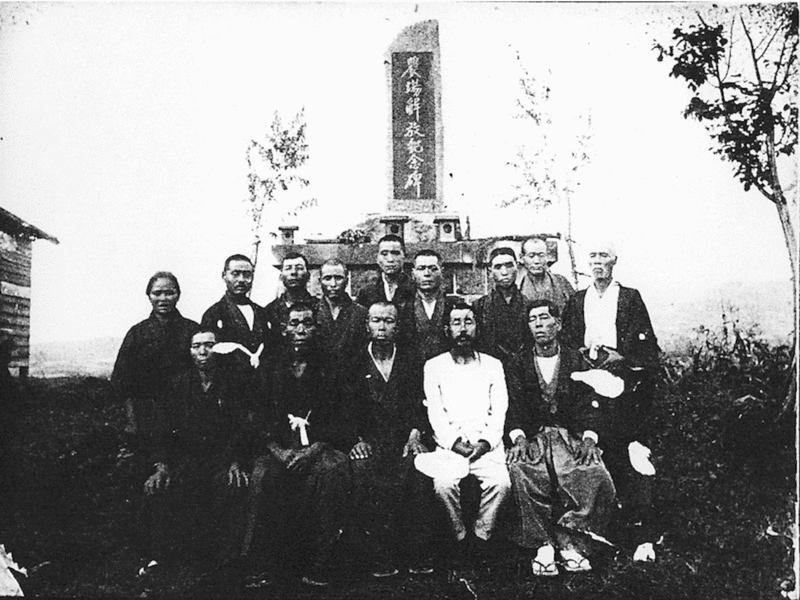
Despite its veritable muteness, the monument nonetheless became an emblem of the community. Commemorative photographs of the community throughout the years were consistently taken with members seated around the monument (Figure 3). The absence of engraved words may have enforced the significance of the monument to liberation and cooperative living. After the struggle over the erection of the monument, it retained its original meaning, irrespective of its muteness.
‘Farm Liberation Monument.’ A photo of a small group from the approximately 100 households on the farm seated around the monument.
Source: ATM Photo Section, 2-2-6.
The words of liberation prohibited by the state silently reappeared as the sacred centerpiece in the farm's office instead. The Cooperative Living Farm mounted the liberation speech on a scroll in a prominent niche of its office.Footnote 82 The office, where the landlord used to sit before liberation, was the former spatial representative of the organizational authority of tenant life. Inside this formerly forbidding structure, a space of the sacred was established to preserve the idea of the farm as mutual aid. That meaning of landlord authority within a broader construct of emperor-centered social hierarchy in early twentieth-century Japan was inverted by the members themselves. Members maintained the new sacredness of the office space for cooperative living by commonly understood rules about the use of the space. Above the liberation scroll was a massive placard, in which Arishima Takeo had personally written and signed in large calligraphy, ‘SŌGO FUJO’ (MUTUAL AID). The words expressed simultaneously the traditional rural values of mutual aid, and the added modern meaning of progressive evolution engendered by mutual aid as theorized by Kropotkin. ‘SŌGO FUJO’ and the liberation speech were situated physically and symbolically above the manager Yoshikawa's place in the office, lending further power to the idea of mutual aid over any authority Yoshikawa might have previously held before liberation. Yoshikawa regularly and scrupulously cleaned the space. Outside those times, no one was allowed to step inside the scroll space.
Entering the office, the first noticeable thing was the unusually high floor that rose up above the entryway. Before liberation, the positioning of the floor referred to the untouchability and authority of the landowner. In order to enter the office, one had to ascend to the platform, which served simultaneously as the floor of the office and a barrier to passage. It was remembered by the farmers as the only structure with ‘takayuka’, which literally meant ‘high floor’. Tenant farmers used the term to refer to the unreachability and power of the landlord.Footnote 83
However, after liberation, this same authoritative space was inverted to suggest cooperatism as the highest principle of human life. The Cooperatists’ motto ‘Mutual Aid’ had become the identity of the farm. The office space, through the farmers’ own practices, had changed in meaning from the symbol of labour under the tenancy system, to a space of mutual financial return and management of the farmers’ collective well-being. In the sacred space of the office, the farm's mutual aid activities were administered and put in order, because members cooperatively controlled the office itself.
Ascending the stone stairs up the main hill at the centre of the farm, and crossing under the simple undecorated wooden gate, torii, leads to a plain wooden shrine, Iyateru Shrine, hidden behind a grove of trees. Unobtrusive and lacking in decoration, the shrine differed from other farm shrines across Hokkaido. The other Shintō shrines that dotted the colonial landscape visible atop its farms’ highest points have been commonly described as authoritative, patriarchal, and forbidding.Footnote 84 They were a spatial symbol of colonial control over the lands which were laid under the shrine's gaze. Behind the gaze were the landlords who built the shrines with the support of the Colonization Bureau. The shrines themselves thereby represented a masculine patriarchal order that supported the emperor-centred ideology of the nation state. The shrines culturally and religiously authenticated settlers’ participation in the national colonization project in Hokkaido.
In contrast, Iyateru Shrine stood out for its modesty. In 1916, one of the first things Arishima Takeo did after inheriting the estate from his father was to approve the shrine's physical removal from its place atop the farm's highest point on Miya Mountain overseeing the Arishimas’ colonial property, to its current position halfway up a small hill, modestly nestled amongst the other hills of the estate's farmlands. Arishima Takeo reassigned its primary use for community meetings and for ceremonies. With the paring down of the shrine's spatial authority, Arishima Takeo began calling shrines ‘meeting places’ (shūkaijo).Footnote 85 So did the farmers, and they began to use their shrine as the farm's first space for communal decision-making. Following liberation, the shrine became a focal point for community activities. The farmers further added a new sacred meaning of their own to the shrine. Soon after liberation, they installed a hidden back window, behind which they erected a sacred hexagonal stone structure of the goddesses, ‘jijin’. When the window was opened for annual ceremonies of cultivation and harvest, it served as a window to the goddesses. The stone memorialized the farm's liberation at the same time that it served as a vehicle for divine intervention in its practices of cooperative farming (see the section, ‘Under the Goddesses of Cooperative Production’).
The new spaces of the Cooperative Living Farm, and members’ modern subjectivity of mutual aid progress, emerged in reciprocal relation to each other. New objects and spaces created on the farm gave new shape to the community, guiding those who conducted everyday life in those spaces. In tandem with the growing experience of cooperative community making, the objects and spaces silently gained in sacredness.
New moral language and practices to divide time
Members of the Cooperative Living Farm divided their new time from the old by adopting new terms to distinguish their existence before and after tenancy. During tenancy, an individual's heavy debt and demanding rents dictated social relations on the farm. Tenants competed for the landlord's favour. After liberation, members began to refer to this old tenant subjectivity as ‘kosakunin konjō’ (tenant mentality) or ‘kosakunin guse’ (tenant habits). Members associated tenancy with a backward habit of servility and catering to power.Footnote 86 They found it difficult to forget moments of contact with the attitudes of elites towards tenant labourers.Footnote 87 Such memories of injustice identified time before liberation with the daily humiliations of a hierarchical social order.
For example, members used the terms in their annual meetings to oppose farm policies that had potential to give rise to the old ways.Footnote 88 They also liked to use the phrase ‘goma suri (grinding sesame),’ which was a colourful way to describe buttering-up to those with power. This referred to a ‘before’ self that was only supposed to exist in the past or in the surrounding capitalist order outside the community. The shared usage of such terms indicated the emergence of a new moral community and values with their own expressions to represent an understanding of a shared experience and progress.
It appears that the shift away from dependency and deferential social actions was never clean, however, and members were constantly reminded of the possibility of the recurrence of tenant habits. Members took notice when some fellow members kept the old habit of calling Yoshikawa by his former title under tenancy, ‘Danna sama’ (Master).Footnote 89 Such moments of recognizing elements from the past were simultaneously moments of realization of change. The very recognition of a former unethical self by the members indicated their consciousness of progress to a new time, even as members recognized how easily those elements could reemerge within themselves after liberation. It was a past within a progressively changing self. After liberation, members sought to call the farm manager by his given name ‘Ginnojō-san’ (Mr Ginnojō) with a respectful familiarity,Footnote 90 a far cry from the perceived use of toadying labels like ‘Danna-sama’. Yoshikawa in turn worked the fields along with the rest of the members. They praised him for his lack of ‘ryōshu mentality’, or proprietary attitude, yet another phrase frequently used that emerged to refer to the tenant past.
The presence of Yoshikawa, who had been manager of the farm under Arishima before liberation, served as an intellectual bridge between the practices of the farmers themselves and the anarchist ideas of mutual aid progress that had inspired the farm's founding. From the authority figure who wielded the landlord's power under the tenancy system, Yoshikawa suddenly became an employee of the newly liberated farmers themselves. When Arishima passed his land into the farmers’ hands, he suggested to them that they keep Yoshikawa on as the farm's manager and advisor. Yoshikawa was asked to manage the farm's finances and was an equal but the only non-elected member of the farm's 8-person managing committee. He became the only wage earner on the farm, whose pay was decided by the members, paid directly from their monthly dues. He had become a manager employed by the managed.
At the same time, Yoshikawa played a guiding ideological role on the farm. He had considerable understanding of Arishima's ideas and played a significant role in bridging these ideas with the everyday work and policies of the farm. In the years of planning the liberation, he had been part of the small circle of people with whom Arishima consulted on the farm's founding. He understood the creation of the farm to be linked with anarchism from the start, and he often reminded the farm members of the founding ideas of the farm. In a personal letter to Kiriyama Katsuo's father, Kiriyama Tokiji, Yoshikawa reminded him that the farm was conceptually framed not only by Arishima's, but also by Kropotkin's thought and thus was part of a larger global progress. Yoshikawa indicated to Tokiji that he had discussed the ideas behind the founding of the farm with Arishima a number of times.Footnote 91 In this capacity, Yoshikawa maintained a particularly delicate relationship with the farmers, and carefully negotiated his new role. He held authority as the one most familiar with Arishima's vision of the future of the farm, whilst linking its existence in the wider world with anarchist concepts of progress and civilization through mutual aid. Using his position, he sought to prevent a new hierarchical order from arising on the farm. It was a seemingly impossible position for a manager that Yoshikawa himself had helped to create.
According to Kiriyama Katsuo, another aspect of their new life on the farm that members had to work on was gift-giving. The post-liberation intellectual universe influenced gift-giving practices on the farm, even as those practices themselves affected their thoughts. Kiriyama recalls that members meticulously practiced the giving of gifts in carefully measured equal number to each member of the farm. The practice of gift-giving was constructed to horizontalize relations amongst members of the community. Members consciously contrasted this new practice with the old times of tenancy, when the gift was often used in a vertical bi-directional manner between managers and the labourers who worked for them, functioning to enhance the power relationship between them. A gift to the landlord or the manager used to grease the machinery of the tenant-landlord relationship of dependency. Usually given in a single direction to those with power, the gift might anticipate or follow a request for a loan, or some other sort of necessity. It might simply put the tenant in the landlord's favour. In turn, gifts or demonstrations of favour from the landlord served to concretize the benevolent status of the landlord in relation to his tenants.Footnote 92 On the Cooperative Living Farm, what might be called the practice of multi-directional gift-giving appears to have functioned as the demonstration of mutual interdependency and the preservation of the non-hierarchy of members’ recognition and value to one other. Overall, it helped to dislodge privilege from community relations.
Kiriyama's distinct recollection of his farm's gift-giving practices in interviews revealed members’ conscious efforts to habitualize the practice into a new farm tradition. Each family drew on their own particular resources and abilities for simultaneous gift-giving in equal measure. Members looked forward to the delivery of gifts from multiple directions, and they knew that no more would be given to any particular member than the other.Footnote 93 The power once given to the former ‘master’ dissipated in the multidirectional material exchange of things. The practice of multi-directional gift-giving was now a practice of ‘new’ time.
Under the goddesses of cooperative production
The view of Japanese anarchism towards the relationship between humans and their natural environment distinguished it from Western modernity. According to anarchists, nature, being vastly greater and more powerful than human beings, creates conditions unfavourable for human life. They claimed that it is the degree of a society's ability to cooperate and organize spontaneously that determines its survival before nature. Those societies that mutually cooperate, enabling them to coexist and prosper before the forces of nature, are those who anarchists anticipated were the most advanced and most ‘cultured’ of civilizations. Japanese anarchists maintained that a powerful and unpredictable nature was not to be overcome, but rather to be cultivated and adapted to human life through cooperative action. Cultural development was to be integrally intertwined with the forces of nature.
Today, the endless supply of ‘Niseko powder’ (snow) makes the mountains surrounding the Cooperative Living Farm the nation's favourite ski destination. The climate so ideal for the skiing industry, however, made life tremendously difficult for farmers a century ago. Members of the Cooperative Living Farm attributed the well being of the community to its co-dependency on the forces of a powerful nature. This idea of co-dependency, expressed in their theological consciousness of their existence, resisted the tenet of mastery over nature that had guided the policy and practice of the colonization of Hokkaido since the 1870s.Footnote 94
A multi-sided goddesses’ stone, or ‘jijin’, paid for by members’ contributions and erected behind Iyateru Shrine, was part of a local religious tradition that had been recently introduced to the area surrounding Niseko from Shikoku in southern Japan. The preponderance of these worship stones in the area surrounding Niseko village was likely due to the large numbers of immigrants coming there from Shikoku.Footnote 95 The tradition came to be shared amongst the members of the farm, despite the fact that they came from different locations of Japan. At first glance their stone appears similar to numerous pentagonal worship stones erected in the region. The other stones were built to honour the Taishō emperor as part of State-sponsored Shintōist practices. Many of the jijin were erected in the years immediately following the new emperor's enthronement, between 1914 and 1916. Yet a close comparison of the Cooperative Living Farm's jijin with the many five-sided jijin at other farms reveals that the cooperative farmers erected their stone independently, to pay tribute to the founding of the farm.
While all the other stones had five sides, close inspection of the jijin at the Cooperative Living Farm reveals its entirely unique sixth side. Members had purposely added the sixth side to the traditional five-sided stone of the five goddesses of production. I have been unable to find this feature anywhere else in the surrounding area, which has many five-sided stones. The unique sixth side was engraved with the date of the erection of the stone, August 1924, to commemorate the second anniversary of the liberation of the farm.Footnote 96 The hexagonal stone thus made it appear as if the five goddesses, inscribed on the five sides, were embracing or giving birth to the Cooperative Living Farm. It was an idea consistent with the community's understanding of the divine nature of the land, which was the deities’ ‘gift’ foundational to the emergence of the community in 1922. The divine given-ness of the soil thus took away the landlord's very right to the land. The sixth side was an invention of the Cooperative Living Farmers, who had inserted their realm of cooperative virtue into the sacred realm of the goddesses.
The goddesses of production on the stone represented a cosmological foundation of human relations of interdependency with nature and with other human beings for survival. The stone behind the shrine became the most sacred object of the community. It thereby further altered the associated patriarchal authority and national sacredness of the original meaning of Iyateru Shrine. It was as if ‘State Shintōism’ had never reached there. The shrine, as part of a localized folk religion of the soil, was placed at the centre of the farm's annual spring planting and autumn harvest festivals. Farm members initiated the festivals with ceremonial offerings to the goddesses from within the shrine. Erected on the second anniversary of the farmers’ liberation, the jijin marked their thanksgiving to the Goddesses of the soil for the gift of production, plentitude and well being after tenancy. This symbolic structure is significant in understanding the Cooperative Living Farm members’ worldview. To date, the goddesses stone remains in the same spot behind Iyateru Shrine, unlike other farms that have moved their stones to either private properties or donated them to city halls following World War Two. The fact that the hexagonal stone has remained undisturbed since the war suggests that members of the Cooperative Living Farm did not see their jijin to be an expression of the State Shinto dismantled after the war.
The jijin served as a central mechanism of the shrine's communal ceremonies. The farm's cultivation and harvest ceremonies held in the sacred structure of Iyateru Shrine were the most important religious ceremonies of the year, and in this respect the farm did not differ from other farming communities in Japan. The harvest ceremony opened with a colourful vision of the fruits of the earth. The members gathered together rice, vegetables and fruits harvested on the farm and placed them decoratively at the centre of the shrine. They ornamented the walls and floor of the interior shrine with other riches from the soil symbolic of their production, flowers, plants, dried stalks and leaves. The ceremonial offering to the goddesses that followed was organized in such a way that no authority figure was felt. Even the incoherently mumbling priest was absent authority. At the infrequent times when shrine gatherings needed a priest, they would call someone over, usually one of the members’ relatives. The head of ceremonies was neither trained nor literate in the ceremonial script, but a ‘divine’ sort of air was probably enough. Everyone knew the so-called ‘priest’ could not read the sacred chants, but they were content with his unintelligible mumbling and chanting, because it played only a peripheral part, if not being entirely redundant, in their collective activities to sanctify the community.Footnote 97 As Kiriyama described it, ‘Maa kono, nanto mōshimasuka, tekitōni nanka gocha gocha iwasete, tekitōna tokorode owarasemashita’ (Oh, well, how do I put it into words? In a very approximate manner, we made him mumble, you know, bla bla bla, and in short, we got it over with).Footnote 98 The absence of a tone of patriarchal order was complete.
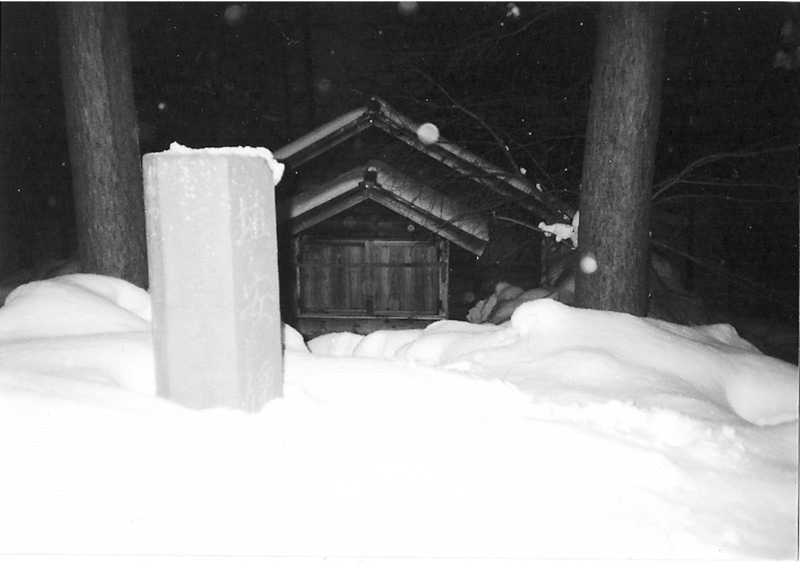
As the ceremony continued, all members entered and sat on the level floor of the shrine around their offerings. They faced the back window as it was slowly opened towards the stone of the goddesses of production, and symbolically presented the deities with the fruits of their labour in ceremonial thanksgiving.Footnote 99 The spatial positioning of the female deities within the farm represented the farmers’ own conceptualization of their relation to the goddesses. The stone of the goddesses of production, whilst standing just a couple of metres away from the shrine itself, was placed in a position figuratively and physically unreachable by human beings inside the shrine. Members had mounted the jijin on a tall mound of concrete and stone built into the steep and untamed hillside overlooking the Shrine and its community activities. When the back window of Iyateru Shrine was opened, not only were onlookers bathed in natural light from the outdoors, but they also observed a carefully constructed view of the jijin, as if emerging out of the soil of the hill above, stretching out into the open sky beyond. It was positioned to fit at exactly just the height to flood the gaze of those standing within the shrine. The stone appeared to float, as if suspended in mid-air, close enough almost to touch, yet appearing to be out of human reach. No path was created to the stone itself. The stone steps up the hill end at the gate of the shrine, leaving no human way to approach the deities along the rocky and steep slope where the stone was situated (Figure 4). The stone expressed the place of human beings in a horizontal existence on earth amongst all beings.
Hexagonal Goddesses’ Stone and the Hidden Rear Window of Iyateru Shrine.
Source: Photograph by Author.
Female spirits represented the highest power in the members’ cosmological order. Simultaneously, the goddesses of the soil as the source of production were embodied in the farm's cooperatist principles. The female gender of the goddesses prevailed over the male representation of the authority of emperor and landlord under a national Confucian ethical code.Footnote 100 The shrine, although it had assumed a communal air and function with liberation, maintained certain residues from tenant times. Yet the goddesses stone, which was physically set even higher than the authority of the shrine, silently took that power away.
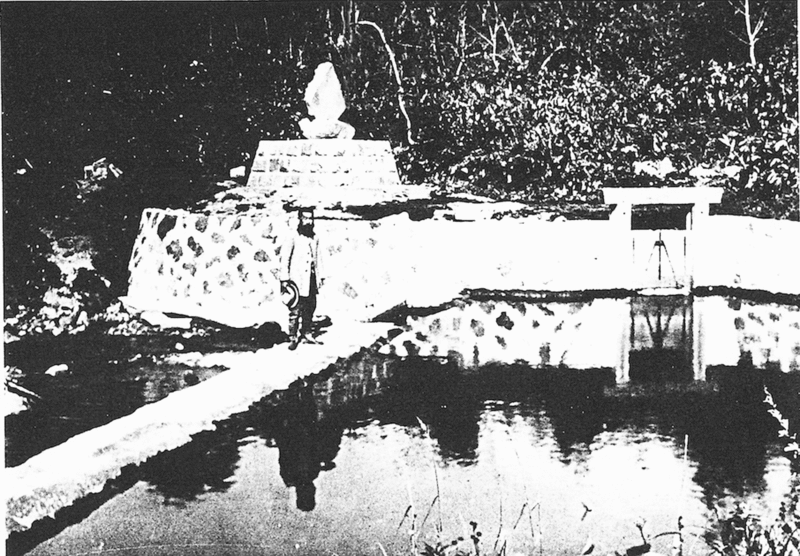
Members also erected a worship stone to the water god. The stone was another structure unique to the region. It stood atop a high foundation overlooking and lending sacredity to the dam, which served as the centre point for the farm's irrigation system. Indicating the centrality of the gift of water to their everyday well-being, members placed in the farm's handbook a photograph of the water god stone overlooking the dam (Figure 5). Although everyone depended on the water running through the dam for the most practical daily tasks, the stone reminded them of the inherent divine in those tasks of cooperative living. These deities of soil, air and water were the community's tutelary gods and goddesses. Together, the two worship stones completed and concretized the cooperative imperative delivered in Arishima's speech of non-ownership and cooperative utilization of natural resources for mutual benefit. The farmers had added their own significance to this basic cooperative idea by making their cooperatively possessed natural resources and agricultural production sacred.
Yoshikawa and the Water God Monument at the Irrigation Dam.
Source: ATM 8-7-90.
The sacredness of the ethical imperative of cooperative coexistence was expressed in the deep feelings of guilt when a member violated that imperative. Kiriyama Katsuo still feels a strong sense of regret when he recalls his violation of the community ethic of shared natural resources. He remembered in an interview that he had once taken his horse, considered a personal possession, to graze along the green grass lining the commonly used water of the irrigation canal. This was an abuse of the designated space of shared natural resources protected by the water god.Footnote 101 The basis of ethical judgement was mutual aid, marked and watched over by the gods.
Festivities of inclusion
The Cooperative Living Farm was an inclusive community that participated in the larger society around it. The spirit of reaching out to the wider community was expressed from the farm's first year, when members devoted space on the farm for regional amusement and interaction. The farm donated a large part of its land for the region's annual childrens’ olympics competitions.Footnote 102 If the community reached out, outsiders also appeared to have reached in. Its harvest festivals were biannual events that simultaneously celebrated the farm's progressive identity and invited people from outside to participate in its events of fun and celebration. Three intense days of festive merrymaking celebrated the farm's accomplishments and gave thanks for the gift of production provided them by one another, and by nature. Held under the gaze of the Farm's tutelary goddesses, the festivals were looked forward to with great excitement. Celebrations of the local at the community shrine were common in Japanese rural life. What was unique to the Cooperative Living Farm was the scale and intensity of its festivals, the added modern meaning of Mutual Aid as progress, and the emphasis on openness to outside participants to join in their festivities.
The festivals were financed voluntarily by members. The farm's Arishima Youth Group, which organized the festivals, solicited and collected donations outside of the required monthly farm payments.Footnote 103 Each family donated what they could. No record of donations was maintained in the office, indicating that they were purely a spontaneous act. Kiriyama recalled that no one complained about the extra expense, and those with more tended to give more.Footnote 104 The farm's festivals grew into a major event as a result of members’ spirited contributions and participation. Members noticed the immediate expansion of the festivals after liberation. According to Kiriyama, before liberation, the farm's ‘festivals’ consisted of haphazard gatherings around the shrine for a cup of sake once or twice a year.Footnote 105 It was after the community itself gained sacredness that the celebrations of community and harvest expanded and became so valued.
As time passed, rumours spread throughout the region about the Cooperative Living Farm festivals. Stories of the celebrations were told far beyond the farm itself. In this way, farm festivals became famous across the region, an event that people outside the farm came to attend. Flying its flag ‘Cooperative Living Farm’ high in the air, the farm welcomed the region to participate in its community celebration of interdependent doing. One of the highlights of the festivals was the children's sumo competition that frequently turned into adult frolicking as the drinking got heavy. Numerous children from across the region came to participate in the sumo competitions to show their skill.Footnote 106 The farm quickly came to be widely known as the ‘festival community’, for it was the farm with the largest and the most celebratory festivals around.
Global visions in the Hokkaido-wide Cooperative Association
Anarchism had offered an attractive ideological construct of evolutionary development based on mutual aid that gave modern value to farmers’ existing practices. By 1926, the Hokkaido-wide industrial cooperative would explicitly adopt anarchism as its organizing ideal. The Cooperative Living Farm was thus ideologically connected with a wider sphere of rural cooperative activity informed by anarchism. Early in its founding, the farm joined an expansive network of cooperatives. In 1919, cooperatives numbered 13,000, were found in almost every village, and had 2 million household members out of a total of 5 million farm households in Japan.Footnote 107 Unlike the Cooperative Living Farm's cooperative ownership, the cooperatives that dotted the countryside were restricted to specific functions like purchasing, credit, marketing and manufacturing, rather than the shared possession of farmland. Landlords were often themselves members of the cooperatives and stood to benefit most from the cooperative activities that helped keep their tenants solvent. Thus, while the spirit of cooperative living was carried by the numerous cooperatives across the country, the tenant system still restricted the extent of cooperative benefit.
In spite of this, the Cooperative Living Farm appears to have anticipated, if not helped inspire anticapitalist attempts to progressively modernize rural everyday life into cooperative living in the early twentieth century. Agricultural studies in Japan have found that the tenant farmer conflicts of the 1920s and 1930s were expressions of tenant farmers’ increasing awareness about the value of rice in the commodities market and their successful self-organization to challenge the terms of tenancy, rather than those of economic despair.Footnote 108 The farmers used their newfound political power and knowledge of the market to form cooperatives. Some cooperatives served as channels for the expression of anarchist ideology during this period.
In 1923, the farm was forced to legally register with the Hokkaido Agricultural Industrial Cooperative Association. The general institutional goals of the industrial cooperative organization were based on private ownership, creating tensions with the farm. Remarkably, however, only three years later, in reverse adaptation, the Hokkaido-wide organization had come to promote the cooperatist practices and echo the anarchist vision behind the founding of the Cooperative Living Farm. Moreover, it advocated mutual aid as an ethic for human progress on a global scale. In 1926, the Hokkaido Agricultural Industrial Cooperative Association published the first issue of its journal Kyōei (Co-prosperity). The association was the representative organ for agricultural industrial cooperatives found across Hokkaido, which were located in every town and village. Kyōei served to outline the modern and cosmopolitan ideals and goals of this large organization. The journal sought to put the ‘world in perspective’, to promote thinking amongst agricultural labourers about world affairs. By doing so, it globalized their cooperative thought and practice, placing them at the heart of the civilizational progress.
The cooperative's journal made sense of farmers’ practices of mutual aid as part of a wider global movement of liberation. However, in merging the Russian Revolution with the liberations in Asia from Western imperialism, the meaning of ‘liberation’ came to assume a new meaning that was absent in both the language of decolonization and Marxism: revolutionary liberation from Western modernity. One article focused on the Russian revolutionary Vladimir Lenin, the leader of the Indian independence movement Mahatma Gandhi, and the leader of the Turkish independence movement Mustafa Kemal Atatürk. The journal selectively (mis)represented the nature of these world leaders and their achievements to fit the cooperative's claims to its participation in a global movement of liberation from the hierarchal order of Western modernity. The cooperative journal read these figures’ achievements in the 1920s in a manner befitting Japanese anarchist conceptions of the world. According to the journal, Lenin had instigated the self-governance of the agricultural villages, while Mustafa Kemal represented the yellow people's challenge to the white people. The journal also called Ghandhi a ‘shishi’ (idealists who fought for the Meiji Restoration), who represented the non-violent path towards independence from empire and freedom of humanity.Footnote 109 The journal referred to local democracy, racial non-hierarchy, and independence from empire, all essential elements of early twentieth-century Japanese anarchism. The above-named leaders of decolonization and communist revolution were far from supporters of anarchism, but such discussions reveal that the farmers perceived themselves as historical actors in a shared global movement against social injustice. That this discussion occurred in the centre of Hokkaido, the heart of Japan's colonial experiment, strongly suggests that the rural cooperative movement was linked by members themselves with the impulse for liberation, democratic life and equality that they perceived in the growing decolonization movement worldwide.
The cooperative association of Hokkaido also joined the anarchist critique of uncontrolled capitalism and Spencerian social Darwinist thought, which, according to the journal, had only prepared the way for the next step: Kropotkinism, or cooperatism. The cooperative proclaimed in 1926 that its principles were that, ‘Our cooperative's activities are to be pursued based on trust and recognition of mutual virtue without disturbance, with strict respect to each personality and individual freedom’.Footnote 110 Here, the individual was respected both as a unique entity and as a participant in a non-hierarchically composed whole. For the cooperative, Kropotkin's anarchist ideas were thoroughly modern. That is, members recognized themselves within a broader universal progressive time alternative to liberal capitalism. The Hokkaido cooperative saw itself as fulfilling the original revolutionary promises of the Meiji Ishin (‘Restoration’). It claimed that while the ‘Great Project’ of the Meiji Ishin had fulfilled the political tasks assigned to it, the cultural resurrection in modern Japan had not yet been achieved. The declaration of the cooperative called for a second, cultural, Ishin through cooperatist everyday practices. The declaration stated,
In the social life of today's civilization, we are trying to conduct a life of less anxiety, more pleasure and hope, a life of more creativity, mutual love and mutual aid. Relying on egoism or (Spencerian) Darwinism will never lead to making a society of peace. It is Kropotkinism or Cooperatism that we believe in. To realize this ideal of both the material and spiritual world, sangyō kumiaiism [industrial cooperativism] is nothing but Kropotkinism.Footnote 111
The quotation suggests that members of cooperatives across Hokkaido used the word ‘cooperation’ and ‘cooperatism’ interchangeably with Kropotkinism, that is, anarchism.
The association even composed its own song, which was made into a record for purchase and circulation among its members. The song centred on the organization's motto, sōgo fujo, or Mutual Aid. Sung at the general meetings and published on the front cover of every issue of the cooperative journal, the ditty went something like this: ‘I pledge allegiance to sōgo fujo, the chain of love to the world. . .’. The record featured a solo performance of the song by the ‘famous alto singer Saitō Shizuko’ on the front side, and on the back, a choral performance. The advertisement for the record, ‘a must for the industrial cooperative meetings!!’ encouraged members to ‘sing high and proud!!’Footnote 112
Conclusion
Cooperative Living Farm members applied anarchist meaning to their practices of cooperative farming, and conceived of themselves as living in a progressive, modern time. The farm merged a familiar ethic and way of life embodied in cooperative rice cultivation with openness to taking risks, experimenting with new enterprises, and adopting new technologies. Far from a separatist and isolated community, the farm was integrated into the wider region. Moreover, the anarchist meanings of progress members gave to their cooperative practices and way of life were echoed on a much broader scale, in local media, in the Hokkaido-wide Cooperative Association that represented local cooperatives across Hokkaido, and certainly amongst farmers themselves. Publications from the Hokkaido Cooperative Association in the 1920s reveal that these meanings of progress and liberation given to mutual aid were viewed as a global trend. ‘Sōgo fujō,’ or mutual aid, was viewed as a radical ethic for social transformation, democratization and elimination of hierarchy that linked Japanese farmers with a broader decolonization movement in Asia as a whole. This anarchist history challenges the Western modern conceptual framework that has categorized rural Japan as the seat of conservative politics, nativism and traditionalism, and the antithesis of modernity.