INTRODUCTION
The deep-sea fish fauna from the north-eastern Brazilian coast was first studied by Günther (Reference Günther1880), who examined collections from the cruises of the HMS ‘Challenger’ in 1873–1876, and subsequently by Vaillant (Reference Vaillant1888), Garman (Reference Garman1899) and Goode & Bean (Reference Goode and Bean1896), who had examined, respectively, collections taken during the expeditions of the vessels ‘Le Travailleur’ and ‘Le Talisman’ (1880–1883), ‘Blake’ (1877–1880) and ‘Albatross’ (1887–1888). However, it took 70 years until this fauna was again inventoried in an extensive way by the cruises of the vessels ‘Oregon’, ‘Silver Bay’, ‘Combat’, ‘Pelican’ (Bullis & Thompson, Reference Bullis and Thompson1965) and ‘Calypso’ (Roux, Reference Roux1973); also, the vessels RV ‘Thalassa’ (Costa et al., Reference Costa, Martins and Olavo2005, Reference Costa, Olavo and Martins2007; Braga et al., Reference Braga, Costa, Lima, Nunan, Olavo, Martins, Costa, Olavo and Martins2007) and ‘Astro Garoupa’ (Melo et al., Reference Melo, Nunan, Braga and Costa2009, Reference Melo, Braga, Nunan and Costa2010) have collected on some parts of the north-eastern Brazilian coast (south of Bahia, 11°S). More recently, the Programme REVIZEE (Programme for Assessment of the Sustainable Yield of Living Resources of the Exclusive Economic Zone) of the Brazilian Government has improved the knowledge about the fish community from the north-eastern continental slope (Lessa & Nóbrega, Reference Lessa and Nóbrega2000; Lessa, Reference Lessa2006). Nevertheless, the deep-sea fish fauna from the region between Maranhão and Bahia is poorly known when compared with other areas along the Brazilian coast.
This paper presents information about an unidentified fish species of Myroconger, recording for the first time the presence of this genus and its family (Myrocongridae) in the western Atlantic. Additionally, the species Ectreposebastes imus Garman, Reference Garman1899 is reported for the first time on the Brazilian coast. The first records for north-eastern Brazil of the species Conger esculentus Poey, Reference Poey1861, Talismania homoptera (Vaillant, Reference Vaillant1888), Physiculus kaupi Poey, Reference Poey1865 and Centrodraco oregonus (Briggs & Berry, Reference Briggs and Berry1959) are also provided.
MATERIALS AND METHODS
The material was obtained from collections taken with bottom long-lines and trawl nets in expeditions of the Programme REVIZEE and commercial fisheries off the coasts of Ceará and Rio Grande do Norte, north-eastern Brazil, at depths between 50 and 500 m from 1998 to 2005. Specimens were preserved in ethanol and deposited in the Coleção Ictiológica Dias da Rocha (CIDRO), at the Instituto de Ciências do Mar, Universidade Federal do Ceará (Fortaleza, Ceará, Brazil). Supraspecific nomenclature follows Nelson (Reference Nelson2006). Morphometric and meristic characters were taken according to Hubbs & Lagler (Reference Hubbs and Lagler1958) and Böhlke (Reference Böhlke and Böhlke1989) for Anguilliformes. The abbreviations D, D1, D2, A, P1 and P2 were used for dorsal, first dorsal, second dorsal, anal, pectoral and pelvic fins, respectively.
RESULTS AND DISCUSSION
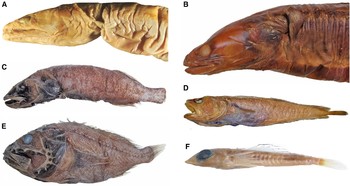
(A) Myroconger sp. CIDRO 81, 431.0 mm total length (TL); (B) Conger esculentus CIDRO 82, 1391.0 mm TL; (C) Talismania homoptera CIDRO 84, 188.3 mm standard length (SL); (D) Physiculus kaupi CIDRO 86, 275.3 mm SL; (E) Ectreposebastes imus CIDRO 94, 109.8 mm SL; (F) Centrodraco oregonus CIDRO 95, 94.3 mm SL.

MATERIAL EXAMINED
CIDRO 81, 1 specimen (431.0 mm total length), Brazil, Ceará, Aracati oceanic bank, 03°28′38″S 37°20′48″W, 253 m, coll. 10 January 2001, Programme REVIZEE, oceanographic vessel ‘Professor Martins Filho’.
DESCRIPTION
P1 16. Pores: supraorbital 3; infraorbital 4; preoperculomandibular 6; supratemporal none; lateral line 5. Total vertebrae 125; predorsal vertebrae 4; preanal vertebrae 48. Measurements in per cent of total length (TL): body depth at the level of vent 6.4; head length 14.9; predorsal length 13.9; preanal length 47.3; pectoral fin length 2.5; caudal fin length 1.5. Measurements in per cent of head length (HL): snout length 24.9; eye diameter 12.7; snout to rictus distance 49.8; gill opening width 10.0; interbranchial distance 24.4; pectoral fin length 16.6. Body without scales; head with slightly superior depression; mouth terminal, without labial folds, jaws reaching posterior margin of eye; two pairs of nostrils, anterior tubular and terminal, posterior not tubular, at the level of upper margin of eye. Intermaxillary teeth in six transversal rows; a space between intermaxillary and vomerian teeth, but not between intermaxillary and maxillary teeth; 3–4 irregular rows of teeth on jaws, internal series with largest teeth; vomerine tooth patch long, slender and irregularly uniserial, its posterior extremity almost in the level of posteriormost border of maxillary teeth.
Colour of preserved material: pale yellow with narrow brown stripe running medially along the body; brown blotches on interorbital region, behind eyes and operculum; belly and fins beige.
REMARKS
This is the first record of this genus and family in the western Atlantic. Five species of Myroconger are known to date: M. compressus Günther, Reference Günther1870, from the eastern Atlantic, M. gracilis Castle, Reference Castle1991 and M. prolixus Castle & Bearez, Reference Castle and Bearez1995, from the western Pacific, M. nigrodentatus Castle & Bearez, Reference Castle and Bearez1995, from the eastern Pacific, and M. seychellensis Karmovskaya, Reference Karmovskaya2006, from the Indian Ocean (Smith, Reference Smith1984, Reference Smith and Böhlke1989a; Castle, Reference Castle1991; Castle & Bearez, Reference Castle and Bearez1995; Karmovskaya, Reference Karmovskaya2006). Our specimen is most similar to M. nigrodentatus in morphometric characters and vertebral counts, but it does not have black pigment on the tips of the maxillary teeth, and the vomerian teeth are not smaller than the intermaxillary teeth (see Castle & Bearez, Reference Castle and Bearez1995). It further differs from M. compressus, M. gracilis and M. seychellensis by having vomerine teeth uniserial (instead of two or more series anteriorly; see Smith, Reference Smith1984, Reference Smith and Böhlke1989a; Castle, Reference Castle1991; Karmovskaya, Reference Karmovskaya2006) and from M. prolixus in the number of lateral line pores (5 versus 11; see Castle & Bearez, Reference Castle and Bearez1995). Additional specimens in good overall condition are necessary for a more precise identification and full description of this species.
MATERIAL EXAMINED
CIDRO 82, 1 specimen (1391.0 mm TL), Brazil, Ceará, Aracati oceanic bank, 03°22′34″S 37°28′30″W, 269 m, coll. 31 March 2001, Programme REVIZEE, oceanographic vessel ‘Professor Martins Filho’. CIDRO 83, 1 specimen (1078.0 mm TL), Brazil, Rio Grande do Norte, off the slope, 04°46′50″S 36°19′32″W, 150 m, coll. 15 November 1998, Programme REVIZEE, oceanographic vessel ‘Professor Martins Filho’.
DESCRIPTION
P1 17–18. Pores: ethmoid 1; adnasal 1; preoperculum mandibular 9; infraorbital 5 + 1; supraocular 1 + 2; supratemporal 1; post-temporal none; preanal lateral line pores 34–36. Measurements in per cent of TL: body depth 6.4–10.3; head length 15.8–16.7; predorsal length 21.5–22.8; preanal length 40.2–40.6; pectoral fin length 5.5–5.6. Measurements in per cent of HL: snout length 26.6–27.2; eye diameter 12.7–13.1; interorbital width 14.4–17.3; upper jaw length 36.2–36.6; gill opening width 14.1–16.9; interbranchial distance 32.1–34.3; pectoral fin length 33.8–35.0. Mouth terminal, with thick lips; maxillae with two rows of sharp teeth, teeth rows separated by large fold, not visible with mouth closed, vomerine tooth patch triangular.
Colour of preserved specimens: pale brown overall, darker in dorsal and anal fin margins and paler in ventral region.
DISTRIBUTION
Western Atlantic, from Florida, Bermuda and Antilles to Venezuela (Kanazawa, Reference Kanazawa1958; Smith, Reference Smith and Böhlke1989b, Reference Smith and Carpenter2003; Cervigón, Reference Cervigón1991), and off the south-eastern and southern Brazilian coast (Bernardes et al., Reference Bernardes, Figueiredo, Rodrigues, Fischer, Vooren, Haimovici and Rossi-Wongtschowski2005; Mincarone & Smith, Reference Mincarone and Smith2005). The material examined represents the first record of this species on the north-east Brazilian coast.
MATERIAL EXAMINED
CIDRO 84, 1 specimen (188.3 mm SL), Brazil, Ceará, Aracati oceanic bank, 500 m, January 2004, commercial fishery.
DESCRIPTION
D 19; A 22; P1 12; P2 7; lateral line scales 58; gill rakers 7 + 18; branchiostegal rays 6. Measurements in per cent of standard length (SL): body depth 19.7; head length 36.2; eye diameter 5.8; interorbital width 5.8; snout length 10.9; upper jaw length 16.9; pectoral fin length 13.4. Head without scales. Upper jaw extends to posterior margin of eye. One canine-like row of teeth on premaxilla, maxilla, dentary, and palatines; vomerine teeth in a single plate. Cycloid scales on body; upper pectoral fin rays filamentous, uppermost reaching pectoral fin origin; dorsal and anal fins opposite. Colour of the preserved material: black.
DISTRIBUTION
Atlantic, in the western Atlantic it occurs from the Gulf of Mexico to northern Brazil (Uyeno et al., Reference Uyeno, Matsuura and Fujii1983; McEachran & Fechhelm, Reference McEachran and Fechhelm1998; Menezes, Reference Menezes, Menezes, Buckup, Figueiredo and Moura2003) and along the Rio Grande Plateau, in the western South Atlantic (Parin et al., Reference Parin, Shcherbachev and Pakhorukov1995). The specimen examined herein is the first record of Talismania homoptera in north-eastern Brazil.
MATERIAL EXAMINED
CIDRO 86, 1 specimen (275.3 mm SL), Brazil, Ceará, Aracati oceanic bank, 03°22′31″S 37°32′30″W, 263 m, coll. 31 March 2001, Programme REVIZEE, oceanographic vessel ‘Professor Martins Filho’.
DESCRIPTION
D 70; A 67; P1 30; P2 8; scales in longitudinal series 138; scales in vertical series from first dorsal fin to lateral line 12; gill rakers short and spinose 4 + 10 (including rudiments). Measurements in per cent of SL: body depth 17.2; head length 29.0; eye diameter 5.8; interorbital width 4.0; snout length 8.1; upper jaw length 13.0; predorsal length 31.6. Measurements in per cent of distance between interventral line and anal fin origin: light organ diameter 11.2; distance interventral line—light organ 20.0; distance light organ—vent 26.4. Mouth terminal, upper jaw reaching posterior margin of eye; premaxillary and maxillary teeth villiform, curved and arranged in many irregular rows; vomer and palatines toothless. Body covered with minute cycloid scales, including the gular region and interradial membranes of dorsal and anal fins. Lateral line slightly arched anteriorly and straight posteriorly. Colour of the preserved specimen: grey, dark purple on belly and anterolateral region of trunk; dorsal and anal fin margins dusky.
DISTRIBUTION
Physiculus kaupi has been reported from the Caribbean Sea to northern Brazil and off south-eastern Brazil (Paulin, Reference Paulin1989; Figueiredo et al., Reference Figueiredo, Santos, Yamaguti, Bernardes and Rossi-Wongtschowski2002; Iwamoto & Cohen, Reference Iwamoto, Cohen and Carpenter2003; Menezes & Figueiredo, Reference Menezes, Figueiredo, Menezes, Buckup, Figueiredo and Moura2003). The material examined is the first record of this species from the north-eastern Brazilian coast.
MATERIAL EXAMINED
CIDRO 94, 1 specimen (109.8 mm SL), Brazil, Ceará, Aracati oceanic bank, 500 m, January 2004, commercial fishery.
DESCRIPTION
D XII-10; A III-6; P1 18; P2 I-4; lateral line scales 26; gill rakers (including rudiments) 5 + 9. Measurements in per cent of SL: body depth 37.4; head length 44.3; eye diameter 6.3; interorbital width 12.1; snout length 14.5; upper jaw length 23.8; pectoral fin length 33.4. Body covered with cycloid scales; lateral line complete and trough-like. Pelvic fin base below pectoral fin base. Head weakly ossified, cavernous; preorbital spines long, first the shortest, opercular spines stout, third the longest. No pit in occiput on top of head. Colour of the preserved material: dark brown, buccal cavity black with brown patches.
DISTRIBUTION
Pacific, Indian and Atlantic, where on the western side it occurs from Canada to French Guiana (Eschmeyer, Reference Eschmeyer1969; Uyeno et al., Reference Uyeno, Matsuura and Fujii1983; McAllister, Reference McAllister1990; Poss & Eschmeyer, Reference Poss, Eschmeyer and Carpenter2003). The specimen examined represents the first record of Ectreposebastes imus in the Brazilian waters.
MATERIAL EXAMINED
CIDRO 95, 1 specimen (94.3 mm SL), Brazil, Ceará, Aracati oceanic bank, 500 m, January 2004, commercial fishery.
DESCRIPTION
D1 III; D2 14; A 13; P1 26; P2 I-5. Measurements in per cent of SL: body depth 12.4; head length 32.4; eye diameter 12.0; interorbital width 1.2; snout length 5.8; upper jaw length 9.7; length of the first dorsal fin spine 18.1; length of the first dorsal fin ray 34.9. Rays of the second dorsal fin with long filaments. First dorsal fin spine longer than second one. Colour of the preserved material: whitish, with three elongate horizontal brown stripes; second dorsal fin distally dark grey.
DISTRIBUTION
Northern Brazil, near the Amazon River mouth (Fricke, Reference Fricke1992; Figueiredo & Menezes, Reference Figueiredo, Menezes, Menezes, Buckup, Figueiredo and Moura2003). The specimen examined represents the southernmost record of Centrodraco oregonus.
ACKNOWLEDGEMENTS
The authors are indebted to Franklin Sterman and Silvana Unruh for assisting in the radiographs of the Myroconger specimen, João Eduardo Pereira de Freitas (LABOMAR/UFC) for the pictures of the specimens herein illustrated, CAPES/FECAP and CNPq for providing financial support (to C.C.P. grant no. 180181/2001-7 and to R.A.C. grant no. 140053/2008-5).