1. FAMINES AS COMMUNITY CRISES
Subsistence crises, and particularly pre-industrial crises, have been the subject of extensive historical research for a long time.Footnote 1 The central focus, triggered by a Malthusian and a Marxian perspective, was on macro processes such as the relationship between famine crises and demographic crises, and the impact of subsistence crises on revolutionary political events.Footnote 2 During the 1980s, the focus shifted to famines as social and communal processes that cause ‘the accelerated destitution of the most vulnerable, marginal and least-powerful groups in a community, to a point where they can no longer, as a group, maintain a sustainable livelihood’.Footnote 3 This broader interpretation is inspired by the food entitlement approach of the Indian economist Amartya Sen, amongst others. Agency became central, particularly people's actions regarding a decreasing ‘command over food’.Footnote 4 The entitlement approach moved the focus from availability of food (production based) towards the distribution of food (market based). As Stephen Devereux pointed out, it failed to take into account the ‘importance of institutions in determining entitlements’, such as households and village communities (transfer based).Footnote 5 Internal household power relations and community networks often remain hidden. This was also true of what Devereux called ‘fuzzy entitlements’, generated from communal property regimes, and rights or claims over resources that are held collectively; ‘Rights can also be exercised at varying levels, from ownership (the strongest form, including rights of disposal) to access and usufruct rights (the weakest form, where ownership and use are often separated).’Footnote 6
This debate confirmed the interpretation of famines as community crises, where scarcity and human suffering are accompanied and aggravated by a social breakdown, ‘a syndrome with webs of causation through which communities lose their ability to support marginal members who consequently either migrate in families because of lack of access to food, or die of starvation or starvation related disease’.Footnote 7 That is why famines are unique experiences that occupy a finite span of historical time and human experience while also being recurring patterns that reveal insight into a society's deeper and more enduring difficulties.Footnote 8
The notion of famine as an event (sudden crisis), process (accelerated destitution) and structure (the breakdown of societal networks) creates the need for more integrated famine research. This includes individual and household coping strategies dealing with acute forms of stress as well as reactions from public authorities.Footnote 9 Even though a lot of new famine research includes historical studies, such as the work of Cormac Ó Gráda amongst others, there is still much we do not know about the agency factor, particularly local exchange networks (markets) of food, labour and credit in periods of extreme economic stress.Footnote 10 It is often assumed that during famine crises existing market and non-market institutions for credit and insurance perform less well, or even collapse. Patronage lineages succumb and alternative, ‘anti-social’ behaviour increases.Footnote 11 However, this is not always the case. What is the role played by these networks in periods of severe social stress? To answer this question, new research must also concentrate on cases where famines did not kill on a massive scale, or where crop failures did not result in a severe famine crisis.Footnote 12 Research that concentrates on extreme situations risks narrowing the focus to the event character rather than to structural variables such as mechanisms of resistance and adaptability.Footnote 13
2. COLLECTIVE COPING STRATEGIES AND PUBLIC RISK MANAGEMENT
A re-examination of rural subsistence crises must aim at a broader understanding of the societal context: families, neighbourhoods, villages, and local and supra-local public authorities. Moreover, this research must not only focus on the visible disasters of hunger, death and societal breakdown, it must also focus on processes of absorption, adaptation and recovery. In short, it must focus on disasters as well as on near disasters or non-disasters. Why did famine not break out? To understand the difference between real and almost famines we need a more integrated analysis. On the most basic level, we must understand the direct impact of a food crisis. In traditional terms this is expressed via measures of declining food availability such as crop and livestock production or market provisioning, the levels of human suffering – reflected in mortality, health and disease – and by the demographic adaptive strategies adopted such as marriage, fertility or migration. On a second level, the focus of this article, we have to understand the formal and informal collective coping strategies. Such an integrated view implies a knowledge of local economics and politics.
The main focus of this article is the local village society from a dual perspective. First, how did the local population as a group cope with the sudden stress of a (possible) hunger crisis? Second, how did local authorities react to this threat of famine? Coping is defined as the manner in which people act within the constraints of existing resources on the one hand and the entitlements they receive to command them on the other hand. Individual resources for coping with famine include labour, land, tools, seed for crops, livestock, draft animals, storable food stocks, cash and valuables that can be sold. The most common individual and household strategies are adaptations of demographic behaviour and consumption patterns, intensification and diversification of the use of family labour, and selling assets and land. Collective coping strategies point at relationships related to exchanging these assets. These strategies can be either defensive and protective or active and offensive.Footnote 14 They can also be embedded in existing societal agreements (accessing markets, exercising rights, calling upon obligations or moral duties, strengthening and enlarging networks of patronage and social support). Securing basic needs goes together with an appeal to guarantee the basic rights of entitlement. If this fails, new forms of coping strategies can break the former rules by circumventing legal and moral laws or by physically leaving the livelihood. They point at a breakdown of the societal structures.
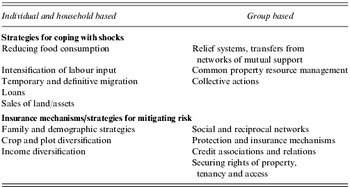
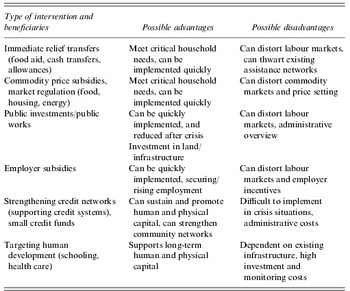
Research on the impact of contemporary crises and natural disasters on household coping strategies reveals a multitude of risk-management arrangements on both a household and a collective level.Footnote 15Table 1 summarises the range of choices that households have for managing risk in crisis situations, during both immediate shocks and longer-term crisis situations. The use and effectiveness of these protection strategies depend on the impact of the crisis, the compatibility of individual choices and the efficiency of public actions. Strategies may also conflict with short-term and long-term goals: reallocation of intra-household labour input and/or food intake can save assets but may also harm long-term health, especially that of children; selling assets may jeopardise the survival of the farm; violating moral standards in using collective goods may harm future participation in credit networks or group-based insurance regulations; adjustments in fertility strategies may affect long-term household labour supply. Public interventions during a period of sudden crisis also have multiple dimensions, as shown in Table 2. We can distinguish between short-term actions such as relief transfers, market regulation and price subsidies, middle-term interventions such as investments in public works and encouraging employers' businesses, and long-term initiatives such as those strengthening credit networks, increasing schooling and improving health-care facilities. Each form of action puts serious pressure on public assets, so choices are often weighted in favour of immediate implementation and effects.
Household risk management strategies in crisis situations

Source: Adapted from E. Skoufias, ‘Economic crises and natural disasters. Coping strategies and policy implications’, World Development 31, 7 (2003), 1087–1102, here 1090.
Public actor interventions in crisis situations

Source: Adapted from E. Skoufias, ‘Economic crises and natural disasters. Coping strategies and policy implications’, World Development 31, 7 (2003), 1087–1102, here 1094–6.
The main aim of this article is not only to measure and explain two (near-) famines in Flanders. By adapting the concepts of household and public risk management, we want to map out and understand the reorganisation of private and public social relations in two periods of sudden social distress. We focus on the relationship between these two sets of collective strategies, and on the way they supplement or replace each other. We will look at both formal and informal local coping and protection mechanisms using two sets of measures: proxies for crises such as increased mortality or criminality, and affirmative actions by public authorities and local credit networks. Our main thesis is that the impact of hunger crises in peasant societies is directly, but inversely, related to the level of stress absorption and risk spreading within the local village community. In Flanders, intra-village distributional networks changed profoundly between the middle of the eighteenth and the middle of the nineteenth century. Local management strategies shifted from predominantly informal networks to predominantly formal institutions. This transition is rooted in structural changes in the Flemish rural society in the eighteenth and nineteenth centuries. Our findings contradict the traditional vision of a more-or-less straightforward shift in crisis management from rural, local and informal to urban, supra-local and formal. We argue that the means of surmounting famine crises has always had local roots.
3. FLEMISH PEASANTRIES
The Flemish countryside between 1750 and 1850 has often been described as the marvel of the (western European) agricultural world.Footnote 16 It was generally acknowledged that this Flemish husbandry represented the upper scale of what could be obtained in agricultural techniques and production. Agricultural land was almost continually in use, crop yields were high and the land was able to sustain a dense population. The basic production unit was the small family farm, characterised by an extremely high labour input. Typically, between 1750 and 1850, Flemish smallholdings were smaller than one or two hectares, often tilled by the spade. These small family holdings were deeply embedded in local village economies but also participated in regional and national economies through local markets and larger farms, and even in the international economy through the export of linen. Each village had its larger farms, linked to peasant holdings through complex dependence relationships and credit systems in the form of labour, goods, services and sometimes money. Smallholders exchanged their labour surplus for the capital and goods surplus of larger farmers, such as horesepower. These local credit networks connected subsistence farming with external markets.Footnote 17
For centuries, the Flemish commercial peasant economy guaranteed the survival of a large majority of families in Flanders.Footnote 18 The last period of accelerated growth started in the middle of the eighteenth century, resulting in unprecedented levels of agricultural yields. Between 1750 and 1850, the population of Belgium almost doubled and actually grew by 75 per cent in the already densely populated Flemish area. This increase was an entirely rural phenomenon related to the success of traditional agrarian society. In 1850, the population density in Flanders had increased to 233 inhabitants per square kilometre, one of the highest densities at that time. The region only had one centre of urban growth: the industrial city of Ghent. Demographic and financial pressures on husbandry had a favourable effect on yields. In the eighteenth century, the agriculture of the Southern Netherlands was highly productive and was able to feed a rapidly increasing population.Footnote 19 In addition, approximately 5 per cent of the grain harvest could be exported as surplus. A permanent effort to improve physical yields in arable farming was the only way to avoid a structural food shortage. The increase in total agricultural output was largely due to diversification and further improvement of existing production methods. Rising food production was the combined result of increased yields resulting from more intensive soil cultivation in arable farming, the spread and differentiation of crop rotation, often without fallow, the introduction and spread of new crops such as the potato, and the longer, often permanent, stabling of livestock. Nevertheless, by the beginning of the nineteenth century, tensions were building around population increase, farm structure and production volumes.Footnote 20 In spite of yield increases, the agricultural sector in the Southern Netherlands could not keep pace with population growth. Agricultural production grew at an average annual rate of 0.58 per cent between 1760 and 1850 and population grew at a rate of 0.69 per cent in the same period. In spite of occasional supply crises, this imminent problem did not result in a structural hunger crisis. This is related to the fact that the Southern Netherlands shifted from being a bread grain exporter to a grain importer (10 per cent to 15 per cent of needs in the mid-nineteenth century). Moreover, the enormous success of the potato-enabled arable farming kept pace with population growth (with an annual output increase of 0.74 per cent between 1760 and 1850 compared with 0.30 per cent for the livestock sector).
In the first half of the nineteenth century, soil yields rose to unprecedented levels. In the middle of the nineteenth century, average bread-grain yields (including oats and barley) were between 40 and 50 per cent higher than a century before; potato yields increased even more. Rising yields and the expansion of cultivated acreage – an additional 17 per cent between 1760 and 1850 due to land reclamation and further fallow reduction – meant that a structural food shortage could be avoided. Demographic growth strengthened the role of agriculture as a producer of staples: bread grains and potatoes. However, physical yield increases had their limits. Expressed in yield ratios (i.e. the ratio of seed sown to seed harvested), productivity growth in both grain and potato cultivation was rather modest. The key to increases in physical yield was higher labour input. Intensification of digging, manuring, weeding and other labour in the fields explains the survival of the rural way of life up until the third quarter of the nineteenth century. Average labour input per hectare in Flanders increased by almost 50 per cent between 1760 and 1850.Footnote 21 Most likely, the physical growth of Flemish agriculture was accompanied by stagnating, or even decreasing, labour productivity. Foreign observers, surprised by the intensive cultivation of small plots of land, spoke of Flemish horticulture.Footnote 22
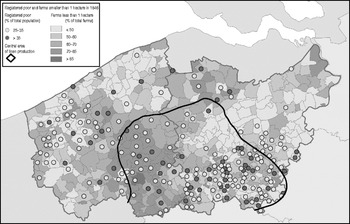
The success of arable farming averted a structural supply crisis in Belgium in the first half of the nineteenth century. On the other hand, Belgian rural society was characterised by increased differentiation and polarisation. In Flanders and the western part of Brabant, the most densely populated regions of the country, 40 to 50 per cent of the farms were less than one hectare in size and 80 to 85 per cent were less than five hectares. During the eighteenth and nineteenth centuries, land fragmentation increased as a result of a combination of partible inheritance, increased peasant debt, severe population pressures and the introduction of the potato. Consequently, the need for income from other sources increased. In addition, land and farms increasingly had to be rented. In central Flanders during the second half of the eighteenth century, two out of three farms were cultivated on lease. Increased land competition caused rents to rise. In the mid-eighteenth century, the annual rent of a hectare of arable land was equivalent to 30 times the daily wage but this price had doubled by the turn of the century and had tripled by 1850. It was no accident that prices increased the most in regions where farm fragmentation was the greatest, leasing was dominant, and flax and linen cottage industries were widespread. These areas also saw accelerated commercialisation of rural life (many small and regional markets) and the revival of small- and medium-sized cities. Flemish peasants responded to this increased financial pressure by working even harder on the land, and augmenting their income at the spinning wheel and the loom. In the first half of the nineteenth century, a quarter to half of the population of central Flanders worked in the rural flax and linen industry. Until the 1840s, 300,000 to 400,000 villagers earned extra income by this proto-industrial labour. Starting in the 1820s, decreased yarn and cloth prices increased pressure on the Flemish peasants' income. By the 1830s, one out of every five Flemish families was registered as indigent. Figure 1 shows that the highest ratios of supported poor were registered in the south, the proto-industrial region with an extremely high number of small farms. An exception was the south-west of West Flanders, a region with a high number of commercial farms and a corresponding share of wage labour. The majority of surpluses produced by household farming were drained away through unequal labour, credit and lease relationships.Footnote 23 The Flemish peasant economy was thus responsible for the majority of national economic growth. A high social price was paid for this growth; countryside impoverishment was clearly apparent by the middle of the nineteenth century.
Map of Eastern and Western Flanders in 1846, showing the percentage of farms less than 1 hectare in size and the percentage of the population who were ‘registered poor’. (Source: Data on farm size from Agriculture. Recensement général de 15 octobre 1846 (Brussels, 1850); data on poor from Population. Recensement général de 15 octobre 1846 (Brussels, 1849). Map by Torsten Wiedemann, HISSTAT – Central database of historic local statistics in Belgium, Ghent University, History Department.)

4. THE SUBSISTENCE CRISES OF 1740 AND 1845–1847
Even though Flanders experienced high-yield agriculture from the late Middle Ages onwards, food and subsistence crises seem to have been a part of life for most generations of peasants until the eighteenth century. Between 1660 and 1750, food shortages were a recurrent feature in the Southern Netherlands. Most harvest failures were triggered by climatic factors, but the effects were aggravated by the almost endemic warfare that characterised the late seventeenth and early eighteenth centuries. During this period, the crises of 1696–1698, 1709 and 1740 stand out when looking at prices for basic foodstuffs. After 1750, food shortages became less frequent. Traditionally this has been seen as the result of both substantial rises in agricultural production and more efficient government action and monitoring of food supplies.Footnote 24 The late eighteenth century marked a short return to the pre-industrial pattern when a combination of war and harvest failure in 1794–1795 resulted in high mortality rates. During the first half of the nineteenth century, the Southern Netherlands experienced food shortages in 1816–1817 and in 1845–1847. After the middle of the nineteenth century, food crises were no longer prevalent in the Southern Low Countries, except for periods of war. Every crisis listed above was characterised by a decline in food production, rising price levels and a peak in mortality rates. However, these basic characteristics hide highly distinctive origins, effects and outcomes. How can the food crises of the 1740s and the 1840s be compared?
4.1. 1740
The food shortages were not a local phenomenon in 1740. Most Western European countries were affected because climatic factors were the origin of this harvest failure. Unlike many other food crises in the early modern period, 1740 was clearly associated with elevated levels of mortality on a wider European scale. In the decades preceding 1740, certain regions were able to build up some immunity from the mortality penalty associated with harvest failures and high food prices.Footnote 25 In 1740 food supply and mortality were closely related in most European countries.Footnote 26 Consequently, 1740 is sometimes viewed as the last great food and mortality crisis of pre-industrial Europe. The origin of the drop in food production was the harsh winter of 1739–1740. The winter of 1740 was characterised by two distinct features: very low temperatures and insufficient grain stocks. Temperatures were exceptionally low by eighteenth-century standards. In Brussels, for example, temperatures of minus 18 or minus 19 degrees Celsius were not uncommon.Footnote 27 More importantly, the winter was exceptionally long. In the collective memory, the legendary winter of 1709 was an exceptionally cold winter (le grand hiver), whilst 1740 is remembered for its long period of frost (le long hiver). Because of this long period of frost – negative temperatures were recorded until May – most crops were partially or completely destroyed. The crops that survived the extreme temperatures could only be harvested very late. The winter of 1740 disrupted the annual growth and supply cycle of crops, and reduced per capita food supply. In addition, compared with earlier years, the harvest of 1739 had been markedly poor so grain stocks were insufficient to bridge the gap until the delayed harvest of 1740. When stocks were exhausted in late April and early May and the prospects of an early and abundant harvest dwindled, prices started to rise. It is highly likely that rising price levels in the spring of 1740 were incited by panic as well as a severe distortion of supply and demand.
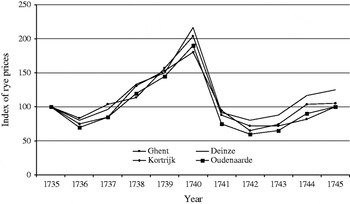
Figure 2 shows that the price of rye had been increasing steadily since 1736 and that prices peaked in 1740.Footnote 28 Although prices appear to have risen continuously over several years, inflation struck particularly hard in 1740 when prices peaked at 25 to 30 per cent above the already high level of 1739. From 1736–1740 the purchasing power of labourers declined by about 60 per cent. Even more striking is the spectacular fall in price levels in 1741 following the harvest failure of 1740, after which prices stabilised at their pre-1735 level. In terms of food availability, rye prices suggest that the harvest crisis was rather short and limited to the period between April 1740 and October 1740. However, the impact of the harvest failure on direct food supply is difficult to measure. In May 1740, the Austrian government ordered a detailed inventory of all grain supplies in the Austrian Netherlands. Local magistrates were instructed to inspect every house and record the quantity of grain stocks.Footnote 29 This information enabled the government to chart grain supplies in the country and identify the regions that either had a surplus or shortage of grain until the next harvest. We assume that this source underestimated the quantities of grain that households possessed, but some important conclusions can be drawn from this exercise. In the rural district of Bruges, data indicate that there was just enough grain to last until the next harvest. Although the projected demand for grain was 1 per cent higher than available supplies, this region was able to meet demand in the following months. In the rural district of Oudenaarde, the situation seems to have been more dramatic. Out of 33 villages, only 3 claimed that they had enough grain to last until the next harvest. Most parishes recorded shortages that varied between 30 and 75 per cent of the available stock.Footnote 30 The differences in the availability of grain reflect different agricultural structures. In the northern part of the district of Bruges which lay in the Polder region, large farms dominated the agricultural and economic landscape whilst the more southern region of Oudenaarde, lying in sandy inland Flanders, was primarily characterised by smallholdings.Footnote 31 Before taking measures, the government needed information about the possibilities of intra-country grain transfers. The exercise indicated that there was indeed an objective threat of food shortages and that most regions had insufficient supplies until the harvest of 1740. One of the effects of grain scarcity and high prices in 1739 and 1740 was to accelerate the spread of the potato into the fields and onto the menu of the rural population.Footnote 32
Index of annual rye prices on selected Flemish markets, 1735–1745 (1735=100).

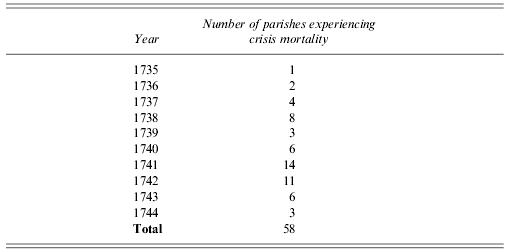
The food crisis of 1740 has typically been characterised by high grain prices, food shortages and increased mortality. However, the demographic effects of the crisis of 1740 were not straightforward. Although mortality rates rose during the late 1730s and early 1740s, no unique link between food prices and mortality rates can be discerned. In the absence of reliable population data to calculate crude mortality rates, we measured the relative intensity of mortality during a period of 15 years.Footnote 33 In our sample, we recorded the number of burials in 26 rural parishes between 1730 and 1744.Footnote 34 During the period 1735–1744, all the parishes under observation experienced at least one year of heightened mortality. Crisis mortality was recorded in 2 or even 3 years during this decade in 20 out of 26 villages. The decade 1735–1744 rather than just the year 1740 should thus be associated with crisis mortality. This is even more apparent when the timing of these crises is reconstructed. In these 26 parishes, 58 crisis years can be observed. As Table 3 clearly indicates, 1740 does not stand out. Mortality was particularly high in 1741 and 1742 when food prices had already dropped. According to contemporary observations, increased mortality during this period was the result of typhus, typhoid fever and relapsing fevers.Footnote 35 These data support John Post's conclusions on a wider European scale and indicate that there was no clear-cut link between price levels and mortality rates.Footnote 36 Although 1740 was clearly marked by a fall in per capita food supply, this did not directly influence mortality levels.
Number of parishes experiencing a mortality crisis in each year 1735–1744; 26 Flemish rural parishes
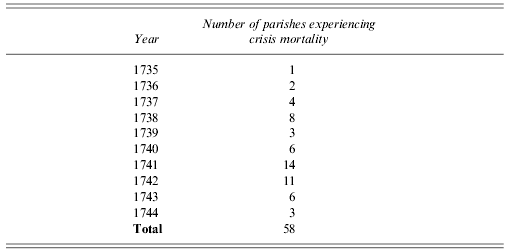
Source: Calculations based on State Archives Beveren, Collection of Parish Registers (parishes of Aarsele, Ardooie, Bazel, Dentergem, Drongen, Dudzele, Kanegem, Kaprijke, Laarne, Ledeberg, Lichtervelde, Lochristi, Markegem, Melle, Meulebeke, Moerbeke-Waas, Nevele, Oedelem, Oostakker, Oostkamp, Oostrozebeke, Ruiselede, Sint-Andries, Sint-Gillis-Waas, Sleidinge and Velzeke).
4.2. 1845–1847
The direct cause of the mid-nineteenth-century subsistence crisis in Europe was the failure of the potato harvests in the years 1845–1850.Footnote 37 Compared with other countries, Belgian potato fields were affected early by the potato blight, Phytophthora infestans, which set in from mid-July 1845 and destroyed 87 per cent of the 1845 harvest. In Flanders, the epicentre of the disease, losses amounted to 95 per cent of the crop. Over the following years, harvests were also poor because fewer potato seedlings were planted and yields remained low. Between 1846 and 1850, barely a third of the ‘normal’ potato harvest was gathered in Flanders. The food situation became very precarious in late 1846 and the first half of 1847 due to poor bread-grain harvests. Bad weather conditions in 1846 caused the rye harvest, by far the most important bread grain, to decrease by more than half, though the losses were smaller for wheat and maslin, just 10 per cent or so. Calculated in grain equivalents, the combined loss of bread-grain and potato harvests in 1846 was 66 per cent, leaving only 125 litres of grain equivalents available per head, compared with 375 litres in previous years. Half the bean and pea harvests were lost too, and because all harvests were affected, the threat of famine also loomed in 1846. Luckily, bumper grain harvests in 1847 and reasonable harvests in subsequent years reduced the threat.
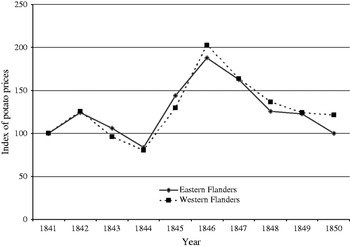
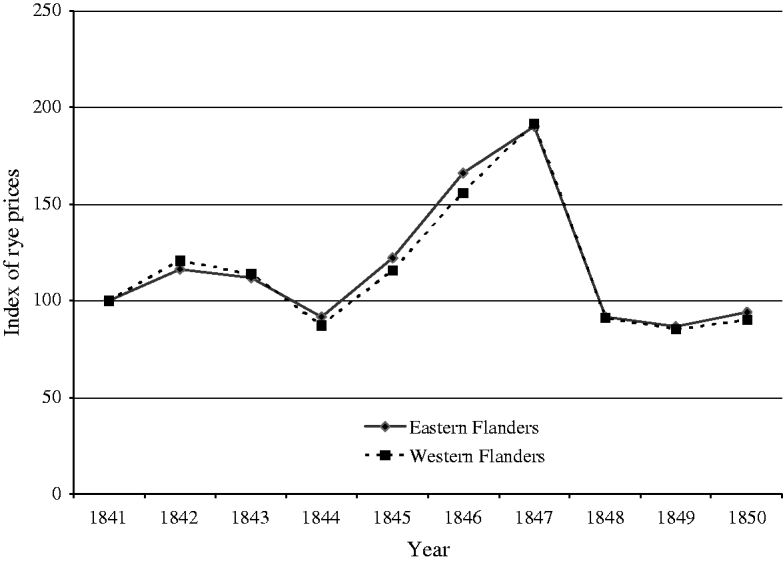
Weekly grain prices peaked in the spring of 1847 after the partial failure of grain harvests. At the peak, rye cost 2.4 times as much as in 1844 and wheat cost twice as much. Also, potatoes were sold at 3.5 times the 1844 level, rice was three times as expensive while peas and beans were 1.8 times as expensive as in 1844 (see Figure 3 and Figure 4 for changes in the annual prices of potatoes and rye). A crisis in the rural flax industry coincided with the subsistence crisis of 1845–1847. Up until then, this industry had provided tens of thousands of Flemish families with crucial additional income. Labour participation in the Flemish linen industry was still rising during the first decades of the nineteenth century, and reached more than 300,000 women and men. In the central Flanders textile regions, at least half of the labour force worked part time in the rural flax and linen industry. Around 1850, it was clear that Flemish flax processing had lost the commercial battle against mechanised cotton and linen production. The actual income of spinners and weavers went into freefall. By 1850, a weaver's daily wage would buy him less than 3.5 kilograms of rye, whereas in 1750 the daily wage was worth four times this amount.
Index of annual potato prices in Eastern and Western Flanders 1841–1850 (1841=100).

Index of annual rye prices in Eastern and Western Flanders 1841–1850 (1841=100).
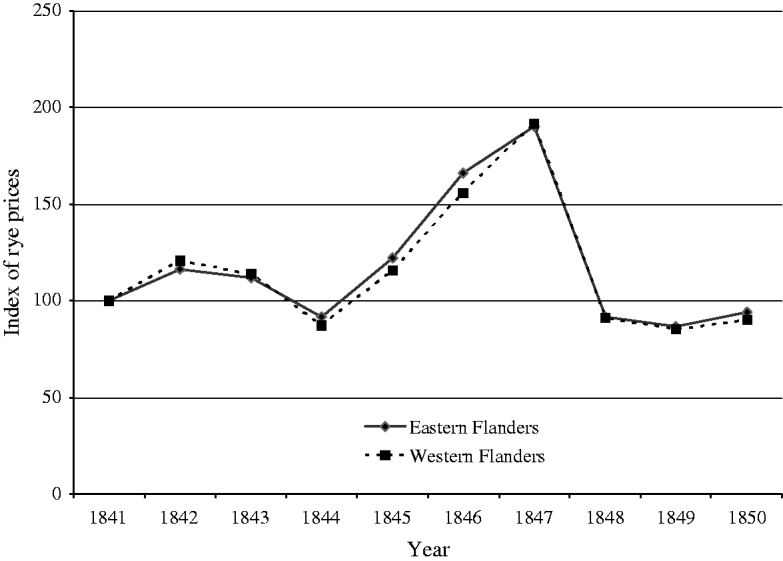
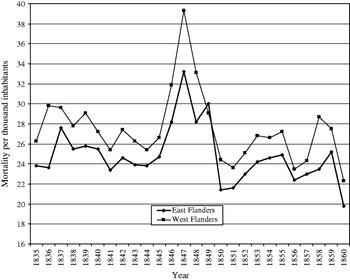
Figure 5 indicates the impact of the crisis years of 1845–1847.Footnote 38 Compared with the reference years of 1841–1845, the year of 1847 had a surplus mortality of 23,000 (+30 per cent), while the three-year period from 1846 to 1848 had a surplus mortality of 44,000 (+15 per cent). The number of births decreased by 47,000 during the same three years (–12 per cent) and there were also 17 per cent fewer marriages. High mortality in 1846–1847 was limited to the geographical area of Inner Flanders, with averages of up to 47–53 deaths per thousand inhabitants in 1847. Total excess mortality in the two Flemish provinces was 15,000 (+40 per cent) in 1847 and 29,500 in 1846–1848 (+27 per cent) compared with 1841–1845. Life expectancy at birth was markedly lower in the Flemish regions: averaging 32–35 years in 1841–1850 compared with 37 years in Brabant and 39–40 years or more in the other Belgian provinces. In the crisis years in Flanders, 18 per cent fewer births than normal and 30 per cent fewer marriages were registered. In the linen district, the declines were 30 per cent and 40 per cent, respectively. Most deaths were a consequence of nutrition-related diseases such as dysentery and typhus. In 1846–1848, typhus was registered in half of the Flemish municipalities, with 46,000 persons registered sick and 10,000 registered deaths. A cholera epidemic took hold from 1848 to 1849, resulting in 5,900 registered deaths in Flanders and 22,400 deaths in Belgium as a whole. Striking differences in local mortality rates were seen, reflecting the impact of local outbreaks of dysentery or typhus.
Mortality rates as annual averages in Eastern and Western Flanders, 1835–1860.

To what extent did these two moments of sudden social stress in 1740 and the 1840s affect public and private social relations? How did formal and informal mechanisms of coping and protection interact or replace each other? Following the subdivisions laid out in Tables 1 and 2, in section 5 we focus on public actor interventions; national and local public actions and then, in section 6, we look at household risk-management strategies as the main form of informal collective coping strategy.
5. PUBLIC ACTOR INTERVENTIONS
Public responses to harvest failure and subsistence crises have been frequently described from the viewpoint of national, supra-regional or urban authorities. During both the 1740s and 1840s, the central state played the role of an intervening actor, but with a strikingly different impact. The actions taken by central governments were always part of a larger panorama of social distress circumvention. First, many of the initiatives could only succeed with the active collaboration of local authorities. During both crises, the central state delegated most crisis management tasks to local communities. Second, and more importantly, all local communities adopted and organised additional measures to secure food availability and alleviate poverty. These local public interventions are characterised by both intra-village and inter-village community actions.
In 1740, the Austrian government resorted to traditional measures to counter rising prices and ensure access to food. In spring 1739, reports reached Brussels stating that the harvest would be low. In May 1739, the government tried to prohibit exports from the Austrian Netherlands, but regional and urban authorities opposed this measure. Grain production and trade centres used their political power to hold off the export prohibition of grain as long as possible.Footnote 39 As a result, it was not until late November 1739 that the government decided to prohibit the export of staple foods outside the territory of the Austrian Netherlands. Because the government intervened too late, food had to be imported from the Northern Netherlands. In 1738, only 115 last were imported, though this number rose to 2351 last in 1739 and in 1740 imports peaked at more than 10,000 last.Footnote 40 New measures were only taken in March 1740. In addition to food, the export of industrial seeds (i.e. used for commercial purposes such as flax and coleseed) was prohibited. As this ordinance clearly stated, it was anticipated that the harvest of 1740 would be bad. When prices skyrocketed in May 1740, the government ordered a census of all available grain supplies in the Austrian territory. Measures taken by central authorities depended on the cooperation of local institutions. In particular, parishes were ordered to enumerate the grain supplies in the villages and to organise patrols to ensure public safety and prevent theft and rioting.Footnote 41 Government action during this period was characterised by a lack of efficiency and depth. The measures adopted to ensure food availability came too late due to a lack of detailed information. Furthermore, the measures that were promulgated focused on the import and export of grain and did not structure the internal (re)distribution of available stocks and imports. As a result, local communities coordinated the physical supply of grain. The actions of local rural communities were diverse and seem quite unstructured. Some local communities organised the purchase of grain in the Northern Netherlands and organised finance and transport themselves. In some regions, supra-local institutions such as the kasselrijen, or chatellenies, played a more active role in organisation and coordination.Footnote 42 Finally, some villages also collaborated with the magistrates of the large and small urban centres to buy grain. It is clear that in the 1740s, public actions of local communities were not guided by a real action plan, nor were they coordinated from above.Footnote 43
In addition to local communities, parochial welfare institutions played an important role in the local food supply. These so-called armendissen or poor boards had organised parochial-based poor relief since the Middle Ages. In years with average and low prices, these welfare institutions only supported the so-called structurally poor. The expenditure of these dissen was primarily aimed at ensuring the survival of more vulnerable members of the local society such as children, orphans, the elderly, the disabled and the widowed of both sexes. These institutions drew their income almost exclusively from charitable donations from the members of the local community. The vast bulk of the expenditure of these poor boards consisted of material assistance either in cash or kind, rent subsidies and free medical aid. During years of dearth, however, the ability of these welfare institutions to aid the increasing number of households who were without sufficient access to food was limited. Compared with their nineteenth-century successors and from the viewpoint of modern welfare relief standards, these poor relief institutions were rather inefficient. The level of support they could provide for the poor was determined and limited by the annual income derived from land, annuities and charitable donations.Footnote 44 Until the late eighteenth century, poor taxes were quite uncommon in this region. As a result, the supply of poor relief in Flanders was highly inelastic.Footnote 45 Because demand for relief exceeded the available resources, poor boards were forced to either concentrate aid on a small fraction of those in need of assistance or to distribute aid less generously over a larger part of the poor.Footnote 46 This became particularly apparent in the crisis of 1740. In 1740, local welfare administrations increased their supply of relief to the needy, but were quickly confronted with the limits to what they could disburse. The number of parishioners applying for poor relief rose sharply, and the average cost of relieving poverty increased substantially. The accounts of these institutions indicate that expenses increased by some 25 to 40 per cent compared with earlier years and that many dissen had to contract debts to finance the rising number of poor parishioners. In the village of Lochristi, more than double what was distributed to the poor during the years 1738 and 1739 was distributed in 1740. Welfare support dropped sharply again after 1740.Footnote 47 Parochial welfare institutions provided poor relief by distributing money, food, clothing and by paying for medical expenses. They were able to support elevated levels of poverty, but only for a short period. After 1740, the debts that were contracted had to be repaid and this could only be achieved by lowering the expenses again. Because of the way they obtained their income, the local welfare system was not very well suited to counter the sudden effects of food shortages and sharply rising prices. In the eighteenth century, the actions of national and local authorities still lacked planning and coordination, as well as the financial and organisational means, to successfully counter a crisis. In this respect, the legal changes instigated by the French Revolution paved the way for more efficient public policy related to distress relief. After the French Revolution, the income of local relief institutions was supplemented by taxes. Taxation was added to the sources of income of welfare institutions to balance the financial losses sustained by the abolition of tithes and other ‘feudal’ dues. Financial deficits by local relief institutions were now by law balanced by communal taxation. In the provinces of Eastern and Western Flanders especially, poor relief institutions depended on taxes to generate sufficient resources for the destitute.Footnote 48
In the 1840s, national, regional and local public authorities were much more active and their actions were much more effective.Footnote 49 However, the swift reaction by the central government to the harvest failures of 1845 and 1846 still followed the traditional policy of protecting home markets and controlling the price level of basic foodstuffs. In September 1845, the Belgian government proclaimed that the import of grains, potatoes and other foodstuffs would be duty free. At the same time, it prohibited the export of bread and biscuits. These laws were extended until the beginning of 1850. The government also bought food from foreign countries. For example, in the spring of 1846, a 100,000 Belgian francs credit was used to buy 5.5 million kilograms of seed potatoes. A second policy was to support local governments financially, e.g. to support the rural flax industry. In the years 1845–1847, the national government allotted 4.8 million Belgian francs to this. Most of it, approximately 3 million Belgian francs, went to the two Flemish provinces of Eastern and Western Flanders. The money also supported the creation of industrial aid committees and werkscholen [working schools]. Third, in cooperation with town councils and on a 50/50 basis, funds were allotted to subsidise public works. In the 1840s, various government bodies, including town councils, spent 14.7 million Belgian francs on public works in the two Flemish provinces, compared with 3.9 million Belgian francs during the previous decade. According to their own calculations, the central government spent 8 million Belgian francs to alleviate problems during the crisis of 1845–1850s. Finally, projects for land reclamation and drainage were stimulated. The reclamation law of March 1847 forced all the municipalities to sell their uncultivated land and reintroduced tax exemption for newly cultivated land. This did not have an effect in the short term. Other initiatives, such as colonisation, amounted to nothing. The same was true of plans to stimulate overseas emigration.
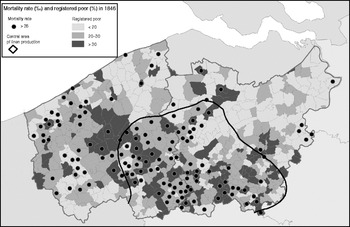
The shocks of the complex societal crisis of the 1840s were mostly absorbed within village communities which responded as soon as it became clear that the potato harvest was failing. They increased poor relief and financed initiatives to create additional jobs through public works, lace ateliers and workhouses, and the setting up of purchase and sales offices for flax, linen yarn and cloth. The local elites organised food handouts. Local patrols and night watches maintained public order and tried to stop the itinerant poor from entering the village. The main policy instruments were the local poor relief institutions. In nineteenth-century Belgium, relief policy was still coordinated locally and the aim of the relief system was to provide as much assistance for as long as possible within an individual's official municipality of legal settlement. Communal law stipulated that each municipality had to have its own local relief institution or bureaux de bienfaisance. Bigger cities also had hôpitaux [hospitals]. Like their predecessors, the dissen, the poor relief institutions were administered by a council made up of the local elite and financed by their own resources and increasingly by municipal authorities. Municipalities had the right to collect separate taxes intended for poor relief administration. The poor institutions rarely received financial support from the national government – 1846–1847 was an exception. The number of registered poor in Flanders, already high, rose sharply in the crisis years (see Figure 6). In some linen-producing regions and some cities, such as Bruges and Kortrijk, 40 per cent of the population was registered as at least partly dependent on poor relief in 1847.
Map of Eastern and Western Flanders in 1846: mortality rate and rate of registered poor. (Source: Population. Recensement général de 15 octobre 1846 (Brussels, 1849). Map by Torsten Wiedemann, HISSTAT – Central database of historic local statistics in Belgium, Ghent University, History Department.)

Public intervention in the 1840s was much more planned, interventionist and effective than in the 1740s. In the eighteenth century, actions were limited to incoherent interventions in the food supply and food markets, and to the temporary alleviation of the strict system of local poor relief. By the mid-nineteenth century, authorities were taking more initiatives. They intervened in and supplied markets, subsidised the system of poor relief distribution, organised local labour demand via public works, industrial committees and working schools, and coordinated systems of control and repression. This shift towards formal public responses contrasted with a second fundamental process: the decreasing impact of informal collective coping strategies.
6. COLLECTIVE RISK-MANAGEMENT STRATEGIES
In the 1740s, the actions of national and regional authorities were primarily aimed at ensuring access to cheap food through urban market centres. The government tried to ensure the distribution of existing food supplies within rural communities, but it did not take any immediate actions to achieve or impose this. This can be seen as a failure of the central authorities to ensure access to food for all of the inhabitants. However, it is more likely that the government did not deem it necessary to impose this kind of measure at the village level. There are some indications that food was rather efficiently distributed within rural communities without the interference of formal markets or supra-local institutions. It should be noted that the importance of urban market centres for the overall distribution of food was limited. Until the second half of the nineteenth century, the vast majority of all food produced was redistributed outside urban markets. Furthermore, by imposing minimum quantities, urban market regulations discouraged rural consumers from buying grain in cities. This does not imply that producers in the countryside sold their produce directly to consumers or that every farm can be viewed as a mini-market. In fact, until the late eighteenth century, legislation explicitly forbade farmers from selling vast quantities of their produce directly to rural consumers. These measures did allow small quantities of food to be exchanged in the countryside. Indeed, farmers exchanged rather than sold part of their produce directly to rural consumers. This exchange of food took place within a specific context of reciprocity and credit networks. These networks defined the exchange entitlements of rural consumers very differently from their urban counterparts. This explains why the authorities did not apply measures in the countryside in 1740. There was simply no need for it. The situation had altered significantly by the 1840s. Both the set of measures and the magnitude of these actions during the latter crisis suggest that intra-village distributional networks underwent a profound change between 1740 and 1850. This section discusses how these intra-village networks were organised.
In the eighteenth century, the Flanders countryside was characterised by a particular form of intense social interaction.Footnote 50 Most of the holdings were small and supplemented their income with proto-industrial activities and day labouring. These two types of extra-household activities had very different purposes. The increased involvement of Flemish peasantries in the flax and linen cottage industry can be explained primarily by surplus extraction. During the seventeenth century, the expansion of rural weaving and spinning was incited by increases in state taxation. In the following century, however, proto-industrial expansion was primarily driven by rising land and leasing prices, fuelled by a growing population. Proto-industry enabled smallholders to obtain supplementary income to pay for these rising expenses.Footnote 51 Between 1750 and 1850, proto-industrial activity as a share of total household income became much more important and both direct and indirect income from farming declined rapidly. In addition to weaving and spinning, small farmers also earned a living as day labourers working on larger farms in their village. During late spring and the harvest months large farms employed men, women and children drawn from a group of smallholders. Smallholders had surplus labour power which they could use to engage in proto-industrial activities or to work as day labourers. In most cases, households engaged in both activities. What distinguishes proto-industry from day labouring was the security that smallholders could gain by selling their labour to larger farms. The relationship between large farms and the labouring households were deeply imbedded within the village community. The labour market in Flemish villages – as far as day labourers are concerned – was highly personalised and aimed at long-term reciprocal relationships. Each large farm in Flanders drew labour from a limited but stable number of households. The relationship between the employers and employees was characterised by intense exchanges of labour, capital and credit. To some extent, these relations constituted a well-balanced rural ecosystem. The core of this ecosystem was the exchange of labour for capital.Footnote 52 Smallholders sold part of their household labour power to large farms without being paid in cash. Money was the means of measurement, but it was not the means of exchange.Footnote 53 The value of labour performed by these households served as a credit line that they could draw on from time to time. In most cases, the virtual savings with the employer were used to hire capital goods from the large farms. In particular, small farms hired animal traction such as horses and capital goods such as ploughs and wagons to work their own smallholding. By using their employer's horses to plough their own fields the peasants saved time that could be used for proto-industrial activities. In addition to labour for capital goods, these exchanges also included other items. Peasants used their credit line to purchase food, fuel, raw materials for proto-industrial production or simply cash when needed.
Such relationships, renewed year after year by the mechanism of reciprocal exchange, formed the basis of village economy in eighteenth-century rural Flanders. They structured the distribution of capital, labour, credit and food within rural communities. They also acted as an insurance mechanism on the part of day labourers. In the middle of the eighteenth century Flemish smallholders sold surplus labour for exchange entitlements rather than for wages. The existence of these networks was particularly relevant when food crises occurred. A farmer's account book between 1735 and 1780 sheds light on how these relationships operated during periods of limited food supply such as 1740. As in other years, part of the labourer's earnings was paid in food rather than in cash or services. More importantly, a supply of food in the future was also guaranteed. The account book recorded agreements indicating that the farmer would deliver specified amounts of food to the labourers at a price and timing agreed upon by both parties.Footnote 54 These contracts were concluded at market prices and not at farm gate prices so the smallholders did not benefit financially. Such exchange networks thus enabled peasant farmers and day labourers to secure food, even in periods of scarcity.
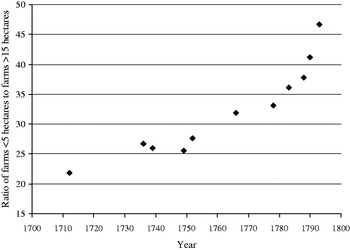
Between 1750 and 1850 this reciprocal exchange system reached its limits. An increasing number of smallholders became disconnected from the informal networks. Large farms still offered services to smallholders, but a rising number of villagers could no longer be absorbed in the exchange system and an increasing share of the rural population was excluded from the support networks. This is illustrated in Figure 7. Between 1750 and 1800 there was a dramatic shift in the ratio of farmers that employed labour and produced surpluses and smallholders that could sell labour and were market dependent. Flanders was characterised by a sharp increase in the number of smallholders that did not produce any food surpluses. In other words, the number of farms that did not produce sufficient quantities of food rose more rapidly than the number of farms that could absorb these smallholders in local exchange networks. Around the middle of the eighteenth century, there was one large farm per 25 to 30 smallholders; by the end of the eighteenth century, this ratio had almost doubled. The implications of this change can hardly be overestimated. Households faced with insufficient food supplies had to turn to formal markets or depend on other, more formal networks of distribution to ensure their survival. The sharply increased reliance on formal or external networks by a large share of the rural population is, in our view, the most important explanation of the different coping strategies during the subsistence crises of the 1740s and the 1840s.
Ratio of farms smaller than 5 hectares to farms larger than 15 hectares: Anzegem, West Flanders, 1700–1800.

The pivotal institutions in these formal support networks were, as described above, the local relief institutions. In the first half of the nineteenth century, the ratio of the population supported by the official poor institutions, albeit mostly temporarily, rose dramatically to around 30–35 per cent of the total population of the provinces of Eastern and Western Flanders (see Figure 6).Footnote 55 In West Flanders, total expenditure by municipal relief institutions in 1846–1849 ran to 9.15 million Belgian francs, more than the total relief sum provided by the central government. Only a minor part of these huge costs could be paid for from the institutions' own resources. The remainder came from additional support from the local communities and, to a much lesser extent, from central government, from the sale of properties and from fund-raising events. During crisis years, poor institutions and many village administrations were virtually bankrupted and were only able to keep running because of higher taxation, the sale of properties, subsidies and initiatives organised by local elites and the Catholic Church. Where village elites withdrew from more informal support initiatives such as direct bestowing, local authorities had to resort to more forceful fund raising via higher taxes.
This fundamental shift in local crisis management was also reflected in the incidence of criminal activities, particularly theft. Some parishes organised armed patrols to discourage criminal behaviour during the late harvest of 1740. There were reports of grain stolen from the fields. The number of prosecutions for theft increased. In the rural district of Bruges, the number of prosecutions for theft rose from 10 in 1739 to 21 in 1740. However, taking into account the large population in this region, these numbers remained very low. An increase in the number of individuals prosecuted under vagrancy laws was also recorded. The number in the Bruges region rose from 1 in 1739 to 13 in 1740.Footnote 56 This echoes the general complaint of rising numbers of vagrants in these years, but, again, numbers remained low. The picture had changed dramatically a century later as the crisis of 1845–1847 triggered an increase in crime.Footnote 57 The number of cases and charges appearing before the criminal court (tribunaux correctionnels) in Belgium increased strongly. During the period 1840–1844, about 17,000 to 19,000 cases involving an average of 26,500 suspects were handled per year. By 1847 this had increased to 32,894 cases involving 38,235 suspects, representing an increase of almost 50 per cent. The biggest increase in charges concerned mendicancy (9 times higher in 1847, compared with 1840–1841), vagrancy (3 times higher), petty theft (3 times higher), trespassing on public woods and land (2.5 times higher) and pillage along with other minor rural criminal activities (3.5 times higher). On the other hand, the number of cases of physical violence decreased. The profile of suspects changed too. At the beginning of the 1840s, 19 per cent of suspects were female, and 11 per cent were under 16 years. In the years 1846–1848, a quarter of the suspects were female and at least 20 per cent were aged under 16 years. Women and children were mainly charged for mendicancy, entering public woods and lands, insulting behaviour, petty theft and stealing crops at night. The number of convictions increased. At the beginning of the 1840s, an average of 78 per cent of suspects were sentenced, and 48 per cent were imprisoned, but by the period 1846–1849 this had risen to 85 per cent of whom two-thirds actually went to prison. Mendicancy, theft and pillage were dealt with more severely. The number of people sentenced to prison remained around 10,000 before the crisis years. This increased to 20,787 in 1846 and 28,348 in 1847, and then fell again. These statistics seem to indicate that governments and possibly ordinary citizens were less tolerant during this period. Such a view is supported by the increasing number of police by-laws, rising from approximately 200 per year before 1844 to 1,116 in 1846 and 1,374 in 1847. In Eastern and Western Flanders, the number of arrested and convicted persons rose by 160 per cent and 250 per cent, respectively, between 1841 and 1847. Most individuals were arrested for minor offences and only detained for a short period. The population of prisons (les maisons centrales) rose by 25 per cent between the early 1840s and 1847 while the number of prisoners doubled in local arrest houses (maisons de sureté et d'arrêt). There was also a sharp increase in the numbers of beggars who often ‘worked’ in groups and during the winter of 1846–1847, the Bruges police arrested 6,000 beggars. They were mostly sent back to their own villages but some were confined in the workhouses for beggars (dépôts de mendicité). From 1845–1850, all rural villages set up their own safety measures such as night patrols and field watches to ward off such criminal activity.
It is clear, therefore, both that more poor households engaged in theft in order to ensure their survival in the 1840s than the 1740s, and that the level of subsequent repressive actions was much higher in the later period.
7. DISCUSSION
Recent famine research has substantially increased our understanding of the way famines, or threats of famine, ‘work’ within specific societal contexts. This implies a careful measuring of food availability and human suffering, as well as an evaluation of the vulnerability of livelihoods, such as the formal or informal security networks regarding food, income and survival. To understand the strategies of risk management we need to focus on ‘established’ famine cases and we also have to analyse near-famines or non-famines. As Brian Murton stated, the real understanding of famines as social events lies not in the ‘triggers’ that cause famines, but in the ‘normal’ economic and political sphere in which they occur – or are prevented.Footnote 58 This runs parallel with the argument of David Arnold that famine as both a sociological concept and a historical phenomenon presents us with a fundamental paradox: it is both event and structure. Famines are exceptional human experiences within a finite space and time span, but they also act as revealing commentaries upon society's deeper and more enduring successes and failures.Footnote 59
Severe food crises occurred in 1740 and 1845–1847 that did not turn into famines in the traditional sense. The peasant economy and village society were able to absorb the main shocks of these crises and the way this happened differed greatly, due to structural changes in the rural economy between 1750 and 1850. Our research concentrated on the way Flemish village society coped with the sudden stress following quickly decreasing food availability during two different moments in time. To understand the impact of a food crisis, we need information both on the extent of the agricultural and demographic crises and on the absorption capacities of the local society. These include formal and informal networks of entitlement and support; networks that supplement and substitute for each other. Cooperative, informal arrangements and the legal organisation of risk sharing and assistance only collapse under the most extreme circumstances.Footnote 60 Genuine famines are always accompanied by a serious breakdown of existing social networks. Institutions fail and informal patterns of cooperation collapse. Neither happened during the severe subsistence crises in Flanders in the 1740s and the 1840s. Food shortages and high food prices were met by the local village society. In the 1840s this was only possible with much more effort and difficulty due to the deeper impact of the subsistence crisis and, most importantly, due to the rapidly decreasing strength of intra-village exchange networks. The margins of resilience, still substantial in the middle of the eighteenth century, were completely absorbed a century later by the combined effects of fast population growth and decreasing returns from farm and proto-industrial labour. Nonetheless, and contrary to the infamous Irish example, a severe Flemish famine was avoided because of the survival of the small but mixed and productive peasant farms, and by the swift and sometimes anticipatory actions of the local and supra-local institutions.Footnote 61
In both cases, the social effects of the subsistence crisis were almost exclusively endured by the village economy. The way this happened differed markedly. In the 1740s, public actions were limited to trade and import regulations. As described above, intra-village distributional networks guaranteed household exchange entitlements for most of the rural population. Small and larger farms were interconnected by labour relations, which in turn supported reciprocal networks of capital and services.Footnote 62 By the 1840s, these local credit systems had been largely undermined and the rural poor had to address formal relief structures more often than before. The elites increasingly resorted to institutional initiatives of aid, employment and repression, backed both legally and financially by an active state apparatus. Village externalities were more prominent in the 1840s than in the 1740s. Social developments between 1750 and 1850 required a new institutional and social framework. A decline in the number of households that could participate in intra-village security networks resulted in the erection of replacement networks that were largely state created and funded.
If famine can be viewed as a tragic magnification of normal market and governmental failures, non-famines or near-famines must be analysed within the context of local survival structures.Footnote 63 Local societies' vulnerabilities to economic distress depend on three critical factors: the impact of the crisis, the social and economic order, and the way people keep control of their own fate, whether as individuals, within the household or as part of the local community. As John Walter and Roger Schofield noted, ‘Famine is a collective problem, starvation an individual fate.’Footnote 64 This collective level includes the rate of social differentiation along lines of income, sex and age, the strength of local institutions and the structure of the regional economy. Further comparative research must deepen our knowledge regarding the impact of peasant versus commercialised agriculture on the vulnerability to famine. As Walter and Schofield have argued, the disappearance of large-scale famines in England in the late seventeenth century was related to the remarkable increase in agricultural production and to the strengthening and formalisation of local entitlement support: ‘Protection against dearth and the provision of grain came publicly and formally through the system of communally organised and funded welfare provision represented by the poor law.’Footnote 65 Our research suggests that a rise in formal protection systems may have had different causes and divergent outcomes in historic Flanders and in a wider West European context.
ACKNOWLEDGEMENTS
The authors would like to thank the anonymous referees for their constructive remarks.