Introduction
Individuals with schizophrenia exhibit negative symptoms, including blunted affect which refers to reductions in gesturing, voice prosody, and facial expressions of emotions (Andreasen, Reference Andreasen1982; Foussias, Agid, Fervaha, & Remington, Reference Foussias, Agid, Fervaha and Remington2014; Kirkpatrick, Fenton, Carpenter, & Marder, Reference Kirkpatrick, Fenton, Carpenter and Marder2006). Facial expressions have adaptive functions that are critical for well-being. However, we know quite little regarding if and what facial expression alterations occur earlier in the disease process, reflecting vulnerability and mechanistic targets relevant for identification, biomarker, and treatment development. Examining facial expressions in individuals considered at imminent risk for developing a psychotic disorder (termed clinical high-risk; CHR) provides a unique window into answering these questions as those with a CHR syndrome exhibit symptoms suggestive of possible conversion to psychosis (e.g. difficulties discerning reality, hearing whispers) in a short window of time (Cannon et al., Reference Cannon, Cadenhead, Cornblatt, Woods, Addington, Walker and Heinssen2008; Fusar-Poli et al., Reference Fusar-Poli, Borgwardt, Bechdolf, Addington, Riecher-Rössler, Schultze-Lutter and Yung2013) .
Negative symptoms in schizophrenia: blunted facial expressivity
Schizophrenia researchers have been interested in the study of negative symptoms going back to Eugen Bleuler, a Swiss psychiatrist who coined the term schizophrenia (Andreasen, Reference Andreasen1997; Zec, Reference Zec1995) and suggested affectivity was at the center of the disorder. Of the negative symptom research thereafter, studies repeatedly found individuals with schizophrenia report no alterations in how they experience emotions generally, however evidence also indicates these individuals show observable, yet subtle blunting in how emotions are expressed (Kring & Elis, Reference Kring and Elis2013). A critical step in research on facial expressivity in schizophrenia was the use of facial electromyography (EMG) to detect alterations in facial expressions. Facial EMG is a sensitive tool that measures facial muscle activity through sensors placed on the face and thereby can detect subtle muscle activity. Two muscles in particular are suggested to be implicated in mental health and are commonly used in EMG studies. The first is zygomaticus major (AU12) which is activated in smiling and often affiliated with positive emotions, such as excitement and amusement (Ekman & Friesen, Reference Ekman and Friesen1982; Ekman, Friesen, & Hager, Reference Ekman, Friesen and Hager2002). Smiles serve important intra- and interpersonal functions; they can be useful for coping with adversity and play an important role in interpersonal interactions (Burton & Kaszniak, Reference Burton and Kaszniak2006; Keltner & Gross, Reference Keltner and Gross1999; Keltner, Kring, & Bonanno, Reference Keltner, Kring and Bonanno1999; Papa, & Bonanno, Reference Papa and Bonanno2008). For example, smiles can provide interoceptive information in social situations (Gray, Ishii, & Ambady, Reference Gray, Ishii and Ambady2011; James, Reference James1948; Noah, Schul, & Mayo, Reference Noah, Schul and Mayo2018) and can be useful for coping with stress such as during bereavement (Keltner & Bonanno, Reference Keltner and Bonannon.d.). The second is corrugator supercilii (AU 4) which is activated in frowning and often affiliated with negative emotions, such as fear and sadness (Cacioppo, Petty, & Morris, Reference Cacioppo, Petty and Morris1985; Johnson et al., Reference Johnson, Haase, Beermann, Sanchez, Tharp, Lwi and Nguyen2017; Lang, Greenwald, Bradley, & Hamm, Reference Lang, Greenwald, Bradley and Hamm1993). Corrugator activity has been suggested to be reflective of concentration and effort as well (Trémeau, Reference Trémeau2006). Facial expressivity such as abnormalities in both zygomatic and corrugator activity can be altered in psychiatric illnesses such as severe mental illness (e.g. schizophrenia) and neurodegenerative diseases (Cowan et al., Reference Cowan, Masucci, Gupta, Haase, Strauss and Cohen2022a; Greden, Price, Genero, Feinberg, & Levine, Reference Greden, Price, Genero, Feinberg and Levine1984; Kring & Elis, Reference Kring and Elis2013; Kring, Kerr, & Earnst, Reference Kring, Kerr and Earnst1999; Sestito et al., Reference Sestito, Umilta’, De Paola, Fortunati, Raballo, Leuci and Gallese2013; Wolf, Mass, Kiefer, Wiedemann, & Naber, Reference Wolf, Mass, Kiefer, Wiedemann and Naber2006).
An early facial EMG study (Dimberg, Reference Dimberg1982) established that healthy individual showed more zygomaticus major activity when presented with positive emotional stimuli and more corrugator supercilii activity when given negative emotional stimuli. Since this groundbreaking study, facial EMG has been used to detect alterations in facial expressions across psychological disorders. Notably, this methodology was central in establishing that individuals with schizophrenia show zygomaticus activity in response to positive stimuli and corrugator activity in response to negative stimuli, thus demonstrating intact valence-congruent facial expressions; while, at the same time, showing that activation of these facial muscles was reduced compared to healthy controls thus demonstrating blunting in facial expressions (Kring et al., Reference Kring, Kerr and Earnst1999; Kring & Elis, Reference Kring and Elis2013; Wolf et al., Reference Wolf, Mass, Kiefer, Wiedemann and Naber2006). Building on this work, studies have demonstrated that facial blunting is also correlated with clinical symptomatology in schizophrenia (Berenbaum & Oltmanns, Reference Berenbaum and Oltmanns2012; Trémeau et al., Reference Trémeau, Malaspina, Duval, Corrêa, Hager-Budny, Coin-Bariou and Gorman2005; Tron, Peled, Grinsphoon, & Weinshall, Reference Tron, Peled, Grinsphoon, Weinshall, Serino, Matic, Giakoumis, Lopez and Cipresso2016). For example, there is evidence that individuals with diminished expression (blunted facial expressions and reduced quantity of speech) also have a greater likelihood of an abrupt emergence of psychotic symptoms and longer duration of hospitalization (Strauss et al., Reference Strauss, Horan, Kirkpatrick, Fischer, Keller, Miski and Carpenter2013). Importantly, blunted facial expressions may not always be present, but in fact may emerge only at specific times when individuals are presented with emotional stimuli, highlighting the importance of timing in detecting alterations in facial expressions (Volz, Hamm, Kirsch, & Rey, Reference Volz, Hamm, Kirsch and Rey2003).
Blunted facial expressivity and the clinical high-risk syndrome
Similar to individuals with schizophrenia, individuals with a CHR syndrome show negative symptoms, including blunted facial expressions, which can impact of quality of life and functional outcomes (Piskulic et al., Reference Piskulic, Addington, Cadenhead, Cannon, Cornblatt, Heinssen and McGlashan2012; Strauss, Pelletier-Baldelli, Visser, Walker, & Mittal, Reference Strauss, Pelletier-Baldelli, Visser, Walker and Mittal2020). In a hallmark study (Walker, Grimes, Davis, & Smith, Reference Walker, Grimes, Davis and Smith1993), using a prospective design, individuals who later developed schizophrenia showed blunted facial expressions (determined via coding of home-movies taken at birthdays and family or holiday gatherings) as a child up until adolescence compared to siblings without a diagnosis. Blunting was particularly pronounced for expressions of joy in females suggesting important specificity related to joy facial expressions that research conducted by our group subsequently confirmed in a series of studies. Specifically, we have found that, compared to healthy controls, individuals with a CHR syndrome exhibit blunted facial expressions of joy during clinical interviews using human coding (including the fine-grained Facial Action Coding System) as well as automated algorithms. Blunting in positive facial expressions is important for our understanding of negative symptoms in the CHR group more broadly because of the important functions that positive facial expressions serve, including signaling information to others and coping (Keltner et al., Reference Keltner, Kring and Bonanno1999). In contrast, we have not obtained evidence for blunting in negative facial expressions, rather finding that individuals with a CHR syndrome either show no alterations in negative facial expressions (Gupta et al., Reference Gupta, Haase, Strauss, Cohen, Ricard and Mittal2022) or heightened expression of anger (Gupta, Haase, Strauss, Cohen, & Mittal, Reference Gupta, Haase, Strauss, Cohen and Mittal2019).
Moreover, we have found that blunted expressions of joy (but not other alterations such as facial expressions of anger) were related to lower social functioning and higher psychosis risk conversion scores (Gupta et al., Reference Gupta, Haase, Strauss, Cohen and Mittal2019), thus providing initial evidence of blunted positive facial expressions as a clinical marker in this vulnerable population. Along these lines, alterations in facial expressions are complicated by the high rates of comorbid diagnoses such as depression and anxiety; isolating facial expressivity from comorbidity and other confounding factors (e.g. positive and negative symptoms) poses a challenge in this area of research but is needed in order to clarify potential mechanistic pathways.
Summary
In sum, while past studies provide important evidence of blunting, specifically blunting of positive facial expressions, in individuals with a CHR syndrome, they also have important limitations. First, previous studies have relied on clinical interviews (or, indirectly, on home movies), which offer high ecological validity, but do not afford the degree of tight, experimental control afforded by standardized emotion-eliciting stimuli, such as evocative film clips (Kring & Elis, Reference Kring and Elis2013). Second, previous studies have employed human coders and automated algorithms, but, to our knowledge, no prior study has applied facial EMG to detect alterations in subtle facial muscle activity that may not be visible to human coders or detectable by software in a CHR sample.
The present study
The current study is the first, to our knowledge, to examine (1) alterations in facial expressions in response to emotionally evocative film clips using facial EMG in individuals at CHR compared to healthy controls and (2) links with clinical symptoms and comorbid symptoms of anxiety and depression in these individuals. Facial EMG was used with a focus on two facial muscles that are centrally implicated in positive and negative emotional responding, respectively, the zygomaticus and corrugator muscle. Multiple, dynamic, film clip stimuli were used, designed to elicit positive (i.e. excitement, amusement), negative (i.e. fear, sadness), and neutral emotions.
Building on prior studies of individuals with schizophrenia that had established blunted but valence-congruent facial expressions (Kring et al., Reference Kring, Kerr and Earnst1999), we expected individuals at CHR to show blunted zygomaticus activity in response to positive (but not negative or neutral) film clips. Additionally, building on facial EMG work with individuals with schizophrenia demonstrating the importance of considering time course (Varcin, Bailey, & Henry, Reference Varcin, Bailey and Henry2010) and, more generally, affective science work emphasizing the importance of eliciting emotions at sufficiently high intensity to establish differences in emotional responding (Levenson, Reference Levenson2014) we expected individuals with a CHR syndrome to show blunted zygomaticus activity specifically during the most emotionally evocative peak period of a positive video (identified based on story arch, facial expressions, gesture, body posture, and vocal expressions in the video) successfully used in prior work (Johnson et al., Reference Johnson, Haase, Beermann, Sanchez, Tharp, Lwi and Nguyen2017) compared to prior to this peak period. Finally, for those film clips where alterations in facial expressions were detected in the CHR group, we assessed the rate of change in facial expressivity and predicted that the CHR group would show reduced rates of change in facial expressions when compared to controls.
Finally, based on our prior work showing a link specifically between blunted joy expressions and psychosis risk conversion scores, we predicted that blunted zygomaticus activity would be related to increased psychosis risk calculator scores (Zhang et al., Reference Zhang, Li, Tang, Niznikiewicz, Shenton, Keshavan and Wang2018) and would be independent of comorbid diagnoses (anxiety, depression) but linked to negative symptoms, including the blunted facial expression item.
Method
Participants
A total of 66 participants (34 CHR, 32 controls), aged 15–28 (M = 20.56, s.d. = 2.37) were recruited through the Adolescent Development and Preventive Treatment Program (ADAPT). Recruitment methods included Craigslist, flyers, the Northwestern University Psychology course recruitment pool, community health referrals, and bus/train advertisements. Exclusion criteria for all subjects included neurological disorders and head injury, lifetime substance use, and the presence of a psychotic disorder diagnosis. Additional exclusion for controls included having a first-degree relative with a psychotic disorder. The authors assert that all procedures contributing to this work comply with the ethical standards of the relevant national and institutional committees on human experimentation and with the Helsinki Declaration of 1975, as revised in 2008. All procedures involving human subjects/patients were approved by the Northwestern University Institutional Review Board, protocol #STU00203263, #STU00203210. Written informed consent was obtained from all subjects/patients.
To identify a CHR syndrome, individuals were given the Structured Interview for Psychosis-Risk Syndromes (SIPS) positive symptom domain (McGlashan et al., Reference McGlashan, Miller, Woods, Rosen, Hoffman and Davidson2001). For the SIPS, if individuals received a score of 3 (moderate) to 5 (severe but not psychotic) on a 6-point scale on any of the positive symptom items, they were considered CHR. Additional CHR criteria included having a first-degree relative with a psychotic disorder and/or schizotypal personality disorder, with a decline in functioning. The Structured Clinical Interview for the DSM-5 (First, Reference First2014) (SCID-5) was also used to rule out a psychosis diagnosis. All interviewers received extensive training on the noted clinical interviews and were reliable, kappa < 0.80.
Facial electromyography
Facial EMG data was collected continuously using Biopac Systems (Biopac Systems Inc, USA) following established guidelines detailed in Fridlund and Cacioppo (Reference Fridlund and Cacioppo1986), with Ag/AgCL electrodes (4 mm) placed over the left zygomaticus major and left corrugator supercilii muscle. A ground electrode was placed on the forehead right below the hairline. EMG data were collected with a sampling rate of 2000 Hz, with an online bandpass filter between 10 and 5000 Hz for zygomaticus activity and between 1 and 500 Hz for corrugator activity. Offline, zygomaticus signals were run through a 50–500 Hz bandpass filter, while corrugator raw signals were run through a high pass filter of 50 Hz, to achieve a final bandpass filter between 50 and 500 Hz for both muscles. Following, filtered data was integrated (root square mean). Collected EMG data was visually inspected for artifacts and usability (e.g. large/small amplitudes and data that did not appear to be collected correctly due to missing segments were not included) and preprocessed using Biopac Systems Acknowledge Software, version 4.4. Data with artifacts were not included in the final sample. Zygomaticus and corrugator values (microvolts) deduced from each film clip were averaged.
Film clip stimuli
Facial EMG data was continuously monitored while participants watched short (2–3 min) film clips designed to elicit positive, negative, and neutral emotional states that have been used extensively in prior work with healthy and clinical populations. Film clip presentation was randomized across participants. Specifically, participants watched film clips eliciting (a) excitement (Gruber, Oveis, Keltner, & Johnson, Reference Gruber, Oveis, Keltner and Johnson2008; Johnson et al., Reference Johnson, Haase, Beermann, Sanchez, Tharp, Lwi and Nguyen2017); (b) amusement (Chen et al., Reference Chen, Lwi, Hua, Haase, Miller and Levenson2017a, Reference Chen, Wells, Otero, Lwi, Haase and Levenson2017b); (c) fear (Gross & Levenson, Reference Gross and Levenson1995); (d) sadness (Rompilla, Hittner, Stephens, Mauss, & Haase, Reference Rompilla, Hittner, Stephens, Mauss and Haase2021; Shiota & Levenson, Reference Shiota and Levenson2009); and (e) a neutral video clip (Johnson et al., Reference Johnson, Haase, Beermann, Sanchez, Tharp, Lwi and Nguyen2017). Additionally, baseline facial EMG was collected prior to each film clip as participants were asked to view a ‘X’ for 1 min. The (a) excitement clip was a film clip showing Sarah Hughes first competing and then ultimately winning the Olympic Gold medal and celebrating her success; (b) the amusement clip was a film clip from ‘I love Lucy’ showing Lucy and her friend manage wrapping chocolate pieces on a conveyor belt that continues to increase in speed; (c) the fear clip was da film clip from ‘The Silence of the Lambs’ showing a detective encountering a criminal they have been searching for; (d) the sadness clip was a film clip from ‘21 g’ showing a mother who learns that her two young daughters died in a car accident; and (e) the neutral clip showed a geometric shape moving along the screen.
Emotional experiences obtained at baseline and after each film clip on a 1 (no emotion) to 8 (the strongest emotion ever felt) scale were examined to apply a manipulation check and examine if groups were experiencing emotions intended to be evoked. All film clips successfully elicited the respective target emotion for both individuals with a CHR syndrome and healthy controls (determined by comparing baseline and post-film clip target emotional experiences). Specifically, the excitement film clip successfully elicited excitement, d (CHR) = 0.31, p = 0.086; d (Control) = 1.54, p < 0.001. The amusement film clip elicited amusement, d (CHR) = 0.76, p = 0.003; d (Control) = 1.57, p < 0.001. Additionally, the fear clip elicited fear, d (CHR) = 0.98, p < 0.001; d (Control) = 1.97, p < 0.001 and the sadness clip elicited sadness, d (CHR) = 1.30, p < 0.001; d (Control) = 1.30 p < 0.001. Lastly, the neutral clip elicited neutral emotion, d (CHR) = 1.59, p < 0.001; d (Control) = 1.20, p < 0.001
To determine the most emotionally evocative peak period of the excitement film clip, we relied on story arch, facial expressions, gesture, body posture, and vocal expressions of the key characters (Sarah Hughes and her coach learn that she won Olympic gold and celebrate her success, both smile at peak intensity, jumping up and down, hugging each other with excitement, letting out screams of joy, and Sarah Hughes then basks in cheers from the crowd as she continues to smile widely) drawing from prior work in healthy youth (Johnson et al., Reference Johnson, Haase, Beermann, Sanchez, Tharp, Lwi and Nguyen2017) as well as older adults with neurodegenerative diseases (Werner et al., Reference Werner, Roberts, Rosen, Dean, Kramer, Weiner and Levenson2007) that had similarly examined this peak period of emotional responding (and focused on an even shorter time period). We compared zygomatic activity during this peak period to zygomatic activity during the pre-peak period (i.e. 80 s segment from the start of the film clip up until the start of the peak, depicting Sarah Hughes completing an ice-skating competition and waiting to learn the results of her performance).
Outliers were generally kept in analyses given that several individuals showed quite a bit of variability in expressivity in response to viewing videos; it may be the case that these individuals could represent unique subgroups. This was the case for all variables except for zygomaticus activity when watching the amusement video which had a single outlier in each group that were displaying very large microvolts of facial expressivity (47, 49 microvolts, respectively). There was also a single outlier for rate of change (made with the pre-peak and peak variables) that was removed as well (23 microvolts).
Psychosis risk conversion scores
A psychosis risk conversion score calculator developed by the Shanghai At-Risk for Psychosis (SHARP) program at the Shanghai Mental Health Center (Zhang et al., Reference Zhang, Li, Tang, Niznikiewicz, Shenton, Keshavan and Wang2018) was used. This calculator provides a probability estimate that an individual with a CHR syndrome will develop psychosis and was developed in order to provide a practical and individualized risk score for psychosis conversion that can be used by both clinicians and researchers (Osborne & Mittal, Reference Osborne and Mittal2019, Reference Osborne and Mittal2022; Zhang et al., Reference Zhang, Xu, Tang, Li, Tang, Cui and Wang2019).
Clinical symptoms and diagnoses
Positive and negative symptom sum scores and items were obtained from the SIPS (McGlashan et al., Reference McGlashan, Miller, Woods, Rosen, Hoffman and Davidson2001; Miller et al., Reference Miller, McGlashan, Rosen, Cadenhead, Ventura, McFarlane and Woods2003). Current anxiety diagnoses (i.e. panic disorder, agoraphobia, specific phobia, social anxiety, generalized anxiety disorder) and major depression/persistent depression diagnoses from the SCID-5 were examined.
Statistical approach
Independent t tests and chi-square tests were employed to assess demographic details. Tests of normality were employed for central facial expressivity (zygomaticus activity for excitement, amusement, neutral and corrugator activity for sadness, fear, and neutral) variables and results indicated data was not highly skewed (skew values were between 0.42 and 1.38 in the CHR group and 0.12–1.66 in the control group) except for zygomaticus activity during the amusement video (CHR = 2.20; control = 2.07). Importantly, the log transformed amusement variable was no longer skewed after a log transformation was applied (CHR = 0.23, control = 0.27). Analyses using the transformed variable of amusement did not change the magnitude or direction of the finding for amusement, t(61) = 0.82, p = 0.81. Additionally, the pre-peak segment of the excitement video clip (examined in later analyses) was not highly skewed while the peak segment was skewed in the CHR group (2.94) but not in the control group (1.78). Importantly, the log transformed variable was no longer skewed (CHR = 0.86). Additionally, analyses with log transformed peak variables did not change the magnitude or direction of findings, t(62) = −2.22, p = 0.03. Furthermore, analyses using non-parametric tests for skewed amusement and peak variables did not change the magnitude or direction of findings. See supplement for further information. As a result, untransformed data was used in analyses to ease interpretation of results. Independent t tests were applied to examine differences in baseline facial expressions (i.e. when viewing a ‘X’) for each clip. Given no differences in baseline facial expressions and to preserve power, independent t tests were applied to examine group differences in facial expressions for each film clip. Please note primary analyses were conducted with zygomaticus activity in response to excitement, amusement, and neutral clips and corrugator activity was examined in the sadness, fear, and neutral clips. Nontarget (e.g. zygomaticus activity in response) emotion analyses were exploratory. Group differences in time segments were examined in facial expressions in which group differences were observed using interaction analyses (group x time). Rate of change was examined by taking the difference between the pre-peak and peak facial activity values. Bivariate correlations examining zygomatic activity (during the film clip in which group differences were observed) and (1) psychosis-risk conversion scores, (2) comorbid diagnoses (i.e. current and lifetime yes/no scores of anxieties (panic disorder, agoraphobia, specific phobia, social anxiety, generalized anxiety) and depression (major and persistent depression) using point-biserial correlations), and (3) the negative symptom item from the SIPS assessing expression of emotion were applied. Exploratory analyses assessing relationships between facial activity variables (i.e. largest effects) and positive and the rest of the negative symptom items were also assessed using bivariate correlations. See supplement for analyses with difference scores (baseline facial activity subtracted from facial activity during evocative film clip viewing). In these analyses, there were no significant associations, p > 0.07. Benjamini-Hochberg false discovery rate (0.05) corrections were applied to hypothesized analyses (differences in zygomaticus activity, differences in corrugator activity, differences in pre-peak and peak, links with psychosis risk conversion scores, links with comorbid diagnoses, and links with negative symptom expression of emotion item) in which findings were observed.
Results
Demographics
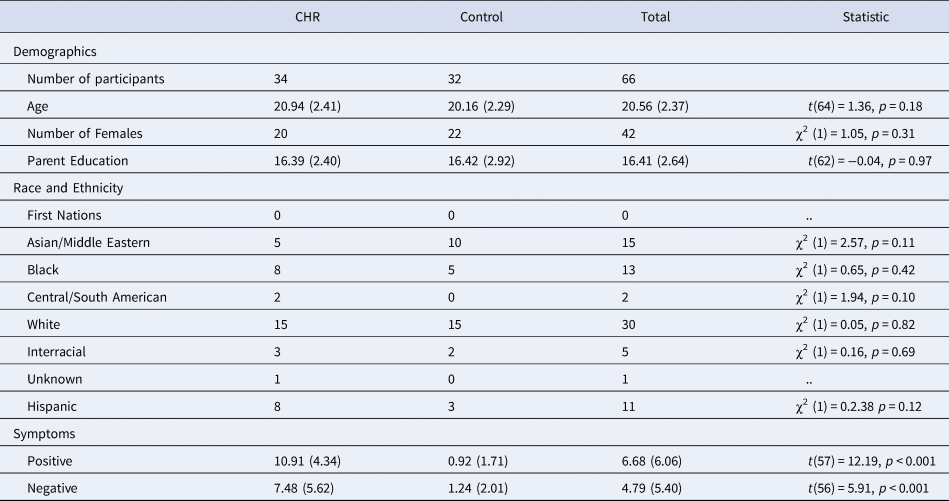
There were no significant group differences between individuals with a CHR syndrome and healthy controls in demographic characteristics. Of the CHR sample, approximately 18% endorsed a depressive disorder and 30% anxiety disorder. See Table 1.
Means and standard deviations for demographics and symptom details in a sample with a CHR syndrome and controls

Note. Clinical high-risk (CHR); Parent education is the average of mother and father education in years; Age is presented in years; Positive and negative symptoms are sum scores taken from the Structured Interview for Psychosis-Risk Syndromes (SIPS); Biological sex and race and ethnicity are recorded as counts.
Group differences in facial expressions: understanding context
Baseline
There were no significant group differences in baseline facial expressions (i.e. as individuals watched an ‘X’ prior to each video clip); zygomaticus activity, p > 0.26, corrugator activity, p > 0.54. See Table 2 for means and standard deviations.
Baseline differences in facial expressions

Note. Clinical high-risk (CHR); baseline differences in zygomatics (ZY) and corrugator (COR) activity; during this portion of the task (i.e. baseline), individuals were asked to view a ‘X’ on the screen.
Film Clip
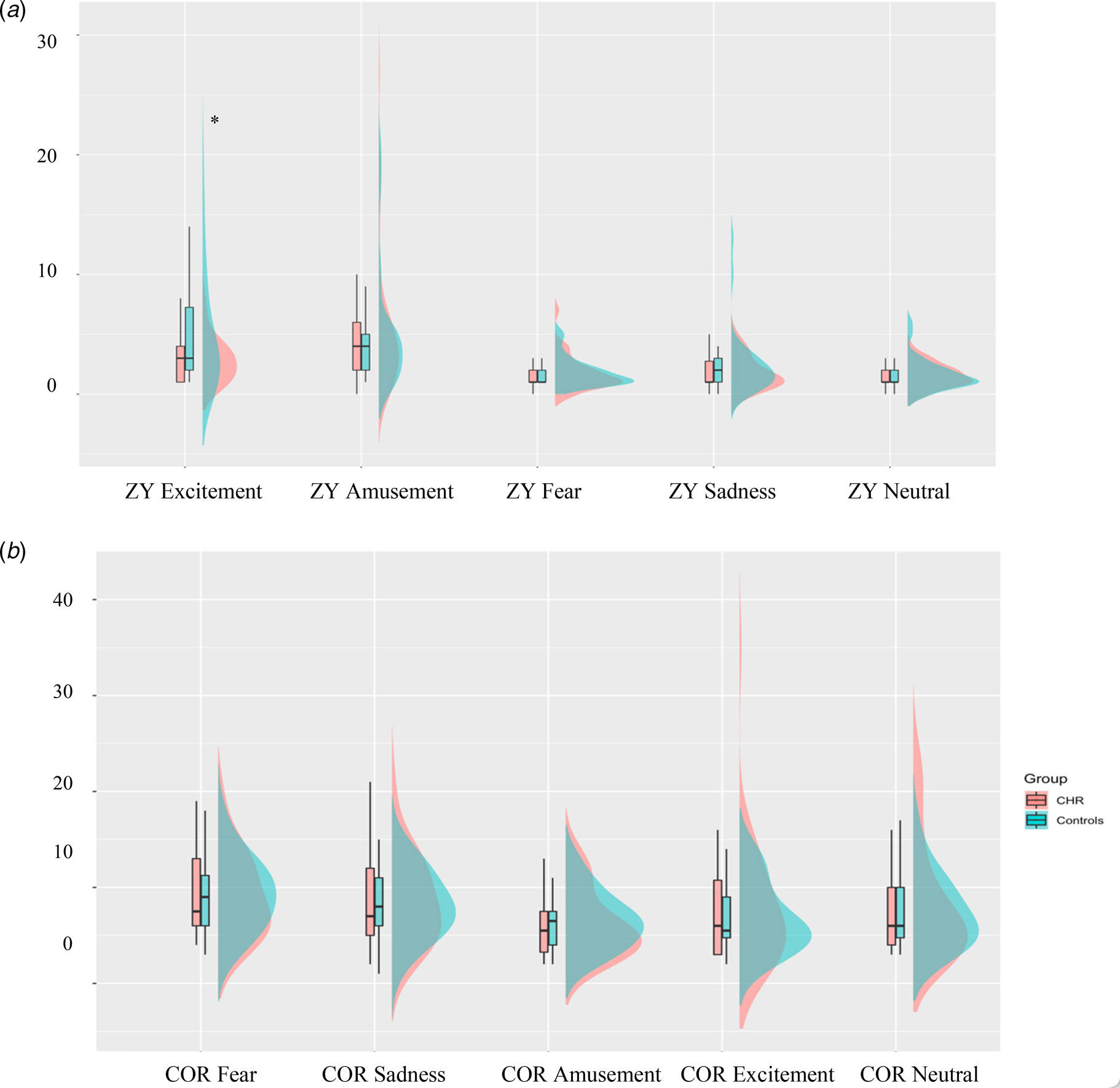
Compared to healthy controls, the CHR group displayed reduced zygomaticus activity in response to the excitement film clip, t(64) = −2.34, p = 0.028, but not in response to the amusement clip, t(62) = 0.50, p = 0.79, or neutral clip, t(64) = −0.12, p = 0.90 (findings for excitement became trend level when correcting for multiple comparisons). There were no significant group differences in corrugator activity across film clips, p > 0.75. See Fig. 1.
Group differences in zygomaticus and corrugator activity from an evocative film clip task in a sample of individual with a CHR syndrome (N = 34) and matched controls (N = 32).
Note. A. = Zygomaticus (ZY) activity; B. = Corrugator (COR) activity; Error bars are standard error; *p < 0.05; Please note primary analyses were conducted with zygomaticus activity in response to excitement, amusement, and neutral clips and corrugator activity was examined in the sadness, fear, and neutral clips. Nontarget (e.g. zygomaticus activity in response to fear) emotion analyses were exploratory.

Timing and rate of change
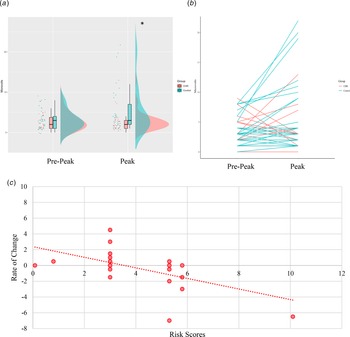
There was a significant group (CHR, control) by time (pre-peak, peak) interaction, F(63) = 7.25, p = 0.000, η p2 = 0.10. Analyses revealed no significant group differences in the pre-peak segment, t(63) = −0.55, p = 0.58, but did show a significant difference during the peak in that the CHR group exhibited less zygomaticus activity during the peak segment of the excitement clip compared to controls, t(63) = −2.42 p = 0.02, d = 0.60 (findings survived correction for multiple comparisons). As expected, there were significant group differences in the rate of change in that the CHR group had a lower amount of rate of change during the excitement video, t(63) = −2.98, p = 0.004, d = 0.72 (Fig. 2).
Facial expressivity and rate of change across two segments in a sample of individuals with a CHR syndrome and controls.
Note. (a) Raincloud plot depicting distribution of zygomaticus activity (in microvolts) when viewing the excitement clip across time segments; Second segment is termed peak (i.e. the clip depicting very high levels of emotion); Pre-peak is the period before; * p < 0.05; (b) Rate of change was computed by taking the difference between pre-peak and peak; (c) Correlation between rate of change and risk scores.

Links with psychosis risk conversion scores
Within the CHR group, findings indicated no significant relationships between zygomaticus activity during the excitement clip and psychosis risk conversion scores when examining the complete film clip, r = 0.11, p = 0.57, or just the peak period, r = −0.20, p = 0.29. However, lower rate of change during the excitement clip was related to greater likelihood of conversion to psychosis, r = −0.58, p = 0.001 (findings survived multiple comparison correction).
Links with comorbid diagnoses
In terms of comorbid diagnoses, decreased zygomaticus activity during the excitement video clip was related to current anxiety diagnoses, r = −0.34, p = 0.047 (this did not survive correction for multiple comparisons). There were no other links between zygomaticus activity during the excitement film clip, p > 0.19, during the peak period, p > 0.19, and rate of change, p > 0.32 and current/lifetime anxiety and depression diagnoses.
Links with expression of emotion negative symptom item
There were no significant relationships between the expression of emotion symptom item from the SIPS and zygomaticus activity during the excitement film clip, r = −0.14, p = 0.44, peak period, r = −0.19, p = 0.31, and rate of change, r = −0.24, p = 0.20.
Links with positive and negative symptoms
There were no significant relationships between zygomaticus activity during the excitement video clip and rate of change and positive symptoms or negative symptoms. However, more zygomaticus activity during the peak period was related to greater grandiosity scores, r = 0.34, p = 0.05. See online Supplementary Table S1 for correlation matrix.
Discussion
The current study is the first to utilize facial EMG to measure facial expressivity and use a set of emotionally evocative film clip stimuli in a CHR sample when compared to controls. This approach revealed findings that may have not been otherwise detected with the current methodological approaches commonly used in the field. Together, these findings provide insights regarding negative symptoms conceptualizations. Additionally, this study highlights the importance of studying negative symptoms in CHR studies (Dukes et al., Reference Dukes, Abrams, Adolphs, Ahmed, Beatty, Berridge and Sander2021) and the value of using facial EMG and emotionally evocative film clip to detect alterations in blunted affect and emotional processes that are difficult to discern using other methods.
Findings revealed that the CHR group showed reductions in zygomaticus facial activity when viewing a film clip intended to evoke excitement (although this finding became trend level when correcting for multiple comparisons). These findings are consistent with previous work applying facial EMG to individuals with schizophrenia who showed reduced zygomaticus activity in response to the presentation of positive pictures (Wolf et al., Reference Wolf, Mass, Kiefer, Wiedemann and Naber2006) and, more broadly, a long line of working showing blunted facial expressions in individuals with schizophrenia (Andreasen, Reference Andreasen1982; Berenbaum & Oltmanns, Reference Berenbaum and Oltmanns2012; Cohen, Morrison, & Callaway, Reference Cohen, Morrison and Callaway2013; Cowan, Strauss, Raugh, Le, & Cohen, Reference Cowan, Strauss, Raugh, Le and Cohen2022b; Gur et al., Reference Gur, Kohler, Ragland, Siegel, Lesko, Bilker and Gur2006; Kring et al., Reference Kring, Kerr and Earnst1999; Kring, Kerr, Smith, & Neale, Reference Kring, Kerr, Smith and Neale1993; Lee, Chun, Yoon, Park, & Kim, Reference Lee, Chun, Yoon, Park and Kim2014). At the same time, there was important specificity of blunted zygomaticus activity in terms of context. In terms of context, blunting in zygomaticus activity was observed uniquely in response to the excitement film clip but not in response to the amusement, neutral, or during the negative film clips. Given null findings during the amusement clip, it is possible that humor-based interventions could be a useful treatment to improve facial expressivity (Ruch & McGhee, Reference Ruch and McGhee2014). Importantly, there were significant findings with zygomaticus activity but not corrugator activity. There are several possible explanations for this finding. For example, it could be the case that only positive facial expressions are affected in this group. This is consistent with our previous work suggesting blunting in facial expressions of joy when using automated and human coding of facial expressions (Gupta et al., Reference Gupta, Haase, Strauss, Cohen and Mittal2019, Reference Gupta, Haase, Strauss, Cohen, Ricard and Mittal2022; Ricard, Gupta, Vargas, Haase, & Mittal, Reference Ricard, Gupta, Vargas, Haase and Mittal2022). It is also possible that this reduced zygomaticus activity may be reflective of internal experiences of positive emotions as there is evidence of reduced positive emotional experiences in this group (Gruber, Strauss, Dombrecht, & Mittal, Reference Gruber, Strauss, Dombrecht and Mittal2018). Furthermore, it could be that what is observed is a motor deficit unique to muscles related to smiling; motor impairments are common in this group as well (Damme et al., Reference Damme, Park, Vargas, Walther, Shankman and Mittal2022; Mittal & Walker, Reference Mittal and Walker2007; Osborne et al., Reference Osborne, Damme, Gupta, Dean, Bernard and Mittal2021; Schiffman, Reference Schiffman2017; Walker, Lewis, Loewy, & Palyo, Reference Walker, Lewis, Loewy and Palyo1999). It could be that there are also challenges with facial mimicry in this group (Varcin et al., Reference Varcin, Bailey and Henry2010). Future research may further probe why no alterations in corrugator activity were found; one additional possibility is that those emerge more consistently later in clinical course, as in individuals with schizophrenia (see, for example Kring et al., Reference Kring, Kerr and Earnst1999).
Contrastingly, it is interesting that, descriptively speaking, there was corrugator activity when viewing the excitement and amusement film clips but this could be perhaps more reflective of concentration or mental effort as these processes may also drive corrugator activity (Cacioppo et al., Reference Cacioppo, Petty and Morris1985). One additional important point to highlight is that it does appear the CHR group is showing facial expressivity, albeit reduced, in line with the valence of the film clip. So while there are abnormalities, there is still facial activity occurring in the valence one would expect.
In terms of timing, blunting in zygomaticus activity was observed only during the most emotionally evocative peak segment of the excitement film clip (whereas no group differences were observed prior to the peak). Our findings suggest that alterations in facial expressions in individuals with a CHR syndrome may only become apparent at sufficiently high levels of emotion, which underscores the value of using experimental stimuli that are able to elicit emotions at intense levels. Perhaps it is the case that those with a CHR syndrome are experiencing reduced arousal and salience which may contribute to reduced facial expressions of emotions (Dowd & Barch, Reference Dowd and Barch2010). Additionally, as shown in the Figures, there may be unique subgroups of facial expressivity. For example, in the peak period, there were individuals that clustered around similar facial expressivity values but there were also individuals that showed particularly high levels of facial expressivity in both groups, especially in the control group. While it may be that these individuals are perhaps outliers, it also could be the case that these individuals represent a unique subgroup, that provide meaningful contributions to our understanding of facial expressivity in this group. Given increasing research examining subgroups across symptoms including negative symptoms (Gupta et al., Reference Gupta, Haase, Strauss, Cohen and Mittal2019), it could be the case that with more participant data, subgroups may emerge. Additional research is needed to better understand this, however.
Our findings further suggest that the CHR group overall showed lower rates of change in zygomatic activity during the excitement film clip and, moreover, that those individuals at CHR who showed lower rates of change had higher likelihood of conversion to psychosis. As mentioned, it is possible that lower rates of change in zygomatic activity are a result of broader motor system abnormalities in this group and may be a clinical marker or a component of the pathogenesis of psychosis; however future research is warranted with longitudinal designs to better tease apart these findings.
Additionally, findings suggesting that reduced zygomaticus activity during the excitement film clip was related to anxiety diagnoses (although findings did not survive correction) hints towards the possibility that blunting in facial expressions may be interconnected with symptoms of anxiety. Teasing apart facial expressions and negative symptoms more broadly from anxiety is challenging given high rates of comorbid diagnoses endorsed by this group, as discussed. These findings are in line with other studies of emotion that suggest processes as such are related to anxiety (Gruber et al., Reference Gruber, Strauss, Dombrecht and Mittal2018). However, more research is needed in this area to better understand these relationships.
Importantly, there were no links observed between facial expressivity in response to the film clips and the SIPS negative symptom expression of emotion item (McGlashan et al., Reference McGlashan, Miller, Woods, Rosen, Hoffman and Davidson2001; Miller et al., Reference Miller, McGlashan, Rosen, Cadenhead, Ventura, McFarlane and Woods2003). While null findings should be interpreted with caution, it is possible that these links emerge most consistently for facial expressions in specific situational contexts and for specific measures of negative symptoms. In some of our work, we have indeed found links between blunting in facial expressions of joy during clinical interviews and clinical interview ratings of blunted facial expressivity (Gupta et al., Reference Gupta, Haase, Strauss, Cohen, Ricard and Mittal2022). It does appear that blunting in facial expressivity is present in different contexts in those with a CHR syndrome (e.g. blunting in clinical interviews, evocative film clips, in clinical ratings), but there may be unique factors at play in the context of viewing evocative film clips, which allow for wider range of facial expressions to be evoked and occur in non-social settings. We should also note that the SIPS item in the present study (‘Has anyone pointed out to you that you are less emotional or connected than you used to be?’) may not be well-suited to isolate alterations in facial expressions specifically. Further research is needed to follow up on these ideas.
While there are several strengths to the study, there are important to discuss as well. While several different videos were used to evoke a range of facial expressions, not all emotions were assessed such as anger. It will be important for additional research to also consider assessing zygomatics and corrugator activity in response to stimuli intended to evoke anger. Another limitation is the use of EMG in that while this method is sensitive to facial movements, EMG can be obtrusive and may draw participants attention towards their face, making them aware of changes in their facial expressions. It may be possible this could influence their facial expressions. Using additional methods such as automated facial analysis and human coding could supplement EMG data and would be an informative future direction. Additionally, studies with larger sample sizes, longitudinal data with conversion status, and unique subgroups are needed. More research is also needed utilizing other physiological and behavioral measures accompanying EMG in order to understand the interplay between the experience and the expression of emotion in these groups. Another limitation is that we examined facial expressions in one context only (e.g. experimental paradigm). There may be important information regarding the degree to which reductions in facial expressivity may or may not be observable to another person; dyadic interactions, for example, would be an important future direction to better understand this. Finally, it will be important for additional studies to understand the effects of culture as well as race and ethnicity using larger samples sizes (Soto, Levenson, & Ebling, Reference Soto, Levenson and Ebling2005).
Supplementary material
The supplementary material for this article can be found at https://doi.org/10.1017/S0033291722003087
Acknowledgements
None.
Author contributions
TG, VAM, and CMH developed the study concept and contributed to the design, data analyses, and interpretation of findings as well as writing and revising of the manuscript. KJO and AN contributed to the study design. TG drafted the paper and all authors provided revisions. All authors approved the final version of the manuscript.
Financial support
Funding for this study was provided by the National Institute of Mental Health Grants R01MH094650, R21MH110374 to V.A.M, R21MH115231 to C.M.H. and V.A.M., NARSAD Young Investigator Grant from the Brain & Behavior Research Foundation to C.M.H, and T32MH018269 to T.G. The aims of the study are original and new. No authors have any potential conflicts of interest.
Conflict of interest
None.
Ethical standards
The authors assert that all procedures contributing to this work comply with the ethical standards of the relevant national and institutional committees on human experimentation and with the Helsinki Declaration of 1975, as revised in 2008.