1. Introduction
Antisemitism in the United States has become a growing problem. In a recent report, one in four American Jews said they experienced antisemitism in the past year.Footnote 1 Since 2018, U.S. Jews have been targeted in numerous deadly attacks at synagogues and other Jewish venues.Footnote 2 Perceived concerns about the seriousness of antisemitism are high as well (Smith and Schapiro Reference Smith, Schapiro, Dashefsky and Sheskin2019). According to a 2020 poll, 62% of Americans—and 88% of Jewish Americans—consider antisemitism a problem. Over 80% of Jewish identifiers agreed in 2020 that antisemitism had increased over the previous 5 years.Footnote 3
In a recent study (Hersh and Royden Reference Hersh and Royden2022), we examined antisemitic attitudes across the ideological spectrum with a focus on the far right. Several of the recent violent attacks against Jews in the United States came from right-wing White nationalists, and we correspondingly find that far-right Americans are much more likely to have negative attitudes toward Jews compared to center- and left-leaning Americans.
In this study, we turn to a different investigation. We seek a better understanding of how anti-Jewish attitudes manifest among racial minority groups in the United States. Some of the recent violent attacks against Jews have come from Black Americans who ascribe to antisemitic conspiracy theories.Footnote 4 Prior research on antisemitism has found that compared to White Americans, Black and Hispanic Americans have less favorable views of Jews (King and Weiner Reference King and Weiner2007; Cohen Reference Cohen2018a). Scholarship in racial politics has long taken interest in antisemitism, particularly as it relates to Black–Jewish relations (Salzman and West Reference Salzman and West1997; Sniderman and Piazza Reference Sniderman and Piazza2002), and we build on this by examining with fresh data whether attitudes toward Jews in racial minority groups may have changed. This is worthwhile not only because of recent conspiracy-fueled attacks but also because the distance from the Holocaust, the changing shape of the Israel/Palestine conflict, and the changing salience of religious messages all may substantially affect antisemitism among racial minority groups today compared to in the past.
Through an original survey of 3,500 U.S. adults, including a representative oversample of 2,500 adults aged 18–30 years, we examine several key hypotheses related to racial minority groups and attitudes toward Jews. We focus, in part, on attitudes among younger Americans (ages 18–30 years) because younger generations are more racially diverse, more educated, and more religiously secular, all of which may influence their exposure to and/or attitudes toward Jews. Some of the prior explanations about antisemitism in minority groups – particularly those about direct group conflict – may no longer be as relevant to younger generations. On the other hand, a decreasing salience of the Holocaust and/or rising salience of the Israel/Palestine conflict may lead younger generations to hold more antisemitic attitudes than previous generations.
In our analysis, we find higher rates of antisemitism among Black and Latino respondents compared to Whites, especially among young people. We find the same results after controlling for potential confounders, such as education, geography, and church attendance. The differences between minorities and Whites are present on the ideological left as well as the ideological right. We consider a popular theory that antisemitism among minority groups stems from affinity for the Palestinian cause. Contrary to this theory, minority respondents actually express more positive evaluations of Israel overall and Israel’s politics and government compared to Whites. Our evidence suggests the Israel/Palestine conflict is unrelated to the high rates of antisemitic attitudes among Black and Latino respondents.
The problem of minority-group antisemitism has not faded away. On the contrary, in our survey, young Black and Hispanic respondents express antisemitic attitudes at about the same rates as White alt-right respondents. Our analysis helps us to reject, at least tentatively, several plausible explanations for why Black and Hispanic respondents are more likely to hold antisemitic views than Whites respondents are. However, the analysis does not reach a definitive conclusion about why antisemitic views are more common among minority groups. Thus, we hope the analysis that follows will spur further research.
2. The roots of minority-group antisemitism
Why might racial minorities, particularly African-Americans and Hispanic Americans, hold anti-Jewish views? Here, we briefly review three explanations: (a) minority-group competition, (b) antisemitism as a manifestation of anti-White attitudes, and (c) demographic/behavioral confounders.
One broad theory of minority-group antisemitism relates to group conflict and scapegoating. As Bobo and Hutchings (Reference Bobo and Hutchings1996) have written, “African Americans, closely followed by Latinos, are most likely to see other groups as competitive threats…These patterns reflect the historical and contemporary forms of racial subordination these groups have faced.” Consistent with this argument, one might expect higher levels of antisemitic views among racial minority groups compared to Whites.
The idea of competitive threat between groups has led scholars to a number of more tailored theories about intergroup conflict and antisemitism. One such theory relates to competition over victimhood status. The Holocaust, argue Antoniou, Dinas and Kosmidis (Reference Antoniou, Dinas and Kosmidis2020), represents the “premium historical analogy or the reference point to any episode of collective suffering.” Attention to collective suffering of various groups can lead to a “spiral of victimhood,” where groups feel they are competing both for victimhood status and the benefits they have been denied as a result of their victimization (see also Perez and Salter (Reference Perez, Salter and Vollhardt2020)). This may lead to higher rates of antisemitism, if minority groups feel they are competing with Jews for victimhood.
But with distance from World War II and the passing of veterans and survivors, the Holocaust may have become a less salient reference point of collective suffering. As such, the victimhood theory might predict that younger generations of Black and Hispanic Americans may feel less victimhood competition with Jews and thus may be less likely to hold anti-Jewish attitudes compared to older Americans.
A separate subtheory related to intergroup conflict focuses on geography. In places such as New York, where Black populations and Jewish populations have long shared neighborhoods, there has been a history of tension and conflict.Footnote 5 In his 1967 essay, James Baldwin argued that Black antisemitism resulted from the seemingly exploitative role Jews played in the life of Black people in the mid-twentieth century.Footnote 6 Black people in Harlem were dependent on Jews for basic matters of “life and death,” according to Baldwin, and antisemitic resentment built up as a result. On geography, see also Feinberg (Reference Feinberg2020) and Enos (Reference Enos2017).
If such sentiment holds today, the theory suggests a geographic hypothesis. That is, racial minority groups that live in areas of the country where Jewish populations are also present may be distinctive from White Americans in outgroup animus toward Jews. However, most regions of the United States have almost no Jewish residents (Dashefsky and Sheskin Reference Dashefsky, Sheskin, Dashefsky and Sheskin2019). Under a theory of localized intergroup relations, one would not expect higher levels of antisemitism among minorities than among Whites in these areas.
A separate class of explanations of minority-group antisemitism focuses not on intergroup competition but on either in-group affinity or out-group animus toward groups identified as White. If racial minority groups have negative views toward White people and they perceive Jews as White, then antisemitic attitudes could merely be standing in for anti-White attitudes. However, several studies suggest that attitudes about Jews are not simply stand-ins for attitudes toward Whites. For instance, in a study of feeling thermometer ratings from 1964 to 2016, Cohen (Reference Cohen2018a) shows that Black Americans have colder feelings toward Jews even after controlling for their feeling thermometer rating of Whites. Likewise, King and Weiner (Reference King and Weiner2007) find that Black and Hispanic Americans believe that Jews have a different vision of American society than them, even after controlling for their perceptions of whether White people have a different vision of American society.
Here, we evaluate the idea that antisemitism is a stand-in for anti-White attitudes by asking a variety of questions about Jews to respondents, not all of which would clearly lead to negative evaluations of Jews under the theory that Jews are merely stand-ins for Whites. For instance, suppose a person agrees with the idea that Jews have too much power. The respondent may really mean that a larger class of White people has too much power. But if the respondent also agrees with antisemitic statements that have no obvious application to a broader group of White people (e.g., Jews are disloyal Americans), then it is harder to see how the antisemitic views stem from anti-White attitudes.
In-group identity or out-group animus is also at the root of a set of explanations of minority antisemitism that connect to the Israel/Palestine conflict. One such theory is that racial minority groups in the United States identify with Palestinians, who they view as non-White, and against Israelis, who they view as White. In this theory, minority groups hold negative views toward American Jews because American Jews largely support a country that, in the eyes of Israel’s opponents, is a (White) oppressor regime (Forman Reference Forman1998; King and Weiner Reference King and Weiner2007; Lipstadt Reference Lipstadt2019; Rubin Reference Rubin, Salzman and West1997; Shenhav-Goldberg and Kopstein Reference Shenhav-Goldberg and Kopstein2020).
One of the simpler hypotheses implied by this theory is that groups that have high negative attitudes toward Jews also have high negative attitudes toward Israel. However, with regard to minority groups, past research has found that Black and Hispanic Americans are actually quite supportive of Israel. Rubin (Reference Rubin, Salzman and West1997) examines Black support for Israel from the 1960s to the 1990s and finds that, while Black Americans did have greater sympathies for the Palestinians than White Americans did, they still tended to remain overall more sympathetic to Israel than to Palestinians. More recently, Black and Latino Democrats have become far more sympathetic toward Israel than toward Palestinians compared to White liberals or Democrats.Footnote 7
A final class of explanations for minority-group antisemitism is that race is simply correlated with other traits, such as education, religiosity, or ideology, that are themselves sources of antisemitic attitudes. Considering education, higher education levels are correlated with lower rates of antisemitism (Cohen Reference Cohen2018a). This may be because education exposes people to multiculturalism and makes them more cognizant of changing societal norms against prejudicial attitudes (Cohen Reference Cohen2018b; Smith and Schapiro Reference Smith, Schapiro, Dashefsky and Sheskin2019; Sniderman and Piazza Reference Sniderman and Piazza2002). White adults are much more likely than Black or Hispanic adults to be attending 4-year colleges or to have graduated from them.Footnote 8 Accordingly, higher rates of antisemitism among minority groups may merely stem from an educational effect.
Another plausible confounder is church. Americans who regularly attend religious services may be more inclined to hold antisemitic views (Cohen Reference Cohen2018a). Antisemitic attitudes have historically emerged in Christian settings (Nirenberg Reference Nirenberg2013). Even today, about a quarter of Americans agree that Jews killed Christ.Footnote 9 Black and Hispanic people are more likely to attend church regularly than White people.Footnote 10 As such, differences in antisemitism by racial group may be standing in for differences in church attendance.
In his study of feeling thermometers, Cohen (Reference Cohen2018a) notes that Catholics are an outlier insomuch as they have exhibited cooler feelings toward Jews over time. Most groups have warmed toward Jews over the 50-year period of the time series. He hypothesizes that the cooling trend for Catholics may stem from growth in population of Hispanic immigrants from Latin American countries “that lack the religious tolerance tradition.” From this, one might hypothesize that antisemitic views among Hispanics are (a) concentrated among church-goers and (b) concentrated among older Hispanics, who are far more likely to be foreign-born and therefore to have been exposed to views about Jewish people outside the United States.Footnote 11
A final potential confounder is political ideology. Several recent accounts of antisemitism have drawn attention to anti-Jewish attitudes on the ideological left, specifically among young people (Lipstadt Reference Lipstadt2019; Weiss Reference Weiss2019). Racial minority groups tend to be more liberal than White Americans. Although we find in our prior work that antisemitism is stronger on the ideological far right, it may be that if antisemitism is indeed concentrated on the ideological left, and minority groups tend to be left-leaning, then a racial difference in views toward Jews may merely be masking ideological differences.
Having reviewed some of the intuitions and hypotheses stemming from different theories of minority-group antisemitism, we now investigate whether antisemitic views are more common among racial minority groups than among Whites. We measure whether these differences are larger or smaller for younger Americans. We examine the relationship between antisemitism and race within ideological cohorts and within educational, religious, and geographic subgroups. We also examine how racial groups perceive the state of Israel as a possible explanation for anti-Jewish views.
3. Data
We fielded an original YouGov survey in November 2020 (November 9–25). The sample size is 3,500 U.S. adults, which includes a representative oversample of adults ages 18–30 years. Both the full sample and the young adult oversample were designed to be representative of the national populations on gender, age, race, education, and 2016 vote choice. The Supplementary Information (SI) includes documentation from YouGov about the construction of weights, which are used throughout this analysis. The study was determined exempt from IRB review by the Tufts University IRB, IRB ID: 00000710, and it conformed to all IRB standards of informed consent.
In this study, we utilize both the full adult sample and the young adult oversample. The full sample, weighted to reflect the national adult population, includes 2,242 White identifiers, 419 Black identifiers, 540 Hispanic identifiers, and 299 identifiers of other races. The young adult oversample, weighted to reflect the national population of 18–30 year olds, includes 1,361 White identifiers, 349 Black identifiers, 540 Hispanic identifiers, and 250 others.
In regression analysis, we include controls for age (in years), gender (dichotomous variable where 1 represents female identifiers), and college status. The college variable equals 1 for respondents who are currently enrolled in a 4-year college program or who have received a 4-year degree, and equals 0 otherwise.
The main analysis in this paper relies on a battery of three agree/disagree questions about Jewish people:
-
(1) Jews are more loyal to Israel than to America.
-
(2) It is appropriate for opponents of Israel’s policies and actions to boycott Jewish American owned businesses in their communities.
-
(3) Jews in the United States have too much power.
The first and third of these questions were assessed by King and Weiner (Reference King and Weiner2007) and are taken from a battery developed by the Anti-Defamation League (ADL).Footnote 12, Footnote 13 Jewish identifiers were not asked these questions. Instead, they were asked if they consider these statements to be antisemitic. Approximately 90% of Jewish identifiers consider each of these statements to be antisemitic. See Supporting Information.
Before seeing these three statements, respondents were randomly divided into two conditions. In both conditions, respondents were prompted, “We’re going to ask you some questions about Jewish Americans.” In one condition, respondents also saw this statement: “Dr. Frank Newport, Editor-in-Chief of the Gallup Poll, concluded in 2019 that 95% of Jews [in the U.S.] have favorable views of Israel.”Footnote 14 In other research with this dataset, we analyze this prime in detail and note that it barely affects respondents’ answers to the battery of agree/disagree questions. In this paper, we combine the two conditions and, in regression analyses, we control for the prime condition.
Respondents taking this survey were also placed into experimental conditions for additional survey experiments that are being assessed in other papers. Respondents saw the questions in those experiments before they saw the battery of questions assessed here. Throughout the analysis, we include control variables for the exact survey path respondents followed through various randomizations. This accounts for variation in responses based on respondents seeing different conditions from one another.
4. Results
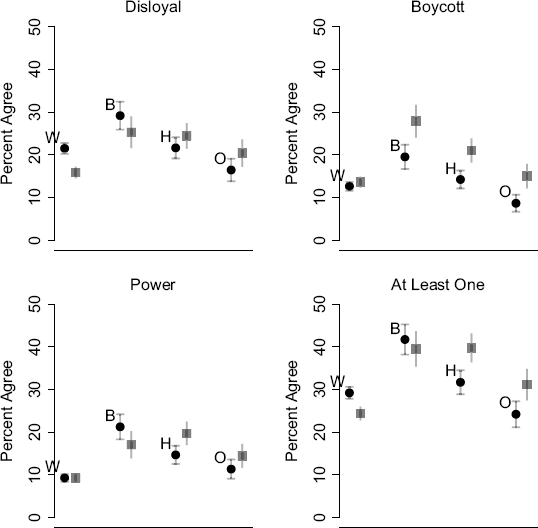
Our first hypothesis is that Black and Hispanic identifiers exhibit more agreement with antisemitic statements than White identifiers. Figure 1, in black dots, shows bivariate relationships for the full adult population.Footnote 15 On all three questions, Black respondents are significantly more likely than White respondents to agree with the antisemitic statement. The lower-right panel reflects agreement with one or more of the three items in the battery. Black respondents are 13% points more likely to agree with one or more statement. For respondents aged 18+ years, on two out of three items, Hispanic respondents agree with the statements at the same level as Whites. Only on the power item do Hispanic respondents have slightly higher support.
Agreement with antisemitic statements by race
Note: Letters indicate racial group, “W” for White, “B” for Black, “H” for Hispanic, and “O” for other. 84% CIs are shown. Black shading reflects agreement with the antisemitic statements among the full adult population. Gray shading reflects agreement among 18–30 year olds. Sample sizes range from 273 individuals in the 18–30 years old Black cohort to 2,087 individuals in the 18+ White cohort.

The gray letters in Figure 1 show the results for the young-adult oversample. In many other forms of prejudice, young people have less prejudicial attitudes than older people (Janmaat and Keating Reference Janmaat and Keating2017; Stewart, von Hippel and Radvansky Reference Stewart, von Hippel and Radvansky2009).Footnote 16 That is not the case here, except for Whites. Among young people, Black and Hispanic respondents are more likely than Whites to agree with all three antisemitism measures. Young Black and Hispanic respondents are especially more likely to agree that it is acceptable to boycott Jewish businesses in protest of Israel.
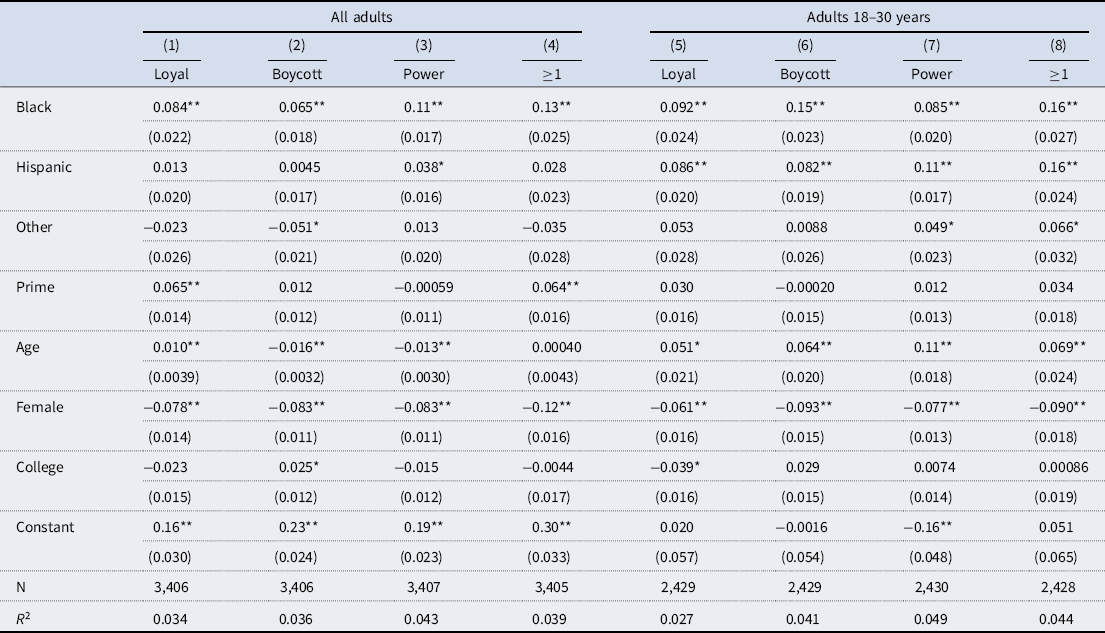
Table 1 shows a regression version of the relationships plotted in Figure 1. Agreement with each of the statements (and, in a summary measure, agreement with at least one of the statements) are dependent variables in OLS regressions. The main explanatory variables are the indicators of racial identity. As in Figure 1, the table shows statistically significant differences by racial group. Particularly among young respondents, Black and Hispanic identifiers are far more likely to agree with the antisemitic statements than White identifiers. Recall the theory that negative attitudes toward Jews are simply a reflection of negative attitudes toward Whites. For instance, when respondents agree that Jews in the United States have too much power, perhaps they would have agreed at similar or higher rates with a statement that Whites have too much power. However, the fact that Black and Hispanic respondents also have very high agreement with the other antisemitic statements—statements in which Jews cannot be seen to be equivalent to Whites in general—is inconsistent with the theory that Jews are simply being negatively evaluated by Black and Hispanic respondents as stand-ins for U.S. Whites.
Agreement with antisemitic statements by race

Note: OLS regression. SEs in parentheses; **p < 0.01, *p < 0.05. Controls for sequence of conditions not displayed. White identity is the excluded racial category; thus, Black, Hispanic, and Other (other non-White) are compared to White respondents.
4.1. Political ideology
Our next question is whether the higher rates of antisemitism among young Black and Hispanic respondents are merely standing in for an ideological phenomenon. We focus on the young-adult oversample here, since this is the population where both Black and Latino respondents are distinct from White respondents in their support for antisemitic statements. Respondents were asked to identify their ideology on a seven-point scale. We collapse that scale into liberal (1–3 on the scale), moderate (4 on the scale), and conservative (5–7 on the scale). While young people trend liberal, still a third of Whites, Blacks, and Hispanics identify on the ideological right. Another 20%–30% identify as moderates, and the remaining 40%–50% identify as liberal. Sample sizes are sufficient for analysis here. Even among 18–30 conservative identifiers, our dataset includes 65 Black respondents and 105 Hispanic respondents.
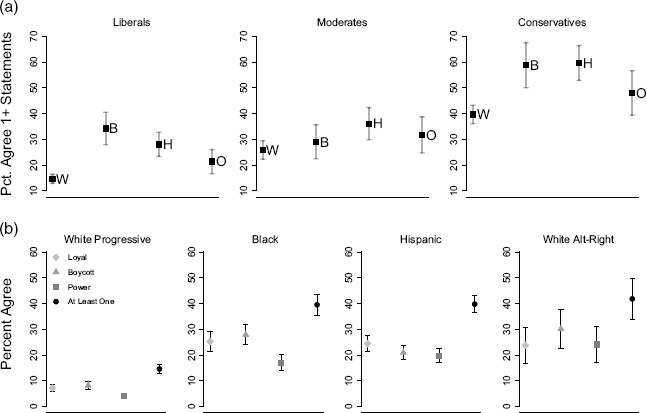
Figure 2 (Panel A) divides the young adults sample into the three ideological cohorts and shows agreement with one or more of the antisemitic statements by racial group. Among liberals, Black and Hispanic identifiers are twice as likely to agree with the statements as White identifiers. Among moderates, the differences by racial group are smaller (though still significant for Hispanics vs. Whites, see table below). For conservatives, Black and Hispanic identifiers are about 20 percentage points more likely to agree with the statements as Whites. Clearly, agreement with antisemitism is higher among all racial groups on the ideological right than the ideological left. However, within ideological cohort, there remains a significant difference by race.
Antisemitic attitudes and ideological cohorts
Note: Panel A shows agreement with one or more of the antisemitic statements by race, within ideological cohorts. 84% CIs are shown. Sample sizes range from 65 in the young Black conservative cohort to 773 in the young White liberal cohort. Panel B shows agreement with the statements among young Black and Latino respondents in comparison with two groups of young White respondents: progressive identifiers and alt-right identifiers.

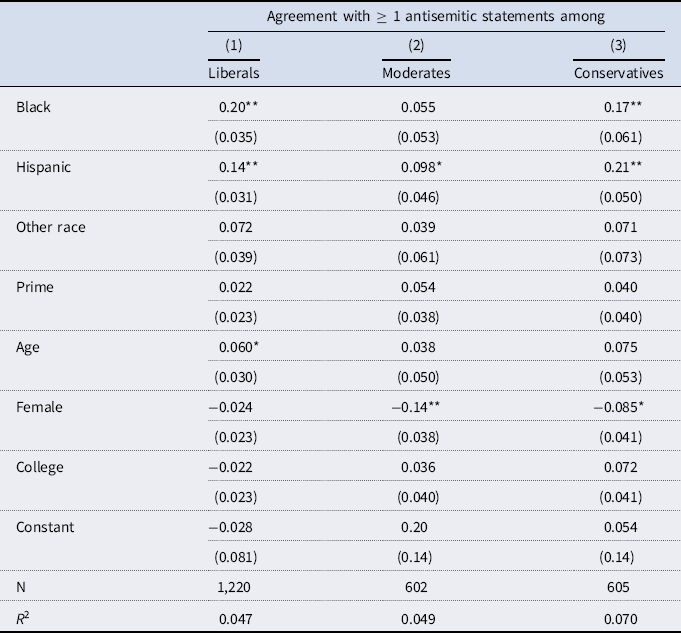
Table 2 shows the regression view of the relationship between race and antisemitic attitudes, within ideological cohort. As with the figure, on both the left and the right, Black and Hispanic identifiers are much more likely than Whites to agree with one or more antisemitic statements. The magnitude of the effect for Black respondents is larger on the liberal side. For Hispanic respondents, it is larger on the conservative side.
Agreement with antisemitic statements by race within ideological cohort

Note: OLS regression. Dependent variable equals 1 for respondents who agree with one or more of the antisemitic statements and 0 otherwise. SEs in parentheses; **p < 0.01, *p < 0.05. Controls for sequence of conditions not displayed. White identity is the excluded racial category; thus, Black, Hispanic and Other (other non-White) are compared to White respondents.
Panel B of Figure 2 shows minority group antisemitism in comparison with White respondents. On the left, we show agreement with each of the ideological statements among young White progressives. Forty-five percent of Whites aged 18–30 years identify as progressive. In that group, 4%–8% agree with any of the three statements and 15% agree with one or more of them.
On the right side of the graph, we show agreement with these statements among White alt-right identifiers. Seven percent of Whites aged 18–30 years identify as alt-right. The graph shows that 20%–30% of alt-right identifiers agree with each of the statements and 42% agree with one or more of them.
The middle of Panel B shows agreement with these statements among young Black and Hispanic identifiers. With regard to these statements, Black and Hispanic identifiers respond similarly to the way the alt-right responds, with 40% of each minority racial cohort agreeing with one or more of the statements. Young Black, Hispanic, and White Alt-Right respondents are similar to each other and quite distinct from the views of young White progressives when it comes to the antisemitism battery we study here.
4.2. Education, geography, and church
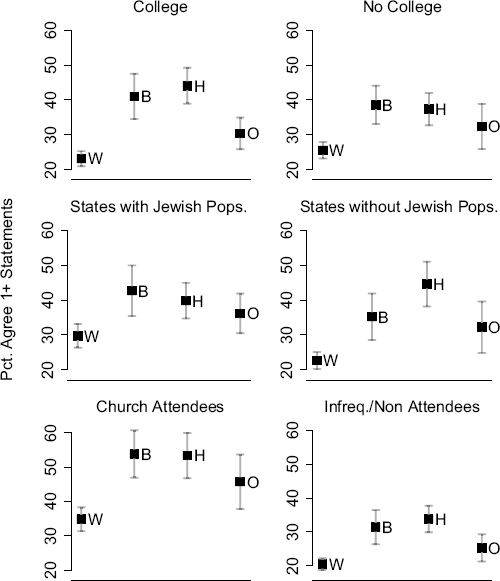
One possible confounder for the relationship between race and antisemitism is education. White young adults, aged 18–30, are much more likely than Black and Hispanic young adults to be attending 4-year college program or to have graduated from these programs. Perhaps the racial effect is masking an education effect where respondents with college degrees hold less antisemitic views. However, in Figure 3, antisemitic views are even higher among Black and Hispanic college-educated respondents than non-college-educated respondents.
Three plausible but incorrect explanations
Note: Means and 84% CIs are shown. College includes those who are in a 4-year degree program or who have received a 4-year degree. States with/out Jewish Populations compares respondents living in states with 3%+ Jewish populations vs. less than 1% Jewish population. Church attendance distinguishes those who report monthly or more attendance versus less than monthly attendance. Sample sizes range from 80 (Other race regular church attendees) to 1,066 (non-church attending White).

Another possible explanation has to do with geography. Perhaps, antisemitism is high in places with large Jewish populations, and Black and Hispanic respondents also happen to live in these places. In Figure 3, we compare respondents in the eight states with the largest Jewish populations (CA, CT, DC, FL, MD, MA, NJ, and NY) to respondents in the 29 states where less than 1% of the population is Jewish (AL, AK, AR, HI, ID, IN, IA, KS, KY, LA, MI, MN, MS, MT, NE, NH, NM, NC, ND, OK, SC, SD, TN, TX, UT, VT, WV, WI, and WY). Black and Hispanic respondents are much more likely than Whites to agree with antisemitic statements in both geographic contexts.
Finally, young Hispanic and especially young Black identifiers are more likely to attend church than young White identifiers. Perhaps, church attendees of all races hold higher rates of antisemitic attitudes. As Figure 3 shows, while it is true that church attendees of all races hold more antisemitic views than non-attendees, within both attendees and non-attendees Black and Hispanic identifiers are significantly more likely to hold antisemitic views than Whites.
We replicate this analysis in regression form as well, with full results in Table SI1 in the Supplementary Information. Agreement with at least one antisemitic statement is the dependent variable, and our explanatory variables include racial identity, college education, church attendance, and Jewish population of respondents’ home states. We include interaction terms between racial identity and each of the subsequent explanatory variables, to test whether these variables disproportionately affect antisemitic agreement among Black and Hispanic Americans. In this model, the base coefficients for Black and Hispanic identifiers remain substantively large and statistically significant. The interaction effects are all indistinguishable from zero. Factors like church attendance and geographic proximity to Jews are correlated with antisemitic attitudes, but they do not explain the higher rates of antisemitic attitudes among Black and Hispanic Americans.
4.3. Israel/Palestine as an explanation
We finally turn to the question of whether agreement with antisemitic attitudes among Black and Hispanic Americans is driven by solidarity with Palestinians and negative views toward Israel. If Black and Hispanic Americans hold more negative views toward Israel, these views may spill over into negative attitudes toward American Jews as well. To examine this theory, we look at respondents’ views on Israel.
Before respondents were asked any questions about Jews, they were asked to evaluate seven countries, including Israel. A random one-third of respondents were asked, How favorable is your impression of each of the following countries, or haven’t you heard enough to say?
Among young respondents, 50% of Whites (N = 392), 66% of Blacks (N = 60), and 54% of Hispanics (N = 88) said they have a favorable view of Israel. The White–Black difference is statistically significant (p < 0.05). The higher antisemitic views of Black and Hispanic respondents compared to Whites are certainly not coupled with more negative evaluations of Israel. Just the opposite: they are coupled with more positive evaluations of Israel.
Another random third of the sample was asked to evaluate countries, but with a different prompt: Thinking about their politics and government, how favorable is your impression of each of the following countries…. If Black and Hispanic respondents exhibit solidarity with Palestinians, they might hold distinctly negative views about Israel in this prompt which asks specifically about Israel’s politics and government. In this condition, 38% of Whites (N = 342), 52% of Blacks (N = 55), and 34% of Hispanics (N = 74) have a favorable of Israel. Here, the White–Hispanic difference is not statistically significant, and the White–Black difference is on the border of conventional significance tests with a p-value < 0.06. Black respondents appear to have a more positive view toward Israel’s politics and government than White respondents.
A final third of the sample was asked to evaluate countries with yet a different prompt: Thinking about their languages, cultures, and religions, how favorable is your impression of each of the following countries… Here, respondents are being asked about the people of Israel. Lower evaluations of languages, cultures, and religions suggests prejudicial attitudes about a people rather than policy attitudes about a government. 64% of Whites (N = 354), 62% of Blacks, and 51% of Hispanics have a positive view of Israel’s languages, cultures, and religions. The White–Hispanic difference is significant (p < 0.05). Thus, in overall evaluations and in political evaluations, we see equal or higher support for Israel among Blacks/Hispanics versus Whites. In evaluations that specifically are asking about culture and religion of Israel, we see more negative attitudes among Hispanics versus Whites. Altogether, these evaluations are inconsistent with a view that opposition to the government of Israel informs Black/Hispanic antisemitic attitudes.
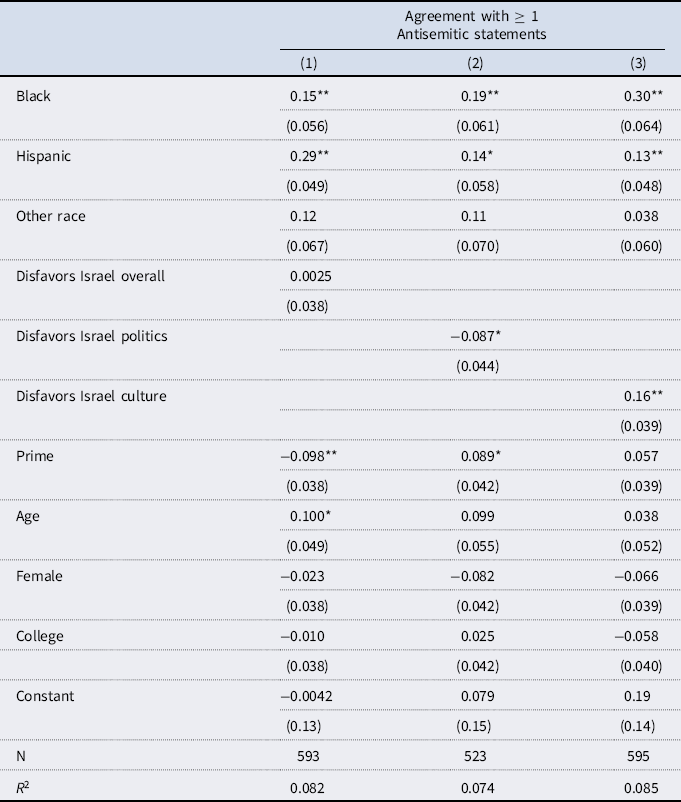
Table 3 shows the regression view of the relationship between race, antisemitic attitudes, and views on Israel among young adults. Because the Israel evaluation questions were an experiment, we run three separate regressions measuring the relationship between views on different facets of Israel and agreement with antisemitic attitudes. The first regression models respondents who were asked about Israel overall, the second models respondents who were asked specifically about Israel’s politics and government, and the third models respondents who were asked specifically about Israel’s languages, cultures, and religions. We also control for the same demographics as in Table 1, making the models in Table 3 the same as the eighth model in Table 1 but with views toward Israel added in. In that Table 1 analysis, we found that young Black and Hispanic respondents were, all else equal, around 16% points more likely to agree to antisemitic statements. If those racial effects are really proxies for anti-Israel attitudes, the base racial effects in our new model should be much smaller.
Agreement with antisemitic statements by race and favorability towards Israel

Note: OLS regression. Dependent variable equals 1 for respondents who agree with one or more of the antisemitic statements and 0 otherwise. SEs in parentheses; **p < 0.01, *p < 0.05. White identity is the excluded racial category; thus, Black, Hispanic, and Other (other non-White) are compared to White respondents.
However, we find that the racial effects for Black and Hispanic Americans remain consistently strong in all three models including views on Israel. Views on Israel do correlate with antisemitic agreement—disfavoring Israeli culture makes respondents considerably more likely to agree with antisemitic statements, whereas disfavoring Israeli politics makes respondents less likely to agree—but they do not seem to be proxies for the racial effects we find. This again is inconsistent with the theory that solidarity with Palestine and opposition toward Israel drive Black and Hispanic antisemitic attitudes.
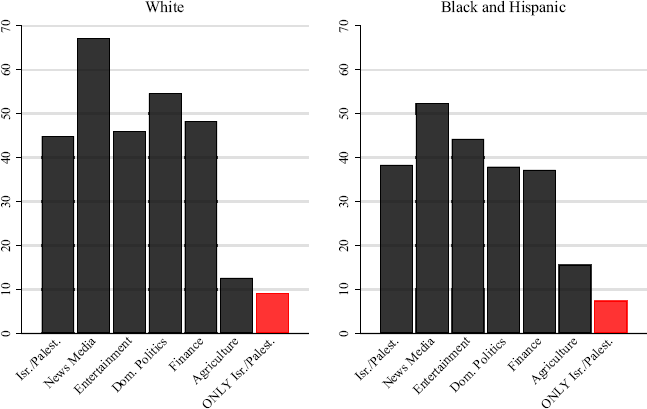
Another window into minority-group solidarity with Palestinians is a follow-up question we asked to respondents who agreed that American Jews have too much power. We asked these respondents, In what domains do you think Jews have too much power? Select all that apply. Respondents could then click one or more of: (1) The Israel/Palestine conflict, (2) News media, (3) Entertainment, (4) US domestic politics, (5) Finance, and (6) Agricultural Production. We included “agricultural production,” an area in which, as far as we know, there is neither evidence of Jewish over-representation nor widespread antisemitic conspiracies of Jewish power. A respondent who holds a set of classically prejudicial attitudes toward Jews would likely click on domains like finance and media, but not agriculture.
If Black and Hispanic respondents’ views about Jews are explained by solidarity with the Palestinian cause and not by classic tropes of antisemitic prejudice, then respondents might click that they believe Jews have too much power over the Israel/Palestine conflict but not other domains. In fact, as Figure 4 shows, both young White and young non-White respondents who believe Jews have too much power do not think exclusively of or mainly of the Israel/Palestine conflict. News media is the most common answer, but answers are fairly uniformly distributed among media, entertainment, domestic politics, finance, and the Israel/Palestine conflict. Of those who say Jews have too much power, only 7% of Blacks/Hispanics and only 9% of Whites click the Israel/Palestine conflict and no other issue.
In What domains do U.S. Jews have too much power?
Note: Responses come from 121 young White identifiers and 110 combined young Black and Hispanic identifiers who agreed that U.S. Jews have too much power. Respondents were asked in which domains Jews have too much power. The red bar shows the percent of respondents who clicked Israel/Palestien but no other domain.

As with the evidence from the country evaluations, the finding here—that minorities and Whites who believe Jews have too much power do not focus on the Israel/Palestine conflict—leads to the conclusion that the high rates of antisemitic attitudes among Black and Hispanic identifiers are not connected with solidarity with Palestinians.
5. Discussion
We have examined overt measurements of antisemitic attitudes across racial and age groups. We find that antisemitic attitudes are more common among Black and Hispanic respondents than White respondents. This gap holds on both sides of the ideological spectrum—we find higher rates overall of antisemitism on the ideological right, but Black and Hispanic respondents are more likely than Whites to hold antisemitic views within both the ideological right and within the ideological left.
Despite younger generations generally exhibiting more cosmopolitan and less prejudicial attitudes (Federico and Sidanius Reference Federico and Sidanius2002; Shenhav-Goldberg and Kopstein Reference Shenhav-Goldberg and Kopstein2020), we find that young Black and Hispanic adults express equal or higher levels of antisemitic attitudes than older Black and Hispanic adults; only young White adults express lower levels of antisemitism than their older counterparts. Young Black and Latino respondents answer this battery of antisemitism questions similarly to how young White alt-right respondents do.
Turning to what may be causing these higher rates of antisemitism, we address several common theories. Examining whether racial effects are proxying for education, geographic location, and church attendance effects, we find that Black and Hispanic respondents continue to have persistently higher rates of antisemitic attitudes within subpopulations of interest. Examining respondents’ attitudes toward Israel allows us to test whether or not solidarity with the Palestinian cause—an oft-mentioned cause of minority antisemitism—is at the root of these antisemitic attitudes. We find higher rates of support for Israel and Israel’s politics and government among Black and Hispanic respondents than among White respondents, a finding clearly inconsistent with the idea that Palestinian solidarity drives minority antisemitism.
What theories may then remain to explain higher rates of minority antisemitism? We can only speculate, but one promising remaining explanation revolves around perceived victimhood. Popular writing has pointed to victimhood as an increasingly prominent force in American political discourse.Footnote 17 If Black and Hispanic Americans have a sense of collective victimhood (a plausible hypothesis, due to the renewed salience of race in America in the wake of the Black Lives Matter movement), that feeling of victimhood could be leading to higher antisemitic attitudes for a number of reasons. One pathway could be through conspiracy theories: recent work has found a correlation between perceived victimhood and conspiratorial thinking among Americans (Armaly and Enders Reference Armaly and Enders2022), so it is possible that collective victimhood among Black and Hispanic Americans could be driving increased beliefs in antisemitic conspiracy theories. Another pathway could be due to competition over recognized victimhood. Antoniou, Dinas and Kosmidis (Reference Antoniou, Dinas and Kosmidis2020) find that perceived victimhood is correlated with an increase in antisemitic attitudes in Greece, which they theorize stems from non-Jewish groups with a perception of collective victimhood feeling competition with or resenting the broad recognition of Jews’ victimhood after the Holocaust. This mechanism could be at work in the United States and could explain increased antisemitic attitudes among Black and Hispanic Americans, as well. Determining whether perceived victimhood drives minority antisemitism and through which pathway(s) would be a promising avenue of future research to build upon our findings in this paper.
No one study, including this one, can answer definitively the question of why prejudicial attitudes are more common among some groups than others. We view this analysis as an important, but tentative, examination of key questions. With its oversample of young adults, this research moves the literature forward by estimating that antisemitic views are not only still common among racial minorities but are even more common among younger generations than older generations. The research also advances the literature by finding that antisemitic attitudes are not just present in narrow subsets of minority groups, such as among regular church goers or among those who live in close geographic proximity to Jewish populations. Rather, the antisemitic views are present across every subpopulation we have examined. Altogether, these findings suggest that the roots of antisemitic attitudes among minority groups are broad rather than narrow and are not well explained by commonly proposed theories. We hope this study can help spur that further research to further refine our collective understanding of this form of prejudice.
Supplementary material
To view supplementary material for this article, please visit https://doi.org/10.1017/rep.2023.3
Acknowledgements
For comments on our research proposal, we thank Marina Bers, Mijal Bitton, Stacy Burdett, Julie Cooper, Mia Costa, Ryan Enos, Josh Kalla, Alexander Kaye, Yanna Krupnikov, Tali Mendelberg, Yehudah Mirsky, Jonathan Sarna, Gregory Smith, Brian Schaffner, Debbie Schildkraut, Daniel Schwartz, Shayna Weiss, and Dov Waxman. We also thank Bernard Fraga, Shana Gadarian, and Ezra Sivan. For funding support, we thank the Klarman Family Foundation and One8 Foundation.