On September 29, 2009, at 6:48 AM, an earthquake measuring 8.1 on the Richter scale struck 190 km south of the island of American Samoa (AS), generating a tsunami that caused more than 184 deaths and widespread destruction of coastal homes and villages.Reference Jaffe, Gelfenbaum and Buckley1 Three weeks after the tsunami, a five-person team from the US Public Health Service (USPHS) was deployed to assist the AS Department of Health (ASDOH) with the emergency response and to help meet the surge of mental health (MH) needs. This team, together with a team from the Centers for Disease Control and Prevention (CDC) and local health officials, implemented the PsySTART Rapid Mental Health Triage and Incident Management System.Reference Pynoos, Schreiber and Steinberg2, Reference Schreiber3 The system was used to (1) determine the acute traumatic impact of the tsunami and associated stressors (eg, home loss, relocations, school absences, economic loss) and (2) establish near real-time situational awareness via a common operating picture of at-risk child and adult populations to guide community-level acute phase incident action planning and potential disaster recovery strategies.
The PsySTART system was developed to provide rapid, clinically-reliable disaster MH triage in mass casualty/disaster situations and facilitate the application of disaster crisis standards of care, as described recently by the Institute of Medicine.4 MH triage using PsySTART is based on survivor-reported trauma exposures, traumatic loss, and ongoing stressors—called triage factors—that are associated with severe acute distress and the development of new incidence MH disorders such as posttraumatic stress disorder and depression in adults andchildren.Reference Pynoos, Schreiber and Steinberg2, Reference Schreiber3, Reference Gurwitch, Kees, Becker, Schreiber, Pfefferbaum and Diamond5-Reference Marshall, Schell, Elliott, Rayburn and Jaycox7 This report summarizes the use of the PsySTART incident management system for clinical triage and active MH surveillance in tsunami-affected disaster systems of care in American Samoa.
Methods
From October 28 to November 6, 2009, a USPHS Mental Health Team provided clinical services and performed secondary triage of patients referred for MH services at Lyndon Baines Johnson (LBJ) Tropical Medical Center on the AS island of Tutuila. Patients were self-referred or were referred by ASDOH for MH services.
Triage was conducted after the initial clinical encounter by reviewing charts for documented traumatic experiences or exposures that matched factors included in the PsySTART triage system. Applying PsySTART during the chart review standardized the method for determining traumatic exposures associated with MH risk; this method helped prioritize clinical care by identifying patients in greatest need of behavioral intervention, in spite of the potential absence of acute symptoms of distress.
PsySTART items were added to the second of two separate Community Assessment for Public Health Emergency Response (CASPER)8 surveys conducted in October 2009 among households in tsunami-affected villages. The questionnaire covered medical needs and availability of medical care, food, drinking water, clothing, and electricity, in addition to questions about earthquake- and tsunami-related injuries, illnesses (including MH concerns), and preexisting chronic conditions; PsySTART questions were modified to match those used after a previous tsunami-related assessment.Reference Thienkrua, Cardozo and Chakkraband6 Confidential referral forms were also completed whenever interviewers encountered urgent needs (eg, prescription drugs, urgent MH counseling). These forms were then forwarded to ASDOH for immediate follow-up.
The CASPER was a two-stage, random cluster survey. The sampling frame included 244 census blocks of the coastline and inland area (up to 1 mile) most highly affected by the tsunami.
A sample of 30 clusters covering 16 villages was selected in the first stage, and seven housing units in each of the 30 clusters were selected in the second stage for interviews. Street maps of selected clusters were created by using geographic information system (GIS) software, and an aerial view map of the selected clusters was created by using Google Earth and provided to survey teams. On October 21, CDC personnel trained 12 CASPER survey teams composed of ASDOH, AS Environmental Protection Agency staff, and volunteer nurses from local health departments; these teams conducted interviews from October 22-24 with one adult representative aged at least 18 years or older from each randomly selected household.
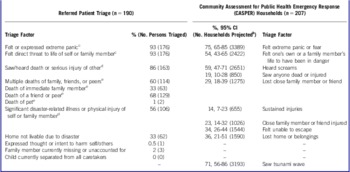
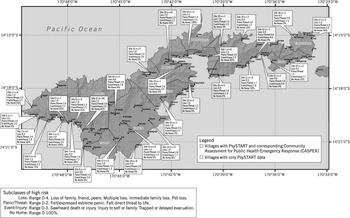
Frequencies and percentages of triage factors reported by patients referred for MH services were calculated (Table 1). Triage factors associated with MH morbidity following tsunamis and other disasters4, Reference Marshall, Schell, Elliott, Rayburn and Jaycox7 were stratified into three subclasses of risk: (1) traumatic loss of a family member, friend, multiple loss, and pet; (2) peritraumatic panic/life threat; and (3) exposure/injury. Scores for each category could range from 0-4, 0-2, and 0-3, respectively. The geographic distribution of these three categories and the proportion of persons reporting home loss were plotted graphically on a GIS-informed map (Figure 1). Epilnfo 2003 (a free statistical software package produced by CDC) was used for CASPER data entry and analysis. The percentage of households reporting triage factors was calculated, with 95% confidence intervals. Weighted analyses, based on the 2000 census, were conducted to estimate the projected number of households similarly affected in the assessment area (Table 1).
Comparison of PsySTART factors reported by patients and community households in American Samoa, 2009Footnote a

Abbreviation: CI, confidence interval.
a Percentages may not total 100 due to rounding.
b Based on weighted analyses using information from 2000 census (4513 housing units with a total population of 25 700).
c Item included in peritraumatic panic/life threat subclassification of risk.
d Item included in exposure/injury subclassification of risk.
e Item included in traumatic loss subclassification of risk.
Map of PsySTART High-Risk Subclasses and Home Loss by Village. Case Review Data From Patients Referred for Mental Health Services After Tsunami in American Samoa (September 29-October 31, 2009).

Results
Of 350 MH referrals made to LBJ Tropical Medical Center, secondary triage was accomplished on 190 patients (101 adults and 89 children) from 31 villages (Table 1); patients not triaged were referred for services before the arrival of the USPHS team. The triage factors that patients reported most often were “felt extreme panic/fear” (93%) and “felt direct threat to life” (93%). A large proportion of patients also reported that they “saw/heard the death or serious injury of another” (86%) and reported the “death of a friend or peer” (68%). When factors were grouped into categories of tsunami-related risk, with higher scores indicating greater MH risk, results ranged from 0-2.7 (mean=0.95, standard deviation [SD]=0.76) for loss of family/friend, from 0-2 (mean= 1.77, SD=0.44) for panic/threat, and from 0-3 (mean= 1.68, SD=0.67) for exposure/injury. Scores for home loss ranged from 0%-100% (mean=23.33, SD=31.58), with 50% or more of patients from nine villages reporting no home (Figure 1).
A total of 207 households in 16 villages contributed data to the CASPER survey; 8 villages had PsySTART data from both CASPER and referred patients (Figure 1). The factors reported most frequently in the community were “felt extreme panic or fear” (75%) and “saw tsunami wave” (71%), followed by “heard screams” (59%) and “felt life to have been in danger” (54%) (Table 1). Weighted analysis indicated that more than 3000 households in American Samoa “felt extreme panic/fear” or “saw the tsunami wave.” A small proportion of community members, compared with patients referred for MH services, “saw/heard death or serious injury of another” (19% vs 86%). Likewise, a small proportion of community members reported the loss “of a friend or peer” (29%) compared with patients who reported the death of immediate family (33%) or a friend (68%).
Discussion
The purpose of this pilot effort was to provide the ASDOH and disaster relief agencies with rapid, actionable information to guide the emergency MH response following the 2009 earthquake and tsunami in American Samoa. Specifically, person-level triage was conducted on individual patients and used to identify the need for secondary clinical assessment; facilitate emergency access to professional care, especially for those patients who had “felt extreme panic/fear” (93%) or “felt a direct threat to life” (93%); and provide a standardized method for reporting MH acuity across care settings. Household-level assessment, based on CDC's CASPER methodology,8 determined that proportions of self-reported traumatic exposures in the community were consistently lower than those reported by patients referred for MH services. The household-level assessment also helped to identify acute and long-term service needs such as mutual aid, National Response Framework/Emergency Support Function 8 mission assignments, and recovery phase Stafford Act services tied to the presidential declaration of disasters.Reference Robert9
Assessing traumatic exposure in the first few weeks following a disaster is important because timely provision of MH services may mitigate subsequent risk and psychological morbidity.Reference Schreiber and Pynoos10-Reference Bryant, Moulds and Nixon14 However, previous approaches to disaster surveillance have focused primarily on physical health issues and demonstrated no ability to identify or match MH needs to resources during the acute phase of a response.Reference Sijbrandij, Olff, Reitsma, Carlier, de Vries and Gersons15-18 The PsySTART system comprises four elements: (1) a disaster systems of care model that provides a common operating picture for MH services; (2) a triage “tag” that can be aggregated to provide population-level risk estimates; (3) a disaster MH crisis standard of care to align in an ethical manner limited MH resources with those persons most at risk,4 achieved via a floating triage algorithm; and (4) an information technology platform that allows surveillance data to be shared, as part of an incident management system, for near real-time situational awareness and a common operating picture—both hallmarks of emergency management that, here tofore, have not been attempted for MH issues.Reference Pynoos, Schreiber and Steinberg2, Reference Schreiber3 Although PsySTART has been used effectively to measure traumatic exposure among children following a 2004 tsunami in Thailand,Reference Thienkrua, Cardozo and Chakkraband6 after wildfires,Reference Marshall, Schell, Elliott, Rayburn and Jaycox7, 19 and in national disaster response exercises,Reference Schreiber and Pynoos10 to our knowledge, this report describes the first time that an evidence-based MH triage tool has been used for behavioral surveillance and community assessment following a disaster. Although this analysis combined traumatic exposure data from adults and children to facilitate the comparison of information systems, further study of the potential differences between these groups is warranted.
Limitations
The surveillance described in this report is subject to at least three limitations. First, using PsySTART was not mandatory for USPHS or CDC staff, which may have resulted in underestimates of MH acuity. Second, changes in population since the 2000 census may have resulted in over- or underestimating the need and risk facing projected numbers of households in American Samoa. Third, triage was conducted on individual patients while CASPER data were derived from assessing affected households; these two systems collect information differently, and estimates may not be comparable.
Conclusion
This report describes how the PsySTART system was used to rapidly provide disaster systems of care with MH triage data at both the individual and community level. We believe that this effort is the first to facilitate disaster MH crisis standards of care by using an evidence-based triage metric composed of both referred patient triage and household-level assessment. Likewise, we believe that this report describes the first operational attempt at compliance with the National Biodefense Science Board Disaster Mental Health Report Recommendation #1a.3 by local and federal responders.20 Future use of this approach in standardized public health community assessments and by disaster responders in clinical settings may help increase situational awareness, contribute to a common operating picture and pre-scripted mission assignments for disaster MH actions across National Incident Management System levels (ie, local governments, states, nongovernmental organizations, and federal disaster response teams), and improve MH outcomes for disaster survivors.20
Disclaimer
The findings and conclusions in this report are those of the authors and do not necessarily represent the official position of the Centers for Disease Control and Prevention.
Published online: April 16, 2012. doi:10.1001/dmp.2012.11