Introduction
Forest-savanna ecotones characterized by a mosaic of forest patches within savanna environments represent a common feature of the landscape of West Africa (Hennenberg et al. Reference Hennenberg, Goetze, Minden, Traore and Porembski2005, McCook Reference McCook1994). Across the tropics, observations of forest encroachment in savannas are on the rise (Bowman et al. Reference Bowman, Walsh and Milne2001, Mitchard et al. Reference Mitchard, Saatchi, Gerard, Lewis and Mier2009, Schwartz et al. Reference Schwartz, Floresta, Mariotti, Balesdent, Massimba and Girardin1996, Veenendaal et al. Reference Veenendaal, Ceca, Sykora, Torello-Raventos, Saiz and Davies2015), generally occurring at decadal timescales with rapid changes in vegetation cover and species composition (Cuni-Sanchez et al. Reference Cuni-Sanchez, White, Jeffrey, Calders, Burt, Disney, Gilpin and Lewis2016, Jeffery et al. Reference Jeffery, Korte, Palla, White and Abernethy2014). Such vegetation transitions have important implications for ecosystem services and local livelihoods due to changes in composition, productivity, diversity and abundance of species (Mitchard et al. Reference Mitchard, Saatchi, Gerard, Lewis and Mier2009, Poulter et al. Reference Poulter, Frank, Ciais, Myneni, Andela, Bi, Broquet, Canadell, Chevallier, Liu, Running, Sitch and Van Der Werf2014).
The process of forest advancement into savannas is still little understood, and the relative influences of fire (Higgins et al. Reference Higgins, Bond, February, Bronn, Euston-Brown, Enslin, Govender, Rademan, Regan, Potgieter, Scheiter, Sowry, Trollope and Trollope2007, Hoffmann et al. Reference Hoffmann, Geiger, Gotsch, Rossatto, Silva, Lau, Haridasan and Franco2012a), edaphic and climatic factors (Bowman et al. Reference Bowman, Perry and Marston2015, Lloyd et al. Reference Lloyd, Domingues, Schrodt, Ishida, Feldpausch, Saiz, Quesada, Schwarz, Torello-Raventos, Gilpin, Marimon, Marimon-Junior, Ratter, Grace, Nardoto, Veenendaal, Arroyo, Villarroel, Killeen, Steininger and Phillips2015, Veenendaal et al. Reference Veenendaal, Ceca, Sykora, Torello-Raventos, Saiz and Davies2015, Reference Veenendaal, Torello-Raventos, Miranda, Sato, Oliveras, Van Langevelde, Asner and Lloyd2018) on the formation of closed-canopy vegetation have been highlighted in several studies. It is also recognized that vegetation (canopy) cover has important influences on fire behaviour and intensity, light and edaphic factors. As a result, tree seedling establishment success can be mediated by the extent of vegetation cover via fire suppression (Bowman Reference Bowman2000, Cardoso et al. Reference Cardoso, Medina-Vega, Malhi, Adu-Bredu, Ametsitsi, Djagbletey, Van Langevelde, Veenendaal and Oliveras2016, Gignoux et al. Reference Gignoux, Lahoreau, Julliard and Barot2009, Hoffmann et al. Reference Hoffmann, Geiger, Gotsch, Rossatto, Silva, Lau, Haridasan and Franco2012a) or through amelioration of factors such as irradiance, soil moisture and soil fertility (Cuni-Sanchez et al. Reference Cuni-Sanchez, White, Jeffrey, Calders, Burt, Disney, Gilpin and Lewis2016, Ruggiero et al. Reference Ruggiero, Batalha, Pivello and Meirelles2002, Saiz et al. Reference Saiz, Bird, Domingues, Schrodt, Schwarz, Feldpausch, Veenendaal, Djagbletey, Hien, Compaore, Diallo and Lloyd2012, Veenendaal et al. Reference Veenendaal, Swaine, Agyeman, Blay, Abebrese and Mullins1996a, Reference Veenendaal, Swaine, Lecha, Walsh, Abebrese and Owusu-Afriyie1996b).
Forest species generally may lack the suite of traits that make savanna species successful in open pyrogenic savannas, while savanna species may be less successful in closed-canopy forests for the same reason and forest advancement in savanna may be facilitated in sites with higher woody canopy cover where low-light conditions constrain performance of savanna species (Armani et al. Reference Armani, Van Langevelde, Tomlinson, Adu-Bredu, Djagbletey and Veenendaal2018, Bowman Reference Bowman2000, Cardoso et al. Reference Cardoso, Medina-Vega, Malhi, Adu-Bredu, Ametsitsi, Djagbletey, Van Langevelde, Veenendaal and Oliveras2016, Hoffmann et al. Reference Hoffmann, Orthen and Franco2004, Ruggiero et al. Reference Ruggiero, Batalha, Pivello and Meirelles2002). However, there is little empirical data on whether canopy closure facilitates the establishment of forest species and to what extent this limits survival and growth performance of savanna species across forest-savanna ecotones.
In this study, we investigated influences of vegetation type (with a focus on canopy cover levels being the main distinguishing factor) and its associated factors on seedling survival, growth and traits (i.e. root mass fraction and root starch concentration) in a field transplant experiment that lasted three growing seasons and two dry/fire seasons. We used two congeneric species pairs of forest and savanna species that are common to the forest-savanna ecotone or to nearby semi-deciduous forest in West Africa to test the following hypotheses: (1) The forest tree species have lower survival than their savanna congeners in savanna due to relatively lower root mass fraction and root starch content needed to survive dry periods and to resprout after fire. (2) Higher vegetation (canopy) cover, being associated with a lower fuel load and higher soil nutrient status, benefits mainly forest tree seedlings as savanna species are less competitive in deep shade.
Materials and methods
Study site
The field transplant experiment was carried out in Kogyae Strict Nature Reserve (KSNR) located in the forest-savanna transition zone of Ghana (7°19′1.661′′N, 1°05′5.863′′W). Climatically, the area has a bimodal rainfall pattern with major peaks occurring in May–June and September–October (Figure 1), with a mean annual rainfall of 1200–1300 mm. Four vegetation types are distinguished in the area: transitional forest, savanna, riparian woodland and boval vegetation (vegetation on flat iron pans) (Wildlife Department 1994), but plot selection for this study was done following the structural classification of Torello-Raventos et al. (Reference Torello-Raventos, Feldpausch, Veenendaal, Schrodt, Saiz and Domingues2013) in woodland, closed woodland and forest vegetation patches. In the study site, tree cover has been stable or slowly increasing over the last 30 y (Janssen et al. Reference Janssen, Ametsitsi, Collins, Adu-Bredu, Oliveras, Mitchard and Veneendaal2018).
Mean monthly precipitation for Ejura, Ghana (nearest meteorological station to Kogyae Strict Nature Reserve ± KSNR) for the experimental period and beyond. Timing of all five censuses conducted are shown.

Species selection
We selected four tree species from two families and two genera. Each species pair in a genus comprised one forest and one savanna species (Table 1). Seeds of Khaya ivorensis and Terminalia superba were collected from a moist semi-deciduous forest (Bobiri Forest reserve, 6.678°N, 1.32°W), while those of Khaya senegalensis and Terminalia macroptera were collected within Kogyae Strict Nature Reserve itself. Seedlings were raised from seeds at the Forestry Research Institute of Ghana nursery in April 2012. At 3 mo old, seedlings were transported to the Kogyae Strict Nature reserve and allowed 7 d to recover from any transportation shock before transplanting.
Classification and biophysical limits of tree species used in this study. All species thrive within the Kogyae Strict Nature Reserve or in nearby semi-deciduous forest in Ghana. Sources of information: Hawthorne (Reference Hawthorne1995), http://www.worldagroforestry.org/sites/treedbs/treedatabases.asp

Transplantation experiment
Thirty-six 10 × 10-m plots were randomly established under the three vegetation types differing in canopy closure; 12 each for cover classes typical for woodland, closed woodland and forest canopies (following Torello-Raventos et al. Reference Torello-Raventos, Feldpausch, Veenendaal, Schrodt, Saiz and Domingues2013) in three sites (blocks) that were about 750 m apart. In each plot, six seedlings each of the four species (Table 1) were assigned and planted in random positions in rows (1.4 m within and between rows of seedlings). A total of 864 seedlings were planted (i.e. 6 seedlings × 4 plots × 3 cover classes × 3 blocks × 4 species). Seedlings were transplanted in September 2012 at the beginning of the second rainy season (Figure 1). No additional watering was done and no fire protection was given during the experimental period.
Canopy cover of plots in the various vegetation patches was assessed using leaf area index (LAI) and canopy openness in October before the end of the rainy season (peak leaf cover). Additionally, we assessed absence/presence of C4 grasses in the herb layer. LAI and canopy openness were obtained by analysing hemispheric photos, taken at 1 m above the ground in each plot with a fish-eye lens mounted on a Nikon E4500 camera. Images were then analysed with Gap Light Analyser software (Veenendaal et al. Reference Veenendaal, Ceca, Sykora, Torello-Raventos, Saiz and Davies2015). Mean percentage canopy openness and (LAI) ranged between 18.5–25% (1.7–2.0) for forest plots, 32–45% (0.7–1.0) for closed woodland plots and 60–73% (0.1–0.25) for (savanna) woodland plots. The herb layer in plots with highest LAI (forest plots) consisted mainly of C3 species, while canopy cover was mainly provided by forest trees. In the closed woodlands tree cover was provided by a mix of different species with tree crowns not touching and C4 grasses were present, while cover in woodlands was provided by savanna trees (Torello-Raventos et al. Reference Torello-Raventos, Feldpausch, Veenendaal, Schrodt, Saiz and Domingues2013).
Data on seedling height and survival were taken for three seasons. Before the first dry season, three censuses were conducted at 1, 2 and 3 mo after transplantation, the third month being at the onset of the first dry season (December 2012) (Figure 1). Subsequent censuses were conducted only at the end of the consecutive growth seasons (December) of 2013 and 2014. The first dry season and its associated fires occurred 5 mo into the experiment (19 January and subsequent days in 2013). The plots also burnt in the second year (around 4 February 2014). The experiment ended in December 2014 at the end of the third wet season (Figure 1). Fire intensity was not measured separately in this experiment, but after each fire event we observed that the forest plots generally had been lightly touched by fire, whereas all plots in closed-woodland and woodland cover types burnt more heavily in both dry-season fires that occurred within the period of this study.
All surviving seedlings at the end of the experiment were carefully excavated. Seedling height, total plant dry weight and root mass fraction were determined. Immediately after harvest, samples were microwaved, in preparation for determination of root starch content, following a carbohydrate extraction protocol of Duranceau et al. (Reference Duranceau, Ghashghaie, Badeck, Deleens and Cornic1999) adapted from Dubois et al. (Reference Dubois, Gilles, Hamilton, Rebers and Smith1956). Root starch content was analysed for all species (except Terminalia superba, for which we had no adequate samples available).
Environmental factors
Soil moisture content of the top layer (0–60 mm) was determined with a theta probe (Delta-T Devices, Cambridge, UK). Five moisture measurements were made across all four plots of each vegetation type within a block (as all four plots laid fairly close to one another). This was done at the centre and at the outer corners of the plots. Measurements were done twice, at 7 wk (November 2012) and 13 wk (December 2012). We took five soil samples per vegetation type per block using a cylindrical auger at the centre and at the mid-distance to the four corners of the outer plots. Sampling was done at three depths (0–10 cm, 10–20 cm and 20–30 cm) and composites were formed from the replicates for each depth category and put in zip-lock plastic bags and later analysed for soil organic matter content (loss-on-ignition method; Ball Reference Ball1964) and some biogeochemical properties. CEC, Mg, Ca, K analyses (Gilman Reference Gilman1979) were done using an Atomic Absorption spectrometer (VARIAN AA240FS, Varian Inc.). Total N and P were analysed according to Novozamsky et al. (Reference Novozamsky, Houba, Van Eck and Van Vark1983) using the Segmented Flow Analyser (SKALAR SAN++ System) and P-Olsen was determined according to Olsen et al. (Reference Olsen, Cole, Watanabe and Dean1954).
Data on fuel load and fuel composition as a proxy for fire intensity were taken from three random 1-m2 quadrats per plot and averaged for each plot per vegetation type. In each plot, cover abundances of grasses and herbs were estimated. Also, dry weights of total herbaceous vegetation (i.e. including herbs and grasses) and litter were determined from sub-samples by cutting vegetation and collecting litter and weighing them after oven drying.
Daily rainfall data from August 2012 to December 2015 recorded in Ejura, the nearest meteorological station (25 km away from experimental site), were obtained from the Ghana Meteorological Agency. There were gaps in the data for some months (October 2012, November 2013 and June 2015). Mean monthly rainfall for months with missing data were estimated using records from the last 15 d of the month before and the first 15 d of the month after the reference month. For example, mean rainfall for October 2012 was estimated as mean of rainfall values from 16 September to 15 November 2012.
Statistical analyses
We used linear mixed-effects models (Zuur et al. Reference Zuur, Ieno, Walker, Saveliev and Smith2009) to test for differences in soil moisture content of the top soil layer among vegetation types and measurement weeks (as fixed factors), including the interaction term of two fixed factors and a random block effect. Similarly, we tested fixed effects of vegetation type including a random block effect on organic matter content, litter mass, herbaceous vegetation biomass and cover abundances of herbaceous vegetation using linear mixed-effects models. Block was included as random factor in these analyses. Soil organic matter content was analysed for each soil depth separately. Also, cover abundance of grass and herbs were analysed separately. We checked for normality and homoscedasticity and applied natural log (ln), square root and arcsine transformations (Sokal & Rohlf Reference Sokal and Rohlf1995) on herbaceous vegetation biomass, litter mass and cover abundance proportions of grasses and herbs respectively. A multivariate analysis of variance (MANOVA) was used to test, for each soil layer, differences in soil chemical properties among vegetation types.
Survival data from each census (conducted at months 1, 2, 3, 15 and 27) were analysed separately to compare survival among species and vegetation types in generalized linear models (GLM) using binomial distribution with logit link function. Sidak correction was used for multiple comparisons.
Seedling heights recorded in years 1, 2 and 3, were tested for differences among years and vegetation types separately for each species in linear mixed-effects models. A random block effect was included in the models and Sidak correction was used for multiple comparisons. Also, for each species, a Kruskal–Wallis test (Sokal & Rohlf Reference Sokal and Rohlf1995) was used to determine if seedling height differed among years 1, 2 and 3. For T. superba, a Mann–Whitney U-test was used to compare height of years 1 and 2 as insufficient samples were available in year 3.
Data on total seedling dry weight, root mass fraction (RMF) and root starch concentration were analysed in separate linear mixed-effects models for each species to determine fixed effects of vegetation type. All analyses were done on SPSS version 23.0.
Results
Soil properties
Soil moisture content (SMC) of the top soil layer (0–60 mm) after 7 wk differed significantly (F2,84 = 8.4, P < 0.001) among vegetation types, higher in forest and closed-woodland (6.11% ± 1.71% and 6.25% ± 1.89% respectively) than savanna woodland at 4.25% ± 2.07%. We found that SMC had dropped to an average of 2.7% at 13 wk into the experiment (i.e. at the start of the dry season) (F1,84 = 66.6, P < 0.001). During the experimental period, all vegetation types showed a similar decline in moisture content and at the end of the experiment SMC was still lower in savanna woodland and closed woodland (1.95% ± 1.53% and 2.69% ± 1.89% respectively) than forest at 4.74% ± 2.2%.
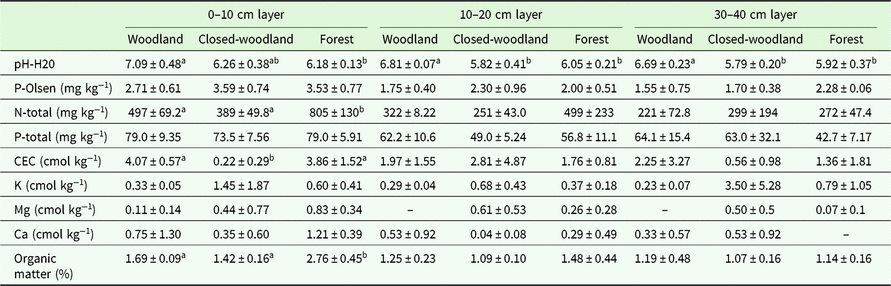
Soil organic matter in the top 10 cm was significantly higher in the forest compared with savanna woodland and closed-woodland sites (F2,6 = 19.6, P = 0.002). Interestingly, no significant differences between vegetation types were found for soil layers below 10 cm (Table 2). Significant differences between different vegetation types were also found for soil pH, total nitrogen and CEC (F2,9 = 5.85, P = 0.039; F2,9 = 17.4, P = 0.003; F2,9 = 16.7, P = 0.004 respectively), but again only in the upper 10 cm soil layer. Soil pH was lowest in forest and highest in woodland. Total nitrogen was higher in forest than in savanna woodland and closed-woodland. CEC was lowest in closed-woodland and similar between savanna woodland and forest. No significant vegetation type effect was found for levels of Ca, Mg, K, total P and P-Olsen (Table 2).
Mean ± SD of soil properties in Kogyae Strict Nature Reserve, Ghana, taken at three depths. Each soil layer (depth) was statistically tested separately for differences among vegetation types (linear mixed-effects models for organic matter content and MANOVA for all chemical properties). Statistical differences (P < 0.05) are shown with letters only for parameters for which cover classes differed significantly

Herbaceous vegetation and litter
Total biomass of herbaceous vegetation (including grasses and herbs) differed among vegetation types (F2,31 = 29.8, P < 0.001). Biomass of herbaceous vegetation was 0.23 ± 0.12 kg m−2 in forest, lower than biomass in closed-woodland and savanna woodland which had similar biomass of 0.84 ± 0.25 kg m−2 and 0.99 ± 0.35 kg m−2 respectively. Similarly, litter mass differed significantly (F2,31 = 23.3, P < 0.001) among vegetation types being higher in forest (0.21 ± 0.11 kg m−2) than closed-woodland (0.06 ± 0.05 kg m−2) and savanna woodland (0.03 ± 0.05 kg m−2).
Overall, grasses were more abundant (F2,31 = 111, P < 0.001) in savanna woodland (51.5% ± 8.8%) and closed-woodland (50.8% ± 8.7%) than forest at 15.4% ± 3.1%. Percentage cover of herbs was low overall (average of 3%) and did not differ significantly (F2,33 = 1.68, P = 0.2) among vegetation types.
Seedling survival
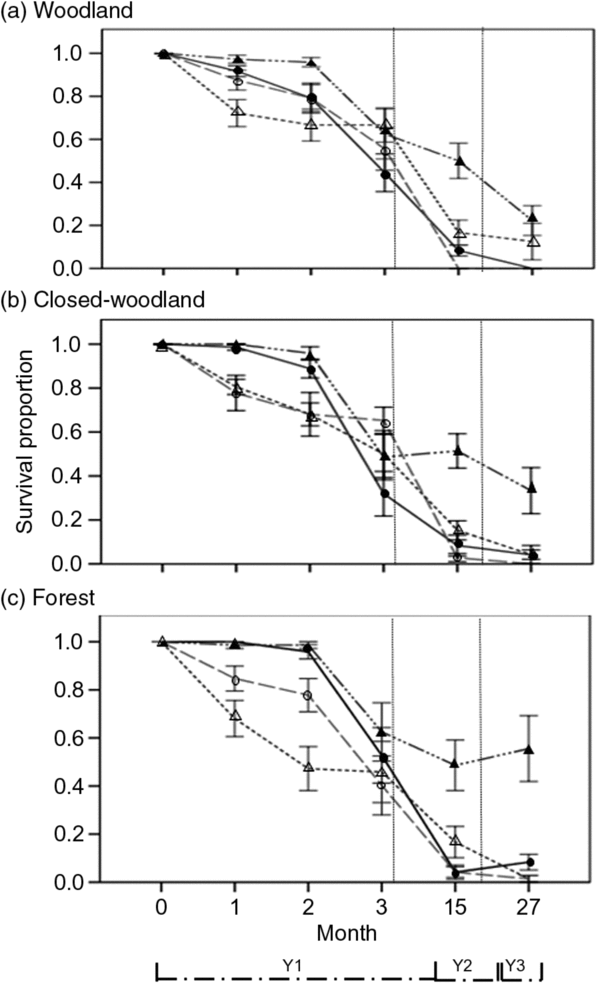
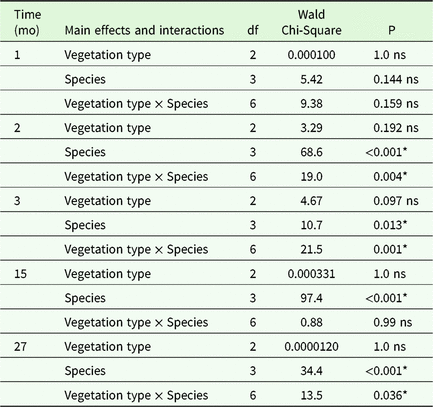
A few weeks (4–8 wk) into the experiment, both Terminalia species showed lower survival, relative to the Khaya species, in forest plots (Figure 2). Survival differences for T. superba versus K. ivorensis (P = 0.02) and T. macroptera versus K. senegalensis (P < 0.001) were revealed through pairwise comparisons (with Sidak correction). Generally, seedling survival remained high, particularly for the Khaya species and regardless of vegetation cover until 3 mo (i.e. onset of the first dry season). By this census, survival had considerably declined for all species (Figure 2). We found a significant species × vegetation cover interaction effect (Table 3), but differences among species were mainly between and not within vegetation cover type.
Proportion of surviving seedlings of Khaya senegalensis (filled-triangle), Khaya ivorensis (filled-circle), Terminalia macroptera (open triangle), Terminalia superba (open circle) at woodland cover (a), closed-woodland cover (b) and forest cover (c) in Kogyae Strict Nature Reserve, Ghana. Month corresponds to the month of transplantation, with month of transplanting = 0. Grey vertical lines indicate times when the dry season fires occurred. Error bars show ± 1 standard error of the mean.

Binomial analysis (with logit link) of seedling survival of four tree species in three vegetation types in Kogyae Strict Nature Reserve, Ghana. Analyses were done separately for each census (month) and all factors included in the separate models are presented. Significant effects are indicated with asterisks and non-significant effects by ‘ns’

At 15 mo, and after the first dry-season fire, significant survival differences were found among species (Table 3). Overall, 50% of all savanna Khaya was still alive versus 6% for its forest congener. We found a similar pattern in genus Terminalia with 16% survival for the savanna type versus 2% for its forest congener. Pairwise comparisons showed that survival of the savanna Khaya was significantly higher than all other species in all vegetation types. Savanna Terminalia also had a significantly higher survival than both forest species in savanna woodland. Between the two forest species, survival in savanna woodland and closed-woodland was higher for forest Khaya than forest Terminalia.
In the final census (27 mo on) after the second dry-season fire and third wet season (Figure 2), 12% of the total number of planted seedlings were still alive. There was a significant interaction effect of vegetation type and species (Table 3). None of the forest species was alive in savanna woodland where 20% survival for the savanna Khaya and 13% for savanna Terminalia were observed. Remarkably, higher survival was observed in forest (55%) and closed-woodland (33%) for the savanna Khaya as compared with 8% and 4% in the respective vegetation types for forest Khaya. The savanna Terminalia survived in very low numbers in closed-woodland (4%) and forest (1%). There were no seedlings of the forest Terminalia surviving in savanna woodland or closed-woodland and only 1% survived in forest (Figure 2).
Seedling growth
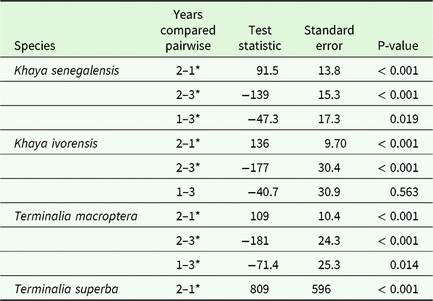
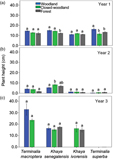
Seedling height was significantly lower in y 2 for all species relative to y 1 heights evidencing shoot loss (Table 4, Figure 3). We found that for the forest species in both genera, seedling height did not differ among vegetation cover types, but for both savanna species, differences between vegetation types were significant (F2,107 = 5.32, P = 0.006 for Khaya and F2,33 = 3.27, P < 0.001 for Terminalia). Savanna Khaya was taller in forest and closed-woodland than woodland while savanna Terminalia was taller in savanna woodland than closed-woodland and forest (Figure 3).
Pairwise comparisons (from Kruskal–Wallis test) of tree seedling height recorded in years 1, 2 and 3 at Kogyae Strict Nature Reserve, Ghana. Analyses were done for each species separately. For Terminalia superba, only years 1 and 2 are compared using Mann–Whitney U-test. Years for which median seedling height differed significantly (P < 0.05) are indicated with an asterisk

At the end of the third wet season, plant height was higher than recorded for y 2 for all species except forest Terminalia for which there were insufficient seedlings for comparison suggesting recovery from y 2 drought/fire. Also compared to y 1, both savanna species in y 3 were significantly taller, but forest Khaya in y 3 did not differ from y 1 height (Table 4), suggesting a higher cumulative shoot recovery of the savanna than forest species in this study.
Mean seedling height of each species at three vegetation types for the three growing seasons in Kogyae Strict Nature Reserve, Ghana. In year 3, Terminalia superba was excluded due to too few numbers to allow for analysis. Also, there were insufficient samples of Khaya ivorensis and Terminalia macroptera for woodland and forest respectively. Statistical comparisons (with Sidak adjustment) are done among vegetation types for each species. Different letters indicate significant differences (P < 0.05). Error bars are ±1 SE of mean.

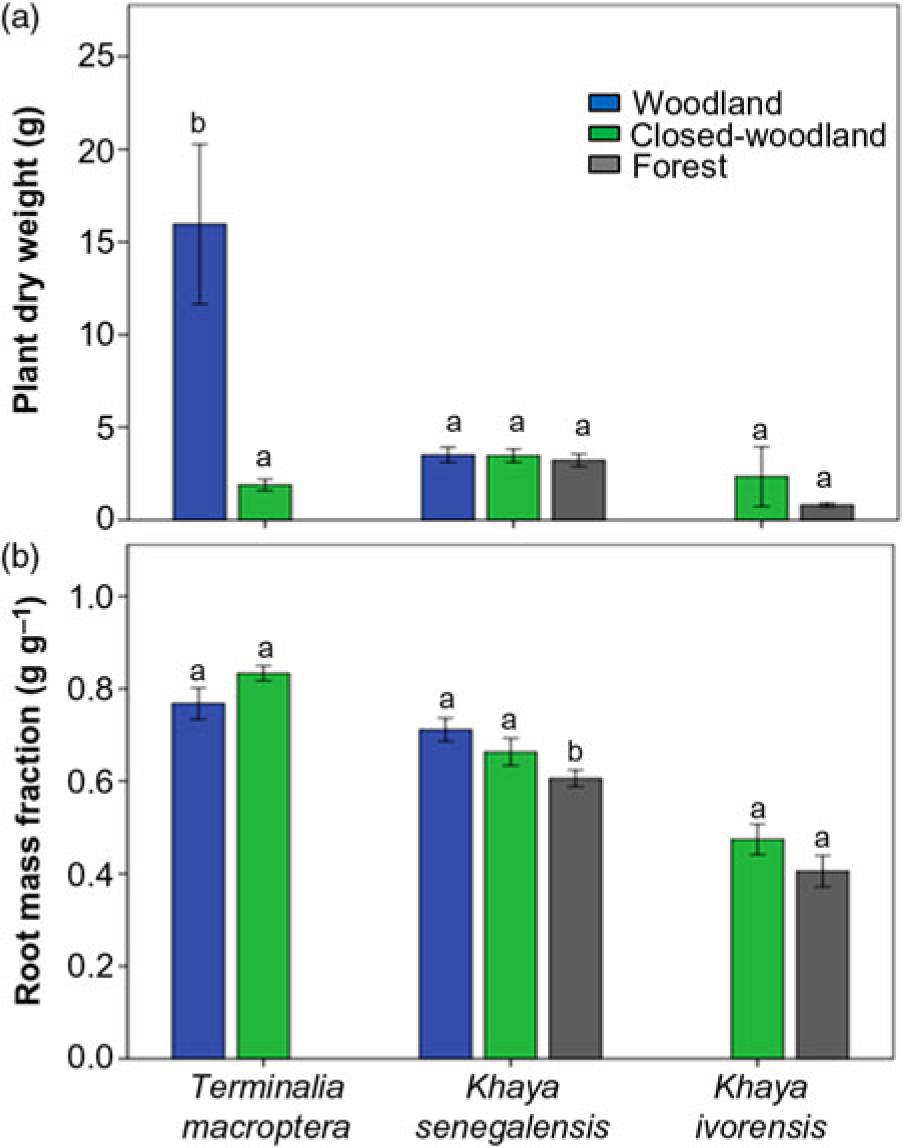
Overall, plant dry weight of the savanna Khaya was 3.4 ± 1.9 g and did not differ significantly (F2,80 = 0.20, P = 0.82) among vegetation types as was the case for its forest congener (F1,5 = 0.22, P = 0.67) (Figure 4a). Seedlings of the savanna Terminalia did grow significantly larger in savanna woodland (16.0 ± 12.9 g; F2,15 = 17.4, P < 0.001) compared to closed-woodland and forest where seedlings weighed on average 1.9 ± 0.5 g. Unfortunately, for the forest Terminalia, biomass could not be analysed because not enough seedlings survived at final harvest (Figure 4a).
Mean seedling dry weight and root mass fraction for three species at three vegetation types in Kogyae Strict Nature Reserve, Ghana. Species are compared statistically among vegetation types, but not among species. Data not presented for Terminalia superba due to insufficient samples. Also, samples were insufficient for Khaya ivorensis and Terminalia macroptera in woodland and forest respectively. Different letters indicate significant differences (P < 0.05). Error bars are ±1 SE of mean.

Biomass proportion and starch concentration in roots
We found that root mass fraction (RMF) significantly differed (F2,77 = 4.88, P = 0.01) among vegetation types for savanna Khaya, which was higher in savanna woodland at 0.71 ± 0.10 g g−1 and lowest in the forest at 0.61 ± 0.11 g g−1 (Figure 4b). RMF of the forest Khaya did not differ significantly (F1,5 = 2.01, P = 0.22) between closed-woodland and forest where it survived till the end (Figure 4b). Also for the savanna Terminalia, RMF did not differ significantly (F1,10 = 1.14, P = 0.31) between savanna woodland and closed-woodlands where it survived till the end.
Overall RMF (regardless of vegetation type) differed significantly (F3,95 = 14.6, P < 0.001) among species being highest in savanna Terminalia (mean = 0.79 ± 0.09 g g−1) and lowest in forest Khaya (mean = 0.44 ± 0.07 g g−1). RMF of savanna Khaya was intermediate (mean = 0.64 ± 0.13 g g−1) between the two other species.
We found that root starch concentration differed significantly (F2,27 = 19.1, P < 0.001) among species and also among vegetation types (F2,27 = 3.48, P = 0.045). Pairwise comparisons revealed highest root starch concentration for seedlings in savanna woodland (21.6% ± 10.7%) and lowest in closed-woodland (13.8% ± 9.8%). Among species, savanna Terminalia stored the most starch in their roots (27.1% ± 9.6%) whereas forest Khaya stored the least (9.6% ± 3.9%) while savanna Khaya had intermediate root starch storage (14.9% ± 6.8%).
Discussion
Forest and savanna species occur predominantly in their respective non-pyrogenic and pyrogenic environments. Yet, widespread observations have been made of forest species encroaching savannas in many places across the globe (Bowman et al. Reference Bowman, Walsh and Milne2001, Mitchard et al. Reference Mitchard, Saatchi, Gerard, Lewis and Mier2009). Higher vegetation cover is hypothesized to increase establishment of forest species, but tests in forest-savanna ecotones produced mixed results (Bowman et al. Reference Bowman, Walsh and Milne2001, Cardoso et al. Reference Cardoso, Medina-Vega, Malhi, Adu-Bredu, Ametsitsi, Djagbletey, Van Langevelde, Veenendaal and Oliveras2016, Geiger et al. Reference Geiger, Gotsch, Damasco, Haridasan, Franco and Hoffmann2011, Gignoux et al. Reference Gignoux, Lahoreau, Julliard and Barot2009, Hoffmann et al. Reference Hoffmann, Orthen and Franco2004). Generally, higher canopy cover suppresses pyrogenic fuel loads (Hennenberg et al. Reference Hennenberg, Fischer, Kouadio, Goetze, Orthmann, Linsenmair, Jeltsch and Porembski2006) and aids tree seedling survival as fire in open savanna vegetation induces high seedling mortality (Cardoso et al. Reference Cardoso, Medina-Vega, Malhi, Adu-Bredu, Ametsitsi, Djagbletey, Van Langevelde, Veenendaal and Oliveras2016, Gignoux et al. Reference Gignoux, Lahoreau, Julliard and Barot2009, Hoffmann et al. Reference Hoffmann, Orthen and Franco2004). Here, we assessed survival and growth of seedlings of two congeneric pairs of forest and savanna trees over a period of 3 y (two dry/fire seasons) allowing for assessments at different moments in time and beyond one season in both forest and savanna environments. We assessed flammable material as an indication of fire intensity, soil characteristics as well as biomass fraction and starch concentration in roots in relation to different vegetation types (differing in extent of canopy closure).
The forest plots typically had higher soil moisture, organic matter and N content compared with the savanna woodland plots, which is in line with other studies (Fensham et al. Reference Fensham, Fairfax, Butler and Bowman2003, Kellman Reference Kellman1985, Markham & Babbedge Reference Markham and Babbedge1979) and which may be caused by the presence of increased cover and litter input by trees (Fensham et al. Reference Fensham, Fairfax, Butler and Bowman2003, Kellman Reference Kellman1985). Higher N content could also be the result of fixation by trees and the nitrification of N (leftover after uptake by vegetation) could explain the lower pH found in forest plots (Ste-Marie & Pare Reference Ste-Marie and Pare1999). These differences between forest and savanna woodlands were found in top (10 cm) soil only. Additionally, several other soil parameters measured such as P, K, Mg, Ca and CEC were similar in both environments. Thus, no firm conclusions can perhaps be drawn on whether soils differ markedly between forest and savanna patches in this ecotone. Nonetheless, higher top soil moisture content, organic matter and N may affect tree seedling growth and survival.
Savanna woodland plots were characterized by higher biomass of herbaceous vegetation, while litter load was somewhat higher in closed-canopy forest cover (but only ∼0.2 kg m−2). This is the result of the higher canopy cover in forest excluding grasses, consistent with findings in other studies (Hennenberg et al. Reference Hennenberg, Fischer, Kouadio, Goetze, Orthmann, Linsenmair, Jeltsch and Porembski2006, Hoffmann et al. Reference Hoffmann, Jaconis, McKinley, Geiger, Gotsch and Franco2012b). Faster and more intense fires have been observed for savanna than forests (Hennenberg et al. Reference Hennenberg, Fischer, Kouadio, Goetze, Orthmann, Linsenmair, Jeltsch and Porembski2006, Hoffmann et al. Reference Hoffmann, Jaconis, McKinley, Geiger, Gotsch and Franco2012b) as a consequence of this difference in type and biomass of herbaceous vegetation.
Seedling survival
Survival in the first few weeks for both species in the genus Terminalia was lower in forest (at LAI of ∼1.7–2.0) than in savanna, while species in genus Khaya were not affected. Clearly, both Terminalia species prefer higher light levels, at least in the first weeks after germination. The forest Khaya is a non-pioneer light demander (Hawthorne Reference Hawthorne1995) while its savanna congener is known to tolerate moderate shade (Kwesiga & Grace Reference Kwesiga and Grace1986). Three months into the first dry season, these apparent species differences were no longer observed and mortality had reached about half for nearly all individuals. Prior to this census (census 3) rainfall had declined from 37 mm in November to 3 mm in December (Figure 1). Thus, the high mortality of the initial establishment phase may suggest a similar response to dry season drought for all species and regardless of vegetation cover. It was in the second dry season that the reported differences between forest and savanna species (Hoffmann et al. Reference Hoffmann, Orthen and Franco2004) became evident in both genera tested in this study. At this stage, seedlings had gone through the first dry and fire seasons and subsequent recovery. And thus fire- and drought-survival traits became more important explaining the greater survival of the savanna species.
At the end, the savanna Khaya had the most survivors in all vegetation types because it is both drought/fire tolerant and also moderately shade tolerant. None of the two forest species survived in woodlands where the highest biomass of flammable material was recorded. Except for the forest Khaya that had few surviving seedlings in closed-woodland, the forest species generally survived in forest, although in very low numbers. This suggests that the long dry seasons and associated fire events in this ecotone limits their colonization possibilities (Cardoso et al. Reference Cardoso, Medina-Vega, Malhi, Adu-Bredu, Ametsitsi, Djagbletey, Van Langevelde, Veenendaal and Oliveras2016). Survival in savanna Khaya was similar to that of savanna Terminalia in savanna woodland, but markedly contrasting in closed-canopy forest and closed-woodland with intermediate canopy cover (although to a lesser extent), with canopy closure favouring savanna Khaya and more open environments favouring savanna Terminalia. Again, this is consistent with the natural distributions of the two species.
Seedling growth, biomass proportions and starch concentration in roots
Within the first growing season, seedlings tended to grow taller (significantly for two species) in woodlands than forest. Perhaps this represents an increased growth response to the increasing light availability (Veenendaal et al. Reference Veenendaal, Swaine, Lecha, Walsh, Abebrese and Owusu-Afriyie1996b) associated with increasing canopy openness from forest to savanna. By the second year, seedling height had greatly reduced for all species indicating shoot loss resulting from drought and/or fire of the first dry season. The difference in height between years 2 and 1 which was greater for the two forest species than their savanna congeners may be an indication of a greater adverse effect of the dry season on the forest species. At the end of year 3, seedlings were a lot taller (relative to year 1 heights) for both savanna species. By contrast, y 3 seedlings of the surviving forest tree K. ivorensis (mortality of forest Terminalia was 99% at this stage) were not taller than they were in year 1 suggesting a higher cumulative recovery and resprouting capacity for the savanna species than their forest congeners. This is consistent with our prediction and also reported in several other studies (Fensham et al. Reference Fensham, Fairfax, Butler and Bowman2003, Gignoux et al. Reference Gignoux, Konate, Lahoreau, Le Roux and Simioni2016, Okali & Dodoo Reference Okali and Dodoo1973).
Vegetation cover type did not have profound effects on shoot loss and subsequent regrowth over the 3-y period except on savanna Khaya in year 2. This is inconsistent with our expectation because flammable material differed among vegetation types and should have influenced extent of stem die-back (top-kill) (Higgins et al. Reference Higgins, Bond, February, Bronn, Euston-Brown, Enslin, Govender, Rademan, Regan, Potgieter, Scheiter, Sowry, Trollope and Trollope2007). Perhaps this finding suggests that drought effect on stem die-back was stronger than the ameliorating influence of canopy cover. The fact that seedlings in closed-canopy forest also experience drought stress (Veenendaal et al. Reference Veenendaal, Swaine, Agyeman, Blay, Abebrese and Mullins1996a) lends support to this assertion. This may explain why patterns of forest development as well as mature trees of Khaya senegalensis appear to closely follow branching patterns of streams (http://www.worldagroforestry.org/sites/treedbs/treedatabases.asp). It may also explain the overall rather slow development of forest vegetation on savanna patches in Kogyae Strict Nature Reserve and elsewhere in the transition (Armani et al. Reference Armani, Van Langevelde, Tomlinson, Adu-Bredu, Djagbletey and Veenendaal2018, Janssen et al. Reference Janssen, Ametsitsi, Collins, Adu-Bredu, Oliveras, Mitchard and Veneendaal2018).
At the end of the experiment, the savanna species outperformed the forest species in terms of attained biomass at harvest, allocation to roots and root starch concentration. This was consistent with our expectation as species from drier pyrogenic environments have been reported to have higher root mass fraction and carbohydrate reserves for overcoming drought and fire (Cardoso et al. Reference Cardoso, Medina-Vega, Malhi, Adu-Bredu, Ametsitsi, Djagbletey, Van Langevelde, Veenendaal and Oliveras2016, Hoffmann et al. Reference Hoffmann, Orthen and Franco2004, O’Brien et al. Reference O’Brien, Leuzinger, Philipson, Tay and Hector2014, Tomlinson et al. Reference Tomlinson, Sterck, Bongers, Da Silva, Barbosa, Ward, Bakker, Van Kaauwen, Prins, De Bie and Van Langevelde2012).
Overall, our results suggest that the possibilities for establishment of moist semi-deciduous forest species in the forest-savanna ecotone are particularly limited by the dry season and its associated pyrogenic environment. More interestingly, we demonstrate that savanna species also differ in their tolerance to canopy cover and open pyrogenic environments specifically related to root storage functions, thus contributing to a better understanding of differences in tree seedling recruitment between species across the forest-savanna ecotones.
Acknowledgements
We are grateful to the Ghana Wildlife Division (GWD) of the Forestry Commission for granting us permission to conduct this research in Kogyae Strict Nature Reserve (KSNR). We thank staff of GWD at Dome Camp of KSNR for their assistance during fieldwork. Nuni Ferawati and José A. Medina-Vega assisted with field data collection of the second year. We thank David Kleijn and two anonymous reviewers for giving critical feedback that greatly improved this paper. We are grateful to Frans Moller and Jan van Walsem for providing assistance with laboratory analysis of plant and soil samples.
Financial support
We are grateful to NUFFIC and Wageningen University for providing financial support for various stages of data gathering.