



1. Introduction
The ability to track raw frequencies, probabilities, and other patterns of day-to-day sensory experience, and to abstract patterns of regularities embedded in sensory information is evidence of a powerful human cognitive process known as statistical learning (SL). This set of mechanisms works behind the scenes, as a form of implicit knowledge construction. In experimental contexts with presented sequences of seemingly meaningless syllable, shape, or sound stimuli, adults and children alike require only a few minutes of exposure to implicitly track low level statistical information embedded in those sequences (e.g., frequencies of individual and grouped elements, or transitional probabilities of adjacent and non-adjacent dependencies). The few minutes’ exposure is sufficient to allow differentiation between novel sequences that have either the same, or a different structure – similar to the way we notice when a radio station switches between two unfamiliar languages. Several studies have linked individual variance on SL tasks with individual variance in tasks of natural language learning and processing, thus suggesting that the two abilities are related (e.g., Christiansen, Conway & Onnis, Reference Christiansen, Conway and Onnis2012; Misyak & Christiansen, Reference Misyak and Christiansen2012). For example, infants exhibit individual differences in statistical learning skills that may modulate their language development trajectories as young children, including the development of comprehension of syntax (e.g., Kidd & Arciuli, Reference Kidd and Arciuli2016; Kidd, Reference Kidd2012). Studies with older children have also linked poor implicit statistical skills with concurrent language and/or reading difficulties (Evans, Saffran & Robe-Torres, Reference Evans, Saffran and Robe-Torres2009; Yim & Windsor, Reference Yim and Windsor2010).
Considering that the experience of acquiring two languages requires bilinguals to track multiple distinct sets of statistical regularities and thus may be related to their sensitivity and approach to novel statistical regularities (Weiss, Poepsel & Gerfen, Reference Weiss, Poepsel, Gerfen and Rebuschat2015), a pertinent research interest would be the relationship between bilingualism and SL. The limited literature on the topic to date suggests that the relationship between bilingualism and SL is nuanced. Bilingual experience was demonstrated to enhance learning outcomes in speakers for an artificial tone language more than prior experience with tonal languages (Wang & Saffran, Reference Wang and Saffran2014). In a word learning task that required participants to extract and learn novel words comprising pure tones based on Morse code in a continuous auditory stream, participants with higher bilingual experience were found to be better at learning words through the tracking of transitional probabilities (Bartolotti, Marian, Schroeder & Shook, Reference Bartolotti, Marian, Schroeder and Shook2011). In a more recent study, Escudero, Mulak, Fu and Singh (Reference Escudero, Mulak, Fu and Singh2016) found that bilingual adults were more accurate than monolinguals at picking up novel word-referent mappings in an implicit cross-situational word learning task. However, in contrast to the positive findings above, Yim and Rudoy (Reference Yim and Rudoy2013) did not find any differences between monolingual and bilingual children on a nonlinguistic auditory tone task and a visual statistical learning task. Similarly, Potter, Wang and Saffran (Reference Potter, Wang and Saffran2015) found an advantage in performance on an artificial tonal language learning task, but not for a visual statistical learning task between a Mandarin-learning group and a control group. Thus, the mixed findings presented suggest that the relationship between bilingualism and SL is not straightforward. Furthermore, the focus on comparing bilingual groups and monolingual controls in this line of research underscores an underlying assumption that bilingualism is an all-or-none phenomenon. In reality, bilinguals vary in their relative proficiency, experience and dominance in their individual languages. Consequently, this study aims to examine how individual differences in bilingual dominance may be related to individual differences in SL.
A concurrent theoretical reason to explore bilingual implicit learning is the putative bilingual cognitive advantage. Bilinguals may benefit from enhanced executive control, particularly aspects of attentional control and inhibition of irrelevant information (Bialystok, Craik & Luk, Reference Bialystok, Craik and Luk2012), as well as greater flexibility in shifting between mental sets (e.g., Prior & MacWhinney, Reference Prior and MacWhinney2010). While others have questioned the bilingual cognitive advantage on methodological grounds (De Bruin, Treccani & Della Sala, Reference De Bruin, Treccani and Della Sala2014; Paap, Johnson & Sawi, Reference Paap, Johnson and Sawi2015), thus keeping the debate open (Bialystok, Kroll, Green, MacWhinney & Craik, Reference Bialystok, Kroll, Green, MacWhinney and Craik2015; Paap, Johnson & Sawi, Reference Paap, Johnson and Sawi2016), here we note that it has largely focused on executive function skills, and mostly neglected learning abilities. Thus, considering the evidence above that bilingual experience may facilitate learning outcomes, we hypothesized that degree of bilingualism is related to implicit learning ability; more balanced bilinguals are expected to exhibit greater SL ability than those who are comparatively dominant in one language.
1.1. Method
To investigate whether adult bilinguals exhibit heightened statistical learning, we looked at their ability to learn two artificial grammars concurrently, and predicted their learning scores from their degree of bilingualism.
1.1.1. Participants
Fifty-five undergraduate students (33 females, mean age=22.02 years, sd=1.49) at a university in Singapore participated for a small monetary token. All but one were born and lived in Singapore all their lives, and were educated through the same national educational system. They reported being bilingual in English and in their heritage language (Mandarin=51, Malay=3, Filipino=1). This sample size was calculated using the pwr.f2.test function in R to achieve a medium effect size with a significance value less than .05 and a power of .8, for a planned multiple regression. In addition, our sample size is more than 4 times the one required to obtain a medium effect size on mean proportion accuracy in the artificial language task planned (see below).
Language dominance
In Singapore multilingualism is the norm and monolingualism the exception. At the same time, Singaporeans’ individual experiences with multiple languages vary greatly, and can yield quite different linguistic profiles from person to person. We decided to capitalize on such variability, rather than treating bilingualism as a homogeneous variable to be tested against monolingualism. The Bilingual Language Profile (BLP) is a validated questionnaire for assessing language dominance through self-reports (Birdsong, Gertken & Amengual, Reference Birdsong, Gertken and Amengual2012; for measures of validity and reliability see Gertken, Amengual & Birdsong, Reference Gertken, Amengual and Birdsong2014). It produces a continuous dominance score and a general bilingual profile taking into account variables of linguistic background, use, and ability. Each question response in the BLP is a scalar associated with a certain point value. We first tallied the point totals based on self-reported values in each language separately for four subcomponentsFootnote 1 : Language History (6 questions), Language Use (5 questions), Language Proficiency (5 questions), and Language Attitude (4 questions). To obtain absolute scores of the four subcomponents independently for each language, the questionnaire was administered twice, once in English and once in the equivalent translation in the other language of the participants. We then obtained a weighted sum of the four subcomponents to ensure that each subcomponent received equal weighting, to yield a global score for each language. The maximum total score possible for each language is 218 points. Finally, we obtained a composite language dominance index for each participant, by subtracting their least dominant language total from the most dominant one. This rendered a dominance score that ranged from 0 (perfectly balanced in both languages) to +218 (strongly dominant in one language only). We used this composite measure as the index of bilingual dominance.
1.1.2. Material and procedure
The task was modeled and adapted from Conway and Christiansen (Reference Conway and Christiansen2006). We generated two different finite-state grammars, Grammar A and Grammar B (Figure 1), each with its own sets of non-overlapping stimuli. We used 9 grammatical sequences from each grammar in the training phase and 10 grammatical sequences from each grammar in the test phase; all sequences contained between three and seven elements. For a given grammar, each shape was randomly paired with a pseudoword from one of two lexicons – the paired unit is indicated by a letter symbol (see Figure 1). The pairing of shapes and pseudowords for each symbol of each grammar within a lexicon was random for each different participant, thus reducing undesired group-wise sequence-specific biases on learning. Therefore, each letter symbol was mapped onto both a shape lexicon (five different shapes) and an auditory lexicon (five spoken pseudowords). Specifically, Grammar A was associated with 5 blue shapes, and 5 pseudowords (rud, pel, dak, vot, jic) generated with the English speaking voice Victoria available from the Speech System Manager of Mac OS X. Grammar B was associated with a different lexicon of 5 red shapes, and 5 pseudowords (ginot, labou, liva, taret, kimosse) generated with the French speaking voice Thomas available from the same software. Conway and Christiansen (Reference Conway and Christiansen2006, Experiment 3) showed that learning suffered when the two grammars used lexicons along the same perceptual dimension; in this case, statistical learning was limited to just one of the two grammars. In a similar task involving statistically-based segmentation of two continuous streams of sounds into word-like units, Weiss, Gerfen and Mitchel (Reference Weiss, Gerfen and Mitchel2009) found that participants were unable to extract two sets of regularities when the same speaker voice was used. Thus, the purpose of using shapes of different color and pseudowords of different pronunciations in our stimuli was to provide robust perceptual cues for the change of grammars. The pseudowords and shapes were presented concurrently, thus forming a multimodal stimulus percept. Visual stimuli were presented in a serial format in the center of a computer screen. Pseudoword stimuli were also presented in sequence and timed to the visual stimuli via headphones. Each shape of a particular sequence was presented for 500 ms, with 100 ms occurring between shapes. A 1,700 ms pause separated each sequence from the next.
The grammars, training items, and test items used in the experiment. The top panels depict the state transitions generating all grammatical sequences by Grammar A and Grammar B respectively. The training items were mapped onto two lexicons of non-words and coloured shapes (centre panels). To create ungrammatical items at test, half of the test items for each grammar were mapped onto the non-words and shapes of the other grammar.
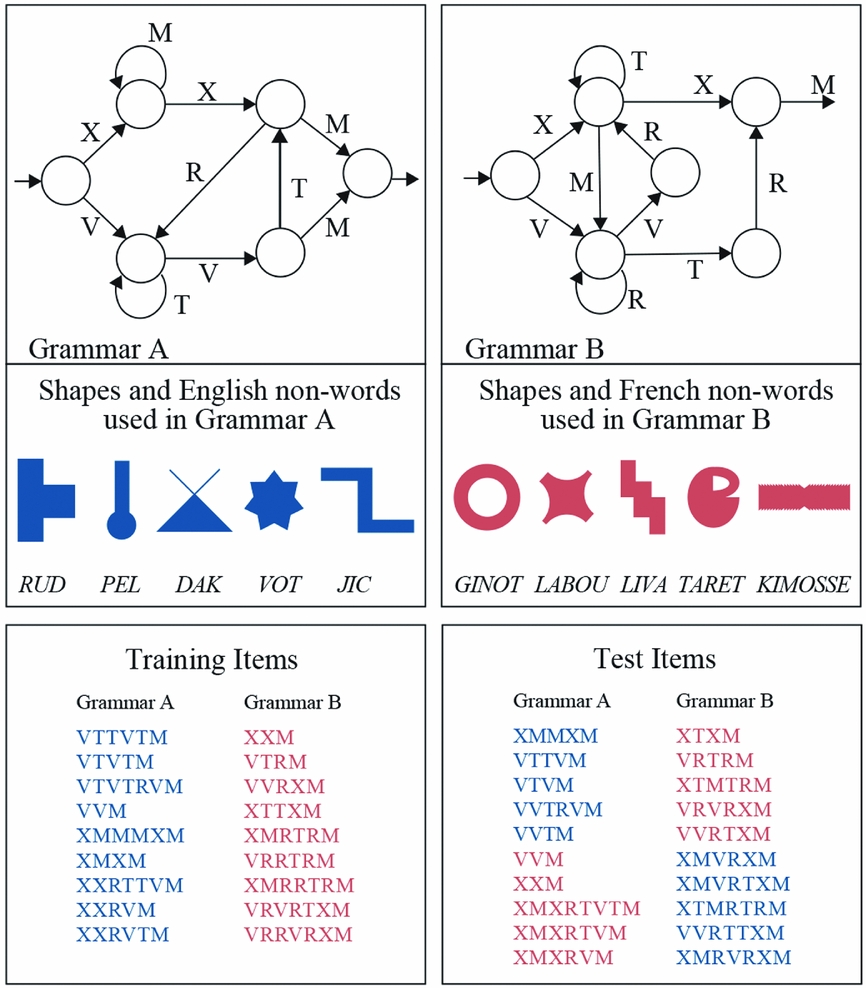
Participants were told that they would experience sequences of shapes and sounds, and it was important to pay attention to the stimuli because afterwards they would be tested on what they had observed. The instructions did not indicate that the sequences followed underlying rules or regularities of any kind, nor that two sets of regularities were present. In the training phase 18 sequences (9 from each grammar) were pseudo-randomly presented in 6 blocks of interleaved sequences, mimicking the language switches characteristic of bilingual speech. Thus, a total of 108 sequences were presented during training. Participants could take a brief break in between blocks.
Before the beginning of the test phase, participants were informed that the stimuli they had observed were generated according to a complex set of rules that determined the order of the elements within each sequence. Participants were told they would next be exposed to other sequences. Some of these sequences would conform to the same set of rules as before, whereas the others would be different. Their task was to judge which of the sequences followed the same rules as before and which did not.
For the test phase, a total of 20 test sentences were used, 10 that were grammatical according to the word order of Grammar A, and 10 that were grammatical according to the word order of Grammar B. For scoring purposes, the test sequences from the grammar that was instantiated with the same stimuli as in the training phase were deemed grammatical, whereas the test sequences from the other grammar were deemed ungrammatical. This effectively implemented a crossover design (Conway & Christiansen, Reference Conway and Christiansen2006) in which half of the grammatical test sequences of one grammar were used as the ungrammatical test sequences for the other grammar. Crucially, for participants to show that they learned the statistical regularities specific to each grammar, they ought to classify a sequence as grammatical only if it was presented in the same stimuli as were the training sequences generated from the same grammar (i.e., with the same visual stimuli mapped to the same pseudowords spoken with the English or French voice). As an analogy from natural languages, word order in Japanese and English differs, and a Japanese–English bilingual can tell that “I you like” is ungrammatical in English while the same order in Japanese would be grammatical. This ability requires subtly internalizing the statistical preferences of each grammar.
All test items were presented in random interleaved order. Participants pressed “Y” on their keyboard if they thought that a particular test sequence conformed to the rules, and “N” if they did not. Classification judgment was scored as correct if the test sequence was judged as grammatical and its stimuli were the same as those of the training sequences that were generated from the same grammar. Similarly, a classification judgment was also scored as correct if the test sequence was judged as ungrammatical and its stimuli were different from those of the training sequences that were generated from the same grammar. In all other cases, a classification judgment was scored as incorrect.
1.2. Results
Data from two participants were not included in the statistical analyses because incomplete in one of the two critical measures. We first calculated accuracy scores on the dual grammar task for each participant and each artificial grammar as the proportion of correct endorsements to grammatical test items and correct rejections to ungrammatical test items. As a group, our participants learned both languages significantly above chance (Figure 2): Grammar A (mean=0.57, sd=0.18, t(52)=2.69, p<=0.01, d=0.37) and Grammar B (mean=0.58, sd=0.19, t(52)=3.21, p<0.01, d=0.45). The measure of language dominance obtained from the questionnaire ranged from 1.58 (close to equally bilingual) to 85.65 (closer to dominant in one language), (mean=32.15, sd=20.78), indicating variability in our sample (Figure 3, top). Forty-four participants were more dominant in English (the global score of English was higher than the global score of the Other language), while 9 were more dominant in the other language. Across all participants, global scores of English calculated by summing scores for Language History, Use, Proficiency, and Attitudes were generally higher (min= 101, max=181, mean=158.5), than global scores obtained from the other language (min= 58, max=176, mean=115.7).
Mean proportion accuracy scores in each artificial grammar, with standard error bars.

Top: the distribution of language dominance scores in the sample of participants. Higher scores indicate a more monolingual profile. Bottom: Plotted effects (and confidence intervals) of Language dominance on the combined mean accuracy scores from both grammars, obtained from a mixed-effects logistic regression. Higher bilingualism predicts higher accuracy scores on the dual grammar task.

To assess whether language dominance (measured as the subtraction of the least dominant language global score from the most dominant one) predicted accuracy scores of the artificial grammar task, we fitted a mixed-effects generalized linear model using the glmer function in R (R Core Team, Reference Core Team2015). Accuracy scores were modeled as a binomial distribution and regressed against Grammaticality of test item (Grammatical, Ungrammatical), Grammar (A, B), and Language Dominance as fixed effects. We also regressed Participants and Test Items as random effects. We first fitted a maximal model with all predictors and interactions between the fixed factors. We then performed a stepwise model selection by AIC to select the most parsimonious model. The final model indicated two main effects: Grammaticality and Language Dominance. Grammaticality (β=0.66, z=2.73, p<.01, d=1.92) suggests that participants were better at endorsing grammatical test items than rejecting ungrammatical test items. This is in line with previous literature on artificial grammar learning (e.g., Pothos, Reference Pothos2007). In addition, Language dominance independently predicted accuracy scores (β=-0.23, z=-2.155, p=0.03, d=0.79); see Figure 3, bottom). Thus, participants with a more balanced bilingual profile performed better than less bilingual individuals.
2. General discussion
The present study investigated whether individual differences in bilingualism correlate with the ability to learn two distinct sets of statistical regularities concurrently in a dual artificial grammar learning task. Previous research suggests that this is a particularly challenging task (Conway & Christiansen, Reference Conway and Christiansen2006; Franco, Cleeremans & Destrebecqz, Reference Franco, Cleeremans and Destrebecqz2011; Weiss et al., Reference Weiss, Gerfen and Mitchel2009). Furthermore, Yim and Rudoy (Reference Yim and Rudoy2013) and Poepsel and Weiss (Reference Poepsel and Weiss2016) found that both monolingual and bilingual children and young adults performed statistical learning tasks with novel miniature grammars equally well, suggesting no bilingual advantage in this cognitive domain. Here we built on and incorporated experimental aspects of all these studies, producing two different sets of regularities associated with different voices, language accents, and visual stimuli. Yet the task required subtle differentiation and learning because of our crossover design. In other words, learning must be language-specific in this paradigm, otherwise performance would be at chance levels as all underlying sequences were grammatical. Participants had to recognize which word-shape order sequence matched a specific grammar, not unlike a bilingual Japanese–English speaker recognizing that “Cats mice eat” is ungrammatical in English but correct in Japanese. Participants learnt both languages at above-chance levels. Crucially, in line with the hypothesis, participants that exhibited a more balanced bilingual profile (relatively equal dominance in both languages) performed better on the grammar test, being more adept at correctly selecting sequences that were grammatical and rejecting sequences that were ungrammatical, irrespective of language.
Research on the extralinguistic benefits of bilingualism has primarily centered on cognitive benefits such as attentional control and task switching (Bialystok et al., Reference Bialystok, Craik and Luk2012). Considering the importance of SL in language, few studies have investigated whether bilingualism modulates SL ability. This study partially fills this gap by proposing that bilinguals may exhibit heightened statistical learning abilities, thus extending the scope of the bilingual advantage. Our findings also contribute to qualify the nature of the advantage as a graded one. We adopted an individual differences approach and treated bilinguals as a heterogeneous group, rather than as a homogeneous group contrasted to monolinguals. The latter approach is frequent, but may obfuscate gradual dimensions of bilingualism that in turn reflect different cognitive sensitivities. The self-reported Bilingual Language Profile aptly revealed a combined large variability across four holistic dimensions of language history, use, proficiency, and attitudes for each of our participants’ languages. By capitalizing on the bilingual variability we found in the questionnaire rather than ignoring it, we unearthed important individual differences that point to the first documented modulating role of bilingualism in adult statistical learning.
One limitation of the current study is that it was not possible to assess whether the bilingual advantage found here involved specific modalities of statistical learning, because in our paradigm the grammars were instantiated by pairing visual non-linguistic with linguistic stimuli. Current empirical evidence suggests that SL may not be a unified domain-general ability, as its modality- and informational specificity across studies suggest that it is instead comprised of multiple distinct subcomponents (Arciuli, Reference Arciuli2017; Siegelman, Bogaerts, Christiansen & Frost, Reference Siegelman, Bogaerts, Christiansen and Frost2017). Thus, SL tasks are not equal in their capacity to capture the specific subcomponents of SL; different tasks may capture different facets of SL. This new theoretical understanding of SL may elucidate the mixed findings seen in studies such as Wang and Saffran (Reference Wang and Saffran2014), where the bilingual advantage in SL was found only in performance on the artificial tonal language learning task, but not a visual statistical learning task. Thus, further studies should investigate whether the bilingual advantage we found in statistical learning is modalityspecific.
Further research may also build upon this finding by examining the directionality of this relationship, perhaps through structural equation models as Spencer, Kaschak, Jones and Lonigan (Reference Spencer, Kaschak, Jones and Lonigan2015) previously demonstrated. One interpretation compatible with our findings is that in order to succeed in bilingual learning, bilinguals must necessarily learn and keep separate distinct sets of statistical regularities for each language, and in doing so their statistical learning skills might be sharpened. However, the opposite direction of causality can also be entertained in principle: it is possible that individuals equipped with better SL abilities are able to better learn and maintain two languages in their life. Additionally, future studies that aim to investigate how individual differences in bilingualism modulate SL should also account for general cognitive abilities that may influence task performance, such as IQ, attention, and working memory. Age may also be a potential factor to be controlled for, as current empirical evidence suggests that there are age-related effects on SL ability (Arciuli, Reference Arciuli2017).
Together with previous studies documenting a relation between statistical learning and language, a broader picture is emerging: not only is statistical learning associated with the acquisition and processing of language, but also specific experiences with language – here bilingualism – may be implicated in individuals’ statistical learning abilities.



