Introduction
Hot water irrigation was first described by N L Guice in 1878 (N L Guice treated the first patient in 1878, but published it in 1884) as an effective method of treating severe, life-threatening epistaxis.Reference Guice1 However, the technique was already in use by nineteenth century obstetricians as a method of treating postpartum bleeding.Reference Hansen2
In the second half of the twentieth century, newer nasal packing products and the development of endoscopic sinus surgery almost completely replaced the irrigation technique as treatment for posterior epistaxis.
However, Stangerup et al. have recently demonstrated that hot water irrigation, using temperatures of up to 50°C, produces vasodilation and oedema of the nasal mucosa without the risk of necrosis.Reference Stangerup, Dommerby and Lau3 This mucosal oedema leads to local compression of the bleeding vessels, while at the same time triggering and probably accelerating the clotting cascade. In Stangerup's series, hot water irrigation had a higher success rate (55 per cent) in treating posterior epistaxis, compared with nasal packing (44 per cent).Reference Stangerup, Dommerby, Siim, Kemp and Stage4 Using a modified irrigation technique, our group was able to stop bleeding permanently in up to 82 per cent of cases of intractable posterior epistaxis, including patients receiving antiplatelet agents or anticoagulants.Reference Schlegel-Wagner, Siekmann and Linder5 We encountered no complications, such as crusting or synechiae formation, during a follow-up period of four to 24 months. Furthermore, successful hot water irrigation was associated with less nasal trauma, significantly less pain, fewer surgical procedures and avoidance of a hospital stay.Reference Stangerup, Dommerby, Siim, Kemp and Stage4, Reference Schlegel-Wagner, Siekmann and Linder5 Hot water irrigation is currently used in our clinic as the first line of treatment for posterior epistaxis.
This report presents a complete description of the method, as well as technical details and practical suggestions.
Method
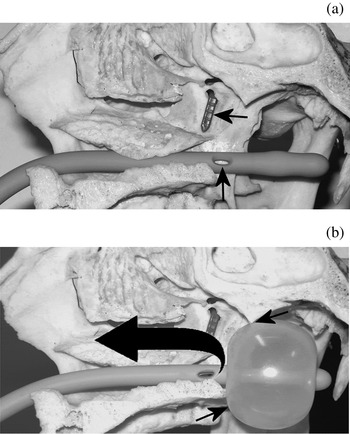
Topical anaesthesia of the relevant nasal cavity is applied using cotton nasal packing impregnated with 4 per cent tetracaine. An Epicat balloon catheter (Abigo Medical AB, Askim, Sweden) is inserted into the affected nasal cavity (Figure 1a). This modified bladder catheter has an irrigation opening located proximal to the balloon. The balloon is inflated within the epipharynx using saline, and then gently pulled back until the choana is blocked off, in order to avoid aspiration (Figure 1b). The proximal irrigation opening enables free flow of irrigation water in the region of the sphenopalatine foramen.
(a) Correct placement of the modified balloon catheter along the inferior meatus, with the orifice of the catheter (arrow) placed underneath the sphenopalatine foramen (second arrow). (b) The large arrow indicates the direction of water flow through the nose during continuous irrigation, while the small arrows show the correct placement of the inflated balloon, anchored within the choana

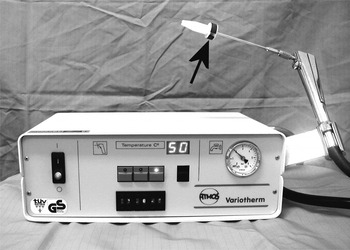
The affected nasal cavity is then continuously irrigated during 3 minutes with 500 ml water heated to 50°C (we treat with 500 ml of hot water using a caloric stimulator. This takes about 3 minutes). Tap water is administered via a water caloric stimulator (conventionally used for vestibular testing) (Figure 2). The metallic tip of the caloric irrigator is inserted into the distal end of the balloon catheter. The patient is then seated upright with their face pointed downward over a basin, to allow outflow of water from the affected nasal cavity into the basin (see video clip; Appendix 1). The caloric stimulator has been technically modified to produce the desired water temperature, providing a continuous flow of hot water without fluctuations of temperature.Reference Schlegel-Wagner, Siekmann and Linder5
A conventional caloric irrigator which has been technically modified to allow a water temperature of 50°C. The arrow indicates the protective valve that must be occluded with a finger during irrigation in order to prevent backflow of water.

Most patients stop bleeding during hot water irrigation. Generally, we would expect bleeding to stop after 10 minutes of continuous treatment. The catheter can then be removed, or left in place for several minutes in case a second irrigation is needed.
Once bleeding is successfully stopped, patients can be discharged home after a two-hour observation period.
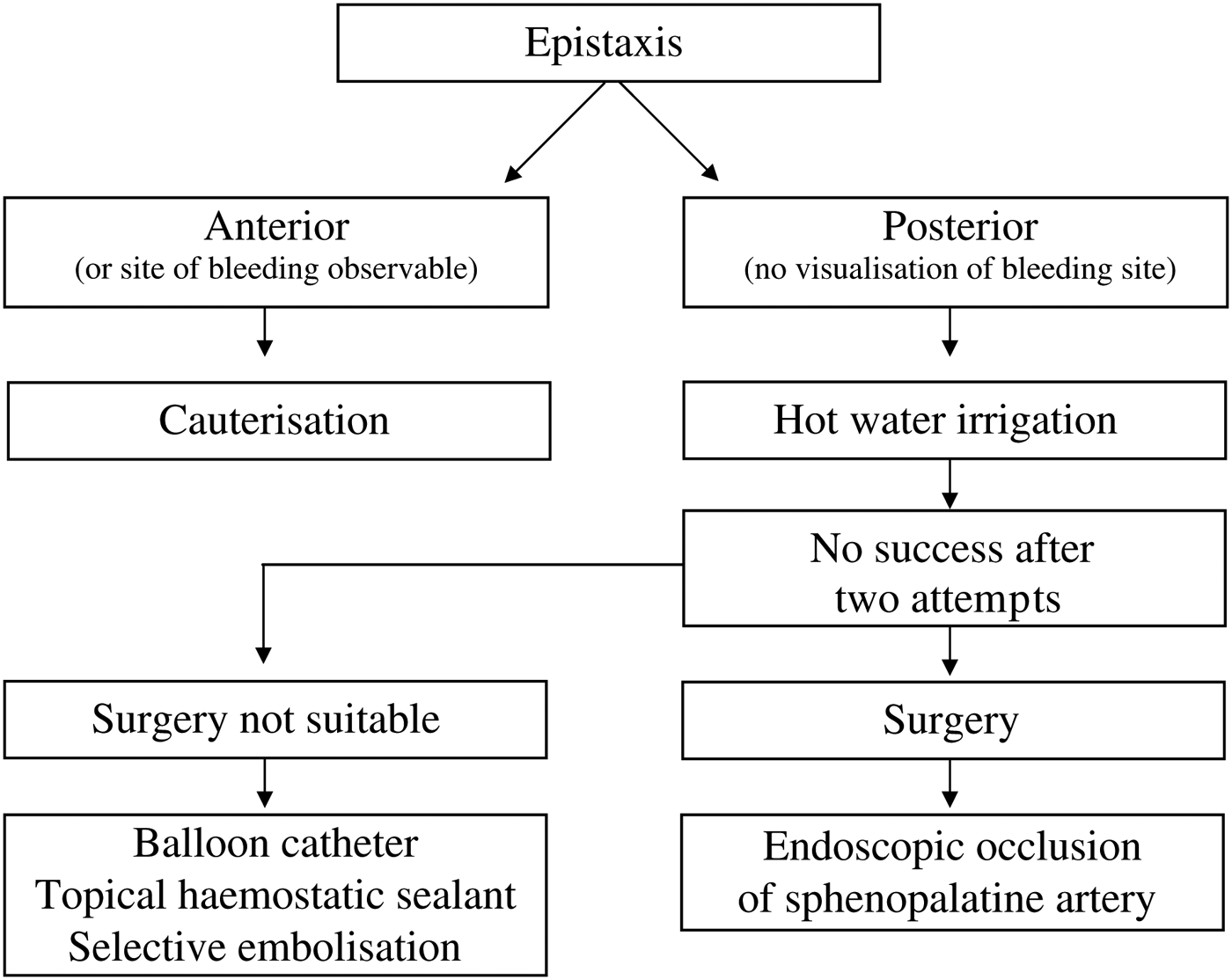
Figure 3 shows an algorithm guiding hot water irrigation treatment for posterior epistaxis.
Treatment algorithm.

Practical advice
We would offer the following practical suggestions on administering hot water irrigation as treatment for intractable posterior epistaxis.
Firstly, it is important to normalise vital signs prior to hot water irrigation. Patients commonly present with elevated blood pressure, which must be addressed first. Anticoagulant or antiplatelet therapy should be suspended whenever possible. Consumption of acetylsalicylic drugs is common, often routinely prescribed as stroke prophylaxis; such drugs have been shown to be one of the major risk factors for epistaxis occurrence and severity.Reference Soyka, Rufibach, Huber and Holzmann6 After discharge, the indication for these drugs should be discussed with the patient's referring physician, general practitioner or cardiologist.
In cases with a visible source of bleeding, cauterisation by any means should be attempted prior to hot water irrigation.
In cases of haemorrhagic shock, bleeding must be stopped immediately using a balloon catheter or urgent surgery.
Clinicians should avoid the use of nasal vasoconstrictors before commencing hot water irrigation, in order not to interfere with the formation of nasal mucosa oedema.
Severe septal deviations do not constitute any inconvenience as regards hot water irrigation, provided the catheter can be correctly placed.
The balloon catheter must be well placed and not bent, and must be anchored within the choana. If water flows out through the mouth, the balloon is certainly not in place. The protective valve at the tip of the caloric irrigator must be occluded with a finger in order avoid backflow of water.
After two failed hot water irrigation attempts, conventional nasal packing and surgical exploration are recommended.
Hot water irrigation is not effective in cases of post-operative bleeding after endonasal surgery of the turbinates or paranasal sinuses, as there is insufficient intact mucosa to sustain local oedema.
Finally, if a caloric irrigator is not available, hot water irrigation can still be performed using a large 100 ml syringe and a thermo-bucket filled with 50°C tap water. It is important to note that at least 500 ml of water should be irrigated through the nose in each 3 minute period. However, this alternative method is not encouraged, as the temperature and amount of instilled water are difficult to control.
Conclusion
Hot water irrigation constitutes a safe, efficient and cost-effective treatment method for posterior epistaxis. This method has the additional benefits of less patient discomfort, less morbidity, less need for surgical intervention and fewer days of hospitalisation.
Hot water irrigation should be considered as the first line of treatment for posterior epistaxis, and medical trainees should be repeatedly instructed in its use in out-patient and emergency settings.
Appendix 1. Supplementary video material
A video clip demonstrating the application of hot water irrigation in a patient with epistaxis is available on The Journal of Laryngology & Otology website, at http://journals.cambridge.org/sup_S002221511100243Xsup001.