Background
Tonsillectomy is a commonly performed surgical operation, with infrequent complications. Post-operative bleeding is an important complication, which may occur either soon after the operation or after the initial recovery, typically following discharge. In some instances, severe or uncontrolled post-operative bleeding may require the patient to be returned to the operating theatre for surgical arrest of the haemorrhage.
In January 2001, it was recommended by the Department of Health that single-use instruments be used for tonsillectomy in order to minimise the risk of variant Creutzfeldt–Jakob disease transmission.1 Difficulties with these single-use instruments were later highlighted, including a possible increase in post-operative bleeding rates, eventually resulting in the reintroduction of reusable instruments in England.2 Concerns over post-tonsillectomy bleeding rates led to several UK studies, including a retrospective study by the Scottish Otolaryngology Society,3 a retrospective study by the British Association of Otorhinolaryngologists – Head and Neck SurgeonsReference Yung4 and the national prospective tonsillectomy audit.5 The latter study described a 0.9 per cent overall rate of returning to theatre for haemorrhage and an increase in the likelihood of bleeding following ‘hot’ surgical techniques (i.e. diathermy or coblation), but no significant evidence for variations in return-to-theatre rates between techniques.
During the national prospective tonsillectomy audit, interim guidance on tonsillectomy techniques was issued by the British Association of Otorhinolaryngologists – Head and Neck Surgeons and the National Institute for Clinical Excellence.6 Subsequent data suggested a fall in the rate of post-tonsillectomy haemorrhage. However, the calendar period of the second part of the study differed from that of the first, and it was not considered that seasonal variation may have been partly responsible for the observed decrease in bleeding rates.
It has been suggested in previous, small-scale studies that the time of year of tonsillectomy could influence the risk of post-tonsillectomy haemorrhage.Reference Carmody, Vamadevan and Cooper7–Reference Roberts, Jayaramachandran and Raine9 One potential mechanism is the prevalence of upper respiratory tract infections in the winter months, which increases the likelihood of developing a tonsillectomy bed infection, occasionally resulting in a post-tonsillectomy bleed. If true seasonal variation in post-tonsillectomy bleeding exists, particularly bleeding severe enough to require a return to theatre, this could be very useful information for clinicians and service commissioners. Firstly, it may add weight to the opinion that secondary post-tonsillectomy haemorrhages are related to upper respiratory infections. Secondly, and perhaps most importantly, all patients – or, particularly, those at high risk of bleeding or of the complications of bleeding – could have this procedure performed at a time of year when the likely risk of post-operative bleeding was minimal.
The widespread debate and controversy surrounding post-tonsillectomy haemorrhage have thus far concentrated on the methods of tonsillectomy. The objective of this study was to retrospectively explore the existence of a monthly and/or seasonal variation in rates of severe post-tonsillectomy haemorrhage, as demonstrated by a need to return to theatre.
Method
Non-identifiable patient data from the hospital episode statistics database for England was used for the purposes of this study. This database includes a record of all in-patient episodes involving surgical procedures for patients treated within NHS secondary care. These episodes are coded using the Office of Population Censuses and Surveys classification of surgical operations and procedures (fourth revision).10 Data from the hospital episode statistics database were provided by the Dr Foster Unit at the Imperial College of Science, Technology and Medicine, London.
All patient episodes which included a procedure with an Office of Population Censuses and Surveys surgical classification code which related to ‘tonsillectomy’ (i.e., codes F34.1, F34.2, F34.3, F34.4, F34.8 and F34.9) and to ‘arrest of tonsillectomy haemorrhage’ (code F36.5) were obtained for the period of April 2000 to March 2005 (a five-year period). These data were for both adults and children. The data were sub-categorised by calendar month and seasonal period, using (for ease of analysis) the following periods: December to February (i.e. winter months), March to May (i.e. spring months), June to August (i.e. summer months) and September to November (i.e. autumn months).
The rate of post-tonsillectomy bleeding requiring a return to theatre was then determined by dividing the total number of ‘arrest of tonsillectomy haemorrhage’ episodes by the total number of ‘tonsillectomy’ episodes, for each time period. This allowed observation of how the rate of tonsillectomy haemorrhage had varied over the five years.
Data for each calendar month over the five-year period were combined to allow comparison on a month-by-month basis. Statistical analysis was performed using the chi-square test (two by 12) to test for an association between the proportion of patients returning to theatre and the calendar month. The calendar month rates were also individually compared using the Kruskal–Wallis test. This is the non-parametric equivalent of the one-way analysis of variance test recommended for multiple group comparisons involving relationships between interval and nominal variables.Reference Bland11 The same process was performed for each three-month seasonal rate, using a chi-square test (two by four) for an association between the proportion returning to theatre and each three-month seasonal period, and testing individual differences in rates using the Kruskal–Wallis test.
Two null hypotheses were proposed. The first stated that there was no statistically significant association between the calendar month and the proportion of ‘return-to-theatre’ severe tonsillectomy haemorrhages. The second stated that there was no statistically significant association between the three-month ‘seasons’ and the proportion of ‘return-to-theatre’ severe tonsillectomy haemorrhages.
Results
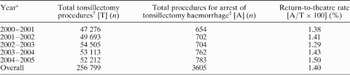
The five-year period studied (from April 2000 to March 2005) included 256 799 tonsillectomy procedures. During this period, there was a total of 3605 post-tonsillectomy bleeding episodes requiring a return to theatre for surgical arrest of haemorrhage. This gave an overall return-to-theatre rate of 1.40 per cent, with month-by-month rates varying from 0.80 to 2.30 per cent over the five-year period. The number of tonsillectomy procedures and return-to-theatre rates for each 12-month period are shown in Table I.
Tonsillectomy procedures and rates of return to theatre for arrest of haemorrhage, for each 12-month period studied

* April to March. †Office of Population Censuses and Surveys classification of surgical operations and procedures (fourth revision) (OPCS4), codes F34.1, F34.2, F34.3, F34.4, F34.8 and F34.9. ‡OPCS4 code F36.5.
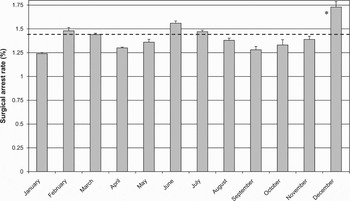
Summary rates were determined for each month of the year (by combining the data for each calendar month in the whole five-year period), and this is shown in Figure 1. There was a statistically significant relationship between calendar month and the proportion of patients returning to theatre for post-tonsillectomy haemorrhage (chi-square=26.739297 with 11 degrees of freedom; p=0.005). On comparing the monthly rates individually, there were significant differences between a number of the months; notably, the rate for December (1.73 per cent) was significantly higher (p=0.0309) than the mean monthly rate (1.44 per cent).
Summary rate of surgical arrest of post-tonsillectomy haemorrhage for each calendar month over the five-year study period. Chi-squared (two by 12) test: total chi-square=26.739297 (11 degrees of freedom); p=0.005. Dashed line represents mean monthly rate. Y-error bars indicate standard error. *=significantly different from mean (p=0.0309) (using un-coalesced data)

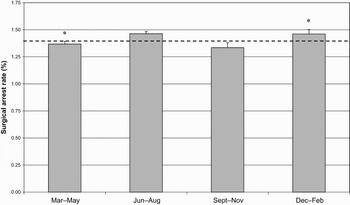
Seasonal summary rates were determined for each three-month period (by combining the data from the whole five-year period), and these are shown in Figure 2. There was a trend towards an association between the three-month seasonal period and the proportion of patients returning to theatre, but this was not statistically significant (chi-square=6.260849 with three degrees of freedom; p=0.0996). On comparing the seasonal rates individually, the summary rate for spring (March to May) was 1.37 per cent and that for winter (December to February) was 1.47 per cent, a statistically significant difference (p=0.0104).
Summary rate of surgical arrest of post-tonsillectomy haemorrhage for each three-month seasonal period over the five-year study period. Chi-squared (two by four) test: total chi-square=6.260849 (three degrees of freedom); p=0.0996. Dashed line represents mean three-monthly rate. Y-error bars indicate standard error. *=significantly different (p=0.0104)

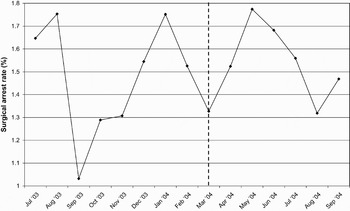
Figure 3 demonstrates the month-to-month variation in the return-to-theatre rate for arrest of haemorrhage during the national prospective tonsillectomy audit (from July 2003 to September 2004).5 The time-point at which the National Institute for Clinical Excellence/British Association of Otorhinolaryngologists – Head and Neck Surgeons distributed their interim guidance6 is indicated; this allows comparison of the return-to-theatre rates before and after this interim guidance was received.
Rate of surgical arrest of post-tonsillectomy haemorrhage for each month of the national prospective tonsillectomy audit.5 Dashed line represents publication of National Institute for Clinical Excellence / British Association of Otorhinolaryngologists – Head and Neck Surgeons interim guidance.6

Discussion
Key findings
This study forms the largest identified retrospective analysis of post-tonsillectomy haemorrhage in the published literature, including over 250 000 procedures over a five-year period. The use of non-identifiable patient data from the hospital episode statistics database makes very large, cross-sectional epidemiological studies like this possible. The overall return-to-theatre rate in the study period was 1.4 per cent. The return-to-theatre rates quoted elsewhere in the UK literature vary widely, ranging from 0.9 per cent (in the national prospective tonsillectomy audit)5 to 3 per cent,Reference Evans, Khan, Young and Adamson12 although a smaller retrospective study from Wales quoted a similar rate (1.5 per cent) to the present study.Reference Tomkinson, De Martin, Gilchrist and Temple13 The present study provides accurate guidance for patients regarding national overall return-to-theatre rates.
The first null hypotheses could be rejected, as there was a statistically significant association between the proportion of cases returning to theatre and the calendar month. The increased ‘return-to-theatre’ rate for December, when compared with the mean monthly rate, could be due to the greater prevalence of upper respiratory tract infections during this month (when colder weather occurs throughout the UK).
The second null hypothesis could not be rejected outright, as overall there was not a statistically significant association between ‘return-to-theatre’ rate and season, although there was a trend towards significance (p<0.1). However, the ‘return-to-theatre’ rate for the winter months was significantly higher than that for the spring months. Overall, there was a bimodal seasonal distribution, with increased rates in the summer and winter compared with the spring and autumn.
Comparison with other studies
Previous studies have not included adequate patient numbers to allow comparison on a month-by-month basis and have explored seasonal variation only. In a retrospective study of 3756 patients by Carmody et al.,Reference Carmody, Vamadevan and Cooper7 it was noted that the majority of secondary haemorrhages occurred in the winter months, although the power was insufficient for analysis of statistical significance. However, these authors noted that none of their patients had an obvious upper respiratory tract infection. In a prospective study by Roberts et al. Reference Roberts, Jayaramachandran and Raine9 of 1090 patients, more post-operative haemorrhages occurred in the summer months, although, again, the study size was very limited. A third publication exploring the issue of seasonal variation reported a small (430 patients) retrospective study by Collison and Mettler.Reference Collison and Mettler8 This demonstrated a very similar distribution of bleeding to the present study, with most haemorrhages occurring in the summer months (p<0.05) and winter months (non-significant), and the lowest rate in the autumn months. Unfortunately, this study was let down by the small numbers involved, with a total of only 14 patients requiring a return to theatre.
• It has been suggested in previous, small-scale studies that the time of year at which tonsillectomy is performed could influence the risk of post-tonsillectomy haemorrhage
• If a true seasonal variation exists, this could provide very useful information for clinicians and service commissioners
• This is the largest identified retrospective study of this nature in the published literature, including data from more than 250 000 tonsillectomy procedures
• Rates of severe post-tonsillectomy haemorrhage requiring a return to theatre showed a monthly variation and a bimodal seasonal variation
• Although statistically significant, the variations were fairly small and the reasons are likely to be multi-factorial
The most obvious explanation for the increased rate of severe haemorrhage in winter relates to the widely held view that post-tonsillectomy haemorrhage is associated with infection. There has been some evidence that spontaneous tonsillar haemorrhage is related to infection.Reference Griffies, Wotowic and Wildes14 However, it has been difficult to obtain robust evidence for an infective cause for post-tonsillectomy bleeding. In the present study, it is possible that the winter increase in severe bleeding episodes was related to the greater prevalence of upper respiratory tract infections and coryza in the winter. This explanation does not explain the trend towards a second peak in incidence during the summer months. An explanation suggested by a previous studyReference Collison and Mettler8 was that an early return to vigorous activity in the summer makes bleeding more likely, and these authors' suggested avoidance of strenuous activity for a fortnight post-operatively is probably prudent. In contrast, a study of the association between weather variables and post-tonsillectomy bleedingReference Lee, Montague and Hussain15 suggested that the likelihood of bleeding might be reduced by performing tonsillectomy in warmer weather when the water vapour pressure is higher.
I compared the return-to-theatre rates before and after publication of the interim guidance on ideal tonsillectomy technique issued from the National Prospective Tonsillectomy Audit.6 I found little evidence that this guidance led to a decrease in severe post-tonsillectomy haemorrhage rates. The period covered by the national prospective tonsillectomy audit demonstrated the fairly typical bimodal distribution, with higher rates of haemorrhage in the winter and summer. As the guidance was issued in March, it seems a reasonable alternative explanation that the seemingly technique-related decrease in post-tonsillectomy bleeding complications may have largely been due to the timing of the publication rather than its content.
Limitations and future work
The present study is subject to the disadvantage that accompanies observational retrospective studies. Namely, there are a multitude of factors which are likely to contribute to an individual requiring a return to theatre for post-tonsillectomy bleeding. Combining data for a very large number of patients across a long time period significantly reduces the influence of other factors and allows meaningful analysis. The present study identified an important and potentially reducible factor that may contribute to return-to-theatre risk. A future prospective, randomised, controlled study or cohort study would allow more precise identification of the influence of time of year on tonsillectomy return-to-theatre rates.
Conclusions
This study demonstrated that the incidence of severe post-tonsillectomy haemorrhage requiring a return to theatre was subject to a monthly variation and bimodal seasonal variation. The incidence was lower in the spring and autumn months and higher in the summer and winter months, particularly in December.
In real terms, the seasonal differences in rates seem small, and the reasons are likely to be multi-factorial. Most significant for future practice may be the increase in severe haemorrhage episodes seen in December. This increase could be due to the greater prevalence of upper respiratory tract infections during this month. Extrapolating the results of this study, if the next 1000 tonsillectomies scheduled for December were instead delayed until January, the number of severe haemorrhages requiring a return to theatre could be reduced from approximately 17 to 12, sparing five patients this life-threatening complication.
Clearly, data extrapolation of this sort may be subject to error in a multi-factorial problem such as post-operative bleeding. However, this study provides important new evidence for a potentially controllable risk factor. Therefore, variation through the calendar year in the risk of post-operative bleeding should be considered by surgeons and theatre list administrators when scheduling patients for tonsillectomy.
Acknowledgements
I would like to thank Paul Aylin and Marc Farr from the Dr Foster organisation for their kind assistance in providing the raw data analysed in this study. Thank you also to Sasha Karakusevic of Torbay Hospital for facilitating contact with the Dr Foster organisation.