Introduction
Chinese sturgeon (Acipenser sinensis) is a type of anadromous fish; adult fish live in the East China Sea and migrate into the upper stream of the Yangtze River to spawn (Yi et al., Reference Yi, Sun and Zhang2016a). The construction of the Gezhouba Dam has brought huge change to the spawning environment for Chinese sturgeon, especially for their spawning grounds, which have been reduced to 5 km long and to one spawning site (Wang et al., Reference Wang, Kynard, Wei, Du and Zhang2013; Shen et al., Reference Shen, Wang, Wang, Yu and Kong2018) from 600 km long and 16 spawning sites (Wei et al., Reference Wei, Ke, Zhang, Zhuang, Luo, Zhou and Yang1997). Due to overfishing, hydrologic regime changes and habitat loss, the numbers in the wild Chinese sturgeon population have dramatically declined from 1266 to 64 from years 1982 to 2014 (Wei et al., Reference Wei, Ke, Zhang, Zhuang, Luo, Zhou and Yang1997; Zhuang et al., Reference Zhuang, Zhao, Zhang, Chen, Liu, Zhang and Kynard2016). Furthermore, no reproduction activity has been observed during 2013 and 2014 (Yi et al., Reference Yi, Sun, Zhang and Yang2016b). In 2010, Chinese sturgeon were listed as critically endangered by the International Union for Conservation of Nature (IUCN) and listed in Appendix II by the Convention on International Trade in Endangered Species of Wild Fauna and Flora (CITES) in 1998 (Raymakers, Reference Raymakers2002). Therefore, there is an urgent need to protect this endangered species through effective ways such as artificial breeding and release into the Yangtze River to enhance the amount of its wild resources.
The artificial breeding efficiency of Chinese sturgeon is always restricted by the unsynchronized maturation of males and females. Mature ova remain in an arrested state at meiotic metaphase-II prior to fertilization or activation in water or other activating medium (Lubzens et al., Reference Lubzens, Young, Bobe and Cerda2010). After ovulation, ova ageing was considered as the most important factor affecting ovum quality of several fish species (Samarin et al., Reference Samarin, Zarski, Palinska-Zarska, Krejszeff, Blecha, Kucharczyk and Policar2017). The quality of ova is the capability to be fertilized, and then develop into normal embryos and hatch into viable larvae (Bobe, Reference Bobe2015; Linhart et al., Reference Linhart, Shelton, Tuckova, Rodina and Siddique2016). The toxicity of cryoprotectants and non-homogeneous freezing and thawing rates make it difficult to conserve ova through cryopreservation (Guan et al., Reference Guan, Rawson and Zhang2008; Tsai and Lin, Reference Tsai and Lin2009). Furthermore, there is an inability of oocytes to withstand cryopreservation (Robles et al. Reference Robles, Cabrita and Herraez2009), a feature specific to fish because of the difficulty of protecting the yolk compartment (Hagedorn et al. Reference Hagedorn, Kleinhans, Artemov and Pilatus1998). The above two reasons hinder the cryopreservation of ova. Delayed egg collection and delayed spawning can lead to oocyte ageing and over-ripening, therefore affecting egg quality (Samarin et al., Reference Samarin, Policar and Lahnsteiner2015), which makes it hard to store ova in vivo. Storage of stripped ova in vitro seems to be a viable approach. Numerous factors, such as temperature, illumination, oxygen, storage medium and pH, may affect the quality of oocytes during the storage period (Billard et al., Reference Billard, Cosson, Noveiri and Pourkazemi2004). To date, much research has focused on ova preservation and performed in Caspian brown trout (Salmo trutta caspius; Niksirat et al., Reference Niksirat, Sarvi, Amiri, Karami and Hatef2007), Scaly carp (Cyprinus carpio; Bozkurt and Yavas, Reference Bozkurt and Yavas2012) and Sterlet (Acipenser ruthenus; Linhart et al., Reference Linhart, Shelton, Tuckova, Rodina and Siddique2016), African catfish (Heterobranchus longifilis; Nguenga et al., Reference Nguenga, Teugels, Legendre and Ollevier2004), rainbow trout (Oncorhynchus mykiss; Richardson et al., Reference Richardson, Gardiner and McNiven2002), and so on.
In this study, the ovulated ova of Chinese sturgeon were stored in different incubation media and temperature regimes to determine the suitable stored environment. Effective short-term storage for Chinese sturgeon ova would be helpful to improve the efficiency of the artificial reproduction and therefore restore the population resource of Chinese sturgeon in the Yangtze River.
Materials and Methods
Experimental animals
Experiments were carried out during the spawning season at the Chinese Sturgeon Research Institute, China Three Gorges Corporation, Yichang, China. One mature female (total length: 254 cm; body weight: 98 kg) and one mature male (total length: 187 cm; body weight: 69 kg) were selected as parental fish for the experiment.
Gametes and coelomic fluid (CF) collection
After measuring the total length and body weight, the two parental fish were transferred into two separate tanks with running water and in which the temperature was 18–19°C throughout the artificial breeding process. Luteinizing hormone releasing hormone analogue 2 (LHRH-A2, P-Glu–His–Trp–Ser–Tyr–d-Ala–Leu–Arg–Pro–ethylamine), purchased from Sansheng Biological Technology Co., Ltd, Ningbo, China, was used to induce spawning. Spermiation was induced by one injection of 1 μg/kg body weight LHRH-A2, whilst ovulation was performed by two injections of LHRH-A2 with a priming dosage of 1 μg/kg body weight and a resolving dosage of 4.5 μg/kg body weight, 12 h later (Nazari et al., Reference Nazari, Modanloo, Ghomi and Ovissipor2010). The milt was collected at 5 h after hormone injection, and sperm quality was then assessed using the Tsinghua Tongfang sperm analysis system MX 7.5. Finally, the qualified seminal fluid was stored at 4°C for further use. Eggs and CF were collected by abdominal massage at 22 h after the priming dosage.
Preparation of artificial medium (AM)
The AM was based on previous studies (KAGAWA et al., Reference Kagawa, Young and Nagahama1984; Sohrabnezhad et al., Reference Sohrabnezhad, Kalbassi, Nazari and Bahmani2006): 1.0 g/l glucose, 0.95 g/l HEPES, 0.41 g/l NaH2PO4, 0.38 g/l KCl, 0.23 g/l MgSO4, 7.25 g/l NaCl, 0.147 g/l CaCl2, 1.0 g/l bovine serum albumin (BSA), 0.2 g/l streptomycin sulfate, and 2 × 10⁵ IU/l penicillin; pH was adjusted to the same as the CF.
Storage of ovulated ova
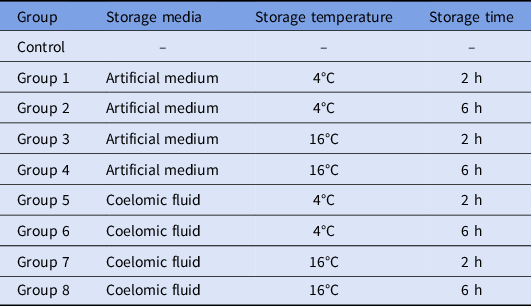
Batches of 5 ml ova (about 100 eggs) were placed into 24 Erlenmeyer flasks, with a volume of 250 ml, under dark conditions. Twelve flasks of ova were immersed in CF and the remaining flasks of ova were placed in AM. Ova in AM were washed with medium two or three times before storage. Six flasks of each medium were placed in a refrigerator (4°C) or a water bath (16°C), respectively. At 2 and 6 h after storage, three replicates from both temperatures were removed and used fertilization immediately after removal. A batch of about 300 ova (100 × 3 replicates) was considered as the control group and were fertilized immediately after gamete collection (Table 1).
Treatment regime for each group

Artificial fertilization and incubation
Eight groups of treated eggs were transferred to plastic bowls and the redundant CF and AM were discarded before insemination; 300 μl milt (with a ratio of sperm to egg of about 105:1) and adequate water were then added to the bowls for further fertilization. Adhesiveness of the egg membranes was eliminated by applying talc powder for 70 min (Guo et al., Reference Guo, Chang, Xiao, Zhu, Wan, Tian and Shu2011). Each group of fertilized and non-sticky eggs was placed into a sifter in an incubator with running freshwater at a temperature of 16–17°C separately. Fertilized eggs were counted at the gastrula stage and the fertilization rate was calculated as the number of fertilized eggs divided by the total number of eggs. Larvae were counted 4–6 days after fertilization and the hatching rate was calculated as the number of larvae divided by the number of fertilized eggs.
Statistical analysis
The parameters in this study were analyzed using Statistical Package for the Social Sciences (SPSS) software. Data are shown as mean ± SD (standard deviation). The significant differences among each group was checked by t-test, with a significant value of P < 0.05.
Results
Effect of storage on fertilization rate
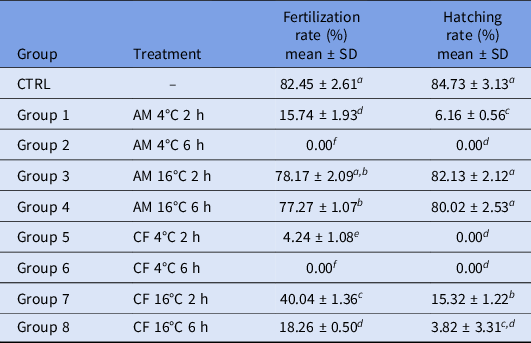
All the groups at 4°C (Groups 1, 2, 5 and 6) or in CF (Groups 5, 6, 7 and 8) showed a significant (P < 0.05) reduction on their fertility. At 16°C, ova can be stored in AM for at least 2 h (Group 3, P > 0.05), but not for 6 h (Group 4, P < 0.05). The results indicated that AM was more suitable to store the Chinese sturgeon ova than CF. Furthermore, stored temperature was more crucial for ova quality than storage time (Table 2).
Fertilization rate and hatching rate in different groups of Chinese Sturgeon ova in vitro

AM, artificial medium; CF, coelomic fluid; CTRL, control. Superscript values a-f means significance difference between each other.
Effect of storage on hatching rate
The rate of hatching showed a distinct (P < 0.05) reduction in all the groups at 4°C (Groups 1, 2, 5 and 6) or in CF (Groups 5, 6, 7 and 8). In contrast, both the ova stored in AM at 16°C for 2 h (Group 3) and for 6 h (Group 4) showed little (P > 0.05) reduction in hatching rate. These results demonstrated that the Chinese sturgeon ova can be stored in AM at 16°C for at least 6 h without a negative effect on hatching rate (Table 2).
Discussion
In this study, the ovulated ova of Chinese sturgeon were stored in different incubation media and temperature regimes to determine the suitable stored environment. The results demonstrated that stripped Chinese sturgeon ova could be stored in AM at 16°C for at least 2 h and 6 h without a significant reduction in fertility and hatching ability, respectively (Table 2); this provided an opportunity to store the ova of Chinese sturgeon for a short time before artificial insemination.
In our research, Chinese sturgeon ova stored in CF showed a dramatic decline in egg ability. Similar results were found in previous studies, for example ovulated eggs of sterlet (Acipenser ruthenus) and Siberian sturgeon (Acipenser baerii) stored in CF at 15°C became over-ripe and lost their fertilization ability and viability between 2 and 6 h after ovulation (Gisbert and Williot, Reference Gisbert and Williot2002). Studies have shown that AM seemed to be more suitable for ova storage than CF, the stable pH of AM was considered to be the reason (Sohrabnezhad et al., Reference Sohrabnezhad, Kalbassi, Nazari and Bahmani2006; Goetz and Coffman, Reference Goetz and Coffman2000). Goldfish Ringers was used to induce follicle maturation of goldfish (Kagawa et al., Reference Kagawa, Young and Nagahama1984). Persian sturgeon (Acipenser persicus) ova could be stored in a specific Persian sturgeon artificial CF (PSACF) for 3 h at 18°C (Sohrabnezhad et al., Reference Sohrabnezhad, Kalbassi, Nazari and Bahmani2006). After analyzing and comparing the above two media, a new AM was designed and used successfully in this study to store Chinese sturgeon ova. As AM was not designed based on a specific species, we intend in the future to verify whether it would be applicable to other fish species.
As well as incubation medium, temperature is another parameter that plays a key role in the short-term storage of ova. Due to biochemical and morphological changes, ova will become over-ripe gradually as they are ovulated, and this will have a negative effect on vitality, as low temperature could retard metabolic development and affect the quality of ova (Formacion et al., Reference Formacion, Venkatesh, Tan and Lam1995). In other studies, storage of lamprey (Lampetra japonicum) ova at 0ºC in vitro caused a drastic reduction in fertilization rate compared with storage at 15ºC (Ciereszko et al., Reference Ciereszko, Glogowski and Dabrowski2000), the quality of Prochilodus marggravii ova at 26ºC was much superior to ova at 18ºC (Rizzo et al., Reference Rizzo, Godinho and Sato2003). In our study, Chinese sturgeon ova were very sensitive to temperature and vitality was reduced comparatively more at 4ºC than at 16ºC, which was consistent with the previous findings.
In summary, we found that Chinese sturgeon ova could be stored for several hours before fertilization. Based on our experimental results, storage medium and temperature were key factors that affected ova quality; ova could be stored in AM at 16°C for at least 6 h without loss of vitality. This success in short-term storage of Chinese sturgeon ova in vitro could contribute to the efficiency of artificial reproduction, and therefore restore the population resource of endangered Chinese sturgeon in the Yangtze River.
Acknowledgements
We are deeply grateful to Dezhi Zhang and his team for help with fish spawning, and to Yacheng Hu, Qingkai Zeng, Kan Xiao for counting fertilized eggs and hatched larvae.
Financial support
Our research was supported by the Three Gorges Environmental Funds of China Three Gorges Corporation (grant number XN270).
Conflicts of interest
None.
Ethical standards
The authors assert that all procedures contributing to this work complied with the ethical standards of the relevant national and institutional guides on the care and use of laboratory animals.