INTRODUCTION
The sequestration of atmospheric carbon in agricultural soils plays an important role in mitigating greenhouse gases especially carbon dioxide. This necessitates the identification of climate-friendly best management practices that enhance soil organic carbon (SOC) sequestration in any cropping sequence. Intensive agriculture with improved nutrient and water management results in enhanced C sequestration due to higher crop productivity and greater return of crop residues, root biomass and root exudates to soil. Results of a 25-year study from the north Indian state of Punjab showed that intensive agriculture resulted in improved SOC status by 38% (Benbi and Brar, Reference Benbi and Brar2009). Recent studies on long-term fertilizer experiments in India indicated that integrated use of farmyard manure (FYM) with chemical fertilizers (100% NPK+FYM) resulted in significant increase in SOC content than 100% NPK in the rice–jute–rice cropping system in humid tropical climate (Manna et al., Reference Manna, Swarup, Wanjaria, Ravankar, Mishra, Saha, Singh, Sahid and Sarap2005), soybean–wheat (Manna et al., Reference Manna, Swarup, Wanjaria, Ravankar, Mishra, Saha, Singh, Sahid and Sarap2005), maize–wheat–cowpea (Purakayastha et al., Reference Purakayastha, Rudrappa, Singh, Swarup and Bhadraray2008), rice–wheat and maize–wheat (Kukal et al., Reference Kukal, Rehana-Rasool and Benbi2009) cropping systems. The use of organic manure and compost enhances the SOC pool more than application of the same amount of nutrients as inorganic fertilizers (Gregorich et al., Reference Gregorich, Drury and Baldock2001). Long-term manure application increases the SOC pool (Gilley and Risse, Reference Gilley and Risse2000), which not only sequesters CO2 but also enhances the productivity of soil (Manna et al., Reference Manna, Swarup, Wanjaria, Ravankar, Mishra, Saha, Singh, Sahid and Sarap2005; Swarup et al., Reference Swarup, Manna, Singh, Lal, Kimble and Stewart2000). There is a paucity of information available on data pertaining to irrigation and inorganic vis-a-vis organic nitrogen applications on C sequestration in the semi-arid tropics of India. Thus, it becomes imperative to study how management practices such as irrigation and manure N could affect SOC, particularly in the semi-arid tropics of India, where decomposition of organic C is fast.
SOC build-up also improves soil's physical properties especially soil aggregation. The application of mineral fertilizers promotes macro-aggregation and enhanced soil organic C concentration (Lugato et al., Reference Lugato, Simonetti, Morari, Nardi, Berti and Giardini2010; Rasool et al., Reference Rasool, Kukal and Hira2008), mainly through the increment of organic C in micro-aggregates (Lugato et al., Reference Lugato, Simonetti, Morari, Nardi, Berti and Giardini2010). In contrast, Sarkar et al. (Reference Sarkar, Singh and Singh2003) and Fonte et al. (Reference Fonte, Yeboah, Ofori, Quansah, Vanlauwe and Six2009) reported that the addition of mineral fertilizers reduced aggregation. Manuring and application of biosolids, as crop residue or compost, also enhances soil aggregation (Benbi et al., Reference Benbi, Biswas, Bawa and Kumar1998). Several studies reveal a strong interaction between SOC and aggregation (Chao-fu et al., Reference Chao-fu, Jing-an, Jiu-pai, Ming, De-ti, Gen-xing and Hasegawa2008; Chevallier et al. Reference Chevallier, Blanchart and Feller2004; Jastrow Reference Jastrow1996; Tisdall and Oades Reference Tisdall and Oades1982). Hudson et al. (Reference Hudson1994) reported organic matter to enhance aggregation and plant available water capacity in most agricultural soils. In an experiment on the long-term application of organic manure and mineral fertilizers, Yu et al. (Reference Yu, Ding, Luo, Geng and Zucong2012) reported proportion of macro-aggregates to be significantly related to organic carbon (OC) concentration in micro-aggregate and free silt + clay fractions. The mass ratio of macro-aggregates plus micro-aggregates to the free silt + clay fraction and macro-aggregates to micro-aggregates was significantly correlated with OC concentration in the free silt + clay fraction. Previous studies have shown that the application of organic manure or compost could improve soil aggregation and aggregate associated organic C (Rasool et al., Reference Rasool, Kukal and Hira2008; Six et al., Reference Six, Elliott and Paustian1999). However, Perfect and Kay (Reference Perfect and Kay1990) reported that increases in wet-aggregate stability did not correlate with increases in total organic carbon content, suggesting that some components of the organic carbon pool are more actively involved in stabilizing aggregates than others.
However, there has been very little research on the relative effectiveness and quantification of nutrient and water management on SOC and aggregation in the maize–wheat system. The objective of this study was to quantify and evaluate the effects of different nitrogen and water regimes on SOC and soil structural stability. The information will be useful to supply groundwork and knowledge for establishing appropriate and sustainable soil management in the maize–wheat cropping system. The relationship between SOC and soil aggregation was also examined.
MATERIAL AND METHODS
For the present study, a field experiment was carried out on a clay loam soil (Typic Haplustept) in the research farm of the Indian Agricultural Research Institute, New Delhi, for four consecutive cropping seasons (kharif and rabi seasons of 2002 and 2003–04). Maize was grown in kharif (July to October) and wheat was taken in rabi (November to April) in both the years. For other experimental details and initial soil properties of the site, reference is made to Lenka et al. (Reference Lenka, Singh and Lenka2009). The texture of the soil varied from loam to clay loam through the soil profile at all depths. Soil was near neutral with pH varying from 7.23 in the 90–120-cm layer to 7.56 in the 0–15-cm layer. Soil was low in organic carbon and available nitrogen (101.2 mg kg−1) and medium in available P (9.9 mg kg−1) and K (99.7 mg kg−1) status. The experimental layout was split plot with irrigation levels as the main plot and nitrogen (N) levels as subplot, replicated three times. The details of water management treatments are W3 (maximum number of recommended irrigation), W2 (medium number of recommended irrigation) and W1 (limited number of recommended irrigation). Irrigation was applied by a flexible hose and was measured by a water meter. Depth of irrigation water applied each time was 60 ± 2.0 mm. In the water treatments maximum, medium and minimum irrigation refer to no water shortage, medium water shortage and low water availability, respectively, for both the crops. The maximum, medium or limited irrigations were defined as per the critical stage approach of the two crops and as per the rainfall received during the crop growth stage.
The details of nitrogen management treatments are T1 (0% N), T2 (75% N), T3 (100% N), T4 (150% N) and T5 (100% organic source; 50% FYM + 25% biofertilizer + 25% crop residue/green manure). Here, 100% nitrogen refers to the recommended dose of 120 kg N ha−1 for both the crops. The recommended dose of P and K, i.e., 75 kg P2O5 and 45 kg K2O ha−1, for maize and wheat respectively was applied to all the treatments (including control) except the organic treatment (T5). Nitrogen was applied as urea in split, 50% at sowing, 25% at knee-height stage (maize) and maximum tillering (wheat) and the rest 25% at tasseling (maize) and panicle emergence (wheat), P and K was applied 100% basal as single superphosphate and muriate of potash, respectively. For the organic treatment (T5), Azotobacter sp. W5 strain was applied on the seeds at the time of sowing as 49.42 mg peat charcoal (dry) carrier based culture per m2 containing 109 cells g−1. The microbial culture was prepared in the Division of Microbiology, Indian Agricultural Research Institute, Pusa, New Delhi. FYM was analysed to have N content of 0.52% by Kjeldhal's method (Page Reference Page1991) with a C:N ratio of 32:1. FYM applied per plot (9×5.25 m2) was 54.78 kg to meet the treatment (T5) requirement of 50% N from FYM. Similarly, the crop residue was incorporated by analysing the N content of previous crop (maize/wheat) residue. The N content of maize and wheat crop residue was found to be 0.75 and 0.58%, respectively.
For the present study, soil samples were collected from five different depths, viz. 0–15, 15–30, 30–60, 60–90 and 90–120 cm from each replication. Moist soil samples were gently broken apart along natural break points and passed through an 8-mm sieve. Plant and organic debris in the sieved soil were carefully identified (by eye) and removed with forceps. After mixing thoroughly, a subsample of the sieved soil was used for soil fractionation analyses. Another subsample was air dried and used to determine soil organic C concentration. Standard procedures were followed for estimation of organic carbon (Walkley and Black, Reference Walkley and Black1934) and soil aggregate analysis using Yoder's apparatus (Yoder, Reference Yoder1936). An analysis of variance (ANOVA) of the collected data was carried out as applicable for a split-plot design followed by the Duncan Multiple-Range Test to compare the treatment means (Gomez and Gomez, Reference Gomez and Gomez1984). The quantification of water and N interaction on SOC was done for the 0–15-cm soil by developing a multiple regression equation using the SAS 9.3 statistical programme (SAS, 2011).
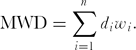
Mean weight diameter (MWD) was calculated according to the procedure developed by Kemper and Rosenau (Reference Kemper, Rosenau and Klute1986). The entire soil sample is passed through an 8-mm sieve prior to analysis. The parameter which Van Bavel (Reference Van Bavel1949) called the MWD is equal to the sum of the products of (a) the mean diameter (di) of each size fraction and (b) the proportion of the total sample weight (wi) occurring in the corresponding size fraction, where the summation is carried out over all ‘n’ size fraction, including the one that passes through the finest sieve, is given in equation (1):
 \begin{equation}
{\rm MWD} = \sum\limits_{i = 1}^n {d_i } w_i .\end{equation}
RESULTS
Aggregate size distribution
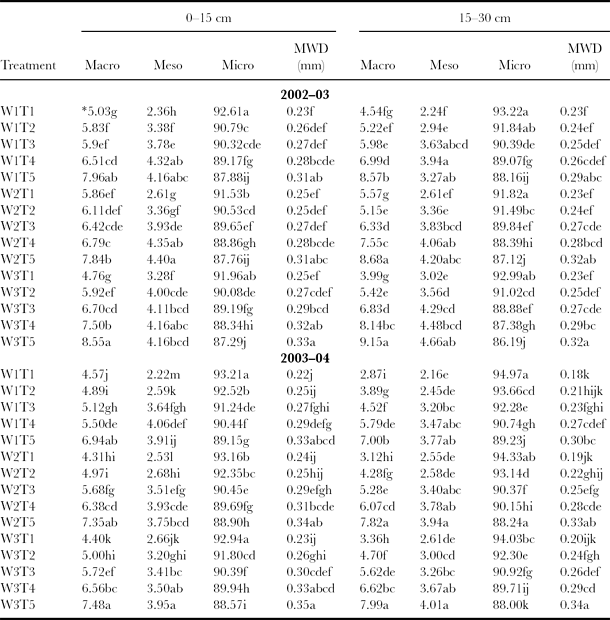
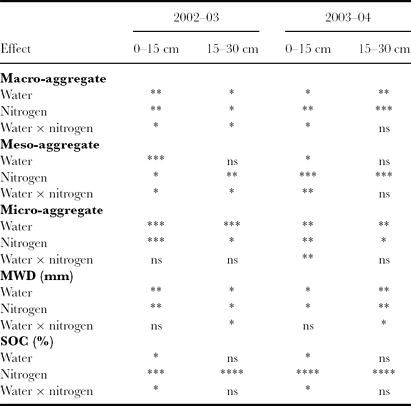
Different sized aggregates under various water and N treatments for wheat 2002–03 and wheat 2003–04 for two soil depths (0–15 and 15–30 cm) are presented in Table 1. The aggregates were classified into three categories, viz. macro-aggregates (>1000 μm diameter), meso-aggregates (1000–250 μm) and micro-aggregates (<250 μm). For both the years, there was a significant difference (p < 0.05) among different water and N treatments in respect of macro- and meso-aggregates. However, the interaction effect of water and N were non-significant (Table 2). Among the water treatments, the effect of W3 was most positive (significant) on macro- and meso-aggregate followed by W2 and W1 in both depths. While the reverse trend of the water regime was observed on the micro-aggregate distribution. Among N treatments, T5 (organic fertilizer) showed the maximum favourable effect with respect to macro- and meso-aggregates. Compared with T1, there was an increase of macro-aggregates by 27, 21, 14 and 6% in T5, T4, T3 and T2, respectively, in wheat 2003–04. The corresponding increases in meso-aggregates for the same crop and treatments were 19, 21, 18 and 11%. Similar differences were observed among different water and N treatments for the 15–30-cm depth also.
Per cent aggregate size distribution and mean weight diameter (MWD) for 0–15- and 15–30-cm soil depths under various water and nitrogen treatments at the end of each maize–wheat cropping system.

*Means in a column followed by common letters are not significantly different at p = 0.05. Macro-aggregate (>1000-μm diameter) meso-aggregate (1000–250-μm diameter) and micro-aggregate (<250-μm diameter).
ANOVA table showing the interaction effect of water and nitrogen on per cent aggregate size distribution, mean weight diameter (MWD) and SOC at 0–15- and 15–30-cm soil depth after the first year (2002–03) and the second year (2003–04) of the cropping system.
*p < 0.05; **p < 0.01; ***p < 0.001.
Mean weight diameter
MWD (in mm) in two different soil depths, viz. 0–15 cm and 15–30 cm, was determined at the end of the first- and second-year cropping systems, i.e. after the harvest of wheat 2002–03 and wheat 2003–04, to study the impact of different water and N treatments. Significant effect of different water and N treatments was found in both depths (Tables 1 and 2). In both the years, the interaction effect was significant for the 15–30-cm depth only. A decreasing trend in MWD was observed for T1 (control) and T2 treatments with increase in cropping years. However in T3, T4 and T5 (organic), MWD increased with cropping year by 3.6, 6.8 and 7.4% than the previous year and there was a decline of 5.4 and 3.9% in T1 and T2 in the surface (0–15 cm) soil. With continuous cropping, the MWD increased by 1.78% (T4) and 4.6% (T5) and decreased by 16.1 (T1), 7.4 (T2) and 8% (T3) in the 15–30-cm soil depth. Among the water treatments, the W1 water regime did not show any change with increase in cropping year, whereas W2 and W3 registered an increase of 5.3% and 1.7%, respectively, in MWD in the surface (0–15 cm) soil. However, at subsurface (15–30 cm) soil, MWD decreased with increase in cropping year. The MWD ranged from 0.21 to 0.35 and 0.18 to 0.34 mm at surface (0–15 cm) and subsurface (15–30 cm) layers, respectively.
Soil organic carbon
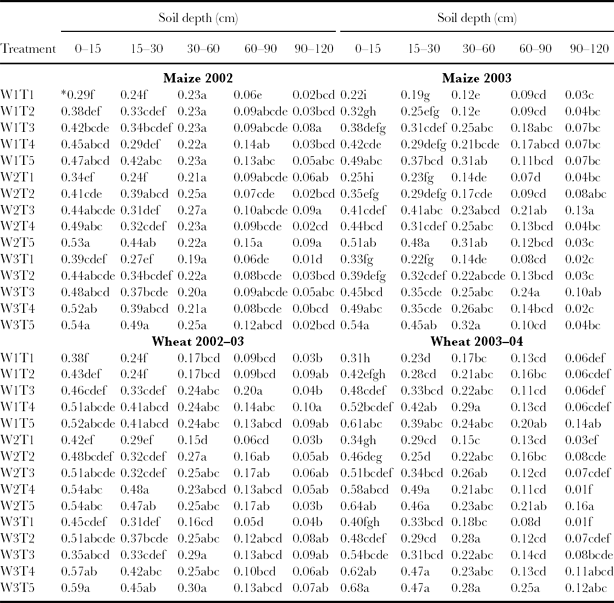
The data on SOC content estimated under different management practices after the harvest of maize and wheat crop up to a depth of 120 cm for both the seasons are presented in Table 3. The ANOVA table showing the main effect of water, nitrogen and their interaction on SOC at 0–15 and 15–30-cm soil depth after the first and second years of the cropping system is given in Table 2. In general, the depth distribution of SOC reflected a decreasing trend, the SOC being maximum in the surface (0–15 cm) soil and minimum at deeper layer (90–120 cm). After the harvest of maize 2002, there was a significant variation in SOC content among different treatments, which was visible only up to 30-cm depth, beyond that the treatment differences gradually disappeared. In the maize 2003 season, similar trends were also observed, where a significant effect of N treatments was up to 60–90-cm depth. The W3 water regime registered significantly higher SOC of 33.7 and 47.9% in maize 2002 and maize 2003 at 0–15 cm, respectively. A decreasing trend of SOC was observed in T1 (control), whereas an increasing trend was observed in T4 and T5 treatments. After the harvest of wheat crop (Table 3), there was no significant effect of the water regime beyond the surface (0–15 cm) layer. However, N treatment had a significant effect even up to a 120-cm soil depth. In wheat 2003–04, the W3 water regime recorded a 13.78% increase in the SOC over W1 in the 0–15-cm soil. Amongst the treatments, W3T5 contained the highest SOC of 0.68% in the 0–15-cm soil.
Soil organic carbon (%) profile under various water and nitrogen treatments after the harvest of maize and wheat crops.
*Means in a column followed by common letters are not significantly different at p = 0.05.
The quantification of water and N interaction on SOC was done for the 0–15-cm soil by developing a multiple regression equation as follows:
 \begin{eqnarray}
{\rm SOC}\,(\% ) = 0.235 + 0.014\,{\rm W}\,({\rm cm}) + 0.00069\,{\rm N}\,({\rm kg}\;{\rm ha}^{{\rm - 1}} )\, - 4.1 \times 10^{ - 6} \,{\rm WN} \nonumber\\
%% \end{equation*}
%% \begin{equation}
- 0.00022\,{\rm W}^2 - 4.01 \times 10^{ - 7} \,{\rm N}^2 ,\quad\quad\quad\quad\quad\quad\quad\quad\quad\quad\quad\quad
\end{eqnarray}
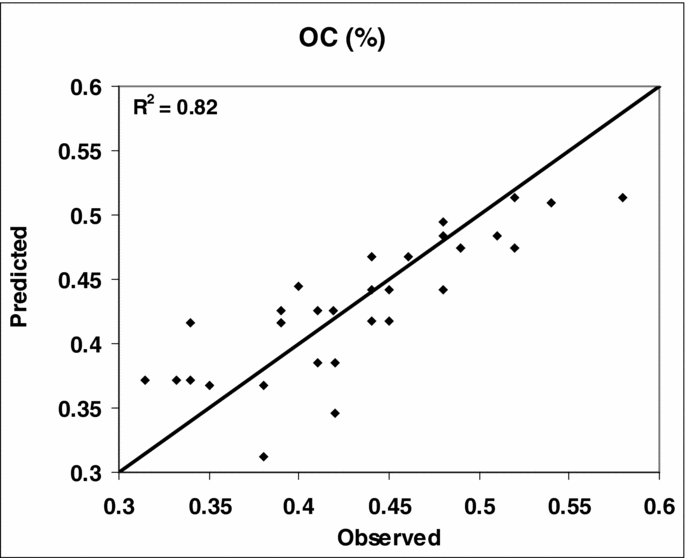
The above equation when validated with SOC of subsequent years has resulted in a significant R2 value of 0.82, as shown in Figure 1.
Predicted and observed SOC by using equation (2) for quantifying the effect of irrigation and nitrogen.
Relationship between soil aggregation and SOC
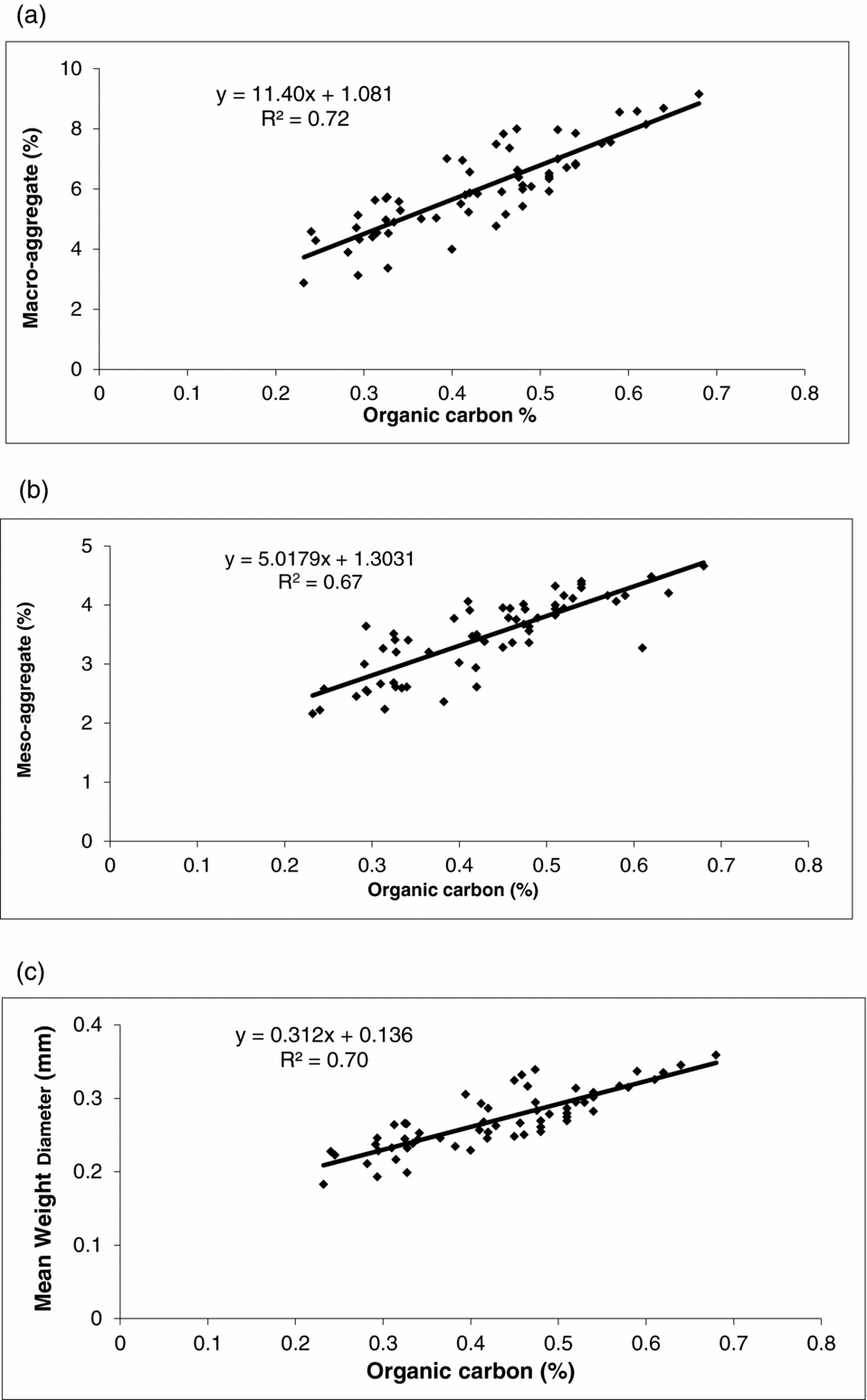
MWD values correlated positively with SOC (Figure 2). The percentage of aggregates (macro-aggregate and micro-aggregate) also correlated positively with SOC (Figure 2). The correlation coefficient was found to vary from 0.67 to 0.72 between SOC and MWD and percentage of aggregates (macro-aggregate and micro-aggregate).
Relationship between soil organic carbon and (a) macro-aggregate (%), (b) meso-aggregate (%) and (c) mean weight diameter.
DISCUSSION
Aggregate size distribution and MWD
A reduction in macro- and meso-aggregates under the W1 (less irrigation) regime may be due to poor crop growth and thus lower root biomass and SOC, which has been reported to have positive correlation with aggregation (Lado et al., Reference Lado, Paz and Ben-Hur2004; Perteck and Kay, Reference Perfect and Kay1990). However, the macro- and meso-aggregates were lower in the case of the 15–30-cm depth than for the 0–15-cm soil layer. With cropping, the absolute values of macro- as well as meso-aggregates reduced for both the soil layers. Increase in the relative proportion of macro-aggregates and reduction in the percentage of micro-aggregates with higher N and FYM application may be due to conversion of some of the micropores to macropores as a result of the cementing action of the organic acid and polysaccharides formed during the decomposition of organic residues by higher microbial activity encouraged by the addition of FYM and production of greater below-ground biomass after the cultivation of maize and wheat (Mishra and Sharma, Reference Mishra and Sharma1997). Reduction in the dispersion of soil due to the addition of organic manures might be another plausible explanation for these results. A favourable effect of higher N dose in increasing the proportion of macro-aggregates and decreasing that of micro-aggregates has been reported by Kesavan et al. (Reference Kesavan, Sharma, Khadikar and Verma1995). The effect of organic manures in increasing macro-aggregate percentage has been reported by Ray and Gupta (Reference Ray and Gupta2001). The increase in water stability of aggregates due to addition of FYM has been reported by Kurual and Tripathi (Reference Kurual and Tripathi1990) and Benbi et al. (Reference Benbi, Biswas, Bawa and Kumar1998). Increase in MWD with increased N application and addition of FYM is due to higher percentage of macro-aggregates. A similar increase in MWD by the addition of N and FYM was observed by Rasool et al. (Reference Rasool, Kukal and Hira2008) and Lugato et al. (Reference Lugato, Simonetti, Morari, Nardi, Berti and Giardini2010).
SOC
The interaction effect of water and N was significant on SOC in maize and otherwise in wheat. As expected, there was a decrease in SOC concentration with soil depth (Kumar et al., Reference Kumar, Sharma and Sharma2002; Liu et al., Reference Liu, Han, Song, Herbert and Xing2003). The SOC after the harvest of wheat was found to be more than after maize, which may be due to the fact that the root derived C from wheat was higher in amount and more easily degradable. Mahmood et al. (Reference Mahmood, Azam, Hussain and Malik1997) also reported higher aerobically mineralizable carbon and specific respiratory activity during the active growth period of wheat than that of maize. A significant effect of N rates on SOC even at a depth of 120 cm was probably due to the contribution of roots and root exudates to SOC (Jenkinson, Reference Jenkinson1984). Among the N treatments, T5 (100% N from organic source) was the best performing. This emphasizes the importance of organic manures in SOC build-up, improving the nutrient status of the soil, enhancing activities of beneficial rhizospheric bacteria (Patil et al., Reference Patil, Pisal and Desale1992) and maintaining soil health (Selvam and Christopher, Reference Selvam and Christopher1998). The effect of T4 on SOC was found to be at par with T5. Inorganic N fertilizer may increase SOC in two ways, namely, directly by immobilization of fertilizer N and indirectly by increasing inputs of organic N in the form of crop residues (roots, root exudates and stubbles; Jenkinson, Reference Jenkinson1984). Increasing fertilization rates also increases the soil microbial biomass (Liang and Mackenzie, Reference Liang and Mackenzie1992). The multiple regression equation (2) developed to quantify the interactive effect of irrigation and N application on SOC shows satisfactory results when validated against the observed SOC of the second year.
Relationship between soil aggregation and SOC
The positive correlation between soil aggregation and SOC indicates the importance of SOC in improving the soil structure and MWD. The results of the present work are in conformity with those reported by Spaccini et al. (Reference Spaccini, Mbagwu, Igwe, Conte and Piccolo2004). They reported that MWD had a positive correlation with total organic carbon (TOC) in an inceptisol (540 g kg−1 of clay) and in an ultisol (740 g kg−1 of clay). Martins et al. (Reference Martins, Cora, Jorge and Marcelo2009) also found a significant and positive correlation between MWD and TOC. However, the percentage of aggregates <0.25 mm correlated negatively with TOC. Similarly, under a long-term no-till system, Lenka and Lal (Reference Lenka and Lal2013) reported the macro-aggregate C and occluded C to be positively correlated with SOC.
CONCLUSION
From the results of the study, it could be observed that water and nitrogen treatments have significant effects on aggregate distribution, MWD and SOC properties particularly in the surface soils, though their interaction effect was variable. The effect of 150% N from inorganic sources had a significantly higher effect on aggregate properties and SOC, than 100% N rates, though the highest effect was observed under 100% N application from organic sources. The study indicates a positive effect of the application of 150% N on soil properties under intensive maize–wheat cropping systems of northern India, when supplemented with maximum water availability corresponding to the recommended number of irrigations for maize and wheat crops.