



1 Introduction
1.1 Background
Let
 $H<G$
be Lie groups and
 $\Gamma $
be a lattice of G. Consider the quotient space
 $X=G/\Gamma $
, then the group multiplication induces a left group action of H on X. If X is non-compact, in many cases, it is particularly important to understand whether or not an H-orbit intersects a given compact subset of X. For example, let
 $H=\{u_t:t\in \mathbb {R}\}$
be a one-parameter unipotent subgroup of G. In their fundamental work [Reference Dani and Margulis8], Dani and Margulis proved that given any
 $x\in X$
, there exists a compact set
 $C\subset X$
depending on x such that
 $\{t\in \mathbb {R}:u_t x \in C\}$
is unbounded. In particular, if this unipotent subgroup satisfies a certain algebraic condition, then this compact set C can be chosen uniformly for all
 $x\in X$
. This result was crucially used in Ratner’s proof of uniform distribution of trajectories of unipotent subgroups on homogeneous spaces [Reference Ratner26]. However, let G be an algebraic group defined over
 $\mathbb {Q}$
and
 $\Gamma $
be an arithmetic subgroup of G. Let
 $H=T$
be a maximal
 $\mathbb {R}$
-split torus of G and
 $X=G/\Gamma $
. Tomanov and Weiss [Reference Tomanov and Weiss34] proved that there exists a fixed compact set C of X intersecting every T-orbit. This result enables them to classify all T-closed orbits on X. Motivated by these results, in this article, we study the following non-divergence property of group action on homogeneous spaces.
Definition 1.1. The action of H on X is said to be uniformly non-divergent if there exists a compact subset
 $C\subset X$
such that for every
 $x\in X$
,
 $H x\cap C\neq \emptyset $
.
Remark 1.2. It is clear that the action of H on X is not uniformly non-divergent if and only if there exists a sequence
 $\{x_n\}_{n\in \mathbb {N}}\subset X$
such that
 $Hx_n$
eventually leaves every compact subset of X.
Now, we take X to be a homogeneous space of the form
 $G/\Gamma $
, where G is the connected component of the real points of a connected semisimple algebraic group
 $\boldsymbol {G}$
defined over
 $\mathbb {Q}$
and
 $\Gamma $
is an arithmetic lattice in G. Moreover, we take H to be a closed subgroup of G. The question that we wish to answer is the following.
Question 1.3. When is the action of H on X uniformly non-divergent?
Note that this property only depends on the G-conjugacy class of H. There are several different approaches toward this question depending on the group H.
-
(1) When H is generated by unipotent flows, one may make use of the polynomial nature of H-orbits. See [Reference Dani and Margulis8].
-
(2) When H is a finitely generated Zariski dense subgroup of a semisimple subgroup without compact factors, one can study the random walk generated by a set of generators of this subgroup. See [Reference Benoist and Quint3, Reference Eskin and Margulis12].
-
(3) When H is the real points of an
 $\mathbb {R}$
-diagonalizable algebraic torus, one of the most successful approaches relies on some tools from algebraic topology initiated by McMullen [Reference McMullen22], and refined by Solan and Tamam [Reference Solan28, Reference Solan and Tamam29] (cf. [Reference Levin, Shapira and Weiss20, Reference Shapira and Weiss27] for similar ideas). See [Reference Tomanov31, Reference Tomanov and Weiss34, Reference Weiss36, Reference Weiss37] for a different approach in this case.

These approaches indicate that certain algebraic obstruction is the only obstruction to uniform non-divergence, which we explain now. In the following, we assume that
 $\boldsymbol {H}$
is an
 $\mathbb {R}$
-algebraic subgroup of
 $\boldsymbol {G}$
and
 $H=\boldsymbol {H}(\mathbb {R})$
.
When
 $H=\{\mathrm {id} \}$
, the uniform non-divergence holds if and only if
 $G/\Gamma $
is compact, which holds if and only if
 $\boldsymbol {G}$
has no proper
 $\mathbb {Q}$
-parabolic subgroups. This is a hint that the general case may have to do with parabolic subgroups, and the formulation we find is linked with
 $\mathbb {Q}$
-quasiparabolic subgroups (see [Reference Bac and Thang1, Definition 1.1]).
Assume that there exists an absolutely irreducible
 $\mathbb {Q}$
-representation
 $\rho : \boldsymbol {G}\to \mathrm {GL}_n(\boldsymbol {V})$
and a non-zero rational vector
 $v\in \boldsymbol {V}(\mathbb {Q})$
such that:
-
•
$\boldsymbol {H}$
fixes v; -
• v is a highest weight vector.

In this case, we say that
 $\boldsymbol {H}$
is contained in a proper
 $\mathbb {Q}$
-quasiparabolic subgroup of
 $\boldsymbol {G}$
. Now, we claim that the H-action on
 $G/\Gamma $
is not uniformly non-divergent. This can be seen as follows. Let
 $\delta : \boldsymbol {G}_m \to \boldsymbol {G}$
be a
 $\mathbb {Q}$
-cocharacter that stabilizes the line spanned by v and satisfies
 $\lim _{t\to 0} \rho (\delta (t)) \cdot v=0$
. Let
 $G_v$
be the stabilizer of v in G. By Mahler’s criterion,
 $$ \begin{align*} H \delta_t \Gamma /\Gamma \subset G_v \delta(t) \Gamma /\Gamma = \delta(t) G_v \Gamma /\Gamma \quad \text{diverges as } t \text{ tends to }0, \end{align*} $$
which implies the claim.
The approaches mentioned above are all able to show that up to G-conjugacy, the converse holds in each case (namely, assume that H is unipotent, finitely generated and Zariski dense in a connected semisimple group without compact factors, or an
 $\mathbb {R}$
-split algebraic torus). In the case of a torus, [Reference Solan28, Reference Solan and Tamam29] did not prove this exactly, but we will later explain how the result follows. In light of this, the following conjecture seems quite plausible.
Conjecture 1.4. Let
 $\boldsymbol {G}$
be a semisimple
 $\mathbb {Q}$
-algebraic group and let G denote its real points. Let
 $\Gamma $
be an arithmetic lattice in G and
 $X:= G/\Gamma $
. Let H be the real points of an
 $\mathbb {R}$
-isotropic connected
 $\mathbb {R}$
-algebraic subgroup
 $\boldsymbol {H}$
of
 $\boldsymbol {G}$
. The following two are equivalent:
-
(1) the action of H is uniformly non-divergent on X;
-
(2) for every
$g\in G$
,
$g\boldsymbol {H}g^{-1}$
is not contained in a proper
$\mathbb {Q}$
-quasiparabolic subgroup of
$\boldsymbol {G}$
.


Recall that an
 $\mathbb {R}$
-algebraic group
 $\boldsymbol {H}$
is said to be
 $\mathbb {R}$
-isotropic if and only if in a Levi decomposition, its reductive part is an almost direct product of an
 $\mathbb {R}$
-split torus and a semisimple group without compact factors.
To allow for a more general class of closed subgroups, one should allow in item (2) above a ‘compact modification’. Moreover, Conjecture 1.4 is wrong without the algebraicity assumption, see Question 1.10 below.
One may wish to compare this non-divergence criterion with the one obtained in [Reference Zhang39, Theorem 1.7] (cf. [Reference Eskin, Mozes and Shah13]) in a related but different context.
Unfortunately, combining approaches mentioned above in a naive way does not seem to yield a proof of the conjecture. Partial progress toward Conjecture 1.4 has been made in our previous work [Reference Zhang and Zhang38] and an application of this partial result has been found to obtain a finiteness result of totally geodesic submanifolds with bounded volume [Reference Zhang and Zhang38, Theorem 1.5]. Nevertheless, in this paper, we settle the conjecture in the affirmative when
 $\boldsymbol {H}$
is reductive (see Theorem 1.5).
We remark that Conjecture 1.4 is also settled when
 $\boldsymbol {G}$
is
 $\mathbb {Q}$
-split, since it reduces to the reductive case. To see this, let us assume that the unipotent radical of
 $\boldsymbol {H}$
is non-trivial and it suffices to explain why statement (2) implies statement (1) in the conjecture above. Let
 $\boldsymbol {H'}$
be the observable hull of
 $\boldsymbol {H}$
in
 $\boldsymbol {G}$
, that is, the smallest subgroup of
 $\boldsymbol {G}$
containing
 $\boldsymbol {H}$
with the property that
 $$ \begin{align*} v \text{ is fixed by }\rho(\boldsymbol{H}) \implies v \text{ is fixed by }\rho(\boldsymbol{H'}) \end{align*} $$
for every finite-dimensional representation
 $\rho $
of
 $\boldsymbol {G}$
and every vector v. If
 $\boldsymbol {H'}$
is equal to
 $\boldsymbol {G}$
, then it is called epimorphic and by [Reference Weiss35, Theorem 9], the action of
 $H'$
is minimal and, hence, uniformly non-divergent. So let us assume that
 $\boldsymbol {H'}$
is not equal to
 $\boldsymbol {G}$
. Then, by appealing to Sukhanov’s theorem [Reference Sukhanov30] (see [Reference Bac and Thang1, Theorem B], the
 $(3)\iff (4)$
part) and note that our
 $\boldsymbol {G}$
is assumed to be
 $\mathbb {Q}$
-split,
 $\boldsymbol {H}'$
is contained in a proper
 $\mathbb {Q}$
-quasiparabolic subgroup of
 $\boldsymbol {G}$
, which violates statement (2) in the conjecture.
In this article, we also study the case where
 $\Gamma $
is not an arithmetic lattice of
 $\boldsymbol {G}$
(see Theorem 1.14). By the Margulis arithmeticity theorem, it is necessary that the algebraic group
 $\boldsymbol {G}$
is of real rank 1. It turns out that in this case, a maximal
 $\mathbb {R}$
-split torus of
 $\boldsymbol {G}$
plays a crucial role in the uniform non-divergence property of subgroup actions.
One may also consider a stronger set-intersection property replacing a compact set C by a ‘deformation retract’ of the whole space. For a small sample of such research, see [Reference Levin, Shapira and Weiss20, Reference McMullen22, Reference Shapira and Weiss27–Reference Solan and Tamam29].
1.2 Notation
We will use the following conventions throughout.
-
• Capitalized boldface letters
$\boldsymbol {A},\boldsymbol {B},\ldots, $
and so on are often reserved for algebraic groups. The corresponding uppercase Roman letters
$A,B,\ldots $
denote their real points (if they are defined over
$\mathbb {R}$
). Additionally, lowercase Gothic letters
$\mathfrak {a},\mathfrak {b},\ldots $
are used for their (real) Lie algebras. -
• For an algebraic group
$\boldsymbol {A}$
, let
$\mathrm {X}(\boldsymbol {A})$
denote the character group of
$\boldsymbol {A}$
consisting of algebraic group morphisms from
$\boldsymbol {A}$
to
$\mathbb {C}^{\times }$
over
$\mathbb {C}$
. Assume that
$\boldsymbol {A}$
is contained in another algebraic group
$\boldsymbol {B}$
. For every
$g\in \boldsymbol {B}$
and
$\chi \in \mathrm {X}(g^{-1}\boldsymbol {A}g)$
, we define a character
$g(\chi )\in \mathrm {X}(\boldsymbol {A})$
by
$g(\chi )(a):=\chi (g^{-1}a g)$
for every
$a\in \boldsymbol {A}$
. -
• For an algebraic group
$\boldsymbol {A}$
(respectively a Lie group A), we let
$\boldsymbol {A}^{\circ }$
(respectively
$A^{\circ }$
) denote its identity component with respect to the Zariski topology (respectively analytic topology). -
• For two groups living in some ambient group,
$\mathrm {N}_{A}(B)$
(respectively
$\mathrm {Z}_{A}(B)$
) denotes the normalizer (respectively centralizer) of B in A. If
$\boldsymbol {A}$
and
$\boldsymbol {B}$
are algebraic groups, we write
$\boldsymbol {\mathrm {N}}_{\boldsymbol {A}}(\boldsymbol {B})$
or
$\boldsymbol {\mathrm {Z}}_{\boldsymbol {A}}(\boldsymbol {B})$
. The notation
$\mathrm {Z}(A)$
(respectively
$\boldsymbol {\mathrm {Z}}(\boldsymbol {A})$
) denotes the center of a group A (respectively an algebraic group
$\boldsymbol {A}$
).


This notation should cause little confusion since for a connected algebraic group
 $\boldsymbol {B}$
over
 $\mathbb {R}$
, the real points of
 $\boldsymbol {\mathrm {N}}_{\boldsymbol {A}}(\boldsymbol {B})$
or
 $\boldsymbol {\mathrm {Z}}_{\boldsymbol {A}}(\boldsymbol {B})$
coincide with
 $\mathrm {N}_{A}(B)$
or
 $\mathrm {Z}_{A}(B)$
, respectively. This is because the real points of a connected real algebraic group is Zariski dense. Same remarks apply to the center operation.
Let us now fix the playground.
-
• Throughout the paper, we let
$\boldsymbol {G}$
be a connected semisimple
$\mathbb {Q}$
-algebraic group and
$\Gamma \subset G$
be an arithmetic lattice.


In addition to this, we also fix the following data associated with
 $\boldsymbol {G}$
.
-
• Let
$\boldsymbol {T}$
be a maximal
$\mathbb {R}$
-split torus of
$\boldsymbol {G}$
containing a maximal
$\mathbb {Q}$
-split torus
$\boldsymbol {S}$
. -
• Fix an ordering of
$\mathbb {Q}$
-simple roots. Let
$r:=\mathrm {rank}_{\mathbb {Q}}(\boldsymbol {G})$
. Let
$\boldsymbol {P}_1,\ldots ,\boldsymbol {P}_r$
be the standard maximal parabolic
$\mathbb {Q}$
-subgroups of
$\boldsymbol {G}$
and
$\chi _1,\ldots ,\chi _r$
be the corresponding
$\mathbb {Q}$
-fundamental weights. Each
$\chi _i$
may be viewed as a character on
$\boldsymbol {P}_i$
or
$\boldsymbol {T}$
for
$1\leq i\leq r$
(for details, see §2). -
• Let
$\mathrm {W}(G)\cong \mathrm {N}_G(T)/\mathrm {Z}_G(T)$
be an
$\mathbb {R}$
-Weyl group of
$\boldsymbol {G}$
. -
• We fix a Cartan involution
$\tau :\boldsymbol {G}\to \boldsymbol {G}$
such that
$\tau (a)=a^{-1}$
for any
$a\in \boldsymbol {T}$
.





Later, we will consider an algebraic group
 $\boldsymbol {M}$
and a maximal
 $\mathbb {R}$
-split torus
 $\boldsymbol {D}$
in
 $\boldsymbol {\mathrm {Z}_G(M)}$
. In this case, we let
 $\mathrm {W}(\mathrm {Z}_G(M))\cong \mathrm {N}_{\mathrm {Z}_G(M)}(D)/\mathrm {Z}_{\mathrm {Z}_G(M)}(D)$
be an
 $\mathbb {R}$
-Weyl group of
 $\boldsymbol {\mathrm {Z}}_{\boldsymbol {G}}(\boldsymbol {M})$
.
1.3 Main results
One of our main results, which confirms special cases of the Conjecture 1.4, is the following theorem.
Theorem 1.5. Let
 $\boldsymbol {M}$
be a connected semisimple
 $\mathbb {R}$
-algebraic subgroup of
 $\boldsymbol {G}$
without compact factors and
 $\boldsymbol {A}$
be an
 $\mathbb {R}$
-split torus in
 $\boldsymbol {\mathrm {Z}_G(M)}$
. Let
 $\boldsymbol {H}=\boldsymbol {A}\boldsymbol {M}$
and
 $\boldsymbol {D}$
be a maximal
 $\mathbb {R}$
-split torus of
 $\boldsymbol {\mathrm {Z}_G(M)}$
containing
 $\boldsymbol {A}$
. Then, the following statements are equivalent:
-
(i) the action of H on
$G/\Gamma $
is not uniformly non-divergent; -
(ii) there exist
$g\in G$
and a non-empty subset
$I \subset \{ 1,\ldots ,r\}$
such that
$g^{-1}\boldsymbol {H}g \subset \bigcap _{i\in I} \boldsymbol {P}_{i}$
, and
$\{ \chi _i,\;i\in I \}$
are linearly dependent as (algebraic) characters on
$g^{-1}\boldsymbol {H}g$
(we say that a set of linear functionals are linearly dependent as algebraic characters (or characters for simplicity) if they are linearly dependent over
$\mathbb {Z}$
); -
(iii) there exist
$g\in G$
and a connected reductive
$\mathbb {Q}$
-subgroup
$\boldsymbol {L}$
of
$\boldsymbol {G}$
containing
$g^{-1}\boldsymbol {H}g$
such that
$\boldsymbol {\mathrm {Z}_G{(L)}}/\boldsymbol {\mathrm {Z}(L)}$
is not
$\mathbb {Q}$
-anisotropic; -
(iv) there exist
$g\in G$
, a
$\mathbb {Q}$
-representation
$\rho : \boldsymbol {G} \to \mathrm {GL}(\boldsymbol {V})$
, and a vector
$v\in \boldsymbol {V}(\mathbb {Q})$
such that
$0\in \overline {\rho (G)\cdot v}$
(that is, v is unstable) and v is fixed by
$g^{-1}H g$
.








Let us briefly mention some previous results in the setting of Theorem 1.5. Tomanov and Weiss [Reference Tomanov and Weiss34] proved that if H is any torus containing a maximal
 $\mathbb {R}$
-split torus of G, then the action of H on
 $G/\Gamma $
is uniformly non-divergent. In our earlier work [Reference Zhang and Zhang38], the uniform non-divergence property was established for that reductive group H with no compact factors satisfying that
 $\boldsymbol {\mathrm {Z}_G{(H)}}/\boldsymbol {\mathrm {Z}(H)}$
is
 $\mathbb {R}$
-anisotropic. Both of these above-mentioned results fall into the scope of Theorem 1.5.
Remark 1.6. We make some useful comments for Theorem 1.5.
-
(1) Statement (ii) in Theorem 1.5 can be regarded as a checkable criterion for statement (i), while statements (iii) and (iv) are algebraic characterizations of statement (i).
-
(2) As all the maximal
$\mathbb {R}$
-split tori in
$\boldsymbol {G}$
are conjugated to each other, the following condition (ii′) is equivalent to Theorem 1.5(ii). Hence, it is worthwhile to note that condition (ii′) can also be used as a criterion for the uniform non-divergence property of H-action.-
(ii′) For every (equivalently, there exists)
$g\in G$
such that
$g^{-1}\boldsymbol {D}g\subset \boldsymbol {T}$
, the following holds: there exist non-empty
$I\subset \{1,\ldots ,r\}$
,
$w\in \mathrm {W}(G)$
, and
$w'\in \mathrm {W}(\mathrm {Z}_G(g^{-1}Mg))$
such that
$g^{-1}\boldsymbol {M}g \subset \bigcap _{i\in I} w\boldsymbol {P_i}w^{-1}$
, and
$\{w'w(\chi _i),\; i\in I\}$
are linearly dependent as (algebraic) characters on
$g^{-1}\boldsymbol {A}g$
.
-








Theorem 1.5 needs to assume
 $\boldsymbol {A}$
to be algebraic. We have the following, more general, Theorem 1.7 dropping the algebraicity assumption on
 $\boldsymbol {A}$
, whose item (2) implies that Theorem 1.5 does not hold without assuming
 $\boldsymbol {A}$
to be algebraic. This is because a set of linear functionals independent over
 $\mathbb {Z}$
is not necessarily independent over
 $\mathbb {R}$
(see Remark 1.8(2)). Indeed, Theorem 1.5 will be deduced from Theorem 1.7 in the next subsection.
Recall that we have fixed a Cartan involution
 $\tau :\boldsymbol {G}\to \boldsymbol {G}$
such that
 $\tau (a)=a^{-1}$
for any
 $a\in \boldsymbol {T}$
.
Theorem 1.7. Let
 $\boldsymbol {M}$
be a semisimple
 $\mathbb {R}$
-algebraic subgroup of
 $\boldsymbol {G}$
without compact factors and A be a Lie subgroup contained in D, where
 $\boldsymbol {D}$
is a maximal
 $\mathbb {R}$
-split torus in
 $\boldsymbol {\mathrm {Z}_G(M)}$
. Let
 $H=AM$
. Assume that
 $\boldsymbol {D}\subset \boldsymbol {T}$
. Then, the following statements are equivalent.
-
(1) The action of H on
$G/\Gamma $
is not uniformly non-divergent. -
(2) There exist
$w\in \mathrm {W}(G)$
,
$w^{\prime }\in \mathrm {W}(\mathrm {Z}_G(M))$
, and a non-empty subset
$I\subset \{1,\ldots , r\}$
such that
$w^{-1}\boldsymbol {M} w\subset \bigcap _{i\in I} \boldsymbol {P}_{i} $
,
$w^{-1}\boldsymbol {M} w\subset \bigcap _{i\in I} \tau (\boldsymbol {P}_i)$
, and
$\{w^{\prime }w(\chi _{i}):i\in I\}$
are linearly dependent as linear functionals on
$\mathrm {Lie}(A)$
(that is, they are linearly dependent over
$\mathbb {R}$
). -
(3) For some
$k\geq 1$
, there exist linear
$\mathbb {Q}$
-representations
$\rho _i:\boldsymbol {G}\to \mathrm {GL}(\boldsymbol {V}_i)$
with norms
$\lVert \cdot \rVert _i$
on
$V_i:=\boldsymbol {V}_i(\mathbb {R})$
and non-zero vectors
$v_i\in \boldsymbol {V}_i(\mathbb {Q})$
for
$i=1,\ldots ,k$
, such that the following holds: for any
$n\in \mathbb {N}$
, there exists
$g_n\in G$
such that for any
$h\in H$
, there exists
$i\in \{1,\ldots ,k\}$
with
$$ \begin{align*} \lVert\rho_i(h g_n)v_i\rVert_i<\frac{1}{n}. \end{align*} $$








Remark 1.8. We have several comments for Theorem 1.7.
-
(1) The assumption that
$\boldsymbol {D}\subset \boldsymbol {T}$
makes the statement of Theorem 1.7(2) clean. It loses no generality because all maximal
$\mathbb {R}$
-split tori in
$\boldsymbol {G}$
are conjugated to each other and conjugation operation does not affect the uniform non-divergence property of
${H}$
. -
(2) For condition (2) of Theorem 1.7, we note that when
$A=\boldsymbol {A}(\mathbb {R})$
is algebraic, linear dependence of
$\{w^{\prime }w(\chi _{i}):i\in I\}$
over
$\mathbb {R}$
on
$\mathrm {Lie}(A)$
is equivalent to linear dependence of
$\{w^{\prime }w(\chi _{i}):i\in I\}$
over
$\mathbb {Z}$
on
$\mathrm {Lie}(A)$
(see Corollary 4.6). This equivalence does not hold when A is not algebraic. -
(3) Condition (3) of Theorem 1.7 is an analog of item (iv) in Theorem 1.5 in the situation where H is non-algebraic (equivalently, A is non-algebraic). Unlike the unique algebraic obstruction in item (iv) of Theorem 1.5, one could find finitely many such obstructions when H is non-algebraic.


We observe that uniform non-divergence property of H as in Theorem 1.7 is preserved if the semisimple part of H is replaced by a Zariski dense finitely generated subgroup.
Corollary 1.9. Under the assumptions of Theorem 1.7, let
 $\Lambda $
be a finitely generated Zariski dense subgroup of M and
 $H'=A\Lambda $
. Then, the action of
 $H'$
on
 $G/\Gamma $
is uniformly non-divergent if and only if the action of H on
 $G/\Gamma $
is uniformly non-divergent.
Proof. The direct implication is immediate since
 $H'\subset H$
. For the converse, the proof follows from [Reference Benoist and Quint3, Remark 5.2, Proposition 5.3]. Let us complete the details below.
Let
 $B \subset G/\Gamma $
be a bounded set. It suffices to show that there exists a possibly larger bounded set
 $B'$
of
 $G/\Gamma $
such that for every
 $x\in G/\Gamma $
,
 $$ \begin{align*} M\cdot x \cap B \neq \emptyset \implies \Lambda\cdot x \cap B' \neq \emptyset. \end{align*} $$
Without loss of generality, we assume that
 ${G}=\mathrm {SL}_n(\mathbb {R})$
and
 $\Gamma =\mathrm {SL}_n(\mathbb {Z})$
for some n. For
 $\varepsilon>0$
, let
 $f_{\varepsilon }: G/\Gamma \to [0,\infty ]$
be a proper function as in [Reference Benoist and Quint3, (5.1)] (
 $H^{\text {nc}}$
there should be replaced by our M). By [Reference Benoist and Quint3, Remark 5.2] and Mahler’s criterion, we find
 $\varepsilon _0>0$
such that
 $$ \begin{align*} M\cdot x \cap B \neq \emptyset \implies f_{\varepsilon_0}(x) < \infty. \end{align*} $$
Then, [Reference Benoist and Quint3, Proposition 5.3] implies that there exists some
 $C_0>1$
such that for
 $x\in G/\Gamma $
satisfying
 $M\cdot x\cap B\neq \emptyset $
, there exists
 $\gamma _x \in \Lambda $
such that
 $$ \begin{align} f_{\varepsilon_0}(\gamma_x\cdot x) < C_0. \end{align} $$
As
 $f_{\varepsilon _0}$
is a proper function,
 $$ \begin{align*} B':= \{y\in G/\Gamma,\; f_{\varepsilon_0}(y)< C_0\} \end{align*} $$
is the desired bounded set.
In light of Theorem 1.7 and Conjecture 1.4, it is curious to ask the following question.
Question 1.10. Let
 $\boldsymbol {G}$
be a semisimple
 $\mathbb {Q}$
-algebraic group and
 $G=\boldsymbol {G}(\mathbb {R})$
. Let
 $\Gamma $
be an arithmetic lattice in G and
 $X=G/\Gamma $
. Let H be a closed subgroup of G, not necessarily algebraic. Consider the following:
-
(1) the action of H is not uniformly non-divergent on X;
-
(2) up to G-conjugacy class of H, condition (3) of Theorem 1.7 holds.
Is item (1) equivalent to item (2) above?
By Proposition 2.4, it is clear that item (2) implies item (1). Additionally, Theorem 1.7 gives an affirmative answer to the above question in the special case where
 $H=AM$
, with
 $\boldsymbol {M}$
semisimple and
 $A\subset \mathrm {Z}_G(M)$
.
We note the following immediate consequences of Theorem 1.7.
Corollary 1.11. Let
 $\boldsymbol {M}$
,
 $\boldsymbol {D}$
, A, and H be as in Theorem 1.7. Assume that
 $\boldsymbol {D}\subset \boldsymbol {T}$
. Suppose that the following holds: for any
 $w\in \mathrm {W}(G)$
, any
 $w^{\prime }\in \mathrm {W}(\mathrm {Z}_G(M))$
, and any non-empty subset
 $I\subset \{1,\ldots r\}$
, if
 $\{w(\chi _{i}):i\in I\})$
are linearly independent as linear functionals on
 $\mathrm {Lie}(D)$
, then
 $\{w^{\prime }w(\chi _{i}):i\in I\}$
are linearly independent as linear functionals on
 $\mathrm {Lie}(A)$
. Then, the action of H on
 $G/\Gamma $
is uniformly non-divergent.
Corollary 1.12. [Reference Zhang and Zhang38, Theorem 1.2]
Let
 $\boldsymbol {M}$
,
 $\boldsymbol {D}$
, A, and H be as in Theorem 1.7. Assume that
 $A=D$
, then the action of H on
 $G/\Gamma $
is uniformly non-divergent.
Proof. If
 $\boldsymbol {A}=\boldsymbol {D}$
, then condition (1) in Theorem 1.7 is automatically satisfied since
 $\mathrm {W}(\mathrm {Z}_G(M))$
preserves D by conjugation. Therefore, the corollary follows.
Corollary 1.13. Let
 $\boldsymbol {M}$
,
 $\boldsymbol {D}$
, A, and H be as in Theorem 1.7. Assume that
 $\boldsymbol {D}\subset \boldsymbol {T}$
and
 $\boldsymbol {M}=\{\mathrm {id}\}$
, so
 $H=A$
and
 $\boldsymbol {D}= \boldsymbol {T}$
. Then, the action of A on
 $G/\Gamma $
is uniformly non-divergent if and only if for any
 $w\in \mathrm {W}(G)$
,
 $w(\chi _1),\ldots ,w(\chi _r)$
are linearly independent as linear functionals on
 $\mathrm {Lie}(A)$
.
Proof. Note that when
 $\boldsymbol {M}=\{\mathrm {id}\}$
,
 $\mathrm {W}(\mathrm {Z}_G(M))=\mathrm {W}(G)$
. Therefore, the corollary follows by Theorem 1.7.
To make our investigation complete, we also study the uniform non-divergence property of subgroup action on quotient
 $G/\Gamma $
, where
 $\mathrm {rank}_{\mathbb {R}}(\boldsymbol {G})=1$
. By the Margulis arithmeticity theorem, in this case,
 $\Gamma $
could be a non-arithmetic lattice. The proof of Theorem 1.7 crucially uses the arithmetic structure of
 $\Gamma $
, which is not available when
 $\Gamma $
is non-arithmetic. Nevertheless, the reduction theory of Garland and Raghunathan [Reference Garland and Raghunathan15] allows us to establish the following theorem in the rank one case. The proof of this theorem will be given in §6.
Theorem 1.14. Let
 $\boldsymbol {G}$
be a connected semisimple algebraic group defined over
 $\mathbb {Q}$
with
 $\mathrm {rank}_{\mathbb {R}}(\boldsymbol {G})=1$
,
 $\boldsymbol {H}$
be an
 $\mathbb {R}$
-algebraic subgroup of
 $\boldsymbol {G}$
, and
 $\Gamma $
be a lattice of G. Assume that
 $G/\Gamma $
is non-compact. Then, the action of H on
 $G/\Gamma $
is uniformly non-divergent if and only if
 $\boldsymbol {H}$
contains a maximal
 $\mathbb {R}$
-split torus of
 $\boldsymbol {G}$
.
Theorem 1.14 allows us to give an alternative proof of the following ‘compact core’ lemma [Reference Fisher, Lafont, Miller and Stover14, Lemma 5.13], which plays an essential role in the analysis of dynamics in non-compact rank one locally symmetric spaces [Reference Bader, Fisher, Miller and Stover2, Reference Fisher, Lafont, Miller and Stover14].
Corollary 1.15. Given
 $1<m\leq n$
, let
 $\boldsymbol {G}=\boldsymbol {SO}(n,1)$
and
 $\boldsymbol {H}=\boldsymbol {SO}(m,1)\leq \boldsymbol {G}$
. Let
 $\Gamma $
be a lattice in G. Then, there exists a compact subset
 $C\subset G/\Gamma $
such that for any
 $x\in G/\Gamma $
,
 $Hx\cap C\neq \emptyset $
.
Proof. By assumption, both
 $\boldsymbol {G}$
and
 $\boldsymbol {H}$
are of rank 1. In particular,
 $\boldsymbol {H}$
contains a maximal
 $\mathbb {R}$
-split torus of
 $\boldsymbol {G}$
. By Theorem 1.14, the action of H on
 $G/\Gamma $
is uniformly non-divergent.
1.4 Proof of Theorem 1.5 assuming Theorem 1.7
(i)
$\implies $
(ii).

Conjugating by some
 $g\in G$
, we assume that
 $\boldsymbol {D}\subset \boldsymbol {T}$
.
If the action of H on
 $G/\Gamma $
is not uniformly non-divergent, then by Theorem 1.7, there exist
 $w\in \mathrm {W}(G)$
,
 $w^{\prime }\in \mathrm {W}(\mathrm {Z}_G(M))$
, and a non-empty subset
 $I\subset \{1,\ldots , r\}$
such that
 $w^{-1}\boldsymbol {M} w\subset \bigcap _{i\in I} \boldsymbol {P}_{i} $
and
 $\{w^{\prime }w(\chi _{i}):i\in I\}$
are linearly dependent as linear functionals on
 $\mathrm {Lie}(A)$
. Since
 $\boldsymbol {A}$
is
 $\mathbb {R}$
-algebraic and
 $A=\boldsymbol {A}(\mathbb {R})$
, by Corollary 4.6,
 $\{w^{\prime }w(\chi _{i}):i\in I\}$
are linearly dependent as (algebraic) characters on
 $\boldsymbol {A}$
.
Let
 $$ \begin{align*} \boldsymbol{H}':= w^{-1}w^{\prime-1}\boldsymbol{H}w' w,\; \boldsymbol{A}':= w^{-1}w^{\prime-1}\boldsymbol{A}w' w,\; \boldsymbol{M}':= w^{-1}w^{\prime-1}\boldsymbol{M}w' w. \end{align*} $$
Also, let
 $\boldsymbol {D}':=w^{-1}w^{\prime -1}\boldsymbol {D}w' w = w^{-1}\boldsymbol {D} w$
, which is a maximal
 $\mathbb {R}$
-split torus in
 $\boldsymbol {\mathrm {Z}}_{\boldsymbol {G}}(\boldsymbol {M}')$
. Then,
 $\boldsymbol {M}' \subset \boldsymbol {P}_i$
for every
 $i\in I$
,
 $\boldsymbol {A}' \subset \boldsymbol {D}' \subset \boldsymbol {T}$
, and
 $\{\chi _i\}_{i\in I}$
are linearly dependent as characters on
 $\boldsymbol {A}'$
. Since each
 $\chi _i$
is trivial restricted to the semisimple
 $\boldsymbol {M}'$
, we have that
 $\{ \chi _i\}_{i\in I}$
are linearly dependent as characters on
 $\boldsymbol {H}'$
. So we are done.
(ii)
$\implies $
(iii).

Replacing
 $g^{-1}\boldsymbol {H}g$
by
 $\boldsymbol {H}$
, we assume that
 $g=\mathrm {id}$
in item (iii). Write
 $\boldsymbol {P}_I= \boldsymbol {L}_I \ltimes \boldsymbol {U}_I$
, where
 $\boldsymbol {L}_I $
is a Levi group defined over
 $\mathbb {Q}$
containing
 $\boldsymbol {T}$
and
 $\boldsymbol {U}_I$
is the unipotent radical of
 $\boldsymbol {P}_I$
. Then, there exists
 $u\in U_I$
such that
 $u\boldsymbol {H}u^{-1}\subset \boldsymbol {L}_I$
. Replacing
 $\boldsymbol {H}$
by
 $u\boldsymbol {H}u^{-1}$
, we may assume that
 $\boldsymbol {H}$
is contained in
 $\boldsymbol {L}_I$
.
By assumption, there are integers
 $\{l_i\}_{i\in I}$
such that
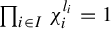 $\prod _{i\in I} \chi _i^{l_i} = 1$
when restricted to
 $\boldsymbol {H}$
. Thus,
 $$ \begin{align*} \boldsymbol{H} \subset \boldsymbol{L} :=\bigg\{l\in \boldsymbol{L}_I \,\bigg\vert\, \prod_{i\in I} \chi_i^{l_i}(l)=1\bigg\}^{\circ}. \end{align*} $$
Note that
 $\boldsymbol {L}$
is a connected reductive
 $\mathbb {Q}$
-subgroup. Hence, it suffices to prove that
 $\boldsymbol {\mathrm {Z}}_{\boldsymbol {G}}(\boldsymbol {L})/\boldsymbol {\mathrm {Z}}(\boldsymbol {L})$
is not
 $\mathbb {Q}$
-anisotropic, which holds if there is a
 $\mathbb {Q}$
-cocharacter whose image centralizes
 $\boldsymbol {L}$
and yet is not contained in
 $\boldsymbol {L}$
.
Indeed,
 $\{\chi _i\}_{i\in I}$
are linearly independent when restricted to
 $\boldsymbol {\mathrm {Z}}^{\text {spl}}(\boldsymbol {L}_I)$
, the
 $\mathbb {Q}$
-split part of the central torus of
 $\boldsymbol {L}_I$
. Hence, there exists a cocharacter
 $\delta : \mathbb {G}_m \to \boldsymbol {\mathrm {Z}}^{\text {spl}}(\boldsymbol {L}_I)$
, which is automatically defined over
 $\mathbb {Q}$
, such that
 $$ \begin{align*} \prod_{i\in I} \chi_i^{l_i}\circ \delta \neq 1. \end{align*} $$
Thus, the image of
 $\delta $
centralizes
 $\boldsymbol {L}$
and is not contained in
 $\boldsymbol {L}$
. So we are done.
Note that in the case where
 $\boldsymbol {A}=\boldsymbol {D}$
, and so
 $\boldsymbol {H}=\boldsymbol {D}\boldsymbol {M}$
, if there exist
 $w\in \mathrm {W}(G)$
and a non-empty subset
 $I\subset \{1,\ldots ,r\}$
such that
 $w^{-1}\boldsymbol {H} w\subset \bigcup _{i\in I}\boldsymbol {P}_i$
, then
 $\{w(\chi _i):i\in I\}$
are linearly independent as characters on
 $\boldsymbol {D}$
. Otherwise, it would contradict the fact that
 $\boldsymbol {Z_G(H)}/\boldsymbol {Z(H)}$
is
 $\mathbb {R}$
-anisotropic.
(iii)
$\implies $
(iv).

By assumption, we can find a
 $\mathbb {Q}$
-cocharacter
 $\delta : \mathbb {G}_m \to \boldsymbol {G}$
whose image centralizes
 $\boldsymbol {L}$
, yet is not contained in
 $\boldsymbol {L}$
. Let U be the horospherical
 $\mathbb {Q}$
-subgroup defined by this cocharacter and let v be a
 $\mathbb {Q}-$
vector in
 $\wedge ^{\text {dim} U} \mathfrak {g}$
representing the Lie algebra of U. Then, v is a vector satisfying the conclusion.
(iv)
$\implies $
(i).

Replacing
 $g^{-1}\boldsymbol {H}g$
by
 $\boldsymbol {H}$
, we assume that
 $g=\mathrm {id}$
in
 $(v)$
. Since
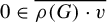 $0\in \overline {\rho (G)\cdot v}$
, by [Reference Kempf17, Corollary 3.5, Theorem 4.2], we can find a
 $\mathbb {Q}$
-cocharacter
 $\delta :\mathbb {G}_m\to \boldsymbol {G}$
such that
 $\rho (\delta (t))\cdot v\to 0$
as
 $t\to \infty $
and the image of
 $\delta $
centralizes
 $\boldsymbol {H}$
. This implies that condition (i) holds.
1.5 Examples
Example 1.16. Let
 $\boldsymbol {G}$
be a semisimple algebraic group defined over
 $\mathbb {Q}$
satisfying
 $\mathrm{rank}_{\mathbb {Q}}(\boldsymbol {G})=\mathrm{rank}_{\mathbb {R}}(\boldsymbol {G})=r\geq 1$
and
 $\Gamma =\boldsymbol {G}(\mathbb {Z})$
. Then,
 $G/\Gamma $
is not compact (see e.g. [Reference Borel and Harish-Chandra7]).
Let
 $\boldsymbol {T}$
be a maximal
 $\mathbb {R}$
-split torus of
 $\boldsymbol {G}$
and
 $A\subset T$
be an
 $\mathbb {R}$
-diagonalizable subgroup (not necessarily algebraic). If A is a proper subgroup of T, then the set of all fundamental weights
 $\{\chi _1,\ldots ,\chi _r\}$
are linearly dependent as linear functionals on
 $\mathrm {Lie}(A)$
, since
 $\dim A<r$
.
Therefore, by Theorem 1.7, we conclude that when
 $\mathrm{rank}_{\mathbb {Q}}(\boldsymbol {G})=\mathrm{rank}_{\mathbb {R}}(\boldsymbol {G})\geq 1$
, the action of A on
 $G/\Gamma $
is uniformly non-divergent if and only if
 $A=T$
.
Example 1.17. Let
 $\mathbb {K}$
be a totally real field extension of
 $\mathbb {Q}$
with
 $[\mathbb {K}:\mathbb {Q}]=m$
. Let
 $\boldsymbol {G}=\mathrm {Res}_{\mathbb {K}/\mathbb {Q}}(\boldsymbol {\mathrm {SL}}_n)$
, where
 $\mathrm {Res}$
denotes Weil’s restriction of scalar operator (see e.g. [Reference Platonov and Rapinchuk24, Ch. 2]). Denote
 $G=\boldsymbol {G}(\mathbb {R})$
,
 $\Gamma =\boldsymbol {G}(\mathbb {Z})$
, and
 $$ \begin{align*} A=\bigg\{\mathrm{diag}(e^{t_1},\ldots,e^{t_n}):\sum_{i=1}^n t_i=0\bigg\}\subset \mathrm{SL}_n(\mathbb{R}). \end{align*} $$
Let
 $\Delta :\mathrm {SL}_n(\mathbb {R})\to G$
be the diagonal embedding. Then, the identity component of the real points of a maximal
 $\mathbb {Q}$
-split torus
 $\boldsymbol {S}$
of
 $\boldsymbol {G}$
is
 $S=\Delta (A)$
. Let W be the Weyl group of
 $\mathrm {SL}_n(\mathbb {R})$
defined by
 $W\cong N_{\mathrm {SL}_n(\mathbb {R})}(A)/Z_{\mathrm {SL}_n(\mathbb {R})}(A)\cong S_n$
, where
 $S_n$
is the usual symmetric group. Then, the Weyl group
 $\mathrm {W}(G)=W\times \cdots \times W$
, that is,
 $\mathrm {W}(G)$
, is the product of m copies of W.
The maximal
 $\mathbb {Q}$
-torus
 $\boldsymbol {T}$
containing
 $\boldsymbol {S}$
can be decomposed uniquely into its
 $\mathbb {Q}$
-anisotropic part and its
 $\mathbb {Q}$
-split part
 $\boldsymbol {S}$
. Thus, we have a projection from
 $\mathrm {Lie}(T)$
to
 $\mathrm {Lie}(S)$
. Note that
 $\mathbb {Q}$
-fundamental weights
 $\{\chi _1,\ldots ,\chi _r\}$
on
 $\mathrm {Lie}(T)$
factor through its projection to
 $\mathrm {Lie}(S)$
. Thus, if for some
 $w \in \mathrm {W}(G)$
the projection from
 $\mathrm {Ad}(w)\mathrm {Lie}(S)$
to
 $\mathrm {Lie}(S)$
is trivial, then
 $\{w(\chi _1),\ldots ,w(\chi _r)\}$
becomes trivial, and hence linearly dependent, on
 $\mathrm {Lie}(S)$
. However, if the projection is surjective, then
 $\{w(\chi _1),\ldots ,w(\chi _r)\}$
is linearly independent on
 $\mathrm {Lie}(S)$
.
Assume that
 $n=2$
and, hence,
 $\mathrm {rank}_{\mathbb {Q}}(\boldsymbol {G})=1$
. It is easy to verify that when m is even, there exists
 $w\in \mathrm {W}(G)$
such that
 $\mathrm {Ad}(w) \mathrm {Lie}(S)$
projects trivially to
 $\mathrm {Lie}(S)$
, where the projection is with respect to the Killing form on
 $\mathrm {Lie}(T)$
. Also, when m is odd, one can verify that for any
 $w\in \mathrm {W}(G)$
,
 $\mathrm {Ad}(w)\mathrm {Lie}(S)$
projects onto
 $\mathrm {Lie}(S)$
. By Corollary 1.13, we conclude that the action of S on
 $G/\Gamma $
is uniformly non-divergent if and only if m is an odd number (cf. [Reference Tomanov32, Reference Tomanov33] for a study on different problems in the similar setting).
When
 $n\geq 3$
and
 $m\geq 2$
, one can always find
 $w\in \mathrm {W}(G)$
such that
 $\{w(\chi _1),\ldots ,w(\chi _r)\}$
are linearly dependent on
 $\mathrm {Lie}(S)$
. We conclude that when
 $n\geq 3$
, the S action on
 $G/\Gamma $
is uniformly non-divergent if and only if
 $m=1$
or
 $\mathbb {K}=\mathbb {Q}$
.
For instance, when
 $n=3$
and
 $m=2$
, the projection
 $\mathrm {Lie}(T)\to \mathrm {Lie}(S)$
can be written as
 $$ \begin{align*} \left( \begin{bmatrix} t_1 & & \\ & t_2& \\ && -t_1-t_2 \end{bmatrix}\, \begin{bmatrix} s_1 & & \\ & s_2& \\ && -s_1-s_2 \end{bmatrix}\right) \end{align*} $$
mapped to the diagonal embedding of
 $$ \begin{align*} \begin{bmatrix} (t_1+s_1)/2 & & \\ & (t_2+s_2)/2& \\ && (-t_1-t_2-s_1-s_2)/2 \end{bmatrix}. \end{align*} $$
One can check that there does not exist
 $w\in \mathrm {W}(G)$
such that this projection becomes trivial on
 $\mathrm {Ad}(w)\mathrm {Lie}(S)$
.
However, if w denotes the Weyl element which fixes the first coordinate, but swaps the first and the last entry in the second coordinate, then the two fundamental weights become, after applying w, linearly dependent on
 $\mathrm {Lie}(S)$
. So, we can still conclude that the action is not uniformly non-divergent by Corollary 1.13.
Example 1.18. Let
 $\mathbb {K}$
be a totally real field extension of
 $\mathbb {Q}$
with
 $[\mathbb {K}:\mathbb {Q}]=2$
. Let
 $\boldsymbol {G}=\mathrm {Res}_{\mathbb {K}/\mathbb {Q}}(\boldsymbol {\mathrm {SL}}_4)$
. Let
 $\Gamma =\boldsymbol {G}(\mathbb {Z})$
. Then,
 $G=\mathrm {SL}_4(\mathbb {R})\times \mathrm {SL}_4(\mathbb {R})$
. Consider the semisimple
 $\mathbb {R}$
-algebraic group
 $\boldsymbol {M}\subset \boldsymbol {G}$
defined by
 $$ \begin{align*} \boldsymbol{M}= \begin{bmatrix} 1 & \\ & \boldsymbol{\mathrm{SO}(2,1)} \end{bmatrix} \times \begin{bmatrix} 1 & & & \\ & 1 & &\\ & & 1 & \\ & & & 1 \end{bmatrix}, \end{align*} $$
where
 $\boldsymbol {\mathrm {SO}(2,1)}$
is viewed as a subgroup of
 $\boldsymbol {\mathrm {SL}}_3$
, which is embedded in the lower right block in
 $\boldsymbol {\mathrm {SL}}_4$
. Note that a maximal
 $\mathbb {R}$
-split torus
 $\boldsymbol {T}$
of
 $\boldsymbol {G}$
is the product of two maximal
 $\mathbb {R}$
-split tori
 $\boldsymbol {T}'$
of
 $\boldsymbol {\mathrm {SL}}_4$
, which are full diagonal tori. So,
 $\mathrm {Lie}(T)=\{(x_1,x_2):x_i\in \mathrm {Lie}(T')\}$
.
A maximal
 $\mathbb {R}$
-split torus
 $\boldsymbol {D}$
of
 $\boldsymbol {\mathrm {Z}_G(M)}$
has real points
 $$ \begin{align*} D^{\circ}=\left\{\begin{bmatrix} e^{3t} & & &\\ & e^{-t} & &\\ & & e^{-t} &\\ & & & e^{-t} \end{bmatrix}: t\in \mathbb{R} \right\}\times (T')^{\circ}. \end{align*} $$
Let
 $\{\unicode{x3bb} _1,\unicode{x3bb} _2,\unicode{x3bb} _3\}$
be the set of all fundamental
 $\mathbb {Q}$
-weights in
 $\boldsymbol {\mathrm {SL}}_4$
with respect to the full diagonal subgroup of
 $\boldsymbol {\mathrm {SL}}_4$
. Then,
 $\{\chi _1,\chi _2,\chi _3\}$
is the set of all fundamental
 $\mathbb {Q}$
-weights in
 $\boldsymbol {G}$
, where for any
 $v=(x_1,x_2)\in \mathrm {Lie}(T)$
,

For
 $1\leq i\leq 3$
, let
 $v_i\in \mathrm {Lie}(T)$
be such that
 $\chi _i(v)=(v_i|v)$
for any
 $v\in \mathrm {Lie}(T)$
, where
 $(\cdot |\cdot )$
is the Killing form on
 $\mathrm {Lie}(T)$
. Denote
 $\mathrm {W}(G)\cong \mathrm {N}_G(T)/\mathrm {Z}_G(T)$
and
 $\mathrm {W}(\mathrm {Z}_G(M))\cong \mathrm {N}_{\mathrm {Z}_G(M)}(D)/\mathrm {Z}_{\mathrm {Z}_G(M)}(D)$
. For any
 $w\in \mathrm {W}(G)$
,
 $w'\in \mathrm {W}(\mathrm {Z}_G(M))$
(implicitly, we are fixing a choice of representatives of these Weyl groups with the understanding that the choice would not affect the discussion below), and non-empty
 $I\subset \{1,2,3\}$
, define a linear subspace
 $$ \begin{align*} U(w,w',I):=\mathrm{Span}_{\mathbb{R}}\{w'w(v_i):i\in I\}\subset\mathrm{Lie}(T). \end{align*} $$
Let
 $$ \begin{align*} B:=\{U(w,w',I): w^{-1}\boldsymbol{M}w\subset \boldsymbol{P}_I, w'\in W(Z_G(M))\}, \end{align*} $$
then B is a finite collection of linear subspaces of
 $\mathrm {Lie}(T)$
. For a linear subspace
 $V\subset \mathrm {Lie}(D)$
satisfying
 $\pi _{U(w,w',I)}(V)=U(w,w',I)$
for any
 $U(w,w',I)\in B$
, let
 $A=\exp (V)\subset D$
(since
 $\dim D=4$
and there are at most three linear functionals in
 $U(w,w',I)$
, generic three-dimensional subspaces V would meet this requirement). Then, by Theorem 1.7 and Corollary 4.4, the action of
 $H=AM$
is uniformly non-divergent on
 $G/\Gamma $
. We also note that one can choose
 $V\subset \mathrm {Lie}(D)$
such that
 $A=\exp (V)$
is non-algebraic.
1.6 Overview of the proof strategy
Here, we indicate the strategy showing that statements (1) and (2) are equivalent in Theorem 1.7.
First, we assume statement (2) does not hold. Let H be as in Theorem 1.7. Denote
 $\pi :G \to G/\Gamma $
. Note that
 $G/\Gamma =\bigcup _{\eta>0} X_{\eta }$
such that
 $\{X_{\eta }:\eta>0\}$
is a nested collection of compact sets and, for any compact set
 $C\subset G/\Gamma $
, there exists
 $\eta _C>0$
with
 $C\subset X_{\eta _C}$
. We want to prove that every H-orbit intersects a fixed compact set
 $X_{\eta _0}$
for some suitably chosen
 $\eta _0>0$
.
Note that
 $H=AM$
, where M is a semisimple group and A is an
 $\mathbb {R}$
-diagonalizable subgroup of
 $Z_G(M)$
. Given
 $g\in G$
, for any
 $h\in H$
, as
 $h\pi (g)=am\pi (g)$
, it is important to understand the structure of the set of elements
 $g\in G$
such that M fails to bring
 $\pi (g)$
back to K.
For any
 $\eta>0$
, consider the subset
 $$ \begin{align*} G^M_{\eta}:=\{g\in G: M\pi(g)\cap X_{\eta}\neq \emptyset\}. \end{align*} $$
Then,
 $G/\Gamma - \pi (G^M_{\eta })$
is the collection of elements in
 $G/\Gamma $
which cannot be brought back by M to the compact set
 $X_{\eta }$
.
By the work of Daw et al [Reference Daw, Gorodnik and Ullmo11],
 $G/\Gamma -\pi (G_{\eta }^M)=\bigcup _{\boldsymbol {P}} \Sigma ^M_{\eta ,\boldsymbol {P}}$
, where the union is taken over all
 $\mathbb {Q}$
-parabolic subgroup
 $\boldsymbol {P}$
satisfying certain conditions determined by M, and
 $\Sigma ^M_{\eta ,\boldsymbol {P}}$
is a certain generalized Siegel set (for a precise description, see the paragraph above Proposition 3.5). We wish to bring back any given element in
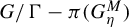 $G/\Gamma -\pi (G_{\eta }^M)$
using subgroup A.
It turns out that the structure of
 $\bigcup _{\boldsymbol {P}} \Sigma ^M_{\eta ,\boldsymbol {P}}$
leads to an open cover of A and, thus, an open cover on
 $\mathrm {Lie}(A)\cong \mathbb {R}^n$
. However, this open cover is not good enough for us to apply a topological covering theorem of Euclidean spaces (Theorem 3.4), which essentially says that one cannot cover an Euclidean space using a family of open sets with ‘low multiplicity’. Thanks to a compactness criterion of Tomanov and Weiss (Proposition 2.3) and the fundamental result of Dani and Margulis on quantitative non-divergence of unipotent orbits (Theorem 3.10), we are able to construct a good cover of
 $\mathrm {Lie}(A)$
(Lemma 3.13) to which the topological covering theorem applies. To finish the argument, we assume that statement (1) holds and prove by contradiction. For suitably chosen
 $\eta _0>0$
, assume that there exists
 $x\in G/\Gamma -\pi (G_{\eta _0}^M)$
such that
 $Ax\cap X_{\eta _0}=\emptyset $
. By some linear algebra argument combined with the covering theorem, this will lead to a contradiction.
To see that statement (2) implies statement (1), we first find a suitable Cartan involution (see Proposition 3.14) and again make use of some simple linear algebra argument (see §4) to finish the proof. This part of proof is inspired by [Reference Tomanov and Weiss34, Example 1].
1.7 Outline of the paper
The rest of this article will be mainly devoted to proving Theorem 1.7. In §2, we will recall some basic notions and theorems from algebraic groups. In §3, we study properties of certain topological cover of the group
 ${G}$
and the
 $\mathbb {R}$
-diagonalizable group A, which is constructed using the work in [Reference Daw, Gorodnik and Ullmo10, Reference Daw, Gorodnik and Ullmo11]. Certain good properties of the cover are ensured by the fundamental result of Dani and Margulis on quantitative non-divergence of unipotent orbits [Reference Dani and Margulis8]. In §4, we prove some simple but useful linear algebra lemmas, which enable us to deal with the situation when A is not necessarily algebraic. In §5, we finish the proof of Theorem 1.7. There, we make use of a topological covering theorem, which is initially introduced by McMullen in [Reference McMullen22], and later developed by Solan and Tamam [Reference Solan28, Reference Solan and Tamam29]. In §6, we recall the reduction theory for real rank one quotient by Garland and Raghunathan, and give the proof of Theorem 1.14.
2 Preliminaries
Recall that
 $\boldsymbol {G}$
is a linear algebraic semisimple group defined over
 $\mathbb {Q}$
and
 $\mathfrak {g}$
is the Lie algebra of its real points G. We also fix a norm
 $\lVert \cdot \rVert $
on
 $\mathfrak {g}$
. A Lie subalgebra of
 $\mathfrak {g}$
is said to be unipotent if and only if it corresponds to a (Zariski closed) unipotent subgroup of
 $\boldsymbol {G}$
.
Let
 $\Gamma $
be an arithmetic subgroup of G. Let
 $\mathrm {Ad}:G\to \mathrm {GL}(\mathfrak {g})$
be the adjoint representation of G on its Lie algebra. By [Reference Borel4], we find a lattice
 $\mathfrak {g}_{\mathbb {Z}}$
of
 $\mathfrak {g}$
such that
 $\mathrm {Ad}(\Gamma )\mathfrak {g}_{\mathbb {Z}}=\mathfrak {g}_{\mathbb {Z}}$
. Let
 $\pi :G\to G/\Gamma $
be the natural projection map. For any
 $x=\pi (g)\in G/\Gamma $
, denote
 $\mathfrak {g}_x=\mathfrak {g}_g=\mathrm {Ad}(g)\mathfrak {g}_{\mathbb {Z}}$
.
2.1 Parabolic subgroups
Recall that
 $\boldsymbol {T}$
is a maximal
 $\mathbb {R}$
-split torus of
 $\boldsymbol {G}$
containing a maximal
 $\mathbb {Q}$
-split torus
 $\boldsymbol {S}$
and
 $r=\dim \boldsymbol {S}$
is the
 $\mathbb {Q}$
-rank of
 $\boldsymbol {G}$
. By [Reference Borel6, 21.8], we can choose compatible orderings of
 $\mathbb {R}$
-root system
 $\Phi _{\mathbb {R}}$
and
 $\mathbb {Q}$
-root system
 $\Phi _{\mathbb {Q}}$
. According to these orderings, we fix a
 $\mathbb {Q}$
-minimal parabolic subgroup
 $\boldsymbol {P}_0$
containing
 $\boldsymbol {T}$
. Let
 $\Delta _{\mathbb {Q}}$
be the set of all simple
 $\mathbb {Q}$
-roots of
 $\boldsymbol {G}$
. By [Reference Borel5], for some
 $t \in \mathbb {R}$
,
 $$ \begin{align} G=K\cdot S_t\cdot C\cdot F^{-1}\cdot \Gamma, \end{align} $$
where K is a maximal compact subgroup, C is a compact subset of G,
 $F\subset G(\mathbb {Q})$
is a finite subset, and
 $$ \begin{align*} S_t :=\{s\in S^{\circ}: \alpha(s)\leq t \text{ for all } \alpha\in \Delta_{\mathbb{Q}}\}. \end{align*} $$
For any subset
 $I\subset \Delta _{\mathbb {Q}}=:\{\alpha _1,\ldots ,\alpha _r\}$
, consider the standard parabolic
 $\mathbb {Q}$
-subgroup
 $\boldsymbol {P}_I=\boldsymbol {\mathrm {Z}_G({S}_I)}\cdot \boldsymbol {N}$
, where
 $$ \begin{align*} \boldsymbol{S}_I :=\bigg(\bigcap_{\alpha\in \Delta_{\mathbb{Q}}\setminus I} \mathrm{Ker} ({\alpha})\bigg)^{\circ} \end{align*} $$
and
 $\boldsymbol {N}$
is a maximal unipotent subgroup contained in
 $\boldsymbol {P}_0$
. In particular,
 $\boldsymbol {P}_0=\boldsymbol {P}_{\Delta _{\mathbb {Q}}}$
. Define the finite collection
 $$ \begin{align} \mathcal{B}:=\{\unicode{x3bb} \boldsymbol{P}_I \unicode{x3bb}^{-1}: I\subset \Delta_{\mathbb{Q}},\unicode{x3bb}\in F\}. \end{align} $$
Then, any parabolic
 $\mathbb {Q}$
-subgroup
 $\boldsymbol {P}$
is conjugate to an element in
 $\mathcal {B}$
by some
 $\gamma \in \Gamma $
(see e.g. [Reference Dani and Margulis8]).
For each
 $\alpha \in \Delta _{\mathbb {Q}}$
, define a projection
 $\pi _{\alpha }:\Phi _{\mathbb {Q}}\to \mathbb {Z}$
by
 $\pi _{\alpha }(\chi )=n_{\alpha }$
, where
 $\chi =\sum _{\beta \in \Delta _{\mathbb {Q}}}n_{\beta }\beta $
. Denote by
 $\mathfrak {g}_{\chi }$
the root space corresponding to
 $\chi \in \Phi _{\mathbb {Q}}$
. Then, by [Reference Borel6, 21.12],
 $$ \begin{align} \mathrm{Lie}(\mathrm{Rad}_{\mathrm{U}}(\boldsymbol{P}_I))=\bigoplus_{\text{ there exists } \alpha\in I,\pi_{\alpha}(\chi)>0}\mathfrak{g}_{\chi} \end{align} $$
and
 $$ \begin{align} \mathrm{Lie}(\mathrm{Z}_G({S}_I))= \mathrm{Lie} (\mathrm{Z}_G({S}))\oplus \bigoplus_{\text{ for all } \alpha\in I,\pi_{\alpha}(\chi)=0}\mathfrak{g}_{\chi}, \end{align} $$
where
 $\mathrm {Rad}_{\mathrm {U}}(\boldsymbol {P}_I)$
is the unipotent radical of
 $\boldsymbol {P}_I$
.
For each
 $i=1,\ldots ,r$
, let
 $\boldsymbol {P}_i=\boldsymbol {P}_{\{\alpha _i\}}$
. Then,
 $\boldsymbol {P}_1,\ldots ,\boldsymbol {P}_r$
are standard maximal parabolic
 $\mathbb {Q}$
-subgroups of
 $\boldsymbol {G}$
containing
 $\boldsymbol {P}_0$
. Let
 $\mathfrak {u}_1,\ldots ,\mathfrak {u}_r$
be the Lie algebra of the unipotent radical of
 $\boldsymbol {P}_1,\ldots ,\boldsymbol {P}_r$
, respectively. For each
 $j=1,\ldots ,r$
, let
 $\mathfrak {R}_j$
be the set of all the Lie algebras of unipotent radicals of parabolic
 $\mathbb {Q}$
-subgroups
 $\boldsymbol {P}$
which are conjugated to
 $\boldsymbol {P}_j$
. Let
 $\mathfrak {R}=\bigcup _{j=1}^r \mathfrak {R}_j$
.
The following propositions are needed in the course of establishing our main theorems.
Proposition 2.1. [Reference Tomanov and Weiss34, Proposition 3.3]
There exists an open neighborhood
 $W_0$
of
 $0$
in
 $\mathfrak {g}$
such that for any
 $g\in G$
, the Lie subalgebra generated by
 $\mathrm {Span}_{\mathbb {R}}(\mathfrak {g}_{g}\cap W_0)$
is unipotent.
The neighborhood
 $W_0$
in Proposition 2.1 is called a(n open) Zassenhaus neighborhood.
Proposition 2.2. [Reference Tomanov and Weiss34, Proposition 5.3]
Let
 $\mathfrak {v}_1,\ldots ,\mathfrak {v}_k\in \mathfrak {R}$
. Suppose that the Lie subalgebra generated by
 $\mathrm {Span}_{\mathbb {R}}\{\mathfrak {v}_j:j=1,\ldots , k\}$
is unipotent in
 $\mathfrak {g}$
. Then, there exists
 $g\in G$
and
 $\{i_1,\ldots ,i_k\}\subset \{1,\ldots ,r\}$
such that
 $\mathfrak {v}_j=\mathrm {Ad}(g)\mathfrak {u}_{i_j}, j=1,\ldots ,k$
.
Proposition 2.3. [Reference Tomanov and Weiss34, Proposition 3.5]
For any subset L of G,
 $\pi (L)\subset G/\Gamma $
is precompact if and only if there exists a neighborhood W of
 $0$
in
 $\mathfrak {g}$
such that for every
 $g\in L$
and every
 $\mathfrak {u}\in \mathfrak {R}$
,
 $\mathrm {Ad}(g)\mathfrak {u}\not \subset \mathrm {Span}_{\mathbb {R}}(\mathfrak {g}_{g}\cap W)$
.
Proposition 2.4. Let k be a positive integer. For
 $i=1,\ldots ,k$
, let
 $\rho _i:\boldsymbol {G}\to \mathrm {GL}(\boldsymbol {V}_i)$
be linear representations of
 $\boldsymbol {G}$
defined over
 $\mathbb {Q}$
, with norms
 $\lVert \cdot \rVert _i$
on
 $V_i:=\boldsymbol {V}_i(\mathbb {R})$
. Let
 $v_i\in \boldsymbol {V}_i(\mathbb {Q})$
be a non-zero vector for
 $i=1,\ldots ,k$
, and
 $H\subset G$
be a subgroup. Assume that for any
 $n\in \mathbb {N}$
, there exists
 $g_n\in G$
such that for any
 $h\in H$
, there exists
 $i\in \{1,\ldots ,k\}$
with
 $$ \begin{align*} \lVert\rho_i(h g_n)v_i\rVert_i<\frac{1}{n}, \end{align*} $$
then the action of H on
 $G/\Gamma $
is not uniformly non-divergent.
Proof. Assume the contrary. Then, there exists a compact subset
 $C\subset G/\Gamma $
such that for any
 $x\in G/\Gamma $
,
 $Hx\cap C\neq \emptyset $
. Since C is compact in
 $G/\Gamma $
, there exists a compact subset
 $\widetilde {C}\subset G$
such that
 $\pi (\widetilde {C})=C$
, where
 $\pi :G\to G/\Gamma $
is the natural projection.
As
 $\rho _i$
are
 $\mathbb {Q}$
-representations of
 $\boldsymbol {G}$
and
 $v_i$
are non-zero
 $\mathbb {Q}$
-vectors,
 $\rho _i(\Gamma )v_i$
are discrete in
 $V_i$
for
 $i=1,\ldots ,k$
. In particular, since we consider only finitely many such representations, there exists
 $\epsilon _1>0$
, such that
 $$ \begin{align*} \min_{1\leq i\leq k}\inf_{\gamma\in \Gamma}\lVert\rho_i(\gamma)v_i\rVert_i>\epsilon_1. \end{align*} $$
By compactness of
 $\widetilde {C}$
, there is
 $0<\epsilon _2<\epsilon _1$
such that
 $$ \begin{align} \min_{i=1,\ldots,k}\inf_{g\in \widetilde{C}\Gamma}\lVert\rho_i(g)v_i\rVert_i>\epsilon_2. \end{align} $$
Choose
 $n\in \mathbb {N}$
such that
 $1/n<\epsilon _2$
. By assumption of the proposition, we may find
 $g_n\in G$
such that for any
 $h\in H$
, there is
 $1\leq i\leq k$
such that
 $\lVert \rho _i(hg_n)v_i\rVert _i<1/n$
. However, since the action of H is uniformly non-divergent, for this
 $g_n$
, there exists
 $h_n\in H$
such that
 $h_n g_n\in \widetilde {C}\cdot \Gamma $
. By (2.5), we have for all
 $1\leq i\leq k$
,
 $\lVert \rho _i(h_n g_n)v_i\rVert _i>\epsilon _2$
, which leads to a contradiction.
2.2 Fundamental weights
For each
 $j=1,\ldots ,r$
, let
 $\bigwedge ^{d_j}\mathfrak {g}$
be the
 $d_j$
th wedge product of the Lie algebra of G, where
 $d_j$
is the dimension of
 $\mathfrak {u}_j$
. We equip
 $\bigwedge ^{d_j}\mathfrak {g}$
with the norm induced from the fixed norm
 $\lVert \cdot \rVert $
on
 $\mathfrak {g}$
, which we still denote by
 $\lVert \cdot \rVert $
by abuse of notation. Let
 $p_j\in \bigwedge ^{d_j}\mathfrak {g}$
be the wedge product of an integral basis of
 $\mathfrak {u}_j\cap \mathfrak {g}_{\mathbb {Z}}$
. Similarly, for any
 $\mathfrak {u}\in \mathfrak {R}_j$
, denote by
 $p_{\mathfrak {u}}\in \bigwedge ^{d_j}\mathfrak {g}$
the wedge product of an integral basis of
 $\mathfrak {u}\cap \mathfrak {g}_{\mathbb {Z}}$
. These vectors are well defined up to sign.
Recall that G acts on
 $\bigwedge ^{d_j}\mathfrak {g}$
through
 $\rho _j:=\bigwedge ^{d_j}\mathrm {Ad}$
. Let
 $V_j=\mathrm {Span}_{\mathbb {R}}\{\rho _j(g)p_j:g\in G\}$
be the irreducible linear representation of G with highest weight vector
 $p_j$
and highest weight
 $\chi _j$
with respect to T. The weights
 $\chi _1,\ldots ,\chi _r$
are called fundamental weights, which are linear functionals on the Lie algebra of T. For each j, denote by
 $\Phi _j$
the collection of all weights in the weight decomposition of
 $V_j$
with respect to T.
Since
 $\boldsymbol {G}$
is semisimple, the Killing form on
 $\mathfrak {g}$
restricts to a strictly positive definite and symmetric bilinear form
 $(\cdot |\cdot )$
on
 $\mathrm {Lie}(T)$
(see e.g. [Reference Helgason16]). Therefore, for any linear functional
 $\unicode{x3bb} $
on
 $\mathrm {Lie}(T)$
, there is a
 $v_{\unicode{x3bb} }\in \mathrm {Lie}(T)$
such that for any
 $v\in \mathrm {Lie}(T)$
,
 $\unicode{x3bb} (v)=(v_{\unicode{x3bb} }|v)$
.
By the diffeomorphism
 $\exp :\mathrm {Lie}(T)\to T^{\circ }$
, for any linear functional
 $\unicode{x3bb} $
on
 $\mathrm {Lie}(T)$
, by abuse of notation, we also say that
 $\unicode{x3bb} $
is a linear functional on
 $T^{\circ }$
by setting
 $$ \begin{align} \unicode{x3bb}(a):=\unicode{x3bb}(v), \end{align} $$
where
 $a=\exp (v)$
, for any
 $a\in T^{\circ }$
. From now on, when we say that some linear functionals
 $\unicode{x3bb} _1,\ldots ,\unicode{x3bb} _k$
are linearly independent on
 $T^{\circ }$
, we mean that they are linearly independent on
 $\mathrm {Lie}(T)$
. This should not cause any confusion.
2.3 Cartan involution
Let
 $\mathfrak {g}=\mathfrak {k}\oplus \mathfrak {p}$
be a Cartan decomposition and
 $\theta :\mathfrak {g}\to \mathfrak {g}$
be the corresponding Cartan involution defined by
 $\theta (k+p)=k-p$
for
 $k\in \mathfrak {k},\; p\in \mathfrak {p}$
. One can lift this Cartan involution
 $\theta $
to a global Cartan involution of
 $\boldsymbol {G}$
, which we also denote by
 $\theta $
. Cartan involutions of
 $\boldsymbol {G}$
are unique up to conjugation by an element in G. As
 $\boldsymbol {T}$
is a maximal
 $\mathbb {R}$
-split torus in
 $\boldsymbol {G}$
, we can choose a Cartan involution
 $\tau $
such that
 $\tau (a)=a^{-1}$
for any
 $a\in T$
. We refer the reader to [Reference Knapp19] for more on Cartan involutions.
For a linear
 $\mathbb {R}$
-representation
 $\rho :\boldsymbol {G}\to \mathrm {GL}(V)$
, we can decompose
 $V=\bigoplus _{\chi \in \mathrm {X}(V)}V_{\chi }$
, where
 $\boldsymbol {T}$
acts on each
 $V_{\chi }$
by some character
 $\chi $
and
 $\mathrm {X}(V)$
is the collection of all characters with
 $V_{\chi }$
non-zero. A Cartan involution
 $\rho (\tau )$
is induced on the image
 $\rho (\boldsymbol {G})$
. Since
 $\rho (\boldsymbol {G})$
is semisimple,
 $\rho (\tau )$
can be extended to a Cartan involution on
 $\mathrm {GL}(V)$
(see e.g. [Reference Mostow23]), which we also denote by
 $\rho (\tau )$
. Moreover,
 $\rho (\tau )$
induces an automorphism on
 $\mathrm {X}(V)$
by
 $\rho (\tau )(\chi )=-\chi $
. Also, for every
 $\chi \in \mathrm {X}(V)$
,
 $v\in \rho (\tau )(V_{\chi })$
and
 $a\in T$
,
 $\rho (a)v=-\chi (a)v$
.
3 Some covering theorems
The analysis of torus orbits on homogeneous spaces relies on certain covering theorems, which we will introduce below.
3.1 A covering for
$\mathbb {R}^n$

Definition 3.1. The invariance dimension of a convex open set
 $U\subset \mathbb {R}^n$
is the dimension of its stabilizer in
 $\mathbb {R}^n$
, that is,
 $$ \begin{align*} \mathrm{invdim}( U):=\dim \mathrm{Stab}_{\mathbb{R}^n}(U), \end{align*} $$
where
 $\mathrm {Stab}_{\mathbb {R}^n}(U)=\{x\in \mathbb {R}^n:x+U=U\}$
. By convention, we set
 $\mathrm {invdim} \emptyset =-\infty $
.
Lemma 3.2. [Reference Solan28, Lemma 2.6]
Let
 $U_1\subset U_2$
be open convex subsets of
 $\mathbb {R}^n$
, then
 $$ \begin{align*} \mathrm{invdim} (U_1)\leq \mathrm{invdim} (U_2). \end{align*} $$
Lemma 3.3. Given k linearly independent linear functionals
 $\unicode{x3bb} _1,\ldots ,\unicode{x3bb} _k$
on
 $\mathbb {R}^n$
and k real numbers
 $a_1,\ldots ,a_k\in \mathbb {R}$
, we define

Then, U is an open convex set with
 $\mathrm {invdim}(U)\leq n-k$
.
Proof. The claim that U is open convex follows by definition. Without loss of generality, we may assume that
 $0\in U$
. Let
 $(\cdot |\cdot )$
be a strictly positive definite and symmetric bi-linear form on
 $\mathbb {R}^n$
. For
 $i=1,\ldots ,k$
, let
 $v_i\in \mathbb {R}^n$
be such that
 $\unicode{x3bb} _i(x)=(v_i|x)$
for any
 $x\in \mathbb {R}^n.$
We claim that each
 $v_i$
is perpendicular to
 $\mathrm {Stab}_{\mathbb {R}^n}(U)$
with respect to
 $(\cdot |\cdot )$
.
Since
 $\mathrm {Stab}_{\mathbb {R}^n}(U)$
is a vector space, for each i, we can write
 $v_i=v_i^1+v_i^2$
, where
 $v_i^1\in \mathrm {Stab}_{\mathbb {R}^n}(U)$
and
 $v_i^2\in (\mathrm {Stab}_{\mathbb {R}^n}(U))^{\perp }$
. As
 $0\in U$
, for all
 $t\in \mathbb {R}$
,
 $t v_i^1\in U$
, and so

This can happen only if
 $(v_i|v_i^1)=0$
, which implies
 $v_i^1=0$
. This proves the claim and thus the lemma.
Theorem 3.4. [Reference Solan28, Theorem 1.4]
Let
 $\mathfrak {U}$
be an open cover of
 $\mathbb {R}^n$
. Assume that:
-
(1) the cover
$\{\mathrm {conv}(U):U\in \mathfrak {U}\}$
is locally finite, where
$\mathrm {conv}(U)$
denotes the convex hull of U (a collection of subsets of
$\mathbb {R}^n$
is locally finite if for any compact subset
$C\subset \mathbb {R}^n$
, there are only finitely many elements in the collection intersect C); -
(2) for every
$k\leq n$
and k different sets
$U_1,\ldots , U_k\in \mathfrak {U}$
,
$$ \begin{align*} \mathrm{invdim}\text{ }\mathrm{conv}(U_1\cap U_2\cap \cdots\cap U_k)\leq n-k. \end{align*} $$


Then, there are
 $n+1$
elements in
 $\mathfrak {U}$
with non-trivial intersection.
3.2 A covering for G
In this subsection, we let
 $\boldsymbol {G}$
,
 $\boldsymbol {M}$
,
 $\boldsymbol {D}$
, and A be as in Theorem 1.7. Recall that
 $\pi :G\to G/\Gamma $
is the natural projection map. For
 $\eta>0$
, define
 $$ \begin{align*} X_{\eta}:=\{\pi(g)\in G/\Gamma:\mathfrak{g}_g\cap W_{\eta}=\{0\}\}, \end{align*} $$
where
 $W_{\eta }$
is an open ball with radius
 $\eta $
in
 $\mathfrak {g}$
centered at
 $0$
. By (generalized) Mahler’s criterion,
 $X_{\eta }$
is a compact subset of
 $G/\Gamma $
. Define
 $$ \begin{align*} G^M_{\eta}:=\{g\in G: M\pi(g)\cap X_{\eta}\neq \emptyset\}. \end{align*} $$
Fix a maximal compact subgroup
 ${K}$
of
 ${G}$
. For every parabolic
 $\mathbb {Q}$
-subgroup
 $\boldsymbol {P}$
, let
 $\boldsymbol {U_P}$
be the unipotent radical of
 $\boldsymbol {P}$
. Then,
 $\boldsymbol {P}/\boldsymbol {U_P}$
is a reductive
 $\mathbb {Q}$
-group. Let
 $\boldsymbol {S_P}^{\prime }$
be the
 $\mathbb {Q}$
-split part of the central torus of
 $\boldsymbol {P}/\boldsymbol {U_P}$
. We fix lifts
 $\boldsymbol {S_P}$
and
 $\boldsymbol {A_P}$
of
 $\boldsymbol {S_P}^{\prime }$
to
 $\boldsymbol {P}$
such that
 $\boldsymbol {S_P}$
is
 $\mathbb {Q}$
-split and
 $\boldsymbol {A_P}$
is an
 $\mathbb {R}$
-split torus invariant under the Cartan involution associated with
 ${K}$
. Let
 $\Delta _P$
be the set of
 $\mathbb {Q}$
-simple roots of
 $(\boldsymbol {S_P},\boldsymbol {P})$
. As
 $\boldsymbol {A_P}$
is conjugate to
 $\boldsymbol {S_P}$
by a unique element in
 $\boldsymbol {U_P}$
, we can also think of
 $\Delta _P$
as the set of simple roots for
 $(\boldsymbol {A_P},\boldsymbol {P})$
.
Let
 $\boldsymbol {{}^0 \!P }$
be the identity component of the subgroup of
 $\boldsymbol {P}$
defined by the common kernel of all
 $\mathbb {Q}$
-characters of
 $\boldsymbol {P}$
. Assume that there are
 $I\subset \{1,\ldots ,r\}$
and
 $\unicode{x3bb} \in F$
(F is as in (2.1)) such that
 $\boldsymbol {P}=\boldsymbol {P}_I^{\unicode{x3bb} }:=\unicode{x3bb} \boldsymbol {P}_I \unicode{x3bb} ^{-1}$
. By rational Langlands decomposition, for each
 $g\in G$
, we can write
 $$ \begin{align*} g=k_g(I,\unicode{x3bb}) a_g(I,\unicode{x3bb}) p_g(I,\unicode{x3bb}) \end{align*} $$
with
 $$ \begin{align*} k_g(I,\unicode{x3bb})\in K,\;a_g(I,\unicode{x3bb})\in A_{P_I^{\unicode{x3bb}}}^{\circ},\;p_g(I,\unicode{x3bb})\in ({{}^0\!P}_I^{\unicode{x3bb}})^{\circ}. \end{align*} $$
For any subset
 $I\subset \{1,\ldots ,r\}$
,
 $\unicode{x3bb} \in F$
, bounded set
 $B\subset G$
, and real numbers
 $\theta ,\epsilon>0$
, as in [Reference Zhang and Zhang38], we define
 $$ \begin{align*} \Sigma_{I,\unicode{x3bb},B}^M(\theta)= \{ g\in G: g^{-1}\boldsymbol{M}g\subset \boldsymbol{P}_I^{\unicode{x3bb}}, \alpha(a_g(I,\unicode{x3bb}))<\theta \text{ for all } \alpha\in \Delta_{P_I^{\unicode{x3bb}}}, \text{ and }\\ \text{ there exists } m\in M \text{ such that } p_g(I,\unicode{x3bb}) g^{-1}mg\in (B\cap {{}^0\!P}_I^{\unicode{x3bb}})\cdot(\Gamma\cap {{}^0\!P}_I^{\unicode{x3bb}}) \}, \end{align*} $$
and
 $$ \begin{align*} \Sigma_{I,\unicode{x3bb},B}^M(\theta,\epsilon)=\{g\in \Sigma_{I,\unicode{x3bb},B}^M(\theta):\text{ there exists } \alpha\in \Delta_{P_I^{\unicode{x3bb}}},\alpha(a_g(I,\unicode{x3bb}))<\epsilon \}. \end{align*} $$
Proposition 3.5. [Reference Zhang and Zhang38, Proposition 3.1]
There exist
 $0<\theta <1$
and a compact subset
 $B\subset~G$
such that the following holds: there exist
 $0<\eta _0<1$
and a function
 $\epsilon _0:(0,\eta _0)\to (0,\infty )$
such that
 $\lim _{\eta \to 0}\epsilon _0(\eta )=0$
, and
 $$ \begin{align*} g\notin G_{\eta}^M \implies g\in \bigcup_{I\subset \{1,\ldots,r\},\unicode{x3bb}\in F} \Sigma_{I,\unicode{x3bb},B}^M(\theta,\epsilon_0(\eta))\cdot \Gamma. \end{align*} $$
For any
 $I\subset \{1,\ldots ,r\}$
,
 $i\in I$
, and
 $\unicode{x3bb} \in F$
, define
 $\alpha _i^{\unicode{x3bb} }(g):=\alpha _i(\unicode{x3bb} ^{-1} g \unicode{x3bb} )$
for
 $g\in \unicode{x3bb} T\unicode{x3bb} ^{-1}$
, where
 $\alpha _i$
is the ith simple root. Then, we may assume that
 $\alpha _i^{\unicode{x3bb} }\in \Delta _{P_I^{\unicode{x3bb} }}$
. For our purpose in this article, we further define the following set. For any
 $I\subset \{1,\ldots ,r\}$
,
 $i\in I$
,
 $\unicode{x3bb} \in F$
, bounded set
 $B\subset G$
, and real numbers
 $\theta ,\epsilon>0$
, we denote
 $$ \begin{align} \Sigma^M_{I,i,\unicode{x3bb},B}(\theta,\epsilon):=\{g\in G: g\in \Sigma^M_{I,\unicode{x3bb},B}(\theta) \text{ and } \alpha_i^{\unicode{x3bb}}(a_g(I,\unicode{x3bb}))<\epsilon\}. \end{align} $$
Note that by definition, we have
 $$ \begin{align} \Sigma_{I,\unicode{x3bb},B}^M(\theta,\epsilon)=\bigcup_{i\in I} \Sigma_{I,i,\unicode{x3bb},B}^M(\theta,\epsilon). \end{align} $$
Let
 $\mathfrak {v} \in \mathfrak {R}$
and
 $\boldsymbol {Q}$
be the maximal parabolic
 $\mathbb {Q}$
-subgroup of
 $\boldsymbol {G}$
whose unipotent radical gives back
 $\mathfrak {v}$
. We can find
 $i\in \{1,\ldots ,r\}$
,
 $\unicode{x3bb} \in F$
,
 $\gamma \in \Gamma $
such that
 $\boldsymbol {Q}=\gamma \boldsymbol {P}_i^{\unicode{x3bb} }\gamma ^{-1}$
. Fix
 $B,\theta ,\eta _0,\epsilon _0$
as in Proposition 3.5. For
 $0<\eta <\eta _0$
, define
 $$ \begin{align} U_{\mathfrak{v}}^M(\epsilon_0(\eta)):=\bigcup_{I\subset \{1,\ldots,r\},i\in I}\Sigma^M_{I,i,\unicode{x3bb},B}(\theta,\epsilon_0(\eta))\cdot \gamma^{-1}. \end{align} $$
By Proposition 3.5 and (3.2), we obtain the following corollary.
Corollary 3.6. For any
 $0<\eta <\eta _0$
, we have
 $G=G_{\eta }^M \cup \bigcup _{\mathfrak {u}\in \mathfrak {R}} U_{\mathfrak {u}}^M(\epsilon _0(\eta ))$
.
Proposition 3.7. Let
 $\theta ,\eta _0,\epsilon _0$
be as in Proposition 3.5. Given a bounded set
 $C\subset G$
, for all sufficiently small
 $0<\eta <\eta _0$
(depending on C), the following holds. For any
 $i\in \{1,\ldots ,r\}$
,
 $\unicode{x3bb} \in F$
, and
 $\gamma \in \Gamma $
, let
 $\boldsymbol {Q}=\gamma \boldsymbol {P}_i^{\unicode{x3bb} }\gamma ^{-1}$
be a maximal parabolic
 $\mathbb {Q}$
-subgroup and define
 $\mathfrak {v}:=\mathrm {Lie}(\mathrm {Rad}_{\mathrm {U}}(\boldsymbol {Q}))$
. Given any
 $I\subset \{1,\ldots ,r\}$
containing i,
 $g\in G$
, and
 $m\in M$
, assume that m and
 $g_1:=g\gamma $
satisfy:
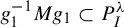
-
•
$g_1^{-1} M g_1 \subset P_I^{\unicode{x3bb} }$
; -
•
$\text { for all } \alpha \in \Delta _{P_I^{\unicode{x3bb} }}$
,
$\alpha (a_{g_1}(I,\unicode{x3bb} ))<\theta $
; -
•
$\alpha _i^{\unicode{x3bb} }(a_{g_1}(I,\unicode{x3bb} ))<\epsilon _0(\eta )$
; -
•
$p_{g_1}(I,\unicode{x3bb} )\cdot g_1^{-1}m g_1\in (C\cap {{}^0\!P}_I^{\unicode{x3bb} })\cdot (\Gamma \cap {{}^0\!P}_I^{\unicode{x3bb} })$
.


Then,
 $\mathrm {Ad}(mg)\mathfrak {v}\subset \mathrm {Span}_{\mathbb {R}}(\mathfrak {g}_{mg}\cap W_0)$
, where
 $W_0$
is a Zassenhaus neighborhood as in Proposition 2.1.
The four conditions listed above say that
 $g_1 \in \Sigma ^{M}_{I,i,\unicode{x3bb} ,C}(\theta ,\varepsilon _0(\eta ))$
and the m implicit in the definition is exactly our m.
Proof. We write
 $\boldsymbol {P}=\boldsymbol {P}_I^{\unicode{x3bb} }$
,
 $k_{g_1}=k_{g_1}(I,\unicode{x3bb} )$
,
 $a_{g_1}=a_{g_1}(I,\unicode{x3bb} )$
, and
 $p_{g_1}=p_{g_1}(I,\unicode{x3bb} )$
for short. By definition, for all
 $j\in I$
,
 $\alpha _j(\unicode{x3bb} ^{-1} a_{g_1} \unicode{x3bb} )<\theta <1$
and
 $\alpha _i(\unicode{x3bb} ^{-1} a_{g_1} \unicode{x3bb} )<\epsilon _0(\eta )$
. Choose a primitive integral basis
 $v_1,\ldots ,v_{d_i}\in \mathfrak {g}_{\mathbb {Z}}$
of
 $\mathfrak {u}_i$
, so
 $\mathfrak {u}_i=\mathrm {Span}_{\mathbb {R}}\{v_j:1\leq j\leq d_i\}$
. Since there are only finitely many standard maximal parabolic
 $\mathbb {Q}$
-subgroups,
 $\lVert v_j\rVert $
is bounded above uniformly for
 $1\leq j\leq d_i$
.
Since C is bounded and F is a finite set, the operator norm of any element in
 $\bigcup _{\unicode{x3bb} \in F}\unicode{x3bb} ^{-1} C \unicode{x3bb} $
on
 $\mathfrak {g}$
is bounded above uniformly. By assumption, there is
 $\gamma _0\in \Gamma \cap {{}^0\!P}$
such that
 $$ \begin{align*} p_{g_1}\cdot g_1^{-1}mg_1\cdot \gamma_0=b \in C\cap {{}^0\!P}. \end{align*} $$
Note that
 $\mathrm {Rad}_{\mathrm {U}}(P_i)$
is normal in
 $P_i$
and
 $\unicode{x3bb} ^{-1} b \unicode{x3bb} \in P_I\subset P_i$
. There is some
 $c_1>0$
such that for every
 $v_j$
, there exist
 $c^j_1,\ldots ,c^j_{d_i}\in \mathbb {R}$
such that
 $|c^j_k|<c_1$
for all k, and
 $$ \begin{align*} \mathrm{Ad}(\unicode{x3bb}^{-1} b \unicode{x3bb})v_j=\sum_{k=1}^{d_i} c^j_{k} v_k. \end{align*} $$
Therefore, for
 $j=1,\ldots ,d_i$
,
 $$ \begin{align*} \mathrm{Ad}(mg_1\gamma_0\unicode{x3bb})v_j&=\mathrm{Ad}(g_1\cdot g_1^{-1}mg_1\gamma_0\unicode{x3bb})v_j\\ \nonumber &=\mathrm{Ad}(k_{g_1} a_{g_1} p_{g_1} g_1^{-1}mg_1 \gamma_0\unicode{x3bb})v_j\\ \nonumber &=\mathrm{Ad}(k_{g_1}\unicode{x3bb})\mathrm{Ad}(\unicode{x3bb}^{-1} a_{g_1} \unicode{x3bb} )\mathrm{Ad}(\unicode{x3bb}^{-1} b\unicode{x3bb})v_j\\ \nonumber &=\mathrm{Ad}(k_{g_1}\unicode{x3bb})\mathrm{Ad}(\unicode{x3bb}^{-1} a_{g_1} \unicode{x3bb} )\sum_{k=1}^{d_i} c^j_{k} v_k. \end{align*} $$
By the description of the Lie algebra of
 $\boldsymbol {P}_i$
in (2.3) and (2.4), and the assumption of the proposition, we have for each
 $k=1,\ldots ,d_i$
,
 $$ \begin{align*} \lVert\mathrm{Ad}(\unicode{x3bb}^{-1} a_{g_1} \unicode{x3bb}) v_k\rVert<|\alpha_i(\unicode{x3bb}^{-1}a_{g_1}\unicode{x3bb})|\lVert v_k\rVert<\epsilon_0(\eta) \lVert v_k\rVert. \end{align*} $$
Let
 $\eta ^{\prime }>0$
be such that the ball
 $W_{\eta ^{\prime }}$
of radius
 $\eta ^{\prime }$
centered at
 $0$
in
 $\mathfrak {g}$
satisfies
 $W_{\eta ^{\prime }}\subset W_0$
. By boundedness of
 $c^j_k$
, compactness of K, and finiteness of F, choosing
 $\eta>0$
small enough (so
 $\epsilon _0(\eta )$
is small), we have for any
 $j=1,\ldots ,d_i$
,
 $$ \begin{align*} \lVert\mathrm{Ad}(mg_1\gamma_0\unicode{x3bb})v_j\rVert<\frac{\eta^{\prime}}{N}, \end{align*} $$
where
 $N<\infty $
is the smallest positive integer such that
 $\mathrm {Ad}(\unicode{x3bb} )N v\in \mathfrak {g}_{\mathbb {Z}}$
for any
 $v\in \mathfrak {g}_{\mathbb {Z}}$
and any
 $\unicode{x3bb} \in F$
. Since
 $\gamma _0\in \Gamma $
, by the choice of N, we have
 $$ \begin{align*} &\mathrm{Ad}(\gamma_0 \unicode{x3bb}) Nv_j\in \mathfrak{g}_{\mathbb{Z}}\quad \text{and}\quad \lVert\mathrm{Ad}(mg_1 \gamma_0\unicode{x3bb}) N v_j\rVert< \eta^{\prime}\text{ } \text{ for all } j=1,\ldots,d_i. \end{align*} $$
Therefore,
 $\mathrm {Ad}(m g_1\gamma _0 \unicode{x3bb} )N v_j\in \mathfrak {g}_{mg_1}\cap W_0$
for
 $1\leq j\leq d_i$
. Note that as
 $\gamma _0\in \unicode{x3bb} P_i \unicode{x3bb} ^{-1}\cap \Gamma $
and
 $\mathfrak {u}_i$
is spanned by
 $v_j$
, we then have
 $$ \begin{align*} \mathrm{Ad}(mg_1)\mathrm{Ad}(\unicode{x3bb})\mathfrak{u}_i=\mathrm{Ad}(mg_1)\mathrm{Ad}(\gamma_0\unicode{x3bb})\mathfrak{u}_i\subset \mathrm{Span}_{\mathbb{R}}(\mathfrak{g}_{mg_1}\cap W_0). \end{align*} $$
Since
 $g_1=g\gamma $
and
 $\Gamma $
preserve
 $\mathfrak {g}_{\mathbb {Z}}$
, we have
 $\mathfrak {g}_{mg_1}=\mathfrak {g}_{mg}$
and
 $$ \begin{align*} \mathrm{Ad}(mg)\mathfrak{v}=\mathrm{Ad}(mg)\mathrm{Ad}(\gamma \unicode{x3bb})\mathfrak{u}_i=\mathrm{Ad}(mg_1)\mathrm{Ad}(\unicode{x3bb})\mathfrak{u}_i \subset \mathrm{Span}_{\mathbb{R}}(\mathfrak{g}_{mg}\cap W_0). \end{align*} $$
Corollary 3.8. Let
 $B,\theta ,\eta _0,\epsilon _0$
be as in Proposition 3.5. For
 $i\in \{1,\ldots ,r\}$
,
 $\unicode{x3bb} \in F$
, and
 $\gamma \in \Gamma $
, let
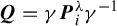 $\boldsymbol {Q}=\gamma \boldsymbol {P}_i^{\unicode{x3bb} }\gamma ^{-1}$
be a maximal parabolic
 $\mathbb {Q}$
-subgroup with
 $\mathfrak {v}=\mathrm {Lie}(\mathrm {Rad}_{\mathrm {U}}(\boldsymbol {Q}))$
. Then, for any
 $I\subset \{1,\ldots ,r\}$
with
 $i\in I$
, any
 $0<\eta <\eta _0$
sufficiently small, and any
 $g\in \Sigma ^M_{I,i,\unicode{x3bb} ,B}(\theta ,\epsilon _0(\eta ))\cdot \gamma ^{-1}$
, there exists
 $m\in M$
such that
 $$ \begin{align} \mathrm{Ad}(mg)\mathfrak{v}\subset \mathrm{Span}_{\mathbb{R}}(\mathfrak{g}_{mg}\cap W_0), \end{align} $$
where
 $W_0$
is a Zassenhaus neighborhood as in Proposition 2.1. In particular, if
 $g\in U_{\mathfrak {v}}^M(\epsilon _0(\eta ))$
, then there exists
 $m\in M$
such that (3.4) holds.
Proof. By assumption,
 $g\gamma \in \Sigma ^M_{I,i,\unicode{x3bb} ,B}(\theta ,\epsilon _0(\eta ))$
. By definition of
 $\Sigma ^M_{I,i,\unicode{x3bb} ,B}(\theta ,\epsilon _0(\eta ))$
, there is
 $m\in M$
such that
 $g_1=g\gamma $
and m satisfy all the assumptions of Proposition 3.7 with B in place of C. Therefore, the corollary follows.
The following proposition will be useful when we apply Theorem 3.4 to a certain topological cover of the
 $\mathbb {R}$
-diagonalizable subgroup A constructed later.
Proposition 3.9. Given a positive integer
 $n\leq r$
, where
 $r= \mathrm {rank}_{\mathbb {Q}}(\boldsymbol {G})$
, there is a sufficiently small
 $\eta>0$
such that the following holds. For any integer
 $1\leq k\leq n$
and k maximal parabolic
 $\mathbb {Q}$
-subgroups
 $\boldsymbol {Q}_1,\ldots ,\boldsymbol {Q}_k$
whose unipotent radicals have
 $\mathfrak {v}_1,\ldots ,\mathfrak {v}_k$
as their Lie algebras, if
 $\bigcap _{i=1}^k U^M_{\mathfrak {v}_i}(\epsilon _0(\eta ))\neq \emptyset $
, then the Lie subalgebra generated by
 $\mathrm {Span}_{\mathbb {R}}\{\mathfrak {v}_i:i=1,\ldots ,k\}$
is unipotent.
To prove Proposition 3.9, we invoke the following fundamental result of Dani and Margulis [Reference Dani and Margulis8].
Theorem 3.10. [Reference Dani and Margulis8, Theorem 2]
Let
 $\boldsymbol {L}$
be a connected linear algebraic group defined over
 $\mathbb {Q}$
without non-trivial
 $\mathbb {Q}$
-characters. Let
 $\Gamma $
be an arithmetic subgroup of L. Then, for any
 $\epsilon>0$
and any compact subset B of
 $L/\Gamma $
, there exists a compact set C of
 $L/\Gamma $
such that for any unipotent one-parameter subgroup
 $\{u(t):t\in \mathbb {R}\}$
of L and
 $g\in L$
, if
 $g\Gamma /\Gamma \in B$
, then for all large
 $T>0$
,
 $$ \begin{align*} \frac{1}{T}|\{t\in [0,T]:u(t)g\Gamma\in C\}|>1-\epsilon, \end{align*} $$
where
 $|\cdot |$
denotes the Lebesgue measure of a measurable set.
Proof. Write
 $\boldsymbol {L}=\boldsymbol {H}\cdot \boldsymbol {R}$
, where
 $\boldsymbol {H}$
is semisimple and
 $\boldsymbol {R}$
is the solvable radical of
 $\boldsymbol {L}$
. Both
 $\boldsymbol {H}$
and
 $\boldsymbol {R}$
are defined over
 $\mathbb {Q}$
. By assumption, the quotient of
 $\boldsymbol {R}$
by its unipotent radical is a
 $\mathbb {Q}$
-anisotropic torus. Here, [Reference Dani and Margulis8, Theorem 2] implies that the above theorem holds for
 $\boldsymbol {\overline {L}}:=\boldsymbol {L}/\boldsymbol {R}$
. Let
 $\pi :L\to L/R$
be the natural quotient map. Since the natural projection map
 $L/\Gamma \to \pi (L)/\pi (\Gamma )$
is proper, we are done.
We also require the following lemma.
Lemma 3.11. Let
 $I\subset \mathbb {R}$
be a non-empty bounded (open or closed) interval, k be a positive integer, and
 $I_1,\ldots ,I_k$
be measurable subsets of I. If there exists
 $0<\epsilon <({1}/{k})$
such that
 $|I_i|>(1-\epsilon )|I|$
for each
 $i=1,\ldots ,k$
, then
 $\bigcap _{i=1}^k I_i\neq \emptyset $
. Here,
 $|\cdot |$
denotes the Lebesgue measure on
 $\mathbb {R}$
.
Proof. Without loss of generality, we may assume that
 $|I|=1$
. We will use induction to show that for any
 $1\leq j\leq k$
,
 $|\bigcap _{i=1}^j I_i|>1-j\epsilon $
. Since
 $0<\epsilon <({1}/{k})$
, we have
 $|\bigcap _{i=1}^k I_i|>0$
. In particular,
 $\bigcap _{i=1}^k I_i\neq \emptyset $
.
When
 $j=1$
, by assumption, we have
 $|I_1|>1-\epsilon $
. Suppose that for some
 $1\leq j\leq k-1$
,
 $|\bigcap _{i=1}^j I_i|>1-j\epsilon $
. Let
 $J_j=\bigcap _{i=1}^j I_i$
. Then, we have
 $$ \begin{align*} 1\geq |J_j \cup I_{j+1}|&=|J_j|+|I_{j+1}|-|J_j\cap I_{j+1}|>1-j\epsilon +1-\epsilon-|J_j\cap I_{j+1}|. \end{align*} $$
Therefore,
 $|\bigcap _{i=1}^{j+1}I_i|=|J_i\cap I_{j+1}|>1-(j+1)\epsilon $
.
Proof of Proposition 3.9
Fix a positive number
 $\epsilon <({1}/{2r})$
and a compact neighborhood
 $C_1$
of
 $\mathrm {id}$
in G.
Recall from (2.2) that
 $ \mathcal {B}=\{\unicode{x3bb} \boldsymbol {P}_I \unicode{x3bb} ^{-1}: I\subset \Delta _{\mathbb {Q}},\unicode{x3bb} \in F\}$
. For any
 $\boldsymbol {P}\in \mathcal {B}$
, denote
 $\Lambda _P=\Gamma \cap {{}^0\!P}$
and
 $B_P=(C_1\cdot B)\cap {{}^0\!P}$
, where B is the bounded set of G as in Proposition 3.5. Since
 $\boldsymbol {{}^0\!P}$
has no non-trivial
 $\mathbb {Q}$
-characters,
 $\Lambda _P$
is a lattice in
 ${}^0\!P$
. We denote by
 $\pi _P:{{}^0\!P} \to {{}^0\!P}/\Lambda _P$
the natural projection map. Note that
 $\boldsymbol {{}^0\!P}=\boldsymbol {H}_P\cdot \boldsymbol {N}_P$
, where
 $\boldsymbol {H}_P$
is a semisimple
 $\mathbb {Q}$
-algebraic group and
 $\boldsymbol {N}_P$
is the unipotent radical of
 $\boldsymbol {{}^0\!P}$
.
For each
 $\boldsymbol {P}\in \mathcal {B}$
, applying Theorem 3.10 to
 ${}^0\!P / \Lambda _P$
,
 $\epsilon $
, and the compact set
 $B_P\Lambda _P/\Lambda _P$
, we obtain a compact subset
 $C_P\subset {{}^0\!P}/\Lambda _P$
such that for any
 $p\in {{}^0\!P}$
, any one-parameter unipotent subgroup
 $\{u_P(t):t\in \mathbb {R}\}$
of
 ${}^0\!P$
, if
 $p\Lambda _P/\Lambda _P\in B_P\Lambda _P/\Lambda _P$
, then for all large
 $T>0$
,
 $$ \begin{align*} \frac{1}{T}|\{t\in [0,T]:u_P(t)p\Lambda_P/\Lambda_P\in C_P\}|>1-\frac{\epsilon}{2}. \end{align*} $$
Since the cardinality of
 $\mathcal {B}$
is finite, we can choose a bounded set
 $C\subset G$
such that for any
 $\boldsymbol {P}\in \mathcal {B}$
, the compact set
 $C_P$
obtained above satisfies
 $C_P\subset \pi _P(C\cap {{}^0\!P})$
. We fix this bounded set C for the rest of the proof and choose
 $\eta>0$
to be sufficiently small such that Proposition 3.7 holds.
Let
 $g\in \bigcap _{i=1}^k U^M_{\mathfrak {v}_i}(\epsilon _0(\eta ))$
. By definition of
 $U^M_{\mathfrak {v}_i}(\epsilon _0(\eta ))$
, for each
 $1\leq i\leq k$
, there exist
 $j_i\in J_i\subset \{1,\ldots ,r\}$
,
 $\unicode{x3bb} _i\in F$
, and
 $\gamma _i\in \Gamma $
such that
 $g\in \Sigma ^M_{J_i,j_i,\unicode{x3bb} _i,B}(\theta ,\epsilon _0(\eta ))\cdot \gamma _i^{-1}$
and
 $\boldsymbol {Q}_i=\gamma _i \unicode{x3bb} _i \boldsymbol {P}_{j_i}\unicode{x3bb} _i^{-1}\gamma _i^{-1}$
. To simplify our notation, for each
 $1\leq i\leq k$
, we write
 $\boldsymbol {P}_i^{\prime }=\unicode{x3bb} _i \boldsymbol {P}_{j_i}\unicode{x3bb} _i^{-1}$
, then
 $\boldsymbol {P}_i^{\prime }\in \mathcal {B}$
. We also denote
 $B_i=B_{P_i^{\prime }}$
,
 $C_i=C_{P_i^{\prime }}$
,
 $\Lambda _i=\Gamma \cap {{}^0\!P_i^{\prime }}$
, and
 $g_i=g\gamma _i$
for
 $1\leq i\leq k$
.
By the Howe–Moore ergodic theorem (see e.g. [Reference Zimmer40]), we can find a one-parameter unipotent subgroup
 $\{u(t):t\in \mathbb {R}\}\subset M$
such that
 $$ \begin{align*} \overline{g^{-1}M g\Gamma/\Gamma}=\overline{g^{-1}\{u(t):t\in \mathbb{R}_+\}g\Gamma/\Gamma}. \end{align*} $$
Since
 $\gamma _i^{-1}\overline {g^{-1}Mg\Gamma /\Gamma }=\overline {g_i^{-1}M g_i\Gamma /\Gamma }$
, we have for each
 $1\leq i\leq k$
,
 $$ \begin{align*} \overline{g_i^{-1}M g_i\Gamma/\Gamma}=\overline{g_i^{-1}\{u(t):t\in \mathbb{R}_+\}g_i\Gamma/\Gamma}. \end{align*} $$
Note that for each i,
 $g_i^{-1}M g_i\subset {{}^0\!P_i^{\prime }}$
. Since
 ${}^0\!P_i^{\prime }\Gamma /\Gamma $
is closed, the natural map
 ${}^0\!P_i^{\prime }/\Lambda _i\to {{}^0\!P_i^{\prime }}\Gamma /\Gamma $
is proper (see e.g. [Reference Raghunathan25, Theorem 1.13]). Therefore, we have for each
 $1\leq i\leq k$
,
 $$ \begin{align} \overline{g_i^{-1}M g_i\Lambda_i/\Lambda_i}=\overline{g_i^{-1}\{u(t):t\in \mathbb{R}_+\}g_i\Lambda_i/\Lambda_i}. \end{align} $$
We may write
 $g_i=k_i a_i p_i$
with respect to the decomposition
 ${G=KP_i^{\prime }}$
. Since
 $g_i\in \Sigma ^M_{J_i,j_i,\unicode{x3bb} _i,B}(\theta ,\epsilon _0(\eta ))$
, by definition, we can find
 $m_i\in M$
such that
 $p_i g_i^{-1} m_i g_i\in (B\cap {{}^0\!P^{\prime }_i})\cdot (\Gamma \cap {{}^0\!P_i^{\prime }})$
. Depending on g and
 $\boldsymbol {P}^{\prime }_i,i=1,\ldots ,k$
, we can choose
 $C_0$
to be a small enough neighborhood of
 $\mathrm {id}$
in G such that for any
 $h\in C_0$
and
 $i=1,\ldots ,k$
, we have
 $p_i h p_i^{-1}\in C_1$
. By (3.5), we find
 $t_i\geq 0$
and
 $h_i\in C_0\cap {{}^0\!P_i^{\prime }}$
such that
 $$ \begin{align*} g_i^{-1} u(t_i) g_i \Lambda_i/\Lambda_i= h_i g_i^{-1} m_i g_i \Lambda_i/\Lambda_i. \end{align*} $$
Then, by the definition of
 $B_i$
,
 $$ \begin{align*} p_i g_i^{-1} u(t_i) g_i \Lambda_i/\Lambda_i=p_i h_i p_i^{-1} p_i g_i^{-1} m_i g_i\Lambda_i/\Lambda_i\in B_i \Lambda_i/\Lambda_i. \end{align*} $$
Let
 $u_i(t)=p_i g_i^{-1} u(t) g_i p_i^{-1}$
be a one-parameter unipotent subgroup for
 $i=1,\ldots ,k$
. Then, by the above, we have
 $$ \begin{align*} u_i(t_i)p_i\Lambda_i/\Lambda_i\in B_i \Lambda_i/\Lambda_i. \end{align*} $$
By Theorem 3.10, for any
 $i=1,\ldots ,k$
, for all large
 $T>0$
,
 $$ \begin{align*} \frac{1}{T}|\{t\in [t_i,t_i+T]: u_i(t)p_i\Lambda_i\in C_i\}|>1-\frac{\epsilon}{2}. \end{align*} $$
Without loss of generality, we may assume that
 $0\leq t_1\leq t_2\leq \cdots \leq t_k$
. Then, for any
 $i=1,\ldots ,k$
, we have for all large
 $T>0$
,
 $$ \begin{align} &\frac{1}{T+t_1-t_k}|\{t\in [t_k,t_1+T]:u_i(t)p_i\Lambda_i\in C_i\}|\nonumber \\ &\quad\geq \frac{T}{T+t_1-t_k}\bigg(\frac{1}{T}|\{t\in [t_i,t_i+T]:u_i(t)p_i\Lambda_i\in C_i\}|-\frac{t_k-t_1}{T}\bigg)\nonumber\\ &\quad\geq \frac{T}{T+t_1-t_k}\bigg(1-\frac{\epsilon}{2}-\frac{\epsilon}{10}\bigg)\nonumber\\ &\quad\geq 1-\epsilon, \end{align} $$
where we choose T large enough such that
 $(t_k-t_1)/T<\epsilon /10$
and
 ${T}/{(T+t_1-t_k)} (1-({\epsilon }/{2})-({\epsilon }/{10}))\geq 1-\epsilon $
.
Fix a large enough
 $T_0>0$
such that the estimate (3.6) holds for each
 $i=1,\ldots ,k$
and
 $t_1+T_0>t_k$
. Let
 $I=[t_k,t_1+T_0]$
and
 $$ \begin{align*} I_i=\{t\in [t_k,t_1+T_0]:u_i(t)p_i\Lambda_i\in C_i\}. \end{align*} $$
Applying Lemma 3.11 to
 $I,I_1,\ldots ,I_k$
, and
 $\epsilon $
, by the choice of
 $\epsilon $
, we have
 $\bigcap _{i=1}^k I_i\neq \emptyset $
. Let
 $t_0\in \bigcap _{i=1}^k I_i$
. Then, for
 $i=1,\ldots ,k$
,
 $$ \begin{align} p_i g_i^{-1} u(t_0)g_i\Lambda_i \in C_i. \end{align} $$
By definition of
 $g_i$
,
 $C_i$
, and (3.7), it is clear that
 $g_i$
and
 $u(t_0)$
satisfy the assumptions of Proposition 3.7. By our choice of
 $\eta $
, Proposition 3.7 shows that for any
 $i=1,\ldots ,k$
, we have
 $$ \begin{align*} \mathrm{Ad}(u(t_0)g)\mathfrak{v}_i\subset \mathrm{Span}_{\mathbb{R}}(\mathfrak{g}_{u(t_0)g}\cap W_0). \end{align*} $$
By Proposition 2.1, the Lie algebra generated by
 $\mathrm {Span}_{\mathbb {R}}\{\mathfrak {v}_i:i=1,\ldots ,k\}$
is unipotent.
From now on, we fix a sufficiently small
 $\eta>0$
once and for all such that Proposition 3.7, Corollary 3.8, and Proposition 3.9 hold for this
 $\eta $
.
Definition 3.12. For every
 $\mathfrak {u}\in \mathfrak {R}$
, we write
 $U_{\mathfrak {u}}^M:=U_{\mathfrak {u}}^M(\epsilon _0(\eta ))$
for short. As a reminder,
 $U_{\mathfrak {u}}^M(\epsilon _0(\eta ))$
is defined in (3.3).
3.3 A covering for torus
In this subsection, we will let
 $\boldsymbol {G}$
,
 $\boldsymbol {T}$
,
 $\boldsymbol {S}$
,
 $\boldsymbol {D}$
, A, and
 $\boldsymbol {M}$
be as in Theorem 1.7.
For any
 $\mathfrak {u}\in \mathfrak {R}$
, let
 $\boldsymbol {P}_{\mathfrak {u}}$
be the parabolic
 $\mathbb {Q}$
-subgroup whose unipotent radical has Lie algebra
 $\mathfrak {u}$
. For
 $\mathfrak {u}\in \mathfrak {R}$
and
 $g\in G$
, define
 $$ \begin{align*} U_{\mathfrak{u}}^{A,g}:=\{a\in A:ag\in U_{\mathfrak{u}}^M\}. \end{align*} $$
Note that if
 $g^{-1}\boldsymbol {M}g\not \subset \boldsymbol {P}_{\mathfrak {u}}$
, then
 $ag\notin U^M_{\mathfrak {u}}$
for any
 $a\in A$
and so
 $U_{\mathfrak {u}}^{A,g}=\emptyset $
. We also define
 $$ \begin{align*} U_0^{A,g}:=\{a\in A: ag\in G_{\eta}^M\}. \end{align*} $$
Lemma 3.13. For any
 $g\in G$
,
 $$ \begin{align*} A=U_0^{A,g}\cup \bigcup_{\mathfrak{u}\in \mathfrak{R}} U_{\mathfrak{u}}^{A,g}. \end{align*} $$
Moreover,
 $\{U_0^{A,g}\}\cup \{U_{\mathfrak {u}}^{A,g}:\mathfrak {u}\in \mathfrak {R}\}$
is an open cover of A.
Proof. By Corollary 3.6, we have
 $$ \begin{align*} Ag= Ag \cap G_{\eta}^M\cup \bigcup_{\mathfrak{u}\in \mathfrak{R}} Ag\cap U_{\mathfrak{u}}^M. \end{align*} $$
Since
 $A\subset \mathrm {Z}_G(M)$
, the assertion that this is an open cover follows by the definition of
 $U_0^{A,g}$
and
 $U_{\mathfrak {u}}^{A,g}$
.
As
 $\boldsymbol {D}$
is a maximal
 $\mathbb {R}$
-split torus in
 $\boldsymbol {\mathrm {Z}_G(M)}$
, we have the following proposition.
Proposition 3.14. Assume that
 $\boldsymbol {D}\subset \boldsymbol {T}$
. Let
 $\tau $
be a Cartan involution of
 $\boldsymbol {G}$
such that for any
 $a\in T$
,
 $\tau (a)=a^{-1}$
. Let
 $g\in G$
. Assume that there are k standard maximal parabolic
 $\mathbb {Q}$
-subgroups
 $\boldsymbol {P}_{i_1},\ldots ,\boldsymbol {P}_{i_k}$
such that
 $g^{-1}\boldsymbol {M} g\subset \boldsymbol {P}_{i_j}$
for
 $1\leq j \leq k$
. Then, there exist
 $w\in \mathrm {W}(G)$
,
 $h\in \mathrm {Z}_G(M)$
, and
 $u\in \bigcap _{j=1}^k P_{i_j}$
such that:
-
(1)
$g=hwu$
; -
(2)
$w^{-1}\boldsymbol {M}w \subset \bigcap _{j=1}^{k} \boldsymbol {P_{i_j}}$
; -
(3)
$w^{-1}\boldsymbol {M}w \subset \bigcap _{j=1}^{k} \tau (\boldsymbol {P_{i_j}})$
; -
(4)
$\bigcap _{j=1}^k w\boldsymbol {P}_{i_j}w^{-1} \cap \boldsymbol {Z_G(M)}$
is a parabolic subgroup of
$\boldsymbol {Z_G(M)}$
; -
(5)
$\{w(\chi _{i_j}):j=1,\ldots , k\}$
restricted to
$D^{\circ }$
are linearly independent as linear functionals.


Proof. In the following proof, for any one-parameter subgroup
 $\{a(t)\}_{t\in \mathbb {R}}$
of G, we denote
 $$ \begin{align*} \boldsymbol{P}_a&:=\{g\in \boldsymbol{G}: \lim_{t\to +\infty} a(t)g a(-t) \text{ exists}\}\quad \text{ and }\\ \boldsymbol{P}_{a^{-1}}&:=\{g\in \boldsymbol{G}: \lim_{t\to +\infty} a(-t)g a(t) \text{ exists}\}. \end{align*} $$
As
 $\boldsymbol {P}_{i_1},\ldots ,\boldsymbol {P}_{i_k}$
are standard maximal parabolic
 $\mathbb {Q}$
-subgroups, there are one-parameter subgroups
 $\{a_1(t):t\in \mathbb {R}\},\ldots ,\{a_k(t):t\in \mathbb {R}\}$
of S such that
 $\boldsymbol {P}_{i_j}=\boldsymbol {P}_{a_j}$
for
 $1\leq j\leq k$
. Since
 $g^{-1} \boldsymbol {M} g\subset \bigcap _{j=1}^k \boldsymbol {P}_{i_j}$
and
 $\boldsymbol {M}$
is semisimple, by [Reference Borel6, Proposition 11.23], there exists
 $u_1\in \bigcap _{j=1}^k {P}_{i_j}$
such that
 $\{a_j(t):t\in \mathbb {R}\}\subset \mathrm {Z}_G(u_1 g^{-1} M g u_1^{-1})$
for
 $1\leq j \leq k$
. Since
 $\boldsymbol {D}$
is a maximal
 $\mathbb {R}$
-split torus of
 $\boldsymbol {\mathrm {Z}_G(M)}$
, by [Reference Borel6, Corollary 11.3], we can find
 $h\in \mathrm {Z}_G(M)$
such that for all
 $1\leq j\leq k$
,
 $$ \begin{align} \{h^{-1}g u_1^{-1}a_j(t)u_1 g^{-1} h:t\in \mathbb{R}\}\subset D. \end{align} $$
For each
 $1\leq j \leq k$
and
 $t\in \mathbb {R}$
, we denote
 $d_j(t):=h^{-1}g u_1^{-1} a_j(t) u_1 g^{-1} h\in D$
. Define
 $$ \begin{align*} \boldsymbol{D}^{\prime}=u_1 g^{-1}h \boldsymbol{D} h^{-1} g u_1^{-1}, \boldsymbol{T}^{\prime}=u_1 g^{-1}h \boldsymbol{T} h^{-1} g u_1^{-1}, \boldsymbol{M}^{\prime}=u_1 g^{-1}h \boldsymbol{M} h^{-1} g u_1^{-1}. \end{align*} $$
Since for any
 $1\leq j\leq k$
,
 $a_j(t)\in \mathrm {Z}_G(M^{\prime })$
, and
 $a_j(t)\in D^{\prime }$
, we have
 $$ \begin{align} \boldsymbol{M}^{\prime}\subset \bigcap_{j=1}^{k} \boldsymbol{P_{i_j}}\quad\text{and}\quad \boldsymbol{T}^{\prime}\subset \bigcap_{j=1}^{k} \boldsymbol{P_{i_j}}. \end{align} $$
As
 $\boldsymbol {T}^{\prime }$
and
 $\boldsymbol {T}$
are maximal
 $\mathbb {R}$
-split tori in
 $\bigcap _{j=1}^{k} \boldsymbol {P_{i_j}}$
, there exists
 $u_2\in \bigcap _{j=1}^{k} {P_{i_j}}$
such that
 $u_2 \boldsymbol {T} u_2^{-1}=\boldsymbol {T}^{\prime }$
. By definition of
 $\boldsymbol {T}^{\prime }$
, we have
 $u_2^{-1}u_1 g^{-1} h \in \mathrm {N}_G(T)$
. Therefore, there exists
 $w\in \mathrm {W}(G)$
, or rather one of its representatives
 $w\in \mathrm {N}_G(T)$
, such that
 $u_2^{-1}u_1 g^{-1} h=w^{-1}$
. Thus,
 $g=hwu$
for
 $u=u_2^{-1}u_1$
. This proves item (1).
Substituting
 $u_1 g^{-1} h$
by
 $u_2 w^{-1}$
in the definition of
 $\boldsymbol {M}^{\prime }$
, by (3.9), item (2) follows.
Define an involution
 $\tau ^{\prime }$
of
 $\boldsymbol {G}$
by
 $$ \begin{align*} \tau^{\prime}(g_1)=u_1 g^{-1}h\cdot \tau(h^{-1}g u_1^{-1}g_1 u_1 g^{-1}h)\cdot h^{-1}g u_1^{-1} \quad \text{for all } g_1\in G. \end{align*} $$
For any
 $1\leq j\leq k$
, on one hand, using
 $u_1 g^{-1}h=u_2 w^{-1}$
, we have
 $$ \begin{align*} \tau^{\prime}(\boldsymbol{P}_{i_j})=u_2 w^{-1} \tau(w \boldsymbol{P}_{i_j}w^{-1})w u_2^{-1} =u_2 \tau(\boldsymbol{P}_{i_j}) u_2^{-1}. \end{align*} $$
On the other hand, using the fact that
 $a_j(t)=u_1 g^{-1} h d_j(t)h^{-1} g u_1^{-1}$
and
 $d_j(t)\in T$
, we have
 $$ \begin{align*} \tau^{\prime} (\boldsymbol{P}_{i_j})=u_1 g^{-1}h \tau(\boldsymbol{P}_{d_j}) h^{-1}g u_1^{-1} =\tau(\boldsymbol{P}_{i_j}). \end{align*} $$
Since the normalizer of a parabolic subgroup is itself, by the above, we obtain
 $$ \begin{align} u_2\in \bigcap_{j=1}^k \tau( {P}_{i_j}). \end{align} $$
Note that for any
 $1\leq j\leq k$
, as
 $a_j(t)\in \mathrm {Z}_G(M^{\prime })$
and
 $\tau (\boldsymbol {P}_{i_j})=\boldsymbol {P}_{a_j^{-1}}$
, we have
 $\boldsymbol {M}^{\prime }\subset \bigcap _{j=1}^k \tau ( \boldsymbol {P}_{i_j} )$
. Substituting
 $u_1 g^{-1} h$
by
 $u_2 w^{-1}$
in the definition of
 $\boldsymbol {M}^{\prime }$
, by (3.10), we obtain item (3).
To prove item (4), note that since
 $a_j(t)=u_2 w^{-1}d_j(t)w u_2^{-1}$
, we have
 $\boldsymbol {P}_{d_j}=w \boldsymbol {P}_{i_j} w^{-1}$
for each j. As
 $d_j(t)\in D\subset \mathrm {Z}_G(M)$
, for any
 $1\leq j \leq k$
,
 $w\boldsymbol {P}_{i_j}w^{-1}\cap \boldsymbol {Z_G(M)}=\boldsymbol {P}_{d_j}\cap \boldsymbol {Z_G(M)}$
is a parabolic subgroup of
 $\boldsymbol {Z_G(M)}$
. This proves item (4).
To see item (5), we use the expression
 $a_s(t)=u_2 w^{-1} d_s(t)w u_2^{-1}$
for any
 $1\leq s\leq k$
as follows: for any
 $1\leq j,s\leq k$
, on one hand,
 $$ \begin{align*} \mathrm{Ad}(a_s(t))p_{i_j}=\chi_{i_j}(a_s(t))p_{i_j}. \end{align*} $$
On the other hand,
 $$ \begin{align*} \mathrm{Ad}(a_s(t))p_{i_j}=\mathrm{Ad}(u_2 w^{-1} d_s(t)w u_2^{-1})p_{i_j}=w(\chi_{i_j})(d_s(t))p_{i_j}. \end{align*} $$
Therefore, we have
 $\chi _{i_j}(a_s(t))=w(\chi _{i_j})(d_s(t))$
for all
 $1\leq j,s\leq k$
. Since
 $\chi _{i_1},\ldots ,\chi _{i_k}$
are linearly independent on the subgroup generated by
 $\{a_j(t)\}_{t\in \mathbb {R}}$
,
 $j=1,\ldots ,k$
, we conclude that
 $w(\chi _{i_1}),\ldots ,w(\chi _{i_k})$
are also linearly independent on the subgroup generated by
 $\{d_j(t)\}_{t\in \mathbb {R}}$
,
 $j=1,\ldots ,k$
, and thus, on
 $D^{\circ }$
. This proves item (5).
Lemma 3.15. Take
 $g\in G$
and
 $\mathfrak {v}_1,\ldots ,\mathfrak {v}_k\in \mathfrak {R}$
. If
 $\bigcap _{j=1}^k U_{\mathfrak {v}_j}^{A,g}$
is not empty, then there exist
 $g_0\in G$
and
 $\{i_1,\ldots ,i_k\}\subset \{1,\ldots ,r\}$
such that
 $\boldsymbol {P}_{\mathfrak {v}_j}=g_0 \boldsymbol {P}_{i_j} g_0^{-1}$
and
 $$ \begin{align*} \boldsymbol{M}\subset g g_0 \boldsymbol{P}_{i_j} g_0^{-1} g^{-1} \quad \text{for all } j=1,\ldots,k. \end{align*} $$
Proof. Since
 $\bigcap _{j=1}^k U_{\mathfrak {v}_j}^{A,g}\neq \emptyset $
, there exists
 $a\in A$
such that
 $ag\in \bigcap _{j=1}^k U_{\mathfrak {v}_j}^M$
. By definition of
 $U_{\mathfrak {v}_j}^M$
(see Definition 3.12), the fact that
 ${A}\subset {\mathrm {Z}_G(M)}$
, and Proposition 3.9, we have:
-
•
$g^{-1} \boldsymbol {M} g\subset \boldsymbol {P}_{\mathfrak {v}_j} \text { for all } j=1,\ldots ,k$
, where
$\boldsymbol {P}_{\mathfrak {v}_j}$
is the maximal parabolic
$\mathbb {Q}$
-subgroup of
$\boldsymbol {G}$
whose unipotent radical has Lie algebra
$\mathfrak {v}_j$
; -
• the Lie subalgebra generated by
$\mathrm {Span}_{\mathbb {R}}\{\mathfrak {v}_j:j=1,\ldots ,k\}$
is unipotent.


By Proposition 2.2, there exist
 $g_0\in G$
and
 $\{i_1,\ldots ,i_k\}\subset \{1,\ldots ,r\}$
such that
 $$ \begin{align*} \mathfrak{v}_j=\mathrm{Ad}(g_0)\mathfrak{u}_{i_j}\quad \text{for all } j=1,\ldots,k. \end{align*} $$
So, we can write
 $$ \begin{align*} \boldsymbol{P}_{\mathfrak{v}_j}=g_0 \boldsymbol{P}_{i_j} g_0^{-1}\quad \text{for all } j=1,\ldots,k. \end{align*} $$
Therefore,
 $\boldsymbol {M}\subset g g_0 \boldsymbol {P}_{i_j} g_0^{-1} g^{-1}$
for any
 $ j=1,\ldots ,k$
.
Theorem 3.16. [Reference Solan and Tamam29, Theorem 2.1]
Let
 $\boldsymbol {L}$
be a connected reductive linear algebraic group over
 $\mathbb {R}$
. Let
 $\boldsymbol {D}$
be a maximal
 $\mathbb {R}$
-split torus of
 $\boldsymbol {L}$
,
 $\boldsymbol {Q}_0$
be a
 $\mathbb {R}$
-minimal parabolic subgroup of
 $\boldsymbol {L}$
containing
 $\boldsymbol {D}$
, and
 $\boldsymbol {N}$
be a
 $\mathbb {R}$
-maximal unipotent subgroup contained in
 $\boldsymbol {Q}_0$
. Let
 $\mathrm {W}(L)\cong \mathrm {N}_L(D)/\mathrm {Z}_L(D)$
be the Weyl group of
 $\boldsymbol {L}$
and let
 $\widetilde {\mathrm {W}(L)}$
be a set of representatives of
 $\mathrm {W}(L)$
in
 $\mathrm {N}_{L}(D)$
. Then, there exist a compact set
 $N_0\subset N$
and
 $w_0\in \widetilde {\mathrm {W}(L)}$
such that
 $L=\widetilde {\mathrm {W}(L)} N_0 w_0 Q_0.$
Proposition 3.17. [Reference Solan and Tamam29, Corollary 2.2]
Let
 $\boldsymbol {L}$
,
 $\boldsymbol {D}$
,
 $\boldsymbol {Q}_0$
, and
 $\mathrm {W}(L)$
be as in Theorem 3.16. Let
 $\rho :\boldsymbol {L}\to \mathrm {GL}(V)$
be an
 $\mathbb {R}$
-representation of
 $\boldsymbol {L}$
and
 $\lVert \cdot \rVert $
be a fixed norm on V. Let
 $\chi _0$
be a character of
 $\boldsymbol {D}$
and take
 $v_0 \in V_{\chi _0}$
, the
 $\chi _0$
-weight space. We further assume that the line spanned by
 $v_0$
is stabilized by
 $\boldsymbol {Q_0}$
. Then, there is
 $c=c(\lVert \cdot \rVert )>0$
such that for any
 $v_0\in V_{\chi _0}$
and any
 $l\in L$
, there is
 $w\in \mathrm {W}(L)$
such that
 $$ \begin{align*} \lVert\rho(l)v_0\rVert\leq c\lVert\pi_{w(\chi_0)}(\rho(l)v_0)\rVert, \end{align*} $$
where
 $\pi _{w(\chi _0)}$
is the natural projection map to
 $w(\chi _0)$
-weight space
 $V_{w(\chi _0)}$
.
Proof. Applying Theorem 3.16, for any
 $l\in L$
, we can write
 $l=w_1 n_0 w_0 q$
, where
 $w_1\in \mathrm {W}(L)$
,
 $n_0\in N_0$
and
 $q\in Q_0$
. By assumption, we have
 $\rho (q)v_0\in V_{\chi _0}$
and, thus,
 $\rho (w_0 q)v_0\in V_{w_0(\chi _0)}$
. As
 $N_0$
is compact and
 $\widetilde {\mathrm {W}(L)}$
is finite, there is a constant
 $c>0$
such that for every
 $n\in \widetilde {\mathrm {W}(L)} N_0 \widetilde {\mathrm {W}(L)}^{-1}$
and every
 $v\in V$
, we have
 $$ \begin{align*} \lVert\rho(n)v\rVert \leq c\lVert v\rVert. \end{align*} $$
Applying this to
 $w_1n_0w_1^{-1}$
, we get
 $$ \begin{align*} \lVert\rho(l)v_0\rVert=\lVert\rho(w_1 n_0 w_0 q)v_0\rVert\leq c\lVert\rho(w_1 w_0 q)v_0\rVert=c\lVert\pi_{w_1 w_0( \chi_0)}(\rho(l)v_0)\rVert, \end{align*} $$
where the last equality comes from
 $$ \begin{align*} \pi_{w_1 w_0( \chi_0)}(\rho(l)v_0) =w_1 \pi_{w_0( \chi_0)}(\rho(n_0w_0q)v_0) = w_1 \pi_{w_0( \chi_0)}(\rho(w_0q)v_0). \end{align*} $$
Setting
 $w=w_1 w_0$
, the proposition follows.
Proposition 3.18. [Reference Solan and Tamam29, Proposition 4.2]
Assume that
 $\boldsymbol {D}\subset \boldsymbol {T}$
. There exists a finite set
 $\Psi \subset \mathrm {X}(D)$
satisfying the following. For every
 $g\in G$
and
 $\mathfrak {u}\in \mathfrak {R}$
, there exist a finite subset
 $\Psi _{\mathfrak {u}}^g\subset \Psi $
and a set of constants
 $\{d^g_{\mathfrak {u},\psi }\in \mathbb {R}:\psi \in \Psi _{\mathfrak {u}}^g\}$
such that:
-
(1) we have the inclusion
$$ \begin{align*} U_{\mathfrak{u}}^{A,g}\subset U_{\mathfrak{u},0}^{A,g}:=\{a\in A:\; \unicode{x3bb}(a)< d^g_{\mathfrak{u},\unicode{x3bb}} \text{ for all } \unicode{x3bb}\in \Psi_{\mathfrak{u}}^g\}; \end{align*} $$
-
(2) the collection
$\{U_{\mathfrak {u},0}^{A,g}:\mathfrak {u}\in \mathfrak {R}\}$
is locally finite; -
(3) take
$\{\mathfrak {v}_j,\;j=1,\ldots , k\}\subset \mathfrak {R}$
and assume that
$\bigcap _{j=1}^k U_{\mathfrak {v}_j}^{A,g}$
is not empty. Then, there exist
$w\in \mathrm {W}(G)$
,
$w^{\prime }\in \mathrm {W}(\mathrm {Z}_G(M))$
,
$\{\chi _{i_1},\ldots ,\chi _{i_k}\}\subset \{\chi _i:i=1,\ldots ,r\}$
, and
$\{c_j\in \mathbb {R}: j=1,\ldots k\}$
such that
$w^{\prime }w(\chi _{i_1}),\ldots ,w^{\prime }w(\chi _{i_k})$
are linearly independent as linear functionals on
$D^{\circ }$
, and
$$ \begin{align*} \bigcap_{j=1}^k U_{\mathfrak{v}_j}^{A,g}\subset \{a\in A:\; w^{\prime}w(\chi_{i_j})(a)<c_j,j=1,\ldots,k\}. \end{align*} $$


Proof. Recall that
 $p_{\mathfrak {u}}$
is a primitive integral vector representing
 $\mathfrak {u}$
. By [Reference Kleinbock and Weiss18, Corollary 3.3], let
 $C_0>0$
be such that for any
 $g\in G$
, any
 $\mathfrak {u}\in \mathfrak {R}$
, if
 $\mathrm {Ad}(g)\mathfrak {u}\subset \mathrm {Span}_{\mathbb {R}}(\mathfrak {g}_{g}\cap W_0)$
, then
 $$ \begin{align} \lVert\rho_j(g)p_{\mathfrak{u}}\rVert< e^{-C_0}. \end{align} $$
Recall from §2.2 that
 $\Phi _j$
are the collection of weights of T appearing in ‘fundamental representations’. Let
 $\Psi =\bigcup _j \Phi _j$
. For each
 $\mathfrak {u}\in \mathfrak {R}_j$
, define
 $$ \begin{align*} \Psi^g_{\mathfrak{u}}:=\{\unicode{x3bb}\in \Phi_j: \pi_{\unicode{x3bb}}(\rho_j(g)p_{\mathfrak{u}})\neq 0\}, \end{align*} $$
where
 $\pi _{\unicode{x3bb} }$
is the natural projection to the weight subspace with weight
 $\unicode{x3bb} $
. For any
 $\unicode{x3bb} \in \Psi ^g_{\mathfrak {u}}$
, denote
 $$ \begin{align*} d^g_{\mathfrak{u},\unicode{x3bb}}:=-\log(\lVert\pi_{\unicode{x3bb}}(\rho_j(g)p_{\mathfrak{u}})\rVert)-C_0. \end{align*} $$
Let
 $\mathfrak {u}\in \mathfrak {R}_j$
and
 $a\in A$
. Assume
 $a\in U_{\mathfrak {u}}^{A,g}$
, then
 $ag\in U_{\mathfrak {u}}^M$
. By Corollary 3.8, there exists
 $m\in M$
such that
 $\mathrm {Ad}(mag)\mathfrak {u}\subset \mathrm {Span}_{\mathbb {R}}(\mathfrak {g}_{mag}\cap W_0)$
. As
 $\boldsymbol {M}$
is semisimple and
 $g^{-1}\boldsymbol {M}g\subset \boldsymbol {P}_{\mathfrak {u}}$
, we have
 $\rho _j(mag)p_{\mathfrak {u}}=\rho _j(ag)p_{\mathfrak {u}}$
. Therefore, by (3.11),
 $$ \begin{align} \lVert\rho_j(ag)p_{\mathfrak{u}}\rVert<e^{-C_0}. \end{align} $$
However, for every
 $\unicode{x3bb} \in \Psi ^g_{\mathfrak {u}}$
, we have
 $$ \begin{align*} \lVert\rho_j(ag)p_{\mathfrak{u}}\rVert&\geq \lVert\pi_{\unicode{x3bb}}(\rho_j(ag)p_{\mathfrak{u}})\rVert= e^{\unicode{x3bb}(a)}\lVert\pi_{\unicode{x3bb}}(\rho_j(g))p_{\mathfrak{u}}\rVert=e^{\unicode{x3bb}(a)-d^g_{\mathfrak{u},\unicode{x3bb}}-C_0}. \end{align*} $$
With (3.12), the above estimate shows that
 $\unicode{x3bb} (a)<d^g_{\mathfrak {u},\unicode{x3bb} }$
. This finishes the proof of item (1).
Let us assume that item (2) is false. Then, there are compact set
 $K\subset A$
and
 $\{\mathfrak {u}_i\in \mathfrak {R}: i\in \mathbb {N}\}$
such that
 $U_{\mathfrak {u}_i,0}^{A,g}\cap K\neq \emptyset $
for all
 $i\in \mathbb {N}$
. By passing to a subsequence, we may assume that there is
 $1\leq j \leq r$
such that
 $\mathfrak {u}_i\in \mathfrak {R}_j$
for all
 $i\in \mathbb {N}$
. By item (1) of the present proposition, for each i, we can write
 $$ \begin{align*} \rho_j(g)p_{\mathfrak{u}_i}=\sum_{\unicode{x3bb}\in \Psi_{\mathfrak{u}_i}^g} \pi_{\unicode{x3bb}}(\rho_j(g)p_{\mathfrak{u}_i}). \end{align*} $$
For any
 $i\in \mathbb {N}$
, there is
 $a_i\in K\cap U_{u_i,0}^{A,g}$
and we have
 $$ \begin{align} \rho_j(a_i g)p_{\mathfrak{u}_i}=\sum_{\unicode{x3bb}\in \Psi_{\mathfrak{u}_i}^g} e^{\unicode{x3bb}(a_i)}\pi_{\unicode{x3bb}}(\rho_j(g)p_{\mathfrak{u}_i}). \end{align} $$
By definition of
 $U_{u_i,0}^{A,g}$
,
 $\unicode{x3bb} (a_i)<-\log (\pi _{\unicode{x3bb} }(\rho _j(g)p_{\mathfrak {u}_i}))-C_0$
for all
 $\unicode{x3bb} \in \Psi _{\mathfrak {u}_i}^g$
. Therefore, by (3.13), there exists
 $C_0^{\prime }>0$
such that for all
 $i\in \mathbb {N}$
,
 $$ \begin{align*} \lVert \rho_j(a_i g)p_{\mathfrak{u}_i}\rVert<C_0^{\prime}. \end{align*} $$
Since K is compact, there exist
 $C_0^{\prime \prime }>C_0^{\prime }$
such that for all
 $i\in \mathbb {N}$
,
 $$ \begin{align*} \lVert \rho_j( g)p_{\mathfrak{u}_i}\rVert<C_0^{\prime \prime}, \end{align*} $$
which is contrary to the discreteness of the set
 $\{\rho _j(g)p_{\mathfrak {u}_i}:i\in \mathbb {N}\}$
. Hence item (2) holds.
Now, let us prove item (3). Assume that
 $\bigcap _{j=1}^k U_{\mathfrak {v}_j}^{A,g}$
is non-empty. By Lemma 3.15, there exist
 $g_0\in G$
and
 $\{i_1,\ldots ,i_k\}\subset \{1,\ldots ,r\}$
such that
 $\boldsymbol {P}_{\mathfrak {v}_j}=g_0 \boldsymbol {P}_{i_j} g_0^{-1}$
and
 $$ \begin{align*} \boldsymbol{M}\subset g g_0 \boldsymbol{P}_{i_j} g_0^{-1} g^{-1}\quad \text{ for all } j=1,\ldots,k. \end{align*} $$
Applying Proposition 3.14 with
 $g g_0$
in place of g there, we find
 $w\in \mathrm {W}(G)$
,
 $h\in \mathrm {Z}_G(M)$
, and
 $u\in \bigcap _{j=1}^k\boldsymbol {P}_{i_j}$
such that:
-
•
$g g_0=h w u$
; -
•
$w^{-1}\boldsymbol {M}w \subset \bigcap _{j=1}^{k} \boldsymbol {P_{i_j}}$
; -
•
$\bigcap _{j=1}^k w\boldsymbol {P}_{i_j}w^{-1} \cap \boldsymbol {Z_G(M)}$
is a parabolic subgroup of
$\boldsymbol {Z_G(M)}$
; -
•
$w(\chi _{i_1}),\ldots ,w(\chi _{i_k})$
restricted to
$D^{\circ }$
are linearly independent.


Take a
 $\mathbb {R}$
-minimal parabolic subgroup
 $\boldsymbol {Q}_0$
of
 $\boldsymbol {\mathrm {Z}_G(M)}$
containing
 $\boldsymbol {D}$
. For each
 $1\leq j\leq k$
, applying Proposition 3.17 to
 $\boldsymbol {\mathrm {Z}}_{\boldsymbol {G}}(\boldsymbol {M})$
,
 $\boldsymbol {D}$
,
 $\boldsymbol {Q}_{0}$
,
 $\rho _{j}$
,
 $\rho _{j}(w)p_{i_j}$
, and
 $w(\chi _{i_j})$
in place of
 $\boldsymbol {L}$
,
 $\boldsymbol {D}$
,
 $\boldsymbol {Q}_0$
,
 $\rho $
,
 $v_0$
, and
 $\chi _0$
, we obtain a
 $c>0$
such that for any
 $h\in \mathrm {Z}_G(M)$
, there is
 $w^{\prime }\in \mathrm {W}(\mathrm {Z}_G(M))$
such that
 $$ \begin{align*} \lVert\rho_{j}(hw)p_{i_j}\rVert\leq c\lVert\pi_{w^{\prime} w(\chi_{i_j})}(\rho_{j}(hw)p_{i_j})\rVert. \end{align*} $$
Thus, we have
 $$ \begin{align*} 0\neq\lVert\rho_{j}(g)p_{\mathfrak{v}_j}\rVert&=\lVert\rho_j(g g_0)p_{i_j}\rVert\\ &=\lVert\rho_j(hwu)p_{i_j}\rVert\\ &\leq c\lVert\pi_{w^{\prime} w (\chi_{i_j})}(\rho_j(hw)p_{i_j})\rVert\\ &=c \lVert\pi_{w^{\prime} w (\chi_{i_j})}(\rho_j(g)p_{\mathfrak{v}_j})\rVert. \end{align*} $$
Therefore, we have
 $w^{\prime } w (\chi _{i_j})\in \Psi _{\mathfrak {v}_j}^g$
for
 $j=1,\ldots ,k$
. By item (1) of Proposition 3.18, there are real numbers
 $c_1,\ldots ,c_k$
such that for any
 $a\in U_{\mathfrak {v}_j}^{A,g}$
,
 $w^{\prime }w(\chi _{i_j})(a)<c_j$
for
 $j=1,\ldots ,k$
. As a consequence, we have
 $$ \begin{align*} \bigcap_{j=1}^k U_{\mathfrak{v}_j}^{A,g}\subset \{a\in A: w^{\prime}w(\chi_{i_j})<c_j,j=1,\ldots,k\}. \end{align*} $$
Since
 $w^{\prime }\in \mathrm {W}(\mathrm {Z}_G(M))$
and
 $w(\chi _{i_1}),\ldots ,w(\chi _{i_k})$
are linearly independent on
 $D^{\circ }$
, we conclude that
 $w^{\prime }w(\chi _{i_1}),\ldots ,w^{\prime }w(\chi _{i_k})$
are also linearly independent on
 $D^{\circ }$
.
4 Some linear algebra lemmas
In this section, we will prove some simple, yet useful linear algebra lemmas, which will be crucial in the course of establishing Theorem 1.7.
In the following,
 $(\cdot |\cdot )$
denotes a strictly positive definite symmetric bilinear form in a real vector space V, with
 $\dim V=k$
for some
 $k\geq 1$
. For any linear subspace
 $U\subset V$
, we denote by
 $\pi _{U}$
the corresponding orthogonal projection map from V to U, and
 $U^{\perp }$
the orthogonal complement to U with respect to
 $(\cdot |\cdot )$
.
Lemma 4.1. Let
 $v_1,\ldots ,v_k\in V$
be k linearly independent vectors. Let
 $\unicode{x3bb} _1,\ldots ,\unicode{x3bb} _k$
be k linear functionals on V satisfying

where
 $\delta _{ij}$
equals
 $1$
if
 $i=j$
and zero otherwise. Furthermore, we define the finite set
 $$ \begin{align*} \Sigma:=\{\boldsymbol{\sigma}=(\sigma_1,\ldots,\sigma_k):\sigma_i=\pm 1,i=1,\ldots,k\} \end{align*} $$
and for each
 $\boldsymbol {\sigma }\in \Sigma $
,

Then, for any choice of
 $v_{\boldsymbol {\sigma }}\in V_{\boldsymbol {\sigma }}$
for each
 $\boldsymbol {\sigma }\in \Sigma $
, we have
 $\mathrm {Span}_{\mathbb {R}}\{v_{\boldsymbol {\sigma }}:\boldsymbol {\sigma }\in \Sigma \}=V$
.
Proof. Let
 $U=\mathrm {Span}_{\mathbb {R}}\{v_{\boldsymbol {\sigma }}:\boldsymbol {\sigma }\in \Sigma \}$
. Suppose that
 $U\neq V$
, then the orthogonal complement
 $U^{\perp }\neq 0$
. Choose a non-zero
 $v\in U^{\perp }$
. Since
 $v_1,\ldots ,v_k$
are linearly independent, we can find
 $a_1,\ldots ,a_k\in \mathbb {R}$
such that
 $v=\sum _{i=1}^k a_i v_i$
. Similarly, for each
 $\boldsymbol {\sigma }\in \Sigma $
, we find
 $b_1^{\boldsymbol {\sigma }},\ldots ,b_k^{\boldsymbol {\sigma }}\in \mathbb {R}$
such that
 $v_{\boldsymbol {\sigma }}=\sum _{i=1}^k b_i^{\boldsymbol {\sigma }} v_i$
. By the assumption on linear functionals
 $\unicode{x3bb} _i$
, we have
 $(\mathrm {sign}(b_1^{\boldsymbol {\sigma }}),\ldots ,\mathrm {sign}(b_k^{\boldsymbol {\sigma }}))=\boldsymbol {\sigma }$
. Note that for any
 $\boldsymbol {\sigma }\in \Sigma $
,
 $$ \begin{align} (v|v_{\boldsymbol{\sigma}})=\bigg(\sum_{i=1}^k a_i v_i|\sum_{j=1}^k b_j^{\boldsymbol{\sigma}} v_j\bigg)=\sum_{j=1}^k b_j^{\boldsymbol{\sigma}}\sum_{i=1}^k a_i(v_i| v_j). \end{align} $$
Since
 $v_1,\ldots ,v_k$
are linearly independent and
 $(\cdot |\cdot )$
is a strictly positive definite symmetric bilinear form, the matrix
 $((v_i|v_j))_{1\leq i,j\leq k}$
is non-singular. As v is non-zero, at least one of
 $a_i$
is non-zero. Therefore,
 $$ \begin{align*} (a_1,\ldots,a_k)\cdot((v_i|v_j))_{1\leq i,j\leq k}=\bigg(\sum_{i=1}^k a_i(v_i|v_1),\ldots,\sum_{i=1}^k a_i(v_i|v_k)\bigg)\neq 0. \end{align*} $$
Thus, we can choose
 $\boldsymbol {\sigma }\in \Sigma $
such that (4.1) is non-zero, in contrast to
 $(v|v_{\boldsymbol {\sigma }})=0$
. This shows that
 $U^{\perp }=0$
and proves the lemma.
Proposition 4.2. Let U be a proper linear subspace of V. Let
 $\{\unicode{x3bb} _i\}_{i=1,\ldots ,k}$
be linearly independent linear functionals on V. Then, there exists
 $v\in V$
such that for any
 $N>0$
and any
 $u\in U$
, there exists
 $\unicode{x3bb} _{j(u)}$
for some
 $1\leq j(u) \leq k$
such that

Proof. Find
 $\{v_i\}_{i=1,\ldots ,k}$
satisfying
 $\unicode{x3bb} _i(v_j)=\delta _{ij}$
as in Lemma 4.1, so they are linearly independent. Also, let
 $\Sigma $
and
 $\{V_{\boldsymbol {\sigma }}:\boldsymbol {\sigma }\in \Sigma \}$
be as in Lemma 4.1. Since U is proper, by Lemma 4.1, there exists
 $\boldsymbol {\sigma }_0\in \Sigma $
such that
 $U\cap V_{\boldsymbol {\sigma }_0}=\emptyset $
. Choose
 $v\in V_{\boldsymbol {\sigma }_0}$
such that
 $\min _{j=1,\ldots ,k}|\unicode{x3bb} _j(v)|>1.$
Since
 $U\cap V_{\boldsymbol {\sigma }_0}=\emptyset $
, for any
 $u\in U$
, there exists
 $1\leq j(u)\leq k$
such that
 $\mathrm {sign}(\unicode{x3bb} _{j(u)}(u))\neq -\mathrm {sign}(\unicode{x3bb} _{j(u)}(v))$
, where by convention, we set
 $\mathrm {sign}(0)=0$
. Hence, either
 $\unicode{x3bb} _{j(u)}(u)=0$
or
 $\unicode{x3bb} _{j(u)}(u)$
has the same sign as
 $\unicode{x3bb} _{j(u)}(v)$
. Therefore, by the choice of v, we obtain

Lemma 4.3. Let U, W be two linear subspaces of V. Assume that
 $\dim U=m\leq \dim W$
. Then,
 $\dim \pi _W(U)=\dim U$
if and only if
 $\pi _U(W)=U$
.
Proof. Assume that
 $\dim \pi _W(U)=\dim U$
. Then, we may choose m linearly independent vectors
 $u_1,\ldots ,u_m\in U$
such that
 $\pi _W(u_1),\ldots ,\pi _W(u_m)$
are linearly independent. Suppose that
 $\pi _U(\pi _W(u_1)),\ldots ,\pi _U(\pi _W(u_m))$
are not linearly independent. Then, we can find
 $a_1,\ldots ,a_m\in \mathbb {R}$
such that at least one of them is non-zero and
 $\pi _U(\pi _W(\sum _{i=1}^m a_i u_i))=0$
. Therefore,
 $0\neq \pi _W(\sum _{i=1}^m a_i u_i)\in U^{\perp }$
. Write
 $u=\sum _{i=1}^m a_i u_i$
. By the decomposition
 $u=\pi _W(u)+\pi _{W^{\perp }}(u)$
, we have
 $$ \begin{align*} 0=(u|\pi_W(u))=(\pi_W(u)+\pi_{W^{\perp}}(u)|\pi_W(u))=(\pi_W(u)|\pi_W(u)), \end{align*} $$
which implies that
 $\pi _W(u)=0$
, and hence, leads to a contradiction. Therefore,
 $\pi _U(\pi _W(u_1)), \ldots , \pi _U(\pi _W(u_m))$
are linearly independent, and so
 $\pi _U(W)=U$
.
Conversely, assume that
 $\pi _U(W)=U$
. We can choose m linearly independent vectors
 $w_1,\ldots ,w_m\in W$
such that
 $\mathrm {Span}_{\mathbb {R}}\{\pi _U(w_1),\ldots ,\pi _U(w_m)\}=U$
. By the same argument as above, we can show that
 $\pi _W(\pi _U(w_1)),\ldots ,\pi _W(\pi _U(w_m))$
are linearly independent, which implies that
 $\dim \pi _W(U)=\dim (U)$
.
Corollary 4.4. Let
 $\unicode{x3bb} _1,\ldots ,\unicode{x3bb} _m$
be m linearly independent linear functionals on V. Let
 $u_1,\ldots ,u_m\in V$
be such that
 $\unicode{x3bb} _i(v)=(u_i|v)$
for any
 $v\in V$
. Denote
 $U=\mathrm {Span}_{\mathbb {R}}\{u_1,\ldots ,u_m\}$
. Let
 $W\subset V$
be a linear subspace. Then,
 $\unicode{x3bb} _1,\ldots ,\unicode{x3bb} _m$
restricted to W are linearly independent if and only if
 $\pi _U(W)=U$
.
Proof. First, we note that
 $\unicode{x3bb} _1,\ldots \unicode{x3bb} _m$
are linearly independent on W if and only if
 $\pi _W(u_1), \ldots , \pi _W(u_m)$
are linearly independent.
Suppose that
 $\unicode{x3bb} _1,\ldots \unicode{x3bb} _m$
are linearly independent on W, then
 $\pi _W(u_1), \ldots , \pi _W(u_m)$
are linearly independent. By Lemma 4.3,
 $\pi _U(W)=U$
.
Conversely, suppose that
 $\pi _U(W)=U$
, again by Lemma 4.3,
 $\dim \pi _W(U)=\dim U$
. Therefore,
 $\pi _W(u_1),\ldots ,\pi _W(u_m)$
are linearly independent, so
 $\unicode{x3bb} _1, \ldots , \unicode{x3bb} _m$
are restricted to W.
Lemma 4.5. Let
 $\unicode{x3bb} _1,\ldots ,\unicode{x3bb} _m$
be m linear functionals on V (not necessarily linearly independent). Let
 $u_1,\ldots ,u_k\in V$
be such that
 $\unicode{x3bb} _i(u_j)\in \mathbb {Z}$
for any
 $1\leq i\leq m$
,
 $1\leq j\leq k$
. Denote
 $U=\mathrm {Span}_{\mathbb {R}}(u_1,\ldots ,u_k)$
. Suppose that there exists
 $(a_1,\ldots ,a_m)\in \mathbb {R}^m\setminus \{0\}$
such that
 $\sum _{i=1}^m a_i\unicode{x3bb} _i\equiv 0$
when restricted to U. Then, there exists
 $(b_1,\ldots ,b_m)\in \mathbb {Z}^m\setminus \{0\}$
such that
 $\sum _{i=1}^m b_i\unicode{x3bb} _i\equiv 0$
when restricted to U.
Proof. Consider the m by k matrix

Since
 $(a_1,\ldots ,a_m)\neq 0$
and
 $(a_1,\ldots ,a_m)\cdot C=0$
,
 $\mathrm {Ker}(C)\neq 0$
. It is well known that the kernel of an integral matrix is spanned by integral vectors. Therefore, there exists non-zero
 $(b_1,\ldots ,b_m)\in \mathbb {Z}^m\cap \mathrm {Ker}(C)$
.
Corollary 4.6. Let
 $\boldsymbol {A}$
be an algebraic
 $\mathbb {R}$
-split torus. Let
 $\unicode{x3bb} _1,\ldots ,\unicode{x3bb} _m$
be
 $\mathbb {R}$
-algebraic characters on
 $\boldsymbol {A}$
. Suppose that there exists
 $(a_1,\ldots ,a_m)\in \mathbb {R}^m\setminus \{0\}$
such that
 $\sum _{i=1}^m a_i\unicode{x3bb} _i\equiv 0$
on
 $\boldsymbol {A}$
. Then, there exists
 $(b_1,\ldots ,b_m)\in \mathbb {Z}^m\setminus \{0\}$
such that
 $\sum _{i=1}^m b_i \unicode{x3bb} _i\equiv 0$
on
 $\boldsymbol {A}$
.
Proof. As
 $\boldsymbol {A}$
is an algebraic
 $\mathbb {R}$
-split torus and
 $\unicode{x3bb} _1,\ldots ,\unicode{x3bb} _m$
are
 $\mathbb {R}$
-algebraic characters on
 $\boldsymbol {A}$
, there exist
 $u_1,\ldots ,u_n\in \mathrm {Lie}(A)$
such that
 $\unicode{x3bb} _i(u_j)\in \mathbb {Z}$
and
 $\mathrm {Span}_{\mathbb {R}}(u_1,\ldots ,u_n)=\mathrm {Lie}(A)$
, see e.g. [Reference Borel6, Proposition 8.6]. By Lemma 4.5, the corollary follows.
5 Proof of Theorem 1.7
Proof of
$(1)\implies (2)$

Let
 $n=\dim A$
. Assume that statement (2) does not hold.
Let m be the maximal integer k such that there exist
 $w\in \mathrm {W}(G)$
and
 $\{i_1,\ldots ,i_k\}\subset \{1,\ldots ,r\}$
, such that
 $w^{-1}\boldsymbol {M} w\subset \bigcap _{j=1}^k\boldsymbol {P}_{i_j}\cap \bigcap _{j=1}^k \tau (\boldsymbol {P}_{i_j})$
and
 $\{w(\chi _{i_j}):j=1,\ldots ,k\}$
are linearly independent as linear functionals on D. Note that m can be attained. Since statement (2) does not hold,
 $m\leq n$
.
Recall that we have fixed an
 $\eta>0$
once and for all such that Proposition 3.7, Corollary 3.8, and Proposition 3.9 hold for this
 $\eta $
. Suppose that
 $Hg\Gamma \cap X_{\eta }=\emptyset $
, then
 $U_0^{A,g}=\emptyset $
. By Lemma 3.13,
 $\{U_{\mathfrak {u}}^{A,g}:\mathfrak {u}\in \mathfrak {R}\}$
forms an open cover of A.
Take
 $\{\mathfrak {v}_1,\ldots ,\mathfrak {v}_k\} \subset \mathfrak {R}$
. By Proposition 3.18(3) and the negation of statement (2) in Theorem 1.7, if
 $k\leq n$
and
 $\bigcap _{j=1}^k U_{\mathfrak {v}_j}^{A,g}$
is non-empty, then there exist k linearly independent linear functionals
 $\unicode{x3bb} _1,\ldots ,\unicode{x3bb} _k$
on A and real numbers
 $c_1,\ldots ,c_k$
such that

By Lemmas 3.3 and 3.2, the above implies that
 $$ \begin{align*} \text{invdim conv }\bigg(\bigcap_{j=1}^k U_{\mathfrak{v}_j}^{A,g}\bigg)\leq n-k. \end{align*} $$
Also, by Proposition 3.18(2), the cover
 $\{\mathrm {conv}(U_{\mathfrak {u}}^{A,g}):\mathfrak {u}\in \mathfrak {R}\}$
is locally finite. Therefore, the open cover
 $\{U_{\mathfrak {u}}^{A,g}:\mathfrak {u}\in \mathfrak {R}\}$
of A meets the assumptions of Theorem 3.4. Applying Theorem 3.4, we obtain
 $n+1$
different
 $\mathfrak {v}_1,\ldots ,\mathfrak {v}_{n+1}$
in
 $\mathfrak {R}$
such that
 $$ \begin{align*} \bigcap_{j=1}^{n+1} U_{\mathfrak{v}_j}^{A,g}\neq \emptyset. \end{align*} $$
Then, by Proposition 3.14 and Lemma 3.15, we have
 $m\geq n+1$
, which leads to a contradiction. Therefore,
 $U_0^{A,g}$
is non-empty and, hence, the H-action is uniformly non-divergent.
The following proof can be regarded as a generalization of the phenomenon in [Reference Tomanov and Weiss34, Example 1] (see also [Reference Solan and Tamam29, §9]).
Proof of
$(2)\implies (3)$

Assume that statement (2) holds. Then, there exist
 $w\in \mathrm {W}(G)$
,
 $w^{\prime }\in \mathrm {W}(\mathrm {Z}_G(M))$
, and
 $\{i_1,\ldots ,i_k\}\subset \{1,\ldots ,r\}$
such that:
-
•
$w^{-1}\boldsymbol {M} w\subset \bigcap _{j=1}^k \boldsymbol {P}_{i_j} $
; -
•
$w^{-1}\boldsymbol {M} w\subset \bigcap _{j=1}^k \tau (\boldsymbol {P}_{i_j}) $
; -
•
$w^{\prime }w(\chi _{i_1}),\ldots ,w^{\prime }w(\chi _{i_k})$
are not linearly independent as linear functionals on
$A^{\circ }$
.


Denote by
 $(\cdot |\cdot )$
the Killing form on
 $\mathrm {Lie}(G)$
, which is a strictly positive definite symmetric bilinear form on
 $\mathrm {Lie} (T)$
(see e.g. [Reference Helgason16]).
Let
 $u_1,\ldots , u_k \in \mathrm {Lie}(T)$
be such that
 $w(\chi _{i_j})(v)=(u_j|v)$
for every
 $v\in \mathrm {Lie}(T)$
and every
 $j=1,\ldots ,k$
. Let
 $U:=\mathrm {Span}_{\mathbb {R}}\{u_1,\ldots ,u_k\}$
and
 $\pi _U$
(respectively
 $\pi _{U^{\perp }}$
) be the orthogonal projection from
 $\mathrm {Lie}(T)$
to U (respectively
 $U^{\perp }$
) with respect to
 $(\cdot |\cdot )$
. By assumption,
 $w(\chi _{i_1}),\ldots ,w(\chi _{i_k})$
are not linearly independent on
 $\mathrm {Ad}(w^{\prime -1})\mathrm {Lie}(A)$
. By Corollary 4.4,
 $U^{\prime }:=\pi _U(\mathrm {Ad}(w^{\prime -1})\mathrm {Lie}(A))$
is a proper linear subspace of U. We also denote
 $U^{\perp \prime }:=\pi _{U^{\perp }}(\mathrm {Ad}(w^{\prime -1})\mathrm {Lie}(A))$
.
Applying Proposition 4.2 to U,
 $U^{\prime }$
, and
 $w(\chi _{i_j})$
in place of V, U, and
 $\unicode{x3bb} _j$
, we obtain
 $v\in U$
such that for any
 $N>0$
, any
 $u\in U^{\prime }$
, there is some
 $1\leq j(u) \leq k$
such that
 $|w(\chi _{i_{j(u)}})(u+Nv)|>N$
. Therefore,
 $$ \begin{align} \text{either}\quad w(\chi_{i_{j(u)}})(u+Nv)<-N\quad \text{or}\quad -w(\chi_{i_{j(u)}})(u+Nv)<-N. \end{align} $$
Recall that for each
 $1\leq i \leq r$
,
 $p_i\in \bigwedge ^{d_i}\mathfrak {g}$
(respectively
 $p_i^{-}\in \bigwedge ^{d_i}\mathfrak {g}$
) is the representative of the Lie algebra of
 $\mathrm {Rad}_{\mathrm {U}}(\boldsymbol {P}_i)$
(respectively
 $\mathrm {Rad}_{\mathrm {U}}(\tau (\boldsymbol {P}_i))$
). As
 $w^{-1} \boldsymbol {M} w\subset \bigcap _{j=1}^k\boldsymbol {P}_{i_j}$
, for
 $j=1,\ldots ,k$
, we have
 $$ \begin{align} \mathrm{Ad}(H w^{\prime} \exp(Nv)w) p_{i_j}&=\mathrm{Ad}(A M w^{\prime} \exp(Nv)w)p_{i_j}\nonumber\\ &=\mathrm{Ad}(w^{\prime}w^{\prime -1} A w^{\prime} \exp(Nv)w)p_{i_j}\nonumber\\ &=\mathrm{Ad}(w^{\prime}) \mathrm{Ad}(\exp(U^{\prime}+U^{\perp\prime}+N v))\mathrm{Ad}(w)p_{i_j}\nonumber\\ &=\mathrm{Ad}(w^{\prime})\mathrm{Ad}(\exp(U^{\prime}+Nv))\mathrm{Ad}(w)p_{i_j}\nonumber\\ &=\exp(w(\chi_{i_j})(U^{\prime}+N v))\mathrm{Ad}(w^{\prime}w)p_{i_j}, \end{align} $$
where for the second equality, we use
 $w^{-1}\boldsymbol {M} w\subset \bigcap _{j=1}^k \boldsymbol {P}_{i_j} $
. Additionally, the third and fourth equality follow from the fact that for any
 $u\in U^{ \perp \prime }$
,
 $w(\chi _{i_j})(u)=0$
. Similarly, as
 $w^{-1} \boldsymbol {M} w\subset \bigcap _{j=1}^k\tau (\boldsymbol {P}_{i_j})$
, for any
 $1\leq j\leq k$
,
 $$ \begin{align} \mathrm{Ad}(H w^{\prime} \exp(Nv)w) p_{i_j}^-=\exp(-w(\chi_{i_j})(U^{\prime}+Nv))\mathrm{Ad}(w^{\prime}w)p_{i_j}^-, \end{align} $$
where in the above equality, we use the fact that
 $\mathrm {Ad}(a)p^-_{i_j}=-\chi _{i_j}(a)p^-_{i_j}$
for any
 $a\in T$
. Then, by (5.1), for any
 $\epsilon>0$
, there exists
 $N>0$
such that for any
 $h\in H$
, there exists
 $1\leq j\leq k$
such that
 $$ \begin{align} \text{either}\quad \lVert\mathrm{Ad}(hw^{\prime} \exp(Nv)w) p_{i_j}\rVert<\epsilon \quad\text{or}\quad \lVert\mathrm{Ad}(hw^{\prime} \exp(Nv)w) p_{i_j}^-\rVert<\epsilon. \end{align} $$
Since
 $p_{i_j}$
and
 $p^-_{i_j}$
are both non-zero
 $\mathbb {Q}$
-vectors for any
 $1\leq j \leq k$
, by (5.4), we conclude that statement (3) holds.
Proof of
$(3)\implies (1)$

This follows from Proposition 2.4.
6 Non-divergence in real rank one quotient
Throughout this section, let
 $\boldsymbol {G}$
be a connected semisimple
 $\mathbb {R}$
-algebraic group with real rank one and
 $\Gamma $
be an arbitrary lattice of G. By the Margulis arithmeticity theorem (see e.g. [Reference Zimmer40]), it is possible that
 $\Gamma $
of G is non-arithmetic.
Let
 $\mathfrak {g}=\mathfrak {k}\oplus \mathfrak {p}$
be a Cartan decomposition, where
 $\mathfrak {k}$
(respectively
 $\mathfrak {p}$
) is the eigenspace with eigenvalue
 $1$
(respectively
 $-1$
) of the corresponding Cartan involution. By [Reference Garland and Raghunathan15, Theorem 4.6], there are only finitely many unit vectors Y in
 $\mathfrak {p}$
such that the unstable horosphere
 $N_{Y}$
of
 $\exp (Y)$
satisfies that
 $N_Y/N_Y\cap \Gamma $
is compact. If we fix such a
 $Y_0$
, then for any other such Y, there exists
 $b_Y\in K$
such that
 $Y=Ad(b_Y^{-1})Y_0$
. Let
 $\Xi $
be the collection of such
 $b_Y\in K$
. In particular, the neutral element
 $e\in \Xi $
. Let
 $\mathfrak {a}_{Y_0}$
be the
 $\mathbb {R}$
-span of
 $Y_0$
and A be the analytic subgroup corresponding to
 $\mathfrak {a}_{Y_0}$
. Then, there is a unique character (simple root)
 $\alpha $
of A such that
 $$ \begin{align*}\mathfrak{g}=\mathfrak{g}_{-2\alpha}\oplus\mathfrak{g}_{-\alpha}\oplus \mathfrak{z}(\mathfrak{a}_{Y_0})\oplus \mathfrak{g}_{\alpha}\oplus \mathfrak{g}_{2\alpha},\end{align*} $$
where
 $$ \begin{align*}\mathfrak{g}_{i\alpha}:=\{v\in \mathfrak{g}:\mathrm{Ad}(a)v=\exp(i\alpha(a))v\text{ for all } a\in A\}, \quad i=\pm 1, \pm 2,\end{align*} $$
and
 $\mathfrak {Z}(\mathfrak {a}_{Y_0})$
is the centralizer of
 $\mathfrak {a}_{Y_0}$
in
 $\mathfrak {g}$
. Note that as before, by abuse of notation, for
 $a\in A$
,
 $$ \begin{align*}\alpha(a):=\alpha(v) \quad \text{where }a=\exp(v) \text{ for }v\in \mathfrak{a}_{Y_0}.\end{align*} $$
Consider the Iwasawa decomposition
 $\boldsymbol {G}=\boldsymbol {KAN}$
. Then,
 $\boldsymbol {Z_G(A)}=\boldsymbol {M}\boldsymbol {A}$
, where
 $\boldsymbol {M}=\boldsymbol {Z_G(A)}\cap \boldsymbol {K}$
. Using this notation, we note that the minimal
 $\mathbb {R}$
-parabolic subgroup
 $\boldsymbol {P}=\boldsymbol {MAN}$
. Denote
 $^{\circ }\!\boldsymbol {P}=\boldsymbol {MN}$
.
For any
 $t\in \mathbb {R}$
, let
 $$ \begin{align*}A_t:=\{a\in A: \alpha(a)<t\}.\end{align*} $$
As
 $G/\Gamma $
is not compact, we have the following theorem about the fundamental domain of
 $G/\Gamma $
.
Theorem 6.1. [Reference Garland and Raghunathan15, Theorem 0.6]
There exists
 $t_0\in \mathbb {R}$
and an open relatively compact subset
 $\eta _0\subset N$
such that:
-
(1) for all
$b\in \Xi $
,
$b^{-1}N b/ b^{-1}N b\cap \Gamma $
is compact; -
(2) for all
$t>t_0$
and all open, relatively compact subset
$\eta $
of N such that
$\eta _0\subset \eta $
,
$$ \begin{align*}G=\bigcup_{b\in \Xi} KA_{t}\eta b \Gamma;\end{align*} $$
-
(3) given
$t\geq t_0$
,
$\eta \supset \eta _0$
, we can find
$t'\in \mathbb {R}$
so that
$t'<0$
, and for all
$\gamma \in \Gamma $
,
$b,b'\in \Xi $
such that
$KA_{t'}\eta b\gamma \cap KA_{t}\eta b'\neq \emptyset $
, we must have
$b=b'$
and
$b\gamma b^{-1}\in {^{\circ }\!P}$
.


By [Reference Raghunathan25, Theorem 2.1] and [Reference Dani and Margulis9, Lemma 3.1],
 $\rho (\Gamma )p_N$
is discrete. Here,
 $\rho =\mathrm {Ad}\wedge \cdots \wedge \mathrm {Ad}$
is the wedge product of adjoint representation of G on
 $\bigwedge ^d \mathfrak {g}$
with
 $d=\dim N$
, and
 $p_N$
is the representative of
 $\exp ^{-1}(N\cap \Gamma )$
in
 $\bigwedge ^d \mathfrak {g}$
. As before,
 $\lVert \cdot \rVert $
is a
 $\rho (K)$
-invariant norm on
 $\bigwedge ^d \mathfrak {g}$
and
 $\pi :G\to G/\Gamma $
is the natural projection. We have the following compactness criterion for subsets of non-arithmetic quotient
 $G/\Gamma $
.
Lemma 6.2. Let
 $L\subset G$
be a subset. Then,
 $\pi (L)$
is precompact in
 $G/\Gamma $
if and only if there exist
 $\epsilon>0$
such that for all
 $b\in \Xi $
,
 $g\in L$
, one has
 $$ \begin{align*} \inf_{\gamma\in \Gamma}\lVert\rho(g\gamma b^{-1})p_N\rVert>\epsilon. \end{align*} $$
Proof. Assume that
 $\pi (L)$
is not precompact. Then, there exists a sequence
 $\{g_n\}_{n\in \mathbb {N}}\subset L$
such that
 $\pi (g_n)\to \infty $
as
 $n\to \infty $
. By Theorem 6.1, there exist
 $t\in \mathbb {R}$
and a compact subset
 $C\subset G$
such that
 $G=CA_t\Xi \Gamma $
. Therefore, we can write
 $\pi (g_n)=\pi (c_n a_n b_n)$
, where
 $c_n\in C, a_n\in A_t, b_n\in \Xi $
, and
 $\alpha (a_n)\to -\infty $
. As
 $\Xi $
is a finite set, by passing to a subsequence, we may assume that
 $b_n=b$
for some
 $b\in \Xi $
and all
 $n\in \mathbb {N}$
. So,
 $g_n=c_n a_n b \gamma _n$
. Since
 $\rho (b\Gamma b^{-1})p_N$
is discrete, so is
 $\rho (\Gamma b^{-1})p_N$
, and we have
 $$ \begin{align*} \inf_{\gamma\in \Gamma}\lVert\rho(\gamma b^{-1})p_N\rVert>0. \end{align*} $$
Note that
 $$ \begin{align*} \lVert\rho(g_n\gamma_n^{-1}b^{-1})p_N\rVert=\lVert\rho(c_n a_n)p_N\rVert\xrightarrow{n\to \infty}0. \end{align*} $$
Therefore,
 $\inf _{\gamma \in \Gamma }\lVert \rho (g_n\gamma b^{-1})p_N\rVert \to 0$
as
 $n\to \infty $
.
Conversely, if
 $\pi (L)$
is precompact, there exists
 $\delta \in \mathbb {R}$
such that for all
 $g\in L$
, if we write
 $g=c_g a_g b_g \gamma _g$
, then
 $\alpha (a_g)>\delta $
. As for all
 $b\in \Xi $
,
 $\rho (\Gamma b^{-1})p_N$
is discrete and there exist
 $\epsilon>0$
such that
 $$ \begin{align*} \inf_{\gamma\in \Gamma}\lVert\rho(g\gamma b^{-1})p_N\rVert>\epsilon\quad \text{ for all } g\in L, b\in \Xi.\\[-43pt] \end{align*} $$
We shall need the following lemma for ‘separation of cusps’ using the representation of G on
 $\bigwedge ^d \mathfrak {g}$
(cf. [Reference Lindenstrauss and Mohammadi21, Lemma 3.2]). This lemma is analogous to Proposition 2.1.
Lemma 6.3. Let
 $t_0\in \mathbb {R}$
and
 $\eta _0\subset N$
be given as in Theorem 6.1. Then, for any
 $t\geq t_0$
and
 $\eta \supset \eta _0$
, there exists
 $t'\in \mathbb {R}$
such that the following holds. For any
 $b\in \Xi $
,
 $\gamma \in \Gamma $
, and
 $g\in KA_t\eta b\gamma ^{-1}$
, if
 $b'\in \Xi $
and
 $\gamma '\in \Gamma $
are such that
 $$ \begin{align*} \lVert\rho(g\gamma' b^{\prime-1})p_N\rVert\leq e^{t'}, \end{align*} $$
then
 $b'=b$
and
 $\gamma '\in \gamma b^{-1}{^{\circ }\!P}b.$
Proof. Let
 $t'$
be given as in Theorem 6.1. Using
 $G=KANb'$
, we may write
 $g\gamma '=k_1 a_1 n_1 b'$
. Then,
 $$ \begin{align*} \lVert\rho(g\gamma' b^{\prime-1})p_N\rVert=\lVert\rho(k_1 a_1)p_N\rVert=\exp(\alpha(a_1))\leq e^{t'}. \end{align*} $$
Note that as
 $N/N\cap b'\Gamma b^{\prime -1}$
is compact, we can find
 $\gamma _1\in \Gamma $
such that
 $b'\gamma _1 b^{\prime -1}\in N$
and
 $n_1 b' \gamma _1 b^{\prime -1}\in \eta $
. Therefore,
 $g \in KA_t \eta b' \gamma _1^{-1}\gamma ^{\prime -1}$
.
Thus, by assumption, we have
 $$ \begin{align*}KA_t\eta b \gamma^{-1} \cap KA_t \eta b' \gamma_1^{-1}\gamma^{\prime-1}\neq \emptyset.\end{align*} $$
Then, Theorem 6.1(3) yields
 $b=b'$
and
 $\gamma '\in \gamma b^{-1} {^{\circ }\!P}b.$
We define an equivalence relation in the product
 $\Xi \times \Gamma $
as follows:
 $(b,\gamma )\sim (b',\gamma ')$
if and only if
 $b=b'$
and
 $\gamma '\in \gamma b^{-1}{^{\circ }\!P}b$
. One can directly verify that this is indeed an equivalence relation. The following is an immediate consequence of Lemma 6.3.
Corollary 6.4. Let
 $t_0\in \mathbb {R}$
and
 $\eta _0\subset N$
be given as in Theorem 6.1. Then, there exists
 $t'\in \mathbb {R}$
such that the following holds. For any
 $g\in G$
,
 $(b,\gamma )\in \Xi \times \Gamma $
, if
 $$ \begin{align*} \lVert\rho(g\gamma b^{-1})p_N\rVert\leq e^{t'}, \end{align*} $$
then, for any
 $(b',\gamma ') \in \Xi \times \Gamma $
such that
 $(b',\gamma ')\nsim (b,\gamma )$
,
 $$ \begin{align*} \lVert\rho(g\gamma' b^{\prime-1})p_N\rVert> e^{t'}. \end{align*} $$
Now, let
 $\omega :G\to G/P$
be the natural projection map.
Lemma 6.5. There exists
 $C>1$
such that for any
 $g\in G$
, there exists
 $a\in A$
such that
 $$ \begin{align*} \lVert\rho(ag)p_N\rVert>C\lVert\rho(g)p_N\rVert. \end{align*} $$
Proof. Using Bruhat decomposition, we can write
 $g=uwza_0v$
, where
 $u,v\in N$
,
 $w\in W(G),a_0\in A,z\in M$
. Note that for any
 $a\in A$
, we have
 $\rho (a)p_N=\exp (\chi _0(a)) p_N$
, where
 $\chi _0=m\alpha $
for some
 $m\in \mathbb {N}$
. Therefore,
 $$ \begin{align*}\rho(g)p_N=\rho(uwa_0)p_N\in V_{ w(\chi_0)}\oplus \bigoplus_{\chi> w(\chi_0)} V_{\chi}.\end{align*} $$
Since
 $\boldsymbol {A}$
is a maximal
 $\mathbb {R}$
-split torus, we can choose
 $a\in A$
such that
 $w(\chi _0)\geq \chi $
for
 $\chi>w(\chi _0)$
and
 $w(\chi _0)(a)>0$
. Therefore, there exists
 $a\in A$
such that
 $$ \begin{align*} \lVert\rho(ag)p_N\rVert>C\lVert\rho(g)p_N\rVert. \end{align*} $$
Proposition 6.6. Let
 $\boldsymbol {A}$
be a maximal
 $\mathbb {R}$
-split torus of
 $\boldsymbol {G}$
. Then, the action of A on
 $G/\Gamma $
is uniformly non-divergent.
Proof. By compactness of
 $G/P$
and a standard continuity argument, we can find a finite set
 $\{a_1,\ldots , a_n\}\subset A$
(indeed
 $n=2$
) and
 $C>1$
such that for any
 $g\in G$
, there exists
 $a_i$
for some
 $1\leq i\leq n$
such that
 $$ \begin{align*} \lVert\rho(a_i g)p_N\rVert>C\lVert\rho(g)p_N\rVert. \end{align*} $$
Let
 $c=\max _{1\leq i\leq n}\{\lVert \rho (a_i)\rVert ,\lVert \rho (a_i^{-1})\rVert \}\geq 1$
, where
 $\lVert \rho (a_i)\rVert $
denotes the operator norm of
 $\rho (a_i)$
. Let
 $t'$
be given as in Corollary 6.4. Assume that
 $g\in G$
is such that there exists
 $(b,\gamma )\in \Xi \times \Gamma $
with
 $$ \begin{align*} \lVert\rho(g\gamma b^{-1})\rVert< c^{-1}e^{t'}, \end{align*} $$
then by Corollary 6.4, for any
 $(b',\gamma ')\nsim (b,\gamma )$
,
 $$ \begin{align*} \lVert\rho(g\gamma' b^{\prime-1})p_N\rVert>e^{t'}. \end{align*} $$
By Lemma 6.5, there exists
 $a_i$
such that
 $$ \begin{align*} \lVert\rho(a_ig\gamma b^{-1})p_N\rVert>C \lVert\rho(g\gamma b^{-1})p_N\rVert, \end{align*} $$
while by the choice of c, for any other
 $(b',\gamma ')\nsim (b,\gamma )$
,
 $$ \begin{align*} \lVert\rho(a_i g\gamma' b^{\prime-1})p_N\rVert>c^{-1}e^{t'}. \end{align*} $$
Therefore, by Lemma 6.2, the proposition follows.
Proof of Theorem 1.14
If
 $\boldsymbol {H}$
contains a maximal
 $\mathbb {R}$
-split torus, then by Proposition 6.6, the action of H on
 $G/\Gamma $
is uniformly non-divergent.
Conversely, assume that
 $\boldsymbol {H}$
does not contain a maximal
 $\mathbb {R}$
-split torus. We may write
 $\boldsymbol {H}=\boldsymbol {SV}$
, where
 $\boldsymbol {S}$
is reductive and
 $\boldsymbol {V}$
is the unipotent radical of
 $\boldsymbol {H}$
. Since
 $\boldsymbol {G}$
is of rank 1, S is compact. Also, by conjugating a suitable element in G, we may assume that
 $\boldsymbol {V}\subset \boldsymbol {N}$
. Let
 $a_t\in A$
be a sequence such that
 $\alpha (a_t)\to -\infty $
as
 $t\to \infty $
, we have
 $$ \begin{align*} \sup_{h\in H}\lVert\rho(ha_t)p_N\rVert\to 0 \quad \text{ as }t\to \infty. \end{align*} $$
Therefore, by Lemma 6.2, the action of H on
 $G/\Gamma $
is not uniformly non-divergent.
Acknowledgements
We thank Professor Yitwah Cheung and Professor Lingming Liao for their interest in this project and their encouragement. We also thank the anonymous referee for helpful comments on an earlier version of this paper. H.Z. is supported by the startup grant of Soochow University and the National Natural Science Foundation of China (No. 12501250). R.Z. is supported by National Natural Science Foundation of China (No. 12201013).



