Summary Box:
What is already known about this subject?
-
Shortage of medical oxygen during the second wave of COVID-19 has caused a severe crisis in Indian health care.
-
The Government of India has taken drastic steps to address the crisis.
What does this study add?
-
Value Stream Mapping approach has been used to study the medical oxygen supply chain in India
-
Insights on regulatory bottlenecks at different levels of medical oxygen supply chain
-
Provides possible reasons behind the ongoing medical oxygen crisis
-
Proposes plausible long-term systemic solutions for the problem
-
No such study to date from India, therefore first of its kind.
Recommendations for Policy and Practice?
-
The study proposes a technology-based data-driven regulatory processes with minimum discretionary human interface
-
Better ease-of-doing business for the medical oxygen industry right from starting new facilities to ensuring compliance to safety and quality standards
-
Systemic changes that can further improve regulation and yet keep processes easy for all stakeholders
-
Can be used for government policy making.
Today, all of humanity is grappling with the deadly impact of the coronavirus disease 2019 (COVID-19), which is rapidly mutating and changing its pathogenicity as it travels across world. The second wave of COVID-19 caught India by surprise, and policy paralysis further weakened the situation in the entire country. It has pushed Indian healthcare to the brink. The fast-rising pandemic has uncovered many long-standing inherent weaknesses in the Indian health-care system.
Recent disruption in supply of medical oxygen to health-care establishments has disrupted normal functioning and triggered an alarm at the national level. The crisis has put not just the executive and government but also the judiciary into an overdrive. Oxygen from industries has been diverted for medical purposes among many other radical moves and yet the crisis looms large.
So, what got us here? As with any disaster situation, there are many schools of thought. Some narratives point to a deficient production capacity, which is not agreed by some experts. Failures to maintain supply chain, a surge in consumption, irrational usage, hoarding, among others are vaguely tossed around to be the cause.
It is, therefore, important to have an objective assessment of the system right from the point of production, all the way to the point of consumption/ usage of medical oxygen. This can help us understand the bottlenecks and improvements can be planned at a systemic level to avert future disasters. Value Stream Mapping helps in identifying wasteful activities, improve efficiency of systems by studying the flow of materials and information. An assessment of the medical oxygen supply chain along this approach can shed more light on the possible causes, which has been done in the current study.
Aim
The aim is to study the medical oxygen supply chain along the principles of value stream mapping, identify bottlenecks, and recommend improvements.
Methodology
1. Process mapping of medical oxygen supply chain was done with an approach of value stream mapping. It was done in lines with Gas Cylinder Rules 2016 (GCR 2016) and Static and Mobile Pressure Vessels (Unfired) Rules 2016 (SMPV 2016). Different approvals, licenses required, conditions of licenses, renewal of licenses, inspections, among others, were studied and factored in.
2. All relevant circulars (Circulars are a means of en-masse dissemination of government decisions), official orders, memos (memos are used for communicating government orders on specific matters to concerned stakeholders), amendments, Government of India gazette notifications pertaining to medical oxygen from April 2020 until April 2021 were studied and findings incorporated.
3. Relevant information pertaining to each step in the process mapping was taken from PESO (Petroleum and Explosives Safety Organization) official website (www.peso.gov.in) and findings incorporated.
Results/ Findings
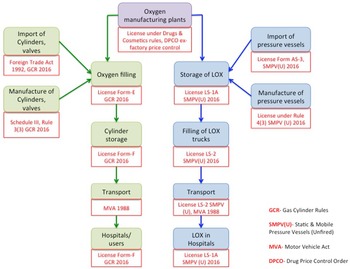
Process mapping of the medical oxygen supply chain starts with the manufacture of oxygen, followed by largely 2 streams: oxygen cylinders and liquid oxygen (LOX). Figure 1 provides an overview of the entire supply chain along with licenses required/statutory requirements for each step, right from the point of production all the way to the point of consumption/end users. The entire system can be studied in 5 parts: (i) manufacture of oxygen; (ii) manufacture, filling, and storage of cylinders; (ii) manufacture, filling, and storage of pressure vessels; (iv) transportation; and (v) hospitals/end-users.
Overview of the medical oxygen supply chain in India.

(i) Manufacture of Oxygen
Demand for medical oxygen during the pandemic has risen almost 4 times, from 750 MT/day to approximately 2800 MT/day. During the COVID-19 pandemic, around 50% of the total LOX production is being used for medical purpose in comparison to around 15% usage during the pre-COVID period. 1 However, the overall production capacity remains more or less the same.
The government implemented measures like diversion of oxygen from other industries 2 and floated a global tender for procurement of liquid oxygen 3 in an attempt to tide over the immediate crisis. Financial viability of cylinder fillers was under question due to which the ex-factory price of oxygen was recently capped. 1
In a desperate attempt to boost overall production capacity, Central Drugs Standard Control Organization (CDSCO) issued circular promising license to manufacturers of industrial oxygen to manufacture medical oxygen within 24 h of applying, under the Drugs and Cosmetics Act 1940 and Rules. 4 Manufacture of oxygen which previously had been tightly controlled and regulated, was loosened during the crisis.
(ii) Manufacture, Filling, and Storage of Cylinders
Oxygen delivery through cylinders is one of the key modalities of oxygen supply, especially for small hospitals, nursing homes, day care facilities, and remote areas. Around 80% of the hospitals in India are less than 50-bed Reference Choudhury and Datta5 and most of them would be dependent on oxygen cylinders for their medical oxygen needs.
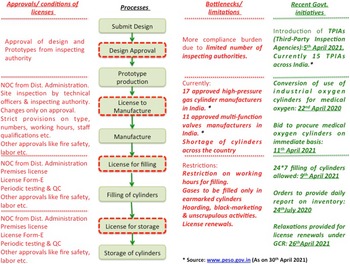
The shortage of oxygen cylinders has become more evident during the pandemic. With only 17 approved high-pressure gas cylinder manufactures 6 and 11 approved multi-function valves manufacturers, 7 India is undoubtedly grappling with shortage of oxygen cylinders. The Government of India has allowed conversion of use of industrial cylinders for filling medical oxygen and floated tender for immediate procurement of oxygen cylinders in a damage control mode.
Figure 2 illustrates the complete process of oxygen supply through cylinders and helps to identify the bottlenecks/limitations.
Oxygen supply through cylinders.

The government has also relaxed the restrictions for filling and storage of oxygen cylinders. Filling of oxygen cylinders round-the-clock has been allowed, which was otherwise not allowed without approval. Even the license renewal process has been relaxed to ease the constraints. Obtaining licenses requires clearances from inspecting authorities, which has been perceived to potentially cause delays, before the pandemic. Enabling Third Party Inspection Agencies (TPIAs) for this purpose is a welcomed step, but so far, there are 15 approved TPIAs across the country. 8 Not-to-mention the other approvals from district administration, fire authorities, labor norms, etc.
Seamless flow of information among all stakeholders is the lifeline for any industrial system. The recent circular instructing all the registered facilities to provide a daily update on inventory status 9,10 sheds light on the lack of real-time data with the regulators. Lack of real-time data can potentially cause delays in decision making at different levels which translates to lesser agility and inertia in the system.
(iii) Manufacture, Filling, and Storage of Pressure Vessels
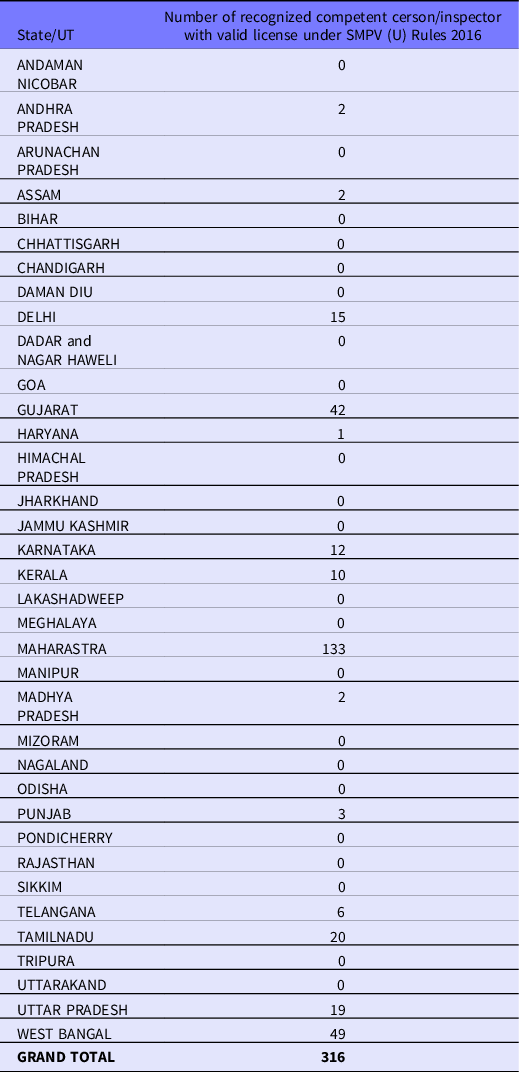
The other important source for larger hospitals and establishments is the LOX, which is also very tightly regulated at every step. Right from the stage of manufacture of pressure vessels to maintaining them with regular filing of compliance requires clearances from recognized inspectors/ competent persons. The PESO official website (as on April 30, 2021) enlists only 316 recognized inspectors/ competent persons with valid licenses across India, with wide regional disparities (Table 1).
State-wise distribution of recognized competent person/inspector under SMPV (U) Rules 2016 (Source: PESO official website as on April 30, 2021)

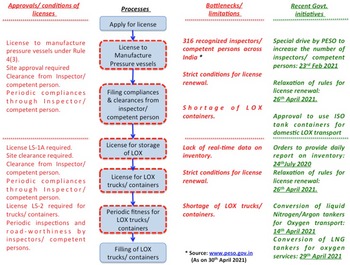
The shortage of LOX containers and trucks has surfaced in light of increase in demand. The Government is grappling with these problems by relaxing certain norms and diverting resources from other industries. Use of ISO tank containers for domestic LOX transport has been allowed. 11 Tankers that were being used for liquid nitrogen/ argon and LNG (liquefied natural gas) are being converted for LOX. 12,13 The renewal process has also been relaxed to hasten the processes. 14
Yet again information gaps are evident from the recent circulars, 9 wherein the regulators do not have real-time information about inventory status. Figure 3 outlines the processes involved in oxygen supply through containers/pressure vessels and highlights the bottlenecks.
Oxygen supply through pressure vessels.

(iv) Transportation
Transportation of oxygen from source to end users is a key aspect and is tightly regulated as well. The conditions of license have strict regulations on all aspects ranging from where these vehicles can be parked, their routes, manpower aspects among others, to ensure safety. Provisions in the Motor Vehicle Act 1988 regulate the inter-district, intra-state, and inter-state movement of these vehicles with restricted timings for plying on roads.
In view of the crisis, the government has intervened at this level as well by relaxing the transport regulations and allowed free movement of oxygen-carrying vehicles across all states and issued orders to this effect as well. 15 Despite these steps, problems persisted, and there was a need for closer monitoring. Recently, vehicle location tracking (VLT) on all oxygen tankers has been ordered for better tracking and real-time information on inventory. 16 The pandemic has, therefore, compelled relaxation of norms and adoption of technology, which otherwise would have been unlikely.
(v) Hospital/End Users
The end user base is diverse ranging from large tertiary care hospitals to small nursing homes and clinics and spread wide across the country. The hospital/health-care establishments also need to have necessary licenses depending on whether their oxygen requirements are met through cylinders or LOX. There are no real-time data on consumption patterns or requirement of oxygen in hospitals, which is yet another blind spot for both industry and policy-makers.
Data-driven decision-making is at the heart of efficient industry and effective policies. In the absence of credible data, both seem to have suffered over the years and in-turn stifled response to the surge created by the pandemic. Whether to prevent hoarding, black-marketing, or to rationalize distribution of oxygen to different hospitals, availability of quality data would have made a huge difference.
Discussion
Value stream mapping approach shows that the entire supply chain right from the point of oxygen manufacture, storage, and transport to the point of consumption has multiple regulatory and compliance steps. Despite being in the best interest of maintaining safety and quality, these have had double detrimental effects during the pandemic.
First, the mainstream/formal system is rendered inefficient with many wasteful steps that render the existing industry less amenable for changes and potentially deters new entrants. This translates to inability to quickly adapt during crises situations like the current pandemic.
Second, such a rigid, restrictive system strongly incentivizes mushrooming of informal sector, which starts fulfilling the needs of smaller users who cannot afford the cost and time overruns of red tape. Wherever there is demand, supply will always find its way. The gray or black markets flourish under such circumstances to meet the needs of small setups like nursing homes, clinics, etc., that cater to the masses.
The government or regulators do not have any data on these gray/black markets and consequently are unable to regulate them. This means a significant segment of health-care could possibly be using medical oxygen from sources where neither quality nor safety can be ascertained. This also reflects in the inability of the government to control black marketing during current crisis.
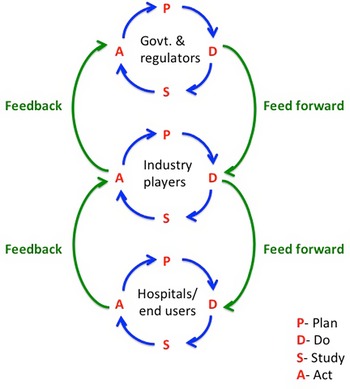
There is almost no real-time data even from the formal channel. The recent circulars mandating daily reporting of inventory status reiterates the same. A robust system requires seamless information flow between all stakeholders, which is clearly lacking in this case. Imagine the government had real-time data on oxygen manufactured, number of cylinders/LOX containers/LOX trucks, their distribution, quality checks, and filling status, the current situation could have been better managed with data-driven policies. Industry players could have innovated and geared up for changing needs and the hospitals/ end users could have improved their systems, as information networks closely knit the ecosystem (Figure 4).
Ideal information flow between stakeholders and continuous quality.

Improvement for a Robust System
The existing system has certainly faltered during the pandemic, with hospitals turning away patients requiring oxygen support or ventilators. Reference Bhuyan17 The domestic industry is not able to meet the rising demand, which has forced government to look for import of oxygen. Reference Bhuyan17 Unless we substantially change the system – the biomedical, maintenance, distribution, and the economic purchasing system for medical oxygen – we would certainly be back in the same situation in 5 y. Reference Usher18
Davidescu et al. studied the main characteristics and perspectives of Romanian Medical oxygen market. The study found that the Romanian medical oxygen market is an oligopoly with a small number of producers and had significant segmentations. Reference Davidescu, Apostu and Stanciu-Mandruleanu19 Even in the current study, it was found that the medical oxygen ecosystem in India is tightly regulated, with not many players and significant regulatory bottlenecks.
The potential solution to these problems lies in digitization and automation. A study from Xie et al. from China emphasizes how predictive modeling and data analytics can be used for optimal allocation of resources in disaster situations like COVID-19, where there is not enough time to ramp up production capacity. Reference Xie, Tong and Guan20 A location-based ubiquitous crowdsourcing approach for emergency supply of oxygen cylinders for patients in need by El Barachi et al. demonstrates how technology platforms can be leveraged. Reference El Barachi, Kamoun and Hachani21
Informational continuity is the foundation for building a credible digital solution Reference Gowda, Kumar and Arya22,Reference Gowda, Satpathy and Singh23 for monitoring. The majority of parameters involved in all the processes of medical oxygen are objective and machine-readable. This means KPIs (Key Performance Indicators) can be measured, captured, shared, and monitored in near real-time across a common network working on IoT (Internet of Things) or Block chain. This can help to create a robust system with continuous quality improvement as illustrated in Figure 4.
Conclusions
There is absolutely no doubt that safety and quality are of paramount importance for medical oxygen. This essentially calls for strict monitoring and tight regulation of all steps/processes, without which the safety of people working in the industry and the patients will be equally at risk. It is also pertinent to note that the existing regulatory processes have served well during normal times ensuring sufficient medical oxygen supply in the system.
However, there is a thin line between “Regulation” and “Restriction”. The pandemic has shown that the existing systems lean more toward being restrictive. Systems which had smoothly functioned during normal times struggled to cope with the medical oxygen crisis due to the pandemic. There is more deterrence and burden on players in the formal/ mainstream who fall under the “Regulatory” ambit, which has its obvious fallouts.
Effective regulation should actually improve the overall quality and safety by bringing in better monitoring without causing unnecessary obstructions in the process-flow. A single-window system for entrepreneurs to set up factories, obtain licenses, periodic renewals of licenses, and file periodic compliance reports can help improve ease of doing business and in turn create capacity to handle any future surges.
Technology-enabled, data driven, and artificial intelligence (AI) powered real-time monitoring of specific safety and quality indicators can not only strengthen regulatory authorities, but also reduce the compliance hassles of manual and random checks by inspectors, which will create ease for industry. Industry players can be incentivized to shift from the informal side to the mainstream by simplifying the processes, which can be a game-changer.
Bringing in technology-based data-driven regulatory processes with minimum discretionary human interface is the way forward. Digital India Mission and its components like e-Governance have been creating remarkable ease for citizens and businesses in other sectors. The current crisis opens an opportunity to introspect and revamp the medical oxygen industry with digitization and align it with Make in India and Start-up India initiatives. These can make the medical oxygen industry more agile to demand shocks in the future as well, improving the overall preparedness and capability to respond.
Data availability statement
All relevant data are part of the manuscript and are being shared.
Author contribution
The study was conceptualized by Dr. Naveen R Gowda and Dr. Vikas H. Necessary data collection, review of official circulars, memos, government gazette notifications relevant to the study was done by all authors, findings were discussed and factored-in. Visualization was prepared by Dr. Naveen R Gowda which was reviewed by Dr. Vijaydeep Siddharth and Dr. Parmeshwar Kumar. Dr. Naveen R Gowda prepared the manuscript and all the authors reviewed and approved it. Dr. Prakash Swaminathan and Dr. Atul Kumar also supported in curating references.
Funding
This research received no specific grant from any funding agency in the public, commercial or not-for-profit sectors.
Conflict of interest
None.
Patient consent
Not applicable.
Ethical Standard
Not applicable.