Introduction
Lower income individuals consume fewer fruits and vegetables than their higher income counterparts (Bowman, Reference Bowman2007; Lallukka et al., Reference Lallukka, Pitkäniemi, Rahkonen, Roos, Laaksonen and Lahelma2010; Moore et al., Reference Moore, Dodd, Thompson, Grimm, Kim and Scanlon2015), which may contribute to the prevalence of and disparities in diet-related disease (Freeman, Reference Freeman1989; Gamm et al., Reference Gamm, Hutchison, Dabney and Dorsey2002; He et al., Reference He, Nowson and MacGregor2006; Wang and Beydoun, Reference Wang and Beydoun2007; Wang et al., Reference Wang, Ouyang, Liu, Zhu, Zhao, Bao and Hu2014). The cause of these disparities is multifactorial, including limited access to foods that are affordable and healthy (Larson et al., Reference Larson, Story and Nelson2009). This is particularly true in rural areas, where people consume fewer fresh fruit and vegetables than their urban counterparts (Lutfiyya et al., Reference Lutfiyya, Chang and Lipsky2012; Lin, Reference Lin2005).
One growing but understudied approach to addressing this access issue is through local food markets, including Community Supported Agriculture (CSA) models (Andreatta et al., Reference Andreatta, Rhyne and Dery2008; Ver Ploeg et al., Reference Ver Ploeg, Breneman, Farrigan, Hamrick, Hopkins and Kaufman2009; Quandt et al., Reference Quandt, Dupuis, Fish and D'Agostino2013; Leone et al., Reference Leone, Haynes-Maslow and Ammerman2017; Vasquez et al., Reference Vasquez, Sherwood, Larson and Story2017). In a typical CSA model, consumers buy a share of the farm produce for the upcoming season, with a preseason lump sum payment (DeMuth, Reference DeMuth1993). They then receive weekly shares of fruits and vegetables (sometimes called produce boxes) at distribution points throughout the growing season (Goland, Reference Goland2002). The ability to have flexible distribution points may meet the geographic access needs of many low-income individuals. CSAs may also increase exposure to healthier foods and reduce exposure to less healthy items that are typically found in the supermarket (SM) setting. CSA program participants report some healthier dietary behaviors (Cohen et al., Reference Cohen, Gearhart and Garland2012; Curtis et al., Reference Curtis, Allen and Ward2015; Wharton et al., Reference Wharton, Hughner, MacMillan and Dumitrescu2015). Currently most CSA programs have a membership composed of primarily middle to upper-income households, with few low-income individuals (Cooley and Lass, Reference Cooley and Lass1998; Russell and Zepeda, Reference Russell and Zepeda2008; Landis et al., Reference Landis, Smith, Lairson, Mckay, Nelson and O'Briant2010; Hanson et al., Reference Hanson, Kolodinsky, Wang, Morgan, Pitts, Ammerman, Sitaker and Seguin2017; Vasquez et al., Reference Vasquez, Sherwood, Larson and Story2017), and standard CSA models have been termed elitist by some critics (Ostrom, Reference Ostrom1997; DeLind, Reference DeLind2004). This is likely because few CSA programs have been designed for lower-income populations (Quandt et al., Reference Quandt, Dupuis, Fish and D'Agostino2013; Leone et al., Reference Leone, Haynes-Maslow and Ammerman2017), as the typical lump sum financial commitment to the farmer before the growing season may be a deterrent for limited resource populations, along with other factors like size and frequency of the shares (Andreatta et al., Reference Andreatta, Rhyne and Dery2008). One approach to improving access to CSAs for this population is a cost-offset CSA, where the prices of the shares are subsidized to make them more affordable. In the USA, different models have been used to subsidize the cost of the shares to make them affordable for low-income consumers and viable for farmers, including pay as you go, Supplemental Nutrition Assistance Program (SNAP) match (Double UP Food Bucks, where a match is made toward the cost of the share for SNAP benefits used) and sliding fee scales (Portland Area Community Supported Agriculture, 2017; Wen Jay Reference Wen Jay2010; Quabbin Harvest, 2017; United States Department Agriculture 2015).
Despite these efforts, it remains unclear what CSA model features would be most appealing to a low-income population in order to maximize program utilization. Understanding participant preferences are imperative for program development and program success and a lack of understanding might lead to wasted resources and ineffective programs (Adamowicz, Reference Adamowicz2004; Rogers, Reference Rogers2005). For farmers offering CSA programs, identifying a previously unreached, low-income population may increase customer base, improve market share, increase working capital, increase community engagement and relationship building, and allow for more equitable access to food (Paul, Reference Paul2015). An adaptation of a choice experiment, an econometric non-market valuation stated preference technique, in which decisions of individuals are used to elicit their preferences for the items of interest, can be used to identify preferences to influence participant shopping behavior (McGuirt et al., Reference McGuirt, Pitts, Ward, Crawford, Keyserling and Ammerman2014).
To our knowledge, no published peer-reviewed studies have completed an in-depth formative evaluation to understand the preferences of low-income participants regarding a CSA program using a modified choice experiment approach. Without this understanding, such programs may lack uptake, effectiveness and sustainability. Quandt et al., Reference Quandt, Dupuis, Fish and D'Agostino2013 suggested that altering some of the financial and operational aspects of traditional CSA programs will be necessary to improve CSA participation in a limited resource audience. Therefore, this study aims to understand low-income consumer's ‘stated preference’ for participating in a CSA program, given particular price, frequency, food quantity and accessibility conditions using an exploratory modified choice experiment approach which combines quantitative and qualitative data collection.
Methods
This formative evaluation was completed as part of a larger US Department of Agriculture (USDA) funded Agriculture and Food Research Initiative (AFRI) to evaluate Cost Offset CSA participation as a strategy to improve dietary quality in low-income families, the Farm Fresh Foods for Healthy Kids (F3HK) Study (Seguin et al., Reference Seguin, Morgan, Hanson, Ammerman, Pitts, Kolodinsky, Sitaker, Becot, Connor, Garner and McGuirt2017). The research project was completed in four geographically diverse states (in which the F3HK intervention would later be implemented) of North Carolina (NC), New York (NY), Vermont (VT) and Washington (WA). For this study, the choice experiment approach was modified to an exploratory mixed-methods approach that included both quantitative direct questioning and qualitative probes within an in-depth interview. This modification was made in order to more comprehensively understand CSA participation intentions, which would allow for triangulation of data sources and a deeper understanding of why certain decisions were being made. In-depth, in-person interviews were conducted with low-income adults (10–11 per state, total = 42). This sample size is similar to the sample sizes of previous mixed-methods qualitative research studies (Denzin and Lincoln, Reference Denzin and Lincoln2011). While the sample size is small for a choice experiment, this exploratory approach is able to detect differences in preferences and is similar to related published choice experiment literature despite using a relatively more intensive approach (de Bekker-Grob et al., Reference De Bekker-Grob, Donkers, Jonker and Stolk2015).
Participants were recruited across the four states to survey a diverse group of potential participants for this type of program given possible geographic and cultural differences. The sampling approach used was a targeted convenience sample to recruit participants similar to those who would be eligible for the Cost Offset CSA intervention. Eligibility criteria included: (1) primary caregiver of a child in the household between the ages of two to 19 years and (2) self-reported income ⩽185% federal poverty level or Expanded Food and Nutrition Education Program (EFNEP) eligible. Participants were passively (e-mails and flyers) and actively (in-person recruitment) recruited from sites most likely to provide access to this demographic, including schools, local health departments and/or social service departments (or similar agencies). Participants were approached, or they contacted the study team and they were screened to ensure eligibility and willingness to participate. This study was approved by the university Institutional Review Board and all respondents provided written informed consent.
The modified choice experiment technique, based on McGuirt et al. (Reference McGuirt, Pitts, Ward, Crawford, Keyserling and Ammerman2014), was utilized to quantitatively and qualitatively examine willingness to travel to and participate in the CSA program given hypothetical scenarios of relevant shopping factors, including travel distance, share size, share frequency and price points. Factors were asked separately and in combination (e.g. distance and amount). In order to ease participant interpretation of the survey and provide a more nuanced view of how intra-variable variation might influence willingness, typically one variable was held constant at one of its levels while the other variable was modified sequentially. For content validity, the instrument was developed based on the existing literature of factors influencing purchase of fruits and vegetables among the low-income (Larson et al., Reference Larson, Story and Nelson2009; Lutfiyya et al., Reference Lutfiyya, Chang and Lipsky2012; Lin, Reference Lin2005) and on input and recommendations from topical experts on the F3HK project team who provided extensive insight regarding factors related to shopping decisions among low income individuals through both team-wide instrument development meetings and independent review. The instrument was tested among study staff and, changes were made to improve question content and format.
Respondents were first provided with the following detailed description of CSA to account for potential baseline differences in knowledge of CSA: ‘A CSA is a partnership between a local farmer and customer in which the customer pays the farmer a set price for a ‘share’ of the farm's harvest. Some farmers deliver a box of produce to a pick-up site on a set day and time each week, and other farmers ask customers to pick-up their share of the produce at the farm. Each produce share contains a variety of the farm's seasonal fruits and vegetables, but the customer often does not choose which items they receive.’ They were then given a detailed description and instructions for completing each section of the exercise and asked their stated preference for each of the following scenarios (see the instrument in Appendix 1):
1. Defined CSA price by share type (including participant stated price willing to pay)
2. Incremental distance to pick up CSA in minutes (including mode of transportation: Car, Walking, Bike, Public Transport)
3. Distance to CSA pickup and CSA price combined
4. CSA share frequency and price combined
5. CSA share size and frequency combined.
Respondents were then asked to identify willingness to participate in a CSA vs purchase from a SM, with the two scenarios being:
1. CSA cheaper than SM (same distance and CSA 5, 10, and 15 min further)
2. CSA more expensive than SM (same distance and CSA 5, 10 and 15 min closer).
Questions were asked in a structured, non-randomized sequence to build up sequentially through varying conditions in order to improve flow and not break logical build-up. Overall, there was a maximum of 95 responses per participant and it took an average of 20 min to complete. The four CSA example share sizes used in the share size scenarios were constructed based on a typical six to eight-item large CSA share (see Fig. 1) (Goland, Reference Goland2002; Oberholtzer, Reference Oberholtzer2004), with size variations presented (Starter Share, Half Share, Full Share Low-Variety, Full Share-Standard Variety) to give a wider range of possible choices. For scenarios including the factor of price, four prices were offered (US$8, US$10, US$15 and US$20) similar to or less than typical weekly CSA share prices (Goland, Reference Goland2002). For the ‘Share Type and Price’ scenario, respondents were first asked for the price they were willing to pay for each share type and then asked their willingness to pay each price offering in increasing order of amount. Respondents were also asked which share they found ‘most appealing’ for each type, frequency and price group scenario. For the ‘Distance willing to travel,’ and ‘Distance and Price’ scenarios, the Full Share Standard Variety share (see Fig. 1) was given to represent a typical share in order minimize the response burden of asking respondents about three varying factors at once.
CSA Share Examples from Exercises.

Respondents were then shown images of produce items available across all study regions and asked to create their ideal share, identifying the items they generally wanted, the number of items they wanted (in units or pounds) and the price they were willing to pay for the share. Amounts were totaled and the mean calculated for each produce type. Interviewers asked probing questions as part of the exercise, including the reasons why certain items and quantities were chosen, whether they could eat all items in 1 week without them spoiling, and which items they would want that was not pictured.
For response process validity, interviewers were trained on how to use the instrument, including details on how to ask and code each scenario, across study sites via webinar, both test takers and interviewers were provided with detailed instructions for completing the exercise with respondents, and qualitative probes captured the level of understanding of the concept being tested. The exercise was audio recorded with detailed hand-written notes and transcribed verbatim. All surveys were independently double tabulated and researchers met periodically to resolve discrepancies by consensus. As such, no inter-rater reliability can be calculated. All audio transcripts were coded using a detailed codebook with inductive codes (codes developed from the raw data) and deductive codes (pre-determined codes based on previous research and theory).
Analysis
For each independent scenario (95 per respondent), the number of respondents willing to participate in the CSA program was summed to obtain a total number of respondents willing to participate. In a few instances, ‘Maybe’ was recorded by research staff (even though not recommended by protocol), which was classified as not being willing. Percentages of respondents willing to participate in the CSA for each price/accessibility situation were generated. The primary analysis for this study was using McNemar's Test to examine for statistically significant differences in willingness across two paired categorical value levels (e.g. Yes/No for Full Share at US$15 versus Full Share at US$20; Yes/No for Full Share versus Half Share, both at US$15). The following equation provides an example:

 $$\hbox{X}^{\rm 2} = \displaystyle{{{(b - c)}^2} \over {\hbox{b} + \hbox{c}}}$$
Only scenarios with large differences in willingness (determined through testing of counts beforehand to establish a general tipping point (n = 7) for significance) were tested to reduce the risk of Type 1 error. To reduce Type 2 error, large yet meaningful increments were used for each category to elicit a larger effect from the change (e.g. US$15–20 rather than US$15–16). Summary statistics from nominal and dichotomous categorical variables from the ‘Ideal share’ scenario and ‘Most appealing share option’ were also generated.
Results for each scenario were separated by self-identified race (White (Non-Hispanic) vs non-White) to examine differences in willingness to participate. Race-ethnicity was collected with five response options but was subsequently combined due to low response in some categories. The continuous variables of age (⩽33 vs ⩾34 years; dichotomized to form equal groups to maximize power), total number of household members (⩽4 people vs ⩾5 people), State (NY, NC, VT, WA) and number of children in the household (⩽2 children vs ⩾3 children) were first dichotomized to examine for differences between each group with each scenario and then analyzed as continuous variables if large differences were seen between the two groups. This approach was taken to reduce the amount of statistical testing. Thus, for each scenario that suggested significant differences, associations between willingness to participate (Yes/No) and the continuous variables ‘Age’, ‘Total number of household members’, and ‘Number of children in the house’ were examined using logistic regression. McNemar's exact test (two-tailed) was used to examine associations between the categorical variable of Race and State with a willingness to participate (Yes/No). Normality was tested for non-categorical variables of interest using the Shapiro Wilk Test. Groups were compared for statistically significant differences from one another for the variables of ‘Share amount price willing to pay’ and ‘Ideal share produce amounts and price point’, using One-way ANOVA and Student's t-tests for normal distributions and Mann Whitney Wilcoxon Test (two-tailed) for non-normal distributions. The level of statistical significance defined for all analyses was p ⩽ 0.05. Quantitative data were analyzed using R Studio and qualitative data were analyzed using NVivo 11.
Results
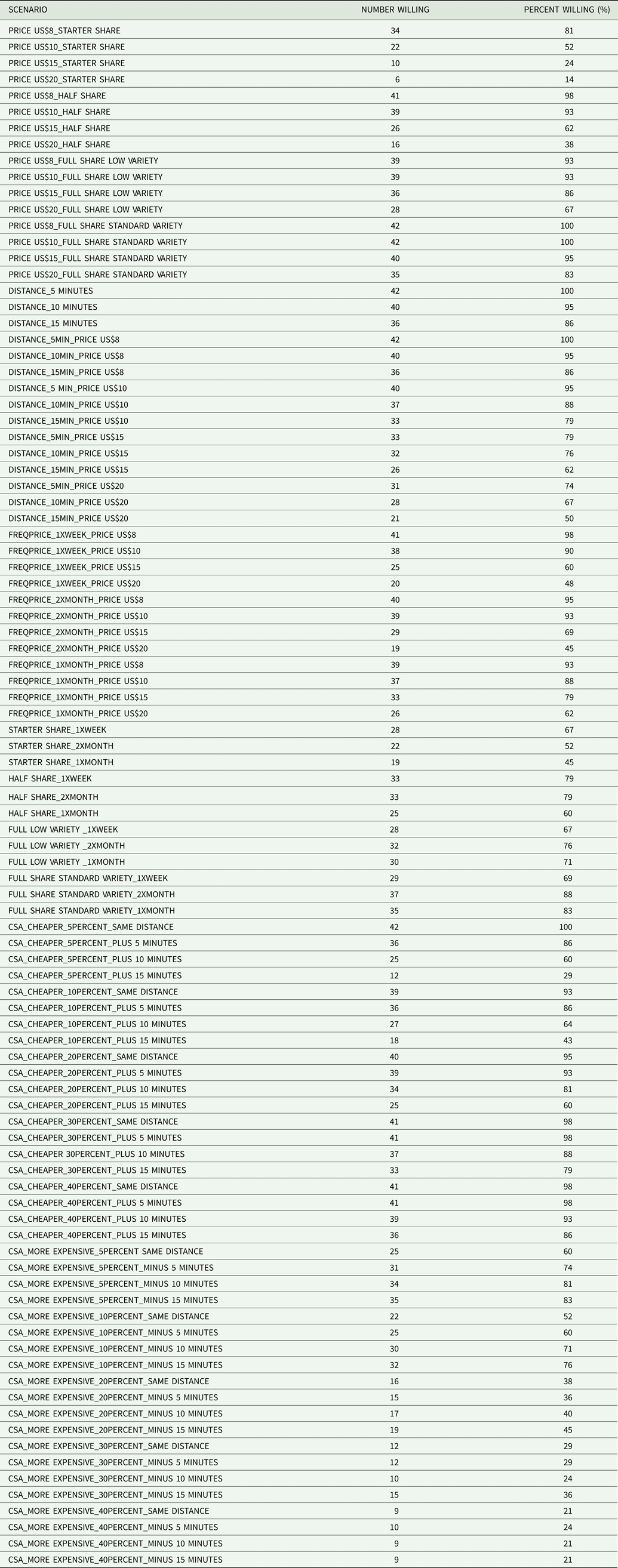
The 42 participants recruited for the larger formative evaluation, who all participated in the choice experiment, were on average 35-years-old and the majority were Female (90%); 50% were White, 33% were Black, 10% were Hispanic and 7% other races; and had an average of 2.3 children in the household (Table 1). The demographics of this sample is similar to national EFNEP demographics (who might be a primary population of interest in a CSA program for low-income) in terms of age [27% ages 30–39 (highest percentage)], number of children in household [27% with 2 children, (second highest percentage behind 1 child)], gender (85% female), and race (55% White, 23% Black, 26% Hispanic) (EFNEP National Report, 2017). There were statistically significant differences by Age [overall P = 0.04; NY (mean = 41.3) vs NC (mean = 31.1) P = 0.03)] and Total in Household [P = 0.02; (NY (mean = 2.9) vs WA (mean = 5.0) P = 0.01], and NY had the four males in the study. Most participants (73%) had no prior awareness or knowledge of a CSA model. A summary of all scenarios can be found in Table 2.
Demographic characteristics of participants completing the choice experiment (N = 42).

Summary of willingness to participate in csa for all scenarios.

Preferences for CSA type and price
Willingness to participate in the CSA and the price participants were willing to pay increased as the share size became larger and decreased as the price of the share increased (Fig. 2) (Table 3). The highest willingness to participate was for the Full Standard Variety share at US$8 (n = 42), and the lowest was for the Starter Share at US$20 (n = 6). The smallest overall decrease in willingness across increasing price points was for the CSA Full Share Standard Variety and the largest overall decrease in willingness was for the Starter Share. There were statistically significant decreases in willingness to participate with the Starter Share as the price rose from US$8 to 10 (P = 0.01) and again from US$10 to 15 (P = 0.01). Willingness to participate in the Half Share also significantly declined as the price rose from US$10 to 15 (P = 0.001) and from US$15 to 20 (P = 0.05). There were statistically significant increases in willingness to participate with the Full Share Standard Variety compared with the Starter Share at all prices—at US$8 (P = 0.005), US$10 (P < 0.001), US$15 (P < 0.001) and US$20 (P < 0.001) and also compared with the Half Share at US$15 (P < 0.001) and US$20 (P < 0.001).
Willingness to participate in CSA Share by Price and Share Size.

Participant defined price willing to pay by share size (N = 41).

Respondents mentioned that they liked having a variety and a larger amount: ‘I just like a variety of different stuff. And the children, they hate to eat the same things all over and over and over again.’ (NC Participant); ‘It's got a lot of, a different variety of stuff, so yeah it'd be great. If it's all useful, then it's worth every dime.’ (WA Participant); ‘Just cuz I got more mouths to feed, so it'll last longer.’ (NC participant)
Distance willing to travel
The majority of respondents would travel by car (n = 35, 83%), though some would walk (n = 5, 12%) or take public transit (n = 2, 5%). For those traveling by car, the mean maximum distance willing to travel for the Full Standard Variety share was 24 min (range of 5–60 min), with most (74%, 26/35) willing to drive 15 min. For the few who reported walking, the mean maximum distance willing to travel was 32 min, with most willing to walk 15 min (80%, 4/5). For the two who reported taking public transit, one was willing to travel 20 min and the other 15 min.
The distance respondents were willing to travel was often influenced by their ability to complete other shopping tasks along the way: ‘Thirty minutes {max distance}, if I know it's gonna be somewhere that's I can get some other shopping done.’ (NC Participant) The distance was particularly a factor for those who walked, as the task of carrying the share long distances was a concern: ‘I wouldn't walk too far because I wouldn't wanna carry it all back, so, you know, have a heavy load.’ (NY Participant)
Distance and price preferences
All respondents were willing to participate in the standard CSA share when at the lowest price and shortest distance (US$8, 5 min), but 50% of respondents were willing to participate with the CSA at the highest price point and distance (US$20, 15 min) (Fig. 3).
Willingness to participate in CSA Share by Price and Distance.

Respondents talked about the value of their time and effort as it compared with the cost of the share and the distance traveled: ‘For 20 dollars, I don't think I would make a 40-minute trip for that. That would be kinda tough.’ (NY Participant)
Share frequency and price preferences
The most popular share was ‘One time per week for $8’, and the least popular share was ‘Two times per month for $20’ (Fig. 4). Respondent's willingness to participate decreased as the price increased across all frequency categories. The one time per month share had the highest willingness at the US$20 price point. For the one time per week frequency, half of the respondents were willing to pay US$20, with a statistically significant difference in willingness to pay US$10 and 15 (P = 0.002). For shares distributed two times per month, there was a statistically significant difference in willingness to pay between US$10 and 15 (P = 0.01).
Willingness to participate in CSA Share by Frequency and Price.

Participants’ willingness under certain frequency and price combinations was influenced by the need to space out distributions in a certain time span, and the ability to pay a given amount. As one WA participant said: ‘It wouldn't be something that's a weekly, or payment-wise repetitive every two weeks. It would be once a month, I pay 20 dollars, I drive 5 min, and I get a variety of really fresh, farmer's vegetables. It just sounds really good.’ (WA participant)
Participants were varied on reasons they did not want a certain frequency/price combination, including being too expensive, too much or too little produce, or too infrequent. One participant stated: ‘Because it seems like that would add up fast.’ (NC participant). Another participant stated: ‘Because like two weeks is enough time, if you get off one week, then you're… like, messing up the flow of your healthy eating because it's a lifestyle… not a, just like, okay, once a month I eat some vegetables. It's not like that.’ (NY participant)
Share size and frequency
Respondents were most willing to participate with the ‘Full Share Standard Variety 2 times per month option and least willing to participate with the ‘Starter Share 1 time per month option. Regardless of frequency, respondents were most willing to participate in the Full Share Standard variety (n = 34) and least willing to participate in the Starter Share (n = 23) (Fig. 5). There was fairly equivalent willingness in CSA Shares available once (n = 27) or twice (n = 31) per month. The largest increase in willingness (+8) was for the Full Share Standard Variety between one time per week to two times per month, and the greatest decrease (−8) was the Half share from two times per month to one time per month. There were statistically significant increases in willingness at two times per month from Starter Share to Half Share (P = 0.02) and Full Standard Variety (P < 0.001), and at one time per month from Starter Share to Full Standard Variety (P < 0.001) and Full Low Variety (P = 0.03) and Half Share to Full Standard Variety (P = 0.03).
Willingness to participate in CSA Share by Frequency and Amount.

Several respondents said that they were concerned about produce spoilage and financial burden with frequent (weekly) larger Full Standard shares and that spacing the shares out would be appealing. ‘The timeframe to use it up {would be difficult}. And as far as income…I'm more likely to have the funds to do that every other week than maybe weekly.’ (NY Participant) However, spacing out to one time per month was not frequent enough, and they thought that the produce would not last: ‘Because those vegetables don't last a month. You have to cook them earlier than that.’ (NY Participant)
Ideal CSA share contents
The mean number of types of produce that participants found generally desirable among all the items was 18.5 (R = 5 30; s.d. = 7.2) items, but the mean number of items wanted in their ideal share was 12.8 items (R = 5 27; s.d. = 5.5). The mean ideal price respondents were willing to pay for this share was US$30.70 (R = US$8 to US$125; s.d. = 21.7) and mean highest price they would pay was US$40.13 (R = US$10 to US$125; s.d. = 23.5). Most thought that they could eat all of the produce in their ideal weekly share (33/40 = 83%). Those that did not think they could eat all the produce (7/40 = 17%) mentioned storing or freezing the remaining produce. Respondents said that they could eat all of the produce because it is how much they normally eat: ‘Yeah. They (children) love to snack, constantly asking for it. So as far as the fruits and vegetables go, I could do a lot with it. Just using it daily.’ (WA Participant)
The top requested items in the ideal share are listed in Table 4. Many said they were choosing items based on foods they or their children liked or typically ate: ‘Those are what we eat more often. Those are what the kids enjoy eating and they can eat on a daily basis.’ (NY Participant) Snacking, using the produce for salad or other specific recipes or dishes, the versatility of items and the healthiness of items were all commonly mentioned. Respondents’ reasons for not wanting some items were because they did not like them or were unfamiliar with them.
Ideal box requested items and amounts.

CSA less expensive than SM
Respondents expressed increasing willingness to participate in a CSA share compared with the SM as savings with the CSA increased for all distances (Fig. 6). The highest willingness was found for ‘Same Distance’ and ‘5 min further to CSA with a 40% discount’ and the lowest willingness was for the ‘CSA 15 min further and 5% discount’. There were 11 (11/41 = 26%) respondents who would participate in the CSA no matter what and zero that would not participate under any circumstances. Statistically significant differences were found for the 5% discount between 5 and 10 min further (P = 0.01) and 10–15 min further (P = .001), and for 10% discount between 5 and 10 min further (P = 0.03).
Willingness to participate in CSA Share when CSA Less Expensive than the Supermarket, with distances being same, 5, 10, and 15 minutes further.

Many were attracted to the monetary discount: ‘If I could pay this, I don't care how far it is, I'm going. For all of them. I love feeling like I'm getting a deal.’ (NY Participant)
CSA more expensive than SM
A summary of the findings for the ‘CSA More Expensive than the Supermarket’ scenario can be found in Figure 7. Respondents were decreasingly willing to participate in a CSA share as savings at the SM increased for all distances and increasingly willing as closeness to the CSA increased. The highest willingness was for the 15 min closer 5% discount at the supermarket’, and the lowest willingness was at the ‘40% discount’ choice across multiple distances. There were four respondents (4/41 = 10%) who would not participate in the CSA under any of circumstances when it was more expensive and five (5/41 = 12%) respondents that would participate in the CSA under all circumstances. Statistically significant differences were found between the 10 and 20% price savings at the SM when the CSA was 5 min (P = 0.046), 10 min (P = 0.007), and 15 min (P = 0.006) closer.
Willingness to participate in CSA Share when CSA More Expensive than the Supermarket, with distances being same, 5, 10, and 15 minutes closer.

Respondents mentioned needing to get the most for their money: ‘It's really easy. I think any human being is going to choose discount over…even if it is fresher and better…unless you're like a head-goin', vegetable-thumping lover. It doesn't matter if it's SM or the CSA. It's a matter of price.’ (WA Participant) ‘If it was the cheaper price. I would buy from the SM. I would have to go where I could get the most of my money, better bang for your bucks.’ (NY Participant), though some would get the CSA no matter the price savings at a SM given the perceived superior quality: ‘But you may have better quality. And that's my thing, if I know it is better quality, I wouldn't mind paying that price.’ (WA Participant)
Differences by household characteristics
A summary of differences by household characteristics can be seen in Table 5. For children in the household, fewer children in the household were associated with an increased willingness for ‘CSA 5% Cheaper and 10 min further than supermarket’ (P = 0.03). There were no statistically significant differences by household size. There were statistically significant differences across States with certain scenarios. Respondents from WA frequently had the highest willingness with the CSA when the SM and CSA were the same distance but CSA more expensive, with particularly large differences in willingness compared to NC respondents.
Differences in willingness by household characteristics.

Discussion
Families with children and low incomes on average preferred a CSA share of eight to nine items of mixed variety, distributed every other week (2 times per month), priced at less than US$15, no more than 10 min further than the SM and preferably less expensive but no more than 20% more expensive than SM prices. Overall, these findings reinforce the idea of strategic food shopping among low-income families to get the best value for their money (USDA, Reference Kathryn, Melody, James, Jim, Julie, Sara, Nicholas and Swetha2013; Hanson et al., Reference Hanson, Connor, Olson and Mills2016).
Our findings of willingness to spend on a CSA are similar to the typical spending habits of US low-income populations on weekly produce purchases but lower than the average price nationally for a CSA share. For individuals who are income eligible for the SNAP (⩽150% poverty level), the average monthly expenditure for produce ranges from US$12.50 to 13.75 per week (US$50–55 per month) (Guthrie et al., Reference Guthrie, Biing-Hwan, Ver Ploeg and Frazao2007). Our findings reflect this price threshold, as once the price level reached US$15 respondents were most willing when receiving the share once per month. Importantly, this amount seems to be less than typical CSA prices of US$17.88 per week (Tegtmeier and Duffy, Reference Tegtmeier and Duffy2005), ranging to US$31 per week in some parts of the country (Berube, Martin, and White, Reference Berube, Martin and White2017), though availability of this data is limited and may be outdated due to the growing complexities of CSA pricing models. CSA's in the USA typically deliver weekly shares for an average of 24 weeks (Tegtmeier and Duffy, Reference Tegtmeier and Duffy2005; Brown and Miller, Reference Brown and Miller2008), so the every 2-week delivery preference would be an adjustment for farmers, who may need to adjust growing, harvesting, and distribution schedules and may have implications for their business model if payments are made less often. Research has also shown that in some locations there is a price saving for CSA produce compared with similar produce from local retail markets (Farnsworth et al., Reference Farnsworth, Thompson, Drury and Warner1996; Handy and Niemeier, Reference Handy and Niemeier1997; Cooley and Lass, Reference Cooley and Lass1998), so the findings from this study may be useful in understanding willingness under that condition. Information from the literature on the typical items found in shares and the average distance that customers travel for their CSA pickup was not found, so a comparison with the findings from this paper cannot be made. With few statistically significant differences between these states regarding demographic variables, differences in willingness may be partially due to cultural influences and market penetration of the CSA model (United States Department of Agriculture, 2014).
Respondents frequently mentioned that they were willing to travel further for the CSA if they could do additional shopping along the way. This planned multipurpose trip approach, or ‘trip chaining,’ has previously been seen in the literature (Sabih and Baker, Reference Sabih and Baker2000; Sharkey, Reference Sharkey2009). Willingness to participate in the CSA was also significantly increased or decreased based on distance to the SM. Locating pickup sites at places with other shopping opportunities, but not too close to SMs (given the general preference for the SM when it was closer or a similar distance to home), may be an important strategy for CSA distribution.
Farmers offering CSAs might find the economic implications of these results of interest. Evidence suggests mixed levels of profitability for farmers offering a CSA and oftentimes inadequate economic returns on labor (Cone and Myhre, Reference Cone and Myhre2000; Lass et al., Reference Lass, Bevis, Stevenson, Hendrickson and Ruhf2003; Brown and Miller, Reference Brown and Miller2008; Galt Reference Galt2013), despite the expected benefits of financial security, reduced marketing demands and decreased production costs (Sabih and Baker, Reference Sabih and Baker2000; LeRoux et al., Reference LeRoux, Schmit, Roth and Streeter2010). While reaching a low-income audience might require modifications to CSA models, the potential economic return of reaching additional customers may make this attractive to farmers.
A strength of this study was the mixed methods approach, which allowed for a more comprehensive understanding of preferences. The examination of multiple factors at once was also a strength, as assessing single factors may not accurately represent the complex nature of shopping decisions. Lastly, the sample was pulled from four different states, included individuals of different races and household size, creating a non-homogenous sample.
This study also had limitations. Shopping influences may be more complex than the two to three factors tested concurrently in this study, as behaviors might also include both observable and unobservable factors and be based on accumulated knowledge and experiences in daily life. It is challenging to conduct a test of more than two shopping factors at a time because it creates a large respondent burden which can negatively impact response rates and data quality. This study utilized a structured question order from simplest to most complex scenarios (rather than a randomized approach to questioning) in order to increase respondent comprehension and facilitate interviewer rapport. Despite limiting choice scenarios to two to three conditions at a time, there may have been some response bias from interview fatigue given a large number of conditions tested. Significant differences identified among the simpler conditions tested earlier in the sequence, therefore, can be considered most robust. There may also be a systematic bias among those who chose to participate given the convenience sampling approach. Furthermore, qualitative probing of the reasons why respondents made certain decisions supported quantitative results and added important detail. The research team did not use a sequential factorial design, which may be a similar but different way of examining this issue and should be considered for future studies given the potential for the elucidation of the dynamics of consumer willingness to participate in the CSA. The approach taken in this study possibly allowed for easier interpretation (given that one variable was held constant at varying levels while the other variable was modified sequentially) and a more nuanced view of how intra-variable variation might influence willingness, but a factorial design may have further elucidated how varying levels between each factor may have influenced participation. The small sample size may have limited generalizability and the ability to conduct some statistical testing, including limiting analysis to mostly dichotomous rather than continuous variables, which may have been more meaningful. Small effects may have been missed in this small sample and thus our findings are likely conservative in nature and non-significant outcomes should be interpreted with some caution. Coding ‘maybe’ as ‘not willing’ to participate may have led us to miss some instances of willingness. Willingness to participate based on hypothetical scenarios may differ from a willingness to participate in reality. Our study also assessed weekly payment, which is not the traditional model for a CSA but an emerging approach (New Entry Sustainable Farming Project, 2012) but may be a required modification for a low-income audience.
Future work should test the instrument for additional aspects concerning validity and reliability, including whether these preferences influence choices in reality. Consideration should also be given to expanding or refining factors to values that are most meaningful to both farmers and potential consumers, including expansion of price points, payment types and distances willing to travel.
Conclusion
The findings from this study contribute knowledge and may inform future research to develop an evidenced-based approach to design and modify CSA programs to make it a viable food access approach for low-income audiences lacking access to fresh fruits and vegetables. Our findings suggest that low-income consumers want CSA only every other week (which is less often than the typical CSA) and want a fairly close pick-up of no more than 10 min out of the way (which is quite different than the typical ‘come to the farm’ model). There are also several important real-world applications and implications that can be derived from this research. Farmers and health intervention professionals could use choice experiment methods as a tool in tailoring CSA programs to fit the needs of low-income individuals. Using the choice experiment tool to determine localized customer preferences could help farmers customize their operations to fit local needs, particularly given differences in demographic characteristics, cultural norms and CSA market penetration. Administration of the tool to prospective customers before CSA program development, either through direct (in-person) or indirect (online survey) approaches, could help inform the location, price, frequency and duration of CSA shares in order to better ensure active participation, though it may signal a movement away from the traditional SA model and towards a more customized food box approach. Similarly, administration of the tool during or after CSA program implementation could be used to modify existing practices or to determine why the existing program structure is not meeting consumer or distribution needs. It is important to note that not all farmers have the capacity to customize their CSA to that level or the willingness as it is a move away from the original CSA model.
Several policy level and administrative recommendations could be informed by the findings of this research, though more expanded research is needed to confirm these findings. Given the monetary gap between typical expenditures on produce among low-income individuals and the cost of a typical CSA, further expansion or support of government benefits for this type of food program (including barriers regarding limited pre-payment), as well as support in developing and administering more innovative CSA models, may be considered. While SNAP-EBT can now be used to purchase a CSA (United States Department Agriculture, 2015), current parameters do not allow for pre-payment, thus more outreach might be necessary from SNAP-EBT administration. Further support and research for non-government cost offset approaches may be considered. A few organizations across the USA have established efforts to work with farmers to figure out cost subsidies for CSAs (Northeast Organic Farming Association of Vermont, 2018; New Entry Food Hub, 2018), but additional research is needed to determine how these programs work for farmers and customers, as well as how they could be replicated more broadly.
While there have been increasing efforts by local government and relevant non-government agencies, these entities could provide more support to these types of initiatives through modifying local zoning ordinances (The City of Portland, Oregon, 2017), developing food hubs (USDA Rural Development, 2013) and leveraging community resources in order to support the storage and distribution of produce to accommodate the needs of both farmers and lower-income populations (Sustainable Agriculture Research and Education (SARE) 2011). Future use of this or other similar choice experiment approaches to examine local food system opportunities may further elucidate community needs and inform needed actions to ensure a more just and equitable food system.
Acknowledgements
This material is based upon work that is supported by the National Institute of Food and Agriculture, U.S. Department of Agriculture, under award number 2015-68001-23230.
Appendix
F. Contingent Valuation of Produce
Interviewer: For this exercise, we want to see how different factors like produce price, amount, share frequency and distance influence participation in a CSA.
{Interviewer fills out the form, showing images and tables to participants and asking all probes. For tables, go row by row}
1. I am going to show you a picture of a quantity of produce, along with different prices. The types of produce shown are representative of typical CSA shares or boxes. Please tell me whether or not you would purchase a CSA share of produce in each situation.
a. First, what would you pay for a starter share of produce? {Interviewer write down response; If they say an amount higher than US$20, check all of the certain prices boxes}.
b. Now, I am going to ask about certain prices. Would you pay US$8? {Interviewer asks about each price for each amount, finishing the price points for a particular amount before starting the next amount}.


*[PROBE]-Which of the share/price combinations is most appealing to you? Least appealing? What are the reasons why?
*[PROBE]-Tell me the reasons you were either more interested in having low variety (multiple of same items) or higher variety (singles of different items)…
2. Now I am going to ask about the distance you would be willing to travel for a share of produce. What would be your most likely travel route? Car, walk, other? {Interviewer show photo of a full share with a standard variety.}
Would you be willing to travel 5 min to pick up this share of produce? {Interviewer ask about each travel time.}


3. Now I want you to consider together both distance and price.
{Interviewer again show a photo of a full share with a standard variety.}
a. Would you be willing to travel 5 min to pick up a share of produce if the price is US$8? {Interviewer ask about each scenario}


4. Now I want you to consider together both the share frequency AND price.
Would you be willing to purchase a share of produce if it was 1 time per week and the share cost US$8?
{Interviewer ask about each scenario}
{Interviewer show photo of a full share with standard variety.}

5. Now I want you to consider together both the share frequency AND amount of produce.
Would you be willing to purchase a share of produce if it was 2 times per week and you got the CSA starter share? {Interviewer continues with each scenario}
*[PROBE]- Which is your ideal share size/frequency? What is the reason for that? Based on the exercise above, would you rather have frequent smaller shares, or less frequent larger shares? What are some reasons why?

6. Now I want to know more about what you would most want in a share of produce. First, please tell me which of the items pictured you would want and why. Next, please tell me what an ideal box weekly box of produce would look like for you and your family by indicating which items and how many of each item you would like.
Interviewer: If the respondent points, please verbalize their choice for transcription purposes.
a. Please tell me about the reasons you choose those items.
b. Please tell me about the reasons you choose that amount for each item
c. Do you think you could eat all of those items in one week, without them spoiling? What are some of the reasons for your answer?
d. Are there items not picture that you would like in a share? What are the reasons you would like those items?
e. What price would you be willing to pay for the share you have selected?
a. What is the highest amount you would pay? Can you tell me more about that?

G. Where You Shop for Produce
Now I want to ask you some questions about your preferences for where you purchase produce.
1. First, I have a table here that displays the price of the CSA produce share compared to produce at the supermarket, and the travel time from your home to pick-up the CSA produce share compared to the supermarket. In each of the first set of scenarios, the CSA produce share is priced lower than purchasing the same produce in the supermarket.
[Hand the table to the participant. Interviewer go through each scenario]
a. Same Distance Scenario
‘If the CSA share was 5% less expensive than the same produce from the supermarket, meaning the CSA produce would cost you US$7.40 instead of US$8.00, would you be willing to purchase from the CSA produce share program if it was the same distance from your home?’
b. Further Distance Scenario
‘If the CSA share was 5% less expensive than the same produce from the supermarket, meaning the CSA produce would cost you US$7.40 instead of US$8.00, would you be willing to purchase from the CSA produce share program if it was 5 min further from your home than the supermarket? 10 min further? 15 min further?’
[Ask the participant to circle the shares they agree with. Go through all further scenarios]

2. Next, I have a similar table in which each scenario has the CSA produce share priced higher than the same produce from the supermarket. [Hand the table to the participant. Interviewer go through each scenario]
a. Same Distance Scenario
‘If the Supermarket produce was 5% less expensive than the same produce from the CSA share, meaning the supermarket produce would cost you US$7.40 instead of US$8.00, would you be willing to purchase from the CSA produce share program if it was the same distance from your home?’
b. Closer scenario
‘If the Supermarket produce was 5% less expensive than the same produce from the CSA share, meaning the supermarket produce would cost you US$7.40 instead of US$8.00, would you be willing to purchase from the CSA produce share program if it was 5 min closer to your home than the supermarket? 10 min closer? 15 min closer?’
[Ask the participant to check the shares they agree with. Go through all further scenarios]]