Introduction
Antibiotic abuse is a serious problem in Taiwan, especially in the field of surgical prophylaxis.Reference McDonald, Yu, Yin, Hsiung and Ho1 The abuse of antibiotics also has substantially influenced the growth of antimicrobial resistance.Reference Boyce2 Therefore, proper usage of prophylactic antibiotics is crucial to reduce the probability of developing resistant strains. It is well known that administration of prophylactic antibiotic in the two hours before surgery lowers the risk of wound infection.Reference Classen, Evans, Pestotnik, Horn, Menlove and Burke3 In addition, Becker et al. in their prospective, randomised, double-blind study about prophylactic antibiotic in patients undergoing oral cavity or pharyngeal cancer surgery concluded that peri-operative usage of cefazolin is useful in reducing the incidence of wound infection.Reference Becker and Parell4 Furthermore, Johnson et al. also found significantly higher wound infection rates in the placebo group when compared with the patients receiving peri-operative prophylactic antibiotic.Reference Johnson, Yu, Myers, Muder, Thearle and Diven5
When studying the regimens, Johnson et al. found that patients receiving gentamicin–clindamycin in the peri-operative period had a statistically significant reduced post-operative wound infection rate when compared to those patients receiving cefazolin alone.Reference Johnson, Myers, Thearle, Sigler and Schramm6 However, their later study about ampicillin/sulbactam versus clindamycin in patients undergoing head and neck surgery showed no significant difference between the two groups in the wound infection rates.Reference Johnson, Kachman, Wagner and Myers7 Although lowest post-operative wound infection rate was noted in the five days gentamicin–clindamycin group, no statistical significance could be found.Reference Johnson, Myers, Thearle, Sigler and Schramm6 Other studies also revealed that short-course prophylactic antibiotic in major head and neck surgery were as effective as an extended course.Reference Fee, Glenn, Handen and Hopp8, Reference Carroll, Rosenstiel, Fix, de, Torre, Solomon and Brodish9
The wound infection rates after major head and neck operations have been reported to be as high as 28–87 per cent because of contamination by exposure to oropharyngeal secretions.Reference Johnson and Yu10 Besides, the antibiotic burden in Taiwan is higher than that of Western populations.Reference Liu, Huang, Huang and Kunin11 Consequently, many head and neck surgeons doubted the guidelines from Western studies were suitable for Taiwan populations. In addition, most of the prospective, randomised studies conducted in Taiwan about the use of prophylactic antibiotics have been in gynaecological and general surgery.Reference Su, Ding, Chen, Lu, Liu and Chang12, Reference Sheen-Chen, Cheng, Chou and Lee13 No study about antimicrobial prophylaxis in major head and neck surgery has been reported in Taiwan. Therefore, the aim of this study was to investigate the impact of the duration of prophylactic antibiotics on post-operative wound infection in patients undergoing major head and neck neoplasm operations. Furthermore, associated factors in post-operative wound infection were also determined.
Materials and methods
This study was conducted at the Taichung Veterans General Hospital from January 2004 to December 2004. This prospective, randomised, double-blind clinical trial was approved by the Institutional Review Board of Taichung Veterans General Hospital. Patients scheduled to receive head and neck surgical procedures that would enter the upper aerodigestive tract were eligible for this study. Those under antibiotic treatment, allergic to clindamycin, with diabetes mellitus or reluctant to join this protocol were excluded. After a detailed explanation about this protocol all patients gave informed written consent.
Basic data, laboratory studies and treatment procedures including gender, age, body mass index, tumour location, tumour stage, pre-operative radiotherapy or chemotherapy, pre-operative serum albumin and haemoglobulin level, reconstruction type, peri-operative blood loss and peri-operative blood transfusion were obtained and recorded. Participants were randomised to the study group and the control group. The assignments were according to a computer-generated randomisation list.Reference Su, Ding, Chen, Lu, Liu and Chang12 The study group received one dose of pre-operative prophylactic antibiotic (intravascular clindamycin 300 mg) one hour before incision and then at six-hour intervals over a period of 72 hours. The control group received the same protocol except the duration lasted only 24 hours.
The primary study outcome was presence or absence of surgical wound infection, which was characterised as purulent discharge either spontaneously or by incision and drainage within 30 days after the operation.Reference Mangram, Horan, Pearson, Silver and Jarvis14 The operative procedures were all performed by a single surgeon (Dr Liu) and the post-operative wound condition was evaluated by another doctor (Dr Shiao). Bacterial cultures were obtained when the surgical wound infection developed and therapeutic antibiotics were started if necessary. As there were no previously published data about the infection rate and the use of extended courses of antibiotics in subtropical areas, we could only use the data of a previous study in a Western countryReference Johnson, Myers, Thearle, Sigler and Schramm6 to estimate the sample size. The null hypothesis is that there is no clinically meaningful difference in post-operative wound infection rates between the short course and extended course of prophylactic antibiotic groups and the alternative hypothesis is that the infection rate in the extended-course prophylactic antibiotic group is lower than that in the short-course prophylactic antibiotic group. With a difference of 13 per cent between the two groups, the estimated sample size to demonstrate a two-tailed significance level of 0.05 with 80 per cent power would require 25 subjects in each treatment arm.
We have used descriptive statistics for general data presentation. In addition, bivariate analysis was applied to compare differences between the study group and the control group as well as infection group and non-infection group. Comparison of nominal or ordinal variables between groups were analysed by the chi-square test or two-tailed Fisher's exact test. In addition, two-tailed Student's t-test was employed when the variables fulfilled the presumption of normal distribution whereas the Mann–Whitney U test was used when the variables were not normally distributed. To determine the relevant factors influencing wound infection, independent variables with a p value less than 0.05 when comparing infection and non-infection groups were enrolled for logistic regression. The dependent variable was surgical wound condition. All statistical analyses were performed by the SPSS software system for Windows (version 10.1; SPSS, Chicago, IL). Statistical significance was considered as p < 0.05.
Results
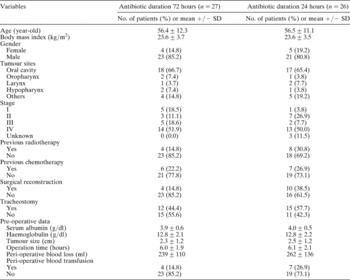
From 1 January 2004 to 31 December 2004, 60 consecutive patients were enrolled in this study and the baseline characteristics are showed in Table I. Two patients refused to participate after signing consents while one patient hesitated with surgery and was referred to radiation oncology for organ preservation therapy. In addition, the treatment protocol was changed during the operation in three patients due to an unresectable status. Furthermore, one patient developed an allergic reaction after treatment and was forced to drop out. A total of 53 patients were enrolled for final analysis. The study group consisted of 27 patients while the control group consisted of 26 patients. The age of the studied population ranged from 34 to 79 years old (average 56.5 ± 11.6 years) and 44 cases were males (83 per cent). The average body mass index in the study group was 23.6 kg/m2 while the average in the control group was 23.6 kg/m2. The average operation time in the study group was 6.0 hours whereas the average operation time in the control group was 6.1 hours. The average peri-operative blood loss in the study group was 239 ml whereas the average peri-operative blood loss in the control group was 262 ml. Fourteen patients (26.4 per cent) received reconstruction during the operation including 12 pectoralis major myocutaneous flaps and two free flaps. There was no significant difference between the two groups according to basic data and laboratory studies.
Descriptive statistics of study population

Thirteen cases (24.5 per cent) developed surgical wound infection within 30 days after operation and were then categorised as the infection group. There was no significant difference in the infection rate and hospital stay between the study group and control group (Table II). Near half of the infections were polymicrobial (6/14, 46.2 per cent). The most common organism isolated was Pseudomonas aeruginosa (9/13, 69.2 per cent) followed by Enterococcus faecalis (4/13, 30.8 per cent), Klebsiella pneumoniae (4/13, 30.8 per cent), Citrobacter koseri (1/13, 7.7 per cent) and Acinetobacter baumannii (1/13, 7.7 per cent). The hospital stay was significantly longer in the infectious group when compared with the non-infectious group (mean 42.2 ± 25.3 days versus 17.8 ± 12.3 days, p = 0.005).
Outcome of study population

* Fisher's exact test, †Student's t-test.
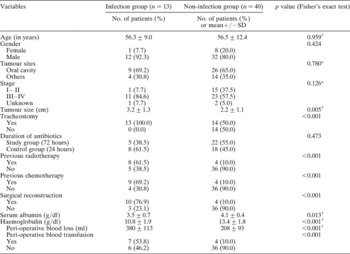
Bivariate analysis of the infection group and non-infection group found no significant difference existed based on age, gender, tumour site, tumour stage and duration of prophylactic antibiotic. However, there were significant differences between the two groups based on tumour size, tracheostomy during operation, previous radiotherapy, previous chemotherapy, surgical reconstruction with a free flap or pectoris major myocutaneous flaps, pre-operative serum albumin level, pre-operative haemoglobulin level, peri-operative blood loss, and peri-operative blood transfusion. Based on post-operative wound condition, receiver operating characteristic curves were used to identify proper cut-off points in continuous variables at which to divide the cases into two groups. (Age < 55 years and >= 55 years, tumour size <= 4 cm and >4 cm, albumin >= 3.9 g/dl and <3.9 g/dl, haemoglobulin >= 10.5 g/dl and <10.5 g/dl, peri-operative blood loss <= 250 ml and >250 ml.) Detailed data are presented in Table III.
Bivariate analysis of study population based on wound condition

† Student's t-test, *Pearson chi-square test.
In bivariate analysis based on post-operative wound condition, tumour size, tracheostomy during operation, previous radiotherapy, previous chemotherapy, surgical reconstruction with free flaps or pectoralis major myocutaneous flaps, pre-operative haemoglobulin levels, peri-operative blood loss and blood transfusion had p values less than 0.05 and were then put into a logistic regression model. By using backward stepwise logistic regression, variables with a p value less than 0.05 were excluded. Finally, pre-operative haemoglobulin level and surgical reconstruction with free flaps or pectoralis major myocutaneous flaps were found to be independent factors significantly related to wound infection (Table IV).
Backward stepwise logistic regression results

† Reference group, *PMMCF = pectoris major myocutaneous flap
Discussion
In this prospective, randomised, double-blind study, we found the duration of prophylactic antibiotic is unrelated to surgical wound infection. The result was comparable with other studies.Reference Fee, Glenn, Handen and Hopp8, Reference Carroll, Rosenstiel, Fix, de, Torre, Solomon and Brodish9, Reference Johnson and Yu10 This highlighted the concept that the most important aspect of prophylactic antibiotic was the timing of initial administration instead of the duration. Besides, a short course of prophylactic antibiotic avoids the risks of superinfection/colonisation and drug side effects.Reference Fee, Glenn, Handen and Hopp8 This is especially true today when patient safety is the first priority.
The post-operative wound infection rate of this study was 24.5 per cent, which was higher than those of other recent studies.Reference Johnson, Kachman, Wagner and Myers7, Reference Carroll, Rosenstiel, Fix, de, Torre, Solomon and Brodish9 In addition, the bacteria obtained from the wound were also different from that of Western populations. In this study, the most common organism was Pseudomonas aeruginosa while the most common organism isolated was Streptococcus species in another study.Reference Rubin, Johnson, Wagner and Yu15 This probably can be explained by the different environmental and weather factors in Taiwan and Western countries. In addition, the different antibiotic regimen used might result in such variation.
Johnson et al., in their study about antimicrobial prophylaxis for contaminated head and neck surgery, showed that patients undergoing laryngectomy were at less risk of post-operative infection, and the pre-operative existence of tracheostomy or prior radiation therapy had no demonstrable effect on the incidence of wound infection.Reference Johnson, Myers, Thearle, Sigler and Schramm6 In contrast, tracheostomy during operation and reconstruction with free flaps or pectoralis major myocutaneous flaps were found to be significantly related to post-operative wound infection in our study. The lack of demonstrable effect on the incidence of wound infection could be explained by the different study populations. Most of our cases (23/37, 62 per cent) were oral cancers while only 38 of 107 (35.5 per cent) cases in their study were oral cancer patients. Meanwhile, laryngectomy turned out to be less attractive because of organ preservation therapy becoming a global trend. Therefore, laryngectomy accounted for a small portion of our cases.
Radiation will cause fibrosis, perivascular necrosis and obscuring or obliteration of the surgical field. Nevertheless, controversy still exists in the relationship between wound infection and previous radiotherapy. A recent large scale study by Schwartz et al., using multivariate analyses, showed that previous radiation therapy was an independent factor associated with post-operative wound infections.Reference Schwartz, Yueh, Maynard, Daley, Henderson and Khuri16 Why our study found no significant relationship between radiation and wound infection might be due to the advance of reconstruction techniques that made extensive ablation possible. Another reason might be that only a small portion of the studied population had previously had radiation and this skewed the results.
• Previous studies have suggested that prophylactic antibiotics reduce wound infection in head and neck surgical procedures involving entry into the upper aerodigestive tract
• This study found that extended courses of prophylactic antibiotic did not reduce surgical wound infection following major head and neck operations in a subtropical country
• A low pre-operative haemoglobulin level and reconstruction with a free flap or pectoralis major myocutaneous flap were closely related to surgical wound infection
Penel et al., in their study about the risk factors for wound infection, found that tumour stage, previous chemotherapy, duration of pre-operative hospital stay, permanent tracheostomy and hypopharyngeal/laryngeal cancers were associated with post-operative wound infections.Reference Penel, Lefebvre, Fournier, Sarini, Kara and Lefebvre17 Conversely, our study failed to illustrate the same findings. The possible explanation might be that they used bivariate analyses whereas this study used a logistic regression model. In bivariate analyses, we also found that previous radiotherapy, previous chemotherapy and tracheostomy were likely to cause post-operative wound infection. However, when adjusted with other variables, only a tracheostomy during the operation was significantly associated with wound infection.
Anaemia may either represent a poorer medical condition or impaired oxygen delivery to the wounded region.Reference Schwartz, Yueh, Maynard, Daley, Henderson and Khuri16 Therefore, it is reasonable to find that lower pre-operative haemoglobulin levels would lead to a higher probability of developing post-operative wound complications. In addition, our results showed weak correlation between peri-operative blood transfusion and wound infection. Allogeneic blood transfusion was thought to cause an immunosuppressive effect that increased the likelihood of post-operation wound infection.Reference Fergusson, Khanna, Tinmouth and Hebert18 Furthermore, the need for a blood transfusion also implied extensive tissue ablation and a large surgical defect that required reconstruction.
Operations that needed reconstruction implied a large surgical defect. Reconstruction of the surgical defect with a muscle or myocutaneous flap has been reported to be associated with a wound infection rate of 20–37 per cent. Girod et al. found that flap reconstruction was associated with a significantly higher complication rate. However, the wound infection rate was not significantly increased.Reference Girod, McCulloch, Tsue and Weymuller19 Another study also demonstrated that same result.Reference Johnson, Myers, Thearle, Sigler and Schramm6 Why our study showed that reconstruction during the operation was an independent factor related to wound infection might be due to the fact that only a small portion of our patients received flap reconstruction.
The limitations of this study are as follows. First, the sample size was not large enough and the statistic power was unsatisfied. The small sample size also caused a widening of the 95 per cent confidence interval in the logistic regression model. Second, there was an absence of data in several categories such as body weight loss and information about wound tension at closure. These factors have been reported to be associated factors with wound infections in some studies, but there was no way to obtain such information retrospectively. Finally, we used only one regimen in this study. Therefore, we could not compare the difference between various regimens.
Conclusion
In conclusion, the duration of prophylactic antibiotic was not a relevant factor influencing surgical wound infection in major head and neck operations. Those with pre-operative haemoglobulin levels <10.5 g/dl and reconstruction with free flaps or pectoralis major myocutaneous flaps were closely related to post-operative wound infection. Although a short course of prophylactic antibiotic was as effective as an extended course it should not be substituted for proper aseptic and meticulous surgical techniques.
Acknowledgement
The authors thank Ms Hui-Ching Ho for statistical software processing. This work was supported by grants from the Taichung Veterans General Hospital (TCVGH-937002A) Taichung, Taiwan, Republic of China.