Introduction
Concerns about Alzheimer's disease (AD) and related disorders have increased in Western societies over the past decades, and the disease has become a major public health priority in both developed and developing countries. The impact of the illness on both formal (Cocco et al., Reference Cocco, Gatti, de Mendonca Lima and Camus2003) and informal caregivers (Yaffe et al., Reference Yaffe2002) is an important issue in the context of public health policies which aim to give high priority to home-care and community-centered support for patients with dementia. Risk factors for institutionalization of such patients have been shown to include the severity of cognitive decline, its impact on activities of daily living, and also the type and severity of their non-cognitive behavioral and psychological symptoms (Steeman et al., Reference Steeman, Abraham and Godderis1997). However, an increased risk of nursing home admission is also associated with the level of burden among informal caregivers (Yaffe et al., Reference Yaffe2002).
Although the determinants of caregiver burden have become clearer, they have been mostly correlated with the patients' characteristics such as behavioral and psychological symptoms (Donaldson et al., Reference Donaldson, Tarrier and Burns1997; Reference Donaldson, Tarrier and Burns1998; Heok and Li, Reference Heok and Li1997; Croog et al., Reference Croog, Sudilovsky, Burleson and Baume2001; Black and Almeida, Reference Black and Almeida2004; Berger et al., Reference Berger, Bernhardt, Weimer, Peters, Kratzsch and Frolich2005). In particular, depression, apathy, anxiety and aggressiveness more than cognitive and functional declines are frequently reported to be associated with an increased risk of burden (Coen et al., Reference Coen, Swanwick, O'Boyle and Coakley1997; Kaufer et al., Reference Kaufer1998). More than the type of symptoms, it is their unpredictable nature that seems to have a significantly greater influence on the increased risk of burden (Donaldson et al., Reference Donaldson, Tarrier and Burns1998). In contrast, caregiver-related characteristics that could expose them to a higher risk of burden have received much less attention. In particular, to the best of our knowledge, there is no available data assessing the link between the level of caregiver burden and attitudes toward the disease. Attitudes toward chronic diseases have emerged as key factors in both the social impact of the disease and the risks of stigmatization and discrimination (Graham et al., Reference Graham2003). Mental illnesses are still poorly perceived by the general public for whom the outcomes appear to be poor even when correctly managed. In addition, patients suffering from mental illnesses are deemed irresponsible, unpredictable and dangerous, despite efforts to improve knowledge and attitudes towards such patients through specific anti-stigma educational programs (Sartorius and Schulze, Reference Sartorius and Schulze2005).
With AD, it can be assumed that attitudes toward the disease may also partially determine caregivers' investment in the care of their patients and thereby increase the risk of – or protect against – emotional distress and burden. Such a hypothesis has several theoretical underpinnings. First, we know from the “learned helplessness” model (Seligman and Badeley, Reference Seligman1975) that the cognitive attributional or explanatory style strongly determines the way people cope with experiencing negative outcomes or failures. As a caregiver, experiencing a lack of success in controlling aspects of the clinical presentation or outcome of the disease may reinforce the view that no matter what action is taken, nothing will change. On the other hand, negative attitudes such as authoritarian or rejecting attitudes could also be developed by the caregiver as an attempt to escape from depression. The caregivers' stress model of Pearlin et al. (Reference Pearlin, Mullan, Semple and Skaff1990) hypothesizes that stress is the consequence of first line contextual elements (cultural and socio-economic status, family network, personal history), as well as some role strains (conflict with job/family/social life and financial problems) and some intra-psychic strains (self esteem, sense of control). Stress arises against this general background as the consequence of behavioral disturbances or their psychological impact. We can assume that attitudes shared among a social group can be considered to be what Pearlin et al. (Reference Pearlin, Mullan, Semple and Skaff1990) define as a first line contextual element. Indeed, some psychological risk factors for caregiver burden have already been studied in AD and in other neurological disorders such as stroke. In AD, the meaning attributed to “care” as well as filial obligation, self-efficacy, demands of care, involvement in care, and coping have all been established as burden determinants (Noonan and Tennstedt, Reference Noonan and Tennstedt1997; Chou et al., Reference Chou, LaMontagne and Hepworth1999), while in stroke an appraisal of caregiving has been linked to carers' psychological well-being and morale (Purk and Richardson, Reference Purk and Richardson1994; Hodgson et al., Reference Hodgson, Wood and Langton-Hewer1996). Additionally, data concerning attitudes toward AD are available (Ngatcha-Ribert, Reference Ngatcha-Ribert2004) and a feeling of stigmatization has been established among AD patients indicating unfavorable attitudes toward them (Burgener and Berger, Reference Burgener and Berger2008). The aim of this study was to assess attitudes towards AD in caregivers of people with AD and their correlation with the level of perceived emotional distress and burden.
Methods
Selection of study population
We enrolled the caregivers of 51 patients who met NINCDS-ADRDA diagnostic criteria (National Institute of Neurological and Communicative Disorders and Stroke and the Alzheimer's Disease and Related Disorders Association; McKhann et al., Reference McKhann, Drachman, Folstein, Katzman, Price and Stadlan1984) for AD and who were living at home, because home-dwelling AD patients are likely to receive less professional support that those living in a nursing home.
We collected data from the memory clinic and the geriatric medicine inpatient ward of the University Hospital of Tours, and from the memory clinics of some local general hospitals in the central area of France (Vendôme, Orléans, Romorantin, Chartres and Amboise).
Procedures
We conducted a cross-sectional study and exclusively used administered or self-report questionnaires for data collection.
Data regarding the clinical characteristics of the patients were collected from each patient's medical records. These included information on their functional status as assessed by the IADL scale (Lawton and Brody, Reference Lawton and Brody1969; Israël, Reference Israël and Guelfi1996), their global cognitive performances through the MMSE score (Folstein et al., Reference Folstein, Folstein and McHugh1975), and their behavioral and psychological symptoms (NPI; Cummings et al., Reference Cummings, Mega, Gray, Rosenberg-Thompson, Carusi and Gornbein1994). We also recorded the time since the first sign of the disease and the time since the first visit to a memory center.
The caregivers were asked to answer a questionnaire regarding their attitudes towards AD, the level of burden they experienced, their quality of life and the emotional distress they felt. Since we could not find any questionnaire or scale which broadly assessed caregivers’ attitudes towards AD in the literature, we used a questionnaire initially designed for studying schizophrenia (the “Community Attitudes toward the Mentally Ill Scale”; Taylor and Dear, Reference Taylor and Dear1981), because AD shares several characteristics with schizophrenia, such as its chronic pattern, its severe impact on cognition and on autonomy in normal daily living activities, and the potential stigmatization and discrimination that can attach to those affected by it. This tool comprises four subscales evaluating four independent dimensions: authoritarianism, benevolence, social restrictiveness and “community mental health ideology”.
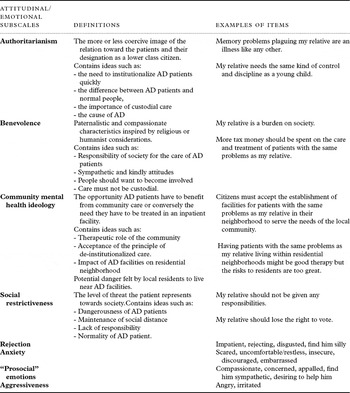
The “authoritarianism” subscale reflects the more or less coercive image the caregiver has of the patient, and the patient's designation as belonging to a “lower class” of society. It contains ideas concerning the need to institutionalize patients quickly, the difference between patients and “normal people”, the importance of custodial care and the belief that a patient's symptoms result from a lack of self-discipline and will. The “benevolence” scale reflects the paternalistic and compassionate components of the relationship, inspired by religious or humanist considerations – i.e. society is responsible for patient care and should support patients sympathetically and kindly, and that such care, wherever possible, should not be custodial. The “community mental health ideology” subscale deals with attitudes toward patient care, and, in particular, the opportunity to benefit from community care or, conversely, the need a patient might have to be treated in an inpatient facility. The values intrinsic to this subscale involve the therapeutic role of the community and acceptance of the principle of de-institutionalized care. This subscale assesses feelings regarding the impact of care facilities on residential neighborhoods and the potential danger felt by local residents in living near such care facilities. Finally, the “social restrictiveness” subscale assesses the level of threat the patient represents to society based on the following themes: the dangers posed by the patients; the need to maintain a social distance; the lack of responsibility and the “normality” of AD patients.
A high score on the scale corresponds to a high intensity of each dimension. The scale comprises 40 statements, 10 for each of the four scales, with each statement being rated on a Likert scale from 1 (do not agree at all) to 5 (strongly agree). We tried to stay as close as possible to the original scale, only substituting the terms “the mentally ill” with “my relative” or “patients with the same problem as my relative”. However, the original proposition that “Anyone with a history of mental problems should be excluded from taking public office” was considered inappropriate in the context of AD and was replaced by “My relative should lose the right to vote”. The proposition “A woman would be foolish to marry a man who has suffered from mental illness, even though he seems fully recovered” was modified so as to become “A woman/man would be foolish to marry my relative”. The term “Alzheimer's disease” was avoided because in our study we tried to evaluate the percentage of respondents who were aware of their relative's diagnosis. Unlike the original tool, we randomly mixed the questions on the different subscales and then reduced each subscale to a score of 100.
We also used questionnaires addressing caregivers’ emotional reactions, their perceptions of patient competencies and their perceived risk of themselves having AD in the future (Werner and Davidson, Reference Werner and Davidson2004; Werner, Reference Werner2006). The first questionnaire comprised a list of emotions that Werner and Davidson used in a population aged over 45 years in response to a clinical vignette describing a patient with AD (Werner and Davidson, Reference Werner and Davidson2004). This process was inspired by Angermeyer and Matschinger (Reference Angermeyer and Matschinger1996) who explored reactions to various mental health problems. In our study, respondents answered the question: To what extent does your relative make you feel . . . [followed by a list of 13 emotions]. Each proposal was rated from 1 (not at all) to 5 (extremely). Emotions were then classified into four groups following Werner (Reference Werner2006): rejection (impatient, rejecting, disgusted, find him/her silly); anxiety (scared, uncomfortable/restless, insecure, discouraged, embarrassed); “prosocial” emotions (compassionate, concerned, appalled, find him/her sympathetic, desiring to help him); and aggression (angry, irritated). Table 1 summarizes the attitudinal and emotional subscales. Werner also performed a survey in which participants were asked use a Likert scale ranging from 1 (very capable) to 5 (completely unable) to rate the abilities of the person described in a clinical vignette in the following areas: driving; making a financial decision; participating in a medical decision; preparing a single cup of tea, taking the bus alone; choosing his/her own clothes (Werner, Reference Werner2006). In our study, we asked caregivers to rate these items with respect to the patient they provided care for using the following question: “To what extent is your relative unable to . . .”. Finally, they were asked to rate their perception of their own risk of one day being diagnosed with one of these disorders, answering the single question: “What do you think is your own risk of one day having the same disease as your relative?” (1 corresponds to “no risk” and 5 “high risk”) (Werner, Reference Werner2006).
Definition and examples of items for each attitudinal/emotional subscales

We used the questionnaire developed by Thomas et al. (Reference Thomas2006) in the PIXEL study for the assessment of quality of life of carers, which explores four dimensions: the ability to cope with problems generated by the patient, relationship to the environment, awareness of the situation, and perception of distress. This questionnaire contains 20 questions; each response that indicates an impairment in quality of life results in a loss of 5 points, with a maximum score of 100. The quality of life is then evaluated in percentage terms, with 100% representing the best possible quality of life.
To evaluate the caregiver's sense of burden, we used the 22-item version of the Zarit Burden Inventory (Zarit et al., Reference Zarit, Orr, Zarit, Zarit, Orr and Zarit1985) as well as the 28-item version of the General Health Questionnaire (GHQ; Goldberg and Hillier, Reference Goldberg and Hillier1979; Bolognini et al., Reference Bolognini, Bettschart, Zehnder-Gubler and Rossier1989) for assessing emotional distress. This latter questionnaire was originally intended to detect psychiatric “cases” in general medicine and has been widely used in social psychiatry.
This study was approved by the ethics committees of our respective institutions. Written informed consent was obtained from both patients and caregivers. Self-assessment questionnaires were then given to the caregiver who returned them by mail. The MMSE and NPI scores were obtained from patient charts. When help was needed in the questionnaire or when data was missing (NPI), the concerned caregiver was contacted by telephone.
Statistical analysis
Statistical analysis was performed using Epi Info software, version 3.5. The tests used were: t tests to compare all two-sample means, Whitney/Wilcoxon test when the t test assumptions were violated (“benevolence” and “community mental health ideology” attitudes subscales; GHQ score); ANOVA test to compare means, the Kruskal-Wallis test when ANOVA test assumptions were violated (GHQ score). Attitudes, emotions, perceived incompetence and perceived susceptibility of one day having AD were respectively linked with the Zarit Burden scale, GHQ and PIXEL caregiver quality of life scale scores using linear correlation (Pearson's coefficient). Significance was assessed with uncorrected p values.
Results
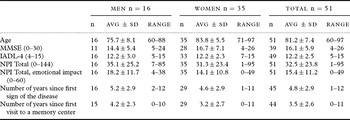
The AD group consisted of 16 men (mean age: 75.7 years; SD: 8.1; range: 60–88) and 35 women (mean age: 83.8; SD: 5.5; range: 71–97). Overall, the mean patient age was 81.2 years (SD: 7.4; range: 60–97). They all had moderate to severe dementia (mean MMSE: 16.1, SD: 5.9; range: 4–26). Their level of functional decline was high (mean IADL–4: 12.2; SD: 2.5; range: 5–15). Most of the patients had several behavioral and psychological symptoms (mean NPI total: 32.5; SD: 23.8; range: 1–95) which often caused emotional distress in their caregivers (mean NPI total, emotional distress: 15.4; SD: 11.2; range: 0–49). The mean onset of first symptoms was 4.6 years (SD: 2.9; range: 1–11) and mean time between the patient's first consultation and the moment the caregiver filled-out the study questionnaire was 3.2 years (SD: 2.7; range: 0–11) (Table 2).
Characteristics of patients according to gender

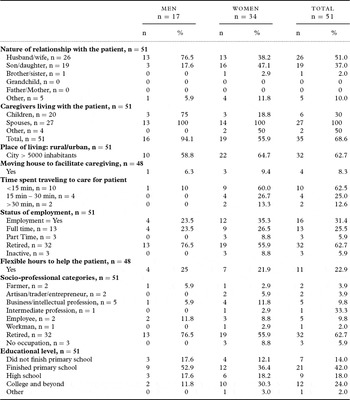
The caregivers' sample consisted of 17 men and 34 women. Women were significantly (t test = 2.8795; p = 0.0059) younger (mean: 64.3 years; SD: 10.2; range: 48–85) than men (mean: 74.5 years; SD: 14.7; range: 48–95). Twenty-six caregivers (51%) were the spouses of the patients they cared for and 20 (39.2%) were children of the patients involved. All spouses were living with the patient and six of the 20 caregivers who were children were living with the patient (30%). Thirty-two caregivers lived in an urban area (62.7%) and only four (8.3%) had moved to facilitate care-giving. Only two caregivers (12.6%) spent more than 30 minutes traveling to their care recipients. Thirty-two were retired (62.7%), 3 were inactive (5.9%), 13 (25.5%) were working full-time and 3 (5.9%) were working part-time. No socio-professional category was clearly over-represented while almost half of the caregivers (n = 22; 44%) had no formal education beyond primary school (Table 3).
Caregivers characteristics according to gender

With respect to the degree of burden and emotional distress, the GHQ score was 26.2 ± 13.2 (range: 5–65) and 64.3% ± 20.1 (range: 20–100) in the PIXEL study caregiver quality of life scale. There was a significant difference between men and women in the Zarit Burden Scale (mean score for women: 38.2 ± 14.0 and range 11–69; mean score for men: 27.6 ± 17.0 and range: 3–57; t test = 2.3256; p = 0.0243). The difference in the total NPI score between men and women was also significant (t test = 2.5831; p = 0.0128) (mean for women: 38.3 ± 23.3 and range: 6–85; mean for men: 20.9 ± 21.3 and range: 1–95). The same was true in the total NPI emotional impact score (mean score for women: 17.8 ± 10.1 and range: 3–38; mean for men: 10.6 ± 11.9 and range: 0–49; t test = 2.2420; p = 0.0295)
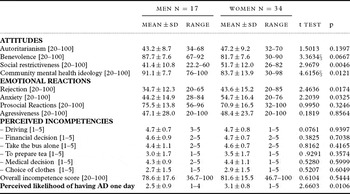
Mean scores for scales submitted to caregivers for assessing their attitudes, emotional reactions, perceived level of patient competences and perceived risk of having AD some day according to caregiver gender are described in Table 4.
Description of attitudes

§ Mann-Whitney/Wilcoxon two-sample test
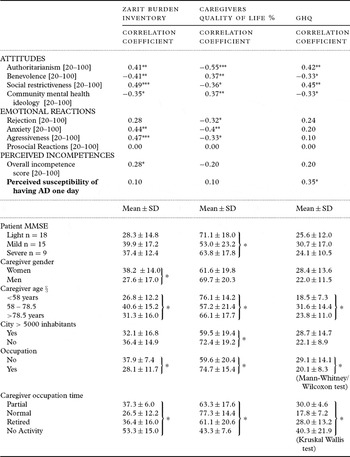
Results of the correlations between the Zarit Burden Inventory, PIXEL caregiver quality of life scale and GHQ with attitudes, emotional reactions, perceived incompetence of the patient, perceived risk for the caregiver one day having AD, patient MMSE score, caregiver gender, caregiver gender by class, place of residence (city or country), employment status and each caregiver's daily schedule, are shown in Table 5. Only significant results have been shown.
Correlations between burden, attitudes, emotional reactions and other characteristics

*p < 0.05 ** p < 0.01 *** p < 0.001
§ Age classes correspond to first and third quartiles
In accordance with our hypothesis, some attitudes and emotional reactions were correlated with scores of the Zarit Burden Inventory, PIXEL study quality of life scale, and GHQ. Among these attitudes, authoritarianism, benevolence, social restrictiveness, “community mental health ideology”, rejection, anxiety and aggressiveness were among the most strongly associated with burden and emotional distress variables.
Discussion
Our study showed significant associations between the Zarit Burden Inventory, GHQ and the PIXEL study quality of life scale scores, and levels of several attitudes such as social restrictiveness, authoritarianism, benevolence, and community mental health ideology. These results support the hypothesis that there is a link between negative attitudes and feeling of burden experienced by caregivers of AD patients.
Regarding caregiver attitudes, the authoritarianism subscale correlated more with the PIXEL study quality of life scale. Because custodial care is part of the authoritarianism concept, an authoritarian vision would result in a heavy investment in care, particularly of time, and would allow the caregiver to gain control over the patient, thus explaining this first correlation. The Zarit Burden Inventory correlated more with the social restrictiveness subscale, which corresponds to the maintenance of social distance and an underlying denial of otherness. The less the patient is recognized as an individual by the caregiver, the heavier the burden appears to be.
The subscales addressing the four attitudes appeared to vary on a continuum ranging from “positive attitudes” to “negative attitudes”; the relevance of this division into subscales in our framework is therefore questionable.
Regarding emotions, “aggression” and “anxiety” correlated well with sense of burden and quality of life. This latter scale also correlated with the “rejection” score. We found no correlation between “rejected” emotions and burden, although for the emotional attitudes, it seems to be an equivalent of “social restrictiveness” attitudes, which are strongly correlated with burden. There was no significant correlation between emotions and GHQ. This suggests that these emotions are not due to symptoms of anxiety and depression but were probably present prior to perceptions of the disease and to the expression of burden. “Pro-social” emotions did not correlate with any of the quality of life, emotional distress and burden scales. This dimension was therefore quite distinct from previous results, suggesting a certain amount of ambivalence in caregivers who experience both positive and negative emotions. Anxiety was the emotion that correlated most with quality of life, whereas aggressiveness correlated more with caregiver burden. This result should be compared to the findings of Coyne et al. (Reference Coyne, Reichman and Berbig1993) which linked burden and abuse. It should be underlined that, in our study, attitudes and emotions toward patients appeared to be generally positive as testified by the means scores of these different variables.
Similar to previously published results, we found a greater burden score in women compared to men (Cossette et al., Reference Cossette, Levesque and Laurin1995; Mui, Reference Mui1995; Donaldson and Burns, Reference Donaldson and Burns1999; Gallicchio et al., Reference Gallicchio, Siddiqi, Langenberg and Baumgarten2002). Furthermore, women had a more intense feeling of social restrictiveness, rejection and anxiety than men. This finding is consistent with the hypothesis that the associations found in the literature between burden and caregiver characteristics are due to links between these characteristics and more or less negative attitudes. These attitudes may be connected to the disease itself, but may also correspond to a concept of the caring role (Noonan and Tennstedt, Reference Noonan and Tennstedt1997), or attributes of gender or age for example, or a conception of the meaning of life in general underpinned by religious or philosophical issues (Farran, Reference Farran1997). We can assume that notions like “mothering” or “taking care of” are usually associated with women. Women may feel more trapped in this social order of “caring” than men. In addition, they probably carry this assumption as part of their social structure. Consequently, this may result in an increased sense of powerlessness, of inevitability, of obligation to maintain this caring role, which could secondarily induce rejection of the patient. In contrast, men are less likely to view caregiving as an obligation and so may feel freer to accept or reject this task. For the same reasons, men with the most favorable attitudes toward AD may accept the role of caregiver more easily. In other words, this suggests that only men with favorable attitudes become caregivers and, in addition, after accepting this role, they feel less compelled to continue, thereby somewhat justifying more favorable attitudes of rejection.
Our results support the argument that negative attitudes towards AD are linked with an increased level of burden. The present results do not contradict the assumption that these attitudes can therefore be considered as a predictive factor of caregiver burden. An alternative explanation may be that these attitudes are induced by the stressful situation of caregiving and are in fact coping strategies, which are unable to reduce the burden linked with the behavioral and psychological symptoms of dementia.
Our study has several limitations. First, the small number of patient/caregiver dyads (51) recruited in our study limits the possibilities of stratified analysis. Secondly, our sample was recruited only in hospitals (mainly outpatient clinics) and so cannot be considered representative of all possible situations and may consequently constitute a selection bias. In addition, we limited our investigation to patients who did not live in nursing homes, although such environments can also generate burden. Most importantly, we based our study on scales and questionnaires which have not been validated for use among AD patients and their carers. We acknowledge that using scales outside their intended context is a severe limitation. The “Community Attitudes Toward the Mentally Ill Scale” (Taylor and Dear, Reference Taylor and Dear1981), for example, was developed for schizophrenia and was based on two essential assertions: that these patients are unpredictable and that they are dangerous. As a result, some items may be ill-suited to AD. But the adaptations we propose here show good acceptability and feasibility, and could be validated. Another shortcoming is the fact that our study is a cross-sectional study. A longitudinal study would have allowed us to observe changes in burden and attitudes over time. We should emphasize that a methodology using questionnaires constitutes a desirability bias, and probably leaves less room for ambivalence and to nuances in the expression of attitudes in general. In addition, it does not allow us to identify whether an item is central or peripheral in the structure of an attitude (Abric, Reference Abric and Abric2003). Another limitation may be the arbitrary choice of attitudes used in our study, as listed in the “Community Attitudes Toward the Mentally Ill Scale”. Finally, we should mention the possibility that respondents answered specifically in relation to their loved one but not necessarily in relation to AD in general.
Despite these limitations, our study constitutes a preliminary exploratory investigation intended to determine the innovative risk factors for caregiver burden. Although it is difficult to determine whether caregiver attitudes to AD were already present before they took on a caregiving role or constitute coping strategies, the dissemination of appropriate information to caregivers through mental health education programs seems to be an appropriate approach for reducing the burden endured by caregivers. These programs should target both caregivers and the general population. Progressive changes in attitudes can be strengthened by positive reporting in the media and through educational support. Another implication of these results is the important role that psychotherapeutic interventions can play, particularly when they focus on attitudes such as authoritarianism and restrictiveness, by confronting the underlying assumptions on which attitudes are constructed.
Conflict of interest
None.
Description of authors' roles
L. Zawadzki, V. Camus and C. Hommet designed the study; L. Zawadzki, C. Hommet, K. Mondon, T. Constans, V. Camus and N. Peru took part in the recruitment of patients and wrote the paper; and P. Gaillard and L. Zawadzki undertook the statistical analysis.
Acknowledgments
We wish to thank the following: Dr. Lemonnier (Orléans); Dr. Ishac (Vendôme); Dr. Yvon (Romorantin); Dr. Naceur (Amboise); Drs. Gibelin and Vaccaro (Chartres).