A great many people think it is obviously bad to be disabled, even setting aside the negative effects of ableist discrimination. A prevalent rationale for this view is the claim that disability restricts a person from accessing many valuable options. If you are disabled in some way, you will find it impossible or difficult to engage in certain life-improving activities, careers, hobbies, experiences, etc. that are open to your non-disabled counterparts. This, the thought goes, is bad for you and provides support for the view that, even in an ableism-free environment, being disabled is likely to make a person worse off. This formulation of the so-called Bad-Difference View of disability is contrasted with the Mere-Difference View that denies disabilities are likely to be bad (or good) under such conditions (cf. Barnes Reference Barnes2016).
In his recently published essay “Disability, Options and Well-Being,” Thomas Crawley seeks to examine and defend this kind of reasoning, which he formulates as follows:
The Options Argument
1. If something reduces valuable options then, to the extent that it does, it can have both negative and positive effects on well-being prospects.
2. Disability reduces valuable options.
3. In disability cases, the negative effects of [valuable] option reduction are greater than the positive effects.
4. Therefore, insofar as it reduces valuable options, disability hinders well-being prospects. (Crawley Reference Crawley2020: 319)
In addition to offering a positive defense of the second and third premises, Crawley argues that some critics of the Options Argument hold inconsistent views. Since we are among those critics, we wish to resist the charge of inconsistency and challenge Crawley's defense. However, we also want to acknowledge that Crawley develops several novel and worthwhile points that advance and deepen discussions about the relationship between disability, opportunity, and well-being. We welcome his contribution to this literature and hope to advance the discussion even further.
In what follows, we present Crawley's case that we and like-minded critics of the Options Argument hold inconsistent views (§1) and explain why we are not guilty of such inconsistency (§2). We then offer some criticism of Crawley's defense of the Options Argument (§3) and close with an observation about the general tendency of such arguments to employ a double standard (§4).
Two important preliminary matters. First, Crawley does not explain what he means by “valuable options” or how he distinguishes them from disvaluable ones. We will not either, relying on an intuitive sense of options that it would be prudentially good to choose. It is instructively difficult to be more precise, though we do not believe that our case against Crawley requires greater precision.
Second, although Crawley seems to identify us as representative proponents of the Mere-Difference View, we do not subscribe to his probabilistic formulation of that view. While we are firmly committed to denying that disabilities are always or almost always bad for a person, we also agree (with various qualifications) that, at the most general level, having a disability is likely to make a person slightly worse off than they otherwise would be, even in ableism-free environments (Asch and Wasserman Reference Asch, Wasserman, McLeod, Nisker and Karpin2010; Wasserman and Asch Reference Wasserman, Asch, Bickenbach, Felder and Schmitz2013; Campbell and Stramondo Reference Campbell and Stramondo2016; Reference Campbell and Stramondo2017: 168–69). However, although we are not defenders of the probabilistic MDV, we are critical of the Options Argument, which is the primary focus of Crawley's essay.
1. The alleged inconsistency
As Crawley rightly notes, critics like us reject the third premise of the Options Argument partly on the grounds that things that make our lives go well – such as happiness and pleasure, achievement, knowledge, fulfilling relationships, appreciation of beauty, and virtue (hereafter, “the goods of life” or simply “goods”) – are multiply realizable (Asch and Wasserman Reference Asch, Wasserman, McLeod, Nisker and Karpin2010: 206–9; Moller Reference Moller2011: 198–99; Schroeder Reference Schroeder and Fletcher2016: 224–25; Campbell and Stramondo Reference Campbell and Stramondo2017: 157–58). A given disability may close off access to some forms of these goods but often leaves plenty of other forms accessible. Blindness limits access to some forms of beauty while still allowing access to beauty in various other forms. Likewise, there are countless ways to experience pleasure, achieve great things, be virtuous, live meaningfully, and so on. Crawley contends that this Multiple Realizability Reply implies the following claim:
Restricting goods (RG): For a subject S and some multiply realizable non-instrumental good G, restricting S's options to access G won't affect S's well-being prospects as long as S still possesses enough options which enable her to access G. (Crawley Reference Crawley2020: 320)
The alleged inconsistency arises because critics who make the Multiple Realizability Reply sometimes also appeal to the valuable options that disability can open up, including some that are unavailable to non-disabled people. Examples of disability-specific options (DSOs) include membership in the disability community (Barnes Reference Barnes2016: 116) and exemption from conscription during wartime (Campbell and Stramondo Reference Campbell and Stramondo2017: 158). Crawley thinks that this appeal to DSOs implies that they improve the well-being prospects of disabled people, which seems inconsistent with a natural extension of RG:
Expanding goods (EG): For a subject S and some multiply realizable non-instrumental good G, adding to S's options to access G won't affect S's well-being prospects as long as S already possesses enough options which enable her to access G. (Crawley Reference Crawley2020: 320)
If RG is true, presumably EG is also true. That is, if someone can have enough options for accessing some good that taking away some of them will not negatively impact their expected well-being, then someone can have enough ways of accessing that good that adding more options will not positively impact their expected well-being. According to Crawley, when critics of the Options Argument make the Multiple Realizability Reply, they commit themselves to RG and, thus, should also accept EG. Yet, when they appeal to the benefits of DSOs, they reject EG and presumably should also reject RG. This is the apparent inconsistency.
2. Avoiding inconsistency
We now wish to establish that we, and other critics of the Options Argument, are not guilty of this alleged inconsistency.Footnote 1 To begin, it is important to emphasize that our employment of the Multiple Realizability Reply was not cast in probabilistic terms. We were not making a point about well-being prospects, or expected well-being. Our point was this: even if a given disability precludes accessing particular forms or instances of significant goods of life, it often will not prevent a person from attaining other forms or instances of those goods (Asch and Wasserman Reference Asch, Wasserman, McLeod, Nisker and Karpin2010: 206–9; Campbell and Stramondo Reference Campbell and Stramondo2017: 157–58). Our sufficiency threshold is one below which one's options give one limited or no access to a prudential good, whereas Crawley's threshold is one above which additional options to access such a good do nothing to increase one's well-being prospects. This is a significant difference, for it is questionable whether there is any such threshold of the sort that Crawley discusses. Even if a person has 1,000 options for attaining some good, the addition of some 1,001st option could easily have a positive or negative impact on their well-being prospects – if, for instance, it carried a high likelihood of being chosen and its value was significantly higher or lower than other options.
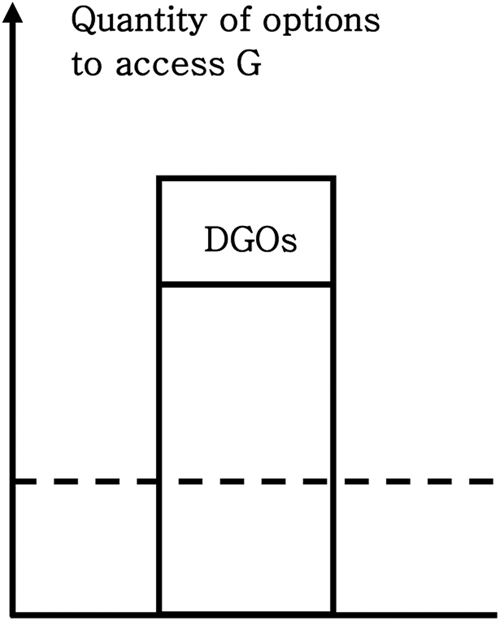
Turning to the alleged inconsistency, we do endorse something in the ballpark of RG and EG, taking into account the qualification above. We acknowledge the possibility that individuals can reach a point of having enough options for attaining some good of life such that, above that threshold, adding and losing options does not impact the person's ability to attain the good. We also endorse a certain claim about reality: in the words of Asch and Wasserman, we think that most people – disabled and non-disabled alike – “enjoy a fortunate redundancy in many of the capacities that are instrumental for, or constitutive of, valuable human goods and activities” (Reference Asch, Wasserman, McLeod, Nisker and Karpin2010: 208). Accordingly, most of us have a surplus of avenues by which we can access those goods. In light of this fortunate redundancy of options, we think the situation of disabled people is very often captured by Figure 1, where “DGOs” refers to disability-given options, i.e. options that a disabled person has in virtue of their disability.Footnote 2
A typical option set of a disabled person.

On this picture, most disabled people are well above the threshold for being able to achieve the goods of life. Of course, this diagram is a simplification and is not meant to imply that all disabled people have equally sized option sets or that each disability allows for equal access to each prudential good.
However, if we do accept something like RG and EG and think that most disabled people tend to be well above the threshold for achieving the goods of life, why give any emphasis to disability-given options? Are we thereby implying that such options are beneficial to have even though they appear to be superfluous?
There are (at least) three reasons to give special emphasis to disability-given options, even if they don't increase a person's access to the goods of life. First, DGOs are an important reminder that disabilities do not merely remove or restrict a person's options; they also open up options. The point here is not to argue that DGOs are beneficial; it is to counteract a widespread tendency to see disabilities as purely option-restricting.
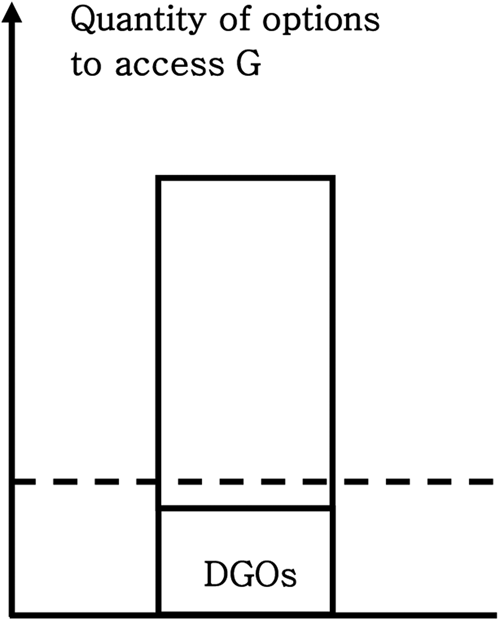
Second, having access to the goods of life improves well-being prospects. When an individual has an overabundant set of options for access to some good, any DGOs in that set are contributing members of an option-set that improves one's well-being prospects – even if they do not, on their own, have that effect. If we consider only the quantity of valuable options, there is no basis for regarding the DGOs as superfluous. To illustrate, imagine a child who is about to purchase one chocolate bar from a collection of 100 nearly-identical bars. If her expected well-being is higher because she has the option to buy a chocolate bar, and if she is equally likely to choose any of the bars, then all 100 bars contribute to that effect. It would be arbitrary, in advance, to single out a particular bar as “the beneficial option” and regard the other 99 as superfluous. A similar point applies to DGOs. Figure 1 gives the impression that the DGOs are superfluous, but one could just as easily present our view via Figure 2, which gives an alternative (and equally misleading) impression.
Alternative framing of a typical option set of a disabled person.

In truth, there is no non-arbitrary way to deem some options superfluous when we are only attending to their quantity. When there is a sufficient set of options for accessing some good, we can sensibly look upon each option in the set as contributing to the effect of granting access to a good and thereby improving well-being prospects.
Lastly, when a disabled person chooses some disability-given option and attains some good, this is a real benefit. When a person develops a rewarding friendship with someone they never would have met had they not been disabled, they benefit. Choosing that DGO is, at the very least, non-comparatively good for them; and, in some cases, it will also be comparatively good for them, rendering them better off than they would have been had they not chosen it.
In sum, there are reasons to highlight DGOs that are perfectly consistent with our view that people often have a surplus of options to access the goods of life and that some options – including one's DGOs – could be removed without undermining that access.
3. Challenging Crawley's positive defense
We turn now to the core of Crawley's positive defense of the Bad-Difference View: his discussion of three alleged benefits that come from having additional valuable options, which correspond to three negative effects of option reduction. As Crawley insightfully observes, having more valuable options makes it more likely that:
1. one will possess options that optimally suit one's tastes,
2. one will possess options well-suited to a variety of contexts, and
3. one will possess more holistically valuable combinations of options. (Crawley Reference Crawley2020: 324–26)
Crawley has hit upon some genuine benefits that can come from additional valuable options that have not been acknowledged in the previous literature. Even so, we believe his defense of the Options Argument falls short in important ways.
First, however, we would highlight a notable shortcoming of the Options Argument, as formulated: it screens out consideration of disvaluable options. For that reason, even if the argument were sound, it would provide very limited support for the Bad-Difference View.Footnote 3 A real-world disability closes off both good and bad options. Establishing the argument's conclusion that insofar as it reduces prudentially good options, disability worsens well-being prospects does not provide a reasonable defense of the Bad-Difference View any more than establishing that insofar as it reduces prudentially bad options, disability improves well-being prospects would constitute a reasonable critique of the BDV. To determine whether or not disabilities are “bad differences,” we must consider both valuable and disvaluable options. And, as it happens, each of Crawley's three benefits has a negative counterpart. Having more options increases the likelihood that one will have more options that (i) suboptimally suit one's tastes, or clash with them, (ii) are suboptimal or negative for each context, and (iii) generate holistic disvalue when combined with other options.
A second and related problem with the argument, and Premise 3 in particular, is that it only attends to the quantity of one's valuable options. When evaluating an individual's well-being prospects, two other features of an option are crucially important: its degree of prudential value, and the probability that it will be chosen. Attending to these features of options reveals problems with the generalization that a greater quantity of valuable options leads to higher well-being prospects. One relatively straightforward instance where extra valuable options often (though not always) decrease one's well-being prospects is when these extra options are less valuable than most or all other options and have a high, or even just non-negligible, probability of being chosen. The presence of less valuable options can lower the odds that more valuable options will be selected.
In his defense, Crawley offers a justification for bracketing off consideration of disvaluable options – namely, that “people seek out value and seek to avoid disvalue.” He suggests that “a rational person” will learn to “avoid or rarely return to” disvaluable options and that, as a result, having a mixture of extra options (some good, some bad) is likely to benefit people (Crawley Reference Crawley2020: 330–31).Footnote 4 This response might be employed to address the worry about less valuable options as well: people will be inclined to seek out more valuable options over less valuable ones, so we need not worry about options of lesser value.
However, this justification implies that most people are motivated to choose the most prudentially valuable options and can discern which ones are most valuable. We doubt both aspects of this claim. Even if most of us have a healthy regard for our own well-being, actual human beings are a far cry from rational self-interest maximizers. Most human beings are not egoists. We care about countless things beyond ourselves (loved ones, projects, moral and religious ideals, social justice) and constantly make choices that do not aim at our own advantage. Moreover, even when we do prioritize our own self-interest, our judgment is often distorted by epistemic limitations and irrationality.Footnote 5 We are influenced by limited or false information, biases, fallacious reasoning, weakness of will, misguided normative views, and so on. For these reasons, it is a mistake to think that we can simply ignore the presence of disvaluable and less valuable options on the grounds that people are rational and will tend to avoid them.
Granted, epistemic limitations may be less of a problem when it comes to what might be dubbed “micro-options,” which are lower-stakes, of short duration, and described at a high level of specificity. Think about options for how to spend one's afternoon (micro-options), in contrast to options for where to live or what career to pursue (macro-options). Crawley's defense mostly appeals to micro-options – particularly options that can lead to enhanced pleasure. However, once we shift our focus to more significant macro-options, several complications emerge.
First, it is not clear how much can be learned from others’ situations. People vary in so many respects that it isn't always clear in advance, even with knowledge of others’ experiences, whether a given option will prove beneficial for oneself. We often lack a deep understanding of ourselves and the unique, intricate circumstances in which we are embedded, much less an understanding of how our choice of certain options, or coincidental events, will transform our perspective, tastes, or identities.
It is also questionable how much can be learned of macro-options from trial and error. Crawley's discussion conjures up the image of life as a test kitchen and the agent as a chef with a well-developed palate. The more ingredients she has, the more likely she is to concoct dishes she finds maximally pleasing. Even if many of her combinations of ingredients, and sequences of dishes, are failures, she can quickly learn from her mistakes. This is roughly the trial-and-error approach that Crawley suggests in addressing concerns about infelicitous option combinations (Reference Crawley2020: 330–31). That's all well and good when we are dealing with certain sorts of micro-options, but many major life-altering options require too much time and commitment to allow for such experimental sampling. In a normal lifespan there is simply not the time, energy, or resources to test out a wide range of career paths. The more time and commitment required to reap the value of an important option, the less tasting and sampling will be helpful in constructing a rewarding life; and the less helpful they are, the less value there will be in additional options, beyond some threshold. Because of the required time commitment, one can usefully explore only a limited number of major options, and most disabilities leave the individual with well above that minimum.
This conclusion complements the multiple realizability claim: not only can the basic components of a good life be realized in a variety of ways; realizing them often requires commitments of time, energy, and conviction that limit the value of sampling and experimentation.
Furthermore, the sampling mindset is itself antithetical to the kind of faith-like commitment and conviction required for many deeply rewarding activities and pursuits. In matters of love or spirituality or vocation, one may need to pursue an option without reservation, “forsaking all other” competing activities and pursuits, at least until one is convinced that it does not yield the rewards one hoped for. The tentative attitude of someone who “samples” options will undermine the prospects for success. A life of sampling, beyond youthful experimentation, is not a strategy for flourishing but a formula for superficiality and cynicism; at best, it is the life of a dilettante.Footnote 6 Many of our paradigmatic examples of flourishing human lives center on deep option-restricting commitments. Since the commitment needed to pursue a rewarding life plan is often hard to sustain, additional options may be unwelcome distractions or temptations. Having golden apples thrown within her reach gave Atalanta more valuable options but cost her the race.Footnote 7 The above points are easily overlooked when attention is primarily focused on micro-options.
Focusing on micro-options is problematic for two other reasons. First, it is questionable whether we can sensibly talk about micro-options being valuable or disvaluable apart from their role in larger macro-options. It may be that any given micro-option could contribute to or detract from the value of a life, depending on what that life involves. This complicates any attempt to make simple generalizations about the value of having more “valuable” micro-options. Second, even when extra micro-options do carry some prudential benefits, they are often minor or trivial, even cumulatively. While it's nice to have your daily activities fall into optimal place – to run, study, and drink when you're in the mood for each – that may not be the kind of benefit that would make a life go comparatively better overall. Given the immense variety of ways people can flourish, it's plausible to regard many flourishing lives not as strictly equal but on a par – a parity unlikely to be upset by minor benefits on either side (Chang Reference Chang2002).
4. Avoiding double standards
We will close with an observation about the general tendency to argue that disability is harmful because of how it restricts options or opportunities. There are countless choices in life that greatly restrict one's options and yet are not widely viewed as “bad differences.” Moving from a city to the country, having children, pursuing advancement in a career, devoting one's life to a religion or social cause – these will often reduce a person's valuable options, and yet they are not widely regarded as harmful, irrational choices. They are not the subject of serious public debate, wherein many people think it urgent to proclaim and demonstrate that they involve harms that should be discouraged by policy or remedied by technology. When a stigmatized trait like disability is picked out as a special case in this way, it ought to strike us as suspect.
Of course, one might respond that these other examples, unlike disability, are typically autonomously chosen and so any foreseeable decrease in options accompanying them is also chosen. But this purported difference is questionable in many real-life cases. It may be physically possible to uproot yourself from the isolated rural community where you grew up and your family has lived for generations, but the emotional, social, and financial costs of leaving may be staggering. It's misleading to say that you, unlike a person with a disability, have chosen to limit your options.Footnote 8
Even so, there are other unchosen conditions that do seem to inevitably limit one's options in a way that is similar to some disabilities that we don't regard as tragedies worthy of social investment. Crawley's example of Ocular Albinism (OA) is a useful foil here since that condition is both congenital and, in contrast to blindness, allows the disabled individual to literally see what she is missing. But while someone with OA might see enough to feel frustrated that she could not see as sharply as required to create many forms of visual art,Footnote 9 her frustration would not necessarily be greater than that of the legions of would-be artists and musicians prevented from reaching the heights of achievement by a mere lack of talent. There is no reason to think that a person whose preferred form of achievement or expression is hindered by disability is more likely to be frustrated, or to experience more frustration, than a person whose preferred form of achievement or expression is hindered by modest talent. If anything, the reverse may be the case: the limitations facing the former are more salient, and more likely to be reinforced by the expectations of family, friends, and community. One of the silver linings of ableism may be that it inhibits overweening ambition.
As such, we maintain that the common practice of singling out disability as an option-limiting condition that reduces well-being employs a double standard. It reflects the stigmatized character of disability far more than its distinctive hardships.Footnote 10