No sooner had scholars “brought the state back in” to the mainstream of political studies than the whole notion of the nation-state came under attack. Throughout the 1990s and into the 2000s, the “globalization thesis” suggested that the real story of the state lay in its “extinction.”Footnote 1 At the same time, though, many outside the United States thought that the real story of globalization lay in the growing influence of American ideas abroad. For some scholars, this simply meant that “current scholarship is particularly concerned with the leading role of America in furthering of globalization.”Footnote 2 For others, it seemed simple: “Globalization equals Americanization.”Footnote 3
For students of American Political Development (APD), the emergence of globalization and Americanization as themes of inquiry has spurred a growing interest in grasping “one of the fundamental facts about modern American history—the development of a legal-economic and geopolitical hegemon.”Footnote 4 In short, APD has become increasingly interested in answering the question of how the projection of national power abroad changed the developmental path of the American state, and how this path led to geopolitical hegemony.
Although a full answer to this question likely requires telling a long story, one particularly important chapter occurred during the American occupation of Germany following World War II. Through occupation the American state most obviously imposed its will on the global stage, assuming all the functions and prerogatives of state power for a people outside its territorial boundaries. At the same time, a close examination of American policy in occupied Germany reveals that occupation leaders―and particularly Lucius Clay, the American Military Governor for Germany―functioned in an environment of severe constraints.
In many ways these constraints seem on the surface counterintuitive. With an enormous army at his command and a defeated enemy prostrate before him, Clay appeared to have a near monopoly on what the social theorist Michael Mann has called “despotic power.”Footnote 5 Indeed, American policy for postwar Germany, often termed a “hard peace,” presumed a significant commitment to “despotic power” in order to effectively bring “home to the Germans that Germany's ruthless warfare and the fanatical Nazi resistance have destroyed the German economy and made chaos and suffering inevitable.”Footnote 6
Nevertheless, three constraints in particular forced Clay to abandon despotic power and move quickly to realize what Mann has also called “infrastructural power.”Footnote 7 First, Clay was constrained by an American moral code that prevented him from allowing the Germans to starve. “‘Let them starve’ sounds fine from the viewpoint of abstract justice,” explained the New York Times shortly after German surrender, “but it doesn't make for a successful occupation regime.”Footnote 8 Second, Clay faced increasing shortages of manpower as Americans demanded the quick return of their soldiers once the war ended. Even if he wanted to impose harsh justice on the Germans, he quickly lost the means to do so. Third, Clay recognized that the American taxpayer would only underwrite the occupation for a limited amount of time. As Dwight D. Eisenhower explained in a directive to military leaders late in 1945, “I should like to see us in all our activities everywhere showing a concern for the tax payer's dollar before we are hounded into it by Congressional committees, by articles in the press, and so on.”Footnote 9
It is important to note that each of these constraints originated with the American public. Indeed, Clay quickly found himself in a difficult and contradictory position. His orders assumed a despotic expression of American power even while the American people refused to grant him the means or moral mandate to express that power. Thus, Clay's turn to infrastructural power amounted to an innovative means for extending the power of the American state without violating the American people's reluctance to see the country become a despotic hegemon.Footnote 10
With diminishing resources on one hand and a directive to reform the Germans so as to prevent yet another military resurgence (and a Third World War) on the other, Clay sought policy solutions that maximized his infrastructural power while requiring the least amount of despotic power.Footnote 11 To this end he came to rely increasingly on his friend and adviser, Joseph Dodge, a banker from Detroit, whose focus on the powerful political effects of financial reform ultimately determined significant portions of the occupation's pathway. Dodge showed Clay that the field of finance allowed for the easiest means of reforming the German economic and political structure with the most profound consequences.
A reconsideration of the American occupation in Germany from the perspective of APD will also help dispel the facile view of postwar Germany as an empty space awaiting American ideas of statehood. Many historians have followed Daniel Rodgers in arguing that “on West Germany, as if on a tabula rasa, the American occupational government wrote its eighteenth-century notion of checked and balanced powers,” which resulted in a broad “Americanization” of Europe.Footnote 12 However, in their quest to see America's corporate ideology ordering the world outside its borders, too many historians have often taken outcomes to signify intentions, assuming that American planners had a unified vision of the postwar order and a significant capacity to implement it.Footnote 13 In reality, “there was no Stunde Null” (“zero hour”), explains Thomas Schwartz. “Both Germans and Americans came to their postwar relations with pre-1945 ideas and conceptions, and both came with a certain narrative of the recent past.”Footnote 14 Yet here, too, the story offered by many historians often posits resistance to American hegemony rather than an analysis of the historical contingencies shaping each state's pathways.Footnote 15
APD tells us that path formation is more than imposition or resistance. Sequence, critical junctures, increasing returns, and unintended consequences played important parts in the outcome of the occupation.Footnote 16 In addition, the idea of bricolage—a concept first developed by the French anthropologist Claude Lévi-Strauss but increasingly useful to business management scholars — helps to illuminate important moments in the development of occupation policy.Footnote 17 As Ted Baker and Reed Nelson argue, “Most organizational entrepreneurship is characterized by severe resource constraints.” Success, they found, usually depends on how well entrepreneurs make due with “whatever is at hand.”Footnote 18
Clay's turn to infrastructural power often involved utilizing resources he found “at hand,” often in the form of German ideas and suggestions. His policy decisions followed a particular sequence that brought increasing returns and some unintended consequences. When the occupation had finished, however, American policy makers had learned some early lessons in how to establish American influence globally without relying on a kind of despotic power the American public remained wary of supporting.
DESPOTIC POWER, INFRASTRUCTURAL POWER, AND BRICOLAGE
Military occupations typically fit what Michael Mann has called “despotic power,” a kind of state where “the ruler and his staff are empowered to … implement [actions] without a routine, institutionalized negotiation with civil society.”Footnote 19 State elites exercise their power “over civil society”; they remain insulated from the interests and concerns originating in the people they govern.Footnote 20 Because the Allies insisted on unconditional surrender from the Germans and then dissolved almost all of the Nazi state American Military Government at least initially functioned like a supreme despot, where it could legally “attempt virtually any action without ‘principled’ opposition” within its occupational zone of southern Germany.Footnote 21
In contrast to despotic power, Mann calls “infrastructural power” the “institutional capacity of a central state … to penetrate its territories and logistically implement decisions.” Infrastructural power functions “through” society, “coordinating social life through state infrastructures.” Put in simple terms, whereas despotic power measures the degree to which state power is coercive without consequence, infrastructural power measures the degree to which state institutions have penetrated society. Authoritarian states usually seek to maximize despotic and infrastructural power, to control civil society while remaining autonomous from it. However, in this regard Mann offers an important insight by suggesting that “infrastructural power is a two-way street: it also enables civil society parties to control the state.”Footnote 22 In short, even totalitarian states like Nazi Germany and the Soviet Union “traded off some loss of infrastructural penetration for high despotic powers.”Footnote 23
Lucius Clay's decision to employ infrastructural rather than despotic power implied that the Germans under his supervision would have opportunity to influence his decisions. It also implied a commitment to develop new state institutions. In analyzing the path genesis of these institutions, the notion of bricolage is particularly helpful because it speaks to both the pragmatic nature of Clay's efforts while also locating the sources for his policy innovations geographically, culturally, and cognitively.
As an analytic concept, bricolage first emerged in the work of Claude Lévi-Strauss who found the source of myths within the objects already present in the subconscious imagination.Footnote 24 He chose the term from the verb bricoler, which, in English, amounts to “do it yourself.” Since then, it has become a useful analytic in a number of fields, although particularly useful within management studies where scholars have tried to explain the heterogeneous pathways entrepreneurs develop while nevertheless facing similar resource dependence.Footnote 25 For management scholars, the better entrepreneurs are at bricolage, the more likely they find success. It “is an invaluable means by which entrepreneurs can quickly and successfully move through the process from opportunity generation to exploitation,” something they accomplish by “making do with controllable resources at hand.”Footnote 26
The concept of bricolage lends itself to analysis of path dependence by supporting the notion that “politicians, activists, and organizations always operated within the institutional context that they inherited” (as Meg Jacobs and Julian Zelizer argue) while rejecting the further claim that “newer institutions were layered on top of old.”Footnote 27 Rather, bricolage suggests that new institutions are built “not on the ruins but with the ruins” of the older institutions.Footnote 28 This second metaphor seems particularly apt as a description of the Germany Clay found when he arrived there in 1945. Germany's wartime collapse left behind neither a tabula rasa nor a determined space; neither an empty canvas nor a paint “by numbers” kit. Instead, Clay discovered a Germany with both limitations and possibilities. Moreover, he brought specific policy tools that fit the materials he found. Ultimately, his pivot from despotic to infrastructural power recognized genuine constraints but also involved a great deal of creative adaptation that shaped the long-term pathways of postwar Germany.
PLANS FOR POSTWAR GERMANY
In May of 1942, Henry Stimson, secretary of war, approved the “School of Military Government” in Charlottesville, Virginia. Prior to becoming secretary of war, Stimson served as governor-general of the Philippines and recognized the need to prepare for the occupation of postwar Germany. No sooner had the school opened, however, than New Dealers within the administration criticized the effort to “militarize” the occupation. Interior Secretary Harold Ickes worried that letting the military play a large role in postwar policy planted “the germ of imperialism.”Footnote 29 Although Stimson thought the protests a “tempest in a teapot”—a “typical New Deal attack from the New Deal cherubs around the throne”—the controversy did raise a larger question: if not the army, then who should assume control of the occupation government?Footnote 30
Ultimately, the “cherubs” conceded that a Military Government should supervise the occupation. However, in most every other way they dominated the formation of policy that would direct Military Government and become the basis for negotiations and agreements with the other Allies. Led by Treasury Secretary Henry Morgenthau, postwar plans for Germany largely ignored past American occupation experiences, blending instead New Deal concerns about the evils of monopoly capitalism and the incorrigibility of the German people.Footnote 31 Thus, American policy anticipated a punitive “New Deal” for the Germans.Footnote 32
The Allies therefore agreed at Yalta and again at the Potsdam Conference that postwar Germany should be demilitarized, denazified, democratized, decentralized, and decartelized.Footnote 33 America's foreign policy establishment summarized these goals in two words: “hard peace.” Throughout the war Franklin Roosevelt had expressed deep cynicism about whether Germany could rejoin the civilized world. They were “hopeless to retrain,” he told George Elsey. “We could do nothing with them.”Footnote 34 To Henry Morgenthau, his treasury secretary, he was even blunter. “We have to be tough with Germany, and I mean the German people not just the Nazis.” More to the point: “We either have to castrate the German people or you have got to treat them in such manner so they can't just go on reproducing people who want to continue the way they have in the past.”Footnote 35
The Allies had agreed at Potsdam to largely curtail German heavy industry and overhaul the German business structure in an effort to eliminate “the present excessive concentration of economic power as exemplified in particular by cartels, syndicates, trusts and other monopolistic arrangements.” In its place, the Allies would reorganize the German economy with “primary emphasis … given to the development of agriculture.”Footnote 36 Behind this policy lay a concern common to many American liberals and New Dealers. “The German economy has been a command economy, run in monopoly form … under a monopoly state,” explained Max Lerner. “Strip away the Nazi state … and you have left the nakedness of monopoly economic power. One trembles to think of how helpless a new democratic German state would be, even given an effort to reconstruct the German trade unions, against the power of the German monopolies…”Footnote 37 Athough decartelization guaranteed a period of economic chaos and severe adjustment for the Germans, this, too, had a purpose, because it would “convince the German people that they have suffered a total military defeat.” The blame fell on them for their suffering: their own “ruthless warfare and fanatical … resistance have destroyed [the] German economy and made chaos and suffering inevitable.”Footnote 38
When Lucius Clay became military governor of the American zone of occupied Germany, he received a secret directive titled JCS 1067, which gave him “supreme legislative, executive, and judicial authority” and allowed him wide latitude to interpret his mandate “broadly” and to “take all measures” he saw “necessary, appropriate or desirable in relation to military exigencies and the objectives of a firm military government.”Footnote 39 JCS 1067 also gave detail to the Allies' broad agreements at Potsdam and instructed Clay to conduct “industrial disarmament” as a precursor to and “preparation for an eventual reconstruction of German political life on a democratic basis.” In short, Clay should take “no steps (a) looking toward the economic rehabilitation of Germany, or (b) designed to maintain or strengthen the German economy.”Footnote 40
Implicit in Clay's orders lay the assumption that the occupation would be hard on the Germans and long-lasting. JCS 1067 gave Clay a high degree of “despotic” power because American policymakers assumed that the Germans only understood strength maintained over a long period of time. “These people are not our allies or our friends,” explained the Pocket Guide to Germany (a pamphlet of instructions given to all U.S. soldiers in Germany). “They are bound by military terms. However friendly and repentant, however sick of the Nazi Party, the Germans have sinned against the laws of humanity and cannot come back into the civilized fold by merely sticking out their hands and saying— ‘I'm sorry.’”Footnote 41
GERMANY 1945
Soon after he entered Germany in the spring of 1945, however, Clay realized that he faced a far more difficult situation than his orders had anticipated. The massive destruction in Germany shocked him and nearly every observer. Time called Berlin a “city of death,” where “the stench of death rose … from corpses still rotting under debris … from the corpse-clogged Lützow Canal, from hasty shallow graves dug in every park and Platz.”Footnote 42The Economist noted that, “The people in the British Zone, sitting in their wrecked houses beside their ruined factories, cold, hungry and parting daily with their last possessions to buy essential needs in a soaring black market, are losing hope.” In dark tones it noted that “this picture of breakdown and collapse is not exaggerated. If anything, it understates the ruin, the misery and the gloom.”Footnote 43
Clay noted to the War Department that “the progress of the war in Germany has accomplished, at least on the surface, very much more destruction than most people at home realize.”Footnote 44 In fact, an American survey done just after the war concluded that Allied bombing had “made 7,500,000 people homeless, killed some 300,000 and wounded 780,000.”Footnote 45 More recent estimates suggest that a little over 3 million German civilians died during the war — from bombing, artillery, crossfire, or murder (although some of these died at the hands of the Nazis themselves).Footnote 46 Moreover, during the Yalta conference, Stalin, Churchill, and Roosevelt had agreed to the ethnic removal of all Germans south and east of the new German borders. In all, a little over 14 million Germans became refugees, of which 2 million died in flight, leaving the 12 million survivors homeless and destitute (and largely residing in the western zones of Germany).Footnote 47 According to the census of 1951, more than twenty percent of Germans in West Germany were refugees.Footnote 48
In the face of so much suffering Clay realized that the plan to convert Germany from an industrial to an agrarian economy would be difficult if not immoral. “We couldn't let starvation and mass deaths take place, where we were responsible,” he explained. Shortly after the armistice (in May), he became even more circumspect. “My exultation in victory was diminished as I witnessed this degradation of [the Germans]. I decided then and there never to forget that we were responsible for the government of human beings.”Footnote 49 In short, “within a week it was clear to me that” the initial postwar plans were “just a lot of damned foolishness.”Footnote 50 Clay decided at an early, critical juncture to modify and possibly ignore his initial orders, setting the occupation on a different pathway than Washington planners had imagined.
Still, finding food for the Germans represented an extraordinary problem. The most heavily agrarian parts of Germany either fell within the Soviet zone or were incorporated into Poland. The Soviets directed any food surpluses in these regions eastward, to feed their own starving population. Western Germany had lost roughly a quarter of the German Empire's arable land at the same time its population swelled with German expatriates from the rest of Europe. Famine conditions immediately set in. The Allies aimed to provide the population with 2,800 calories per person per day. In reality, they came closer to 1,550. In the winter of 1946, a worldwide famine reduced the food supply further, leaving the average intake for most western Germans at 1,100 calories a day.Footnote 51 Food riots and strikes consistently broke out in the West and particularly in the British zone, which had even less arable land and a large, industrial population.Footnote 52 On top of that, a large portion of the population had little to do. As Clay worried, “We are carefully studying the potential political danger which exists [in the] fact that people in urban areas are largely idle.” The “absence or low level of industrial activity” because of the “war and [policy] directives” meant that most working-class Germans spent their day pondering their empty stomachs.Footnote 53
Because American agriculture survived the war intact, the American farmer largely kept Europe alive during the critical shortages of 1945–1947.Footnote 54 However, this raised its own problem. Clay recognized that military government lived on borrowed time. He knew that budget constraints and domestic politics, not to mention many Americans' desire to return to normalcy, meant that Americans would not pay to keep the Germans alive for long. At the same time, with the German economy at a standstill, and the rest of the world struggling to recover from the war, basic goods could only come from the United States. As Clay noted, “The cost to the United States was going to be terrific unless we could really get in there and get this thing moving again.”Footnote 55 In short, the sooner Germany could return to economic self-sufficiency, the better.
Almost immediately, however, Clay faced perhaps the biggest constraint facing military government. No sooner did the war end than many American families demanded the return of their soldiers. Of the three million American troops in Europe at the time of German surrender, nearly two million had shipped out by November 1945; Clay saw his troop levels drop at the rate of roughly 400,000 men a month. By summer, 1946, he had a drastically reduced force under his command. By contrast, the Allies had taken almost seven million Germans prisoner during the war, and these prisoners began returning home in droves. In short, at the same time his manpower shrank Clay found his need for policing the Germans (in the cold of winter and in famine conditions) dramatically rise.Footnote 56 “I think that too much of our planning at home has envisaged a Germany in which an existing government has surrendered with a large part of the country intact,” he wrote Secretary of State James Byrnes in April 1945. “In point of fact, it looks as if every foot of ground will have to be occupied. Destruction will be widespread, and government as we know it will be non-existent.”Footnote 57 The problem went beyond government. Clay “quickly began to realize that … much of the manpower that had been working [during the war] was now in [denazification] camps” and so “our real big job was to get enough work [and] agriculture going to really keep this country alive.”Footnote 58
A PIVOT TOWARD INFRASTRUCTURAL POWER
As soon as Clay realized that he faced “a far more chaotic condition than … visualized by [the] rather academic organization” of Washington planners, he made another decision shaping the subsequent pathway of the occupation. He concluded that to have any control at all, he had to have the cooperation of the Germans themselves. In short, he had to initiate at a much earlier juncture than postwar plans had contemplated the development of infrastructural power—the capacity to work through German society and institutions rather than in spite of them.Footnote 59 This included all the mundane tasks of government, from “getting the courts going … getting the police working … [to] getting the tax collectors out.” It also “required selection of Germans who were willing to do this … [who] were not obviously members of the Nazi Party and [had] the experience and background to do the job.”Footnote 60 More importantly, however, it required that the Germans would have to embrace the legitimacy of a German state created by military government. The only way Clay could imagine doing this was to introduce democracy far earlier than anyone had contemplated.
Although JCS 1067 strictly prohibited precisely the kind of economic revival Clay contemplated, it inadvertently gave permission to use “German authorities … to the fullest extent practicable … to proclaim and assume administration of [government] controls.”Footnote 61 Initially, this clause came from the same punitive motives animating the whole document. “It should be brought home to the German people,” it went on, “that the responsibility for the administration of [military government directives] and for any breakdowns in those controls will rest with themselves and German authorities.”Footnote 62 In short, military government should employ Germans so as to have a scapegoat in case of failure.
Clay chose to ignore the punitive aspects of the instructions and began quietly to develop plans for a restitution of German government in August 1945. As he explained in a cable to Washington, “Immediately after the Potsdam Agreements were announced, we modified the outstanding instructions to … authorize the formation of political parties and other political activities at local levels.” Specifically, Clay wanted “a program for local elections.” As he explained to Washington, he decided this for two reasons. First, “this program is one of the most important in reestablishing democratic attitudes and methods. It will give the Germans an opportunity to learn democratic procedures on the lower levels before undertaking elections for larger units.” Second, and perhaps more importantly, “the election of such local officials will tend to relieve military government of many duties at that level.”Footnote 63 By November of 1945 he started telling the Germans he wanted elections by June of 1946.
Clay's efforts to introduce democracy so quickly disturbed Washington. The War Department protested his plans, as did a number of American advisors consulting on German political rehabilitation. However, official Washington remained preoccupied and, in the early days of the Truman administration, unprepared to focus on the day-to-day events of military government. Clay took advantage of Washington's confusion to exercise his autonomy.Footnote 64 His plans for elections went forward. Moreover, Clay also insisted that the Germans begin state-level constitutional conventions. This time, many German leaders protested, but by early February 1946, the work had begun.Footnote 65
In asking the Germans to police themselves, Clay had shifted the source of the occupation's power from the raw despotic power of the army to the “prestige” of military government.Footnote 66 Clay became extremely protective of that “prestige”: time and again when he argued with Washington over food rations, French recalcitrance, or red tape, he explained that the military government's “prestige” depended on outcomes that took German concerns seriously.Footnote 67 “In view of our objectives in Germany, the views of our German officials must be taken into consideration,” he explained. The “effect on our prestige in Germany cannot be over-emphasized.”Footnote 68 Having staked American power on American prestige, Clay realized that he needed to protect that prestige even when it meant clashing with Washington over broader policy aims.Footnote 69
Unfortunately democratization only solved part of Clay's problem, and in many ways made the other part—reviving the German economy—more urgent. “Democratic processes may be expected to grow only in an atmosphere of political and economic stability,” he explained in April of 1946.Footnote 70 “Hitler made the most of the desire of a people for economic security to destroy their freedom,” he noted several years later.Footnote 71
FROM INDUSTRIAL REORGANIZATION TO FINANCIAL REORGANIZATION; FROM BERNSTEIN TO DODGE
JCS 1067 demanded both the reorganization and dismantling of many firms and factories.Footnote 72 Initially, Clay asked Washington to rescind JCS 1067 to encourage industrial rehabilitation. In the summer of 1945 he sent Lewis Douglas, his financial director, back to Washington to try to convince the new Truman administration to rewrite the policy.Footnote 73 However, Douglas failed to change any minds in Washington and then quit as financial director. Clay's superiors suggested he “live with [JCS] 1067, but don't live it to the extent that you let this country starve to death or break down with the lack of opportunity for economic life.”Footnote 74 But these instructions created a new problem. Clay had built his initial occupation bureaucracy with the hard peace in mind. This included the appointment of a number of officials from the Treasury Department on Secretary Morgenthau's suggestion. Foremost among this group was Colonel Bernard Bernstein, a favorite of Morgenthau's but someone increasingly out of step with Clay.Footnote 75 Worse (from Clay's perspective), the more he tried to encourage German economic reconstruction, the more Bernstein tended to go over Clay's head to his friends back in Washington.Footnote 76 Because JCS 1067 remained controlling policy, Bernstein could always argue that Clay pursued objectives beyond his mandate.
After Lewis Douglas quit as financial director, the conflict between Washington advocates of a hard peace and Clay's increasingly independent pursuit of economic reconstruction came to a head. In Washington, Morgenthau lobbied for Bernstein to replace Douglas as finance director of the occupation. From this position Bernstein could forestall Clay's efforts to revive the economy, but Clay demurred. He told Morgenthau that Bernstein “is busy as a bird dog and most useful and most helpful … but [I] don't think he can handle the big affair.”Footnote 77 While Clay kept Morgenthau and Washington at arm's length, he recruited his own candidate to fill the position: his former assistant from the War Contracts Board, Joseph Dodge.
Dodge was born in Detroit in 1891, the son of a poor Quaker artist. As a teenager he tried boxing before he got a job as a bank messenger. He never attended college but managed to make his way up the ladder at the bank, moving from messenger to clerical and then bookkeeping positions. After a stint working as a bank regulator, the founder of the Bank of Detroit asked him to become an operating officer. At the beginning of the depression, Dodge managed to engineer a series of mergers and reorganizations that saved his bank from the widespread failures sweeping the nation. Becoming president of the bank in 1933, he increased its assets and profits despite the economic struggles plaguing the rest of the country. Although a Republican, he felt the patriotic tug and went to work for the War Department in 1942, eventually assisting Clay in war contracts.Footnote 78
Clay wrote Dodge to see if he might take a role in military government. “I suppose it would be useless to try to persuade you to get away from your bank [but] if you were interested in the slightest and felt you could take another leave, you could be of great help to us here.”Footnote 79 Although Dodge resisted initially, Clay eventually prevailed upon his friend to help in the reconstruction effort, and by late summer of 1945, Dodge had arrived in Germany, ready to help.
Clay's delaying strategy with Morgenthau proved fortuitous when, in frustration with Truman, Morgenthau quit the administration in July, 1945. A month later Clay appointed Dodge to head the Finance Division and made it clear he hoped to reorganize the division and change its direction. Clay would be using Dodge to solve the “Bernstein problem,” frankly telling Dodge that Bernstein “runs a one-man show, all his acts [are] slanted in one direction, no one could work with him, or could follow him, all over the lot.”Footnote 80 On 12 September 1945, Dodge finished his reorganization and moved Bernstein to a new Division of Investigation of Cartels and External Assets under the Legal Division (which had broad investigative authority but no power to affect industry).Footnote 81 The selection of Dodge over Bernstein proved to be another important decision at a critical juncture, once again significantly affecting the pathway of the occupation thereafter.Footnote 82
For one thing, Dodge's loyalty went to Clay and no one else. In addition Dodge was (like Clay) a pragmatist when it came to politics, and he admitted repeatedly in his journal that he had a great deal to learn about Germany, government, and global finance. He “felt like a schoolboy who had been pulled off the street to bat for the Tigers against the Yanks.”Footnote 83 Like Clay, Dodge was also shocked at the widespread destruction he discovered in Germany. “Try to guess how long it will take to supply common necessities with the complete destruction which has taken place here and its collateral effects on the population,” he wrote in his journal late in 1945. “With the help of a solvent Government, insurance payments, and every other agency, it took 15 years to cover the damage to San Francisco after the earthquake and fire.” Meantime, “every city in Germany has the same situation, no Government and no insurance payments or outside help.” He then considered some of the very practical problems he saw. “The cost of removing debris alone will be astronomical and take years of non-productive labor for hundreds of thousands of workers. Then what will be the cost of reconstruction and how will that be met? … And what type of a generation (physical) will take its place? Now 170 women to 100 men, but the men are old men or boys.”Footnote 84 After only a few weeks in the country, Dodge had started to think like Clay about reconstructing a decimated nation.
However, Dodge's move into the Finance Directorate had larger policy significance because he brought a different sensibility to the job. Dodge was a banker and Bernstein an attorney. This meant, ultimately, that Bernstein saw political economy through legal eyes: cartels, trusts, corporate charters, and the laws that enabled these relationships. In terms of policy implementation on the ground, Bernstein functioned despotically. He aimed to reconstruct the internal structure of German firms and industrial relations through occupational orders and commands. By contrast, Dodge thought in terms of money, how it flowed, who held it and how it was used. He could see how small changes in these monetary flows could affect broader changes in the German social order. In short, very little despotic power could accomplish broad changes in society.
Bernstein had cut his policy teeth in the Treasury Department during the 1930s investigating big industry. Like many New Dealers, he had come to think of industrial concentration as a potential threat to democracy.Footnote 85 Like many New Dealers, Bernstein simply mapped domestic politics onto the war effort. The Treasury Department, under Morgenthau, argued that “as a consequence of this unholy alliance between Hitler and the cartelists, Germany's plans for economic warfare, aimed at ultimate world domination, were expanded.” Or, “under cover of cartel agreements, Germany penetrated the economy of other nations … [which] impaired the production of other nations [and] gathered intelligence and spread Nazi propaganda.”Footnote 86 Bernstein saw “a conspiracy [in Germany] dating back to some of its Junker and Prussian traditions.” Bernstein's suspicions informed his opinion that a German industrial conspiracy had “helped to a considerable extent in financing the Nazi Party before it came into power.”Footnote 87
Washington planners had largely ignored questions of finance and left instructions for Clay to work within the existing German banking structure (after seizing Nazi accounts and dismissing Nazi employees).Footnote 88 Clay had initially only asked Dodge to join military government as a way of creating a loyal staff inclined to agree with his decision to rehabilitate the German economy.Footnote 89 Once he arrived, however, Dodge decided to put his expertise in banking to work. His first surprise came when he discovered that German banks could hold stock in the same companies they lent money to—in his view a conflict of interest begging for abuse. Soon, however, he realized that this arrangement had not come about as an effort to profiteer; rather, it functioned as a backdoor mechanism through which the Nazi state controlled industry.
A very small number of German banks held a great deal of stock in the major industries within the German economy. The Nazis dominated the management of these banks either directly or through the policies of Germany's central bank: the Reichsbank. Through a centralized banking structure, the party controlled the flow of capital investment, finance, and (ultimately) industrial policy.Footnote 90 This approach all fit within the system of geräuschlose Kriegsfinanzierung (silent financing). In industry, the Nazis preferred to govern “out of sight,” maintaining the semblance of a free market but acting behind the scenes to influence and, ultimately, command the economy by deciding which companies got loans based on what industries they thought might be useful in the coming war and which firms supported the Nazi Party. As one German banker complained in 1938, “The banks can hardly decide any longer which services to render to the entire economy.”Footnote 91 While the Nazis usually wore their nationalism proudly, when it came to economic policy, they preferred to keep their domination a secret. In this regard Hitler famously remarked that he had “no need to nationalize German businesses if the population itself could be nationalized.”Footnote 92
Dodge's discovery fundamentally contradicted the assumptions underpinning the decartelization policy. It suggested that German industry had been neither a conspirator nor collaborator with the Nazis. Rather, the fact that the Nazis pursued a policy of “silent financing” suggested that German industry was instead a victim of the Nazi state. Dodge alerted military government to the Nazi financial system in a memo to the Legal Division in late 1945. “I have introduced for consideration of the Finance Directorate several papers which would eliminate the excessive concentration of economic power in banking and destroy the intimate relationship between German banks and large corporations.” In explaining the issue, Dodge argued that his “proposals are an integral part of our program to ensure that the German financial hierarchy will never again play any part in disturbing the peace of the world.”Footnote 93
By breaking up the centralized banking structure, Dodge could decouple the finance system from state control and, in the process, obviate the need to pursue decartelization. Dodge hoped to implement a federalized banking system based in part on the American Federal Reserve System. He wanted each Land (the equivalent of a U.S. state) to have its own “head office … in the Land (no Nation-wide branches).” He also hoped to “take bank supervision away from the Reichsbank” (Germany's central bank) and separate all central banking functions from the federal state, creating in its place “a coordinating Banking Council of … Chairmen (appointed by the Land President) and the ‘Banking Commissioners’ to bring the [Länder] as close together as possible, without setting up a Zonal (U.S.) operation.” Although he acknowledged that a unified banking structure had “practical advantages,” still he thought it “not good policy” because he aimed to “decentralize a highly centralized banking structure formerly run nationally by the Reichsbank and a few big commercial banks which also dominated and actually controlled industry.”Footnote 94
In mid-November, 1945, Clay responded enthusiastically to Dodge's plan and he circulated it among the Allies and the German authorities in the American-occupied Länder. Footnote 95 Initially the Soviets seemed interested, but the British opposed it, arguing that it contradicted the Potsdam agreement, which stated that Germany should be governed as a single economic entity. Behind this claim, however, lay the British fear that breaking up the Reichsbank might create too much financial chaos at a time when they needed a smooth flow of German finance to help pay the costs of their occupying army. The British had maintained the Nazi system but co-opted it to their own purposes.Footnote 96
For most of 1946 the Allies debated the banking plan, agreeing in principle but allowing the Länder banks to coordinate a common currency policy (something Dodge had opposed but later accepted). By late 1946 Clay managed to get the banking plan enacted in the American zone by the newly elected German assemblies.Footnote 97 The French soon enacted the plan in their zone as well, but for distinct reasons. Normally, the French rejected American plans for reviving German industry, but they accepted the banking plan precisely because they thought it would fail. Because the French had suffered the brunt of German aggression, they remained committed to any effort they thought might set the German economy backward, and in February of 1947 they accepted the Dodge banking plan with that in mind.Footnote 98 Given French support, the British recognized the inevitability of Dodge's banking plan, and, finally in March of 1948, they closed all the remaining branches of the Reichsbank and established their own Land banks, bringing to fruition Dodge's initial vision of a new decentralized and independent banking structure.Footnote 99
The new Bank deutscher Länder proved more centralized than Dodge had initially hoped, in part because many officials from the Reichsbank made the transition to the new bank, and in part because of the need for a national banking policy. The new bank quickly adopted many features of a national bank (including overall power over the monetary base).Footnote 100 However, in some critical aspects it retained Dodge's initial vision. Most importantly, it remained independent from the national government (indeed, more so than the American Federal Reserve Banks at that time).Footnote 101 In this respect, Dodge closed the “backdoor” the Nazis had used to dominate industry and moved finance into the open—into “plain sight.”
For Clay, however, Dodge's banking reform freed him from having to act despotically toward the German industrial order. He could become agnostic about the organization of most German firms because changing the banking structure meant industry remained free from the German state. Moreover, by allowing German firms to remain largely intact, they could function more securely and productively. Had Clay appointed Bernstein rather than Dodge to head the Finance Division, Clay feared that the ensuing uncertainty would have left German industry unable to “compete in world markets.” As a consequence, “an inevitable increase in the burden of support by the United States” would have followed—a burden Clay feared the American public might have rejected.Footnote 102
POLICY BRICOLAGE AND THE POLITICAL ECONOMY OF INFLATION
Leaving the industrial order largely intact did not on its own bring about economic recovery, however. Indeed, Clay remained uncertain about exactly how to revive the German economy. He was not alone. The Depression of the 1930s had amply demonstrated that the mere desire to revive an economy hardly predicted success at doing so. It was one thing to want to revive an economy and quite another to know how to do it.Footnote 103 By 1945 many economists in the Truman administration had embraced Keynesian economics. Did that apply to the German context? If not, what then? In searching for a solution to this problem, once again Clay turned to Dodge, whose research in Nazi finance had also revealed the extraordinary extent of German inflation.
Like many governments, the Nazis had used deficit spending to finance an array of public works and armaments projects through the 1930s. The German capital markets largely accommodated the state and absorbed the growing debt. However, near the end of 1938, amidst the growing uncertainty of a coming war, the market balked. Nearly one-third of a Nazi bond-issue failed to find a buyer: the market “was on strike.”Footnote 104 The market had offered a referendum on the direction in which Hitler seemed ready to take the country.
This rejection by the market worried the Nazi leadership. The remaining opponents to Hitler's rapid militarization of the economy used the “market strike” to suggest a pause; Hjalmar Schacht, head of the German Reichsbank, implored Hitler to wait to pursue further military action out of fear that German prices would spiral with an outbreak of rapid inflation.Footnote 105 But at this point Hitler had made up his mind. In June 1939, the Nazis solved the opposition of the market by eliminating its ability to pass judgment on German policy: they changed the laws governing the Reichsbank to remove any limits on its ability to create money. Schacht was relieved of his duties and replaced by the Führer who formally became the supreme monetary authority in Germany. The Nazi government then promulgated additional regulations prohibiting credit from going to anything other than the war effort. Banks now had no choice but to buy German war debt, with the Reichsbank functioning as the lender of last resort. The German national budget and all its financing thus became secret, a matter of interbank transfers, with the Reichsbank ultimately underwriting what private bank deposits could not sop up. The German government no longer asked its people to buy debt directly, and as a result, the German people did not know (and thus could not pass judgment) on the magnitude of that debt or how it was spent.Footnote 106 To Dodge, this quickly appeared as the most pernicious aspect of “silent financing.”
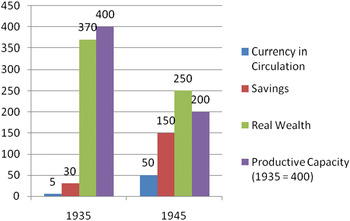
Unsurprisingly, by war's end nearly all banks (as well as the Reichsbank) had no assets besides Nazi war bonds. In the meantime, the Reichsbank dramatically expanded the volume of money pulsing through the German economy: by 1945 the bank had printed roughly ten times the volume of currency in use in 1936Footnote 107 (see Figure 1).Footnote 108
German Economy (Valued in bl of Reichsmarks).

Upon discovering the extent of the inflationary forces unleashed by the Nazis, Dodge moved monetary reform to the top of the Finance Division's agenda.Footnote 109 By early November 1945, he had informed Clay that military government had no chance of reviving a market economy in Germany in such an inflationary environment. However, neither he nor Clay had a clear sense how to solve the problem. Clay sent Dodge back to Washington to seek assistance.Footnote 110 Dodge's efforts eventually resulted in a directive from Washington to Clay on 25 January 1946, giving Clay permission to put together a “mission” to investigate German inflation. Tellingly, the directive included instructions that the mission be “directed to analyze programs and results of anti-inflationary action taken by other European countries as well as analyze the German situation.”Footnote 111 Here, the directive simply acknowledged the obvious: Americans had little experience with inflation and lacked policy insights for how to resolve it. “What then is the modern technique for curbing inflation?” asked the United Nations Relief and Rehabilitation Administration in 1945 when asked to devise a plan for doing just that. “In spite of all that economists and administrators have learned about price control and monetary management in the last thirty years, experience and theory suggest no simple answer.”Footnote 112
With no policy advice coming from Washington, Clay and Dodge found themselves forced to take advantage of the resources at hand—to perform policy bricologe. They soon turned to European economists who had lived through the inflationary aftermath of World War I—economists from continental Europe attuned as much to politics as economics. Dodge embarked on a fact-finding mission and met with Alfred Weber (brother of Max), then a senior economist at Heidelberg University, as well as other economists throughout central Europe; he reviewed the works of Costantino Bresciani-Turroni, Léon Dupriez, and Bruno Foa.Footnote 113 From these Europeans Dodge developed a handful of specific insights about inflation that became the blueprint for military government's reform plans.
First, “inflation is provoked by continual demands made on the Central Bank by the state.” The process “follows a classical scheme: budget deficit, increase of note issues, increase of internal prices, all of which add up to a decline of the purchasing power of paper money.” In short, inflation had little to do with consumer psychology or a wage-price spiral; it could not be solved by exhortation or appeal to patriotism. It came from deficits and money creation. Second, inflation quickly distorted the structure of incentives that normally equilibrated the market economy. “There is a diminution of the intensity of labor because inflation provokes a diminution of real wages.” Because money no longer functioned as a store of value, “unproductive work acquires ever increasing proportions” and “clandestine commerce grows.” Moreover, these distortions rapidly escalated because “economic currents once set off…are difficult to reverse.” Third, and finally, the rise of unproductive labor and clandestine commerce frayed the moral fabric of society: inflation “always generates a profound moral disturbance.” It “dispenses its favors blindly and often the least meritorious enjoy them,” thus provoking a general disillusion amongst the citizenry with the economy and, ultimately, the government.Footnote 114
Dodge's European tutors had reinforced his ideas about separating central banking from state control by showing not only how the state might dominate industry but also create inflation. They also suggested “limitation of the quantity of money” to stabilize “the price structure,” implying that a currency conversion that reduced the volume of currency in circulation might restore the economy's normal functioning. Most importantly, Dodge learned of the process by which the state created an inflationary crisis it then resolved through increasing incursions into the economy―thereby slowly taking control of the entire economy. “It should be recognized,” Dodge concluded, “that if Government controls over the economy are to be used to combat inflation, then wage controls are an essential part of them … This represents the ultimate loss of both freedom and enterprise, and we should note that the most significant result in the most planned and regimented economies is a stabilized poverty.”Footnote 115
CURRENCY CONVERSION
In collaboration with several other economists, Dodge developed a report delivered to Clay in the spring of 1946.Footnote 116 The report discussed inflation in epistemological, as much as economic, terms. “The discrepancy between Germany's financial superstructure and her ability to produce has created a monetary illusion,” it explained. “The absurdities of the present financial situation in Germany are due to this basic discrepancy between financial superstructure and economic realities.” In short, the plan aimed to “draw away the confusing veil of money” and repudiate the Nazi policy of hidden or “silent” finance.Footnote 117
By restoring to money its function of accurately communicating economic reality, the plan aimed to restore incentives to the market economy. Specifically, the plan called for a ninety-percent reduction in the volume of German currency; the old Reichsmarks were to be replaced by new Deutschmarks. The plan also recognized that reducing the volume of currency essentially gave an advantage to those Germans who had assets in real property over those who had their savings in currency. As a result, Dodge's plan called for a mandatory mortgage placed on all real assets (land, buildings, factories, equipment, etc.). The proceeds of these mortgages would “equalize” war losses—that is, support many of the refugees who lost everything in the war. It also equalized the effect of the reform between those who held large cash reserves and the few who held real property. Finally, the plan called for a capital levy on all windfalls earned during the war. This levy would also go to refugees.Footnote 118
Clay enthusiastically embraced Dodge's report and quickly understood its economic implications. “In view of the fact that [we] were paying [German] people to work in currency that was depreciating all the time,” he explained, “there was a very little incentive for people to work.”Footnote 119 Germans continued to report to their jobs and get paid; but they completed very little work. Likewise, German firms brought few goods to market because the profits they earned had little real value. If the money problem could be fixed, economic recovery might follow as a matter of course. In Washington, however, the currency reform plan fell into a bureaucratic limbo. The joint State-War-Navy Coordinating Committee (SWNCC) formed by Truman to oversee the occupation could not agree on the plan's mortgage and capital levy. Throughout the summer of 1946, Dodge went from office to office in Washington explaining his reasoning for each of these measures. In the process he gained the support of John Kenneth Galbraith and many other economists within the administration.Footnote 120 In August the SWNCC informed Clay that it accepted the ninety percent reduction in currency but chose to defer the mortgage and capital levy for a future German government to decide.Footnote 121
Clay was predictably frustrated with SWNCC's compromise. By the August 1946, Clay had concluded that economic stabilization remained paramount for the overall project of founding a legitimate German state that would function within America's broader foreign policy agenda. “If we are truly interested in democracy in Germany,” he lamented, “and really expect to have free enterprise, then we must face … reform courageously to create a stable [financial] condition which will be conducive to democracy and free enterprise.” To him, Washington's inability to approve the plan amounted to a kind of cowardice. “Our failure to act now is a relegation of the leadership which we have exercised in this field and is certain to result in the loss of confidence of our [Allied and German] colleagues. In point of fact, it may well result in our own plan being presented by others. We have now lost four months of study and effort.”Footnote 122
However, Washington's strategic view of Germany began to shift during this period as the Cold War began to harden. As George Kennan explained, if the Soviet Union could combine “central European and the Russian military-industrial potentials,” the United States might become vulnerable to Soviet domination.Footnote 123 After the Moscow meeting of the Council of Foreign Ministers failed to provide new agreements for settling the German question in April 1947, Marshall instructed Clay to begin taking actions to revive the western German economies. Marshall himself began work on the plan that would ultimately take his name and rebuild Western Europe with West Germany included.Footnote 124 However, of course, much of the preparatory work for Marshall's plan had already occurred. Indeed, Clay's development of a pathway that included restoring the German economy and state largely enabled the shift in strategic thinking Marshall embraced.
Eventually in June 1948, the three western zones of Germany adopted the new currency. The Soviets responded by issuing their own currency within their own zone. The move precipitated the Berlin blockade and the split of Germany. The new currency marked not only the transition into economic stability and growth in the West, but signaled that two new German states would emerge as the postwar political settlement of the “German problem.”
THE UNINTENDED DEREGULATION OF THE WEST GERMAN ECONOMY
For some West German officials, the currency reform also provided an opportunity to assert policy views and take political advantage in anticipation of the sovereignty to come—and none more so than Ludwig Erhard, the Bavarian economics minister.
Clay's efforts to democratize Germany had allowed Erhard to climb the political ladder into a leading position within the Economics Ministry. Prior to currency reform, Erhard had expected to be informed of the date of the conversion and have some input into its execution due to his position in the provisional government. More importantly, he hoped to initiate additional reforms that would lift wage and price controls. The Allies had maintained the Nazi system of supervising the economy after the war as the only means, short of currency reform, to control inflation. In May 1948, Erhard presented his plan for decontrol that he hoped to couple with currency reform on the theory the controls would no longer be necessary once currency reform occurred.Footnote 125 Clay agreed to consider it but suggested that it would require the unlikely acceptance of the British who still maintained price controls in their domestic economy. In the meantime, Clay prepared for the currency reform in secret without Erhard's knowledge, recognizing that any hint of the date of conversion would spur currency speculation.
On the afternoon of June 18, 1948, Clay called Erhard to his office to let him know that the reform would be announced in a few hours. Erhard was incensed. He had been excluded from any input on the timing of the reform despite being the German responsible for economic policy. “This is a question of honor and dignity,” he complained. “I must resign … I have been made a fool before the German people.” Clay apologized but added politely, “If you're going to resign, you had better do it [soon]. The currency reform will be announced at eight o'clock.” Erhard stormed out of Clay's office.
Erhard hosted a weekly radio show on the Hessische Rundfunk that happened to be that same day. He left Clay's office and headed straight for the station. Somewhere en route he devised his revenge. As he took to the air, he suddenly announced the currency reform (a few hours before the Allies had planned to make the announcement) and took credit for it, as if it had been his idea all along. Moreover, he announced that with the currency reform most price and wage controls would be lifted (in accordance with his own proposal from several months earlier), freeing the German economy from the last vestiges of the Nazi state.Footnote 126
Immediately the British complained to Clay about Erhard. It was an embarrassment for the Germans to see their economy return to normal while the victorious British remained under controls. Although Clay had already concluded that price controls ought to end with currency reform, he also recognized that “out of sympathy with Great Britain, operating under controls and a victor in the war, I would have found it very difficult to have tried to force approval” for removing them. As a show of solidarity with the British, he called Erhard back to his office the next day and severely reprimanded him, calling him insubordinate and lambasting him for taking an initiative without approval. He did not veto the reforms, however, nor insist that Erhard revoke them, nor that Erhard acknowledge the true authors of the currency reform or in any way publicly contradict his radio show from the prior day. Nor did Erhard offer. From Clay's perspective, Erhard had now taken ownership of the economic reforms Clay had wanted, and in this way he made them “German.” In retrospect Clay concluded that “the way it happened was the very best way for it to happen.” Erhard got credit, Clay got the reforms he wanted, and despite official protests the British never pressed the point and ultimately took their zone off of the controls as well.Footnote 127
In many ways, Erhard only moved faster down the pathway Clay had initiated. His embrace of the currency reform and simultaneous move to end economic controls proved an unintended consequence that nevertheless followed the logic of Clay's own policy trajectory. “We were well on the way to regimenting democracy to death and reducing the fundamental democratic rights of our people to a mere shadow,” Erhard explained to West Germans in announcing his decision. “Only when these rights find expression again in a free choice of occupation, in the freedom to change jobs and, above all, in freedom for the consumer, can we expect the German people to play the same active part in political affairs as before.”Footnote 128 Clay had linked democratic stability to monetary stability. Erhard linked democratic freedom to labor and consumer freedom. In short, both Erhard and Clay followed Dodge in seeing that money and markets mediated the everyday encounter between citizen and state in the most dramatic way.
What followed in the bizone (British and American) surprised nearly everyone. Previously empty shelves suddenly filled. Prior to the reform many firms had hoarded raw materials and inventory because goods held far more value than Reichsmarks.Footnote 129 The combination of a new, stable currency and decontrolled prices signaled to firms across West Germany that they needed to rush their goods to market to gain market share. They began to draw down their inventory and production took off. “The immediate benefits of currency reform have been unbelievable,” Clay wrote in September 1948. “The result is that Germany is going back to work, and in western Germany particularly the people on the street visibly have taken a new hold on life.”Footnote 130
At the same time, a rise in prices that soon followed the sudden rush of goods to the market tempered some of Clay's enthusiasm. Between June and October prices in the American zone rose at an annualized rate of 33 percent, and producer prices rose even faster, at roughly 45 percent.Footnote 131 By mid-October Erhard in particular faced growing criticism from fellow German officials. His own party called for his resignation; but then prices stabilized.Footnote 132 The entire episode cemented the trajectory of Erhard's political career, which included 14 years as minister of economics, followed by three years as chancellor of West Germany.
For his part, Clay claimed that he knew the inflation would peter out. “Of course an immediate buying spree resulted” from the currency reform as the “consumer-starved population rushed to spend its new marks.” However, while his “own staff became apprehensive of runaway inflation,” Clay remained convinced that there “was insufficient money in circulation” to allow for it. Moreover, “raw materials were arriving regularly, production was increasing rapidly, and I was certain that with the exhaustion of the initial issue of currency the buying spree would stop,” he said.Footnote 133
The extraordinary success of the reforms also served as an example of “increasing returns,” validating the many decisions Clay had made prior to that moment and demonstrating the power of monetary reform to accomplish more efficiently the kind of price stability that price controls, rationing, and state management of the economy aimed at.Footnote 134 Indeed, these returns increased even further when the French continued with a controlled economy in their zone, despite participating in the currency reform. As a result, policy makers had a clear comparison of the effects that followed the removal of price controls. The results were unambiguous. As the months passed, a large productivity gap appeared between the bizone area and the French zone, prompting French officials to reluctantly bring their zone's policies in line with the British and Americans within the year.Footnote 135 In retrospect, the currency reform not only marked the stabilization and reconstruction of the German economy (what came to be called Wirtschaftswunder or “economic miracle”), it also became a “founding myth” for the West German nation.Footnote 136
Indeed, in May of 1949 the Federal Republic of Germany formed out of the British, French, and American occupation zones. Clay departed Germany at about that same time, leaving behind a country on the path to economic recovery and a willing American ally in the hardening Cold War. The next decade became a “golden age” of German-American relations, a period in which the American public and private institutions became increasingly interested and intertwined in West German life and politics.Footnote 137
CONCLUSION
No sooner had Clay become military governor than he encountered a fundamental contradiction in American postwar policy for Germany. On the one hand, New Deal planners had imagined a long period of supervised democratization, backed by a powerful military government, itself under strict orders to show no leniency toward the Germans. On the other hand, once the extent of the war's destruction became clear, the American public had little appetite to inflict further harm on the Germans, nor to support the cost in money or manpower of a long-term occupation. Clay realized that to accomplish his fundamental purpose of restoring Germany in a way that did not threaten the future peace, he had to resolve this contradiction. Ultimately, he accomplished this by abandoning despotic uses of American power and invoking instead infrastructural expressions of power.
The employment of infrastructural power included the rapid democratization of German political organizations and with it an allowance of limited German influence over Clay's own policy making. More importantly, Clay discovered that financial institutions provided the means for extending the reach of the occupation without requiring extensive coercive power. “Currency reform affects the everyday life of the individual as no other measure,” Clay explained. “The introduction of currency reform combined with the redevelopment of a sound banking system created a financial structure indispensable to economic recovery. The effect on the German economy was electric.”Footnote 138
In short, Clay discovered that American power in the postwar era might extend its reach most effectively through the development of infrastructural power tied to financial policy. In this way, he developed insights in practical governing that coincided with other efforts at the geopolitical level to tie global finance together—efforts most obviously associated with the Bretton Woods agreements. The occupation thus functioned as an important chapter in the ongoing story of the American state in the world.