Without . . . the steady action of the entrepreneurs in specifying the uses of capital and modifying such decisions, as the forces of change unfold, a civilized economy could not survive at all. (Lachmann, Reference Lachmann1956: 127)
1. Introduction
The main theories of entrepreneurship expounded in 20th-century economics, especially the landmark contributions of Joseph Schumpeter and Israel Kirzner, have usually been exposited by commentators seeking to explain the roles and functions of entrepreneurs within a market-economy context.Footnote 1 Furthermore, the usual referent for distinguishing various types of entrepreneurs has been based on the ultimate impact of the entrepreneur on the market end-state. Thus, the fundamental question expositors of these landmark theories are driven to ask normally focuses on what entrepreneurs do, for example on the entrepreneur as an equilibrating agent or a dis-equilibrating agent and on whether or not the actions of entrepreneurs function to coordinate market processes.
When dwelling on how landmark economic theories characterize what entrepreneurs do and how they function, we can overlook another key element of all theories of the entrepreneur, namely suppositions concerning their behaviour and modes of decision-making (see e.g. Casson, Reference Casson1982; Harper, Reference Harper1996). Specific types of behaviour (rather than functions) may independently define an ‘entrepreneur’ and differentiate the entrepreneur from other economic agents. Instead of concentrating on the nouns, such as entrepreneurship, entrepreneurial effects and functions in the market process, what we call a ‘behavioural’ approach (as opposed to a functional approach) would primarily be interested in the verbs, the things that convey actions and the content of those actions – what it means for the entrepreneur to act, decide, plan, combine, appraise, and form expectations. As Schumpeter (Reference Schumpeter1954: 20–21) once remarked, consideration of these kinds of ‘behaviour’ constitutes an important part of the sub-discipline of ‘economic sociology’. When considering the nature, scope and distinctiveness of various theories of the entrepreneur in the ‘behavioural’ sense, some remarkable differences have been discovered between the ways that behaviour is characterized in the works of Schumpeter and Kirzner and neoclassical theories (Endres and Woods, Reference Endres and Woods2006, Reference Endres and Woods2010).
Section 2 of the present paper investigates the development of Ludwig Lachmann's conception of the entrepreneur without being encumbered by such issues as whether or not the entrepreneur functions as an equilibrating or dis-equilibrating agent.Footnote 2 Our first objective is to demonstrate the legitimacy of speaking of ‘Lachmann's entrepreneur’ as distinct from other prominent 20th-century characterizations, such as Schumpeter's or Kirzner's entrepreneurs. In keeping with this objective, we use textual exegesis to distil Lachmann's explanation of the behaviour of the entrepreneur from all his writings beginning with his first publication in the 1930s and ending with his last publication in the 1990s. Any behavioural depiction must be concerned with the contents of the acts that enable entrepreneurs to take decisions, and it must, wherever possible, explain the processes by which those decisions are made. The following questions must therefore guide the following exegesis:
1. How do Lachmann's entrepreneurs make decisions and over what specific phenomena?
2. What general rules do they follow when making decisions?
3. What modes of communication and problem-solving methods do they employ?
4. What computational capabilities do they possess when making decisions?
5. Are there definite sequences of behaviour that characterize entrepreneurial action?
Section 3 traces the transition from Lachmann's seminal insights on entrepreneurial behaviour and agency, as outlined in Section 2, to the full-blown Lachmannian entrepreneur that has emerged, we maintain, in some more recent contributions in the field. We provide examples of domain-specific institutions that influence entrepreneurial actions and often emerge from, and are maintained by, those very actions. In Section 4, we extend Lachmann's original vision by offering a capsule comparison of the Lachmannian, Schumpeterian and Kirznerian entrepreneur. In our conclusion, we outline the prospects for further research that would extend what is a clearly established Lachmannian approach to entrepreneurship.
2. Lachmann's explanation of entrepreneurial behaviour: some textual exegesis
Lachmann's early work on information and entrepreneurial interpretation
In his first publications, Lachmann foreshadowed some of the ideas he would use in his later magnum opus, Capital and Its Structure (Reference Lachmann1956). These publications also contained the seeds of his first comprehensive statement on methodology which argued for the extension of the economists’ research domain to study the ‘subjectivism of interpretation’ (or expectations) in addition to their traditional research on the ‘subjectivism of want’ or preference (Lachmann, Reference Lachmann1943: 18). One theme in his first articles was the interpretation of information flows by entrepreneurs. He emphasized the fact that while entrepreneurs make investment decisions by assigning resources to production in the light of market prices for inputs and outputs, other diverse sources of information were also utilized in making those decisions. Apart from information derived from personal contacts, other public sources that were not immediately reflected in current market prices included information and predictions on changing patterns of resource supplies, commodity stocks and so forth; latent consumer demands; current shocks affecting particular industries and predictions and data on trends in intermediate goods production (Lachmann, Reference Lachmann and Lavoie1994a). A major implication of all this is that information deriving from a wide range of sources is subject to change and entrepreneurs must keep up to date.
In principle, if entrepreneurs are on average successful in this deceptively simple task, they will have been able to smooth-out business cycle fluctuations and macroeconomic shocks over time (Lachmann, Reference Lachmann and Lavoie1994b: 56). However, there is no guarantee that ‘entrepreneurial foresight’ (even on average) is perfect. Indeed economic systems can ‘relapse’ frequently into crises precisely because entrepreneurs get some of their assessments of information wrong: ‘in a dynamic world. . .many make mistakes’ (Lachmann, Reference Lachmann and Lavoie1994c: 78). Information sources can be volatile. An information source can often be misinterpreted as indicative of short-term volatility when in fact it turns out eventually to be a signal of a long-term trend. Lachmann underscores the importance of not only the availability of relevant data and the interpretation of them but also the limitations of data sources and the entrepreneur's understanding of them. For example, interpretation of financial market data can lead to systematic error and these are manifested in malinvestments. The timing and extent of systematic error both depend on entrepreneurs’ interpretive judgements of information rendered from the market, and these judgements, no less than the information sources, are fundamentally imperfect (Lachmann, Reference Lachmann and Lavoie1994c: 86).
In studying the actions of a particular class of entrepreneurs, namely ‘financiers and investment bankers’, Lachmann (Reference Lachmann and Lavoie1994d) continues the information theme evident in his earliest articles. These entrepreneurs rely on ‘comprehensive general knowledge of the whole economic system’ in order to make effective decisions about the provision of working financial capital to a diverse range of enterprises. As with all entrepreneurs, investment bankers must be involved in ‘active planning and decision-making’ that incorporates all relevant information. Just like Schumpeter, Lachmann denies that entrepreneurs are risk bearers (who earn interest) in this process, on account of some objective, exogenous event or on the basis of something that is already given and universally available in market data. Entrepreneurs have to cope with the uncertainty connected with their interpretations of market data, and profit is a reward for the accuracy of those interpretations (Lachmann, Reference Lachmann and Lavoie1994d: 110–111).
In a 1944 article (reprinted in Lachmann, Reference Lachmann and Lavoie1994d), Lachmann provides the first most general definition of an entrepreneur: entrepreneurs are described as ‘problem-solving’ individuals who ‘change’ and ‘direct capital flows’. Economic change can either be ‘man-made’ or it just ‘occurs’ exogenously. The entrepreneur's ‘purpose and plan’ have a pivotal role in the former event (Lachmann, Reference Lachmann and Lavoie1994d: 112, 121–22). At this point, Lachmann takes issue with Frank Knight (Reference Knight1921: 315–316). While Knight ‘almost exclusively’ viewed the entrepreneur as a mere reactor to exogenous changes, Lachmann wanted to emphasize change wrought by the strategic plans of entrepreneurs. Many economic changes need to be explained by investigating entrepreneurial actions, by the readiness of these agents variously to make bad investments, their readiness to reorient capital goods to new uses, and create new markets (pp. 111–113). Entrepreneurs generate endogenous change:
all progress does not start with investment in new machinery, but often with thousands of entrepreneurs experimenting with, and in the process reshuffling, their existing capital combinations; or that in addition to the innovators and their imitators there are also those who try to go one better than those achievements they emulate, so that a new technique of production becomes modified and diversified in the very process of diffusion. (Lachmann, Reference Lachmann1958: 100)
By experimenting, entrepreneurs bring about endogenous change. This behavioural disposition, he later called ‘learning by doing’ (Lachmann, Reference Lachmann1963: 169).
Lachmann's earliest conception of entrepreneurial action embeds the decisions of entrepreneurs in a communications infrastructure, transmitting a variety of information flows. Entrepreneurs respond to information selectively and they often interpret information idiosyncratically, thereby creating change. In contrast to general human action, entrepreneurial behaviour seems naturally predisposed by some inherent active ‘qualities of the mind’ to interpret domain-specific information in a particular manner (Lachmann, Reference Lachmann and Lavoie1994d: 119).Footnote 3 Entrepreneurs are ‘better equipped than others’ in being able to ‘wrest economic meaning’ from the market (Lachmann, Reference Lachmann and Lachmann1951: 102). Nevertheless, some entrepreneurs will be more successful than others ‘at grasping what the market wants from them’ (Lachmann, Reference Lachmann1958: 100).
Entrepreneurs use capital goods to create capital combinations. This combinatorial behaviour is given by the special properties of the entrepreneurial mind. Capital is created, and continuously ‘regrouped’ as information from the market is reinterpreted. The ‘real test of entrepreneurship’ is to identify opportunities for ‘capital regrouping which are inherent in a given situation’. Entrepreneurs are like archaeologists – they rake over the ‘fossils’ of old production plans and make new plans (Lachmann, Reference Lachmann1947, Reference Lachmann1948: 135). From the outset, they seem to be equipped with pre-existent rules or mental tools for selecting and scrapping capital goods as the case demands. They proceed to identify those capital goods that have substitution possibilities or complementary uses in their production plans, and capital goods that can be turned to completely new uses. The deliberation costs of interpreting information are not given any significance. It is as if entrepreneurs already know how to ‘turn failure into success and benefit from the discomfiture of others’ who might be suffering capital losses (Lachmann, Reference Lachmann1956: 18). However, success ultimately turns on correct interpretation of market data. The realization of entrepreneurs’ interpretations of market information is manifested in actual profit from capital combinations.
The problem-solving and communicating entrepreneur in Lachmann's Capital and Its Structure (Reference Lachmann1956)
Lachmann (Reference Lachmann1956) elaborates on the combinatorial behaviour of entrepreneurs. His fundamental proposition is that entrepreneurs make and revise plans so as to exploit gaps in the capital structure and plans are ‘governed by expected profits’ (Reference Lachmann1956: 54, 65). All plans provide ‘a scheme of orientation’ for future action; for the entrepreneur they are a matter of organizing production – of organizing ways to use heterogeneous resources in real time in the light of plans being made by others (p. 13). Plan revision involves dissolving and reshuffling previously constructed capital combinations, and such planning makes use of certain pre-existing ‘instruments of interpretation’ (p. 22). As we shall see, these instruments too are open to selection and revision.
Capital-making plans are neither based on rational optimization with full relevant information nor on optimally imperfect information (à la Stigler, Reference Stigler1961). For example, resource complementarities are not given data over which a decision maker can optimize. Plan revisions can render complements in one possible production activity substitutes in another activity (Lachmann, Reference Lachmann1956: 56). At every turn, complements and substitutes in resource use and capital formation have to be discovered and crafted. Nowhere in Lachmann (Reference Lachmann1956) do we gather the impression that entrepreneurs make finely calibrated decisions based on the probabilistic calculus. And we have no cause to believe from his discussion that entrepreneurs’ combinatorial capabilities are perfect. Later, Lachmann (Reference Lachmann and Dolan1976: 150) points out explicitly that only when capital is regarded as homogeneous, as it is in standard neoclassical approaches to capital formation, would it be meaningful to assume that entrepreneurs, and the managers who implement their plans, make capital-using decisions in a finely calibrated, marginalist manner. Indeed, ‘rational analysis’ by economists ‘cannot grasp’ the entrepreneur's behaviour; it cannot understand their interpretations of past market experience and attempts to form expectations of future experiences. Expectations ‘embody problematical experience, i.e. an experience which requires an interpretation’ (Lachmann, Reference Lachmann1956: 20; his italics). Thus, when economists analyse entrepreneurs’ plans and decisions, they ‘must elucidate the problems’ that entrepreneurs experience when attempting to judge an ‘an uncertain future’ and they must ‘clarify the modus interpretandi’ (pp. 20–21; his italics). Consistent with his earlier work and also his 1971 book, this is a call for an interpretive social-science approach to the behaviour of entrepreneurs engaged in the process of capital formation, and it comes with the presumption that entrepreneurs are like social scientists – they too proceed interpretively.
Interpretive behaviour is essentially problem solving. Lachmann likens it to testing a scientific theory:
Business expectation and scientific hypothesis serve the same purpose; both reflect an attempt at cognition and orientation in an imperfectly known world, both embody imperfect knowledge to be tested and improved by later experience. (Lachmann, Reference Lachmann1956: 23)
Undertaking this kind of ‘testing’ entails interpreting a range of conditions in markets often in which those entrepreneurs doing the testing are also participants. A complex ‘network’ of communication exists in markets and, as we saw earlier, the information content of those communications goes well beyond price data. For Lachmann, markets are ‘imperfect’ communication networks; they transmit incomplete information some of which is downright ‘misleading’. It is not obvious that entrepreneurs as a group or on average can always ‘read the signs of the times’ (Lachmann, Reference Lachmann1956: 71). Market messages (and not only price data) can be delayed, garbled, or interpreted incorrectly (pp. 22, 29). Stock market prices are volatile but they do provide a source of information for some entrepreneurs on opportunities for capital regrouping (pp. 70–71). Lachmann takes issue with the Keynesian view that the stock exchange is like a ‘casino’ (p. 69). In fact, it can function as one guide to ‘market opinion’ on the availability and price of certain capital goods. In addition, and contra Keynes and the Keynesians, entrepreneurial acts are ‘steady’ and deliberate (p. 127) – they are not generally chaotic, herd-like or generally given over to reckless gambling.
Although entrepreneurs are equipped with various mental ‘instruments of interpretation’ that they continue to refine, imperfect interpretation and imperfect knowledge are always endemic in a ‘world of continuous change’ (Lachmann, Reference Lachmann1956: 22–23). Production plans will therefore continuously diverge. Despite the facts that (i) market processes are imperfect, (ii) entrepreneurs’ decisions are not without error, and (iii) entrepreneurial plans are often inconsistent, there is an enduring incentive for entrepreneurs to fill profitable gaps in the capital structure. The profit incentive ensures some degree of consistency in entrepreneurial behaviour and the execution of capital-making plans.
Anyone applying combinatorial skills in production is essentially an ‘entrepreneur’. Alternatively stated, all entrepreneurs are concerned with the ‘management of assets’ such that those assets may ultimately provide an income (Lachmann, Reference Lachmann1956: 98). Those assets may be either owned or hired and they may be dissolved and reformed in many different ways (pp. 13, 16). The ‘capitalist-entrepreneur’, including financiers and investment bankers, offers financial capital and human capital or other resources to invest in a broadly specified activity. The ‘manager-entrepreneur’ then proceeds to identify particular capital goods that may be fused or matched to form a part of a specific capital combination (p. 99). There may be several layers of ‘specifying’ how resources might be used before concrete capital combinations are formed and begin production (p. 16). Lachmann (Reference Lachmann1956) uses the example of product retailing. First, the manager-entrepreneur makes a
specifying decision to use the capital so received in building or extending a department store in one suburb rather than another suburb, or another city. The manager of this local department store makes further specifying decisions, and so on, until the capital has been converted into concrete assets. (p. 99)
Specifying is a forward-matching decision in the sense that resources have to be linked in a plan before production begins and is therefore oriented towards output demanded in the future (Endres and Harper, Reference Endres and Harper2012: 968). In Lachmann's example, it is evident that specifying is not necessarily a single decision; there is a sequence of decisions, often taken by more than one individual, depending on the case. Here Lachmann was thinking in terms of ‘entrepreneurial teams’ – an idea that has only very recently received the full treatment that it deserves (Harper, Reference Harper2008).
Secondly, entrepreneurs make plans for capital formation by ‘appraising’ useful objects that may eventually become capital (Lachmann, Reference Lachmann1956: vii).Footnote 4 The act of appraisal is a forward-looking process often involving formal acts of interpretation such as monetary calculation and numerical computation (e.g. establishing future cash flows on the basis of anticipated market prices, and discounting those flows). However, there is no reason to believe that ‘appraisal’ is only ever a simple accounting operation or the sole input in the forward-matching decision, otherwise that decision could be given over to accountants, that is, to a purely ‘automatic, mechanical process’ (Lachmann, Reference Lachmann1956: 18 quoting S. H. Frankel). There is a significant degree of judgement required by entrepreneurs, based on their expectations, that has to be incorporated in all combinatorial acts and that goes well beyond accountants’ computations. Entrepreneurial ‘appraisals’ are made on the interpretation of information transcending price data which for some products may not be reliable or in the case of novel products, not yet in existence. And different judgements lead to divergent expectations and heterogeneous capital combinations.
Entrepreneurs were active participants in the ‘learning-by-doing’ process that is the centrepiece of growth generation in the market economy (Lachmann, Reference Lachmann1963: 169). Entrepreneurs must make profitable use of resources at their disposal including knowledge. Learning by doing is necessary because ‘there. . .is no such thing as a common state of knowledge shared by all’ which entrepreneurs can regard as a datum. If such a situation transpired, there would be no profitable opportunities to discover, no market shares to compete over, and no gaps in the capital structure to exploit.Footnote 5 Indeed, successful entrepreneurship requires ‘knowledge superior to that of others’. Real economic progress therefore depends not on common knowledge, but on creating a public good out of knowledge. When knowledge is distributed unevenly among entrepreneurs, we ‘cannot say what concrete actions an entrepreneur with a given situation will actually take’ (p. 169). Yet we can say that all entrepreneurs’ plans will not succeed and that full coordination of those plans is incompatible with their struggle for shares in relevant markets. This is because entrepreneurs may interpret market situations in quite different ways. It is ‘a figment of the imagination’ of some economic theorists to presume that the creation of an equal distribution of commercial knowledge will in fact ‘create growth’ in the market economy. The starting point for understanding the behaviour of entrepreneurs is that they face conditions of unexpected change. Accordingly, Lachmann leaves considerable room for the study of entrepreneurial error. The starting point and ongoing impetus for economic development is that some entrepreneurs have inferior knowledge, evidenced by the fact that they have interpreted market situations relatively poorly and subsequently make mistakes (Lachmann, Reference Lachmann1956: 17).
It is the context-specific aspect of knowledge that Lachmann highlights when he underscores the non-tradable, operational nature of entrepreneurs’ knowledge, such as the knowledge gained from learning by doing in the combinatorial process, and entrepreneurs’ divergent, and often precarious, interpretations of market situations. The very existence of Lachmann's entrepreneurs is predicated on their use of knowledge in creating capital combinations and on not being able fully to codify, transfer, aggregate, articulate, socialize, or appropriate the context-specific knowledge that arises from their attempts to ‘wrest meaning’ from market situations.Footnote 6
The cognitive dimension of entrepreneurial behaviour in Lachmann's 1970s work
During the 1970s and after, Lachmann argued that the ‘ceaseless streams of knowledge’ in which entrepreneurs are immersed may be qualitatively decomposed to reveal heterogeneity in entrepreneurs’ interpretations of market requirements. These heterogeneous interpretations can in turn generate associated variations in the shape of capital combinations.
Lachmann (Reference Lachmann and Dolan1976: 148) considered Israel Kirzner's term ‘alertness’ as a behavioural prerequisite for capital formation which was founded on continuous ‘alertness to change and a willingness to make frequent changes, the switching “on” and “off” of various output streams as well as reshuffling capital combinations’. Lachmann avoided any purely psychological explanations for entrepreneurial alertness. While economists must start with some psychological presuppositions, be concerned with what distinguishes entrepreneurial behaviour and with the scope and content of entrepreneurial plans, the ‘psychic processes’ and psychological motives that engender this behaviour are matters for psychology not economics (Lachmann, Reference Lachmann1977: 155). This view is consistent with Mises, Hayek and Kirzner (Butos, Reference Butos2003). Nonetheless, Lachmann delves into the detailed logical structure of entrepreneurs’ plans much more than his contemporaries in the Austrian tradition (Runde, Reference Runde and Earl1988: 114). He wanted to consider various steps in the decision process which precede action, the ways and means by which business ideas are critically evaluated by entrepreneurs and the shared cognitive categories commonly used by entrepreneurs in the evaluation process. He took what Harper (Reference Harper1996: 31) later called a ‘cognitive-logical perspective on the rationality of the entrepreneur’. In this perspective, the economist does not investigate mental processes, only their precedent conditions and outcomes (plans, scripts, signposts, methods of plan evaluation, and actual decisions that result in capital combinations). While economists could not apply their traditional apparatus of neoclassical rationality to the behaviour of entrepreneurs, Lachmann (Reference Lachmann1943: 68, 72–73) wanted to retain the designator ‘rational’ to describe entrepreneurial behaviour because the latter should be seen as ‘intelligible’ rather than ‘determinate’. In attempting to understand why entrepreneurs ‘act in the way they do’ without entering into a discussion of deep psychic processes, the neoclassical concept of rationality should be rejected because
it now means nothing more than the maximization of certain functions. We use the term in this traditional meaning of ‘bringing reason and experience to bear on one's circumstances’. Needless to say, rational action in this sense implies an attitude of critical scrutiny, rather than headlong ‘maximization’, toward any function one happens to encounter. (Lachmann, Reference Lachmann1986: 115)
As we saw earlier, entrepreneurs’ plans are based on conjectures that require testing (‘critical scrutiny’). This is tantamount to saying that entrepreneurs form and test expectations (and it has a Popperian flavour, anticipating Loasby, Reference Loasby and Langlois1986, and Harper, Reference Harper1996). Entrepreneurs are charged with interpreting, in a critical manner, market data – not just prices, but experiences, general circumstances within the ambit of their commercial interests, extensive numerical computations and presumably even dialogue with others in the market. As Koppl (Reference Koppl, Koppl and Mongiovi1998: 63) succinctly summarized the matter, for Lachmann all expectations are interpretations. Entrepreneurs are keenly aware of the ‘indeterminateness’ of the market process in which they participate (Lachmann, Reference Lachmann1986: 115–116). In that utterly endogenous process, they behave as interpretive change-agents, communicating their interpretations by acts of capital formation.
In outlining the ‘modes of action’ typical of entrepreneurs, Lachmann (Reference Lachmann1986: 132) did not believe that this practice would cross the disciplinary boundaries into pure cognitive psychology.Footnote 7 We should ‘be able to show to what ends, means and obstacles human action is oriented . . . and . . . to ascertain the boundaries of action’. Furthermore, we can form generalizations about those specific human activities that lead to the ‘ordering and formulating of ends, allocating means to them, making and revising plans, determining when action has been successful’ – these are all outcomes of an underlying, active mental process (Lachmann, Reference Lachmann1971: 37–38). Mental processes are inaccessible. Nevertheless, it is still possible for economists to look at capital ‘the way the entrepreneur does’ (Lachmann, Reference Lachmann1956: 72). The meaningful expressions and practices of entrepreneurs as they form capital are accessible. Mental processes generate and use signposts or orientation schema allowing entrepreneurs to coordinate their capital-forming actions with others. There is, in short, a cognitive dimension to Lachmann's conception of institutions (Foss and Lorenzen, Reference Foss and Lorenzen2009).
Entrepreneurs are not isolated individuals; they participate in a commercial culture that is a domain specific, though not unconnected, part of human society and they too must produce intelligible accounts of the behaviour of others. Commercial activity is based on forward-looking production plans made to cope with change – it is ‘orientative’ rather than ‘mechanical’ (Lachmann, Reference Lachmann and Lavoie1994e: 204–250). Entrepreneurs position their plans in relation to the relevant market. Their actions are always and everywhere ‘orientative’ in the sense that they are ‘neither determined by what happened in a past period nor by the distance of their present position from an imaginary equilibrium’ in their interaction with the plans of others. And those actions, like all human action, are both constrained and enabled by institutions, that is, the ‘network of constantly renewable meaningful relations between persons and groups . . . who may not all ascribe the same meaning to the same set of relations’ (Lachmann, Reference Lachmann and Lavoie1994g: 282).
The orientative behaviour of entrepreneurs is multi-layered and occurs on three levels (Lachmann, Reference Lachmann1971: 21–23, 38, 68–69, 88–89):
Level 1: The socio-cultural and cognitive dimension of the institutional system. Decisions are mediated by a general structure of ‘elements’ common to all orientation schemes – social norms, the general environment in which plans are made including means, widely shared signposts and categories of interpretation, interpersonal relations, regulatory obstacles and rules, and existing property rights.
Level 2: The properties and capabilities of individuals who manipulate elements at level 1. Individualized orientation schemes possess operational (including computational) ‘directives’ garnered from often-divergent perceptions and interpretations of what to do and how to do it. Once acted upon, there is a path-dependent aspect to these directives.
Level 3: Concrete acts as observable manifestations of active minds. Orientation materializes in concrete acts such as entrepreneurs’ acts of capital formation and capital-goods transformation.
Orientation is therefore a social-institutional and a practical process.Footnote 8 The entrepreneurial task is to dovetail operational procedures at level 2 with the domain of concrete actions at level 3. This task need not be linearly sequential: levels of orientation can interact (see suggested interactions in Figure 1). The process may conceivably be iterative, serial, or form an interwoven pattern. Data generated by the mutually orientative actions of market entrepreneurs are by their very nature historical ‘elements’ at level 1 that have to be continuously interpreted at level 2. Market data, and more particularly the methods of data interpretation used by entrepreneurs, serve as ‘points of orientation’ (Lachmann, Reference Lachmann and Lavoie1994f: 271).Footnote 9Figure 1 provides a stylized depiction of the dynamic sequence of actions that typifies an entrepreneur's behaviour beginning from level 2 in the orientation process. Continuous feedback from capital-forming actions prompts entrepreneurs to reinterpret the market environment and update their interpretive techniques for handling new and different problems.
A non-linear sequence of entrepreneurial actions.

A synthesis of the key behavioural characteristics of Lachmann's entrepreneur
We may now list some behavioural characteristics that distinguish Lachmann's entrepreneur from those of ordinary individuals. On this matter, Lachmann's work was not a perfectly integrated whole. Rather, it offered some explicit, piecemeal suggestions for the development of a theory of entrepreneurial action. Here we put all the main pieces together. Lachmann's entrepreneur is always and everywhere involved in capital formation and capital restructuring. He insisted that all entrepreneurial behaviour is concerned with production decisions, and in particular, with concrete acts of capital formation. Our earlier exegesis generates the following main features of entrepreneurial behaviour.
Entrepreneurs are distinctive because they:
1. Are dynamically and mutually ‘orientative’ rather than ‘mechanical’ – they are always positioning and revising their production plans relative to each other.
2. Combine resources to form capital and produce goods and services for profit.
3. Possess the mental apparatus to generate knowledge and expectations about gaps in the capital structure.
4. Solve problems by forming and testing expectations about how to exploit gaps in the capital structure, though not always without error.
5. Are interpretive agents who produce and use domain-specific data and rules that are related to filling gaps in the capital structure: numerical expressions and algorithms (e.g. prices, charts, computations, and cash flow statements), written documents (market reports, accountants’ reports, and predictions of market experts), and verbal and non-verbal expressions (personal contacts and interactions).
6. Specify and appraise resources that will form complementary combinations in production, though again not always without error.
7. Use a range of mental interpretive instruments relevant to (1)–(6) above, and update these in the light of feedback from previous actions.
3. From Lachmann's entrepreneur to the ‘full-blown’ Lachmannian entrepreneur
The interpretative nature of entrepreneurial calculation
The ‘interpretive’ entrepreneurial behaviour of the kind that pervades Lachmann's work deserves to be elaborated through the lens of modern scholarship that explicitly takes Lachmann's ideas as a point of departure.Footnote 10 From the very outset, following our exegesis of Lachmann's work, we begin with his fundamental proposition that the entrepreneur proceeds interpretively within a communications network, seeking to synthesize and integrate fragmented and contradictory evidence, so as to render intelligible readings of events in the economy, and more pertinently of the environment within which capital is intentionally structured. We turn next to consider some implications of this proposition.
As depicted in Figure 1, Lachmann's conception of the entrepreneur's sequence of actions is an elaboration of the problem of economic calculation – a problem that involved behavioural complexities that were ignored in the early debates on socialist calculation. Apart from the basic point that market prices for resources in a monetary economy enable economic calculation (such as numerical operations and profit and loss accounting) and that such calculation ensures a tendency towards the efficient allocation of capital goods, Mises and Hayek did not delve into the intricacies of the decision-making process which in fact gives effect to successful calculation.Footnote 11 Lachmann does not use the words ‘economic calculation’ at any point in his work on the nature of capital and its structure. Instead, the concept of the market as a ‘network of communications’ (1956: 21) comes to the fore. In order for entrepreneurs to communicate in a concrete manner within this network, they not only assess opportunities to form capital but they must also actualize that goal (i.e. implement plans to combine capital goods). In assessing these opportunities, entrepreneurs make widespread use of mental ‘instruments of interpretation’. It is scarcely surprising that Lachmann avoids the word ‘calculation’ in this connection because it has connotations of performing mathematical and arithmetical operations and not much more. By contrast, Lachmann's mental ‘instruments of interpretation’ do not just encompass arithmetical assessment; more generally, they are associated with imagining, establishing and then communicating forward-looking courses of action in the realm of capital formation.Footnote 12
The social and material embeddedness of interpretive entrepreneurial behaviour
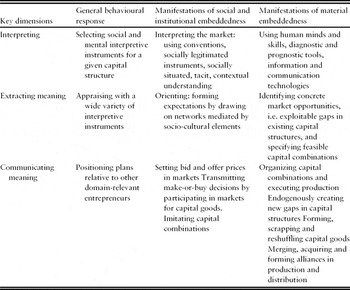
Existing capital structures and the economic, social and legal circumstances in which existing capital has been formed, mediate entrepreneurs’ interpretations but they do not determine them. (The relevant circumstances include property rights, trading conventions, labour, finance, asset and product market regulations.) The social embeddedness of entrepreneurship, the fact that interpretive instruments are often shared and legitimated in social networks, should not have deterministic overtones (see Table 1, column 3). Consequently, the discovery of profit opportunities is not an outcome of unalloyed, socially isolated perceptions – entrepreneurs proceed by interpreting opportunities in the market that presents itself as a social network (Lavoie, Reference Lavoie and Berger1991a, Reference Lavoie and Caldwell1991b, Reference Lavoie and High2006). Furthermore, Lachmann's entrepreneur carries material and historical baggage into the capital-combinatorial process. Modern research utilizing some of Lachmann's original model of humans as interpretive beings maintains that there is a recursive relationship between human agency and socio-economic structures – agency and structure are ‘mutually constitutive’ (Lewis and Runde, Reference Lewis and Runde2007: 183; also Lewis, Reference Lewis2008: 849–851). Furthermore, all human action is ‘materially embedded’; it does not issue from a clean slate (Lewis, Reference Lewis, Davis, Marciano and Runde2004). Entrepreneurial acts of capital formation are no exception: they are anchored to, or embedded in, existing capital structures and go on to shape and transform them, for example, by interpolating novelty into those structures that may eventually have far-reaching effects at the level of the firm, industry and economy as a whole (Endres and Harper, Reference Endres and Harper2012: 974–975). Again, because of the interdependencies between capital structure and entrepreneurial behaviour, the open-system properties of real-world economies are undeniable.Footnote 13
Manifestations of interpretive entrepreneurial behaviour: the Lachmannian view

By implication, the entrepreneur's instruments of interpretation are also part of the materially embedded context of entrepreneurial decision-making (see Table 1, column 4). The instruments are applied and transformed in a recursive fashion by entrepreneurial agency. For example, old techniques for assessing different combinations of capital goods, such as discounted cash flow analysis, may be applied and revitalized in an interactive, iterative fashion as innovatory accounting methods emerge and reveal previously hidden values in potentially new capital combinations. Well-established algorithms for assessing bid and offer prices on financial asset markets can be refined iteratively in the application of innovative computer programs and information technologies. In addition, new financial derivatives can be manufactured by innovative combinations of new algorithms, human capital and information technology that seek to meet investor needs in previously undiscovered, missing markets.Footnote 14 Here economic calculation is not ‘all in the mind’; it is, to some extent, ‘an exosomatic process that involves tight loops of interaction among human agents and material tools, other concrete objects and physical media’ (Harper, Reference Harper and Endres2010: 185). Also pertinent here is the burgeoning literature on the social studies of finance which reaches a conclusion that is very Lachmannian in tone. According to MacKenzie (Reference MacKenzie2009: 3), the ‘human actors who make up markets are not disembodied agents or abstract information processors . . . They are embodied human beings, and bodies are material entities. The capacities and limitations of these material entities (including those of human brains) are hugely important to how markets are constructed’. Thus traders of financial derivatives are not just socially embedded; their interpretive ‘“equipment” matters’ (p. 4) for market outcomes. And that equipment which is essentially concerned with interpretive capability is not uniformly distributed among traders.
The role of domain-specific institutions
The facts that entrepreneurial behaviour is mediated by institutions and that the role of institutions needs to be explained would not be a revelation to economic sociologists. However, in the period from the 1950s to the 1970s, Lachmann was a rare exception among economists in making this point. Modern work in a Lachmannian vein has elaborated on the specific types of institution that entrepreneurs must confront and either reproduce or transform (Lavoie, Reference Lavoie and Berger1991a, Reference Lavoie and Caldwell1991b, Reference Lavoie, Birner and Garrouste2004, Reference Lavoie and High2006). Those institutions are diverse and complex and occur at different levels of action. Obviously, like all humans, entrepreneurs act in a ‘social process of mutual orientation’. And all social processes in any particular environment operate within a wide range of macro-social institutions such as a particular configuration of property rights, laws of contracting etc. The distinguishing feature of entrepreneurial behaviour is that it must also confront domain-specific institutions, that is, a specific ‘communicative-technological environment’ in which attempts are made to signal ‘readings’ of the market, act in conformity with those readings and then plan to form capital (Lavoie, Reference Lavoie, Birner and Garrouste2004: 26). That environment may include the use of techniques for assessing and helping form or manipulate consumer requirements; price setting behaviour; garnering certain capabilities to interpret market data more successfully; participating in raw materials, intermediate goods and services markets in order to buy and sell productive inputs; choosing a form of business organization such as a hierarchical or non-hierarchical production structure. In short, the environment may include all manner of everyday contextual factors that assist entrepreneurs in forward-looking and forward-matching actions that form capital.
4. Prominent 20th-century approaches to entrepreneurial behaviour and the Lachmannian tradition: some comparisons
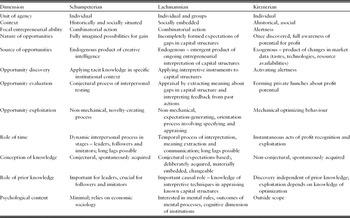
We are now in a position to bring into sharper focus the distinctiveness of the Lachmannian entrepreneur. Table 2 distils the main points of complementarity and contrast between the Schumpeterian, Lachmannian and Kirznerian entrepreneur.Footnote 15 In keeping with the essential features of Lachmann's approach as exposited in Section 2, the key behavioural differences constitute the main focus of the ‘dimension’ column in Table 2.Footnote 16
The behaviour of the Schumpeterian, Lachmannian and Kirznerian entrepreneur: a comparison

The sole-individual bias in the Kirznerian characterization of entrepreneurial behaviour contrasts with the openness to team-based, group agency in Lachmann's work. In particular, Kirzner's concept of ‘alertness’ is a state of mind; it is a singular property of individuals. Alert individuals act on a previously overlooked profit opportunity. Lachmann does not make a sharp distinction between managers (as mere resource administrators), entrepreneurs and capitalists. While Mises made these distinctions based on resource ownership, Kirzner's subsequent development of the Misesian entrepreneur blurred the distinctions (Salerno, Reference Salerno2008).Footnote 17 For Schumpeter, the matter did not arise since, to count as an entrepreneur, individuals must simply act as agents of change in the economic process and, in doing so, must take risks rather than bear risk.
Kirzner abstracts from cultural and institutional factors relevant to entrepreneurial behaviour and instead focuses on the pure entrepreneurial function. By contrast, the social dimension of entrepreneurial behaviour is a feature of the Schumpeterian entrepreneur and it is more than matched in the Lachmannian emphasis on the entrepreneur as a culturally constituted agent. Both Schumpeterian and Lachmannian approaches elucidate the potential interpersonal character of both entrepreneurial discovery and exploitation. The Lachmannian entrepreneur does not merely rely on interpersonal interactions; such interactions must be successfully interpreted through the filter of institutions (signposts, shared interpretive techniques) and result in effective capital formation. Moreover, deliberate search and interpretation of prevailing institutions (‘orientation’) are the hallmark of the Lachmannian entrepreneur and this kind of behaviour contrasts with the other two approaches. Lachmann also made entrepreneurs’ expectations about the production plans of others a crucial part of the entrepreneurial orientation process whereas both Kirzner and Schumpeter downplayed the role of expectations.
The Schumpeterian and Lachmannian entrepreneurs are not mechanical decision makers or imaginary constructs – they are embedded in a social context. Once a profit opportunity is perceived, the Kirznerian entrepreneur, by contrast, turns into a mere mechanical optimizer at the opportunity exploitation stage (Kirzner, Reference Kirzner and Boettke1995: 107). Although Schumpeter's entrepreneur is impacted by macro-institutional forces in different capitalist epochs, Lachmann's entrepreneur is also influenced by a host of micro-institutional factors (as elaborated in the multi-layered decision process in Section 2 and Figure 1). There is also a strong mimetic basis to Schumpeter's leader–follower–imitator model of entrepreneurial conduct in which entrepreneurs are not all of equal ability and failure is a widely observed phenomenon (Endres and Woods, Reference Endres and Woods2010). Again, these sociological aspects of entrepreneurial action are matched in the Lachmannian tradition, as we demonstrated in Section 3.
Perhaps the most distinctive feature of the Lachmannian entrepreneur is that opportunities for capital-goods combinations and profit do not appear fully formed at the outset of the entrepreneur's orientation process. The elaboration of the rich contents of this time-dependent process – in which socially and materially embedded interpretive techniques are used in stages to plan, form expectations and solve capital formation problems – marks the very essence of the Lachmannian approach. In the act of mutual orientation, Lachmannian entrepreneurs fill gaps in the capital structure and, by so doing, they endogenously and unintentionally create new gaps for others to evaluate and exploit. Discovery is not instantaneous; it occurs throughout the gap-filling process and is therefore ‘dynamically continuous’ (Rizzo, Reference Rizzo2000: 23). While there is partial endogeneity in the Schumpeterian focus on the emergence of novelty, only Lachmannian entrepreneurs traverse a path in which opportunities are incomplete and ill-structured at the outset and other opportunities are generated by their own actions.
5. Concluding remarks
We have demonstrated that Lachmann was not an also-ran in the provision of a substantial theory of entrepreneurial behaviour in the 20th century. Throughout his life's work, Lachmann offered a distinctive theory of entrepreneurial behaviour (and entrepreneurship) – a theory that has been extended in some fruitful directions by 20th-century Lachmannian scholars. Lachmannian entrepreneurs, like all others, are profit-seeking change-agents in the market process. Yet for the Lachmannian entrepreneur, profit opportunities do not appear all at once and do not result from isolated insights; they arise from the application of thoroughgoing interpretive practices over time that ‘wrest meaning from the market’ and find meaningful gaps in capital structures. Entrepreneurs approach capital structures like complex networks of artefacts that require continuous interpretation. In performing that task, entrepreneurs must be receptive to new and emerging techniques of interpretation that enhance their ability to discover structural gaps and then act accordingly.
Crucially, Lachmann's interpretive entrepreneur undertakes a process of appraising and discovery in the pursuit of profit. This must all occur prior to the creation of ‘capital’ or of ‘assets’. There can be no such thing as capital or assets without prior operation of Lachmannian interpretive agency. Legal title or ownership, while important in some instances, is not an essential precondition for the general exercise of entrepreneurship.
Modern work has extended Lachmann's idea of mutual orientation in the behaviour of entrepreneurs and it has demonstrated how new modular structures and interfaces can be created through innovation. Relying on many of Lachmann's original insights, Harper and Endres (Reference Harper2010: 37–38) and Endres and Harper (Reference Endres and Harper2012) show that relations of capital-goods complementarity and substitutability are often transformed by entrepreneurs and these transmit knowledge about new connections in the market-wide system of communication (for example, by changing both the prices of productive inputs and services and their flows from one capital combination to another). This Lachmannian-inspired research captures some of the major dimensions of entrepreneurial action: the realities of agency, dynamics, transience and emergence in specific institutional settings. Other important work has moved in a similar Lachmannian direction, most notably research on how entrepreneurs change the way they ‘modularize’ production activities (Langlois, Reference Langlois2002; Lewin, Reference Lewin2008: 177–179) and create complex complementarities between ‘co-specialized assets’ (Teece, Reference Teece2009, Reference Teece, Hall and Rosenberg2010).
It is scarcely surprising that Lachmann's socially embedded entrepreneur, captured in his concept of ‘mutual orientation’, could have wide application in modern research on strategic management in which the rivalrous interactions of entrepreneurs are a major consideration (Chiles et al., Reference Chiles, Bluedorn and Gupta2007). Thus, all asset management problems have a strategic dimension in modern firms in which entrepreneurs use their combinatorial skills to create resource complementarities or, in other words, build synergies. As Mathews (Reference Mathews2010: 240) explains, Lachmannian insights furnish management scientists with ‘an alternative starting point for strategizing’ because the ‘focus can be firmly on the process of creatively recombining business elements and dynamically adjusting to new circumstances’. The endogenous impact of Lachmannian entrepreneurial behaviour is expressed in their disruptive, divergent and always unfinished, interpretations of capital structures. In the Lachmannian view, it is this very interpretive process that constitutes the background to, and substance of, attempts to ‘recombine business elements’.
In all this modern work that draws on Lachmann's original ideas, further contributions to the field of complexity research would seem particularly compelling (e.g. Koppl, Reference Koppl and Rosser2009; Rosser, Reference Rosser and Rosser2009). Generalizing somewhat, Lachmann (Reference Lachmann and Lavoie1994f: 274) mentioned that the ‘world of markets is one of complexity’. He derived the following prediction: a ‘quite undreamt of’ increase in the ‘complexity’ of capital structures was in the offing as capitalist economies evolve (Lachmann, Reference Lachmann1956: 85). The emergence of these complex higher-level structures from lower-level systems depends on the interpretive and combinatorial actions of entrepreneurs – actions that give rise to novelty, new niches in production and new capital-goods complementarities. Empirical evidence is beginning to confirm Lachmann's prediction that diverse, complex capital structures and their equally diverse products, emerge in more highly developed, industrial and service economies (Felipe et al. Reference Felipe, Kumar, Abdon and Bacate2012; Hidalgo et al. Reference Hidalgo, Hausmann and Dasgupta2009). The Lachmannian entrepreneur is indeed active in creating the kind of complex capital structures that appear today, including emergent structures that are currently beyond our ability to comprehend.