Introduction
Palliative care plays an essential role in enhancing the quality of life and quality of death for individuals with progressive life-limiting illnesses in the long-term care home setting. Long-term care homes (LTCHs), also known as nursing homes, provide the on-site provision of personal assistance with activities of daily living, nursing, and medical care for older individuals 24 hours a day, seven days a week (Smets et al., Reference Smets, Onwuteaka-Philipsen, Miranda, Pivodic, Tanghe, van Hout, Pasman, Oosterveld-Vlug, Piers, Van Den Noortgate, Wichmann, Engels, Vernooij-Dassen, Hockley, Froggatt, Payne, Szczerbińska, Kylänen, Leppäaho, Barańska, Gambassi, Pautex, Bassal, Deliens, Van den Block and PACE2018). The palliative approach to care aims to improve the quality of life for individuals facing life-limiting illnesses through the prevention and relief of suffering by means of early identification, the assessment and treatment of pain, and other physical, psychosocial, and spiritual problems (WHO, 2013). This approach to care is well-suited in the long-term care setting given that most residents are living with multiple comorbidities for which there is no cure and death is inevitable (Froggatt et al., Reference Froggatt, Hockley, Parker and Brazil2011; Kinley et al., Reference Kinley, Froggatt and Bennett2013; Goodman et al., Reference Goodman, Sharpe, Russell, Meyer, Gordon, Dening, Corazzini, Lynch and Bunn2017).
Although there is momentum in understanding the value of the palliative approach to care in the LTCH setting, including higher quality and satisfaction with care and fewer or shorter duration of hospital admissions, there have been many studies outlining the lack of integration of the palliative approach to otherwise deserving residents in this setting (Hall et al., Reference Hall, Kolliakou, Petkova, Froggatt and Higginson2011; De Gendt et al., Reference De Gendt, Bilsen, Stichele and Deliens2013). It is also becoming more evident that the palliative approach to care is best delivered early in the trajectory of an individual's illness rather in the last days or weeks of life, the latter being the more common initiation point for palliative care services in LTCHs (Zimmermann et al., Reference Zimmermann, Swami, Krzyzanowska, Hannon, Leigh, Oza, Moore, Rydall, Rodin, Tannock, Donner and Lo2014).
From a clinical perspective, barriers to providing early palliative care include unpredictable dying trajectories, apprehensiveness in talking about dying in advance of clinical acuity and a lack of palliative care knowledge or skills (Aldridge et al., Reference Aldridge, Hasselaar, Garralda, van der Eerden, Stevenson, McKendrick, Centeno and Meier2016; Sommerbakk et al., Reference Sommerbakk, Haugen, Tjora, Kaasa and Hjermstad2016; Cable-Williams and Wilson, Reference Cable-Williams and Wilson2017). Another clinical barrier includes access to specialist palliative care consultation in the LTCH setting for non-urgent cases or in supporting earlier conversations concerning prognosis, advance care planning, and goals of care discussions. Specialists in palliative care are a limited resource in most jurisdictions and having one physically come into an LTCH may not be feasible due to factors such as availability and geography. Although residents of rural or remote LTCHs are disadvantaged in accessing palliative care specialist consultation, this can also hold true for urban LTCHs. In general, telemedicine has proved to contribute to matters of overcoming distance and enabling access to high-quality medical care for currently unassisted communities, even in large urban centers (AlDossary et al., Reference AlDossary, Martin-Khan, Bradford and Smith2017). Telemedicine is one potential option to improve palliative care service delivery, although its uptake is not widespread and its value has not been extensively studied (Greenhalgh et al., Reference Greenhalgh, Vijayaraghavan, Wherton, Shaw, Byrne, Campbell-Richards, Bhattacharya, Hanson, Ramoutar, Gutteridge, Hodkinson, Collard and Morris2016). Given the sensitivity of topics discussed, concerns over the quality of communication raise concerns for many clinicians providing palliative care. Other concerns raised over palliative telemedicine include technical, logistical, and privacy issues (Tieman et al., Reference Tieman, Swetenham, Morgan, To and Currow2016). However, relatively little is known about the delivery of palliative care consultation via videoconferencing to LTCHs and even less is known about the feasibility of doing so early in a resident's illness trajectory.
This project focused on palliative telemedicine, specifically evaluating whether the integration of early palliative care specialist consultation into an LTCH would be feasible through the implementation of videoconferencing during routine interdisciplinary resident care conferences.
Methods
Study design
During the pilot program implementation, clinical staff in two pilot communities at the Baycrest Health Sciences LTCH monitored residents during routine clinical care and informed the most responsible physician (MRP) on a weekly basis by completing a form if any of the following four clinical events occurred. These four clinical events related to the appropriateness for consideration of a palliative approach to care and included (1) a request from the resident or their substitute decision-maker (SDM) for the palliative approach to care, (2) all re-admissions from an unplanned admission to acute care hospitals, (3) clinical judgment, and (4) routine quarterly review. Using clinical judgement that a resident may benefit from the palliative approach included resident circumstances such as a decline in functional status, recent infection, and active symptoms. The routine quarterly review was included as a trigger to ensure that all residents are at least considered for the palliative approach to care on an on-going basis in case there were no other triggers outlined above.
These four events served as a prompt for the MRP to further explore the appropriateness of the palliative approach to care by using the Gold Standard Framework Proactive Identification Guidance tool (GSF PIG) as a screening tool (Gold Standards Framework, 2006). The GSF PIG is a standardized tool for identifying residents with palliative care needs. As part of the GSF PIG tool, the MRP asked themselves the surprise question: “Would you be surprised if this resident were to die within the next 12 months?” If the MRP indicated that they would be surprised, then usual care was provided. If the MRP indicated that they would not be surprised if the resident was to die within 12 months and that it was appropriate to consult palliative care, then the resident was approached for their consent to schedule an interdisciplinary care conference with a palliative care specialist integrated remotely via videoconference, using the Ontario Telemedicine Network (OTN). If the resident was not capable of decision-making, then their SDM was approached for consent. If the MRP felt that the integrated palliative care videoconference was not urgent (defined as the resident needing to have a care conference in less than a week), the integrated palliative care videoconference was scheduled at the time of the resident's next routine care conference or within 3 months, whichever came first. Prior to the pilot program implementation, there was no routine or standardized method of palliative care screening using trigger forms, including the use of the GSF PIG tool in both communities.
Setting and population
The Baycrest Health Sciences LTCH is a 472-bed, not-for-profit, urban academic long-term care home situated in north Toronto, Ontario. The resident cohort included all residents in the two pilot communities at Baycrest Health Sciences LTCH. There are 51 beds in the two pilot communities, but the total sample size of residents was 61 due to deaths and new admissions during the study period. Care conferences for residents in this LTCH are routinely held in a conference room where the resident, their SDM, and caregivers are invited to sit alongside the interdisciplinary team. Prior to the first videoconference, participating clinical staff completed a short training exercise in the use of the telemedicine hardware and software by the Baycrest Telehealth Coordinator. The videoconferencing equipment included a computer through which the videoconference connection could be made and peripheral devices which included a widescreen television monitor, a video camera mounted on top of the television monitor and an external microphone. All videoconferences were conducted through OTN. A two-page “quick guide” was provided in the conference room with reminders around how to use all the equipment and a contact number for the Baycrest Telehealth Coordinator for any technical difficulties during the videoconference. The palliative care specialists remotely videoconferenced in appearing on the widescreen television monitor embedded in the conference room. The family and SDMs were also provided with a videoconference link but were given the choice to attend in person or through videoconference. Integrated palliative care videoconferences took place for 6 months in the first community and a second community joined the study for 3 months halfway into the pilot. The 6-month study period was defined as November 1, 2017–April 30, 2018.
Data collection and analysis
This was a mixed-methods evaluation of a pilot program implementation to better integrate early palliative care into an LTCH setting by using videoconference during interdisciplinary care conferences.
The project utilized a chart review to describe the study population. Baseline measures evaluated for all residents at the start of the evaluation or near the time of admission (whichever came later) and included Palliative Performance Scale (PPS) score, the Changes in Health, End-Stage Disease, Signs and Symptoms scale (CHESS) score, the Activities of Daily Living (ADL) score, as well as basic demographic information. The PPS is a measure of the progressive functional decline of a resident, on a scale from 100 (normal activity, no evidence of disease), in increments of 10 down to 0 (death). The CHESS score is a measure of health instability on a scale of 0–5, where 0 represents no health instability and 5 represents very high health instability. The ADL score rates the individual's dependency or independence in completing ADL on a scale of 0–6, where 0 represents independence and 6 represents total dependence.
Research assistants obtained written consent from participating clinical staff and family members, to complete de-identified self-administered paper or online surveys. Palliative telemedicine feasibility was evaluated using clinical staff and family surveys that evaluated their experience. For participating clinical staff, the project also utilized surveys to evaluate their demographics, palliative telemedicine knowledge and readiness, at the baseline prior to the pilot project, and at the end of the pilot, and palliative telemedicine videoconference satisfaction surveys. Clinical staff also completed a survey on confidence in palliative care and another survey specific to palliative telemedicine confidence. Participating family members completed a demographics survey in addition to three videoconference surveys on the topics of (1) videoconference satisfaction, (2) illness understanding, goals of care and management, and (3) access to palliative care. Finally, for the videoconferences with palliative consultant integration, the charts were reviewed retrospectively for discussion themes. Research ethics approval was obtained from the Baycrest Research Ethics Board (REB) to conduct the evaluation.
Descriptive summaries include means and standard deviations (SD) or median and interquartile ranges (IQR) and proportions. The changes in mean item scores for staff from pre-study to post-study were evaluated using paired t-tests and summarized using standardized response means (SRM). Group differences in changes in item scores were evaluated using independent t-tests. The relationships between continuous variables (such as the number of telemedicine sessions) and ordinal outcome variables (such as questionnaire item ratings) were summarized for staff using Pearson correlation coefficients which range from r = −1.0 to r = 1.0, with values close to 0 indicating no correlation. For this report, a P-value of less than or equal to 0.05 is considered statistically significant. All analyses were completed using SAS version 9.4.
Results
A total of 11 integrated palliative care videoconferences took place during the study period. Every videoconference was attended in person by at least one family member who identified themselves as the SDM for the resident. The care conferences were collectively attended by a total of 17 out of the 22 clinical staff and 20 family members. Clinical staff who attended the videoconferences included individuals from the following disciplines: palliative care specialists (physician, nurse practitioner), the MRP for the resident, nursing (registered and practical), occupational therapy, physiotherapy, social work, recreational therapy, registered dietician, personal support worker (PSW), and the manager for the community.
Resident population description
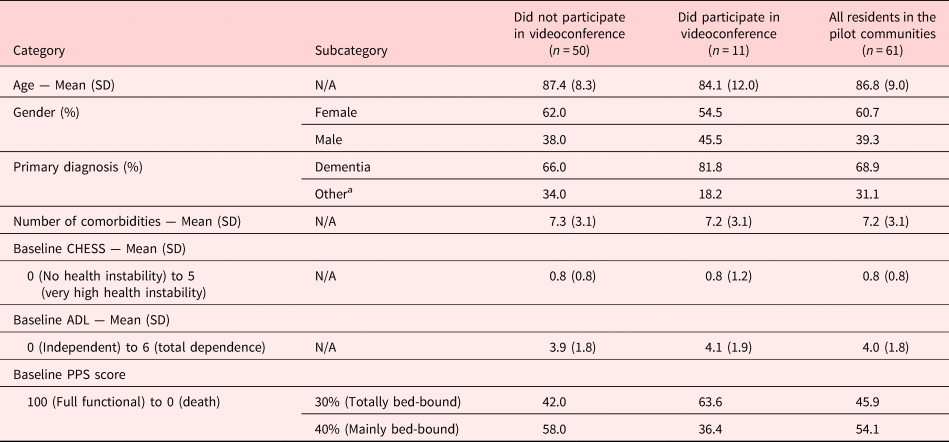
For the two pilot communities, residents were on average 87 years old, with a higher proportion of females than males. Roughly seven comorbidities per resident were identified. Two-thirds of the residents had dementia as their primary diagnosis, which was defined as the reason for their admission to long-term care. Residents’ baseline PPS scores indicated that nearly 54% of residents were mainly bed-bound and 46% were totally bed-bound. The low mean CHESS score of 0.8 indicated very low health instability, and ADL scores indicated on average extensive resident dependence. See Table 1 for resident demographics.
Resident population demographics

a Diagnosis of “Other” includes cardiovascular, respiratory, general frailty, psychiatric, hematological, and other neurological diagnosis.
Out of the 11 residents who had a scheduled palliative telemedicine care conference, one was capable of giving consent and physically attend. The other 10 residents who had a palliative telemedicine care conference had advanced dementia and were not able to give consent nor able to physically attend. As such, for these 10 residents, their SDMs gave consent for scheduling the palliative telemedicine care conference.
Resident population GSF PIG triggers
For the 11 residents who had a palliative telemedicine care conference, most of them were triggered by the clinical staff to the MRP for further screening for palliative needs using the GSF PIG tool based on the routine quarterly review (55%). The next most common reasons for the triggers for MRP review included clinical judgement (27%) and re-admission from acute care (18%). The reasons for clinical judgement triggers included a decline in functional status (66%) and recent pneumonia infection (33%). All referrals were non-urgent and were scheduled either as close as possible to the next scheduled care conference or within 3 months, whichever came sooner. For the 11 palliative telemedicine care conferences, 10 of them (91%) occurred within six weeks of referral.
Family population description
All 11 resident palliative telemedicine care conferences were attended by at least one family member who identified themselves as the SDM. There were 20 family members in total who attended the care conference in person rather than choosing videoconference. A total of 10 family members consented to take the self-administered surveys. Out of the 10 family members who consented to take the survey, 70% were adult children of the residents, and 10% were spouses or other individuals. The majority were female (70%) with an average age of 52.5 years (SD = 19.8). They completed on average 16.6 years of education (SD = 2.9) and had post-secondary education. Travel duration to Baycrest Health Science LTCH varied among participants, with responses nearly evenly split between 20 min or less and 20 min to 1 h; a slightly lower proportion reported 1–2 h of travel time to Baycrest.
Clinical staff population description
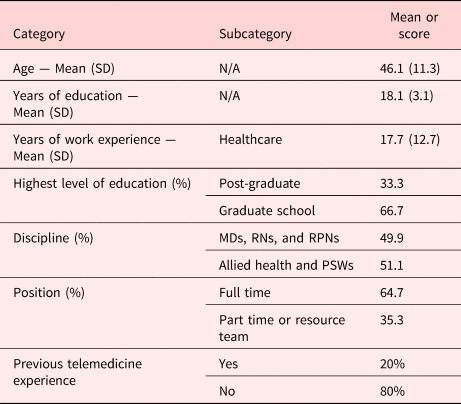
Twenty-two clinical staff participated in the demographics survey of which 64% had attended at least one palliative care videoconference thereafter. The vast majority of the clinical staff who consented to the study and completed pre- and post-study questionnaires were female (more than 90%), with a mean age of 46 years. Most of the clinical staff were well educated, with an average of 18 years of education, with either graduate or post-graduate training. Half of the clinical staff participants were allied health professionals and PSWs, while the other half were physicians and nurses; the majority were the full-time staff. On average, they had 18 years of experience in the healthcare field. The majority of clinical staff had not used telemedicine in their practice prior to this study. See Table 2 for staff demographics.
Staff population demographics (n = 22)

Palliative telemedicine videoconference family experience
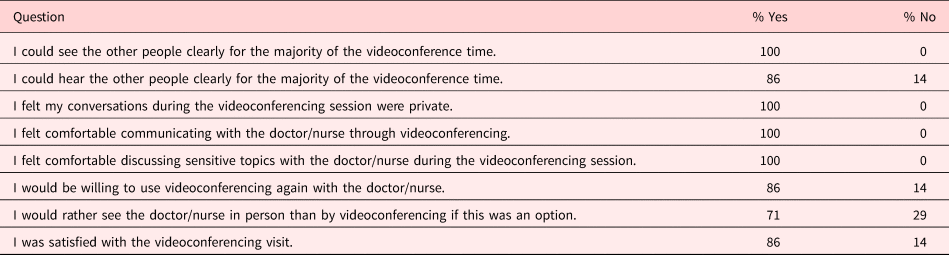
Family members who attended palliative telemedicine care conferences were asked to complete a satisfaction survey following the meeting. Families were asked to respond “yes” or “no,” or select “not applicable,” for the statements below as they pertained to the videoconference. Refer to Table 3 for a summary of their responses. There was a fairly high rate of agreement (86–100%) that technical, privacy, and comfort factors were satisfactory, and that family members felt comfortable and respected. The majority of family participants reported overall satisfaction with the videoconference and would be willing to use it again. Further, they felt that the videoconference had improved their experience. However, around 70% still indicated that they would have preferred to see the physician in person if this were an option.
Family palliative telemedicine videoconference satisfaction survey responses — technical and comfort factors (n = 10)

Palliative telemedicine videoconference clinical staff experience
Palliative care specialists recorded connectivity details for care conferences, specifying a median of one attempt to connect to the internet per videoconference (SD 0.9), median 3 min attempting a connection (SD 6.6 min), and median videoconference duration of 45 min (SD 12.3 min). The mean length of time for the palliative care integrated videoconference was 45 min (SD 10.3 min).
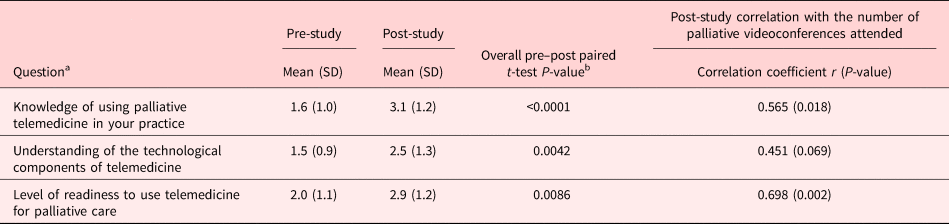
Prior to project launch, and then again after the study was completed, pilot communities’ clinical staff, including the palliative care specialists completed telemedicine knowledge and readiness surveys. Seventeen of the 22 clinical staff completed this survey. Overall, the average pre-study scores for the knowledge and understanding of telemedicine questions and the level of readiness to use telemedicine for palliative care were in the poor to the fair range. The mean scores to all questions increased significantly to fair to good by the end of the study (overall pre–post t-test values P = <0.0001, 0.0042, and 0.0086, respectively; see Table 4). Furthermore, for most questions, the more telemedicine sessions the clinical staff participated in, the higher post-study ratings were (P = 0.018–0.069; see Table 4).
All clinical staff palliative telemedicine knowledge and readiness responses (n = 17)

a Range of scores: 1 = poor, 2 = fair, 3 = average, 4 = good, 5 = excellent.
b t-Test compared pre-study and post-study responses.
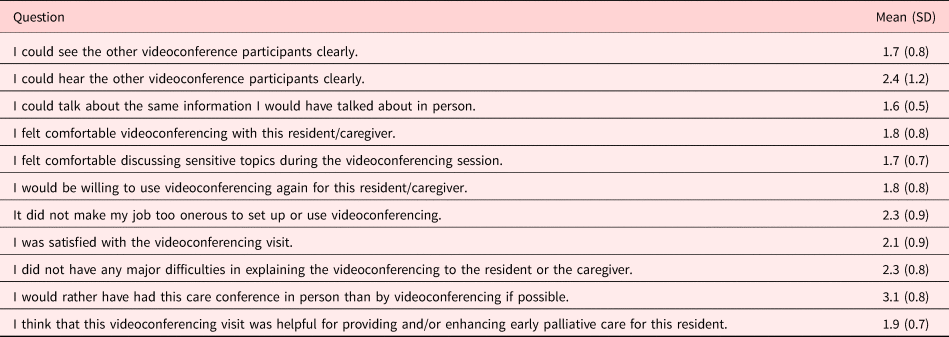
Clinical staff who attended the palliative telemedicine care conferences from the conference room in addition to the palliative care specialist who participated in the care conference remotely completed a satisfaction survey following every videoconference, whereupon they rated their level of agreement on each of the items in Table 5. The clinical staff agreed or strongly agreed with most of the statements, including those indicating participants were able to see each other and that the conversation and comfort level seemed appropriate. The clinical staff ratings were slightly closer to neutral in terms of participants being able to hear each other, the setup not being too onerous and their ability to easily explain videoconferencing to residents or families. Clinical staff reported general satisfaction with the videoconferencing visit that they would be willing to have another videoconference for the resident if needed, and that the videoconference was helpful in providing and/or enhancing early palliative care for the resident. However, their responses were neutral in terms of whether they would rather have had the care conference in person if possible.
Clinical staff palliative telemedicine videoconference satisfaction survey responses — technical and comfort factors (n = 17)

Range of scores: 1 = strongly agree, 2 = agree, 3 = neutral, 4 = disagree, 5 = strongly disagree.
Clinical staff technical implementation factors
In evaluating the implementation process of the videoconferences, clinical staff also responded to questions related to the technical aspects of the call. 46% of videoconferences had at least one clinical staff respondent identify that there was some form of the barrier during the call. When asked to specify the barrier to the videoconference survey, the most common response was noise (65%). Clinical staff also specified other technical barriers in their comments, including difficulty trouble-shooting or obtaining technical support (22%), the screen transitioning to sleep mode (6%), an inability to see all of the conference room attendees on the videoconference screen (5%), and speakers running out of batteries (2%). 72% of clinical staff specified that they would appreciate a designated person for at the moment technical support if needed.
Discussion themes
For the 11 resident care conferences that had integration of a palliative consultant via videoconference themes raised for discussion at every conference included defining the palliative approach to care, illness understanding and prognosis, clarifications of goals of care, symptoms control and current treatment plan, and plans for life-sustaining treatment (PLST). Other themes included exploration of psychosocial and spiritual needs, preferred location of death and loss and grief.
Impact: clinical staff confidence in palliative care
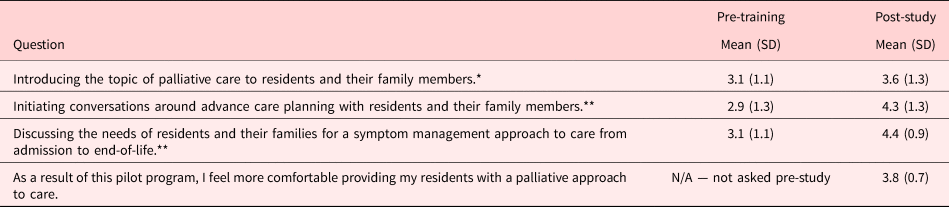
Clinical staff rated their confidence in performing palliative care-related tasks; this survey excluded the palliative care specialists. There was a medium to high level of confidence prior to the study and the mean confidence ratings for all clinical staff trended toward more confidence post-study (see Table 6). However, there was a significant increase in confidence related to “introducing the topic of supportive care to residents and their family members” (P = 0.03). Similarly, there was a significantly greater increase in confidence in “initiating conversations around advance care planning with residents and their family members” and “discussing the needs of residents and their families for a comfort and symptom management approach to care from admission to end-of-life’ post-study (P = 0.04). Additionally, the more telemedicine sessions the clinical staff participated in, the higher their post-study confidence in “introducing the topic of supportive care to residents and their family members,” “initiating conversations around advance care planning with residents and their family members,” and “discussing the needs of residents and their families for a comfort and symptom management approach to care from admission to end-of-life” (r = 0.61, P = 0.007; r = 0.68, P = 0.002; and r = 0.68, P = 0.002, respectively).
Clinical staff palliative confidence survey responses (n = 17)

Range of scores: 1 = not at all confident, 3 = somewhat confident, 5 = very confident (2 and 4 no corresponding text specified).
* P = 0.03, **P = 0.04.
Impact: clinical staff confidence in palliative telemedicine
As part of the palliative telemedicine knowledge and readiness surveys, staff answered a question related to their perceived confidence in using telemedicine for providing palliative care, at pre-study and post-study timepoints. Confidence was significantly higher in the post-study period than it had been prior to the study (see Table 7).
Staff telemedicine confidence survey responses (n = 17)

a Range of scores: 1 = poor, 2 = fair, 3 = average, 4 = good, 5 = excellent.
Impact: family member illness understanding, goals of care and management, and access to specialist palliative care
When family members (n = 10) were asked if as a result of the palliative videoconferencing visit, they have a better understanding of the resident's illness, goals of care and management, 71% of family members responded “yes”. However, the number of respondents was small, and results should be interpreted with caution. 71% of family members who completed the survey also agreed that they would prefer a videoconference if it meant that their loved one could be seen by the palliative care specialist sooner, or more often than by in person visits.
Discussion
There is a lack of studies relating to palliative telemedicine in the long-term care setting. The aim of this study was to evaluate the feasibility of early integration of palliative care specialist services into an LTCH via videoconference. The strength of this study was that it was designed to increase access to palliative care by asking the clinical team to consider the palliative approach to care earlier in the illness trajectory. Many LTCH residents die in acute care hospitals primarily for palliative care needs, so the early integration of the palliative care philosophy for those residents with life-limiting illnesses is anticipated to be a significant intervention in reducing inappropriate transfers and burdensome interventions (Tanuseputro et al., Reference Tanuseputro, Wodchis, Fowler, Walker, Bai, Bronskill and Manuel2015). Furthermore, in Ontario LTCHs admission and yearly interdisciplinary care conferences are legislated for all residents and his or her SDM (Long-Term Care Homes Act, 2007). Considering this, another strength of this study included its pragmatic consideration in that the palliative care specialists joined the next scheduled resident case conference (or within 3 months of screening positive for palliative care needs) as the care conferences were all non-urgent — this adds to both external validity and generalizability.
The results of this study demonstrate the acceptability of videoconferencing in a number of areas of palliative care delivery in LTCHs that include, supporting team communication, introducing palliative concepts to the clinical team and SDMs early in illness trajectory, engaging with SDMs in advance care planning and increasing clinical staff confidence in palliative telemedicine. In a recent study that examined the use of web-based videoconferencing for rural palliative care consultation with elderly patients at home (Read Paul et al., Reference Read Paul, Salmon, Sinnarajah and Spice2019), the results demonstrated comfort by the participants to discuss palliative care needs, and our survey feedback suggests that videoconferencing in the LTCH setting was well received and that clinical staff and families were comfortable with the conversations. Technical issues are cited as a common theme of concern with videoconferencing (Collier et al., Reference Collier, Morgan, Swetenham, To, Currow and Tieman2016; Read Paul et al., Reference Read Paul, Salmon, Sinnarajah and Spice2019). In our study, despite technical issues, most clinical staff and families were satisfied with the videoconference and were willing to use it again. This is a significant finding in that the overall patient and family experience of care is influenced not just by what clinicians do, but how they relate to and communicate with those receiving care, which is oftentimes at the core of concern when it comes to providing care through telemedicine (Wanzer et al., Reference Wanzer, Booth-Butterfield and Gruber2004). Nevertheless, families would still generally prefer to see the palliative care specialist in person if possible, while staff were neutral on this point which is not surprising to the authors given the content of discussions. Clinical staff gained confidence and knowledge in the use of palliative telemedicine through their involvement in the program. However, they still were not comfortable with the technical setup of the videoconferences and appreciated technical support. Future implementation of palliative videoconferences should (a) consider training and enhancing staff comfort in setting up the videoconferences; (b) provide role clarity as to who should be designated to complete this task; and (c) determine how technical support will be delivered.
This evaluation also provides quantitative evidence of significant increased staff confidence in initiating discussions around advance care planning and the palliative approach to care, as well as increased comfort in discussing and providing palliative care to residents and using telemedicine. It is known that participative and interactive learning strategies may be particularly important in palliative care training and the authors attribute this study's results of increased clinical staff confidence in palliative care partly to the role modeling of the palliative care specialists to the long-term care staff, in their use of language during discussion themes and partly to in the moment learning (Pulsford et al., Reference Pulsford, Jackson, O'Brien, Yates and Duxbury2013). The implications of improved confidence in delivering the palliative approach to care included improved resident and family engagement. The discussion themes consistently included defining the palliative approach to care, illness understanding, prognosis, advance care planning, goals of care, symptoms control, current medications, and the treatment plan. Balancing the sensitive content of palliative discussions and having a palliative care specialist involved when there's no health acuity appears to be feasible based on survey results. There is also some suggestion that families gained a better understanding of and ability to manage residents’ goals of care after the care conference and this is important considering cognitive impairment is a common diagnosis in LTCHs. It is important to note that comfort in initiating discussions in LTCHs by staff is important because most residents have non-cancer diagnoses, where the trajectory of illness is often unpredictable, and diseases have exacerbations with difficult to predict outcomes.
There are several limitations to this study. The resident, staff and particularly the family sample size was low, reducing the power and the generalizability of the results. The staff and family who did not consent to participate or to release their data for a research purpose may have had different responses than those who consented to their data being included in the evaluation results. The use of self-assessment items measuring confidence is subject to selection bias, with participants perhaps more likely to respond if they felt they could report favorably on the intervention's impact. The staff and family members who consented to complete the surveys could mean that they may be more responsive to the intervention than those clinical staff and family who did not consent. Also, the pre–post-study design is methodologically weak in terms of assessing effectiveness for which the randomized controlled trial is the gold standard. It would be interesting to assess the impact of the intervention over time, for example, confidence on clinical outcomes at 3- and 6-months post-intervention. These points should be considered when interpreting our findings.
Conclusion
The need for improving access to the palliative approach to care in LTCHs is generally agreed upon and the feasibility of early integration of palliative care specialist services through videoconferencing during care conferences is supported by our study findings. Early integration of palliative care specialist services into an LTCH through videoconferencing also led to improved self-rated confidence in the palliative approach to care by clinical staff and families and this warrants further research. Future research is needed to evaluate the impact of resident, family, clinical staff outcomes, and cost-effectiveness.
Acknowledgments
The authors of this study acknowledge Pallium as some survey questions in this study were adapted from the Pallium Canada Palliative Care Knowledge Quiz and Pallium Canada Attitudes and Comfort Surveys.
Conflict of interest
The author(s) declare(s) that there is no conflict of interest.