Introduction
In tropical and sub-tropical areas of the world, strongyles are the most important group of parasites (Amarante & Amarante, Reference Amarante and Amarante2016). Haemonchus contortus and Haemonchus placei are among the major parasites of small ruminants and cattle, respectively. For several decades, H. placei was not recognized as a valid species, being considered a synonym of H. contortus (Gibbons, Reference Gibbons1979). The first evidence that Haemonchus from cattle and sheep belonged to different species was reported by Roberts et al. (Reference Roberts, Newton-Turner and McKevett1954) in Australia. They found evidence of some degree of host specificity and concluded that the populations in sheep and cattle represent distinct species: H. contortus and H. placei, respectively.
In artificial infections, H. placei and H. contortus establish well in both sheep and cattle hosts (Santos et al., Reference Santos, Xavier, Amarante, Bassetto and Amarante2014; Fávero et al., Reference Fávero, Buzzulini, Cruz, Felippelli, Maciel, Salatta, Teixeira, Soares, Oliveira, Lopes and Costa2016), but host specificity is evident where cattle and sheep share pastures (Santiago et al., Reference Santiago, Costa and Benevenga1975; Amarante et al., Reference Amarante, Bagnola, Amarante and Barbosa1997). However, cross-infections can occur in areas where both parasites are sympatric, a situation that favours the production of hybrids (Hussain et al., Reference Hussain, Periasamy, Nadeem, Babar, Pichler and Diallo2014). Le Jambre & Royal (Reference Le Jambre and Royal1980) demonstrated that hybrid Haemonchus produced by crossing H. placei and H. contortus presented low fecundity or were sterile, due to meiotic abnormalities. Nevertheless, there is recent evidence of genetic flux occurring due to cross-breeding in places where both species are sympatric (Chaudhry et al., Reference Chaudhry, Redman, Abbas, Muthusamy, Ashraf and Gilleard2015).
In addition, H. contortus developed resistance to all the major classes of anthelmintics, having a significant economic impact on a worldwide scale (Kotze & Prichard, Reference Kotze, Prichard, Gasser and Von Sampson-Himmelstjerna2016). There also have been reports of anthelmintic resistance in H. placei, although the level of resistance is not so extensive (Neves et al., Reference Neves, Carvalho, Rinaldi, Cringoli and Amarante2014). The proper identification of the various species, as well as knowledge regarding the epidemiology of parasitic gastroenteritis, is essential for the establishment of sustainable strategies of parasite control. Therefore, accurate identification of the two species and their hybrids is imperative in epidemiological studies where the species are sympatric, especially when small ruminants and cattle share the same pastures.
Spicule morphometry is the most frequently used technique for differentiating Haemonchus species. However, due to overlapping spicule measurements, a reliable morphometric identification of specimens is not possible (Santos et al., Reference Santos, Xavier, Amarante, Bassetto and Amarante2014; Vadlejch et al., Reference Vadlejch, Lukešová, Vašek, Vejl, Sedlák, Čadková, Langrova, Jankovská and Salaba2014). It is important to emphasize that the morphological characteristics, despite being useful for specific identification, are based on subtle differences. Therefore, only properly trained personnel are able to perform a precise diagnosis of H. placei and H. contortus based exclusively on morphometric analysis.
In recent decades, advances in molecular biology have produced several approaches for studying helminth systematics. DNA sequences of the first and second internal transcribed spacers (ITS-1 and ITS-2, respectively) or external transcribed spacer (ETS) of nuclear ribosomal DNA (rDNA) have been used extensively for nematode identification, given their abundance in all genomes (Zarlenga et al., Reference Zarlenga, Chute, Gasbarre and Boyd2001; Von Samson-Himmelstjerna et al., Reference Von Samson-Himmelstjerna, Harder and Schnieder2002; Gasser et al., Reference Gasser, Bott, Chilton, Hunt and Beveridge2008; Amarante et al., Reference Amarante, Bassetto, Neves and Amarante2014).
Zarlenga et al. (Reference Zarlenga, Stringfellow, Nobary and Lichtenfels1994) described polymerase chain reaction (PCR) primers 75 and 86, designed from sequences proximal to the 3′- and 5′-ends of the large and small rDNA, that span the ETS sequence. Amplification of H. contortus genomic DNA resulted in two DNA fragments of 1.63 and 1.32 kb, while amplification of H. placei genomic DNA produced a single 1.63-kb fragment, which enables differentiation between Haemonchus sp. However, this primer pair does not detect the presence of hybrids in a population under study because hybrids present the same amplification pattern as parental H. contortus.
The aim of the present study was to establish a straightforward, reliable, conventional PCR-based method using species-specific primer pairs to differentiate between H.contortus, H. placei and hybrid specimens. We designed new sets of primers that amplify exclusively H. placei or H. contortus, which allow the detection of hybrid specimens. The primer sets were validated with different populations of H. contortus, H. placei and hybrids.
Materials and methods
DNA isolates
In the present study we used individual male adult specimens of Haemonchus of the following isolates, preserved in 70% ethanol.
RsHco1 – laboratory isolate
Adult males were obtained from sheep in a trial described by Santos et al. (Reference Santos, Xavier, Amarante, Bassetto and Amarante2014). Originally, this H. contortus isolate was obtained from sheep raised in Rio Grande do Sul State, Brazil. It is susceptible to all anthelmintics (Echevarria et al., Reference Echevarria, Armour and Duncan1991) and was kindly donated by Dr F.A.M. Echevarria.
SpHco2 – laboratory isolate
Haemonchus contortus isolated from sheep raised in São Paulo State, Brazil with multiple resistance to anthelmintics (Almeida et al., Reference Almeida, Garcia, Torgerson and Amarante2010).
MriHco3 – laboratory isolate
Adult specimens of H. contortus from Moredun Research Institute, Penicuik, UK. Kindly donated by Dr W. David Smith.
CeHco4 – field isolate
Adult specimens of H. contortus obtained from sheep raised in Ceará State, Brazil. Generously donated by Dr Marcel Teixeira (EMBRAPA Caprinos e Ovinos).
SpHco5 – field isolate
Adult specimens of H. contortus were obtained from sheep raised in Botucatu, São Paulo State, Brazil by Bassetto et al. (Reference Bassetto, Picharillo, Newlands, Smith, Fernandes, Siqueira and Amarante2014b).
SpHco6 – field isolate
Adult specimens of H. contortus were obtained from sheep raised in Piracicaba, São Paulo State, Brazil by Amarante et al. (Reference Amarante, Susin, Rocha, Silva, Mendes and Pires2009).
SpHpl1 – laboratory isolate
Adult specimens of H. placei isolated from cattle raised in São Paulo State, Brazil were obtained by Bassetto et al. (Reference Bassetto, Silva, Newlands, Smith and Amarante2011). The ITS-2 rDNA sequence of this isolate was analysed in another study, confirming H. placei identity based on single nucleotide polymorphism (SNP) differences between the Haemonchus species (Chaudhry et al., Reference Chaudhry, Redman, Abbas, Muthusamy, Ashraf and Gilleard2015).
SpHpl2 – field isolate
Adult specimens of H. placei were obtained from cattle raised in Botucatu, São Paulo State, Brazil by Bassetto et al. (Reference Bassetto, Silva, Newlands, Smith, Ratti Júnior, Martins and Amarante2014a).
Hybrids
Hybrids were obtained in our laboratory following an artificial infection of worm-free lambs with 2000 infective larvae (L3) of H. placei (SpHpl1 isolate) and 2000 L3 of H. contortus (SpHco2 isolate). Faecal samples from these lambs were taken to produce L3 for infecting other worm-free lambs. These last lambs were sacrificed to obtain hybrids (Michelle C. dos Santos, PhD thesis in preparation).
DNA extraction
Genomic DNA was obtained from cattle and sheep blood samples (hosts) and from specimens of H. contortus and H. placei previously identified based on morphological analysis and used in our laboratory as positive and negative PCR controls. Additionally, DNA was obtained from two hybrids and five biological replicates of each H. contortus isolate (RsHco1, SpHco2, MriHco3, CeHco4, SpHco5 and SpHco6) and ten replicates of each H. placei isolate (SpHpl1 and SpHpl2). All samples were extracted from single specimens of Haemonchus sp. with the QIAamp DNA Mini Kit (QIAGEN, Hilden, Germany) according to the manufacturer's instructions.
Obtaining new species-specific primer pairs and PCR reactions
Initially, the primer pairs 75 and 86 described by Zarlenga et al. (Reference Zarlenga, Stringfellow, Nobary and Lichtenfels1994) were used to amplify two DNA bands (1.63 and 1.32 kb) from H. contortus and a single one (1.63 kb) from H. placei DNA. Haemonchus placei PCR products were purified using Affymetrix ExoSAP-It (Thermo Fisher, Cleveland, Ohio, USA) and fully sequenced using the Big Dye Terminator V3.1 Cycle sequencing Kit (Applied Biosystems, Foster City, California, USA). Sequencing reactions were analysed on a 3730xl DNA Analyzer (Applied Biosystems) and assembled with BioEdit (Hall, Reference Hall1999). The H. placei sequence was compared to known sequences by basic local alignment tool (BLAST) analysis against the National Center for Biotechnology Information (NCBI) database, in order to identify the rDNA regions. The 1.63-kb H. placei sequence was also compared to HQ389234.1 (H. contortus) sequence (NCBI database) by BLAST analysis.
Then, two species-specific primer pairs were designed using Primer3 (Rozen & Skaletsky, Reference Rozen, Skaletsky, Krawetz and Misener2000): for H. placei, HpBotuF 5′-CCAGACCCGAGACTCGCC-3′ and HpBotuR 5′-CTGAAGGTAATGTCAAAATTTCT-3′; for H. contortus, HcBotuF1 5′-TGTCGAACACGAAACTCGTC-3′ and HcBotuR2 5′-TGTGTCTCTACCGCCCGAGT-3′.
Each DNA sample was tested with both primer pairs (HpBotuF/R and HcBotuF1/R2). The Gene Amp PCR System 9700® thermocycler (Applied Biosystems) was employed to perform PCR reactions. Amplification was carried out in a 10 μl reaction mix containing 10 mm Tris-HCl, 1.5 mm MgCl2, 50 mm KCl (pH 8.0), 100 μm each deoxynucleoside triphosphate (dNTP), 20–50 ng genomic DNA and 0.5 U Taq polymerase (Invitrogen, Carlsbad, California, USA). The cycling conditions for the primer pair HpBotuF/R were as follows: 95°C for 5 min; followed by 35 cycles of 95°C for 30 s, 58.5°C for 15 s and 72°C for 30 s; followed by 5 min at 72°C and 4°C to finalize. The cycling conditions for the primer pair HcBotuF1/R2 were largely the same, except the annealing time and temperature: 59°C for 40 s. PCR products were electrophoresed on 2% agarose gels in 1% Tris–acetate–EDTA (TAE) buffer containing ethidium bromide, and photographed under UV light using a Sony Cyber-shot DSC-HX1 camera (Sony Electronics, San Diego, California, USA).
Results and discussion
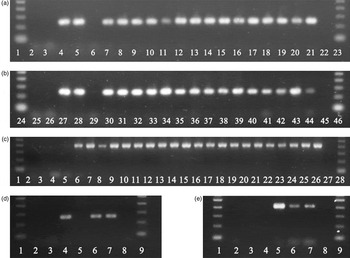
PCR amplification (fig. 1) was used to verify primer pair specificity by using control DNA samples from bovine (lane 2 in a, c, d and e; lane 25 in b) and ovine hosts (lane 3 in a, c, d and e; lane 26 in b), H. contortus (lanes 4, 5 in a and c; lanes 27 and 28 in b; lane 4 in d and e) and H. placei (lane 6 in a and c; lane 29 in b; lane 5 in d and e).
PCR reactions using DNA samples. (a, b) Species-specific primer pair HcBotuF1/R2 employed to amplify H. contortus from isolates RsHco1 (lanes 7–11), SpHco2 (lanes 12–16), MriHco3 (lanes 17–21), CeHco4 (lanes 30–34), SpHco5 (lanes 35–39) and SpHco6 (lanes 40–44). (c) Species-specific primer pair HpBotuF/R employed to amplify H. placei from isolates SpHpl1 (lanes 7–16) and SpHpl2 (lanes 17–26). (d and e) Amplification with hybrid specimens using species-specific primer pairs: (d) HcBotuF1/R2 (lanes 6 and 7) and (e) HpBotuF/R (lanes 6 and 7). Each photograph also shows reactions with: control samples from bovine (lane 2 in a, c, d and e; lane 25 in b) and ovine hosts (lane 3 in a, c, d and e; lane 26 in b); H. contortus (lanes 4 and 5 in a and c; lanes 27 and 28 in b; lane 4 in d and e); H. placei (lane 6 in a and c; lane 29 in b; lane 5 in d and e); and reagents without DNA in lanes 22 in a, 45 in b, 27 in c, and 8 in d and e. Molecular markers (100 bp; GE Healthcare) were run in lanes 1 (a, c, d and e), 9 (d and e), 23 (a), 24 (b), 28 (c) and 46 (b).

An amplification band was obtained with all H. contortus samples with the HcBotuF1/R2 primer pair (fig. 1a and b), while no amplification of these samples was observed with the HpBotuF/R primer pair. The opposite occurred with DNA samples from H. placei (fig. 1c).
Figure 1a shows the result of the use of HcBotuF1/R2 primer pair. Lanes 7–11 and 12–16, which are from laboratory isolates RsHco1 and SpHco2 (from H. contortus – Rio Grande do Sul and São Paulo, Brazil) present a 260-bp amplification product. Lanes 17–21 also show a 260-bp band in MriHco3 samples, an H. contortus laboratory isolate (the Moredun Research Institute, UK). Additionally, a 260-bp PCR band is presented in fig. 1b, lanes 30–34, 35–39 and 40–44, which are from the CeHco4, SpHco5 and SpHco6 Brazilian field isolates, one isolated in Ceará State and two in São Paulo State, respectively. Lanes 4, 5, 27 and 28 are positive H. contortus controls, and no amplification band was observed in lanes 6 and 29 (H. placei DNA control samples).
In fig. 1c, the species-specific primer pair HpBotuF/R was employed, and a 459-bp amplification band is presented in all H. placei samples. Lane 6 is a positive control, and no amplification band was observed in lanes 4 and 5 (H. contortus DNA control samples). A 459-bp PCR band was observed in lanes 7–16 and lanes to 17–26, which are SpHpl1 and SpHpl2 laboratory isolates, respectively, from São Paulo state, Brazil.
PCR of two hybrid samples using the species-specific primer pairs HcBotuF1/R2 (fig. 1d) and HpBotuF/R (fig. 1e) was performed with DNA samples from hosts (bovine and ovine, lanes 2 and 3, respectively), control samples (H. contortus and H. placei, lanes 4 and 5, respectively) and hybrids (lanes 6 and 7). The presence of hybrids is evident because a 260-bp amplification band (from H. contortus) is observed in lanes 6 and 7 of fig. 1d and a 459-bp band (from H. placei) is presented in lanes 6 and 7 of fig. 1e.
In Brazil, cattle and sheep usually share pastures, and a specific diagnosis is important because these ruminants normally harbour mixed infections, favouring the production of hybrids (Hussain et al., Reference Hussain, Periasamy, Nadeem, Babar, Pichler and Diallo2014). This phenomenon can result in genetic flux between populations, with implications for interspecies transmission of resistance genes (Chaudhry et al., Reference Chaudhry, Redman, Abbas, Muthusamy, Ashraf and Gilleard2015).
Therefore, a precise identification of Haemonchus species is essential for differentiating between these species and their hybrids. PCR primer pairs have been employed successfully to identify nematode genera (Schnieder et al., Reference Schnieder, Heise and Epe1999; Von Samson-Himmelstjerna et al., Reference Von Samson-Himmelstjerna, Harder and Schnieder2002). In this work, we present a reliable conventional PCR-based method with just two species-specific primer pairs that can be used to identify individual specimens of H. contortus and H. placei and their hybrids.
It is important to mention that the HcBotuF1/R2 primer pair was used to identify laboratory (RsHco1, SpHco2 and MriHco3) and field isolates (CeHco4, SpHco5 and SpHco6) of H. contortus from different places. RsHco1, SpHco2 isolates are kept in Brazilian laboratories (Echevarria et al., Reference Echevarria, Armour and Duncan1991; Almeida et al., Reference Almeida, Garcia, Torgerson and Amarante2010) and MriHco3 in the Moredun Research Institute, UK. The other three H. contortus field isolates are originally from two distinct places in Brazil, São Paulo (Amarante et al., Reference Amarante, Susin, Rocha, Silva, Mendes and Pires2009; Bassetto et al., Reference Bassetto, Picharillo, Newlands, Smith, Fernandes, Siqueira and Amarante2014b) and Ceará states, which are located in the south-eastern and north-eastern areas of Brazil, respectively. It is important to stress that these states present very different weather, temperature and precipitation ranges throughout the year, which corroborates our assertion that the HcBotuF1/R2 primer pair is able to identify positively a spectrum of H. contortus DNA samples.
In conclusion, testing the two primer pairs (HpBotuF/R and HcBotuF1/R2) in eight different populations of H. contortus and H. placei has demonstrated the primers’ accuracy in the differentiation of individual and hybrid species.
Financial support
This study was supported by the São Paulo Research Foundation (FAPESP, grant number 2014/02305-6). M.C.S. and C.C.B. received financial support from FAPESP (grant numbers 2012/23941-2 and 2015/00221-2, respectively). A.F.T.A. received support from Conselho Nacional de Desenvolvimento Científico e Tecnológico (CNPq, grant number 3037125/2013-9).
Conflict of interest
None.
Ethical standards
This trial was approved and conducted in accordance with the experimental protocol approved by the local Ethical Committee (protocol number 449-CEEA).