Introduction
Radiotherapy is considered a ‘caring profession’, with students being expected to demonstrate compassion and empathy towards patients. Heightened compassion and empathy are essential in order to provide excellent patient care 1 which are needed alongside the technical aspects of the profession. Often this caring and working with patients is cited by students as one of the main reasons they choose the radiography profession.Reference Coombs, Park, Loan-Clarke, Arnold, Preston and Wilkinson 2 , Reference Palumbo, Rambur, Mcintosh and Naud 3
Compassion satisfaction (CS) encompasses the positive aspects derived from caring, such as altruism, satisfaction and success.Reference Harr, Kelly, Riley and Moore 4 , Reference Stamm 5 Yet, while it is possible to derive pleasure from providing care it must also be acknowledged that working in a caring environment can also potentially impact negatively on the healthcare professional. This negative aspect derived from caring was first formally defined in 1995 by Dr Figley, and gave rise to the concept of compassion fatigue (CF). CF is unique to caring professions and is experienced as a result of helping and caring for others which has been shown to compromise quality of care that is given.Reference Bao and Taliaferro 6 , Reference Sinclair, Raffin-Bouchal, Venturato, Mijovic-Kondejewski and Smith-MacDonald 7 CF occurs as a result of the physical and emotional impact of caring in often stressful situations and is often referred to as the ‘cost of caring’ and can negatively affect a healthcare worker’s quality of life and also compromises their ability to care for the patient.Reference Slocum-Gori, Hemsworth, Chan and Kazanjian 8 Although this is the most commonly held definition of CF, McHolmReference McHolm 9 differentiates between two types of CF that may arise in staff. CF level 1 which arises when someone closely identifies with the patient and absorbs their trauma or pain, and CF level 2 a worker who repeatedly re-experiences the patients’ traumatic events as described/witnessed as well as closely identifying with the patient.
CF can be broken down into two further constructs, secondary traumatic stress (STS) and burnout (BO).Reference Stamm 5 STS is a negative feeling that arises from being vicariously traumatised, the effects of which may be the same as if a person had experienced the event themselves and may include imagery distress and functional impairment. BO is linked to work related chronic stress and tends to develop gradually resulting in apathy and disinterest in work. BO is widely believed to have three dimensions, emotional exhaustion, depersonalisation and reduced personal accomplishment.Reference Janssen, Schaufelioe and Houkes 10
The prevalence of CF has been studied in many different health professionals and has a tendency to be seen more widely professions who repeatedly witness and care for patients after trauma. This prevalence tends to be especially true for inexperienced professionalsReference Yoder 11 as they may not have developed coping mechanisms of experienced staff or be aware of the support mechanisms that are in place. The impact of CF may cause stress-related symptoms and dissatisfaction with their job within caregivers, which in turn may lead to an increase in job turnover within the healthcare system. 12 This link between CF and staff turnover has also been noted by other studies, Sung et al.Reference Sung, Seo and Kim 13 stating that for Korean nurses CF accounted for ~30% of the variance for staff turnover. Because of these reasons interest in Professional Quality of Life (ProQOL) is a growing topic of interest in healthcare. A recent reviewReference Sorenson, Bolick, Wright and Hamilton 14 of 42 papers on CF in health-related workers including nurses, emergency workers, physicians, midwives and students undertaken in the 10 years up to 2015 concluded that CF is a prevalent concern across a wide variety of clinical settings affecting not only the individual but also their interactions with patients. StammReference Stamm 5 – Reference Stamm 8 identified three distinct factors that might impinge on ProQOL; work environment, client environment and person environment. For example, a supportive work environment might positively affect an individual’s level of CS, and this in turn might be affected by other factors such as personality and gender and the type of work being undertaken. Hunsaker et al.Reference Hunsaker, Chen, Maughan and Heaston 15 found low levels of managerial support for emergency department nurses was a significant factor in determining CF. Interventions are now being implemented in professions such as nursing, for example supportive counselling and helping staff to develop their own positive self-care strategies.Reference Lombardo and Eyre 16 , Reference Duarte, Pinto-Gouveia and Cruz 17
The aim of this study was to establish the level of CS, STS and BO in student therapeutic radiographers and assess the association of the factors with time and training site.
Method
This study was reviewed and approved by City, University of London’s School of Health Sciences ethical committee before commencement (151602).
Data were collected over a 2-year period between 2015 and 2016 by link lecturers visiting students in their clinical departments. All subjects read and gave written informed consent on a university approved consent form before data collection. Data collection took part during a fixed week in their final clinical period of the year, this was at the end of a long period in the clinical department during which there were no academic or clinical deadlines. During this 2-year period, we had ~80 students each year attending the programme, giving an overall response rate of ~54% (86 returns). The main reasons for missing data were students being on their recreational day during the link lecturer’s visit and students being rotated to placements at non-recurrent clinical sites during this time. Both these factors could classify the missing data as ‘missing completely at random’ meaning that the missing observations are a random subset of all observationsReference Bhaskaran and Smeeth 18 and as such it can be assumed that they will have similar distributions to the observed variables.
Data were independently entered into two different excel spreadsheets and compared to verify correctness of the data. Analysis was undertaken using IBM SPSS Statistics for Windows, version 24.0 (IBM Corp., Armonk, NY, USA); statistical significance was set at p≤0·05. Where possible parametric analyses were undertaken if it was established that the data conformed to the tests underlying assumptions.
Instruments
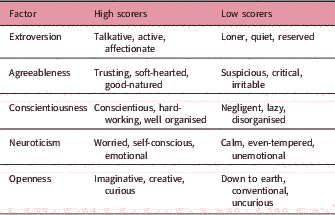
The questionnaire consisted of three sections: (i) demographic section, (ii) the Big Five Inventory-10 (BFI-10)Reference Rammstedt and John 19 that contains ten items on personality and gives details about five components of personality, extraversion, agreeableness, conscientiousness, neuroticism and openness to experience (Table 1) and (iii) ProQOL. In order to establish the levels of CS, STS and BO the ProQOL survey instrument developed by StammReference Stamm 5 was utilised. This instrument contains 30 items in order to generate the three constructs, CS, CF and BO. Each construct is unique and cannot be combined and is derived from ten questions having a minimum score of 10 and a maximum score of 50. Scores for each construct can be classed into one of three groups for ease of interpretation; scores of 22 and below are rated as ‘low’, scores between 23 and 41 as ‘average’ and scores of 42 or more as ‘high’.
Big Five personality factors

Results and Discussion
Most respondents were Asian females and the average age of the sample was 22 years of age, range 18–50 years. These figures relate to the data, rather than the population as some students were included in the data analysis twice.
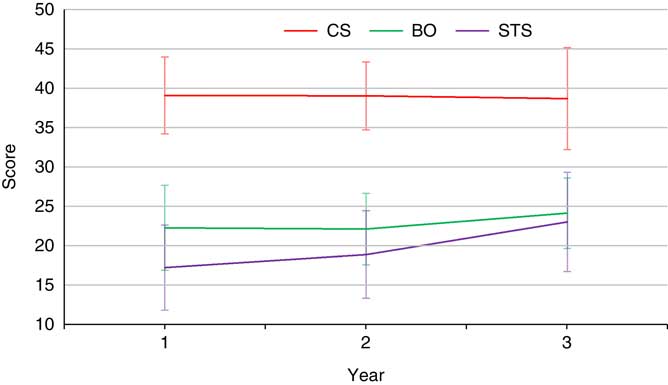
Figure 1 shows that CS slowly decreased year on year during the 3 years of training, although the difference from year 1 to year 3 (0·39) was very small and the change was not significant, F=0·175, p=0·84. Both BO and STS showed an increase in score as training progresses, BO by a score of 1·87 (F=1·727, p=0·184) and STS by a total of 5·79 (F=5·725, p=0·005). The biggest change in scores occurred between years 2 and 3.
Compassion satisfaction (CS), burnout (BO) and secondary traumatic stress (STS) scores over time.

The pattern of change was the same for males and females for both STS and BO, but for CS females showed a mean increase in score of 1·9 whereas males showed a lowering of CS by 0·94. The levels of CS reported by 3rd year students was slightly higher than that reported by Kolthoff and HickmanReference Kolthoff and Hickman 20 on inexperienced nurses (37·6), BO and STS scores were lower (31·6, 28·7). However, the patterns of change are common between both studies with Kolthoff and HickmanReference Kolthoff and Hickman 20 reporting that more experienced nurses have a lower CS, higher BO, and STS scores than inexperienced nurses, a pattern reflected in the current study within the radiotherapy students. Yu et al.Reference Yu, Jiang and Shen 21 reported scores on qualified oncology nurses and again the CS scores being reported by student radiographers were higher than that being reported by qualified nurses (31·81), however, the CF scores being reported by student radiographers were also higher by the end of training than the oncology nurses, (21·39 and 21·14). Although the change in BO during the training period was not significant its increase might be significant as a primary difference between BO and CF is that BO typically demonstrates a gradual onset while CF may suddenly happen.Reference Lombardo and Eyre 16
The rating of CS was as expected seeing Figure 1 being relatively consistent over the 3 years with 40% of students having a high CS score compared with 31% in year 1, so despite the average score in year 3 falling, the percentage of students having a high CS score increased. No student reported high levels of BO, 52% of students reporting average levels of BO in year 3 compared with 50% in year 1. Again reflecting the change seen in Figure 1 the biggest change occurred in STS. No one reported high levels of STS, but the numbers having an average STS score rose from 18·8% in year 1 (81·2% reporting low levels) to 48% in year 3 (52% reporting low levels).
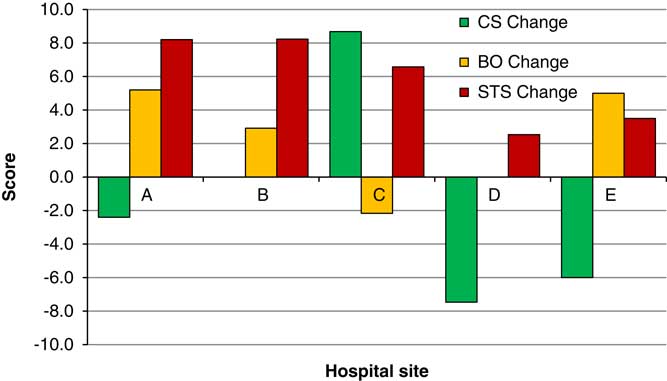
A multilinear model confirmed the interaction between the training point and STS, but all other factors age, ethnicity, marital status and site had no effect on the three constructs being measured. When looking at the change in the CS, BO and STS on each site (Figure 2) there were major differences between the sites about the pattern of change. All sites showed an increase in STS whereas for three sites (A, D and E) there was also a reduction in CS. This inverse relationship between CS and both BO and STS has been noted in other publications and is to be expected, however, site C reported an increase in CS and an increase in STS which is unusual. Possible explanations for this might be the different patient workloads in the different hospitals. Some departments are busier than others possibly increasing exposure to stressful events, which might also affect a student’s ability to deal with the experiences. Also, patient groups varied between sites which might have affected the results, the most extreme difference being that one of the sites specialised in children’s cancers where staff and students not only have to deal with the patient but also the stress and support needed for the family. The difference in levels of BO between sites to some degree reflected the findings of Probst’s studyReference Probst 22 on qualified therapeutic radiographers that also observed marked variation in BO experienced between some clinical sites. This may indicate that BO and STS cannot be assumed to be at base levels on qualification and levels may dependent on their training site and starting to change before the radiographers are even qualified.
Change in construct score with training site. Abbreviations: CS, compassion satisfaction; BO, burnout; STS, secondary traumatic stress.

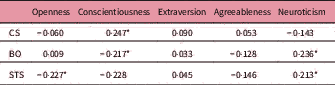
Finally, the relationship between personality and CS, BO and STS was investigated (Table 2). Relationships were found between various personality traits and CS, BO and STS. Students who had higher levels of conscientiousness (were efficient and organised) tended to have higher CS levels than those that did not whereas students who were not conscientious and lacked direction, and had higher levels of neuroticism were more prone to BO. Finally, students who were more closed to new experiences and had higher levels of neuroticism (more sensitive and nervous) tended to show higher levels of STS.
Correlations between personality scores and Professional Quality of Life scores

Note: *Significant at 0.05 level.
Abbreviations: CS, compassion satisfaction; BO, burnout; STS, secondary traumatic stress.
The study has a number of limitations. The BFI-10 has established validity and reliability,Reference Rammstedt and John 19 however, personality is a complicated concept and having only ten questions gives only limited information about an individual’s personality as the scale has diminished psychometric properties compared with larger instruments. The sample size is small and only representative of one education provider’s students. Having a small sample size decreases the statistical power (the likelihood that an effect will be detected when there is an effect to be detected) of the tests and in this study is more important when looking at the hospital site data as the size in any one hospital site is further reduced increasing the loss of power even more. Limiting data collection to one education provider does mean that there is less variation within the sample as many experiences are common to the programme; it does, however, mean that making inference to other sites is more problematical. Despite this the issue of CF in students may be of concern and further investigation is warranted. The study did not consider attrition, but further research into this area should also be considered as attrition within radiotherapy students is of concern to the profession. A survey by the Society and College of Radiographers in 2011 23 suggested that dissatisfaction with practice placements was the most commonly reported reason why students failed to complete their undergraduate programme. If we accept the premise that there is a relationship between staff turnover of healthcare staff and CF this might also be reasonable to propose the same relationship in students and link CF to attrition and therefore looking at CF during training and putting mechanisms in place during training might help reduce CF and hence attrition.
Conclusion
The study identified a marked increase in STS in radiotherapy students over their 3 years of study along with a slight decline in CS and a small increase in BO. Students who were organised and were more secure and confident on clinical placement appeared to be better protected from BO issues while students who were less organised or lacked direction were more at risk of developing BO. Using the ProQOL instrument students at an increased risk of BO could be identified before or during clinical placements, for example, through personal tutoring sessions. One possible way forward is to introduce mechanisms to help students cope with their work experiences and possibly target students at risk of developing STS and offer them extra support during their training. Finally, there was marked variation between hospital sites on the change in the three constructs during the 3 years of training and qualifying students are entering the profession with quite varied levels of CS, CF and BO which largely appears to be dependent on their training site, however, more work needs to be done in this area before this can be stated conclusively.
Acknowledgements
The authors would like to acknowledge the radiotherapy students at City, University of London who helped us with this research.