


Many important political, legal, and economic decisions are made by committees.Footnote 1 Usually, committees are composed of experts with asymmetric information. The voting rule used for decision-making may vary across committees, and even within a committee it may vary across issue areas.Footnote 2
Deliberative committees typically talk and share information before reaching decisions by voting. Does the voting rule impact the amount of information that members' transmit before voting? Does uncertainty about individuals' private preferences contribute to a decline in information transmission? For committee members, how does the possibility of providing evidence supporting private information affect the decision making? Requiring a unanimous vote is widely believed to provide “some insurance that the opinions of each of the debaters will be heard and discussed” (Walker and Lane Reference Walker and Lane1994, 2).Footnote 3 It is also believed that full revelation of (decision-relevant) information occurs when personal biases are made clear before deliberation. However, recent literature suggests that both intuitions are flawed and thus calls into question the supposed benefits of a unanimous vote and preference certainty. In this article, we show that both intuitions are restored if individuals can provide evidence to support their private information.
The formal game-theoretic literature on strategic deliberation not only offers clear-cut answers for some specific contexts but also highlights the impact of preference uncertainty. In the jury context, Coughlan (Reference Coughlan2000) shows that individuals share private information fully in equilibrium if and only if their preferences are close enough so that they never disagree about the preferred outcome once all private information is revealed. This result holds for any voting rule, because once private information becomes public, homogeneous preferences promote a consensus. When there is uncertainty about individuals' preferences, Doraszelski, Gerardi, and Squintani (Reference Doraszelski, Gerardi and Squintani2003), and Austen-Smith and Feddersen (Reference Austen-Smith, Feddersen, Austen-Smith and Duggan2005) show (respectively in contexts of two and three voters) that sufficiently close preferences are still needed to obtain truthful communication in equilibrium under a unanimity rule. Austen-Smith and Feddersen (Reference Austen-Smith and Feddersen2006) generalize this result. In a context of preference uncertainty, they show that a fully revealing equilibrium exists under a unanimity rule if and only if it is common knowledge that all players invariably share identical preferences over the alternatives. Although this condition also guarantees complete revelation under other voting rules, they show that the reverse is not true: For some conflicting preferences, other rules, such as majority rule, may support full information sharing. In summary, these formal models of committee decision-making reach the following conclusions. First, the unanimity rule performs worse than other supermajority rules because it requires stronger conditions over preferences for full revelation. Second, uncertainty about individuals' private preferences can promote full information sharing (a result also obtained by Meirowitz Reference Meirowitz2006).
These models assume cheap-talk deliberation, where a committee member's report does not depend on what he or she has observed. We argue that real life debates are best described by a model that allows informed individuals to submit substantive evidence to support their information. For example, an individual may have access to scientific reports, certified documents, or physical evidence that can be presented to others.Footnote 4 In this article, we relax the assumption that agents cannot report verifiable information.Footnote 5
In a context where debaters can provide evidence to support their private information, we show that both previous conclusions are reversed. First, we find that unanimity performs better than any other supermajority rule, as it is the only rule under which a fully revealing equilibrium always exists. Second, we find that under fairly general conditions over individuals' preferences, preference uncertainty prevents full information sharing.
The article is organized as follows. The next section presents an intuitive review of the formal game-theoretic literature on committee deliberation and our contribution to this literature. Next, we offer a simple example that provides an intuitive review of our main results. Followed by a section that rigorously states and proves our results in a more general setting.
INTUITIVE REVIEW OF THE RESULTS
Coughlan (Reference Coughlan2000) and Austen-Smith and Feddersen (Reference Austen-Smith and Feddersen2006) consider a deliberative committee that makes a decision between the status quo and an alternative. Prior to voting, the committee members communicate simultaneously in one round. The deliberation is cheap talk, in that messages are costless and unverifiable by others. In a context of preference certainty, Coughlan (Reference Coughlan2000) shows that under any supermajority voting rule, truthful communication is an equilibrium if and only if players share sufficiently close preferences. Sufficiently close preferences provide debaters with an incentive to share information. Closeness is necessary for revelation. For example, if one individual is more inclined than others to choose the status quo, he has an incentive to misreport by exaggerating the extent to which his information favors the status quo. Austen-Smith and Feddersen (Reference Austen-Smith and Feddersen2006) develop an example where preference uncertainty promotes full information sharing. If member i is uncertain about member j's preferences (e.g., i does not know whether j is more or less inclined than i is), then misreporting may be too risky, so i prefers telling the truth. However, they show that such an argument does not apply to the unanimity rule: A fully revealing equilibrium exists under the unanimity rule if and only if it is common knowledge that all voters share homogenous preferences. The reason that unanimity performs worse than other rules is that it is the only rule where each voter can impose the status quo. Therefore, there is no downside risk to lying by exaggerating the extent to which information contests the status quo. When a consensus is needed to change the status quo, lying may be beneficial because it is costless. Even if the lying debater favors the status quo, he can unilaterally impose it after debate.
We extend the Austen-Smith and Feddersen (Reference Austen-Smith and Feddersen2006) model in two ways. First, we allow for various deliberation structures. Our results hold if deliberation is simultaneous, sequential, or a mix of the two. Second, we allow committee members to provide verifiable evidence to support their private information. This latter extension is motivated by real-life debates. With these extensions, we provide three general theorems that change these results. First, unanimity performs better than any other supermajority rule because it is the only rule where a fully revealing equilibrium always exists (Theorem 1). A fully revealing equilibrium may not exist under any other supermajority rule (Theorem 2).Footnote 6, Footnote 7 Second, under fairly general conditions, uncertainty about individuals' preferences prevents full information sharing. Finally, for a wide class of preferences (including preferences considered in Coughlan Reference Coughlan2000 and Doraszelski, Gerardi, and Squintani Reference Doraszelski, Gerardi and Squintani2003), a fully revealing equilibrium always exists under any supermajority voting rule if preferences are common knowledge (Theorem 3), but may fail to exist if preferences are privately observed (Theorem 2).
Prior to presenting an intuitive review, let us discuss how the possibility for debaters to provide evidence can change the outcome. Presenting evidence allows an individual to prove that he is telling the truth, even if it does not necessarily produce consensus about the preferred action. For instance, in a jury context, by presenting a video showing the defendant arguing with the victim one hour before the crime occurred, a sender provides evidence for the statement, “The defendant was arguing with the victim one hour before the crime took place.” This statement, without any materials or testimony sustaining it, could make the receivers skeptical. So, even if there is still the possibility of a sender withholding information, it is more difficult for her to convince fellow jurors of a false event in a context where evidence (if it exists) can be presented.
Under what conditions will a sender reveal evidence to support her private information? A sender's ability to transmit evidence does not always ensure that she will report her evidence. Instead, a sender may assert a false statement, be vague, or remain silent. Then other committee members must draw an inference about the sender's actual observation. If they know that this member promotes the alternative, they can encourage her to transmit evidence sustaining it, by skeptically rejecting any unproven statement against the status quo. More precisely, when members' preferences are publicly observed and every individual reports truthfully, the committee can sometimes identify who is the decisive voter (if one exists). A receiver can promote full information sharing by skeptically inferring that any debater who does not report evidence has observed information that strongly supports the status quo if this debater is a priori more reluctant than the decisive voter to choose it.Footnote 8
When preferences are privately observed, it can be impossible for a receiver to draw a skeptical inference. This inference requires an individual to know the identity of the decisive voter and whether the sender who does not report evidence is more or less reluctant toward the alternative relative to the decisive voter. Under preference uncertainty, the unanimity rule offers an unconditional advantage over all other rules. Because each committee member can veto the alternative under the unanimity rule, each individual has an incentive to distort her information in only one direction no matter her preference bias: exaggerating the extent to which it contests the status quo. To encourage a sender to tell the truth, a receiver should skeptically infer that her information sustains the status quo. Thus, under unanimity, a sender has an incentive to provide evidence (regardless of whether her biases are private or public information). Consequently, uncertainty about individuals' preferences is only damaging under nonunanimous supermajority rules.
Why does the unanimity rule produce opposite results when communication is verifiable rather than cheap? Unanimity is the only rule under which a committee member can unilaterally guarantee the status quo. In a context of cheap-talk deliberation where no statement is verified, unanimity is uniquely bad. For there is no downside risk to lying by exaggerating the extent to which information favors the alternative to the status quo. A committee member who is less inclined to vote for the status quo has a strong incentive to lie during deliberation. Surprisingly, the weakness of the unanimity rule in a cheap-talk setting is its strength in a context where evidence can be provided. Under the unanimity rule, individuals are encouraged to distort their information in only one direction. Thus, the committee can promote truth-telling by ignoring any statement against the status quo that does not offer supporting evidence. Unanimity is superior to other rules because the committee's inference that promotes truth-telling may be impossible to draw under nonunanimity rules.
The intuition for our first three theorems is as follows. When a sender has the ability to provide evidence about her decision-relevant information, the existence of a fully revealing equilibrium relies on a receiver making a worst case inference. When evidence is withheld, the privately observed information either favors an alternative not preferred by the sender or sustains an event under which the sender's vote will not be decisive. Under unanimity, a receiver with a worst case inference assumes that any information reported without evidence supports the status quo (Theorem 1). Under a nonunanimoity rule, a worst case inference is not always appropriate, as a sender who withholds evidence could exaggerate the extent to which her information favors the status quo. In some cases, any inference provides incentives to withhold evidence (e.g., remaining silent or pretending having observed nothing relevant). The cheap-talk message can be used by a sender willing to exaggerate the extent to which her information favors the status quo and a debater willing to reduce it (Theorem 2). Under a nonunanimous supermajority rule, full information sharing can be restored if individuals' preferences are commonly known and the committee can identify the decisive voter. If preferences are publicly observed, each individual is known to be either more or less inclined toward the status quo relative to the decisive voter. So the skeptical inference can be tailored to which side of the decisive voter a debater is on (Theorem 3). Finally, our results hold when deliberation is simultaneous, sequential, or a mix of the two: In Theorems 1 and 3, neither the separating strategies nor the skeptical inference used at fully revealing equilibrium depend on the history of past messages; in Theorem 2 the constructed deviation is profitable for the “last” speaker (i.e., nobody talks after him), whatever the history of past messages.
AN EXAMPLE
In this section, we preview our contribution. In our examples, we use jury terminology.
Consider a three-person jury N = {1, 2, 3}. Assume that communication is simultaneous and that no individual receives better quality signals than others. Under a supermajority rule, this jury chooses to acquit (A) or to convict (C) a defendant. The status quo is acquittal. The defendant is either guilty (G) or innocent (I). We assume that G and I occur with equal probability. Each juror j gets a signal s j = g or s j = i that is correlated with the true state; specifically,

Let s = (s 1, s 2, s 3) be the realized profile of signals.
Juror preferences differ only in their bias, b, in favor of acquittal. Suppose jurors are either high- (h), medium- (m), or low-bias types (l). A high-bias individual prefers to convict if and only if all three jurors observe a guilty signal, whereas a medium-bias (resp. low-bias) individual prefers to convict if and only two or more jurors (resp. one juror) observe a guilty signal. Let u(C, b, s) be the payoff from conviction C, given that individual has bias b and the profile of signals is s, and so forth. To make our point regarding preference uncertainty most simply, assume that

Suppose that each voter knows his own bias (high, medium, or low) but is unsure about the biases of other jurors. Assume the ex ante probability that a juror has a medium bias is q ∈ (0,1); a high bias is  ; and a low bias is . Assume that each juror can either provide or withhold evidence in her observed signal. Formally, denote by M(s) the set of available messages when observing signal s, and assume there are three messages m g, m i, and m satisfying

so that the message m s, s ∈ {g, i}, provides evidence for having observed signal s, whereas message m is a cheap-talk statement that intrinsically proves nothing.
Result 1. A fully revealing debate equilibrium always exists under the unanimity rule.
Under the unanimity rule, a juror, no matter her bias, has an incentive to distort her signal in only one direction: pretending to observe a guilty signal when she observes an innocent signal. By skpetically inferring that a vague sender received an innocent signal, the jury provides a sender with an incentive to report evidence.
The following strategy from each member j ∈ N with type (b j,s j) supports separation at equilibrium:
— Sending message m g if s j = g; m i if s j = i.
— Having received message m k from sender k ≠ j, inferring that s k =

— After the debate, voting for conviction if and only if #{s k = g, k ∈ N} ≥ {αb j/2.

Result 2. For some probability distribution over biases and signals, there is no fully revealing debate equilibrium under any nonunanimous supermajority rule.
Under a nonunanimous supermajority rule, a sender may distort her signal in either direction, depending on her realized bias. Her fellow jurors must employ a worst case inference that prevents the sender from being vague, irrespective of her private information. For a sender, the expected costs and benefits of being vague depend on her fellow jurors' inferences about her received signal and also on the probability distribution over biases and signals. For she does not know the biases and signals of other jurors. For any inference, there is always a pair of probabilities (p, q) such that the expected benefit of being vague exceeds the cost.
Assume that a decision is made by majority vote. Suppose that a particular individual has a low bias and observes an innocent signal: (b, s) = (l, i). Under majority rule there are four possible situations in which her report could change the outcome. Those situations are depicted in Table 1. In situation S 1, both of her fellow jurors have a high bias and both received guilty signals: S 1 = b_ = (h, h), s_ = (g, g)}; in situation S 2, the other jurors have a high and a medium bias and received guilty and innocent signals: S 2 = {b_ = (h, m), s_ =(g, i)}; in situation S 3, the other jurors have a medium bias and received guilty and innocent signals: S 3 = b_ = (m, m), s_ =(g, i)}; and in situation S 4, both of the other jurors have a low bias and received innocent signals: S 4 = b_ = (l, l), s_ = (i, i)}. In situations, S 1, S 2, and S 3 an individual with a low bias and an innocent signal prefers conviction to acquittal. But if she tells the truth and reports an innocent signal in S 1, S 2, and S 3, the defendant is acquitted. Conversely, in situation S 4, where he prefers acquittal to conviction, telling the truth is the only way to secure this outcome. The downside risk of lying increases with the probability that situation S 4 occurs.
Individual's Preferences and Payoffs with Low Bias and Innocent Signal in Each Situation (Others' Types) Where His Report Could Change the Outcome

Similarly, when a sender has a high bias and received a guilty signal (b, s) = (h, g), there are four possible situations in which her report could change the outcome (see Table 2). It is similar to the previous case, except that situation S 2 is replaced by S 5, where the other jurors have a low and a medium bias and received guilty and innocent signals: S 5 = b_ = (l, m), s_ = (g, i)}. In situation S 3, S 4, and S 5, a high-bias sender with a guilty signal prefers acquittal to conviction. But if she tells the truth in S 3, S 4, and S 5, the defendant is convicted. Conversely, in situation S 1 where she prefers conviction telling the truth is the only way to secure this outcome. The downside risk to lying increases with the probability that S 1 occurs.
Individual's Preferences and Payoffs with High Bias and Guilty Signal in Each Situation (Others' Types) Where His Report Could Change the Outcome

For a sufficiently high likelihood of having a medium bias, situations S 4 and S 1 occur with a small probability, so the expected cost of lying is small. Now let us show that for a sufficiently high q there is no separating equilibrium. Whatever the committee's inference when observing the cheap-talk statement m, a sender with either low bias and an innocent signal or a high-bias type who has received the guilty signal has an incentive to withhold evidence. To illustrate, for a b-bias person with a signal s in situation S r, let ΔEU(S r, b, s) denote the difference in expected payoffs from reporting evidence and reporting the cheap-talk statement m. Assume that the committee infers that a sender with a cheap-talk statement m observed a guilty signal. Then, if a low-bias individual with an innocent signal reports evidence in S 1 (resp. S 2 and S 3), the defendant is acquitted, and this low-bias juror's payoff is  (resp.
 ); if she reports the message m, the defendant is convicted, and the low-bias juror's payoff is
 (resp.
 ). Hence, ΔEU(S 1, l, i) = −3 and ΔEU(S 2, l, i) = ΔEU(S 3, l, i) = −1. Similarly, calculate ΔEU(S 4, l, i) = 1. Now, the probability of situation S r, with r ∈ {1, 2, 3}, conditional on an individual having an innocent signal is given by

And situation S 4 occurs with conditional probability

It follows that reporting the cheap-talk statement m rather than evidence is a profitable deviation for a low-bias juror with an innocent signal when


with a = p(1−p) and b = p 3 + (1−p)3.
Similarly, if a committee interprets a cheap-talk statement m as evidence of that the sender observed an innocent signal, then a high-bias type with a guilty signal has an incentive to deviate by reporting the cheap-talk statement m rather than evidence when


which, using that Pr(S 3|g) = Pr(S 3|i), Pr(S 4|g) = Pr(S 1|i), Pr(S 5|g) = Pr(S 2|i), and Pr(S 1|g) = Pr(S 4|i), is equivalent to (1).
More generally, for any committee's inference (either degenerated or not) following the cheap-talk statement m, both the low-bias type with an innocent signal and the high-bias type with guilty signal have an incentive to deviate from their separating strategy. In particular, in both cases [p = .6 and q > 0] and [p ≤ .975 and q = .75], the deviation is strictly profitable.
Result 3. If preferences are publicly observed before the debate takes place, then a fully revealing debate equilibrium always exists under any supermajority voting rule.
If preferences are publicly observed, then a committee can identify the decisive voter under sincere voting. Furthermore, given a juror's bias, the committee can determine the direction of distortion: pretending to have a innocent signal when her bias requires less innocent signals than does the decisive voter's bias for preferring the status quo to the alternative.
Assume that a decision is made by a majority vote and the realized bias profile is (l, m, h), so that the decisive voter has a medium bias. The following strategy from each member j ∈ N with type (b j, s j) supports separation at equilibrium:
— Sending message m g if s j = g; m i if s j = i.
— Having received message m k from sender k ≠ j, inferring that
— After the debate, voting for conviction if and only if #{s k = g, k ∈ N} ≥ αb j/2.

MODEL AND RESULTS
In the previous section, our example presents an intuition for our results in a very specific context: a committee of three individuals, with three possible biases. The individuals observe a binary signal and do not use subjective probabilities in updating their beliefs; no individual receives better quality signals than others; and the communication is simultaneous. The following model relaxes all of these assumptions.
Model
Following Austen-Smith and Feddersen's (Reference Austen-Smith and Feddersen2006) model, hereafter referred as ASF, consider a committee N = {1, 2, . . ., n} (n odd) that has to choose an alternative z ∈ {x, y}; let x be the status quo. The decision is made in two stages. First, the committee has a debate. Second, each committee member casts a vote. Before debate, each committee member i ∈ N observes private information that has two components; an informative signal s i regarding the alternatives, and a preference parameter, bias b i. Individual i's private information, or i's type, is a pair (b i,s i) ∈ B × S, where B and S are assumed to be finite and common across agents. A types profile is a pair (b, s) ∈ B n × S n, where b is a bias profile (b 1,. . ., b n) and s is a signals profile or state (s 1,. . ., s n) that occurs with probability denoted as p(b, s), which, for convenience, we assume to be positive for every pair.Footnote 9 Individual i ∈ N has a von Neumann–Morgenstern utility function that depends on the committee decision z ∈ {x, y}; his own bias b i ∈ B; and the state s ∈ S n. This payoff is written u(z, b i, s). Let S bn denote the subset of states s at which u(y, b, s) > u(x, b, s). Assume that the set of signals S is ordered by a binary relation, ≻, such that ceteris paribus, s ≻ s′ implies that s is stronger information than s′ in favor of y and against x. The first axiom formalizes such an order for signals.Footnote 10
Axiom 1 (Single Crossing). For any b ∈ B, for any s, s′ ∈ S and s_ ∈ S n−1, if s ≻ s′ then u(y, b, (s, s_)) − u(x, b,(s, s_)) > u(y, b, (s′, s_)) − u(x, b, (s′, s_)).
According to the single-crossing property, for an arbitrary profile of n−1 signals, a juror's relative evaluation for choosing the alternative over the status quo is increasing in the remaining signal no matter what his bias. In particular, this implies that if (s_, s′) ∈ S bn then (s_, s) ∈ S bn (take the right-hand side of the inequality to be positive). Similarly, if (s_, s) ∉ S bn then (s_, s′) ∉ S bn (take the left-hand side of the inequality to be negative).
Next, let us extend the ASF model to deliberation structures that mix simultaneous and sequential. The timing proceeds as follows. At first, each individual i ∈ N privately observes her bias b i ∈ B and her signal s i ∈ S. Then, each individual begins a deliberation stage with T periods, T ≤ n. A sender reports in only one period and knows the previous messages at the time of reporting, but several senders can report simultaneously in the same period. For simplicity, we assume that the set of senders reporting in period t is nonempty for every t ≤ T. At period t, based on her bias, her signal, and the received messages, each individual that belongs to the set N t sends a unique message to all committee members. Note that one-period deliberation describes simultaneous reporting, and n-period deliberation describes roll-call reporting in which each sender reports in a different period. Subsequently, a voting stage begins when each individual votes based on his bias, his signal, and the transmitted messages through deliberation. The votes are assumed to be simultaneous. Finally, under the k-supermajority voting rule, k ∈  , x is the final outcome unless at least k individuals vote for y. Unanimity (resp. majority) rule corresponds to the case k = n (resp. k =
 ). We assume that only the realized types profile (b, s) ∈ B n × S n is not common knowledge.
Let us now extend the ASF model to evidence. Following Mathis (Reference Mathis2008), a signal s ∈ S, having been observed, the set of available messages is denoted as M(s), and is assumed nonempty. Let  ≡ ∪s ∈ SM(s) be the whole set of messages with generic element m. Let S(m) ≡ {s ∈ S|m ∈ M(s)} be the set of signals s for which the message m is available. The message m rules out signals that do not belong to S(m). Said differently, the message m “verifies,” “certifies,” or “proves” the set S(m). The second axiom formalizes the assumption that there is an available message that is not available when another signal is observed.
Axiom 2 (Evidence). For any s ∈ S, there is a message m ∈ M(s) satisfying m ∉ M(s′), for all s′ ≠ s.
Contrary to cheap-talk deliberation, where the set of available messages does not vary with individuals' private information (e.g., Austen-Smith and Feddersen Reference Austen-Smith, Feddersen, Austen-Smith and Duggan2005, Reference Austen-Smith and Feddersen2006; Coughlan Reference Coughlan2000; Doraszelski, Gerardi, and Squintani Reference Doraszelski, Gerardi and Squintani2003; Gerardi and Yariv Reference Gerardi and Yariv2007; Levy Reference Levy2007; Meirowitz Reference Meirowitz2006, Reference Meirowitz2007; and Visser and Swank Reference Visser and Swank2007), Axiom 2 formalizes the assumption that any individual can provide evidence for the signal that she privately observed. By reporting a particular message that is available only for a given signal, an individual proves to the committee that she observed that signal.
During the deliberation stage, the set of period-t histories of reports is given by  t ≡ n t, where n t denotes the total number of senders who report in periods 1,. . ., t−1, with the convention that n 1 ≡ 0 and 0 ≡ {Ø}. A history h t ∈ t is thus a list of n t messages. The set of all histories is given by = ∪t = 1Tt. Let t(i) be the period in which player i reports. A (pure Footnote 11) messages strategy for player i ∈ N is a map μi from B × S × t(i) to the set of messages , which satisfies that only messages available when the signal s is observed are transmissible via μi, i.e., μi(b, s, h t(i)) ∈ M(s), for all s ∈ S. A message profile m = (m 1, m 2,. . ., m n) ∈ n is called a debate. A message strategies profile μ = (μ1, μ2,. . ., μn) is fully revealing (or separating) if under this profile there are no two distinct signals for which a member sends the same message; i.e., for any i ∈ N, for every s, s′ ∈ S,
 ∩
 . When the deliberation is made under a profile of fully revealing message strategies, each voter learns the realized state s ∈ S n. Because individuals' preferences depend only on the state s ∈ S n and their own biases, if a debate fully reveals the state then additional information about others' biases is decision-irrelevant. A (pure) voting strategy for voter i ∈ N is a function v i from B × S × n to the set of alternatives {x, y}. After observing a bias b i ∈ B, a signal s i ∈ S, and a debate m ∈ n, the voter i will vote for the alternative v i(b i, s i, m) ∈ {x, y}. A fully revealing debate equilibrium is a perfect Bayesian equilibrium (μ, v) = ((μ1, μ2,. . ., μn), (v 1, v 2,. . ., v n)) such that μ is fully revealing, and v is a profile of weakly undominated voting strategies.
Results
When an individual can provide evidence to support her decision-relevant information, the receiver may use a worst case inference to compel her to provide it. That is, when evidence is withheld, a receiver skeptically infers that the observed information either favors an alternative that is not preferred by the sender or sustains an event under which the sender's vote is not decisive.
Unanimity Rule. Under a unanimity rule, each individual can impose the status quo. Therefore, at the communication stage, no sender has an incentive to convince a fellow juror to vote for the status quo. On the contrary, a sender has strong incentives to convince her fellow jurors to vote for the alternative y. First, a consensus is needed to implement the alternative. Second, there is no downside risk of exaggerating the extent to which the information supports the alternative y. After the debate, if the sender prefers the status quo, she can impose it. A worst case inference consists of inferring that any observed information reported without evidence supports the status quo. Formally, using the single-crossing property, it consists of inferring that the observed signal is the smallest one for which the transmitted message is available. In this scenario, committee members have no profitable deviation from reporting evidence.
Theorem 1. Assume single crossing and evidence. Fully revealing debate equilibrium always exists under a unanimity rule.
When individuals cannot provide evidence (cheap-talk setting), there is no way to prevent an individual from misreporting her information to convince her fellow committee members to vote for the alternative y. As long as two committee members have different biases, misreporting may be beneficial. ASF show that the unanimity rule promotes fully revealing deliberation only if it is common knowledge that the committee shares homogeneous preferences, so that there is never any disagreement about when alternative y is the best choice (i.e., S bn = S b′n for all b, b′ ∈ B).
Nonunanimous Supermajority Rule (i.e., k-rule with k < n). When an individual can provide evidence, the previous worst case inference is not always appropriate to nonunanimous supermajority rule, because a sender refusing to report evidence might exaggerate the extent to which her information favors the status quo. In some situations, any inference provides an incentive to withhold evidence, because doing so is profitable for a sender. For instance, fix a profile of n − 1 signals s_ such that (s_, s) ∈ S bn but (s_, s) ∉ S b′n, so that under s_ a sender with bias b prefers the alternative, but a sender with bias b′ prefers the status quo. If there is a signal s′ such that (s_, s′) ∈ S b′n, then a sender with type (b, s) would prefer to report to the receiver with bias b′ that she observed the signal s′ rather than s to convince the receiver to vote for the alternative. Further, assume that there is also the possibility for a bias b″ such that (s_, s′) ∉ S b″n, so that a sender with type (b″, s′) would prefer to report to the receiver with bias b′ that she observed the signal s rather than s′ to convince the receiver to vote for the status quo. Therefore, under a profile of n−1 bias b_ = (b′,. . ., b′), if the deviating sender reports a message that is available for both signals s and s′, then regardless of the receivers' inference, it is profile for the sender with bias b or bias b″ to withhold evidence. Of course, such a deviation might be costly under other counterparts' profile of types. Our next result establishes that we can always find some probability distributions over the types such that the expected benefit of lying exceeds the cost. For sufficiently high probabilities p((b_, s_)|b, s) and p((b_, s_)|b″, s′) the deviating sender can even be chosen into the group of the first speakers.
For this deviation to be possible, there must be a message that is available for at least two different signals. In practice, an individual can report opinions that do not prove anything, or even worse, she can remain silent. The third axiom formalizes the assumption that at least one common message is available to all signals.
Axiom 3 (Cheap Talk). There is a message that is available for any signal; i.e,  .
The fourth axiom formalizes the assumption that there is a possibility of conflicting preferences.
Axiom 4 (Conflicting Preferences). There is a profile (b, b′, b″, s_, s, s′) ∈ B 3 × S n+1 satisfying (s, s_) ∈ S bn, (s, s_) ∉ S b′n, (s′, s_) ∈ S b′n, and (s′, s_) ∉ S b″n.
Under conflicting preferences, for a sufficiently high probability that the receiver's profile of types is (b′,. . ., b′, s_) ∈ B n−1 × S n−1, both types (b, s) and (b″, s′) have an incentive to be misidentified as another type by sending the same message rather than their respective separating messages. Observe that the cheap-talk assumption does not exclude the possibility of hard evidence, so the next result holds whether or not there is room for reporting evidence.
Theorem 2. Assume cheap talk and conflicting preferences. For some probability distributions over the types, there is no fully revealing debate equilibrium under the k-rule, k < n.
Superiority of Unanimity Rule. Under nonunanimous supermajority rule, when no evidence can be provided, ASF show that full revelation may occur even if the committee members have heterogeneous preferences. Because an individual cannot impose the status quo, the costs of lying may exceed the benefits. ASF develop an example of specific preferences and preferences distribution where truth-telling sustains an equilibrium under majority rule. This, together with their result on unanimity, establishes the inferiority of the unanimity rule in the cheap-talk environment.
Theorem 1 and Theorem 2 establish that ASF's inferiority result is reversed when evidence is incorporated: Unanimity rule performs better than any other k-rules, as only unanimity always promotes fully revealing deliberation.
Preference Certainty. Does preference uncertainty hinder full information sharing? Our next result considers full information sharing when individuals' preferences are common knowledge. This assumption is formalized by the following axiom.
Axiom 5 (Preference Certainty). Any realized bias profile is publicly observed before the debate takes place.
Theorem 1 extends to preference certainty, because the worst case inference does not depend on preferences. But Theorem 2 does not. Indeed, when individuals' preferences are commonly known, if the committee can identify the decisive voter—that is, the voter who is pivotal under sincere voting—then full information sharing can be restored under nonunanimous supermajority rules. Full information sharing relies on the following worst case inference: the belief that any debater who does not report evidence has observed information that supports the status quo as strongly as possible if this debater is less reluctant a priori than the decisive voter to choose the alternative y. Individuals' preferences in our example overlap. The set of signals profiles for which a high bias prefers the alternative y is included in the set of a medium bias, which is itself included in the set of a low bias (i.e., S hn ⊂ S mn ⊂ S ln). The generalization of such a class of preferences is formalized in the next axiom. This class of preferences includes preferences characterized by a threshold of reasonable doubt as in Coughlan (Reference Coughlan2000), Doraszelski, Gerardi, and Squintani (Reference Doraszelski, Gerardi and Squintani2003), and Schulte (Reference Schulte2010).Footnote 12
Axiom 6 (Overlapping Preferences). For all b = (b 1, . . ., b n) ∈ B n, there is a permutation σ : {1,. . ., n} ↦ {1,. . ., n} such that S b σ(1)n ⊆ . . . ⊆ S b σ(n)n.
The next result highlights the notion that full information sharing under nonunanimous supermajority rules fails in equilibrium because of preference uncertainty.
Theorem 3. Assume single crossing, evidence, preference certainty, and overlapping preferences. A fully revealing debate equilibrium always exists under any supermajority voting rule.
Without overlapping preferences, it might be impossible to draw the inference that promotes full information sharing, because the identity of the decisive voter may vary with the realized signals.
When no evidence is allowed, Coughlan (Reference Coughlan2000) shows that under preference certainty, full information sharing cannot occur for any voting rule if voters have heterogeneous preferences. The example in ASF shows that full information sharing occurs under majority rule because of preference uncertainty. Voters have an incentive to report truthfully because they do not perfectly observe the downside risk of lying. For some given preferences, the benefit of lying exceeds its cost. Because individuals do not perfectly observe the preferences, they calculate expected benefits and costs instead. In ASF's example, the expected benefit of lying exceeds its expected cost. In the cheap-talk environment, uncertainty about individuals' preferences promotes full information sharing.
When evidence can be provided, Theorems 2 and 3 illustrate that under fairly general conditions this result is reversed: For a wide class of preferences, uncertainty about individuals' preferences hinders full information sharing.
EXTENSIONS
Our evidence assumption (Axiom 2) is strong. In this section, we relax it. First, we consider the case where an individual can only provide partial evidence. Second, we study the case where a committee member may receive no signal.
Only Partial Evidence Is Available
Axiom 2 is violated if a juror cannot provide evidence that she observed one particular signal, but can provide evidence for a subset of signals. Said differently, she can provide partial evidence for her signal. Due to time or technical constraints, a juror may certify a subset of signals larger than a singleton.
We assume that each individual speaks only once by sending a unique message. Is there an available message that sums up all partial evidence? Assume that an individual that observed the signal s 1 can either send message m, which certifies signal s 1, s 2, or s 3, or message m′, which certifies signal s 1, s 3, or s 4. If this individual could send both messages m and m′ together, she could provide evidence for observing either signal s 1 or s 3. A message summing up this information, m″, directly certifies having observed either signal s 1 or s 3. The next axiom considers a message summary.
Axiom 7 (Summary). For any signal there is a message that sums up all available partial evidence.
For the unanimity rule, our next result gives some conditions that ensure an equilibrium when only summaries are reported. The intuition is the following. Because a player can fail to provide evidence, the skeptical posture consists of inferring that she observed that the smallest signal (with respect to order ≻) that allows her to send the received message is no longer appropriate on the equilibrium path. However, this skeptical posture can still be used off the equilibrium path to encourage individuals not to deviate by using a message that is out of the whole set of the summary. For instance, consider three signals, s 1, s 2, and s 3, with s 1 ≺ s 2 ≺ s 3. Assume that the summaries of signals s 1 and s 2 are the same, say message m 12. Facing a strategy that consists of reporting summaries, it is rational to infer that when message m 12 is received there is a positive probability for both events: The sender has observed signal s 1, and signal s 2. In equilibrium, the use of message m 12 by a player with signal s 2 requires that no higher signal summary be available. Indeed, if the summary of signal s 3 is a message m 123 that certifies the set {s 1, s 2, s 3}, then s 2 would prefer to report m 123 rather than m 12 to be pooled with higher signal s 3. Observe that m 12 is available when the signal s 1, which is lower than s 2, is observed, but m 12 is also the signal s 1 summary. The next axiom formalizes this message structure.
Axiom 8 (Nonmanipulable Higher Signal Summary). If a given signal summary can be provided when a lower signal is observed, it also constitutes this lower signal summary.
Theorem 4. Assume single crossing, summary, and nonmanipulable higher signal summary. An equilibrium where everyone reports his signal summary always exists under the unanimity rule.
Observe that as a particular case of Axioms 7 and 8, where each summary is available for only one signal, we obtain Axiom 2 (evidence assumption). Hence, Theorem 4 is a generalization of Theorem 1.
It is easy to construct an example to show that Theorem 4 does not extend to k-rule, k < n. Note that Axioms 3, 4, 7, and 8 can be satisfied altogether. So the problem with a nonunanimous rule is the same as that discussed with Theorem 2: It may be impossible to encourage a sender not to deviate from summary reporting using a cheap-talk message. A high-signal type and a low-signal type may have an incentive to pool together rather than separate into two different groups each containing some signal types that are closest to them, as could be the case for summary reporting.
Possibility of Observing No Signal
Axiom 2 is also violated when there is some positive probability that a committee member does not receive a signal but (naturally) cannot prove this. For instance, as in our example, assume there are two possible relevant signals, g and i, for which there is evidence. Furthermore, assume that a juror may receive no signal, or said differently, he may observe an irrelevant signal “Ø,” for which there is no evidence: to pretend to have observed no signal is feasible even if untrue.
If jurors interpret the irrelevant signal Ø to be weaker information than g in favor of conviction, then the order ≻ can be extended with g ≻ Ø ≻ i. In this case, Axiom 8 is violated. Indeed, a signal Ø summary is available when any signals are observed, and in particular signal i, whereas it does not constitute signal i summary (evidence for having observed signal i can be provided). Hence, Theorem 4 does not apply here.
Intuitively, under unanimity, one may think: To convince her fellow committee members to convict the defendant and to become the decisive voter, any juror has an incentive to report evidence for observing the signal g when it is the case. Surprisingly, this is not always true: For some preferences, even under preference certainty, a juror may have an incentive to pretend that she observed no signal rather than report evidence in support of signal g. The reason is the following. As before, a juror j, having observed the signal i, has an incentive to alleviate this information because she does not want to convince another juror k to use his veto in favor of acquittal, whereas juror j would prefer that the defendant be convicted. So juror j may have an incentive to pretend that she observed no signal instead of reporting evidence for her observed signal i. What is new here is that skeptically inferring that the sender of a cheap-talk message (e.g., pretending to observe no signal) observed an innocent signal becomes inappropriate because she may indeed have observed no signal. Consequently, the unraveling argument no longer applies. The possibility of observing no signal gives a juror some incentive to withhold evidence of an innocent signal. Surprisingly, this may also give a juror some incentive to withhold having observed a guilty signal. For instance, this is the case if juror j is more confident in juror k's signal than in her own signal, and symmetrically juror k is more confident with respect to juror j's signal. That is, when juror j's signal is guilty, j prefers the defendant to be convicted if juror k's signal is guilty or juror k observed no relevant signal, but j prefers acquittal if k's signal is innocent. Because j does not learn through deliberation whether juror k received an innocent or no relevant signal, j does not want to influence juror k's vote by reporting evidence for having observed a guilty signal. Rather, she prefers to pretend that she observed no signal, so that juror k will vote according to his own signal.
In summary, then, when juror j is very confident in juror k's signal, if he does not learn k's signal through deliberation then j prefers to withhold her private information, so that k will vote according to his own signal only. The possibility of observing no relevant signal gives juror k some incentive to withhold information that would sustain the status quo. Because there is no available evidence for having observed no relevant signal, the unraveling argument does not apply here. In turn, to not influence juror k's vote, juror j withholds all information by pretending to observe no relevant signal, regardless of her own signal. The following example illustrates this more formally.
A Second Example
This example show idea that under the unanimity rule there are some environments where the possibility of observing no signal may discourage a juror from reporting evidence for the signal she observed. In this simple example, there are only two jurors and preference certainty. At each equilibrium, juror 2 pretends she observed no signal, regardless of her received signal.
Consider a two-person jury N = {1, 2} that has to choose under unanimity whether to acquit (A) or convict (C) a defendant. The status quo is to acquit. The defendant is either guilty (G) or innocent (I). We assume that G and I occur with equal probability. Each juror j ∈ N observes an irrelevant signal Ø with probability γ ∈ (0, 1), and with probability (1−γ), a juror gets one of the two signals s j = g or s j = i, which is correlated with the true state. Juror j has a subjective probability p j(.) on how a given signal is correlated with the true state. Each juror is more confident about his counterpart's signal (if relevant) than his own. Specifically, for any j ∈ N and k ∈ N, k ≠ j, we assume

and

with .5 < α β. Such subjective probabilities are compatible with a common prior over the signals. This common prior is given in Table 3.
Common Prior p(s 1, s 2) over Jurors' Signals

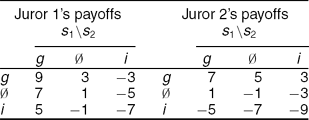
For simplicity, we assume preference certainty. Specifically, assume that juror j's bias, denoted by b j, satisfies u(C, b j, (s 1, s 2)) = −u(A, b j, (s 1, s 2)), where u(C, b j, (s 1, s 2)) is given by Table 4. So we have

and

In other words, juror 1 prefers the defendant to be convicted if and only if juror 2 observed a guilty signal; or juror 2 observed no relevant signal and juror 1 has not observed an innocent signal. Juror 2 prefers the defendant to be convicted if and only if juror 1 observed a guilty signal; or juror 1 observed no relevant signal and juror 2 observed a guilty signal.
Jurors' Payoffs for Conviction under the Pair of Signals (s 1, s 2)

Assume the communication is simultaneous and there are three messages, m g, m i, and m Ø, satisfying

such that m g and m i are evidence for having observed the signal g and i, respectively; and m Ø is a cheap-talk message that is available for any signal, with the interpretation that the sender of m Ø pretends to have observed no relevant signal.
To greatly simplify the analysis, we assume that the probability γ of observing no relevant signal is sufficiently high so that a juror receiving the message mØ will vote (under a weakly undominated voting strategy) as if the sender's signal were indeed Ø, no matter what the sender's message strategy. From the payoffs given by Table 4, this holds for any γ >  . So jurors' weakly undominated voting strategies are given by

and

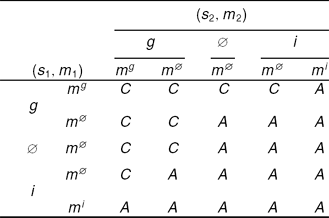
The outcomes matrix depending on jurors' signals and messages is shown in Table 5. Tables 4 and 5 allow us to deduce three things about the jurors' equilibrium message strategies.
Outcomes Depending on Jurors' Signals and Messages ((s 1, m 1), (s 2, m 2))

First, juror 1 always reports evidence for having observed signal g (if any). Indeed, whether juror 1, having observed signal g, reports m g or mØ will change the outcome in only two cases (see Table 5): (s 1, (s 2, m 2)) ∈ {(g, (Ø, m Ø), (g, (i, m Ø)}. Because γ > , whatever juror 2's message strategy is, juror 1's gain from reaching conviction when (s 1, s 2) = (g, Ø) is higher than the loss when (s 1, s 2) = (g, i) (see Table 4).
Second, juror 2 always pretends that she observed no relevant signal when her signal is i. Indeed, whether juror 2, having observed signal i, reports m i or mØ will change the outcome in only one case: ((s 1, m 1), s 2) = ((g, m g), i). The fact that juror 1 always reports evidence for having observed signal g ensures that juror 2 will never report evidence for signal i.
Third, juror 2 always pretends that she observed no relevant signal when her signal is g. Assume per contra that there is an equilibrium where juror 2 reports evidence m g. Then juror 1 will never report evidence m i for having observed signal i, because in the only case where this will change the outcome, he prefers conviction to acquittal. In this situation, juror 2 prefers to report mØ rather than m g, a contradiction.
It is now easy to check that there are two equilibria, depending on whether juror 1 reports evidence for signal i when she observes it. Hence, we obtain the result that in any equilibrium sustained by weakly undominated voting strategies, for any γ > , juror 2 always pretends to observe an irrelevant signal.
This second example illustrates that under unanimity, an individual will not always try to convince other committee members to vote against the status quo. If he thinks he is poorly informed relative to another, he may prefer not being pivotal at the voting stage. This idea obviously extends to other rules. In particular, for any other supermajority voting rule k, k < n, it is easy (but requires an higher number of jurors) to construct an example where at least (n + 1 − k) jurors pretend to observe no relevant signal, regardless of their signals. The generalization of this example is left for further research.
CONCLUSION
This article is concerned with information aggregation and voting rules. We consider how different rules encourage voters to share information prior to taking a vote. Austen-Smith and Feddersen (Reference Austen-Smith and Feddersen2006) show that, first, the unanimity rule performs worse than other supermajority rules for promoting fully revealing deliberation and, second, uncertainty about individuals' preferences is beneficial for full information sharing. We show that Austen-Smith and Feddersen's results are reversed when committee members can provide verifiable evidence for their private (decision-relevant) information. Our results restore two ideas. First, the requirement for a consensus of all committee members provides the strongest incentives for individuals to share their opinions and information most fully. Second, uncertainty about individuals' preferences is damaging for full information sharing.
This article deals mainly with situations where speakers can provide evidence in support of their private information. Our modeling choice is motivated by the need to enhance Austen-Smith and Feddersen's model to a setting where speakers are not limited to cheap-talk reporting. In many real-world settings, although debaters can provide evidence for particular information, evidence for any private information is not always available. Because the two models offer opposing results, a natural question is to determine what would happen between the two; that is, when members can provide evidence for some but not all of their private information. As our second example illustrates, when a committee member does not observe relevant information and cannot certify this, the argument used in the article may not apply. A general study of this case is a topic for future research.
Our study can be pursued in several other directions. For instance, we could consider costly communication. Is it efficient to compel committee members to provide strong evidence when they have to spend time or money to acquire it? Another limitation of this model is that both options are fixed before the debate takes place. What happens if the two possible outcomes are rather endogenously shaped after the different views in the committee have been summarized through the debate?
APPENDIX A: PROOFS OF THEOREMS 1, 2, AND 3
Proof of Theorem 1. Consider the following strategies profile (μ, v). During the deliberation stage, let μ be the profile of fully revealing message strategies according to which each player i ∈ N having observed s i ∈ S and regardless of the past history h t(i) ∈ sends a message m s i that is not available when another signal is being observed (existence of such a message is ensured by the evidence assumption). During the voting stage, consider the profile of weakly undominated voting strategies v such that each player i ∈ N, having observed (b i, s i,m) ∈ B × S× n, votes for the alternative y if and only if the profile of signals ( 1, 2,. . ., n) ∈ S b in, where i = s i; and for any j ∈ N, j ≠ i, j denotes i's beliefs about j's signal conditional on the messages m j, with j = s j if the message m j is evidence of having observed s j, and j = min(S(m j)) with respect to the order ≻ else.
Now, let us show that (μ, v) constitutes an equilibrium. Note that i's voting strategy v i(s i, m), i ∈ N, is independent from i's message sent during the deliberation stage. Moreover, because μ is revealing, having received m−i on the equilibrium path of μ−i, i learns the realized signal profile. Thus, v i(s i,m) maximizes i's payoff for any realized signal profile, and there is no beneficial deviation during the voting stage. During the deliberation stage, there is no beneficial unilateral deviation if for any sender i ∈ N, and for any (b i,s i, h t(i)) ∈ B × S × , i's expected payoff is higher when reporting m s i than when reporting any other available message  ∈ M(s i). Formally,

where  [U i(m i,b i, s i, h t(i))] denotes i's expected payoff when sending the message m i after having observed (b i, s i, h t(i)). This expected payoff is written as

where u(z, b i, s) and Pr(z|b, s, m i) denote respectively i's expected utility and the probability that z ∈ {x, y} is the final outcome conditional on the bias profile b = (b−i, b i), the state s = (s−i, s i), and the debate (m−i, m i) = (ms−i, m i), with ms = (m s 1,. . ., m s n). From (3), the inequality (2) can be written as

To verify the inequality (4), let us distinguish among the profile of signals s and bias b i whether [u(x, b i, s)−u(y, b i, s)] is strictly positive or strictly negative.
Under the unanimity rule, any voter can impose the status quo whatever his signal is, and so he can force the equality Pr(x|s, ⋅) = 1 for any (b−i, s−i) ∈ B n−1 × S n−1. This is in particular satisfied for voter i under the voting strategy v i, when u(x, b i,s) − u(y, b i, s) > 0, i.e., when the state s does not belong to S b in.
Suppose that u(x, b i,s) −u(y, b i, s) < 0, i.e., s ∈ S b in. If the message is off the equilibrium path of the strategy μi (not evidence), by definition of the voting strategy profile v, and by the single-crossing property, for any (b, s) ∈ B n × S n, Pr(x|b, s, m s i}) is lower than or equal to Pr(x|b,s, ). By the evidence assumption, the message cannot be on the equilibrium path of the message strategy μi when another signal s i′ ≠ s i is observed.
We have shown that for any (b−i, s−i) ∈ B n − 1× S n − 1, if u(x, b i, s) −u(y, b i,s) > 0, then Pr(x|b, s, m s i) − Pr(x|b, s, m i) = 0; and if u(x, b i, s) − u(y, b i, s) < 0, then Pr(x|b,s, m s i) − Pr(x|b, s,m i) ≤ 0 . So, for any (b i, s i) ∈ B × S and for any ∈ M(s i), both the inequality (4) and the condition (2) hold. ■
Proof of Theorem 2. We proceed by contradiction. We show that there is a probability distribution such that at least one sender, say sender i, belonging to the set of the last speakers has an incentive to deviate from her separating strategy, regardless of the timing of the deliberation and the k-rule, k < n. More precisely, using the notation of the conflicting preferences assumption, we show that there is a probability distribution satisfying the following. If i's counterparts have the profile of types (b−i, s−i) ∈ B n − 1 × S n − 1 with b−i=(b′, . . ., b′) and receive a cheap-talk message (either on or off the equilibrium path) from sender i, then whatever the inference they draw on i's signal, either i's type (b, s) or (b″, s′) has an incentive to send a cheap-talk message that is not her separating message. The deviation is profitable under any k-rule, k < n, and regardless of the number of speakers who report before sender i.
Assume that both events ((b−i, b), (s−i, s)) and ((b−i, b″, (s−i, s′)) occur with positive probability. Further assume that

with ϵ ∈ (0, 1). Fix a k-rule, k < n, and assume that i's counterparts play a separating strategy. Let ρj(m) ∈ Δ(S) be the receiver j's inference on the sender i's signal when i sends a cheap-talk message m that is not her separating message. Observe that under i's counterparts' separating strategy the inference ρj(m) may depend on (b j, s−i). Denote as  the profile of i's counterparts' inferences. Let z(b−i, s−i, ρ(m), t) ∈ [0, 1] be the probability that the outcome is y when i's counterparts have a profile of types (b−i, s−i), receive message m from i, and choose the inference ρ(m), and sender i votes for t ∈ {x, y}. Observe that under conflicting preferences at separating equilibrium, sender i votes t = y if her type is (b, s); and t = x if her type is (b″, s′). Let
 denote the induced difference in expected payoff for a (b i, s i) type that has observed the history h t(i) from reporting her separating message m s and from reporting the cheap-talk message m, when i's counterparts have a profile of types (b−i, s−i). Reporting m rather than m s is a nonprofitable deviation for sender i with type (b, s) and history h t(i) only if

Clearly, the probability that sender i assigns to her counterparts' types depends on the history h t(i) of past messages, as she may learn some information during the deliberation. From (5), when i's counterparts have a profile of types (b−i, s−i), we have

(In particular, this inequality is an equality when the deliberation is simultaneous, and the left-hand side is equal to zero when the deliberation is completely sequential and sender i is the unique last speaker.) From the conflicting preferences assumption,  is both negative and strictly decreasing with z(b−i, s−i, ρ(m), y).
Similarly, reporting m rather than m s′ is a nonprofitable deviation for sender i with type (b″, s′) and history h t(i) only if

From (5), when i's counterparts have a profile of types (b−i, s−i), we have

From the conflicting preferences assumption,  is both negative and strictly increasing with z(b−i, s−i, ρ(m), x). Observe that under any k-rule, we have z(b−i, s−i, ρ(m), y) ≥ z(b−i, s−i, ρ(m), x). For ϵ sufficiently close to zero, there is no z(b−i, s−i, ρ(m), t) with t = y for (b, s) and t = x for (b″, s′) such that both (6) and (7) hold. Hence, there is no inference ρ(m) that prevents sender i from a profitable deviation with respect to her separating strategy. ■
Proof of Theorem 3. Consider a supermajority voting rule where the status quo x is the final outcome unless at least k, k ∈  , committee members vote for the alternative y. To the overlapping preferences assumption at each bias profile corresponds a permutation σ such that S b σ (1)n ⊆ . . . ⊆ S b σ (n)n. So σ (n + 1 − k) is a decisive voter in that under a sincere voting strategy with respect to a revealed state, the alternative y is chosen if and only if he votes for it. From the preference certainty and overlapping preferences assumptions, the committee knows exactly both the identity of the decisive voter and, for any member i ∈ N, whether σ(i) is higher or lower than σ(n + 1 − k). During the deliberation stage, consider the profiles of fully revealing message strategies μ, such that each player i ∈ N, having observed (b i, s i, h t(i)) ∈ B × S × , sends a message m s i that is not available when another signal is being observed (existence of such a message is ensured by the evidence assumption). During the voting stage, consider the profile of weakly undominated voting strategies v, such that each player i ∈ N, having observed b, s i, m) ∈ B n × S × n, votes for the alternative y if and only if the profile of signals (1, 2, . . ., n) ∈ S b in, where i = s i; and for any j ∈ N, j ≠ i, j denotes i's beliefs about j's signal conditional on the messages m j, with j = s j if the message m j is evidence of having observed s j; otherwise j= max(S(m j)) (with respect to the order ≻) if σ (j) < σ (n + 1 − k), and j = min(S(m j)) if σ (j) ≥ σ (n + 1 − k).
Now, let us show by contradiction that μ, v) constitutes an equilibrium. For ease of exposition, we will not be going through details. The missing ingredients and notations of the proof are the ones exposed in the proof of Theorem 1. Assume that σ (i) < σ (n + 1 − k). The only case where player i, having observed a signal s i, would have an incentive to deviate from reporting evidence m s i ∉ ∪s≠s iM(s) is when there is an available message such that

where with a convenient abuse of notation “” denotes i's counterparts inference about s i when player i reports . Because ≠ m s i, from the evidence assumption, is off the equilibrium path of our separating strategy for any signal and any history. Thus i's counterparts infer that i's signal is higher than s i which, by the single-crossing property, contradicts (8). An analogous argument applies when σ (i) ≥ σ (n + 1 − k). ■
APPENDIX B: PROOF OF THEOREM 4
Let us formally rewrite both Axiom 7 and Axiom 8. Denote as S(m) the set of signals that the message m certifies (that is, the set of signals for which such a message is available).
Axiom 7 (Summary). For any s ∈ S there is m s ∈ M(s) such that  .
Axiom 8 (Nonmanipulable Higher Signal Summary). For any s ∈ S, if ∈ M(s) satisfies  , then for any s′ ∈ S, with s′ ≺ s, either ∉ M(s′) or
 .
Proof of Theorem 4. Consider the strategies profile (μ, v). During the deliberation stage, let μ be the profile of summary reporting strategies according to which each player i ∈ N, having observed s i ∈ S and regardless of the past history h t(i) ∈ , sends a message m s i ∈ M(s) such that S(m s i) = ∩m ∈ M(s i)S(m) (existence of such a message is ensured by the summary assumption). During the voting stage, consider the profile of weakly undominated voting strategies v, such that each player i ∈ N, having observed (b i, s i, m−i) ∈ B × S × n−1, votes for the alternative y if and only if

where p(ċ|b i,s i, m−i) denotes i's updated belief over his counterparts' types. This belief is obtained using Bayes's rule when m−i is on the path of the summary reporting strategy. Otherwise, if at least one component of m−i does not belong to the set of summaries, by denoting m−i ≡ (m j)j ∈ N \ {i}, this belief takes value 1 if s−i = (min S(m j))j ∈ N\{i} with respect to the order ≻, and takes value 0 otherwise.
Observe that this inference is such that if one debater deviates by sending a message that is not a summary, then receiver i will infer that every sender j≠i has observed the lowest signal that allows her to send her report, even if some senders are not deviating. Such a punishment is needed to prevent one sender j from deviating to influence i's belief on k's signal, k≠j, because types uncertainty may remain along the summary reporting strategies path and types distribution can be correlated.
Now, let us show that (μ, v) constitutes an equilibrium. Note that i's voting strategy v i(s i,m), i ∈ N, is independent of i's message sent during the deliberation stage. Moreover, because μ consists of reporting the most precise information that can be transmitted over each signal (summary assumption), v i(s i, m) maximizes i's expected payoff and there is no beneficial deviation during the voting stage. During the deliberation stage, there is no beneficial unilateral deviation if for any sender i ∈ N, and for any (b i, s i, h t(i)) ∈ B×S× , i's expected payoff is higher when the summary m s i is reported than when any other available message ∈ M(s i) is reported. To check this, we can proceed as in the proof of Theorem 1. In particular, we can use (2) and (3), and verify the inequality (4). An analogous argument applies, using the following. If the message is off the equilibrium path of the strategy μi (not a summary), by definition of the voting strategy profile v, and by the single-crossing property, for any (b, s) ∈ B n × S n, Pr (x|b, s, m s i) is lower than or equal to Pr (x| b, s, ). By the nonmanipulable higher signal summary assumption, it is also the case when is on the equilibrium path of the message strategy μi. ■






Comments
No Comments have been published for this article.