INTRODUCTION
The genus Zeugopterus comprises two species (Chanet, Reference Chanet2003); both are distributed in the north-east Atlantic and recorded in Galician waters: the topknot Zeugopterus punctatus (Bloch, 1787) and Eckström's topknot Zeugopterus regius (Bonnaterre, 1788). Zeugopterus regius occurs from the British Isles to Morocco and in the Mediterranean (Nielsen, Reference Nielsen and Whitehead1986; Lloris & Rucabado, Reference Lloris and Rucabado1998). It inhabits coastal waters from 10 to 180 m depth (Quéro et al., Reference Quero, Porche and Vayne2003), although Lozano y Rey (Reference Lozano y Rey1960) reported this species from Portuguese waters between 233 and 300 m depth.
In the Galician region, Eckström's topknot is a scarce species of minor commercial importance which is usually discarded. The biology of Z. regius is poorly known; the same morphological and meristic characters are invariably used to describe the species in most of the fish faunas of recent decades. These reports indicate that the description of Eckström's topknot is incomplete because the number of available specimens is limited. The aim of the current study is to re-describe Eckström's topknot based on specimens collected from the natural environment in Galician waters.
MATERIALS AND METHODS
The study area covered the coastal waters of Galicia (north-west Spain), between the river Miño outlet (41°50′N 9°40′W) and the river Eo outlet (43°32′N 7°01′W). Specimens of Zeugopterus regius were collected during a monitoring programme of artisanal fisheries carried out by Unidade Técnica de Pesca de Baixura (UTPB) of Xunta de Galicia. During the period 2001–2005, a total of 83 specimens was caught between 2 and 71 m depth with several coastal fishing gears, mainly beam trawls, beach seines and gill-nets.
On board, total length (TL) to the nearest cm and total weight to the nearest gram was noted. Twenty-three specimens were preserved refrigerated or frozen for further analysis. In the laboratory, measurements and meristic characters were recorded according to Norman (Reference Norman1934) and gonads were observed macroscopically to determine sex. The specimens were stored in the fish collection of the Instituto de Ciencias del Mar de Barcelona (ICICMB) [Reference Nos. IIPB 21/2006 to IIPB 43/2006].
RESULTS
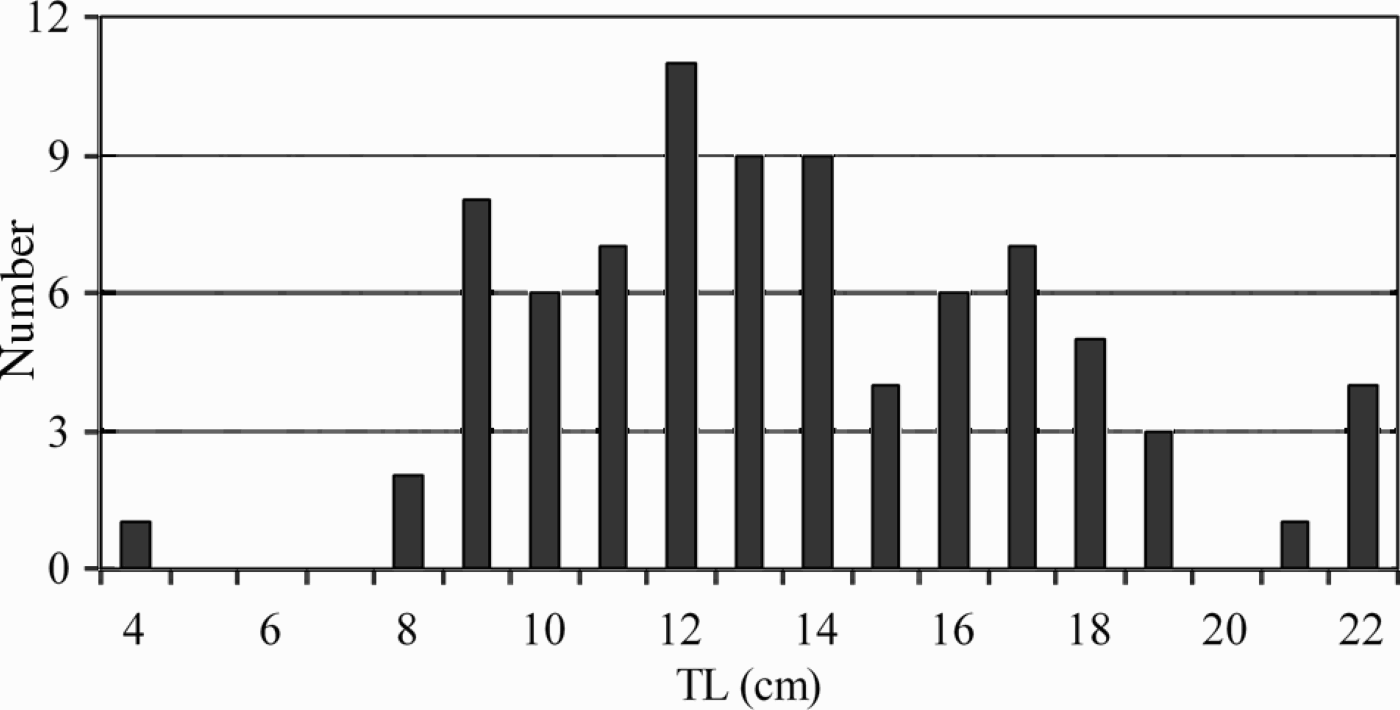
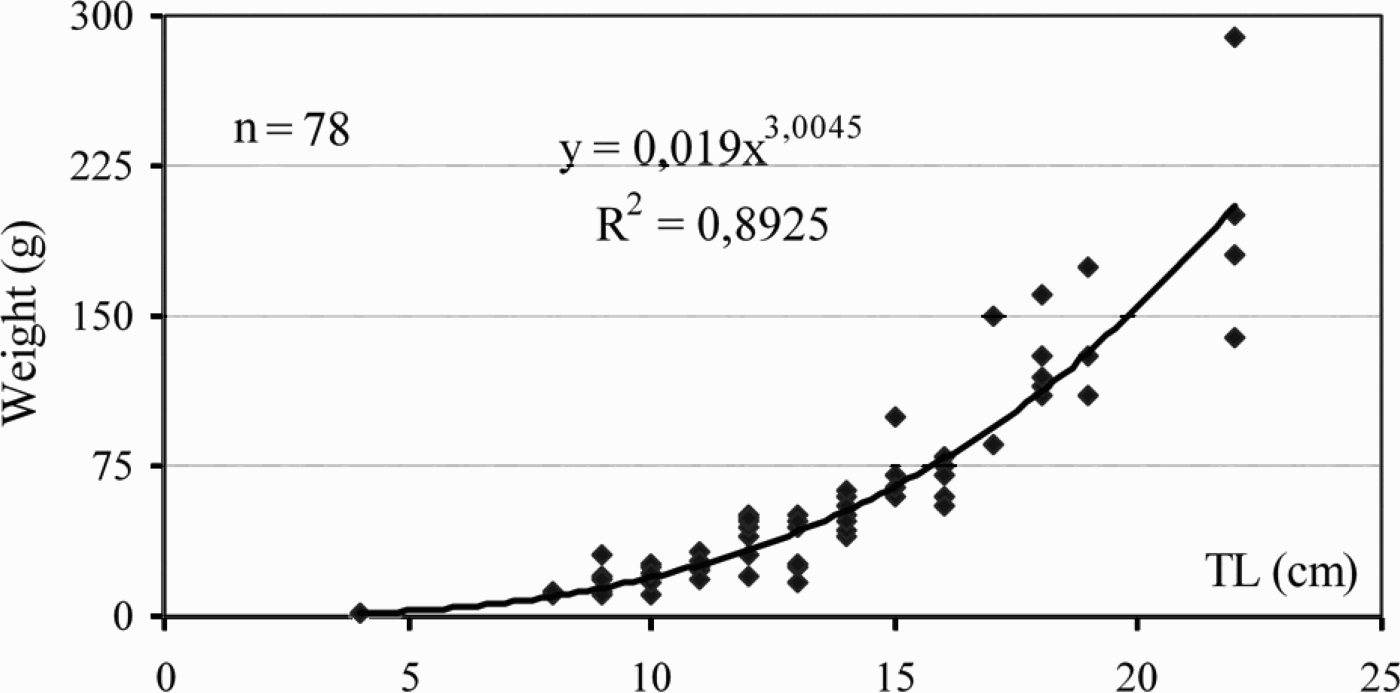
Total length ranged between 4 and 22 cm (Figure 1). Sex was determined in 21 specimens, six males between 82 and 103 mm and 15 females between 86 and 124 mm. The length–weight relationship was described by the following equation:

Length distribution in catches of Zeugopterus regius.

Length–weight relationship of Zeugopterus regius.

DIAGNOSIS
The range of counts is followed by the mean ± SD in parentheses. D: 80–88 (84.7 ± 1.9); A: 64–72 (68.3 ± 1.9); P: 10–13 (10.5 ± 0.8); V: 6; C: 16; gillrakers in first arch: 4–6 + 11–12 = 15–18; branchiostegal rays: 7. The number of scales in lateral line were very difficult to count and therefore undetermined.
The percentage range of lengths in standard length (SL) is followed by the mean ± SD in parentheses: head length 26.2–36.4 (30.7 ± 2.4); mouth length: 8.8 –13.6 (10.7 ± 1.4); preorbital length: 5.9–11.5 (7.5 ± 1.1); postorbital length: 13.1–20.5 (16.3 ± 1.5); eye length: 5.3–9.4 (6.9 ± 1.1); first dorsal fin ray length: 9.3–15.6 (11.6 ± 1.5); predorsal length: 3.4–11.7 (6.5 ± 1.6); dorsal base length: 82.6–95.5 (90.6 ± 2.9); preanal length: 12.9–25.0 (18.5 ± 3.1); anal base length: 72.1 86.3 (80.1 ± 3.6); pectoral length: 15.5–20.4 (17.3 ± 1.3); blotch diameter: 5.6–9.6 (7.6 ± 1.0); body depth: 45.2–57.3 (52.7 ± 3.3) and body width: 6.3–14.0 (10.5 ± 1.5).
DESCRIPTION
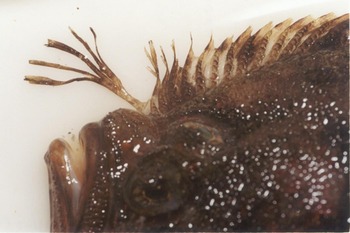
Body oval and compressed, body depth about two times in SL; small head; deep notch in front of the upper eye; snout about as long as eye; mouth terminal, oblique, with a little knob on lower jaw; eyes oval, protruding, closely set, separated by a little prominent inter-orbital ridge; lower eye slightly in advance of upper; maxillary extending to middle part of eye, first dorsal fin ray free, thickened, elongated and branched, appearing frayed or fringe-like, normally divided to medium height or less in two main branches subdivided into secondary branches of different heights with 2–5 filaments distally (Figure 3). (Two abnormal specimens had more than one elongated rays in the dorsal fin: a female specimen of 110 mm SL had the first four elongated rays decreasing posteriorly in length and a female of 105 mm SL had the two first elongated rays of similar length.) Body and rays scaled; small and heavily toothed scales on ocular side, with 4–7 smaller teeth on the free edge of each scale, giving a rough surface; ctenoid scales on blind side; terminal rays of dorsal and anal fins divided to its base on the underside of body forming lobes, all other rays divided at their extremities; ventral fin small with the last ray double; pectoral and caudal fins with marginal fin rays simple, all other rays branched; only one distinct round blotch towards tail-end of the lateral line.
Detail of first elongated dorsal fin ray of Zeugopterus regius.

Colour on ocular side brownish with irregular dusky, reddish spots and blotches on head and body; dorsal and anal fins with a series of dark blotches; distinctive circular blotch towards tail-end, reddish inside with a black ring externally; blind side white.
DISCUSSION
The flat morphology, relatively small size and low abundance of this species probably explains their low gear catchability. These facts, together with their minor commercial interest, could explain the scarcity of biological data and limited knowledge on Zeugopterus regius. In the eastern Atlantic, the main literature dealing with Z. regius relates to specimens from the British Isles area (Day, Reference Day1880–1884; Norman, Reference Norman1934; Wheeler, Reference Wheeler1969) with very little information from either French (Cazaux & Labourg, Reference Cazaux and Labourg1973; Quéro et al., Reference Quero, Dardignac and Vayne1989) or Spanish areas (Lozano y Rey, Reference Lozano y Rey1960).
The results exhibited sexual dimorphism, with females reaching a larger size than males, as previously noted in other flatfish species (Nash & Geffen, Reference Nash, Geffen and Gibson2005). The maximum TL found in the current study was 22 cm, similar to that previously reported; 20 cm SL (Nielsen, Reference Nielsen and Whitehead1986).
The main diagnosis of the current specimens agreed with those previously reported by other authors but there were some differences and inaccuracies.
The number of dorsal and anal fin rays was higher than previously described. Dorsal fin ray counts ranged from 80 to 88 in Galician specimens compared with 70 to 80 previously reported in the literature, while anal fin ray counts ranged from 64 to 72 compared with 60 to 68 in previous papers. Prior to the current study, the greatest number of dorsal (70–80) and anal (60–68) fin ray counts were reported by Norman (Reference Norman1934) apparently based on the examination of 14 specimens from several locations in the Mediterranean and Atlantic. The higher number of specimens examined in the current study (23) from a more restricted area might explain these differences. Furthermore, regional differences in dorsal and anal fin ray counts may indicate the presence of different populations as noted in other Scophthalmid species (Bagge & Nielsen, Reference Bagge and Nielsen1993; Chanet et al., Reference Chanet, Quero and Vayne2003).
The presence of an elongated first dorsal fin ray is an important descriptive character for this species (Day, Reference Day1880–1884; Wheeler, Reference Wheeler1969), which was present in all specimens examined, including both males and females of similar length. Moreover, two of the specimens (9%) exhibited more than one elongated dorsal fin ray which seems to be an abnormal character for this species.
The fringe-like appearance of the first dorsal fin ray is omitted from most of the previous descriptions of this species and is only referred in some of them as a setiform ray (Day, Reference Day1880–1884; Moreau, Reference Moreau and Masson1881; Norman, Reference Norman1934).
The number of rounded blotches on the body is another unclear descriptive character. Whereas some authors described only one distinct blotch (Norman, Reference Norman1934; Soljant, Reference Soljan1963; Wheeler, Reference Wheeler1969) others described four (Lozano y Rey, 1960; Nielsen, Reference Nielsen and Whitehead1986; Bauchot, Reference Bauchot and Fischer1987). The dark spots and blotches that were spread over the dorsal surface of the body were composed of a rhomboid, blurred and light area and were present to a greater or lesser extent in all specimens examined. This area seems to be limited to four blotches, one at each angle, however, only one of them, described in this paper, can be clearly distinguished in all specimens, characterized by a round shape and an external black ring. The other three, when distinguishable, were irregular, not clearly round and the outer black ring was absent. Therefore, the presence or absence of these blotches cannot be considered to be of taxonomic importance.
ACKNOWLEDGEMENTS
We wish to thank the personnel of UTPB for providing the specimens from Galician waters and to Mar Sacau and Begoña Santos for help with the English translation. The Xunta de Galicia supported this study.