Scholars have long argued that governments are more likely to be re-elected in good times than in bad. More contentious is what, if anything, incumbents can do to engineer ‘good times’. One of the tools most commonly attributed to the government for manufacturing good times prior to an election is fiscal manipulation – spending more or taxing less. Whether governments manipulate fiscal policy depends upon the domestic institutional, political and economic context of each election, as has been demonstrated through many single country and cross-national studies.Footnote 1 With the exception of Clark and Hallerberg, who analyse the role of the exchange rate on pre-electoral fiscal manipulation, the key variables in these studies have been domestic, with little attention paid to how international variables may affect fiscal manipulation.Footnote 2
In a global economy increasingly characterized by cross-border trade and capital flows, governments’ choices are shaped by their countries’ exposure to the international economy. In particular, a government’s decision to engage in pre-electoral fiscal manipulation is mediated by their country’s exposure to international volatility and international competition. While exposure to international volatility increases governments’ incentives to engage in pre-electoral fiscal manipulation, concerns that fiscal manipulation will erode the country’s international competitiveness reduce governments’ incentives to manipulate fiscal policy prior to an election.
A country’s exposure to international economic volatility may increase as its trade openness increases and as its exchange rate becomes less flexible. Thus, governments may face a greater incentive to engage in pre-electoral fiscal manipulation if their country has a fixed exchange rate or if their country is heavily engaged in trade. Conversely, when under a fixed exchange rate, governments’ concern about eroding international competitiveness through a fiscal expansion may increase as trade increases. These competing incentives suggest that pre-electoral fiscal manipulation is more likely to occur when the country’s exchange rate is flexible and the economy is highly open to trade, and when the exchange rate is fixed and the economy is relatively closed to trade. This argument is tested empirically through a quantitative analysis of changes in government debt in twenty OECD countries from 1974 to 2008.
Pre-electoral fiscal manipulation as a tool to ensure economic good times
Governments that oversee strong economic growth are more likely to be re-elected than governments facing re-election under a weak economy.Footnote 3 This finding, coupled with governments’ desire for re-election, has led scholars to expect governments ‘to turn on the spigot surely and swiftly and fill the trough so that it counts with the electorate’.Footnote 4 Whether governments can manufacture favourable economic conditions prior to an election has been the subject of debate within the political business cycle (PBC) literature.Footnote 5 Early PBC models posited naïve voters who rewarded governments for electoral year expansions.Footnote 6 These first generation models, while significant for identifying an important political rationale for governments’ economic policy making, were deemed unrealistic. Rather than modelling governments exploiting myopic voters, second generation PBC analyses have spotlighted the importance of favourable economic conditions in voters’ perception of government performance.Footnote 7 In an environment of asymmetric information where voters cannot identify government competence, pre-electoral economic conditions act as a signal of government competence. By producing an election-year expansion, governments demonstrate their governing ability. Under these models, the absence of an election-year expansion may signal low government competence.
For both first- and second-generation PBC models, governments have strong incentives to engage in pre-electoral fiscal manipulation. Recent analyses have focused on institutional characteristics that affect governments’ ability or incentive to engage in pre-electoral fiscal manipulation. Governments may be institutionally constrained in their ability to manipulate the economy. Most broadly, governments’ ability to engage in pre-electoral fiscal manipulation may diminish as the number of political actors involved in policy making increases. As Franzese argues, ‘problems of bargaining, agency, coordination, and collective action will dampen, or otherwise complicate, electioneering, especially in so far as these entities serve different constituents’.Footnote 8 Saporiti and Streb present this argument more formally, arguing that PBCs are unlikely when the executive does not have unilateral control over fiscal policy.Footnote 9 Thus, as the number of veto players involved in policy making increases, governments should be less likely to engage in pre-electoral fiscal manipulation.Footnote 10
In particular, this argument extends to cabinet composition. Pre-electoral fiscal manipulation should be most likely in a single-party cabinet where one party has control over budgetary decision making. A single-party minority government may have even greater incentive to engage in fiscal manipulation than a majority government, as their electoral position is more precarious.Footnote 11 Coalition governments, in which multiple parties within the cabinet control policy making, should generally be less able to engage in pre-electoral fiscal manipulation and have less incentive to do so as it may be more complex to claim the credit.Footnote 12
Similarly, budgetary rules that limit discretionary control over fiscal policy also limit the government’s ability to engage in pre-electoral fiscal manipulation. In a study of PBCs in the American states, Rose finds that states with balanced budget requirements are less likely to engage in pre-electoral fiscal manipulation.Footnote 13 In an analysis of budget procedures in the nations of the European Union, Hallerberg, Strauch and von Hagen find that deficit spending is constrained when budget decisions are delegated to less politicized actors.Footnote 14 Thus, pre-electoral fiscal manipulation should be less likely when there is less political influence in the budget process.
An election-year expansion is more effective in garnering votes if voters are unable to detect the government’s manipulation. As voters’ ability to observe fiscal policy increases, voters will be less likely to reward pre-electoral fiscal manipulation, thus reducing governments’ incentive to engage in fiscal electioneering. As a result, Alt and Lassen argue that increased fiscal transparency leads to smaller political budget cycles.Footnote 15
Governments’ incentive to engage in pre-electoral fiscal manipulation also depends on their desire to remain in office. Bernhard and Leblang argue that incumbents with a higher cost of losing power are more likely to inflate the economy prior to an election.Footnote 16 In particular, incumbents in majoritarian systems, in which a small electoral loss can result in a large seat loss and in which the opposition have very little policy influence, have a greater incentive to inflate the economy. Conversely, governments in proportional representation systems have less incentive to engage in economic electioneering.
Governments’ ability to engage in fiscal manipulation may also be constrained by their country’s exchange rate regime. Clark and Hallerberg argue that in a world of perfect capital mobility, governments engage in fiscal expansion prior to an election only under a fixed exchange rate, never under a flexible exchange rate.Footnote 17 This argument depends crucially upon the role of perfect capital mobility. If capital is viewed as partially rather than fully mobile, a view that is more reflective of the reality of the last few decades, exchange rate flexibility does not render fiscal manipulation fully ineffective but may reduce its effectiveness. Empirically, studies of pre-electoral fiscal manipulation in the United States and Britain demonstrate that fiscal manipulation does occur in countries with flexible exchange rates.Footnote 18
In sum, governments have an incentive to engage in pre-electoral fiscal manipulation because their prospects for re-election improve with the strength of the economy. Previous analyses have shown that governments are more likely to engage in electioneering when they are institutionally less constrained, the costs of losing office are high, and the exchange rate is fixed. Despite the widespread understanding that the international economic environment has a substantial influence on countries’ economic performance, with the exception of Clark and Hallerberg, prior studies have primarily analysed domestic determinants of governments’ incentives to engage in fiscal manipulation. In this article, I seek to redress this balance, and in the following sections examine how a country’s trade and exchange rate ties influence governments’ incentives to manipulate the economy prior to an election.
Pre-electoral fiscal manipulation and international volatility
In a global economy increasingly characterized by cross-border trade and capital flows, governments’ choices are shaped by their countries’ exposure to the international economy. In this section, I argue that greater exposure to international economic volatility through trade openness or a fixed exchange rate increases the uncertainty of economic good times prior to an election. Greater economic uncertainty increases governments’ incentives to manufacture favourable economic conditions prior to an election.Footnote 19
Trade openness acts as a conduit for international economic volatility. As Kose, Prasad and Terrones note, ‘while there appears to be a general consensus that openness to trade flows stimulates domestic growth, it is also the case that such openness increases the vulnerability to external shocks.’Footnote 20 Theoretically, the effect of trade openness on overall domestic volatility is indeterminate. By increasing market size for a country’s output, trade may reduce demand volatility. Conversely, by encouraging specialization, trade makes countries more vulnerable to specific demand shocks. More generally, trade openness exposes countries to volatility in their terms of trade – the unit price of a country’s exports relative to the unit price of its imports. High levels of trade do not necessarily lead to greater terms of trade volatility,Footnote 21 but in the absence of trade, such volatility would have no impact on the economy.Footnote 22 Empirically, scholars have found a positive association between trade openness and domestic volatility.Footnote 23 In particular, increased exposure to terms of trade volatility resulting from greater trade, rather than the trade flows themselves, appears to be the causal explanation for this relationship.Footnote 24 As a result, while trade openness may increase long-run economic growth, by exposing the economy to terms of trade volatility, trade openness may also increase domestic volatility. Domestic volatility, in turn, has long been shown to have a strong negative effect on economic growth.Footnote 25
High trade openness, by increasing the economy’s exposure to international volatility, increases uncertainty about the strength of the economy prior to an election, and concomitantly increases the government’s electoral uncertainty. As a result, as trade increases, the government’s incentive to engage in a fiscal expansion to improve their re-election chances also increases. Whether governments can increase fiscal expenditures in the face of trade openness is a large debate. Some scholars suggest that trade openness and public expenditures are negatively correlated (the efficiency hypothesis), while others argue that trade openness and public expenditures are positively correlated (the compensation hypothesis).Footnote 26 The compensation hypothesis posits that governments in countries that are highly open to trade will maintain high levels of public expenditures to cushion the domestic economy from adverse international shocks.Footnote 27 The role of public expenditures in this view is to act as a stabilizing force to smooth and redistribute aggregate income. Thus, under the compensation hypothesis, as trade increases, public expenditures will increase.
Alternatively, proponents of the efficiency hypothesis argue that while high levels of trade may increase the government’s desire to cushion the economy, they reduce the government’s ability to do so. This occurs because increased trade openness increases the economy’s exposure to international competitive pressures. As competitive pressures increase, domestic producers are forced to produce goods more competitively. To do so, domestic producers must reduce their costs, and one key mechanism to do this is to reduce their tax burden. As a result, increased trade forces governments to reduce taxes, reducing their tax revenue and leading to a reduction in public expenditures. Thus, under the efficiency hypothesis, as trade increases, public expenditures will decrease.Footnote 28
While empirical support for both arguments has been mixed due to differences in definitions, samples and methodology, recent research finds stronger support for the compensation hypothesis than for the efficiency hypothesis. Taken as a whole, the empirical results from this research agenda suggest that governments in countries that face higher levels of international volatility do appear to spend more money, but that when governments do so depends on the type of international volatility the country faces,Footnote 29 that governments do so within constraints,Footnote 30 and that they target where to increase expenditures.Footnote 31
These analyses have focused on the long-run relationship between trade openness and public expenditure. However, when a government considers manipulating fiscal policy prior to an election, its time horizon is quite short. The short time horizon involved in pre-electoral fiscal manipulation further calls into question the explanatory power of the efficiency hypothesis. Since the efficiency hypothesis relies on the long-run effect of public expenditures on domestic competitiveness, as the time horizon for increased public expenditures declines, any constraints on expenditures imposed by trade openness will also decline. Thus, in the short run, increased trade, by increasing the economy’s exposure to terms of trade volatility, increases the government’s desire to manipulate fiscal policy in the run up to an election, while constraints on the government’s ability to do so are not as binding.
A country’s exchange rate also acts as a conduit for international economic volatility. As the inflexibility of a country’s exchange rate increases, international shocks are imported into the domestic economy. As Edwards and Levy-Yeyati note, a flexible exchange rate acts as a ‘shock absorber’.Footnote 32 The logic for this argument stems from Meade’s and Friedman’s arguments that in an economy typified by some degree of price rigidity, i.e., all economies in practice, flexible exchange rates allow prices to adjust more quickly to international shocks.Footnote 33 This means that such shocks result in lower volatility in the domestic market when the exchange rate is flexible than when it is fixed. As Broda notes, reducing the importation of international volatility ‘has become one of the least disputed arguments in favour of flexible exchange rate regimes’.Footnote 34
For governments, this means that the likelihood that an adverse economic shock will hurt the domestic economy increases as exchange rate inflexibility increases. Solidifying this concern for governments, empirical studies have found that countries with fixed exchange rates experience higher growth volatility. Broda and Edwards and Levy-Yeyati demonstrate that flexible exchange rates insulate economies from terms of trade shocks much better than fixed exchange rates.Footnote 35 Similarly, di Giovanni and Shambaugh demonstrate that international interest rate shocks are more likely to reduce domestic growth in countries with a fixed exchange rate.Footnote 36 Therefore, I expect that the increased volatility imported into the economy through a fixed exchange rate will increase governments’ desire to engage in pre-electoral fiscal manipulation.
In sum, this section argues that, all else equal, the more exposed the country is to international volatility, either through trade openness or through a fixed exchange rate, the more uncertain the government will be about the strength of the economy prior to an election, and thus, the greater the government’s incentive to engage in pre-electoral fiscal manipulation. However, as will be elaborated in the following section, the government’s desire to generate a fiscal expansion to dampen the potentially deleterious effects of international volatility may be offset by concerns over the economy’s international competitiveness.
Pre-electoral fiscal manipulation and international competitiveness
Under a flexible exchange rate, an increase in government spending is associated with both an increase in domestic output and consumption, and a depreciation of the country’s real exchange rate.Footnote 37 Greater domestic output and consumption suggests that under a flexible exchange rate, pre-electoral fiscal manipulation may generate economic gains for voters, while a real exchange rate depreciation suggests that the country’s exports remain competitive internationally – at least in the short term.Footnote 38 As a result, under a flexible exchange rate, pre-electoral fiscal manipulation appears to be an effective tool for generating economic good times without sacrificing international competitiveness.
This prediction stands in stark relief to Clark and Hallerberg’s prediction that governments will not engage in fiscal manipulation when the exchange rate is flexible.Footnote 39 Under the Mundell–Fleming model, which assumes perfect capital mobility (and hence international asset market flexibility), a fiscal expansion under a flexible exchange rate leads to an increase in domestic output, consumption and interest rates, which attracts foreign investment, and leads to a currency appreciation. This currency appreciation is expected to hurt the country’s international competitiveness, which reduces output, consumption and interest rates, perfectly offsetting the fiscal expansion. However, empirical analyses find that under a flexible exchange rate, fiscal expansion tends to increase consumption, which is not offset by increased interest rates or investment.Footnote 40 With respect to the Mundell–Fleming model, these findings may reflect rigidities in international asset markets, which mitigate the positive relationship between increases in government consumption, interest rates and international capital flows.Footnote 41
Increased consumption and the concomitant real exchange rate depreciation following an increase in government expenditure under a flexible exchange rate is theoretically puzzling within the new open economy macroeconomics (NOEM) framework, as well.Footnote 42 Within the NOEM framework, an increase in government consumption should generate a negative wealth effect as actors account for the increased tax bill that will result from increased government expenditures. Based on this framework, a fiscal shock should decrease rather than increase consumption. As Beetsma documents, there currently exists no theoretic consensus as to why increased government expenditure is positively correlated with increased consumption.Footnote 43 Competing explanations for this outcome focus on why private consumption remains high in the face of increased government consumption, citing demand inelasticity, which mitigates the negative effect of increased government consumption on private consumption,Footnote 44 high inter-temporal elasticity of consumption, which weakens the negative effect of an increase in actors’ future tax bills,Footnote 45 and the presence of ‘rule-of-thumb’ actors who consume all of their wages in each period, neither saving nor borrowing inter-temporally, and therefore do not change their consumption decisions based on government consumption.Footnote 46
Under a fixed exchange rate, an increase in government spending is associated with a real exchange rate appreciation.Footnote 47 An appreciated real exchange rate hurts the tradable sector because their goods become more expensive relative to foreign goods, making it more difficult for exporters to sell their goods abroad and for import-competing goods to compete effectively against imports. Thus, a real exchange rate appreciation is associated with a deterioration of a country’s current account as exports fall and imports rise. As a result, while pre-electoral fiscal manipulation may improve the country’s short-term aggregate economic performance, it may also come at the cost of a deterioration of the country’s international competitiveness.
A real exchange rate appreciation may be an unwelcome externality of a fiscal expansion under a fixed exchange rate, but if it does not occur until after the election, it may not affect the government’s decision to engage in fiscal manipulation.Footnote 48 However, in their analysis of the effect of a fiscal shock on the real exchange rate in eleven countries belonging to the European Monetary Union from 1970 to 2006, Bénétrix and Lane find that the real exchange rate appreciation associated with an increase in government expenditure under a fixed exchange rate occurs very quickly and is relatively long-lived.Footnote 49 Although Bénétrix and Lane’s analysis is not limited to pre-electoral expansions, their results parallel the finding that under fixed exchange rates, currencies are often overvalued prior to an election, leading to a much greater likelihood of a post-election devaluation.Footnote 50 This suggests that when considering a fiscal expansion under a fixed exchange rate, governments may face a trade-off between increasing economic performance and protecting their country’s competitiveness.
A deterioration of the country’s international competitiveness is only likely to influence the government’s decision to engage in pre-electoral fiscal manipulation if the tradable sector is politically important. When the country’s trade flows are low, a loss of competitiveness has very little impact on the economy or on voters’ decision making.Footnote 51 As trade increases, the tradable sector will become increasingly important to the government. As pre-electoral fiscal manipulation hurts an increasingly large segment of the economy, the benefit that the government accrues from its fiscal expansion will be offset as domestic producers lose international competitiveness.Footnote 52 Taken to the extreme, rather than increasing the government’s chances of re-election, in an economy marked by high trade openness, pre-electoral fiscal manipulation may hurt the government’s chances of re-election. Thus, I expect that when governments take into account the effect of a fiscal expansion on international competitiveness the likelihood, the government will engage in pre-electoral fiscal manipulation decreases as both the inflexibility of the exchange rate and trade openness increase.
Trade openness, exchange rate regimes and pre-electoral fiscal manipulation
The previous two sections explored the relationship between pre-electoral fiscal manipulation and exposure to international volatility and international competition, respectively. While exposure to international volatility increases governments’ incentives to engage in pre-electoral fiscal manipulation, concerns about international competitiveness reduce governments’ incentives to manipulate fiscal policy prior to an election. A country’s exposure to international economic volatility increases as its trade openness increases, or as its exchange rate becomes less flexible. Thus, governments face a greater incentive to engage in pre-electoral fiscal manipulation if their country has a fixed exchange rate, or if their country is heavily engaged in trade. Conversely, when under a fixed exchange rate, governments’ concern about eroding international competitiveness through a fiscal expansion increases as trade increases. The interaction of these two competing incentives generates three hypotheses.
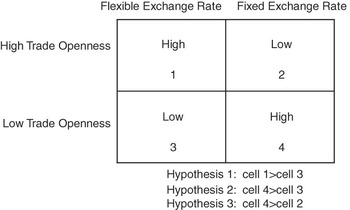
As discussed in the previous section, when the exchange rate is flexible, pre-electoral fiscal manipulation does not erode a country’s international competitiveness in the short term. Therefore, for governments under a flexible exchange rate, concerns about their country’s competitiveness do not act as a constraint on fiscal manipulation. As a result, when the exchange rate is flexible, the likelihood that the government engineers a fiscal expansion prior to the election should increase as the economy becomes more exposed to international volatility. As trade increases, the economy is more exposed to international volatility. Thus, under a flexible exchange rate, governments become more likely to engage in pre-electoral fiscal manipulation as trade openness increases, all else equal. This leads to Hypothesis 1:
HYPOTHESIS 1: When the exchange rate is flexible, pre-electoral fiscal manipulation is more likely as trade openness increases.
When the exchange rate is fixed, a fiscal expansion is associated with an erosion of international competitiveness through a real exchange rate appreciation. However, when the economy is closed to trade, a deterioration of the country’s competitiveness is not politically salient and therefore should not adversely affect the government’s re-election chances. As a result, when trade is low, the likelihood that the government engineers a fiscal expansion prior to the election should increase as the economy becomes more exposed to international volatility. As the inflexibility of the country’s exchange rate increases, the domestic economy is more exposed to international volatility. Thus, when trade openness is low, governments become more likely to engage in pre-electoral fiscal manipulation as the inflexibility of the exchange rate increases, all else equal. This leads to Hypothesis 2:
HYPOTHESIS 2: When trade openness is low, pre-electoral fiscal manipulation is more likely under a fixed exchange rate than under a flexible exchange rate.
In contrast, when a country is highly open to trade, the erosion in a country’s competitiveness generated by a fiscal expansion under a fixed exchange rate is quite politically salient. With greater trade, the proportion of the country’s production exposed to international competition is higher. Thus, as trade openness increases, the loss of competitiveness resulting from pre-electoral fiscal manipulation hurts a larger percentage of voters, who are less likely to vote in favour of the government. As a result, all else equal, when under a fixed exchange rate, governments should be less likely to engage in pre-electoral fiscal manipulation as trade openness increases.Footnote 53 This leads to Hypothesis 3:
HYPOTHESIS 3: When the exchange rate is fixed, an increase in trade openness reduces the likelihood of pre-electoral fiscal manipulation.
Taken together, these three hypotheses suggest that governments are more likely to engage in pre-electoral fiscal manipulation when the exchange rate is flexible and trade openness is high, and when the exchange rate is fixed and trade openness is low. Governments are less likely to engage in pre-electoral fiscal manipulation when the country’s exchange rate is fixed and trade openness is high, and when the exchange rate is flexible and trade openness is low. This is outlined graphically in Figure 1.
Likelihood of pre-electoral fiscal manipulation as trade openness and exchange rate regime vary

Empirical analysis
The three hypotheses presented above are explored in this section with a quantitative analysis of pre-electoral fiscal manipulation in twenty OECD countries from 1974 to 2008. The results are consistent with the hypotheses: pre-electoral fiscal manipulation is most likely when the exchange rate is fixed and trade openness is low, and when the exchange rate is flexible and trade openness is high. The magnitude of these effects, however, appears to vary over time.
The baseline model is similar to Clark and Hallerberg’s analysis.Footnote 54 This model was chosen for two reasons. First, Clark and Hallerberg’s findings represent the alternative hypothesis for this project – that governments engage in pre-electoral fiscal manipulation when the exchange rate is fixed and not when the exchange rate is flexible. Secondly, Clark and Hallerberg adopt a well-accepted array of controls for fiscal policy analyses. The estimation technique is ordinary least squares regression with panel corrected standard errors.Footnote 55
The proxy for fiscal manipulation is Change in Gross Government Debt as a Percentage of Gross Domestic Product.Footnote 56 This measure assumes that increases in government expenditure, or decreases in taxes, will be reflected in an increase in government debt. One drawback of this measure is that, to the extent that governments can target fiscal expenditures, fiscal manipulation may be less evident in such an aggregate measure. Thus, using an aggregate measure for fiscal manipulation should reduce the likelihood of observing a significant level of fiscal manipulation, making it more difficult to find support for the argument. Another potential drawback is that this measure may be inversely correlated with the strength of the economy. To control for this, Change in Unemployment is included as a proxy for the strength of the economy.Footnote 57 The lagged dependent variable (Change in Government Debt as a % of GDP, lagged) is included to control for temporal stickiness in the government’s fiscal stance.Footnote 58 Finally, government debt also reflects Debt Service Costs. As the cost of servicing the government’s debt increases, government debt increases as well, all else equal.Footnote 59
The independent variables of interest are Election, Exchange Rate and Trade. Election is a dichotomous variable coded 1 in a year in which a regular election occurs, and 0 otherwise, where an election is coded as regular when it occurs either in the last 10 per cent or the last six months of the constitutional inter-election period.Footnote 60 The logic behind limiting the analysis to regular elections is that, all else equal, fiscal manipulation is less likely when an election is early than when it occurs at the end of its constitutional inter-election period. There are two reasons for this. First, to the extent that governments call early elections when the economy is doing well, or more specifically, when there is a belief that the economy will do less well later on, there is less need to manipulate the economy.Footnote 61 Secondly, given that many early elections occur unexpectedly, there should be less fiscal expansion prior to an early election as there is less time to plan for the election.Footnote 62
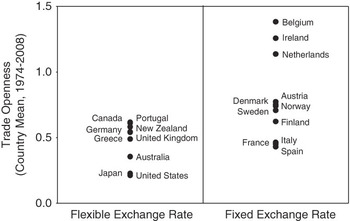
Flexible Exchange Rate is a dichotomous variable coded 1 if a country has an officially declared flexible exchange rate and 0 otherwise, as reported to the IMF.Footnote 63 Trade is (Exports + Imports)/Gross Domestic Product.Footnote 64 Figure 2 presents a graphical representation of countries’ trade openness and exchange rate flexibility.
Trade openness and exchange rate regime by country

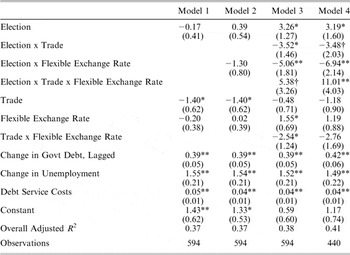
Model 1 in Table 1 presents the baseline model for this analysis. When the effect of a country’s trade and exchange rate ties on fiscal manipulation is not taken into account, there is no evidence that an election is associated with an increase in government debt. Similarly, government debt is not correlated with a country’s exchange rate regime. Government debt is negatively associated with trade flows and is positively associated with government debt in the previous year, unemployment and debt service costs.
Pre-Electoral Fiscal Manipulation as Exchange Rate Regime and Trade Openness Vary

Notes: †p < 0. 1, *p < 0.5, **p < 0.01; standard errors in parentheses.
Model 2 includes an interaction between Election and Flexible Exchange Rate to test the alternative hypothesis that governments engage in pre-electoral fiscal manipulation when the exchange rate is fixed and not when it is flexible. If so, then Election should be positive and significant, while Election x Flexible Exchange Rate should be negative. This is not the case. Although Election is positive, it is highly insignificant. Based on these results, there is no evidence of pre-electoral fiscal manipulation under a fixed exchange rate.
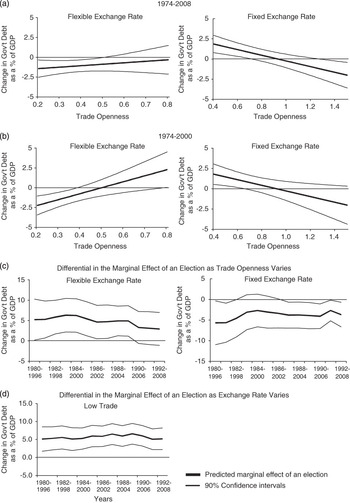
Model 3 tests the argument that governments’ decision to engage in pre-electoral fiscal manipulation is dependent on their country’s trade ties and exchange rate regime. To do so, Model 3 includes a three-way interaction between Election, Flexible Exchange Rate and Trade. Since Model 3 tests an interactive effect, the size and significance of these results are difficult to ascertain from the regression results. To gauge support for the hypotheses more precisely, Panel A in Figure 3 graphically displays the marginal effects of Election under fixed and flexible exchange rates as Trade varies.Footnote 65
Marginal effect of an election as exchange rate and trade openness vary

Recalling Hypothesis 1, the marginal effect of an election under a flexible exchange rate should increase as trade openness increases. This argument does not receive strong support in Model 3. The marginal effect of an election under a flexible exchange rate when trade openness is high is not significantly different from the marginal effect of an election when trade openness is low. The most that can be concluded from these results is that pre-electoral fiscal manipulation is less likely under a flexible exchange rate when trade openness is low – an effect that is not significant as trade openness increases. In contrast, when the analysis is limited to 1974–2000 (Model 4), there is strong support for Hypothesis 1. As shown in Figure 3 Panel B, under a flexible exchange rate, the marginal increase in government debt in an election year as trade openness increases from its 5th (0.2) to its 95th (0.8) percentile is 4.5 percentage points of gross domestic product (GDP), an effect that is substantively large and statistically significant.
The difference between these two samples is surprising and raises questions about the robustness of these results to alternative temporal samples. To address this question, I adopt an analysis of a moving sub-sample of years to assess how support for these hypotheses varies over time. This analysis is composed of thirteen regressions of seventeen-year sub-samples from 1980 to 2008, i.e. the first regression includes 1980–96, the second covers 1981–97, and the thirteenth includes 1992–2008. Seventeen years represents half of the temporal range included in the thirty-five year dataset. The 1974–79 period is excluded from the sub-sample analysis due to the small number of observations for which data are available in this period. To assess support for Hypothesis 1 in this sub-sample analysis, in Figure 3 Panel C, I present the difference in the marginal effect of an election under a flexible exchange rate as Trade varies from its 5th to its 95th percentile. This difference is positive and statistically significant even in the smaller samples for the periods from 1980 to 2005, though the effect is weaker and is not significant at conventional levels in the three most recent sub-samples (those ending in 2006, 2007 and 2008). These results suggest that the positive relationship between trade openness and pre-electoral fiscal manipulation under a flexible exchange rate may be eroding over time, although this decline is not statistically significant in this sample. However, the decline may be consistent with Hellwig and Samuels’s and Duch and Stevenson’s findings that as globalization increases, voters’ assessments of government performance appear less tied to their evaluation of economic performance.Footnote 66 If so, governments may be less likely to engage in pre-electoral fiscal manipulation over time.
Hypothesis 2 suggests that when trade is low, pre-electoral fiscal manipulation is more likely under a fixed exchange rate than under a flexible exchange rate. Models 3, 4 and the sub-sample analysis all provide support for this hypothesis. This can be seen most clearly in Figure 3 Panel D, which graphically displays the difference between the marginal effect of an election under a fixed exchange rate versus under a flexible exchange rate when trade openness is low (0.2). This difference is always significantly different from 0, and varies from a low of 5.1 percentage points of GDP to a high of 6.6 percentage points of GDP across sub-samples.
Finally, recalling Hypothesis 3, the marginal effect of an election under a fixed exchange rate should decrease as trade openness increases. This hypothesis receives support from both Models 3 and 4. As shown in Figure 3 Panels A and B, under a fixed exchange rate, the marginal effect of an election declines 3.9 and 3.8 percentage points of GDP, respectively, as trade openness increases from its 5th (0.4) to its 95th percentile (1.5), an effect that is substantively large and statistically significant. As the sub-sample analysis demonstrates in Figure 3 Panel C, support for Hypothesis 3 has varied over time. The substantive effect is largest in the earliest sub-samples, but the confidence intervals are also widest in these samples. Starting with the 1983–99 sub-sample, the effect is somewhat smaller but estimated with a higher degree of precision. The negative relationship between trade openness and pre-electoral fiscal manipulation under a fixed exchange rate is statistically significant in nine of the thirteen sub-samples.
These results suggest that governments’ decision to engage in pre-electoral fiscal manipulation reflects their country’s exposure to international volatility and international competition through their trade and exchange rate ties. Pre-electoral fiscal manipulation is greater when the exchange rate is fixed and trade openness is low, and when the exchange rate is flexible and trade openness is high. In contrast, governments are less likely to engage in pre-electoral fiscal manipulation when their exchange rate is flexible and trade flows are low, as the economy is relatively unexposed to international volatility. Governments’ decisions not to engage in an election-year fiscal expansion when the exchange rate is fixed and trade openness is high reflect their concerns over eroding their country’s international competitiveness.
Alternative explanations
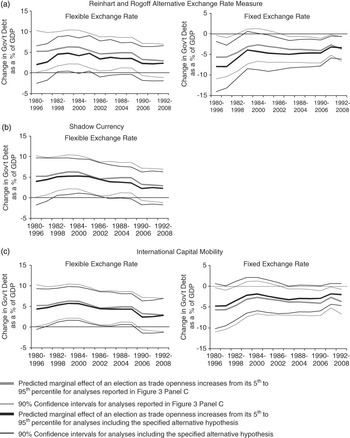
The results reported in the previous section provide support for the argument developed in this article. In this section, I consider alternative explanations for these findings. I first consider alternative variables capturing international economic ties, followed by additional domestic factors that may influence the incentives for and constraints on fiscal manipulation.Footnote 67 Each alternative hypothesis is assessed through the moving sub-sample analysis described in the previous section. These results are presented graphically in Figures 4, 6 and 7, and are juxtaposed with those reported in Figure 3 Panel C for ease of comparison.Footnote 68
Marginal effect of an election as exchange rate and trade openness vary, controlling for alternative hypotheses

The previous analyses relied on countries’ self-identification of their exchange rate regime. However, countries’ exchange rate behaviour often deviates from their declared exchange rate regime, and these deviations may systematically reflect their trade ties. If so, then the results reported in the previous section may prove spurious. To address this concern, I have re-run the analysis with two behaviourally-based exchange rate measures. The first is Exchange Rate (RR), an observational measure from Reinhart and Rogoff’s coding of exchange rate regimes based upon both how flexible countries say their exchange rate is and how flexible it is in reality. This variable is coded 1 for fixed exchange rates, 2 for limited exchange rate flexibility, and 3 for floating exchange rates.Footnote 69 Based on this variable, I have created three dichotomous exchange rate variables, one each for fixed, intermediate and flexible exchange rates. Each of these variables is interacted with Election and Trade. Based on the results presented graphically in Figure 4 Panel A, Reinhart and Rogoff’s behaviourally-determined exchange rate measure produces results that are very similar to those produced with Flexible Exchange Rate. The flexible exchange rate results are slightly weaker, while the fixed exchange rate results are slightly stronger.
Secondly, even when countries adopt a nominally flexible exchange rate, they may still attempt to ‘shadow’ another currency to minimize volatility with a large trading partner. As a result, support for pre-electoral fiscal manipulation when the exchange rate is flexible and trade is high may reflect the shadowing of currencies whose exchange rates are relatively fixed. To assess whether support for pre-electoral fiscal manipulation under a flexible exchange rate is actually support for fiscal manipulation under a fixed exchange rate in disguise, I have created Shadow Currency, which is coded 1 if the exchange rate is shadowing another currency, and 0 otherwise.Footnote 70 To test this alternative hypothesis, I have included an interaction between Election and Shadow Currency and limit the sample to country-year observations with a flexible exchange rate. If this alternative hypothesis is correct, then the positive differential between the marginal effect of an election under a flexible exchange rate at low and high levels of trade openness should no longer exist once Election x Shadow Currency is included in the analysis. As can be seen in Figure 4 Panel B, this is not the case. Controlling for the electoral effect of countries shadowing another currency does not significantly erode the increase in pre-electoral fiscal manipulation as trade openness increases under a flexible exchange rate.
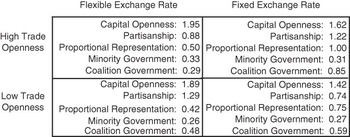
In the post-Bretton Woods period, individual countries have attempted to reduce capital mobility, and by weakening the economy’s ties with international capital markets, lower capital mobility may increase governments’ scope for fiscal policy. If so, then capital mobility may act as a constraint on pre-electoral fiscal manipulation. Figure 5 displays the mean values of Chinn and Ito’s Capital Openness measure by trade openness and exchange rate.Footnote 71 Based on Capital Openness, capital mobility appears lowest when the exchange rate is fixed and trade openness is low. Thus, the high pre-electoral fiscal manipulation found under a fixed exchange rate and low trade may reflect lower exposure to international capital mobility rather than lower exposure to international competitiveness concerns. If this alternative hypothesis is correct, then pre-electoral fiscal manipulation may be dependent on variation in countries’ capital mobility rather than on variations in trade openness and exchange rate regime.
Mean values for alternative explanatory variables as exchange rate regime and trade openness vary

To test this argument, I have included an interaction between Election and Capital Openness in the sub-sample analysis. If governments’ decision to engage in pre-electoral fiscal manipulation reflects their country’s capital mobility rather than their trade and exchange rate ties, then including Election x Capital Openness will render the Trade and Flexible Exchange Rate election interactions insignificant. As can be seen in Figure 4 Panel C, this is not the case. Although in recent years countries with higher international capital mobility appear to engage in lower levels of pre-electoral fiscal manipulation, this effect does not erode the positive relationship between trade openness and pre-electoral fiscal manipulation under a flexible exchange rate and the negative relationship between trade openness and pre-electoral fiscal manipulation under a fixed exchange rate.Footnote 72
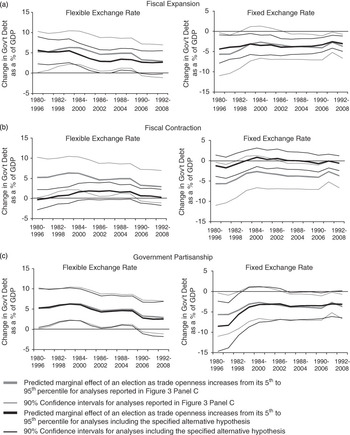
The argument presented above is predicated upon governments’ desire to engineer good times prior to an election. However, engineering pre-electoral good times creates domestic economic distortions. As a result, if the government’s goal is to smooth domestic economic performance (as is assumed in the compensation hypothesis literature), rather than induce a pre-electoral fiscal expansion (as is assumed in the political budget cycle literature), then increased international volatility should be as likely to generate a pre-electoral fiscal contraction as an expansion. To test this alternative hypothesis, I have created two new dependent variables, Fiscal Expansion, which equals Change in Government Debt when Change in Government Debt is positive, and 0 otherwise, and Fiscal Contraction, which equals Change in Government Debt multiplied by -1 when Change in Government Debt is negative, and 0 otherwise, which are used in the sub-sample analyses presented graphically in Figure 6 Panels A and B.
Marginal effect of an election as exchange rate and trade openness vary, controlling for alternative hypotheses

If governments care more about engineering pre-electoral good times than about smoothing domestic economic performance, then the results from Fiscal Expansion will be stronger than the results from Fiscal Contraction. Alternatively, if governments care relatively more about smoothing the domestic economy, then the results from these two alternative dependent variables should be similar. Based on the results presented in Figure 6 Panels A and B, pre-electoral fiscal expansions are more likely when the exchange rate is fixed and trade openness is low, and when the exchange rate is flexible and trade openness is high. In contrast, there is no correlation between a country’s trade and exchange rate ties and pre-electoral fiscal contractions. Together, these two analyses provide support for the assumption that governments are concerned about engineering pre-electoral good times, not simply smoothing the economy.
The previous two analyses provide support for the opportunistic use of fiscal policy to engineer a pre-electoral economic expansion, but fiscal opportunism may not be universal across governments. In particular, governments’ fiscal policy may reflect their political ideology. If so, then more conservative governments may be less likely to engage in fiscal manipulation. To assess this alternative argument, I have included Partisanship, which captures the left–right position of the chief executive’s party.Footnote 73 This variable is coded 0 if the party is on the left, 1 if the party is in the centre and 2 if the party is on the right. At a descriptive level, this alternative hypothesis has merit. Based on the mean values of Partisanship reported in Figure 5, a leftist government orientation appears greatest when the exchange rate is fixed and trade is low, and when the exchange rate is flexible and trade is high. However, based on the results presented in Figure 6 Panel C, controlling for government partisanship does not weaken the positive relationship between trade openness and pre-electoral fiscal manipulation under a flexible exchange rate and the negative relationship between trade openness and pre-electoral fiscal manipulation under a fixed exchange rate.
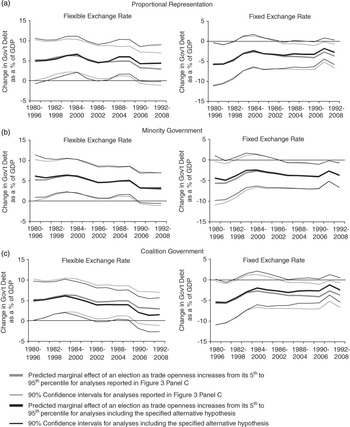
Political institutions structure governments’ incentives to engage in pre-electoral fiscal manipulation. In particular, Bernhard and Leblang argue that the electoral system matters.Footnote 74 Incumbents in majoritarian systems, in which a small electoral loss can result in a large seat loss and in which the opposition have very little policy influence, have a greater incentive to engineer pre-electoral good times than incumbents in proportional representation systems. Based on the descriptive statistics in Figure 5, almost all countries with a fixed exchange rate regime have a proportional representation system. To test the hypothesis that governments are less likely to engage in pre-electoral fiscal manipulation under a proportional representation electoral system, I have included an interaction between Election and Proportional Representation in the analysis presented in Figure 7 Panel A. Based on these results, there is little support for this hypothesis. Controlling for electoral system does not negate the positive relationship between trade openness and pre-electoral fiscal manipulation under a flexible exchange rate and the negative relationship between trade openness and pre-electoral fiscal manipulation under a fixed exchange rate.
Marginal effect of an election as exchange rate and trade openness vary, controlling for alternative hypotheses

Cabinet composition may also affect the incentives for pre-electoral fiscal manipulation. Fiscal manipulation may be greater under a minority government, as their precarious electoral position increases their incentives to engage in a fiscal expansion. In contrast, fiscal manipulation may be lower under a coalition government in which more than one party exercises control over policy making, reducing individual parties’ ability both to control fiscal policy opportunistically and to claim credit for economic good times. Based on the descriptive data in Figure 4, there is initial support for these hypotheses: coalition governments appear most commonly under fixed exchange rates and high trade openness (where pre-electoral fiscal manipulation is low), while minority governments are most likely when the exchange rate is flexible and trade is relatively high (where pre-electoral fiscal manipulation is high), although the range of variation is quite low. To test these alternative hypotheses, I have included interactions between Election and Minority Government and Coalition Government, respectively, in the analyses presented in Figure 7 Panels B and C.Footnote 75 Based on these results, controlling for the minority status of governments does not affect the relationship between trade, exchange rate regime and pre-electoral fiscal manipulation, although controlling for governing coalitions does somewhat weaken the magnitude of the positive relationship between trade openness and pre-electoral fiscal manipulation under a flexible exchange rate and the negative relationship between trade openness and pre-electoral fiscal manipulation under a fixed exchange rate.
Conclusion
Since the end of the Bretton Woods period, governments have been more likely to engineer a pre-electoral fiscal expansion when their exchange rate is fixed and trade openness is low, and when the exchange rate is flexible and trade openness is high. Governments have been less likely to engage in pre-electoral fiscal manipulation when their exchange rate is fixed and trade openness is high, and when the exchange rate is flexible and trade openness is low. These findings provide support for the argument that governments’ decisions to engage in pre-electoral fiscal manipulation are mediated by their countries’ exposure to international volatility and international competition. These results stand in contrast to Clark and Hallerberg’s finding that governments engage in pre-electoral fiscal manipulation when the exchange rate is fixed, and not when the exchange rate is flexible.Footnote 76 The difference between these two arguments stems from different assumptions made in each about the nature of capital mobility and the pattern of economic adjustments in reaction to an increase in government expenditure.
Under the Mundell–Fleming model, which assumes perfect capital mobility, a fiscal expansion under a flexible exchange rate leads to an increase in domestic output, consumption and interest rates, which attracts foreign investment, and leads to a currency appreciation. This currency appreciation hurts international competitiveness, which reduces output, consumption and interest rates, perfectly offsetting the fiscal expansion and rendering pre-electoral fiscal manipulation ineffective. In contrast, under a fixed exchange rate, the monetary authority lowers interest rates to prevent a currency expansion, and together the fiscal and monetary expansion increases domestic economic output.
The argument developed in this article differs from Mundell–Fleming in two key aspects. First, capital mobility is imperfect. Therefore, a fiscal expansion under a flexible exchange rate is not fully offset and fiscal manipulation remains a viable weapon in a government’s arsenal. Secondly, in keeping with the empirical findings of open-economy macroeconomics, a fiscal expansion under a fixed exchange rate is assumed to generate a real exchange rate appreciation. An appreciated real exchange rate erodes international competitiveness, and when the country is highly open to trade, acts as a constraint on pre-electoral fiscal manipulation. These findings suggest that when countries are most exposed to international economic volatility – when their exchange rate is fixed and trade openness is high – governments are least able to engage in pre-electoral fiscal manipulation. In these circumstances, governments have less room to manœuvre than expected under the Mundell–Fleming model. In contrast, governments’ room for manœuvre under a flexible exchange rate may be greater than expected. Thus, arguments based on Mundell–Fleming may both underestimate and overestimate governments’ room for manœuvre.
The Mundell–Fleming framework is a powerful workhorse for political economic analyses and has provided a simple, elegant framework for incorporating the international economic environment into our understanding of domestic macroeconomic policy making. In particular, it has allowed scholars a better understanding of the trade-offs governments face amongst their choice of macroeconomic policy tools.Footnote 77 One of the reasons that the Mundell–Fleming framework has played such an important role in political economic analyses is because it makes such stark assumptions about the world. These assumptions yield clear, empirically testable hypotheses. In the light of the theoretical leverage gained through these assumptions, it is important to assess how closely these assumptions reflect reality. Empirical analyses suggest that capital is not as mobile, and that the real exchange rate does not adjust as easily as is assumed in the Mundell–Fleming model. The argument developed in this article is one example of how relaxing these two assumptions leads to alternative hypotheses. This article is not a call to abandon the Mundell–Fleming framework, but rather is a call to assess more critically how the assumptions embedded within the framework shape the model’s predictions. To the extent that these assumptions do not reflect reality, do they yield hypotheses that are also less reflective of reality? When they do, future research in political economy will require moving beyond the Mundell–Fleming framework.Footnote 78
These differences also have an important substantive effect, as can be seen through the two arguments’ implications for pre-electoral fiscal manipulation in the Eurozone. To the extent that Eurozone member states are characterized by high levels of trade openness, the argument forwarded in this article suggests that governments will be less likely to engage in pre-electoral fiscal manipulation. This stands in marked contrast to Clark and Hallerberg, which argues that Eurozone members will be more likely to engage in fiscal manipulation.
More broadly for comparative politics, these results highlight the importance of taking into account the international environment in which domestic decisions are undertaken. By looking only at domestic characteristics of pre-electoral fiscal manipulation, scholars implicitly assume that the macroeconomic costs and benefits of manipulating fiscal policy remain constant regardless of the country’s international ties. In contrast, the analysis in this article demonstrates that a country’s international economic ties affect both how desirable pre-electoral fiscal manipulation is to the government, and how costly it is to the government to engage in such manipulation. Understanding these internationally-generated incentives is important for identifying when governments will engage in fiscal manipulation. As Drazen notes in his appraisal of empirical research on the political business cycle, ‘there is much less hard evidence than both the theoretical models and the conventional wisdom about the prevalence of ‘election-year economics’ would suggest.’Footnote 79 Without taking into account how countries’ international economic ties constrain governments’ abilities to engage in fiscal manipulation, scholars will continue to fail to recognize the context-specific nature of pre-electoral fiscal manipulation.