


Introduction
Mental health problems account for a large proportion of the disease burden in young people worldwide (World Health Organization, 2012). Most mental disorders emerge during adolescence (10–19 years of age) (Sawyer et al., Reference Sawyer, Afifi, Bearinger, Blakemore, Dick, Ezeh and Patton2012), although these are often first detected later in life with serious impacts for young people (Kessler et al., Reference Kessler, Berglund, Demler, Jin, Merikangas and Walters2005). Among the most common mental health disorders in youth are anxiety and depression, with approximately 20% of adolescents experiencing either depression or anxiety in any given year (World Health Organization, 2012). Suicide is the second leading cause of death for young people, accounting for an estimated 8.5% of all youth deaths (World Health Organization, 2014).
New Zealand has the highest rate of completed youth suicides in the developed world for those aged 15–19 years (World Health Organization, 2017) with Māori, the indigenous people of New Zealand, having almost one and a half times higher suicide rate than non-Māori young people (Beautrais and Fergusson, Reference Beautrais and Fergusson2006). Moreover, mental health issues are particularly salient for many New Zealand adolescents (Feehan et al., Reference Feehan, McGee, Raja and Williams1994; Fergusson and Horwood, Reference Fergusson and Horwood2001; Fleming et al., Reference Fleming, Clark, Denny, Bullen, Crengle, Peiris-John and Lucassen2014). Approximately a quarter of participants in both the Dunedin Multidisciplinary Study and the Christchurch Health and Developmental Study met DSM-III-R criteria for at least one disorder at age 15 (Fergusson and Horwood, Reference Fergusson and Horwood2001; McGee et al., Reference McGee, Feehan, Williams, Partridge, Silva and Kelly1990) and over a third met these criteria by the age of 18 years. The increases in rates of disorder were notably due to increases in rates of anxiety, depression and substance use disorders between 15 and 18 years. More recently, findings from the national adolescent health surveys Youth ’07 and Youth ’12 indicated a slight deterioration in aspects of self-reported mental health amongst New Zealand secondary school students between 2007 and 2012, predominantly due to small increases in the proportions of students reporting significant depressive symptoms, low mood, self-harm, hyperactivity and peer problems (Fleming et al., Reference Fleming, Clark, Denny, Bullen, Crengle, Peiris-John and Lucassen2014). Poor mental health has been found to interrupt the achievement of developmental competencies and tasks in young people and is strongly related to other health concerns, substance use and abuse, violence, poor reproductive and sexual health and attempted and death by suicide (Patel et al., Reference Patel, Flisher, Hetrick and McGorry2007).
The aetiologies of both anxiety and depression are complex and include biological, psychological and social factors (Cicchetti and Toth, Reference Cicchetti and Toth1998; Davidson et al., Reference Davidson, Lewis, Alloy, Amaral, Bush and Cohen2002; Lewinsohn et al., Reference Lewinsohn, Roberts, Seeley, Rohde, Gotlib and Hops1994; McCauley et al., Reference McCauley, Pavlidis, Kendall and Goodyer2001). With reference to psychological factors, cognitive models propose that distorted and maladaptive cognitions (i.e. dysfunctional schemas, cognitive distortions/errors and automatic negative thoughts) may play an important role in the aetiology and treatment of emotional disorders in youth (Beck, Reference Beck1976; Beck et al., Reference Beck, Emery and Greenberg1985). One type of cognition considered being particularly influential in the development and maintenance of depression and anxiety is negative cognitive errors through which perceptions and interpretations of experience are distorted, in response to ambiguous or negative life events (Beck et al., Reference Beck, Rush, Shaw and Emery1979). In this paper, the term cognitive errors is used interchangeably with cognitive distortions to refer to these systematic errors in processing (Beck et al., Reference Beck, Rush, Shaw and Emery1979). Beck (Reference Beck1963, Reference Beck1967) described several specific cognitive errors, including catastrophizing (anticipating that the worst possible outcome of an experience or event will be catastrophic), overgeneralization (assuming that a single negative outcome of an experience will apply to similar experiences in the future), personalization (taking excessive personal responsibility over the outcomes of negative events), and selective abstraction (selectively focusing on the negative aspects of an event or situation).
The link between negative cognitive errors and mental health in youth is well established. A number of empirical studies demonstrated that cognitive errors are strongly associated with symptoms of anxiety and depression among clinical samples of children and adolescents (Kempton et al., Reference Kempton, Van Hasselt, Bukstein and Null1994; Ostrander et al., Reference Ostrander, Nay, Anderson and Jensen1995; Tems et al., Reference Tems, Stewart, Skinner, Hughes and Emslie1993; Thurber et al., Reference Thurber, Crow, Thurber and Woffington1990; Weems et al., Reference Weems, Berman, Silverman and Saavedra2001). Similar results have been reported with community samples (Cole and Turner, Reference Cole and Turner1993; Epkins, Reference Epkins1996; Ishikawa, Reference Ishikawa2012; Leitenberg et al., Reference Leitenberg, Yost and Carroll-Wilson1986; Leung and Poon, Reference Leung and Poon2001; Leung and Wong, Reference Leung and Wong1998; Maric et al., Reference Maric, Heyne, van Widenfelt and Westenberg2011; Stewart et al., Reference Stewart, Kennard, Lee, Hughes, Mayes, Emslie and Lewinsohn2004; Tairi et al., Reference Tairi, Adams and Zilikis2016; Watts and Weems, Reference Watts and Weems2006; Weems et al., Reference Weems, Costa, Watts, Taylor and Cannon2007). For example, Tairi et al. (Reference Tairi, Adams and Zilikis2016) examined the interrelations between cognitive errors and symptoms of anxiety and depression in 883 community adolescents aged 12 to 18 years. Results indicated that negative cognitive errors were significantly associated with and statistically predictive of greater levels of symptoms of anxiety and depression, after controlling for the other symptom measure. Of interest was the finding that younger adolescents (12–15 years) reported more overall cognitive distortion and less anxious and depressive symptoms than older adolescents (16–18 years), respectively. Consistent with the cognitive developmental theory (Inhelder and Piaget, Reference Inhelder and Piaget1958; Piaget, Reference Piaget1964, Reference Piaget1972), Tairi et al. (Reference Tairi, Adams and Zilikis2016) argued that young adolescents’ inclination to endorse cognitive errors more frequently in their thinking may be conceptualized as developmentally appropriate in early adolescence because they have not yet achieved a consolidation of formal operations, thus reflecting their difficulty with abstract thinking. This finding supports the idea that the cognitive distortions manifested during the early adolescence period may be related to normal cognitive development.
Moreover, research on cognitive errors as measured with the Children’s Negative Cognitive Errors Questionnaire (CNCEQ; Leitenberg et al., Reference Leitenberg, Yost and Carroll-Wilson1986) has been examining whether certain cognitive errors are disorder specific, but empirical evidence so far has yielded mixed findings. For example, overgeneralization has been found to be predictive of both anxiety and depression (Leitenberg et al., Reference Leitenberg, Yost and Carroll-Wilson1986), and of anxiety alone (Epkins, Reference Epkins1996; Maric et al., Reference Maric, Heyne, van Widenfelt and Westenberg2011; Tairi et al., Reference Tairi, Adams and Zilikis2016). Similarly, Weems et al. (Reference Weems, Berman, Silverman and Saavedra2001, Reference Weems, Costa, Watts, Taylor and Cannon2007) found that catastrophizing and overgeneralization were more uniquely associated with anxiety symptoms, while Epkins (Reference Epkins1996) found that there was no difference in catastrophizing between anxious and depressed groups. The most consistent results have been reported on selective abstraction, characterized by a focus on negative aspects, which has been found to be more commonly associated with depression than with anxiety (Epkins, Reference Epkins1996; Leitenberg et al., Reference Leitenberg, Yost and Carroll-Wilson1986; Leung and Poon, Reference Leung and Poon2001; Weems et al., Reference Weems, Berman, Silverman and Saavedra2001, Reference Weems, Costa, Watts, Taylor and Cannon2007). There are a few possible explanations for these mixed findings. First, one relates to the CNCEQ’s potential inability to differentiate between its four types of errors as all the studies, with the exception of Karakaya et al. (Reference Karakaya, Coskun, Agaoglu, Oc, Cakin Memik, Sismanlar and Arslan2007), provide evidence for a single general factor of ‘negative thinking’ (Cole and Turner, Reference Cole and Turner1993; Messer et al., Reference Messer, Kempton, Hasselt, Null and Bukstein1994; Stewart et al., Reference Stewart, Kennard, Lee, Hughes, Mayes, Emslie and Lewinsohn2004). It is worth pointing that Leitenberg et al. (Reference Leitenberg, Yost and Carroll-Wilson1986), who developed the CNCEQ, and a few other researchers, who have used the same scale since then (e.g. Weems et al., Reference Weems, Berman, Silverman and Saavedra2001, Reference Weems, Costa, Watts, Taylor and Cannon2007), did not examine the instrument’s factor structure, even though these authors explored the relationships between specific types of cognitive errors and other variables. Second, high and significant correlations (i.e. >.60) between the cognitive error subscales have been reported (e.g. Tairi et al., Reference Tairi, Adams and Zilikis2016; Weems et al., Reference Weems, Costa, Watts, Taylor and Cannon2007), pointing to considerable overlap across these cognitive constructs. Finally, another plausible explanation relates to the difficulty in determining whether anxiety and depression are discrete overlapping disorders or part of a more global dimension of negative affectivity (Watson and Clark, Reference Watson and Clark1984).
Overall, the review of the literature suggests that Beck’s cognitive model (Beck et al., Reference Beck, Emery and Greenberg1985) has a strong empirical base, assigning to cognitive errors a central role in the theoretical and clinical formulation of anxiety and depression in youth and supporting them as targets during cognitive behavioural interventions (see Brent et al., Reference Brent, Emslie, Clarke, Wagner, Asarnow, Keller and Zelazny2008; Curry et al., Reference Curry, Silva, Rohde, Ginsburg, Kratochvil, Simons and March2011; Stallard, Reference Stallard2009). While there is strong evidence for the relation of cognitive errors and youth psychopathology, there is a lack of local, New Zealand research on this issue. In order for cognitive behavioural therapy to be adapted and refined to improve its relevance to young New Zealanders, including Māori, we need to examine the impact of culture on Beck’s cognitive model and to consider its generalizability to a New Zealand adolescent population. A greater understanding and inquiry of these cultural considerations may enhance the cultural relevance and quality of prevention and treatment delivery.
Furthermore, depressive symptoms and disorders increase sharply in adolescence, particularly in girls, with prevalence rates among girls being double those for boys (Angold et al., Reference Angold, Costello and Erkanli1999; Costello et al., Reference Costello, Mustillo and Erkanli2003; Harrington, Reference Harrington, Rutter, Taylor and Hersov1994; Kazdin, Reference Kazdin1993). Taking into account New Zealand’s very high rates of youth mental health issues, assessing the relation of cognitive errors and psychopathology, including gender differences in a community sample of adolescents as an attempt to detect vulnerability factors, before a clinical presentation is apparent, may be critical. There is more point to finding predictors in what could be a pre-clinical population (i.e. a school population) than in a clinical population, which has already been diagnosed and thus has some known underlying pathology. Such information will contribute to our understanding of maintaining factors of youth psychopathology and will help us to tailor treatment to the needs of adolescents. The impetus of this study was to inform primary prevention efforts along with refining the continuing intervention practices.
The aim of this study was to examine the associations between negative cognitive errors and mental health issues in a community sample of New Zealand adolescents. Given previous findings, it was predicted that increased cognitive distortion would be associated with higher levels of anxiety and depression. It was also predicted that negative cognitive errors would be endorsed more frequently by adolescents with high versus low scores on the anxiety and depression measures.
Method
Participants and procedure
Participants were 490 adolescents aged 16 to 18 years (mean = 16.46 years; SD = 0.57) from eight secondary schools in the Wellington and Palmerston North regions. Only older adolescents were recruited as previous findings (e.g. Cannon and Weems, Reference Cannon and Weems2010; Tairi et al., Reference Tairi, Adams and Zilikis2016) indicated that cognitive errors may reflect normal cognitive development in younger adolescents (i.e. 12–15 years). The schools included were geographically spread out, with decile ratingsFootnote 1 ranging from 3 to 9, allowing for a representative cross-section of the local adolescent population. The completion rate was 65%. Women were 88% (n = 432) because two of the participating schools were single-sex girls’ schools. Most participants identified their ethnicity as New Zealand European (65%); the remaining were Māori, the indigenous people of New Zealand (14%), Asian (12%), Pasifika (4%), and 5% of other ethnic backgrounds.
Thirty-two state secondary schools within the Wellington and Palmerston North region were sent letters introducing the aims of the study and requesting permission to include their students in the study. Of these, eight schools (six co-educational schools, n = 160; and two single-sex girls’ schools, n = 330) agreed to participate, while the others declined due to having already committed to other research studies earlier in the year. Consenting schools were then asked to electronically distribute the link to the online survey to the target population (i.e., 16- to 18-year-old students). The study design involved an anonymous online survey, administered using the online survey software, Qualtrics, allowing participants to complete it in their own time. The survey took approximately 30 minutes to complete. The survey included a consent question and participants who did not give consent were redirected to the last page of the survey and thanked for their time. Students were informed that participation was voluntary and that they had the right to decline to answer any particular question. Parental consent was not required, as participants were 16 years old or over and written school consent was obtained.
As Māori youth were included as participants, cultural consultation was ongoing throughout the duration of the research and involved effective and efficient feedback from Māori representation regarding the overall research project to ensure its cultural appropriateness, taking into account the diverse ethnic characteristics of the schools’ population. An item analysis of each scale was conducted to ensure that these were culturally appropriate for use with New Zealand secondary school students in Years 11, 12 and 13. The study was carried out according to the regulations and with the approval of the Human Ethics Committee of the university.
Measures
Children’s Negative Cognitive Error Questionnaire (CNCEQ; Leitenberg et al., Reference Leitenberg, Yost and Carroll-Wilson1986)
The CNCEQ is a 24-item self-report questionnaire that assesses cognitive error in children and adolescents aged 6 to18 years (Leitenberg et al., Reference Leitenberg, Yost and Carroll-Wilson1986). Cognitive errors are broken down into four theoretically derived subscales: catastrophizing, overgeneralization, personalization and selective abstraction. Each subscale contains six questions. Each item consists of a description of a situation and of a negative automatic thought, which represents one of the four cognitive errors. Participants are asked to rate the similarity of each statement to their own thought when they imagine being in that situation or experiencing that event on a 5-point scale from not at all like I would think (1 point) to almost exactly like I would think (5 points). The CNCEQ has demonstrated acceptable internal consistency and test–retest reliability estimates (Leitenberg et al., Reference Leitenberg, Yost and Carroll-Wilson1986; Weems et al., Reference Weems, Berman, Silverman and Saavedra2001). In the present study, internal consistency was high for total cognitive errors (α = 0.94). Following cultural consultation, minimal amendments to the CNCEQ included modification of a few words to ensure its adjustment and appropriateness for distribution to New Zealand youth. For instance, ‘school recess’ was replaced with ‘school interval’; ‘school is a drag’ with ‘school is boring’; ‘lousy’ was replaced with ‘bad’; ‘skiing lessons’ were replaced with ‘rowing lessons’; ‘playing catch’ was changed to ‘throwing a ball’.
State-Trait Anxiety Inventory, Trait subscale (Form Y-2) (STAI-T; Spielberger, Reference Spielberger1983)
For the purpose of this study only the Trait subscale of the STAI (STAI-T) was used. The trait subscale consists of 20 statements, where participants rate them based on how they generally feel on a 4-point scale, ranging from almost never (1 point) to almost always (4 points). A cut-off point of score >44 was selected to distinguish anxious from non-anxious adolescents (see Ercan et al., Reference Ercan, Hafizoglu, Ozkaya, Kirli, Yalcitas and Akaya2015). The STAI has been used extensively with high school students (12–18 years), college students, working adults and psychiatric patients. It is a widely used, well-researched measure with satisfactory reliability and validity estimates (Spielberger, Reference Spielberger1983). An internal consistency coefficient of 0.93 was obtained in the present study.
Center for Epidemiological Studies Depression Scale (CES-D; Radloff, Reference Radloff1977)
The CES-D is a 20-item self-report scale designed to assess depressed mood, feelings of worthlessness/guilt, sense of helplessness/hopelessness, psychomotor retardation, loss of appetite, and sleep disturbance among adults and adolescents (Radloff, Reference Radloff1977; Schoenbach et al., Reference Schoenbach, Kaplan, Grimson and Wagner1982). Using a 4-point scale (0–3), respondents indicate the frequency of symptoms (over the past week), ranging from rarely or none of the time (0 points) to most or all of the time (3 points). A higher cut-off score of 21 (see Henry et al., Reference Henry, Grant and Cropsey2018) was chosen, as there is evidence that the classic cut-off score of 16 proposed by Radloff may lead to significant false positives (Dozeman et al., Reference Dozeman, van Schaik, van Marwijk, Stek, van der Horst and Beekman2011; Haringsma et al., Reference Haringsma, Engels, Beekman and Spinhoven2004; Roberts et al., Reference Roberts, Andrews, Lewinsohn and Hops1990; Santor et al., Reference Santor, Zuroff, Ramsay, Cervantes and Palacios1995). The CES-D has been used to screen for depression among adolescent samples (12–17 years) and has shown psychometric properties in adolescents similar to adults (Radloff, Reference Radloff1991; Roberts et al., Reference Roberts, Andrews, Lewinsohn and Hops1990). In the present study, Cronbach’s alpha coefficient of internal consistency for the total score was 0.93.
Data analysis
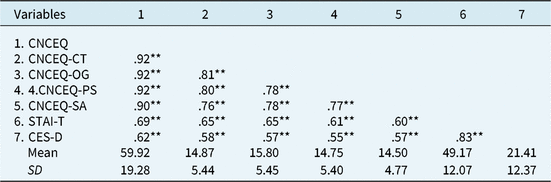
The assumptions required to conduct the various statistical tests were verified and p values below .05 were considered as indicating significant results. Skewness and kurtosis values indicated acceptable ranges on all measures. No outliers were established. Means and standard deviations for the total CNCEQ score, the four CNCEQ subscales, the anxiety (STAI-T) and the depression measures (CES-D) are presented in Table 1, together with the intercorrelations between all variables. All correlations between the variables under examination with the CNCEQ overall score were statistically significant in the expected directions, ranging from .55 to .92. High intercorrelations among the CNCEQ subscales (.76 to .81) called into question the validity of the four CNCEQ scales. Thus, the factorial structure of the CNCEQ was examined. In order to examine age differences, a one-way analysis of variance (ANOVA) was conducted between 16-, 17- and 18-year-old adolescents. The main effect of age was not significant for any of the measures; CNCEQ, F (2,487) = .06, p = .939, STAI-T, F (2,487) = .33, p = .722, and CES-D, F (2,487) = .39, p = 675. Gender differences on each of the variables were examined using independent samples t-tests. No significant gender differences were found for any of the measures; CNCEQ, t (488) = 1.28, p = .201; STAI-T, t (488) = –.85, p = .399; and CES-D, t (488) = –.62, p = .534.
Means, standard deviations and inter-correlations of the variables

CNCEQ, Children’s Negative Cognitive Error Questionnaire; CT, catastrophizing; OG, overgeneralization; PS, personalization; SA, selective abstraction; STAI-T, State-Trait Anxiety Inventory-Trait subscale; CES-D, Center for Epidemiological Studies-Depression Scale. **p < .01, two-tailed.
Results
Factor analysis of the CNCEQ
A principal component analysis (PCA) was computed on the 24 CNCEQ items. Inspection of the correlation matrix revealed significant correlations, suggesting that a principal components or factor analysis was appropriate. The Kaiser-Meyer-Olkin measure of sampling adequacy was .96. The PCA resulted in three components with eigenvalues greater than 1.0. Not unexpectedly, the first component accounted for the majority of the variance (44%; eigenvalue = 10.49) with the remaining two components accounting for 5% and 5% of the variance, respectively. Inspection of the scree plot strongly suggested that a one-component solution was appropriate. As a follow-up analysis to investigate the parsimony of a single-component analysis, a PCA was computed with a forced one-component solution. Inspection of the item loadings and communality estimates revealed that a single-component solution adequately accounted for the CNCEQ items’ variances. Consequently, results from the preceding exploratory and follow-up PCAs strongly supported the parsimony of a single-component solution.
Associations between negative cognitive errors and adolescents’ self-reported symptoms of anxiety and depression
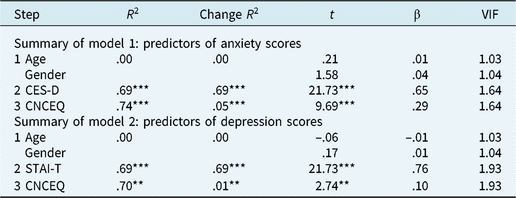
The data were analysed using a hierarchical multiple-regression approach. The first analysis examined the linear relationship of the overall CNCEQ score to anxiety symptoms, after age, gender and depressive symptoms had been partialed. It is important to note that in this analysis, and the subsequent one as well, the capacity of cognitive errors to predict symptoms was examined after partialing from the symptom measure both age, gender and the other symptom measure. This is a stringent test of the predictive capacity of the targeted cognitive errors. Table 2 summarizes these results. The analysis showed that, after age, gender and depressive symptoms (which accounted for 69% variance) had been partialed, together the CNCEQ accounted for an additional 5% of the variance in anxiety scores, F (4,485) = 339.47, p < .001. This analysis thus demonstrated that cognitive errors control significant variance in anxiety independent of the effects of age, gender and depressive symptoms.
Hierarchical regression analyses for the prediction of anxiety and depression

CNCEQ, Children’s Negative Cognitive Error Questionnaire; STAI-T, State-Trait Anxiety Inventory-Trait subscale; CES-D, Center for Epidemiological Studies-Depression Scale. **p < .01; ***p < .001.
The next analysis examined the association of the overall CNCEQ score to depressive symptoms, independent of age, gender and anxiety symptoms. The total CNCEQ score was significantly, but weakly related to depression, accounting for slightly less than 1% of the variance in depressive symptoms, F (4,485) = 270.44, p < .001 (see Table 2).
Base rates and comparisons between adolescents with high and low scores on anxiety and depression
Using the cut-off point of 44 on the STAI-T, 66.5% of the adolescents in the overall sample (39 [67%] men and 287 [66%] women) were identified as having anxiety symptoms, while 47.6% (28 [48%] men and 205 [47%] women) scored above the cut-off point of 21 on the CES-D and were identified as having depressive symptoms. No significant gender differences were found, χ2 (1, N = 490) = 0.15, p = .903 for anxiety and χ2 (1, N = 490) = 0.14, p = .906 for depression.
Comparisons on the total cognitive distortion score of adolescents with high and low scores on the anxiety scale are summarized in Table 3. An independent-samples t-test indicated a significant difference in total cognitive distortion score, t (460) = –15.78, p < .001, d = 1.40, demonstrating that adolescents who scored high on anxiety exhibited significantly more cognitive errors. Levene’s test indicated unequal variances (F = 35.61, p < .001), so degrees of freedom were adjusted from 488 to 460. Likewise, comparisons on the total cognitive distortion score of adolescents with high and low scores on depression revealed a significant main effect for depression on the total distortion score, t (420) = –13.41, p < .001, d = 1.22. Levene’s test indicated unequal variances (F = 26.28, p < .001), so degrees of freedom were adjusted from 488 to 420.
Summary of comparisons on the total cognitive distortion score (CNCEQ) between adolescents with high and low scores on the anxiety (STAI-T) and the depression (CES-D) scales

CNCEQ, Children’s Negative Cognitive Error Questionnaire; STAI-T, State-Trait Anxiety Inventory-Trait subscale; CES-D, Center for Epidemiological Studies-Depression Scale; Cohen’s d effect size statistic. ***p < .001.
Discussion
This investigation adds to the literature by being the first study to examine the associations between negative cognitive errors and anxiety and depression in a large community sample of New Zealand adolescents. Consistent with previous research (Ishikawa, Reference Ishikawa2012; Stewart et al., Reference Stewart, Kennard, Lee, Hughes, Mayes, Emslie and Lewinsohn2004; Tairi et al., Reference Tairi, Adams and Zilikis2016; Watts and Weems, Reference Watts and Weems2006; Weems et al., Reference Weems, Berman, Silverman and Saavedra2001, Reference Weems, Costa, Watts, Taylor and Cannon2007), the results indicated that distorted cognitions were associated with self-reported anxiety and depression among New Zealand youth and extend the previous work in four important ways. First, the results revealed significant moderate to high correlations between cognitive distortion and anxiety and depression, providing empirical support for a cognitive model of depression and anxiety in New Zealand youth. Even though no conclusions about the direction of the associations should be drawn from this study, determining that cognitive errors are linearly related to anxious and depressive symptoms in a community sample is an important first step in establishing that such distorted cognitions are not only found at the extremes of anxiety and depression levels (i.e. in clinically depressed and/or anxious youth).
Second, concerning the factor structure of the CNCEQ, results failed to support the proposed multidimensional composition of the scale representing four distinct cognitive errors. Analyses were supportive of a single factor solution, suggesting the presence of a general ‘negative cognitive error’ dimension. The finding of a single construct is in line with most previous studies (e.g. Cole and Turner, Reference Cole and Turner1993; Messer et al., Reference Messer, Kempton, Hasselt, Null and Bukstein1994; Stewart et al., Reference Stewart, Kennard, Lee, Hughes, Mayes, Emslie and Lewinsohn2004), which yielded a single general factor. Thus, it appears that the CNCEQ is not capable of discriminating among distinct cognitive error types in adolescents. However, these results do not negate the heuristic value of the CNCEQ scale but rather suggest that it should be used to give an overall total cognitive distortion score. Development of other assessment methods may be necessary to reliably identify the distinct cognitive processes associated with internalizing problems in New Zealand adolescents.
Third, results add a congruent line of evidence to research showing that overall cognitive distortion was a significant statistical predictor of anxious symptoms and, to a lesser extent, of depressive symptoms, independent of age, gender and the other symptom measure (Ishikawa, Reference Ishikawa2012; Stewart et al., Reference Stewart, Kennard, Lee, Hughes, Mayes, Emslie and Lewinsohn2004; Tairi et al., Reference Tairi, Adams and Zilikis2016; Watts and Weems, Reference Watts and Weems2006; Weems et al., Reference Weems, Berman, Silverman and Saavedra2001, Reference Weems, Costa, Watts, Taylor and Cannon2007). Such results point to the potential importance of cognitive errors in understanding both anxiety and depression in New Zealand adolescents and suggest that longitudinal studies examining the prediction of anxiety and depression with these variables are warranted in order to clarify temporal associations.
Finally, the present study revealed high rates of anxious and depressive symptoms in a non-clinical sample of adolescents, which warrant study in their own right. Even though anxious and depressive symptoms fall short of being major clinical disorders, previous research has shown that anxious and/or depressive tendencies that appear in adolescence often develop into clinical disorders later in life and also predict poor interpersonal functioning and psychological adjustment (Kandel and Davies, Reference Kandel and Davies1986; Kovacs et al., Reference Kovacs, Feinberg, Crouse-Novak, Paulauskas, Pollock and Finkelstein1984). Comparisons between adolescents with high and low scores on both anxiety and depression measures revealed the same finding: adolescents who were identified as having anxiety symptoms and those who were identified as having depressive symptoms endorsed cognitive errors significantly more strongly than their non-anxious and non-depressed counterparts. These results demonstrate that the overall cognitive error score did significantly differentiate between adolescents with high and low scores on both anxiety and depression, consistent with previous research (e.g. Leitenberg et al., Reference Leitenberg, Yost and Carroll-Wilson1986) and theory (Beck, Reference Beck1976; Beck et al., Reference Beck, Emery and Greenberg1985).
When interpreting the current results of this study, it is important to note its limitations. First, although the sample size was large, the relative small number of men limits the interpretation of the results for this subgroup of adolescents. Second, although it appears that some of the participants may meet diagnostic criteria for anxiety and depressive disorders, one cannot consider this to be a clinical sample of adolescents. Third, a convenience sample was used, which can lead to the under-representation or over-representation of particular groups. It is also unclear why some adolescents agreed to take part in the survey while others did not. As the sample is not chosen at random, the inherent bias in convenience sampling means that any generalizations of findings must be made with caution. However, the observed high levels of anxious and depressive symptoms are somewhat consistent with the high rates of mental distress found among New Zealand adolescents (Feehan et al., Reference Feehan, McGee, Raja and Williams1994; Fergusson and Horwood, Reference Fergusson and Horwood2001; Fleming et al., Reference Fleming, Clark, Denny, Bullen, Crengle, Peiris-John and Lucassen2014; McGee et al., Reference McGee, Feehan, Williams, Partridge, Silva and Kelly1990). Fourth, the study relied on self-report measures for the assessment of anxiety, depression and cognitive errors, with the potential issue of single method bias. However, it is important to note that self-report measures are considered to be the optimal method for assessing these types of internal cognitive processes (Alfano et al., Reference Alfano, Beidel and Turner2002), and allowed the inclusion of a larger sample than more comprehensive interviews would yield. Furthermore, the CNCEQ does not appear capable of making fine cognitive distortion discriminations in New Zealand adolescents, but rather measures a general cognitive error tendency. Nevertheless, the measure showed promise in the ability to differentiate adolescents with high anxiety scores from adolescents with low anxiety scores on one component scale, and the same was true for depression scores. Finally, although the models tested predictive relationships, the use of cross-sectional data precludes the ability to draw causal conclusions. Prospective studies are warranted to explore the stability of cognitive errors and examine whether cognitive errors precede the development of anxious and depressive symptoms in adolescents.
Despite the above limitations, the evidence of cognitive distortion in anxiety and, to a lesser extent, in depression lends support to the generalizability of Beck’s cognitive theory to a New Zealand adolescent population and raise three primary implications for clinical research and practice. First, these cognitive errors, which are not typically assessed by commonly used measures of anxiety and/or depression or by DSM-based clinical interview, may be important targets in the treatment of youth anxiety and depression. These findings point to the need to include a component of intervention directed towards the modification of dysfunctional cognitive patterns, ensuring that psychologists working with anxious and/or depressed youth be alert to their thinking, systematically identifying, evaluating and targeting cognitive errors in therapy. Second, based on these findings and taking into account the high levels of mental distress among New Zealand adolescents, future priorities should give emphasis to prevention and intervention programmes with a focus on cognitive restructuring applied early in life for youth who manifest persistent depressive and/or anxious symptoms before meeting diagnostic criteria. Finally, future research should address the efficacy of such prevention and early intervention strategies in order to track progress in improving adolescent well-being in New Zealand.
Acknowledgements
Special thanks to the participating students and to the staff and schools for their support.
Financial support
This work was supported by the Massey University Research Fund (grant number RM17268).
Conflicts of interest
The author has no conflicts of interest with respect to this publication.
Ethical statements
The author has abided by the Code of Ethics for Psychologists Working in Aotearoa New Zealand as set out by the NZPsS, the NZPB, and the NZCCP (http://www.psychology.org.nz/wp-content/uploads/2014/04/code-of-ethics.pdf). Ethics approval was granted for this project by the Massey University Human Ethics Committee: Southern B, Application 14/13.




Comments
No Comments have been published for this article.