Introduction
A systematic review of the literature considering the impact of alcohol problems on the course of depression was performed by Sullivan et al. (Reference Sullivan, Fiellin and O'Connor2005). Five relevant studies were identified. Two studies found that alcoholics were less likely to recover from a depressive illness (Cook et al. Reference Cook, Winokur, Garvey and Beach1991; Mueller et al. Reference Mueller, Lavori, Keller, Swartz, Warshaw, Hasin, Coryell, Endicott, Rice and Akiskal1994), whilst three studies found no evidence to support association between alcohol use and recovery (Hirschfeld et al. Reference Hirschfeld, Kosier, Keller, Lavori and Endicott1989; Labbate & Doyle, Reference Labbate and Doyle1997; Melartin et al. Reference Melartin, Rystala, Leskela, Lestela-Mielonen, Sokero and Isometsa2002). All the identified studies considered subjects drawn from clinical settings, and have a variety of study designs. Cross-sectional (Mueller et al. Reference Mueller, Lavori, Keller, Swartz, Warshaw, Hasin, Coryell, Endicott, Rice and Akiskal1994; Melartin et al. Reference Melartin, Rystala, Leskela, Lestela-Mielonen, Sokero and Isometsa2002) designs cannot exclude the possibility of reverse causality, namely that slowed recovery leads to excess alcohol consumption, rather than is caused by it; case-control studies (Labbate & Doyle, Reference Labbate and Doyle1997) may be subject to recall bias. Anxiety and depression are common in the household population and the role of alcohol in the aetiology of such common mental disorders (CMD) is therefore of interest from a public health perspective. To the best of our knowledge, there have been no community-based longitudinal studies that have considered the effect of alcohol on recovery from CMD. The British National Psychiatric Morbidity Survey and its 18-month follow-up (Singleton & Lewis, Reference Singleton and Lewis2003) provide an opportunity for such a study.
Method
National Psychiatric Morbidity Survey
Data were used from the 18-month follow-up of the Office for National Statistics 2000 Psychiatric Morbidity Survey (Singleton & Lewis, Reference Singleton and Lewis2003). Full details of the survey methodology are available elsewhere (Singleton & Lewis, Reference Singleton and Lewis2003). A total of 3536 patients were identified for follow-up, of whom 2406 were successfully interviewed. Ethical approval of the study was obtained from the London Multi-centre Research Ethics Committees in England.
Measurement of alcohol consumption
In the baseline survey, alcohol use was recorded using the Alcohol Use Disorders Identification Test (AUDIT) (Saunders et al. Reference Saunders, Aasland, Babor, de la Fuente and Grant1993). The AUDIT comprises 10 questions relating to alcohol use and its consequences in the 12 months prior to baseline. Subjects were asked to enter their responses directly into a computer. A score of ⩾8 on the AUDIT, out of 40, has been suggested to denote hazardous alcohol use (Saunders et al. Reference Saunders, Aasland, Babor, de la Fuente and Grant1993).
Subjects who scored ⩾10 on the AUDIT were asked to complete the Severity of Alcohol Dependence Questionnaire (SAD-Q), which has been validated as a measure of dependence (Stockwell et al. Reference Stockwell, Murphy and Hodgson1983). The SAD-Q consists of 20 questions, covering a range of symptoms of dependence, each scored 0–3. The reference period is the 6 months prior to the interview. A total score of ⩾4 indicates alcohol dependence.
Alcohol use was classified in three ways: (1) abstinent, non-hazardous, and hazardous alcohol use as defined by AUDIT; (2) abstinent, non-binge drinkers, or binge drinking (six or more drinks on one occasion on at least a monthly basis), and subclassified into frequency of binge drinking (using data from the AUDIT); (3) abstinent, non-dependent and alcohol dependent (AUDIT score ⩾10 and SAD-Q ⩾4).
Measurement of psychiatric morbidity
CMD was used as a diagnostic category as most people with significant psychiatric problems have symptoms of anxiety and depression, and many meet the criteria for more than one diagnosis. The revised version of the Clinical Interview Schedule (CIS-R) has been validated as a measure of CMD (Lewis et al. Reference Lewis, Pelosi, Araya and Dunn1992). This was administered at the time of both the baseline and follow-up surveys. As the CIS-R focuses on recall over the previous week, a true measure of ‘non-recovery’ from CMD was not obtainable for the period between baseline and follow-up, as cases may have recovered and then subsequently relapsed. However this phrase will be used as shorthand with the understanding that a random misclassification may have occurred.
Dataset
In total, 2406 subjects completed the baseline and follow-up surveys. In order to examine the association between alcohol consumption at baseline and persistence (or non-recovery) of CMD at the 18-month follow-up, we excluded the 1656 subjects who did not have CMD at baseline (i.e. those who had a CIS-R of ⩽11). The cohort therefore comprised 750 subjects with CMD at baseline, of whom 706 (94%) had data available on a range of potential confounders also recorded at baseline (measures of socio-economic status, life events, type of area (urban/rural), size of primary support group, current smoking habits, illicit drug use in the previous year, use of psychotropic drugs or therapy, hospital treatment in the past 3 months for mental health problems, and consultations with mental health professional(s) in the past year).
Statistical analysis
All analyses were conducted using survey commands in stata release 8.0 (1993, StataCorp, College Station, TX, USA). Probability weights were used to account for the stratified sampling procedure and non-response in all analyses. Further details of the weighting procedure are described in the original report (Singleton et al. Reference Singleton and Lewis2003).
Logistic regression was used to examine the association between alcohol use and non-recovery from CMD (CIS-R score ⩾12) at 18 months. Univariable associations [in terms of odds ratios (OR) and their 95% confidence intervals (95% CI)] are reported. Associations were adjusted for (i) baseline CIS-R score and (ii) other potential confounders. The referent group was designated to be the ‘normal’ drinkers, rather than abstainers, as previous studies into the effects of alcohol suggest a U-shaped dose–response curve (Lipton, Reference Lipton1994).
Results
Baseline drinking patterns
Of the 706 subjects at baseline, 111 (14.5%, 95% CI 10.8–15.6%) had not consumed alcohol in the preceding 12 months, 184 (27.1%, 95% CI 23.4–35.7%) were identified as displaying hazardous drinking, 202 (31.5%, 95% CI 27.2–35.7%) drank six drinks or more at least every month (binge drinkers) and 86 (13.5%, 95% CI 10.7–16.3%) were identified as being alcohol dependent.
Of the 202 subjects identified as binge drinkers, 149 (73.7%) were hazardous drinkers. Of the 184 subjects identified as hazardous drinkers, 149 (81.0%) were binge drinkers.
Associations between baseline alcohol consumption and non-recovery from CMD at follow-up
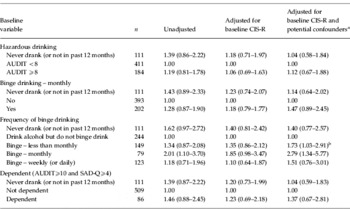
Of the 706 subjects with CMD at baseline and complete data on confounders, 360 (51.0%, 95% CI 45.1–55.3%) had not recovered at follow-up. After adjustment for potential confounding factors, there was no excess of non-recovery from CMD in the group who displayed hazardous drinking at baseline (Table 1) (adjusted OR 1.12, 95% CI 0.67–1.88). Binge drinking on a monthly basis was associated with increased odds of non-recovery, although again the 95% CI spanned unity (adjusted OR 1.47, 95% CI 0.89–2.45). When stratified on the frequency of binge drinking, there was weak support for a linear trend (ORlinear trend 1.18, 95% CI 0.95–1.47, p=0.12). Abstinence was associated with non-recovery compared with the non-bingeing referent group, although this was not statistically significant (adjusted OR 1.40, 95% CI 0.77–2.57). Alcohol dependence was associated with non-recovery from CMD, but again the CI spanned a wide range (adjusted OR 1.37, 95% CI 0.67–2.81).
Associations between alcohol consumption and non-recovery from common mental disorder at follow-up

CIS-R, Revised version of the Clinical Interview Schedule; AUDIT, Alcohol Use Disorders Identification Test, SAD-Q, Severity of Alcohol Dependence Questionnaire.
Values are odds ratios (95% confidence intervals).
a Age, gender, ethnicity, marital status, educational qualifications, employment status, social class, housing tenure, life events, type of area (urban/rural), weekly income, size of primary support group, current smoking habits, illicit drug use in the previous year, use of psychotropic drugs or therapy, hospital treatment in the past 3 months for mental health problems, and consultations with mental health professional(s) in the past year.
b Linear trend of increase across categories of binge drinking, amongst drinkers (adjusted odds ratio 1.18, 95% confidence interval 0.95–1.47, p=0.12).
Not unsurprisingly, markers of severity of illness at baseline (including baseline CIS-R score, contact with health professionals and hospitalization for mental disorder) were the strongest confounders of the association between alcohol consumption and non-recovery from CMD. Other important predictors of non-recovery included high socio-economic status, area of residence (living in a rural area) and a greater number of life events (data not shown). There was little variation in the influence of any single confounder for the different drinking patterns.
Discussion
Findings
The consumption of six or more drinks on one occasion on at least a monthly basis (binge drinking) was associated with an increased odds of non-recovery from CMD. However, as the 95% CIs surrounding the effect estimate are relatively broad and span unity, we cannot rule out the possibility of no association. There was only weak evidence to support a dose-dependent relationship according to the frequency of binge drinking. There was little evidence that hazardous drinking was associated with non-recovery from CMD.
Comparison with previous studies
To our knowledge there have been no previous longitudinal community-based studies that have considered the effect of alcohol consumption on recovery from CMD. Previous studies have recruited from clinical settings and used a variety of measures of alcohol consumption, including lifetime alcoholism (Cook et al. Reference Cook, Winokur, Garvey and Beach1991; Mueller et al. Reference Mueller, Lavori, Keller, Swartz, Warshaw, Hasin, Coryell, Endicott, Rice and Akiskal1994), current alcoholism (Hirschfeld et al. Reference Hirschfeld, Kosier, Keller, Lavori and Endicott1989; Mueller et al. Reference Mueller, Lavori, Keller, Swartz, Warshaw, Hasin, Coryell, Endicott, Rice and Akiskal1994), lifetime abuse/dependence (Labbate & Doyle, Reference Labbate and Doyle1997) and current abuse/dependence (Melartin et al. Reference Melartin, Rystala, Leskela, Lestela-Mielonen, Sokero and Isometsa2002). The findings of these previous studies have been equivocal, ranging from decreased recovery from depression if diagnosed with current alcoholism (of a magnitude of 1.2% recovery per week v. 2.3% for non-alcoholics) (Mueller et al. Reference Mueller, Lavori, Keller, Swartz, Warshaw, Hasin, Coryell, Endicott, Rice and Akiskal1994), to studies that have found no association (Hirschfeld et al. Reference Hirschfeld, Kosier, Keller, Lavori and Endicott1989; Labbate & Doyle, Reference Labbate and Doyle1997; Melartin et al. Reference Melartin, Rystala, Leskela, Lestela-Mielonen, Sokero and Isometsa2002).
Two studies used cross-sectional designs (Mueller et al. Reference Mueller, Lavori, Keller, Swartz, Warshaw, Hasin, Coryell, Endicott, Rice and Akiskal1994; Melartin et al. Reference Melartin, Rystala, Leskela, Lestela-Mielonen, Sokero and Isometsa2002), and cannot therefore disentangle the temporal nature of the relationship between alcohol use and delayed recovery. The case-control study design of Labbate & Doyle (Reference Labbate and Doyle1997) was not able ascertain whether alcohol is a risk factor or a means of self-medication, and may have been subject to recall bias.
Two studies used longitudinal designs: Cook et al. (Reference Cook, Winokur, Garvey and Beach1991) reported subjects who had a previous history of alcoholism to be at reduced risk of recovery, as measured by a variety of outcome measures, when compared with subjects without a history of alcoholism. However the study did not consider possible confounding factors, such as sociodemographic characteristics and severity of illness at baseline. Hirschfeld et al. (Reference Hirschfeld, Kosier, Keller, Lavori and Endicott1989) compared a group of 66 subjects, who were diagnosed with depression [as defined by the Schedule for Affective Disorders and Schizophrenia (SADS; Endicott & Spitzer, Reference Endicott and Spitzer1978)] and alcoholism (diagnostic criteria not defined), with a group of 289 subjects who suffered depression alone. Subjects were recruited from amongst in-patients and out-patients. There were considerable between-group differences, such as gender and age (but not disease severity). Potential confounders were not considered in the analysis. At 2-year follow-up there was very little difference in the mean SADS score of the two groups. The proportion of patients dropping out in each group was not recorded. CIs were not presented.
Our findings are broadly in agreement with the studies of Hirschfeld et al. (Reference Hirschfeld, Kosier, Keller, Lavori and Endicott1989), Labbate & Doyle (Reference Labbate and Doyle1997) and Melartin et al. (Reference Melartin, Rystala, Leskela, Lestela-Mielonen, Sokero and Isometsa2002) in that alcohol dependence and hazardous alcohol use were not associated with an excess of non-recovery. None of the previous studies have explicitly used binge drinking as a marker of abnormal drinking, and it is therefore our suggestion that binge drinking may represent a particularly sensitive marker of problem drinking or may itself be of greater pathological significance than other abnormal drinking patterns. Prior work using this dataset lends support to this suggestion, with binge drinking identified as a possible risk factor for the onset of CMD (Haynes et al. Reference Haynes, Farrell, Singleton, Meltzer, Araya, Lewis and Wiles2005).
Strengths and limitations
By using national population data, we have avoided the selection and referral biases inherent in studies of clinic-based patients. Observer bias was eliminated by the subjects themselves entering data directly into a laptop computer. The longitudinal study design eliminated the possibility of recall bias, as might be found in a case-control study and concerns of reverse causality. In addition, well-validated tools were used to measure alcohol consumption (SAD-Q and AUDIT) (Stockwell et al. Reference Stockwell, Murphy and Hodgson1983; Saunders et al. Reference Saunders, Aasland, Babor, de la Fuente and Grant1993) and CMD (CIS-R; Lewis et al. Reference Lewis, Pelosi, Araya and Dunn1992).
Our measure of binge drinking was based on one question from the AUDIT (having six or more drinks on one occasion). Unlike recent guidelines [Alcohol Harm Reduction Strategy for England (The Prime Minister's Strategy Unit, 2004)], our definition was not gender specific. It may appear surprising that an increased odds of non-recovery was associated with a measure of binge drinking that was based upon a relatively low level of alcohol consumption, and was not associated with hazardous drinking, as measured by the AUDIT. As highlighted earlier, this may suggest that binge drinking is a particularly harmful pattern of drinking. Further studies are required to confirm or refute this.
Prior studies have suggested a U-shaped relationship between alcohol consumption and mental health, such that abstainers are at greater risk of depressive symptoms than those who drink modestly (Lipton, Reference Lipton1994). The referent group for our analyses was therefore ‘normal’ drinkers (for each measure of alcohol consumption). The results of the unadjusted analyses were consistent with the postulated U-shaped relationship, although the CI surrounding the estimate for non-drinkers spanned the null. This U-shaped relationship was no longer evident after adjustment for confounders.
Whilst a comparatively large number of subjects were surveyed in this study, the power to detect associations for alcohol dependence, in particular, was limited. This lack of power is reflected in the wide CIs surrounding the effect estimates. The possibility of a type II error cannot be discounted. The CIS-R detected CMD in the week prior to interview; cases of CMD may have resolved after baseline survey, then relapsed, and be measured as non-recovery. Therefore a random misclassification may have occurred.
Conclusions and public health implications
Binge drinking was identified as a potential risk factor for non-recovery from CMD. However, there was only weak evidence to support a dose–response effect and we cannot exclude the possibility of no association. Nonetheless, these findings warrant further investigation, particularly in light of the increase in this pattern of drinking in the general population in recent years. It is worthy of note that the measure of binge drinking used in this study is relatively low, as six units represents around two and a half pints of most commercially available beers.
Traditional advice regarding ‘safe levels’ of alcohol consumption has focused on weekly consumption [21 units for men, 14 units for women (Royal College of Physicians, 2005)] rather than binge drinking. More recent guidance published in the Alcohol Harm Reduction Strategy for England focuses on daily consumption [3–4 units per day for men, 2–3 units for women (The Prime Minister's Strategy Unit, 2004)] in an attempt to address concerns over binge drinking. However, in order to adequately assess the impact of alcohol consumption, including the binge-drinking phenomenon, on recovery from CMD, much larger studies are required.
Acknowledgements
We thank the Office for National Statistics staff who were involved in the fieldwork and data preparation of the National Psychiatry Morbidity Survey. The data collection was funded by the Department of Health and the Scottish Executive Health Department. However, the views expressed in this paper are those of the authors alone and not necessarily those of the Department of Health or Scottish Executive.
Declaration of Interest
None.