Introduction
In rural China, elders in most areas do not have a formal support safety net and the majority of them depend exclusively on their children for support, the importance of which is enforced by cultural enthusiasm about filial piety (Joseph and Phillips Reference Joseph and Phillips1999; Lee and Xiao Reference Lee and Xiao1998; Zimmer and Kwong Reference Zimmer and Kwong2003). Nevertheless, elders are also providers. Instead of being a unidirectional upward flow of resources from children to older parents, as endorsed by Confucianism (Sung Reference Sung1998), intergenerational relationships in current China are also guided by reciprocity (Cong and Silverstein Reference Cong and Silverstein2008a, Reference Cong and Silverstein2011). Comparatively larger numbers of studies have addressed the influences of grandchild care on intergenerational interactions (Silverstein, Cong and Li Reference Silverstein, Cong and Li2006; Yang Reference Yang1996). Whereas, almost no study has addressed how children's support to parents is influenced when parents provide child care for their other children, i.e. siblings of the children who provide support.
More and more researchers have used a network family perspective in intergenerational studies, e.g. Ward (Reference Ward2008) and Pillemer and Suitor (Reference Pillemer and Suitor2008) suggested the complexity of how support from multiple children contributes to parents' wellbeing. When global ageing has challenged the sustainability of formal support to elderly people, family support has become more consequential (Bengtson and Lowerstein Reference Bengtson and Lowerstein2003). Accordingly, the co-operation and co-ordination among siblings to provide for their older parents would be an important policy-related question.
As an important predictor for intergenerational relationships, caring for grandchildren might trigger a renegotiation of responsibilities and relationships within an extended family. Guided by a gendered extended family perspective, we investigated how financial and emotional support from children to parents is affected by parents' help with child care for their other children. This perspective complements and improves a dyadic approach that focuses on dyadic relationships between an older parent and the adult child whose children are taken care of. This is especially relevant for cultures where extended familism is endorsed and dyadic exchanges are conditional on exchanges within a wider family network (Agree, Biddlecom and Valente Reference Agree, Biddlecom and Valente2005). In rural China, an average elder has four children (China Research Center on Aging 2003), which brings the necessity as well as opportunities to study how children respond to their parents' exchanges with their siblings within extended families.
Background
Importance of intergenerational support for rural elders
In rural China, formal support systems are far from sufficient to meet elders' needs; consequently, many elders have little choice but to reply on their children for support, which may take the form of financial, emotional, or hands-on help, and sometimes co-residence (Cong and Silverstein Reference Cong and Silverstein2008b, Reference Cong and Silverstein2010; Zimmer Reference Zimmer2005; Zimmer and Kwong Reference Zimmer and Kwong2003).
As a result of modernisation and its accompanying labour force migration of adult children from rural to urban areas, intergenerational support in the form of hands-on help and co-residence has substantially weakened because of the reduced availability of children in proximity as well as changed norms and values (Cai Reference Cai2006; Cong and Silverstein Reference Cong and Silverstein2008a, Reference Cong and Silverstein2010; Guo, Aranda and Silverstein Reference Guo, Aranda and Silverstein2009; Yan, Chen and Yang Reference Yan, Chen, Yang and Whyte2003). In this paper we focus on financial and emotional support, because financial and emotional support could go beyond distance and provide hope and comfort that is vital for elders' wellbeing (Cong and Silverstein Reference Cong and Silverstein2008a; Silverstein, Cong and Li Reference Silverstein, Cong and Li2006).
Elders in rural China are vulnerable financially because of the lack of social security programmes and pensions, life-long poverty, and inter vivo asset transfers in times of sons' wedding and the serial division of families (China Research Center on Aging 2003; Pang Reference Pang2004; Yan Reference Yan2003). This results in rural elders' excessive reliance on their children for financial support (Lee and Xiao Reference Lee and Xiao1998). Emotional support is another crucial dimension of intergenerational support stipulated by filial piety, which expects that financial support and hands-on help must be delivered with respect and love (Sung Reference Sung1998). In addition, emotional values of children have increased after the industrial revolution and during the process of modernisation because of social and cultural changes (Alwin Reference Alwin, Mandell and Cahill1990; Hillcoat-Nallétamby and Dharmalingam Reference Hillcoat-Nallétamby and Dharmalingam2006; Inglehart and Baker Reference Inglehart and Baker2000; Yan Reference Yan2003). Because of these, emotional support sometimes is more effective than other dimensions of support in improving Chinese elders' psychological wellbeing and physical health, and reducing their mortality (Cong and Silverstein Reference Cong and Silverstein2008a; Li, Song and Feldman Reference Li, Song and Feldman2009; Silverstein, Cong and Li Reference Silverstein, Cong and Li2006; Zhang, Li and Silverstein Reference Zhang, Li and Silverstein2005).
Corporate group model: grandchild care and support to parents
Motivations of intergenerational support are usually examined as either based on altruism or self-interests of expecting something as an exchange following the principle of reciprocity (Becker Reference Becker1974; Cox Reference Cox1987). The corporate group model synthesises these arguments and explains intergenerational exchanges as motivated either by long-term arrangements that maximise the family's wellbeing, e.g. parents invest in children's education and children are expected to pay back in the future to provide for their parents' old age, or by short-term exchanges that benefit each side (Cong and Silverstein Reference Cong and Silverstein2011; Lee and Xiao Reference Lee and Xiao1998). The corporate group model has been widely examined and usually supported in Chinese families in regards to reciprocal dyadic parent–child interactions (Cong and Silverstein Reference Cong and Silverstein2011).
In rural China, grandchild care is a valuable resource that older parents can provide (Secondi Reference Secondi1997; Sun Reference Sun2002; Yang Reference Yang1996). Particularly in the face of large-scale labour force migration, older parents' support with child care facilitates adult children's migration (Liu and Reilly Reference Liu and Reilly2004). The household registration system that separates rural and urban areas in China has engendered many barriers for rural migrants to bring their children to urban areas, such as high education and child-care expenses (Bai and Song Reference Bai and Song2002).
When providing care for grandchildren, elders themselves also benefit by receiving increased remittances from those migrant adult children, which is described as ‘time-for-money’ exchanges that parents provide child care in exchange for transfers of money or food (Cong and Silverstein Reference Cong and Silverstein2008a, Reference Cong and Silverstein2011; Frankenberg, Lillard and Willis Reference Frankenberg, Lillard and Willis2002; Yang Reference Yang1996). This is also likely to be true with emotional support from children, because increased interactions with adult children and a sense of gratitude or indebtedness on the children's side are important factors for improved emotional closeness (Chen, Short and Entwistle Reference Chen, Short and Entwistle2000; Mercier, Shelley and Wall Reference Mercier, Shelley and Wall1997; van Gaalen, Dykstra and Komter Reference van Gaalen, Dykstra and Komter2010).
Interactions in extended families: support mobilisation versus support alienation
Although the motivations for dyadic intergenerational support could be explained by corporate group model, a far less studied area is whether the corporate group model is applicable to extended families in China. In fact, intergenerational relationships typically deploy within the extended family context; and support from adult children to their elder parents is correlated as a result of joint decisions made by family members with different preferences and variant constraints (Agree, Biddlecom and Valente Reference Agree, Biddlecom and Valente2005; Checkovich and Stern Reference Checkovich and Stern2002; Cong and Silverstein Reference Cong and Silverstein2010; Konrad et al. Reference Konrad, KüNemund, Lommerud and Robledo2002). When we apply the corporate group model to an extended family, we will expect that siblings will co-ordinate their time, money and other resources to improve the wellbeing of the whole extended family. Therefore, adult children may increase their support to parents as they are in need of financial and emotional resources when helping with child care for their other children.
On the contrary, if siblings are not collaborative to maximise the benefits of the extended family, several factors may contribute to the alienation of support to older parents. First, adult children in China usually provide for their parents based on their parents' needs (Lee and Xiao Reference Lee and Xiao1998; Li, Feldman and Jin Reference Li, Feldman and Jin2004; Sun Reference Sun2002). Thus, other adult children may refrain from supporting their parents, knowing that the grandchildren's parents will assume more responsibilities for their elderly parents, just like the crowding out effect of public transfers on private transfers (McGarry and Schoeni Reference McGarry and Schoeni1995). Moreover, adult children in China also provide for their parents following the principle of reciprocity (Lee and Xiao Reference Lee and Xiao1998; Sun Reference Sun2004). When older parents have to devote more time to the caring job, they have to reduce providing help to their other children, which will eventually reduce other children's support based on the principle of reciprocity or a sense of unfairness (Shi Reference Shi1993; van Gaalen, Dykstra and Flap Reference van Gaalen, Dykstra and Flap2008; Yang Reference Yang1996).
Because of the lack of empirical evidence about children's responses to their parents' helping other children with child care, we proposed two alternative hypotheses – support mobilisation, in which support from children will be enhanced, and support alienation, in which support from children will be reduced when parents help their other children with child care.
Gender
We suspect that sons and daughters may respond differently to their parents' helping with child care for their siblings because sons and daughters are different concerning their rights, obligations and motivations in intergenerational interactions (Cong and Silverstein Reference Cong and Silverstein2008b; Yang Reference Yang1996). First, grandchild care is heavily oriented towards sons' children; and daughters receive much less child care than their brothers in rural China (Chen, Short and Entwistle Reference Chen, Short and Entwistle2000). This is because in the patrilineal family system, sons will carry family names and assume major responsibilities of providing for their older parents. Daughters, however, theoretically become family members of other families when they get married (Davis-Friedmann Reference Davis-Friedmann1991; Feldman et al. Reference Feldman, Tuljapurkar, Li, Jin, Li, Gauthier, Chu and Tuljapurkar2007). Grandchildren care itself has an implied meaning of fostering intergenerational bonds and extending family heritage including family name reproduction, which rationalises the dominance of paternal grandparents in providing grandchildren care (Chen, Short and Entwistle Reference Chen, Short and Entwistle2000; Feldman et al. Reference Feldman, Tuljapurkar, Li, Jin, Li, Gauthier, Chu and Tuljapurkar2007).
Sons are more likely than daughters to regard their brothers' children (their nephews/nieces) as closer kin or even a part of their immediate family, because of shared family name (Chao Reference Chao1983). Therefore, we expect that sons may devote more resources to their brothers' children when called upon, as in the situation when their older parents are taking care of their siblings’, mainly their brothers’, children. We name this mechanism that sons will be more responsive to the needs of the extended family the patrilineal family hypothesis.
However, as kin-keepers of the family and being strongly attached to their natal families, daughters may care about the offspring of their natal families more than sons do (Fingerman, Hay and Birditt Reference Fingerman, Hay and Birditt2004; Merrill Reference Merrill2007; Rossi and Rossi Reference Rossi and Rossi1990). In spite of the patrilineal family and patrilocal marriage tradition in current rural China, adult daughters may also be more attached to their natal families than sons are, and provide considerable support to their parents because of improved transportation and economic independence (Zhang Reference Zhang2005). Thus, it is likely that daughters respond to parents' helping with child care for their other children more positively than sons do. We name this mechanism the kin-keepers hypothesis.
Which hypothesis is applicable depends on the relative power of the tradition against social changes accompanying modernisation. The patrilineal family hypothesis is built upon traditional values and the patrilineal family practice, whereas the kin-keepers hypothesis is derived from a western approach to relationships in extended families.
Research questions and hypotheses
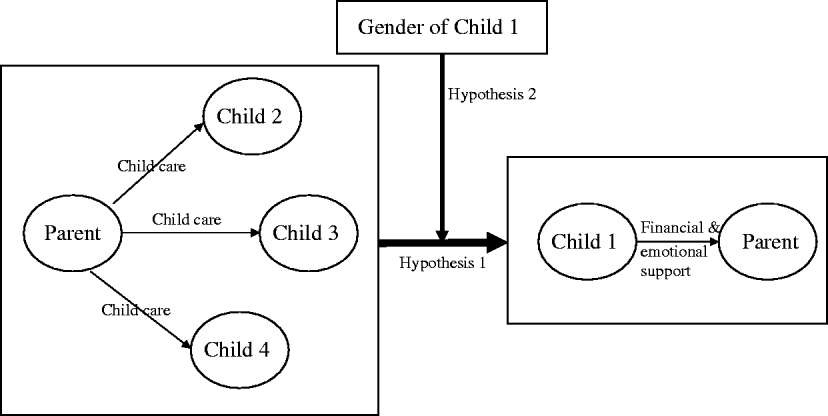
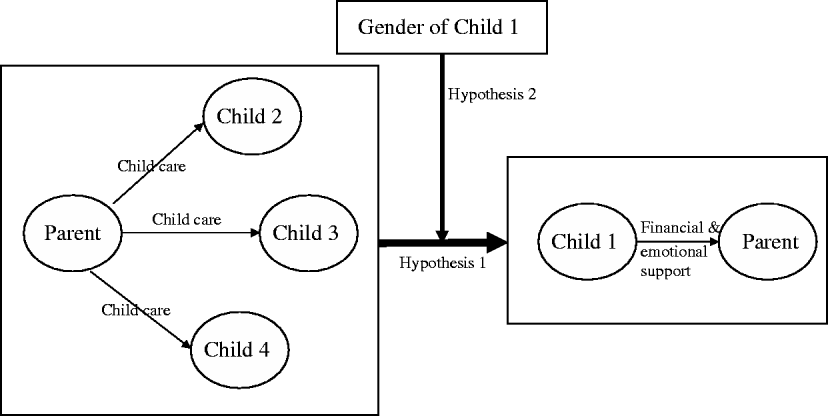
To sum up, we ask the following two research questions, which are further illustrated in Figure 1, assuming the example family has four children.
1. How will financial and emotional support from children (e.g. child 1 in Figure 1) change when parents help with child care for their other children (e.g. child 2, 3 and 4 in Figure 1)? For this research question, we have two competing hypotheses:
● H1a (support mobilization): Children will increase financial and emotional support to parents when parents help with child care for their other children.
● H1b (support alienation hypothesis): Children will reduce financial and emotional support to parents when parents help with child care for their other children.
2. Children (e.g. child 1 in Figure 1) of which gender will respond more positively by providing more support to parents when parents help with child care for their other children (e.g. child 2, 3 and 4 in Figure 1)? For this research question, we also have two competing hypotheses:
● H2a (patrilineal family hypothesis): Sons will be more positive to parents' helping with child care for their other children.
● H2b (kin-keepers hypothesis): Daughters will be more positive to parents' helping with child care for their other children.
Theoretical model of proposed mechanisms.
Data and measures
The sample for this investigation was derived from the Anhui Province of China, a mostly rural province and the fifth most populous province in China. This region was chosen specifically for its relatively high density of older adults and high levels of out-migration of working-age adults (State Council of the People's Republic of China 2000). Data were collected from a sample of adults aged 60 and over living in rural townships within Chaohu, a city of 4.5 million people located on the north bank of the Yangtze River in the central part of Anhui Province. This rural area of the province is generally known for its high rates of labour migration to the cities of Hefei, Nanjing and Shanghai (Chaohu Statistical Bureau 2001).
The sample was identified using a stratified multistage method to select randomly 1,800 potential respondents (see Cong and Silverstein Reference Cong and Silverstein2011 for details). Of 1,800 individuals randomly selected for the study, 1,715 completed the survey, yielding a response rate of 95.3 per cent. In October 2003 the follow-up survey was conducted with 1,368 respondents, or 79.8 per cent of the original participants. Mortality was the major reason for attrition.
We limited our examination to elders who had at least two children, which made it possible for us to study adult children's responses when their parents provided support to their siblings. This reduced our sample to 1,250 respondents. After deleting missing values for variables in the analysis, we had 1,162 respondents with 4,791 children, which was equivalent to 7 per cent missing at the parent level for those who had at least two living children. Intergenerational emotional support suffered the most serious missing values, which was 2.2 per cent for the follow-up. We used Multiple Imputation and found that our results were robust, and we presented the results based on listwise deletion (Allison Reference Allison2001).
Dependent variables
Financial transfers from children at the second wave were based on the total amount of money that the parent received from each child during the past 12 months. Respondents (parents) were asked to provide the exact amount of money first, and if they could not give an exact number, they were asked to choose from the following categories based on Chinese RMB currency (100 RMB=14 US dollars): 0=none, 1=less than 50, 2=50–99, 3=100–199, 4=200–499, 5=500–999, 6=1,000–2,999, 7=3,000–4,999, 8=5,000–9,999, 9=more than 10,000. In the analysis, we took the actual amount if it was available and then used the median amount of the category if the exact amount was not supplied. We used its log transformation (ln+1) to adjust its distribution. To minimise the risks of endogeneity, in models predicting financial support, we controlled for first-wave financial support from children, which was measured in the same way as the second-wave financial support from children. Hence, coefficients of other variables in the model indicated their effects on residualised change in financial support from children between waves.
We measured the second-wave emotional support by using three questions adapted from the Affectual Solidarity Inventory (Cong and Silverstein Reference Cong and Silverstein2008a; Mangen, Bengtson and Landry Reference Mangen, Bengtson and Landry1988), which assesses emotional cohesion between generations. The questions were: (a) ‘Taking everything into consideration, how close do you feel to (this child)?’ (b) ‘How much do you feel that (this child) would be willing to listen when you need to talk about your worries and problems?’ and (c) ‘Overall, how well do you and (this child) get along together?’ We coded the items as follows: 0 (not at all close/not at all/not at all well), 1 (somewhat close/somewhat/somewhat well) or 2 (very close/very much/very well). We computed an additive scale, ranging from 0 to 6, for each child.
In models predicting emotional support, we also controlled for baseline emotional support to minimise the risk of endogeneity, which was measured in the same way. The reliability coefficient for these items was 0.86 for both waves.
Independent variables
We asked the respondents the frequency of child care that they provided for each child, ranging from 0 (not taking care of grandchildren) to 6 (the whole day, from morning to evening). We included variables representing baseline child care and the change in child care between two waves for each child. This approach minimised the risks of endogeneity in the event that financial support from children encouraged parents to provide grandchildren care.
In addition, we summed up parents' help with child care for all other children at baseline, and measured its change over time as the difference in the total amount of child care those other children received at baseline and at the second wave.
In models predicting financial support, we controlled for children's emotional support at the second wave; and in models predicting emotional support, we controlled for children's financial support at the second wave.
We controlled for important parents' characteristics and children's characteristics at baseline, which were shown to influence financial transfers between them (Cong and Silverstein Reference Cong and Silverstein2011; Li, Feldman and Jin Reference Li, Feldman and Jin2004; Liu and Reilly Reference Liu and Reilly2004; Shi Reference Shi1993). Parents' characteristics at baseline included age in chronological years, and dummy variables for gender (1=female, 0=male), education (1=some formal education, 0=no formal education), and occupation (1=agricultural work, 0=others). We also measured marital status as a dummy variable (1=married, 0=unmarried). Those who were widowed, never married and divorced were combined into the unmarried category, because less than 1 per cent of respondents were either divorced or never married. Income was measured as the logged RMB value of the total annual income of respondent and spouse from work or pension (+1). In addition, parents' health status was measured as the extent of functional impairments, calculated as the sum of 15 items reflecting difficulties in performing personal activities of daily living, instrumental activities of daily living (IADLs) and activities requiring physical strength, mobility and flexibility. Respondents indicated the level of difficulty performing each task: 0 (no difficulty), 1 (some difficulty) or 2 (cannot do it without help). Because these items had high reliability (alpha=0.96), we calculated a summed scale that ranged from 0 (no difficulties) to 30 (unable to perform all tasks). We also controlled for their number of children.
Children's characteristics at baseline included their age, gender, marital status and education. Age was represented as age in years at baseline. Gender was coded as 0=male, 1=female; marital status as 0=not married, 1=currently married; education as three dummy variables, i.e. 1=primary school, 2=junior middle school, 3=senior middle school, vocational training, college, university or above, with ‘no education’ as the reference group.
We also controlled for children's distance to their parents at the second wave. We classified children into three categories, i.e. those who lived in the same village with parents but did not co-reside, those who co-resided with parents, and those who did not live in the village. Thereupon, we could explicitly display the influence of co-residence as well as migration.
We controlled for the baseline instrumental support and financial support from parents, which might also stimulate children's support to their parents at the second wave following the rule of reciprocity (Li, Feldman and Jin Reference Li, Feldman and Jin2004; Sun Reference Sun2002). Parents' instrumental support to each child was measured by a dummy variable with 1 meaning that the parent gave this child and/or the spouse of this child any help during the past 12 months in two areas: (a) household tasks, such as cleaning the house and washing clothes, and (b) personal care tasks such as bathing and dressing. Financial transfers from parents at baseline were measured similarly as financial transfers from children.
In addition, we controlled for children's help to parents in farm labour and instrumental support at the second wave, because different dimensions of support were usually correlated (Altonji, Hayashi and Kotlikoff Reference Altonji, Hayashi, Kotlikoff, Mason and Tapinos2000; Lee, Netzer and Coward Reference Lee, Netzer and Coward1994). Children's instrumental support to their parents was measured with a similar dummy variable as instrumental support from parents. Children's farm labour help was also measured as a dummy variable with ‘1’ meaning this child gave any farm labour help to the parent during the past 12 months. We measured other children's financial support to parents by adding up all other children's financial contributions to parents at baseline. We also controlled for its changes between two waves.
Method
We used Stata (Statacorp 2009) to estimate the random effects model, examining children's financial and emotional support to their parents. Random effects model is used for nested data. It regards the intercept as the result of a random deviation from some mean intercept based on group membership, and produces unbiased standard errors resulting from clustering (Rabe-Hesketh and Skronda Reference Rabe-Hesketh and Skronda2008). This method fits the data of this study because children are nested within each parent.
We did the analysis for sons and for daughters separately, and then for all children combined. For the all-children sample, we introduced interactions between gender and child care-related variables to examine whether gender differences we could possibly detect were statistically significant.
Results
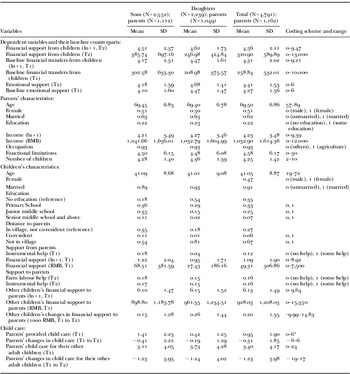
In Table 1, we show the descriptions of variables. The average age of respondents, i.e. older parents, was 70 years, slightly more than half (51%) were female, 62 per cent were married, 22 per cent had some formal education. The average income was 1,033 RMB (standard deviation=1,614), and the average functional impairment score was 4.58 out of a possible 30. The average respondent had four living children.
Description of analytic variables

Notes: SD: standard deviation. T1: 2001. T2: 2003. 1. 0=not taking care of grandchildren, 1=seldom, 2=about once a month, 3=several times a month, 4=at least once a week, 5=a period of a day (not the whole day), 6=whole day, from morning to evening.
Sons' financial support to parents was greater than that of daughters at both waves; however, daughters' emotional support to their parents was great than that of sons at both waves. Sons and daughters resembled each other in age (averaged 41) and marital status (89 and 93% were married, respectively), but daughters had substantially lower education than sons. Eleven per cent of sons were co-residing with their parents, 54 per cent lived out of the village, and 35 per cent lived in the village but did not co-reside with their parents. Only 1 per cent of daughters co-resided with their parents, 81 per cent lived out of the village, and 18 per cent lived in the village without co-residing with their parents. On average, daughters received far fewer financial transfers and much less instrumental help from their parents at baseline, even though daughters provided only a little bit less farm labour and instrumental help to their parents at the second wave. Similarly, daughters received much less child care from parents than sons did. Both sons and daughters received reduced child care over time.
For a son, his siblings totally received 3.11 child care from their parents; and for a daughter, her siblings received 3.73 child care from their parents. Over time, parents also reduced their help with child care for their other children. On average, for each son, his parents' other children provided 899 RMB to their parents, and for each daughter, her parent's other children provided 961 RMB. Other childrens' financial support to parents increased during two waves.
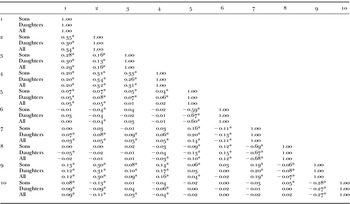
In Table 2, we present the correlation among different dimensions of support. Interestingly, children's financial support was positively correlated with their siblings' financial support to parents, which might result from the needs of parents. Child care for a specific child (and its change over time) is positively correlated with child care received by this child's siblings (and its change over time), which might be associated with the parents' capability of providing child care. Daughters' emotional support to parents at the second wave was positively correlated with parents' child care for their other adult children at baseline.
Bivariate correlations among key intergenerational exchange variables

Notes: Sample sizes: sons, N=2,552; daughters, N=2,239; all, N=4,791. T1: 2001. T2: 2003. 1=Financial support from children (ln+1, T2); 2=Financial support from children (ln+1, T1); 3=Emotional support (T2); 4=Emotional support (T1); 5=Parents' provided child care (T1); 6=Parents' changes in child care (T1 to T2); 7=Parents' child care for their other children (T1); 8=Parents' changes in child care for their other children (T1 to T2); 9=Other children's financial support to parents (ln+1, T1); 10=Other children's changes in financial support to parents (1000 RMB, T1 to T2).
Significance levels:
* p<0.05.
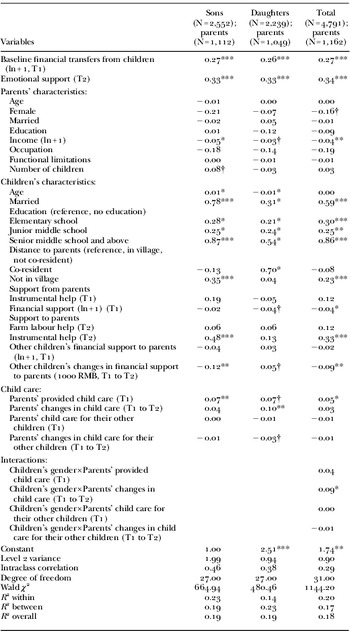
As shown in Table 3, we showed three models estimating financial support to parents. Neither sons' nor daughters' financial transfers to parents were influenced by parents' help with child care for their other adult children, which does not support the support mobilisation hypothesis. Sons' financial transfers, however, were reduced when parents received more money from their other children between two waves. Parents' baseline help with child care for sons and increases in child care for daughters between two waves increased these children's financial support to parents. For the all-sample analysis, significant interaction between children's gender and changes in child care between two waves suggested that daughters were more sensitive to parents' changes in child care and rewarded their parents higher than their brothers for parents' increased help.
Random effects models predicting T2 financial transfers from adult children to their older parents

Notes: T1: 2001. T2: 2003.
Significance levels:
† p<0.1,
* p<0.05,
** p<0.01,
*** p<0.001.
Sons provided more financial support to parents with lower income. In addition, sons provided more financially to their parents if sons were emotionally closer to their parents, were older, married, had higher education, lived out of the village, and provided parents with instrumental support. Daughters provided more financially to their parents if daughters were younger, married, with higher education, and emotionally closer to their parents.
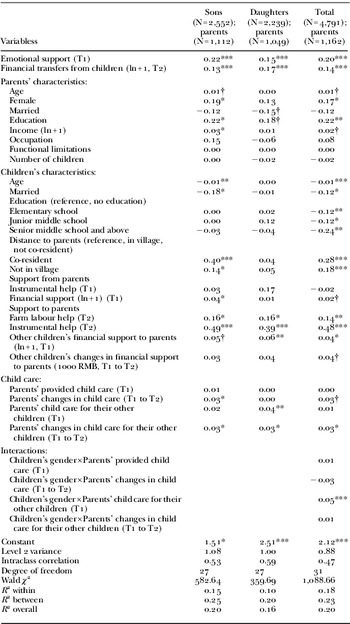
With respect to emotional support, as shown in Table 4, sons' emotional support to parents was enforced when parents increased their child care for their other children between two waves; and daughters' emotional support was strengthened by both baseline child care and increases in child care that parents provided for their other children. This provides support to the support mobilisation hypothesis. This gender difference was statistically significant in the analysis for all children, indicated by the significant interaction between children's gender and parents' help with child care for their other children at baseline. This suggested that daughters were more emotionally responsive when parents helped with child care for their other children at baseline, which supports the kin-keepers hypothesis.
Random effects models predicting T2 emotional support from adult children to their older parents

Notes: T1: 2001. T2: 2003.
Significance levels:
† p<0.1,
* p<0.05,
** p<0.01,
*** p<0.001.
In addition, baseline financial support from other children helped to strengthen parents' emotional ties with daughters. Increases in child care for sons between two waves helped to increase their own emotional support to parents, but increases in child care for daughters did not show any influence on emotional support from daughters themselves. Sons provided stronger emotional support to mothers and to parents who had some education and higher income. Sons, who provided more financial support to parents at baseline and who were younger and unmarried, had better emotional relationships with their parents. Both co-resident sons and sons who were not in the village provided stronger emotional support to their parents than did the sons who lived in the village but did not co-reside with parents. Sons who provided farm labour help and instrumental help to parents and received more financial support from parents also provided more emotional support. Daughters tended to have closer relationships with parents if daughters provided farm labour, instrumental help, and more financial support.
Discussion
Caring for grandchildren is an important contribution that older parents in rural China can make to help their adult children (Secondi Reference Secondi1997; Silverstein, Cong and Li Reference Silverstein, Cong and Li2006). How grandchildren care influences support from adult children, who are the major sources of support and whose support has significant influences on elders' wellbeing, is an important topic in the field of gerontology and has attracted wide attention (Cong and Silverstein Reference Cong and Silverstein2008a, Reference Cong and Silverstein2010; Hermalin Reference Hermalin2002, Whyte Reference Whyte2001).
We asked whether adult children would increase or reduce their support to their parents, who helped with child care for their siblings. We found that the answer was contingent to the dimension of support that was of interest. We did not find strong evidence that children's financial support to parents was influenced when parents provided child care for their other children. Emotional support from children, however, was enhanced when elder parents provided child care help for their other children, which presents evidence that in rural China the interactions of a parent–child dyad are affected by interactions of other parent–child dyads.
Several reasons may explain why children's financial support was not affected. Firstly, when children themselves receive help with child care, they provide financial support to their parents as compensation (Secondi Reference Secondi1997; Silverstein, Cong and Li Reference Silverstein, Cong and Li2006). This relieves parents' financial burden and thus reduces the necessity of getting financial support from their other children. In addition, most adult children are struggling financially themselves and earn barely enough to make ends meet in rural China, therefore their support to their parents is usually at a very low level, even with very strong filial norms to provide for their parents (Cong and Silverstein Reference Cong and Silverstein2011). This limits adult children's capacity of providing financial help as a response to their parents' involvement in caring for grandchildren for their siblings.
Nevertheless, that both sons and daughters became emotionally closer with their parents when their parents provided more child care over time for their siblings was consistent with our support mobilisation hypothesis, i.e. when elders took care of grandchildren, they had more support from their other children, though the support was emotional instead of financial. In current rural China, caring for grandchildren often occurs in the situation when grandchildren's parents migrate for job opportunities. Under this circumstance, both grandparents and grandchildren left behind might have higher levels of demands for emotional care. Elders' other children, i.e. grandchildren's aunts and uncles, are naturally the first and most feasible and responsive persons who may meet these needs. This is consistent with the support mobilisation hypothesis, underpinning the applicability of corporate group model in extended families. The extended family works as a corporate group to facilitate adult children's migration by providing emotional support to elder parents who help directly in the process.
In addition, we found significant gender differences concerning emotional support. Although both sons and daughters provided more emotional support when their parents took care of their siblings' children, we found this effect was stronger for daughters. This is consistent with the prediction of the kin-keepers hypothesis that daughters are kin-keepers of the family and they are more responsive to the needs of the family and care more about the wellbeing of their natal families (Rossi and Rossi Reference Rossi and Rossi1990). Hence, social changes have gained advantages over tradition in the specific situation investigated in this study. Even when patrilineal tradition is still dominating in rural China, daughters are important players in older parents' support networks because of daughters' gradually gained independence, autonomy and elevated social status (Zhang Reference Zhang2007). Particularly for emotional support, daughters are more functional than sons, who may become estranged from their parents after getting married (Cohen Reference Cohen1998; Zhang Reference Zhang2005).
Concerning dyadic interactions, we found that sons would increase their financial support to parents if those sons themselves received more help with child care at baseline; whereas daughters would increase their financial support to parents if daughters themselves had received increased child care from parents between two waves. Sons and daughters' different responses to their parents' help with child care are consistent with previous findings that daughters' exchanges with parents are short-term oriented and sons' exchanges with parents are long-term oriented (Yang Reference Yang1996). Sons provided more emotional support to parents when parents provided increased child care help between two waves; whereas for daughters, receiving child care did not significantly affect their emotional support. Yet, bivariate correlations showed that daughters' emotional support to parents was positively correlated with parents' baseline help with child care. For this reason, we suspect that variables of intergenerational exchanges that we controlled for fully explained why daughters were more emotionally close when they received child-care help at baseline.
We also found that financial support from sons, but not daughters, was reduced by their siblings' financial support to parents. In supplemental analyses, we examined whether the effect of caring for grandchildren sired by other children was mediated by these other children's financial support. We did not find evidence to support the mediating effect, which suggests that the crowding-out effect of financial support from other children was not related to grandchild care for other children. The bivariate correlation showed that financial support from a specific child was positively correlated with financial support from his/her siblings. Therefore, the effect we found could be more appropriately interpreted as within-family crowding out. This may occur under circumstances when parents have higher levels of needs and children provide at an overall higher level; however, within the family, children's support complements each other. This crowding-out effect is not applicable for daughters, possibly because daughters are less obligated to their parents than their brothers (Cohen Reference Cohen1998). When providing support to parents is an optional self-choice out of love, it may be less sensitive to financial support from other siblings.
This investigation brings up the usefulness of taking a gendered extended family perspective when studying intergenerational interactions in rural China. Support from sons and from daughters was influenced by elder parents' child-care efforts provided to their other adult children. However, sons and daughters responded in different ways. When labour force migration from rural to urban areas increases the demands for child care provided by grandparents for their migrant adult children, and when patrilineal tradition is challenged by gender equality and other social changes, how the whole family responds to elder parents' caring for their grandchildren is an important but understudied area (Silverstein, Cong and Li Reference Silverstein, Cong and Li2006; Zhang Reference Zhang2005).
Although we stress the necessity of taking a gendered extended family perspective to study intergenerational relationships, our data do not have measures of direct exchanges and negotiations among siblings. Examining side-transfers among siblings is likely to expand the explanatory purview of our conclusions. Furthermore, the findings and conclusions of this investigation may only work for rural Chinese families, where the familism is comparatively strong. Whether the support is mobilised or alienated under a certain situation may be different in different cultures. For example, a bigger sibling care-giver network is associated with more IADL support and less financial support from each child in White families, whereas it is associated with reduced IADL support from each child in African American families (White-Means Reference White-Means2008).
In addition, we only had elders' report of their interactions with children. The lack of access to children's side of the story implies some degree of bias in intergenerational relationships that we have measured, e.g. elders tend to report higher levels of intergenerational solidarity than their children (Giarrusso, Feng and Bengtson Reference Giarrusso, Feng, Bengtson, Silverstein and Schaie2004; Shapiro Reference Shapiro2004).
In the future, the comprehensive physical and mental health consequences of taking care of grandchildren should be further evaluated, incorporating the complexity of its elicited changes in social support. Even though taking care of grandchildren has shown positive effects in securing higher remittances from grandchildren's parents and higher emotional support from grandchildren's uncles and aunts, many elders start providing child care reluctantly for the purpose of accommodating their children's needs; this may overburden elders and result in deteriorated health when accompanying social support is not sufficient to counteract the related stresses (Chen, Short and Entwistle Reference Chen, Short and Entwistle2000; Cong and Silverstein Reference Cong and Silverstein2008a; Silverstein, Cong and Li Reference Silverstein, Cong and Li2006).
Overall, the findings of this investigation demonstrate that members of an extended family work together for the benefits of the whole extended family in rural China. It is crucial to move from a dyadic to a gendered extended family approach when studying intergenerational relationships in China. With this approach, we will understand with greater depth and width how various support arrangements are negotiated among older parents and their adult children, in response to the needs of children and elder parents when filial norms together with the patrilineal family tradition are rivalling with and adjusting to social changes.
Acknowledgements
This research was supported by Grant No. R03TW01060-01 from the Fogarty International Center of the National Institutes of Health. We thank Shuzhuo Li, Jersey Liang, Judith Treas, Feng Wang, and Wenjuan Zhang for their valuable assistance in the planning phase of this project, and Yin Liu for her assistance during manuscript preparation. We would also like to thank Angelique Chan and two anonymous reviewers for their thoughtful comments and suggestions.