1 Introduction
The present article reports on the results of a corpus-based study that deals with the syntactic behaviour of eight pairs or triplets of competing prepositions. Throughout, the focus is on verb-dependent items, and the timespan covered ranges from the Early Modern English (EModE) period to the present day. In the relevant environments the members of these sets are found to be interchangeable in logically equivalent statements like (1).
(1) He put the coins in/into his pocket.
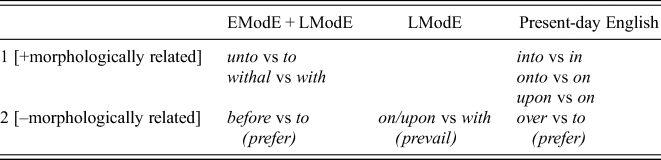
Concerning their degree of explicitness and cue validity in specific functions, these prepositions can be distinguished as representing more or less explicit variants. Thus, in directional uses such as (1), into is to be regarded as more explicit than in. Broadly similar contrasts are found in the remaining cases. Table 1 gives an overview of the rival prepositions with regard to their morphological relatedness and the respective periods providing the data for their analyses.
Overview of morphological types and relevant historical periods

From the morphological perspective, we can distinguish between two categories. In category 1, comprising five of the eight sets under consideration, the distinction between more or less explicit prepositions corresponds to morphologically related complex (or strengthened) items and morphologically simple ones like into vs in. In category 2, the rival prepositions are not formally related. However, their functional closeness is reflected in the fact that, in each of the three sets, the rivalry is tied to just one verb. In addition, as will be shown at a later stage, the items in category 2 involve the same syntactic frames and tendencies as those in category 1. While the inventory of category 1 may be complete for the overall timespan under consideration, that is less likely to be the case for category 2. Incidentally, the pair out of vs out, though interesting in its own right, will not be dealt with in this article for at least two reasons: (i) here it is the shortened rather than the strengthened item that represents the contextually restricted variant; (ii) out of appears not to have reached full compound status.
This article seeks to explore the – the generally neglected – question as to what grammatical environments, available to both (or all three) members of the eight sets involved, influence the selection of the individual prepositions. Considering in 1969 the choice between on and onto as well as that between in and into in directional uses, Leech found the problem to be intractable:
It is difficult to prescribe [sic], both with verbs of movement (i.e. intransitive verbs) and causative verbs (i.e. transitive verbs like put or toss), the circumstances under which on may replace on to and in may replace into. There seems to be variation among lexical items without any semantic conditioning. (Leech Reference Leech1969: 192–3)
We will take up the challenge by examining a number of grammatical complexity contrasts which, on the basis of previous work, are expected to constrain the distribution of the more or less explicit prepositional alternatives. The analyses are usually guided by the Complexity Principle, which involves a correlation between two dimensions, the presumed degrees of processing complexity and grammatical explicitness (see e.g. Rohdenburg Reference Rohdenburg1996, Reference Rohdenburg2007, Reference Rohdenburg2016; Schlüter Reference Schlüter2005; Vosberg Reference Vosberg2006; Mondorf Reference Mondorf2009; Berlage Reference Berlage2014). The principle, which accounts for a large number of grammatical variation phenomena in English and other languages, stipulates that ‘in the case of more or less explicit grammatical options, the more explicit ones(s) will tend to be preferred in cognitively more complex environments’ (see e.g. Rohdenburg Reference Rohdenburg1996: 151; Reference Rohdenburg2007: 24). In this sense the notion of increased grammatical explicitness (e.g. into vs in) equates to that of greater functional explicitness regarding specific contexts (e.g. certain directional uses).
In the past, the wording of the Complexity Principle has occasionally been less than satisfactory, with the term structural being used misleadingly to refer to all kinds of grammatical alternants. To dispel any doubt, let me stress that, from the outset, the term grammatical has encompassed rival function words or ‘closed class elements’ like on vs upon (Rohdenburg Reference Rohdenburg1996: 149, 151) and from/to vs than after different (Rohdenburg Reference Rohdenburg, Cuyckens and Radden2002: 94–6).
This is not the place to provide a detailed account of the great variety of competing grammatical phenomena whose distribution has been shown to be largely constrained by the Complexity Principle. Suffice it to give an overview of major rival expressions and processing complexities as well as a brief exemplification of their relationship.
(a) rival grammatical expressions (more or less explicit): that-clauses vs various non-finite complements, the complementiser that vs zero, should + infinitive vs the subjunctive after mandative predicates, marked vs unmarked infinitives, marked infinitives vs gerunds, prepositions variably introducing gerunds (e.g. from) or subordinate interrogatives, perfective vs non-perfective gerunds (e.g. after recall), subject and object relative clause marking (who[m]/which/that/zero), the variable use of resumptive pronouns, the variable use of being in far from being + predicative, analytic vs synthetic comparatives, the suffix -ly variably marking intensifiers, grammaticalised enough variably postmodifying sentence adverbs like oddly, the subordinator that variably marking adverbial conjunctions (e.g. notwithstanding) etc.
(b) processing complexities: passivisation, discontinuous structures, subordinate clause negation, clause length, low-frequency vs high-frequency items, other than there-clauses vs easy-to-process there-clauses, finite vs infinitival subordinate interrogative clauses, various forms of NP/PP extraction, right node raising, gapping, transitive vs intransitive structures, noun phrase complexity (with subjects, objects and prepositional phrases including the contrast between premodified/postmodified and unmodified NPs), plural vs singular subjects and objects, past tense vs present tense predicates, indefinite vs definite subject NPs, complex vs simple predicatives etc.
Since the 1990s an increasing number of correlations between grammatical alternants and complexity factors as in (a) and (b), respectively, have been established: in fact, most types of processing complexities are known to constrain the choice between more and less explicit variants in more than one case. Consider, for instance, (easy-to-process) there-clauses like those in (2)–(4), which contain, respectively, the antecedents of relative clauses of reason, nouns governing that-clauses, and nouns associated with interrogative clauses. Compared with all other (more complex) clauses, there-clauses are less likely to be associated with subordinate clauses introduced by some explicit subordinator or clause linker (see e.g. Rohdenburg Reference Rohdenburg2019: 244–6).
(2) There is no reason (why/that) a writer should not do that.
(3) There is a danger (that) the parcel might get lost.
(4) There are some doubts (as to/about/over/on) whether the ball has crossed the line.
Conversely, the choice between more or less explicit options of a given variable may be influenced by several complexity factors. Thus, in the case of the gerund in experience difficulty (in) V-ing, the use of the (omissible) preposition tends to be promoted by e.g. passivisation of the verb as well as premodification and pluralisation of the noun (Rohdenburg Reference Rohdenburg, Cuyckens and Radden2002: 80–2).
No doubt, the Complexity Principle constitutes a powerful generalisation accounting for literally dozens of grammatical variation phenomena in English and other languages. Even so, a few counterexamples have been discovered where other, independently motivated, tendencies produce contrary effects. They include the following:
(i) Concerning the role played by the extraction of postverbal elements out of complement clauses, Rohdenburg (Reference Rohdenburg2016) observes that some types conform to the Complexity Principle wheras others are captured by the opposite tendency of Domain Minimisation (Hawkins Reference Hawkins1999).
(ii) The longstanding trend in English towards reducing argument complexity discussed in Rohdenburg (Reference Cuyckens, Smet, Heyvaert and Maekelberghe2018) may in part be held responsible for the fact that the inclusion of prepositional complements after variably reflexive verbs such as brace, disport and indulge is likely to promote the choice of the variant without the reflexive (see further section 3.5).
(iii) In line with the cross-linguistic distribution of stranded prepositions in active and passive clauses (Maling & Zaenen Reference Maling and Zaenen1985; Truswell Reference Truswell2009), the avoidance of preposition stranding with variably prepositional verbs has been shown to be more pronounced in the (more complex) passive than the active (see further section 3.4 and Rohdenburg Reference Rohdenburg2017).
In this study, the inventory of grammatical alternants in list (a) above and that of the complexity factors in list (b) constraining them will be systematically extended in two directions.
(i) The article is the first to analyse – in large historical and present-day text collections – the verb-dependent distribution of the rival items with the whole range of prepositions set out in table 1. On this basis, it will be possible to compare the evidence relating to different verbs and prepositions as well as the parallels between the present-day situation and that in earlier centuries.
(ii) In addition to the passive, I will examine the question whether and to what extent certain other non-canonical clause types are more likely than simple active clauses to favour (contextually) more explicit prepositions over less explicit ones. In part, this explains the restriction of the study to verb-dependent uses. Another reason for this procedure is that (certain) verb uses provide a prominent or even the most important context accommodating the rival prepositions. Regretfully, other factors interacting with the Complexity Principle will have to be neglected in this article (see, however, the conclusion).
As regards the passive, a succession of scholars have argued that it generally constitutes a cognitively more complex category than the active (see e.g. Clark & Clark Reference Clark and Clark1977: 105–6; Davison & Lutz Reference Davison, Lutz, Dowty, Karttunen and Zwicky1985; Atkinson, Kilby & Roca Reference Atkinson, Kilby and Roca1988: 300–3, 309; Givón Reference Givón1990: 957–8; Wanner Reference Wanner2009). This is why the expected increase of more explicit grammatical alternants like into in the passive as in (5b) over the active in (5a) would be treated as a specific manifestation of the Complexity Principle.
(5)
(a) They had put the greengages in/into the freezer.
(b) The greengages had been put in/into the freezer.
Incidentally, the choice between the so-called short passive and the much less common by-passive does not appear to generally affect the contrast between the active and the passive and will accordingly be neglected in this article.
Concerning rivalries like those between in and into in directional uses such as (1) and (5a, b), the more explicit (and morphologically strengthened) prepositional variants can indeed be shown to be used more frequently in the passive than the active. Crucially, the tendency to favour the more explicit items in complex environments is independent of the evolutionary pathways of the prepositions in question. Thus, while before after prefer was phased out at the expense of to, to itself has begun to be replaced by over. Yet in both cases (before vs to and to vs over) the more explicit preposition in question, namely before or over, is seen to be especially attracted to the passive. In the case of on and upon (see sections 3.1–3.2), voice contrasts similar to those in (5a, b) were already pointed out by Andersson (Reference Andersson1985). However, their systematic character has so far not been generally recognised. Nor has the tendency for certain complex structures in the active to trigger similar effects to passive clauses.
In addition to passivisation, a number of exploratory soundings point to the following phenomena as potential factors favouring the choice of the more explicit prepositional variants: Heavy NP Shift, the relativisation of direct objects, object complexity and preposition stranding. However, individual verbs differ greatly as to which of these constraints provide – even in large-scale analyses – sufficient examples for a statistical analysis. This is one reason why most case studies deal only with a limited range of the total set of constraints under consideration. Significantly, the verbs associated with preposition stranding tend to differ in structural terms from the remaining verbs illustrating the roles of object-related movements and object complexity. Stranded prepositions typically occur with (two-place) prepositional verbs lacking a direct object. By contrast, preposition stranding is rarely found with the frame verb + direct object + prepositional phrase. Accordingly, this article is confined to verbs representing these two classes, and their treatment has been assigned to different sections.
Finally, concerning the corpus analyses conducted, a few methodological remarks may be in order:
– The research documented in this article makes use of the vast electronic text corpus made available by the University of Paderborn. The database used here consists of several years of British and American (full text) newspapers from the 1990s and early 2000s and a sizeable collection of historical British narratives and dramatic works covering the sixteenth to the late eighteenth century which are provided by Chadwyck-Healey. Further details are given in the References, which specify the relevant abbreviations used in tables or illustrative examples as well as the word counts of the individual newspapers and historical text collections.
– None of the datasets are tagged, and the corpus analyses have been carried out by means of the concordancer MicroConcord (published in 1993 by Oxford University Press). The tool allows the verb-dependent preposition (the context word) to be retrieved within a window of nine words to the right of the verb itself (the search word).
– While the focus is on British English, only one single case study is based on American English, where the relevant variation phenomenon is much better attested than in British English (see section 2.1).
– Both for reasons of economy and homogeneity, the search procedures adopted have been modified in a wide variety of ways. In addition, in terms of size and text type, the datasets have generally been selected to suit the purpose in question as far as possible. For instance, to obtain statistically sufficient examples for foist associated with on/upon-phrases (see section 2.2), the database has been substantially increased over that of the more common verb inflict.
– The case studies in this article do not consider any particle verbs (e.g. foist off) derived from the verb(s) under scrutiny.
– Throughout, any detected duplicates and quotations from earlier periods than the (presumed) year of publication of the source in question have been excluded from consideration.
– Based on the chi-squared test according to Pearson, three levels of statistical significance will be distinguished: significant (p <0.05 or p <0.025), highly significant (p <0.01) and extremely significant (p <0.001).
The rest of this article is organised as follows. Using the frame direct object + prepositional argument, section 2 is concerned with the roles of passivisation, object complexity and ‘non-canonical’ orderings of major clausal constituents in the active such as Heavy NP Shift. Focusing on prepositional verbs without a direct object, section 3 compares the distribution of rivalling prepositions in continuous prepositional phrases with those involving stranded prepositions in both active and passive clauses. Finally, the conclusion in section 4 provides a summary and brief discussion of the main findings of this article.
2 The frame verb + direct object + prepositional phrase
2.1 Competing prepositions with prefer indicating dispreferred alternative entities
This section compares the prepositions used in Early and Late Modern English and at present to indicate the dispreferred entities indicated by the verb prefer as in (6).Footnote 1
(6) He preferred her society before/above/to/over that of all other women.
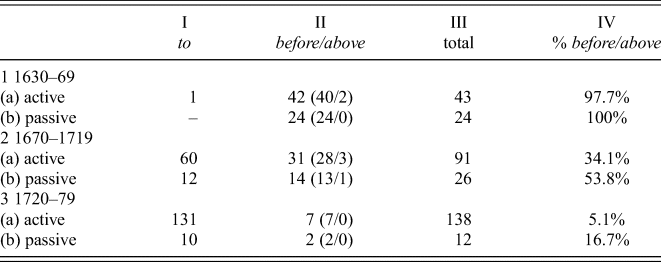
While above has been around as a rare competitor of before and to since at least the Early Modern English period, modern to began to assert itself at the expense of before only towards the middle of the seventeenth century. At present, to itself is being challenged by over, which has become a prominent option in American newspapers. Unlike to, which has a multitude of non-transparent and highly abstract functions, the other three prepositions in examples like (6) constitute immediately transparent transfers from the spatial or temporal domain to the abstract one of rank. This is why we can regard to in (6) as a less explicit grammatical element than the other three. In the case of Late Modern English, we would accordingly predict that – together with the rare use of above – the outgoing option before should be preferred over to in more complex environments. Consider the evidence in table 2 retrieved from the English Prose Drama database (EPD), which deals with the voice contrast. While the results for the periods 1630–69 and 1720–79 are far from statistically significant, those for 1670–1719 suggest, at p <0.10, that before is preserved longer in passive than active clauses. This active-passive asymmetry is, at p <0.025, clearly confirmed for the first part of the eighteenth century in the Eighteenth Century Fiction corpus (ECF1) (see table 3).
The expression of dispreferred alternatives with the verb prefer by means of the prepositions to and before/above in the English Prose Drama corpus (EPD) between 1630 and 1779

Note: The bracketed figures distinguish between before and above.
The expression of dispreferred alternatives with the verb prefer by means of the prepositions to and before/above in ECF1 (the first part of the Eighteenth Century Fiction corpus containing authors born between 1660 and 1699 and publications dating from 1705 to 1754)

Note: The bracketed figures distinguish between before and above.
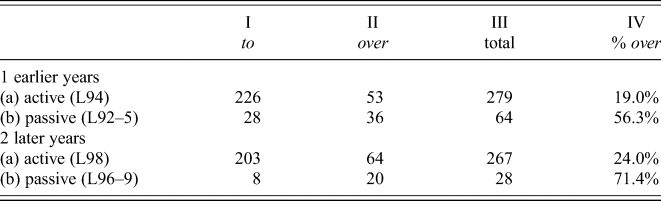
This brings us to the rivalry between to and over, which is well documented in the language of American newspapers (see table 4). Here, we note again that the more explicit preposition, namely over, shows a special affinity for the passive. The use of over replacing to is illustrated in examples (7) and (8), drawn from the Los Angeles Times for 1994.
(7) … they preferred speed bumps over stop signs … (L94)
(8) Peer counselors are preferred over adult counselors … (L94)
The expression of dispreferred alternatives with the verb prefer by means of the prepositions to and over in the Los Angeles Times for 1992–9

Note: The information concerning the later years is reproduced from Rohdenburg & Schlüter (Reference Rohdenburg and Schlüter2009: 387).
Moreover, the comparison of earlier and later years suggests that, while the use of over is increasing, the gap between actives and passives seems to be widening: concerning the shares of over, the difference between the active and the passive has increased from 37 percentage points to 47.
2.2 The rivalry between on and upon
This section focuses on verb-dependent prepositional phrases introduced by the contextually equivalent prepositions on or upon. Concerning the rivalry between on and upon, recent studies have shown that the use of upon has been declining for centuries (e.g. Mair Reference Mair, Lüdeling and Kytö2009; Hundt & Leech Reference Hundt, Leech, Nevalainen and Traugott2012). If anything, this development may have contributed to the divergence of the two variants in terms of grammatical explicitness. Rohdenburg (Reference Rohdenburg1996) describes the situation as follows:
… upon may be regarded as more explicit than on, and perhaps for two reasons. One –tentative – reason may be that the longer variant is simply more prominent phonologically, and, therefore, a more effective signal, in particular in cases of increased processing complexity. The second and more important reason is a semantic one. Comparing the interpretations available with on and upon, we find that on is far more general in meaning than upon. While on involves a great variety of concrete and abstract uses, upon definitely favors [sic] certain abstract uses … (Rohdenburg Reference Rohdenburg1996: 170)
In a similar vein, Hundt & Leech (Reference Hundt, Leech, Nevalainen and Traugott2012) conclude that upon shows a definite affinity for lexically bound uses including verb-dependent ones. The environments favoured by upon certainly include those expressed by the verbs that are dealt with in this section and those in sections 3.1–3.2 below. And with these verb-dependent uses we would expect upon to be favoured in complex environments.
Here, we are concerned with the class of verbs instantiating the frame V – NP1 – on/upon NP2, where the prepositional phrase following the direct object is licensed by the verb in question. The class includes the items listed in (9).
(9) bestow, confer, exert, foist, force, heap, impose, inflict, lavish, levy, loose, obtrude, serve, shower, unleash, visit, wish, urge etc.
In pilot studies involving The Times for 1990 (not detailed here) I have examined four of these items, representing, respectively, a very common verb in this context (inflict), two less common ones (bestow and confer), and a relatively rare one (foist). All of them have been found to display fairly similar distributional profiles.
This article presents a detailed analysis of two of these verbs, inflict and foist. In canonically ordered active clause structures as in (10), the verb is followed, in this order, by the direct object and the prepositional object.
(10) They inflicted/foisted these ideas on/upon their unwitting clients.
Apart from canonical active structures and the passive, the analysis includes two kinds of non-canonical active uses as in examples (11) and (12).
(11) These are some of the ideas that they inflicted/foisted on/upon their unwitting clients.
(12) They inflicted/foisted on/upon their unwitting clients some of the ideas they had picked up lately.
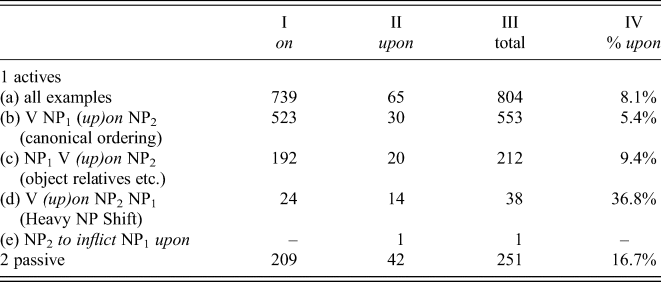
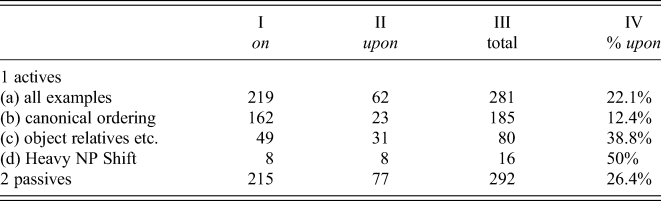
Examples like (11) involve object relativisation (and a few related patterns referred to in row 1c of table 5 below) where the direct object precedes the verb. In common with a succession of (psycho)linguists (e.g. Ford Reference Ford1983; Gibson Reference Gibson1998; Diessel Reference Diessel, Givón and Shibatani2009) I am assuming that object relatives are harder to process than both canonical actives and subject relatives. In (12), an unusually ‘heavy’ direct object has been moved across another constituent to clause-final position, a reordering commonly referred to as Heavy NP Shift (see e.g. Kimball Reference Kimball1973; Wasow Reference Wasow2002). As is well known, strict adjacency of the verb and its direct object is a characteristic feature of Modern English. Unlike object relativisation as in (11), which is not subject to any special conditions relating to the relative ‘heaviness’ of the direct object, the extraposition seen in (12) is usually only acceptable in proportion as the weight of the direct object exceeds that of the preceding prepositional phrase. This suggests that Heavy NP Shift as in (12) might increase the processing load of the overall clause to a greater extent than does object relativisation. Compared with canonical examples like (10), we would therefore expect examples like (11) to show a moderate increase in upon and examples such as (12) to produce a distinctly larger one.
The verb inflict in the Daily Mail and Mail on Sunday for 1994–8 (120, 561, 301 words)

Note: Similar orderings to object relatives may be found in dependent interrogative clauses, than-comparatives or infinitival constructions such as (i).
(i) It is an appalling burden to inflict on a small child. (m94)
Row 1e refers to an exceptional case involving a stranded preposition:
(ii) … an overaged yob in search of a bus shelter to inflict graffiti upon. (m94)
As seen in table 5, both expectations are confirmed. The evidence comparing canonical uses like (10) and object relatives like (11) (see rows 1b and 1c) is statistically significant at p <0.05, while that comparing object relatives as in (11) and Heavy NP Shift as in (12) (see rows 1c and 1d) is even extremely significant at p <0.001. Furthermore, at p <0.001, the overall percentage of upon in the passive is twice as high as that of the active. Incidentally, here as elsewhere, the selection of the Daily Mail is simply motivated by the observation – made in previous work (Mondorf Reference Mondorf2009) – that tabloids may reflect certain processing constraints more clearly than quality papers.
The analysis of the less common verb foist is presented in table 6. In order to achieve statistically worthwhile results, in particular for the rarer patterns shown in (11) and (12), we have resorted to the vastly increased database provided by a broadsheet, The Daily Telegraph and Sunday Telegraph for 1991–2000, 2002, 2004–5 (amounting to 478,837,275 words). It is apparent that, in each of the rubrics distinguished, the percentages of upon are higher than the corresponding ones in table 5. No doubt, this effect is due to the replacement of inflict by a more formal and less common verb in conjunction with the choice of a quality paper over a tabloid. Even so, the evidence in table 6 displays fairly similar contrasts to those in table 5, including that between passives and canonical actives (at p <0.001). Admittedly, while pointing in the expected direction, the results comparing (a) object relatives and Heavy NP Shift as well as (b) passives and all active uses fail to reach statistical significance.
The verb foist in The Daily Telegraph and Sunday Telegraph for 1991–2000, 2002 and 2004–5

2.3 The rivalry between in and into in directional phrases
A broadly similar contrast to on vs upon in the preceding section is provided by that of in vs into in directional phrases. Here, too, we are dealing with contextually equivalent items. This study focuses on transitive uses of the verb put as in (13) and (14).
(13) …, she put her clubs in the boot of her car, … (m94)
(14) The danger comes if is [sic] put into a bottle or feeder cup, … (m93)
The choice of put is motivated by three considerations: (i) as a transitive verb, it can be passivized as in (14), which allows us to analyse the voice contrast; (ii) in the relevant use some directional phrase is obligatory, which clearly facilitates the search procedure; (iii) put probably is the most common transitive verb associated with the rivalry between in- and into-phrases. In (13) and (14), the prepositional phrases associated with put indicate the goal of the actions described. While into is confined to such directional uses, in is typically found with indications of place elsewhere. This means that – in examples like (13) and (14) – the more specific and strengthened preposition into represents the more explicit variant. Accordingly, we are led to expect that the proportion of into should be higher in the (more complex) passive than the active.
The hypothesis has been tested in the Daily Mail and the Mail on Sunday for 1993–2000 with the 22 lexemes given in list (15) (including both the singular and the plural). The list involves a representative, though arbitrarily chosen, group of ordinary and concrete container nouns.
(15) bag, basket, bin, boot (immediately followed by an of-phrase as in (13)), bottle, bowl, container, cupboard, drawer, freezer, fridge, jar, oven, pram, purse, safe, saucepan, sink, suitcase, tin, wallet, wardrobe
In line with the Complexity Principle, a range of previous studies in other domains suggests that the division of the object category into personal pronouns and all other cases might provide a similar contrast in the active, with (the simpler and more accessible) personal pronouns triggering a smaller proportion of into than the (more complex) remaining cases (see e.g. Quirk Reference Quirk1957; Wasserman Reference Wasserman1976; Tottie Reference Tottie, Melchers and Warren1995; Rohdenburg Reference Rohdenburg1996, Reference Rohdenburg, Cuyckens and Radden2002; Temperley Reference Temperley2003). This assumption will also be investigated. To guarantee a high degree of comparability concerning the examples retrieved, the analysis is restricted to examples like (13) and (14) involving concrete containers, thus disregarding any non-literal uses such as those in (16).
(16) I don't want to be put in a drawer. (m93)
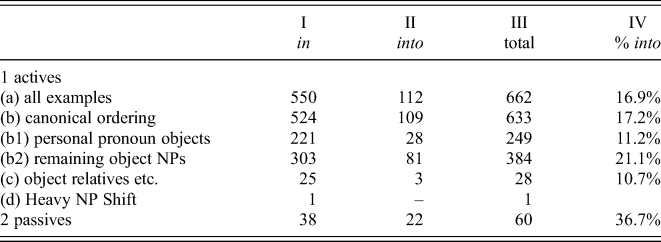
An overview of the corpus analysis is presented in table 7, which delivers two expected findings. On the one hand, at p <0.001, the more explicit preposition into does indeed display a higher proportion of examples in the passive than all actives or the canonical active (see rows 1a, 1b and 2). On the other, the evidence in rows 1b1 and 1b2, which is highly significant at p <0.01, exhibits a similar divergence in the active between the two types of object NPs examined: personal pronouns and the remaining (mostly full) NPs. As expected, the more complex type induces a higher ratio of into-phrases than do personal pronouns. The parallel between the active–passive contrast and that between personal pronouns and other NPs in the active is important since it underscores the assumption that the active–passive asymmetry is also motivated by the Complexity Principle. There are two kinds of transitive uses in the active that are less well attested: Heavy NP Shift represented only by example (17), and 28 instances of object relatives and related structures as in (18).
(17) … losing our freedom to put in our own bins what we like, when we like. (m98)
(18) … and a photograph … which I put into a drawer … (m00)
The use of in and into after the verb put in the Daily Mail and Mail on Sunday for 1993–2000 (206, 762, 410 words)

Admittedly, the low proportion of into with object relatives and similar orderings does not agree with the behaviour of upon-phrases after inflict and foist in section 2.2 and that of unto-phrases after a set of five verbs in section 2.5 below. We will return to the contrast between in and into in section 3.5.
2.4 The rivalry between on and onto (on to) in directional phrases
Comparing on and onto (or on to) after transitive motion verbs, we find that – just like in and into – they may represent contextually equivalent prepositions. Significantly, while on occurs in both indications of place and direction, onto is confined to directional uses.Footnote 2 This is why, in examples like (19) and (20), onto, the strengthened variant of on, can be treated as the more explicit variant of the two.
(19) Grobbelaar took the package and tossed it on the sofa behind him. (t94)
(20) A grappling hook is tossed on to the ship, and … (t91)
In line with the Complexity Principle, it may be assumed, therefore, that onto should be more strongly attracted to more complex environments including the passive than its less explicit and simpler rival on. Again, the case study presented below involves only one verb, namely toss as in examples (19)–(20). The choice of toss is motivated by several practical considerations. Exploratory soundings suggest that the verbs put and place simply do not – even in large databases – provide a sufficient number of relevant concrete onto-phrases. Turning to the verbs of throwing, which yield a very much higher proportion of onto-phrases, it was toss that appeared to be the most suitable for an initial case study such as this one. Unlike the verbs throw, fling and hurl, toss associated with onto- and on-phrases is hardly ever found with reflexive objects. Reflexive uses involve less than fully transitive clauses in the sense of Hopper & Thompson (Reference Hopper and Thompson1980), they do not have direct passive equivalents and they have occasionally been found to display contrary tendencies to clauses containing non-reflexive objects (e.g. Rohdenburg Reference Rohdenburg2014). More important, at about 30 per cent, toss appears to exhibit the highest passive-active ratio of the verbs of throwing, with chuck, for instance, only providing about 10 per cent in a pilot study (not detailed here).
As in the case of in vs into, the analysis of on vs onto with toss has been restricted to concrete uses like (19) and (20) involving surface contact, thus ruling out non-literal examples such as (21):
(21) … they tossed Confucius on to the ashheap of history. (t04)
The textual frequency of on(to)-phrases after transitive toss is very much lower than that of in(to)-phrases after transitive put. To obtain statistically worthwhile results for transitive toss associated with an (on)to-phrase, it has been necessary, therefore, to make use in table 8 of a substantially enlarged database over that in table 7.
The use of on and onto after the verb toss in British newspapers: t90–00, g90–00, d91–00, i93–4 (1, 165, 367, 553 words)

Note: There are no examples of Heavy NP Shift and only three instances of object relative clauses.
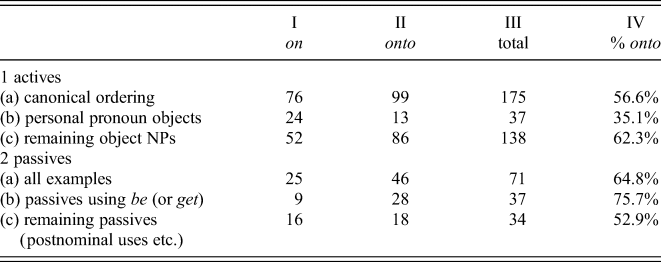
While suggesting that passives induce a higher proportion of onto-phrases than actives, the evidence in table 8 is far from significant (at p < 0.24). However, within both the active and the passive, we find a clear-cut contrast – in the expected direction – between arguably more or less complex uses.
As regards the active, the evidence shows that the (simpler) personal pronoun objects as in (19) tend to trigger a lower proportion of the more explicit onto-phrases than the remaining (more complex) object NPs. The relevant data in rows 1b and 1c, which parallel the corresponding ones in table 7, turn out to be highly significant (at p <0.01).
In the passive, a distinction can be drawn between those instances containing be (or get) as in (20) and all others not containing the copula. The latter category is overwhelmingly represented by postnominal uses as in (22).
(22) … to sleep on a mattress tossed on the floor. (t94)
In some other domains, reduced constructional variants have been shown to trigger lower proportions of variable grammatical markers. A case in point is provided by infinitival interrogative complements as in (23a), which tend to be associated with lower shares of introductory prepositions than their finite counterparts as in (23b) (Rohdenburg Reference Rohdenburg, Cuyckens and Radden2002: 89–90; Reference Rohdenburg, Rohdenburg and Mondorf2003: 228–32).
(23)
(a) They were at a loss how to react.
(b) They were at a loss as to how they should react.
As expected, the evidence in rows 2a and 2b of table 8 shows that, at p <0.05, the reduced passive variant is less likely to select the more explicit onto-phrase than the be-passive.
2.5 The rivalry between to and unto in the sixteenth and seventeenth centuries
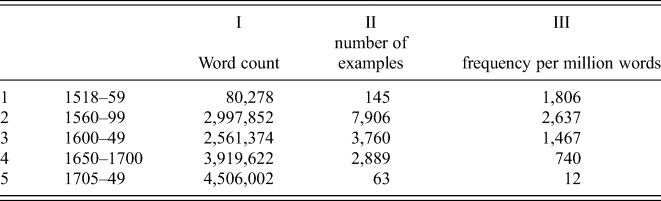
Next we turn to the contrast between to and unto in Early Modern English. While to is still going strong in its prepositional function, unto has been obsolescent or obsolete outside biblical language for the last few centuries. The evidence in table 9 shows that the decline of unto was dramatic between the sixteenth and eighteenth centuries.
The decline of unto in the EEPF and the ECF between 1518 and 1749

The database used in the following is confined to the EEPF, whose publications range from 1518 to 1700. Admittedly, the text base preceding 1555 is extremely small, accounting only for 0.6 per cent of the total of 9,562,865 words.
In parallel with on vs upon, in vs into, on vs onto and with vs withal, the strengthened variant unto could be expected to be a more explicit grammatical element in certain environments than prepositional to. However, a look at the OED entry for unto suggests that – discounting a rare use of unto for until – the semantic spectrums of to and unto are absolutely congruent. Even so, I think we can make a good case for the assumption that unto is a more explicit exponent than to of its prepositional function with transitive verbs like present as in (24). These verbs will be discussed below.
(24) Parmenio presented this trauel vnto the Emperour. (EEPF, 1582)
To begin with, the cue validity of unto should be rated higher than that of to for two reasons. First – just like the morphologically strengthened items upon, into and onto – unto may be regarded as a more effective signal of its function thanks to its prosodic bulk alone (see the introduction of upon in section 2.2 above). Second, while unto is only used as a preposition, the predominant use of the form to is that of an infinitive marker.
More important, there are a number of distributional arguments pointing in the same direction. Those to be reported here relate to the greater affinity of unto than to for a restricted spectrum of uses within its potential range of application. In other words, we are assuming that unto is favoured in some grammatical areas and disfavoured in others. To be able to identify more or or less typical uses of unto we need to know its average proportional use throughout the EEPF. The texts sampled for the sixteenth century and the timespan 1600–1700 are enumerated in lists (a) and (b).
(a) 1555–99: AN01.555: 20,351 words, AN01.560: 6,695 words, 542010241.575: 36,630 words, 5550101M.579: 35,035 words, AN01.568 + FL01M.568: 32,521words, FL01M.585: 39,629 words, 5580105M.588: 19,971 words, 5580201M.596: 32,828 words
(b) 1600–1700: 5430104M.612: 26,659 words, AN01.632: 31,087 words, FL01 F.651: 30,141 words, AN0.672: 35,281 words, AN01.699 + AN02.699: 17,584 words.
The last three digits of the text codes listed in (a) and (b) indicate the years of publication of the text samples involved. This shows that they have been selected to be representative of the two timespans. The differing number of probes is explained by the fact that the respective proportions of unto show a greater fluctuation in the sixteenth century than the seventeenth century.
On the basis of the samples in (a) and (b), the average proportion of unto rivalling to has been estimated at 13.6 per cent for the sixteenth century (3,078,134 words) and at 4.1 per cent for the timespan 1600–1700 (6,484,730 words). Allowing for the quantity difference between the two periods, the weighted average percentage of unto for the whole EEPF amounts to 7.2 per cent of the total.
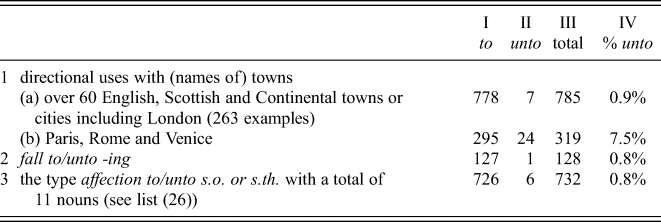
In the following, I will argue that the prototypical domain of unto-phrases is that of verb-dependent arguments, in particular those involving human or related NPs. Accordingly, there should be many areas typically avoided by unto. Let us take a brief look at three such tendencies as indicated in table 10.
The distribution of to and unto in three areas outside of verb-dependent human arguments in the EEPF

First, comparing to and unto in their directional uses involving place names, we find that, at 0.9 per cent, the proportion of unto with (the name of) any British and Continental town or city is well below that of the estimated average of 7.2 per cent for the whole EEPF. It is only (the names of) Paris, Rome and (perhaps also) Venice that – unlike London – assume a special role: presumably owing to their exceptional status in terms of sheer size, cultural or religious importance and economic strength these names induce, at 7.5 per cent, a distinctly higher percentage of unto matching that of the overall average.
The second area shunned by unto is represented by (certain types of) gerunds. In their earlier stages, gerunds were mostly introduced by prepositions (see e.g. Fanego Reference Fanego2016). Yet unto is rarely found as a rival of to. For instance, in the entire EEPF, the aspectual use of fall + preposition +V-ing – apart from examples featuring on, in and the reduced form a – is represented by only one example using unto, namely (25), and 127 instances involving to.
(25) …, and they fell vnto belabouring of him with their whips, … (EEPF, 1603)
The third case study in table 10 concerns the class of nouns in list (26), which denote personal feelings or attitudes towards somebody or something. Their usage is illustrated in (27), where the prepositional phrase after hatred or affection is a complement of the noun rather than constituting an independent argument of the verb.
(26) affection, aversion, constancy, friendship, hate, hatred, inclination, lust, malice, obligation, revenge
(27) … it was only her hatred to Babtisyna and her affection to Amarantha which drew her to this resolution … (EEPF, 1635)
Again, it is found that the proportion of unto is well below that of the estimated average percentage for the whole EEPF.
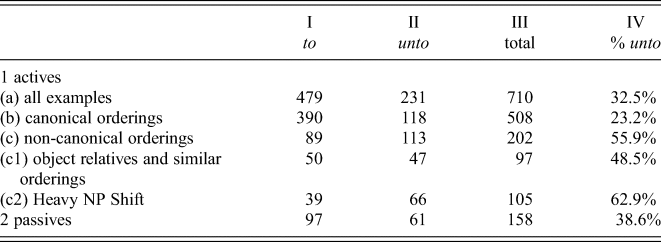
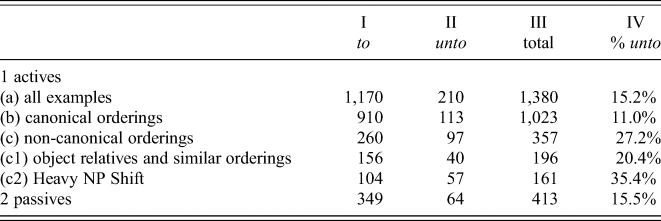
By contrast, two large-scale investigations – displayed in tables 11–12 in this section and in table 17 in section 3.6 below – have shown that verb-dependent prepositional arguments featuring human or related NPs attract a strikingly higher proportion of unto than the estimated average percentage for all of its uses. On the basis of these observations, we can assume – that at least in these constellations – unto constitutes a more explicit grammatical element than to.
The distribution of to and unto after five transitive verbs (commit, deliver, offer, present, reveal) in the EEPF data between 1555 and 1599

The distribution of to and unto after five transitive verbs (commit, deliver, offer, present, reveal) in the EEPF data between 1600 and 1700

The analysis to be presented in this section deals with five reasonably common verbs of transfer and showing that occur in the same clausal patterns as inflict or foist in section 2.2: commit, deliver, offer, present and reveal. They may be associated with both a passivisable direct object and a prepositional object introduced by either to or unto and which typically involves human or human-related NPs. As is done in tables 5 and 6 for inflict and foist, we distinguish between canonically ordered active clauses as in (28a), object relatives (or similar structures) as in (28b), Heavy NP Shift as in (28c) and passives as in (28d).
(28)
(a) … master Eyer, who … committed the gouernment of his ship to John the Frenchman, … (EEPF, 1637)
(b) … impatient of businesse; which hee oft committed to untrusty seruants. (EEPF, 1625)
(c) … I must … commit vnto thy secrets a matter of import, … (EEPF, 1617)
(d) …, that the determining of controversies was committed vnto them, … (EEPF, 1625)
All five verbs display the same general tendencies. However, to bring out a maximum of functionally based distinctions, it has seemed preferable to treat them together. This way we can afford to distinguish between two chronological timespans, the sixteenth century and the period ranging from 1600 to1700. As expected, the evidence summarised in tables 11 and 12 allows us to make fairly similar observations to those presented in section 2.2 for the pair on and upon associated with inflict.
The data in both tables reveal that there is a clear-cut contrast, at p <0.01 for both timespans, between canonical and non-canonical orderings in active clauses. Within the domain of non-canonical orderings, we can observe again a significant contrast – at p <0.05 for the sixteenth century and at p <0.01 for the timespan 1600–1700 – between object relatives etc. and Heavy NP Shift. The latter structure displays the highest proportion of unto at 62.2 and 35.4 per cent for the two periods, respectively. In other words, the analysis of the contrast between to and unto has produced strikingly similar results to that between on and upon after inflict and foist in section 2.2. However, concerning the relationship between passives and actives overall in tables 11 and 12, the expected contrast turns out to be non-significant. But then, we do find a greater proportion of unto in passives than canonical actives, at p <0.001 for the sixteenth century and at p <0.025 for the timespan 1600–1700, respectively. This parallels the situation found in table 6 concerning the rivalry between on and upon after foist. Thus, the lesson to be learnt here as well is that passives should ideally be compared with what seem to be their most direct active counterparts, i.e. canonical actives. If the number of non-canonical orderings in the active is too high, this may distort the overall relationship between actives and passives.
3 Preposition stranding and the frame verb + prepositional phrase
3.1 The rivalry between on and upon in prepositional objects preceding to-infinitives
Most likely, Andersson (Reference Andersson1985: 63–5) has to be credited with having discovered the active-passive asymmetry involving the use of on vs upon. However, he was not concerned with verbs like inflict that – in the active – typically use the frame verb + direct object + prepositional object dealt with in section 2.2. Andersson's treatment was confined to the five verbs in list (29) and to constructions like (30a, b), where the frame verb + prepositional object and its passive counterpart are associated with a following infinitive.
(29) call, count, depend, prevail, rely
(30)
(a) The journalists called/prevailed on/upon 10 Downing Street to release the document.
(b) 10 Downing Street was called/prevailed on/upon (by the journalists) to release the document.
Comparing the aggregate tallies of these five verbs in constructions like (30a, b) in his narrative database, Andersson notes that in the passive upon clearly outnumbers on (at 15 instances out of a total of 17). By contrast, in the active tally of 17 examples, on is said to be ‘somewhat more common than upon’ (Reference Andersson1985: 65). If we can assume that there are (at least) 10 instances of on in the active, the active-passive contrast is highly significant at p <0.01.
Previous studies using large electronic databases have provided further evidence in support of these asymmetries either for the five verbs taken together or for individual verbs (see e.g. Rohdenburg Reference Rohdenburg1996: 170–1 on prevail and Rohdenburg Reference Rohdenburg, Cuyckens and Radden2002: 90–1 on call). Moreover, in the case of call, Rohdenburg (Reference Rohdenburg, Cuyckens and Radden2002) has shown that, in active clauses, (easy-to-process) pronouns are less likely to be associated with upon-phrases than all other NPs.
With reference to the passive participle of call as in (30b) (immediately preceding on or upon), an anonymous reviewer wonders whether the Principle of Rhythmic Alternation (see e.g. Schlüter Reference Schlüter2005) may play a role here in favouring upon. I am convinced that several case studies in this article would greatly benefit from the inclusion of the prosodic perspective (see my observations in section 3.2 and the conclusion). However, despite showing similarly striking contrasts between the active and the passive, two of the five verbs in list (29), namely count and depend, would not infringe the Principle of Rhythmic Alternation if they happened to favour on over upon immediately following their participial forms.
There is an important difference between cases like (30a, b) and those dealt with in section 2.2. Passive examples like (30b) invariably involve stranded prepositions, a property which Andersson (Reference Andersson1985: 65) only touches upon. Preposition stranding is a specific manifestation of filler-gap dependencies as discussed by Hawkins (Reference Hawkins1999: 276–7). All of them are assumed to involve increased processing loads compared with corresponding structures without gaps. Hawkins goes on to argue that gaps after prepositions are more difficult to process than gaps after verbs. The same conclusion may be drawn from Keenan & Comrie's (Reference Keenan and Comrie1977) Accessibility Hierarchy, which implies in the case of relativisation that, cross-linguistically, direct objects rank higher than prepositional objects. Accordingly, constructions involving preposition stranding will be treated as specific manifestations of increased grammatical complexity. In the following, the environments associated with preposition stranding will also be included in the broad category of non-canonical structures (for a useful overview of the range of possibilities involved see Yáñez-Bouza Reference Yáñez-Bouza2015: 4–5). On the other hand, with the verbs under consideration in this and the subsequent subsections, the term canonical will be confined to ‘unmarked’ actives where the subject + verb combination precedes a continuous prepositional phrase as in (30a) above. This means that corresponding Pied Piping structures are also regarded as non-canonical. Owing to their general infrequency in Present-day English, they have usually been neglected in this article (see, however, section 3.2).
At this point, it may also be instructive to draw the reader`s attention to the cross-linguistic distribution of preposition stranding. As pointed out by Maling & Zaenen (Reference Maling and Zaenen1985) and Truswell (Reference Truswell2009), there are several languages which may use stranded prepositions only in the active, but none that allow preposition stranding only in the passive. In addition, in certain environments such as (31), passives can be shown to strand less freely than actives (Hornstein & Weinberg Reference Hornstein and Weinberg1981: 65).
(31)
(a) Which problems did you talk to Harry about?
(b) *Those problems weren't talked to Harry about.
The observations made by Maling & Zaenen, Truswell and Hornstein & Weinberg suggest that the processing load produced by preposition stranding in the passive should be higher than that found in the active or that the intrinsic complexity of passives is increased in cases like (31b) which additionally involve preposition stranding. The hypothesis is further supported by the fact that – with variably prepositional verbs like agree in present-day British English – preposition stranding is tolerated more easily in active than passive clauses (Rohdenburg Reference Rohdenburg2017). In line with the Complexity Principle, we would then expect the replacement of on by the more explicit upon to be more common in the passive than the active. Ideally, we should therefore compare passives like (30b) not only with active structures like (30a), which do not involve preposition stranding, but also with those containing stranded prepositions. Unfortunately, since stranded prepositions – in most active clauses featuring two-place prepositional verbs – are comparatively rare, such comparisons often involve extremely large databases. However, by (a) collapsing verbs featuring reasonable proportions of stranded prepositions in the active and by (b) substantially increasing the database in the following sections, we have been largely able to overcome the problem.
3.2 The rivalry between on and upon with other prepositional verbs
There are many other prepositional verbs that also offer a choice between on and upon in both the active and the passive and which are not complemented by an additional infinitive. Given sufficiently large databases it should be possible to provide more detailed analyses going far beyond the simple contrast between passive clauses and all actives referred to in the preceding section. In particular, we will test the hypothesis that preposition stranding in passives correlates with higher proportions of upon than preposition stranding in actives. Pilot analyses involving the first few relevant verbs that had occurred to me (see list (32)) suggest that all of them display the expected behaviour. For an in-depth study I have chosen the verb embark, whose (prepositional) object nouns will – for the sake of homogeneity – be confined to the twelve common items listed in (33).
(32) dote, embark, expand, frown, intrude, pounce, prey, pronounce
(33) adventure, campaign, drive, enterprise, initiative, journey, policy, programme, project, scheme, tour, venture.
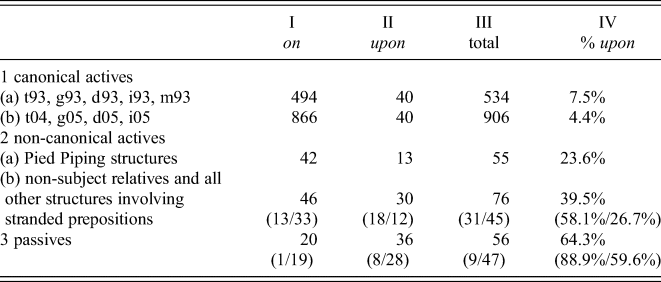
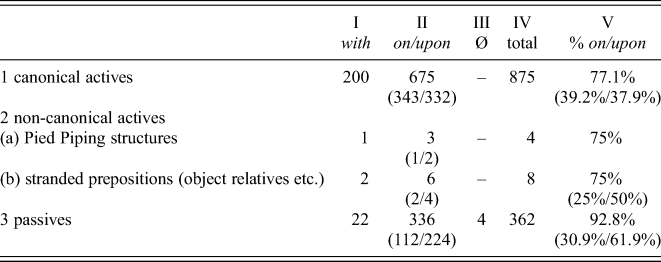
In the case of embark, which also displays a striking active-passive asymmetry (see table 13), it has proved to be both possible and illuminating to distinguish between the following structural choices in the active and the passive:
(i) canonical active uses as in (34), where the verb precedes the prepositional object,
(ii) (non-canonical) active Pied Piping structures as in (35),
(iii) (non-canonical) active uses involving preposition stranding as in (36), and
(iv) passive uses necessarily involving preposition stranding as in (37).
(34) They are embarking/embarked on/upon an extensive advertising campaign.
(35) The project on/upon which they had embarked …
(36) This was the most ambitious programme (that/which) they had embarked on/upon so far.
(37) The policy (which was) embarked on/upon two years later …
The prepositional verb embark associated with prepositional object or subject noun phrases featuring twelve different nouns in British newspapers

Note: The category of active forms includes a sprinkling of combinations like is/was embarked, where the past participle conveys a similar interpretation to the present participle. Both non-canonical active structures and passive uses have been retrieved from the following newspapers: t90–00, g90–00, d91–00, i93–4, m93–00.
The evidence in rows 1a and 1b of table 13 (which is statistically significant at p <0.025) shows that the decline of upon is still ongoing. In addition, the results in table 13 reveal that – in the active – the use of upon is promoted by both Pied Piping and preposition stranding, with the latter environment displaying a distinctly greater affinity for upon than the former. Crucially, within the domain of stranded prepositions, it is the passive that clearly attracts a higher proportion of the strengthened and more explicit variant than the active. In both cases, it has been possible to examine the role of clause-final position as well. Accordingly, the bracketed figures distinguish (in that order) between those clauses explicitly indicated as completed by the use of certain punctuation marks (./,/;/–/:/?) or generous headline spaces and all other instances. It is seen that the use of the preposition at the end of clauses explicitly marked as such increases the share of upon in both active and passive clauses. However, while the results for the active are highly significant at p <0.01, those for the passive are not statistically significant at p <0.10.
3.3 The rivalry between stranded with and withal in the sixteenth and seventeenth centuries
In the Early Modern English period and part of the eighteenth century, the preposition with had a rival in the morphologically strengthened form withal. More specifically, unlike with, withal happened to be confined to the function of a stranded preposition as, for instance, in examples (38a, b) (see e.g. the OED s.v. withal and Yáñez-Bouza Reference Yáñez-Bouza2015: 36, 81).
(38)
(a) … a Ladie in this Court, whome I knowe not howe to speake withal, … (EEPF, 1598)
(b) … and still she would not be spoken withall, … (EEPF, 1626)
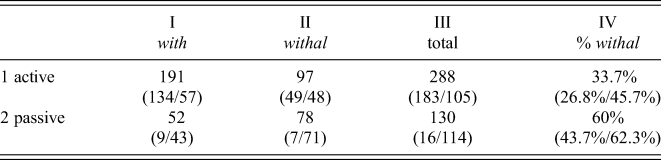
This means that, despite the potential interference of adverbial withal, the function of a stranded preposition was presumably more clearly signalled by withal than with. In line with the Complexity Principle and the observations made in the preceding subsection, we would thus assume that, compared with its simpler rival with, withal should be attracted more strongly to the passive than the active. The ensuing analysis is based on eleven verbs discovered so far in the Early Modern English Prose corpus (EEPF) which, individually, meet the following conditions: (i) they occur in stranding contexts, (ii) they are attested with both competing prepositions, and (iii) they are found in both the active and the passive. The overall (non-bracketed) results in table 14, which are extremely significant at p <0.001, confirm the assumption that the proportion of withal is higher in the passive than the active. Furthermore, concerning the bracketed information, both the high-frequency verb meet and the remaining verbs as a whole are seen to favour the use of withal in the passive. However, while the evidence for meet – due to its low share of passive examples – fails to reach the basic level of significance set at p <0.05, that for the remaining ten other verbs is significant at p <0.01.
The rivalry between with and withal functioning as stranded prepositions associated with the verbs bear, compound, converse, deal, dispense, fight, meet, meddle, play, speak and talk in the EEPF

Note: The bracketed figures distinguish between the high-frequency verb meet and the remaining verbs.
Incidentally, the contrast between with vs withal is less mysterious than might have been thought. We could interpret the situation as just another manifestation of the threefold division seen with on and upon on a scale ranging from canonical actives via preposition stranding in actives to preposition stranding in passives. The only difference is that – at zero – the proportion of the strengthened alternative withal in canonical actives simply represents an extreme case on the scale in question.
3.4 The rivalry between with and on/upon after prevail in Late Modern English
So far, the discussion of stranded prepositions possessing more or less explicit rivals has been concerned with morphologically related variants, on vs upon and with vs withal. This section returns us to prevail, one of the verbs mentioned in section 3.1 as occurring in prepositional object + to-infinitive constructions. As shown in previous studies (Rohdenburg Reference Rohdenburg, Plag and Schneider2000: 34–5; Reference Rohdenburg2007: 224), the present-day rivalry between on and upon after prevail was preceded by that between with, on and upon in Early and Late Modern English.
The loss of with in the prepositional object + to-infinitive construction is not an isolated case. Of the verbs and adjectives in (39) once compatible with the combination with-phrase + to-infinitive, only two verbs denoting weak manipulative acts, plead and intercede, have retained the original construction.
(39)
(a) expostulate, insinuate, intercede, labour, plead, prevail, work
(b) be + adjective: eager, earnest, importunate, instant, solicitous, urgent
The remaining ones have either given up the construction involving prepositional objects + to-infinitives altogether or, as in the case of prevail, they have switched over to on or upon. Throughout the period during which the preposition with was declining in favour of on or upon, the latter variants were established much faster in the passive than the active. For instance, this can be seen in table 15 (p <0.001).Footnote 3
The verb prevail associated with the combination of (prepositional) object + to-infinitive and the corresponding passive in the ECF (1705–80)

The most central Old English sense of with (still visible in withstand) corresponds to that of (formal) German wider ‘against’. Over time, the novel comitative and instrumental senses of with had been strengthened, making the preposition increasingly inappropriate for the representation of relatively strong manipulative acts such as those described by the verb prevail. This is why the findings in table 15 can be accounted for in terms of the Complexity Principle: with, the preposition least suited to referring to strong manipulative acts (and therefore the least explicit item in this environment) was more strongly disfavoured in the passive than the active. Incidentally, while the results of table 15 do not yield sufficient examples to warrant any detailed statements concerning both types of non-canonical actives, they do indicate that the special affinity of upon for the passive has been around for at least 200 years. Finally, it may come as a surprise to find that there are also four passive examples like (40) not containing any preposition at all.
(40) And had I thought of being prevailed to marry any other man, … (ECF, 1754)
At first blush, this voice split could strike one as utterly paradoxical. On the one hand, the preposition on tended to be replaced in the passive by the more explicit and strengthened variant upon, and on the other it was dispensed with altogether. However, I do not think we are dealing here with an idiosyncratic occurrence of the zero option. To begin with, the four examples of type (40) come from four different authors, and moreover, the phenomenon surfaces in other historical databases (Rohdenburg Reference Rohdenburg, Plag and Schneider2000: 35). In any case, in a complementary study, Rohdenburg (Reference Rohdenburg2017) provides two further case studies on the coincidence of the zero variant and an increased use of stranded upon instead of on, suggesting that this constitutes a fairly regular phenomenon. Thus, with variably prepositional verbs, the awkward stranded preposition may be made more prominent and explicit or it may be omitted altogether.
3.5 The rivalry between in and into with get (oneself) in(to) (…) mess
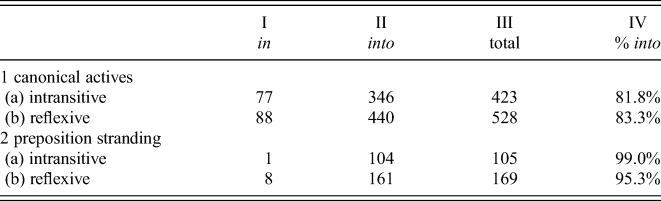
The contrast between in and into as constituents of transferred directional collocations like get (o.s.) in(to) (…) fight(s)/habit/hot water/mess/muddle/pickle/tangle/ trouble has been dealt with before (Rohdenburg Reference Rohdenburg2009: 174–5; Reference Rohdenburg2014: 562–3). The two studies focus on the role played, in canonical clause structures, by in and into on the choice between intransitive and reflexive uses of the verb get. As a possible exception to the Complexity Principle, it is found with most of these collocations that, proportionally, into combines less frequently with the reflexive than in. In this section, the focus is on the question of what effect the use of preposition stranding might have on the choice between in and into. Pilot studies involving the above-mentioned collocations suggest that all of them show the same general tendency: in stranding contexts, and in line with the Complexity Principle, into, the more explicit rival, is preferred over in after both intransitive and reflexive uses of get. This article illustrates the behaviour of get in(to) (…) mess in British newspapers. Since the database does not contain any corresponding passive constructions with this type of collocation, we will be comparing active clauses such as (41a, b), distinguishing at the same time between intransitive and reflexive uses.
(41)
(a) How did you get in such a mess? (t04)
(b) It's amazing the mess you got into. (t96)
To retrieve a sufficient number of examples for the purpose in hand we must again make use of an extremely vast collection of British newspapers. The results of the corpus analysis are summarised in table 16. At p <0.001, the evidence confirms the expected contrast between canonical orderings and preposition stranding for both intransitive and reflexive uses.
The type get (o.s.) in(to) (…) mess in British newspapers (t90–04, g90–05, d91–00, 02, 04–5, i93–94, 02–5)

3.6 The rivalry between to and unto in the sixteenth and seventeenth centuries
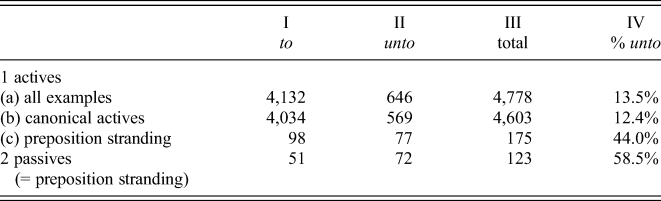
Finally, this returns us to the contrast between to and unto. Unlike the verbs in section 2.5, this section is concerned with verbs complemented only by a prepositional object. Nonetheless, in the verb-dependent contexts circumscribed below, unto must also be regarded as the more explicit variant of the two: anticipating the evidence for the entire EEPF in table (17), we find that the proportion of unto in the relevant contexts (at 14.7 per cent) is well above the approximate overall percentage of unto (at 7.2 per cent), determined in section 2.5.
The investigation includes the combination take + heed (omitting any attributive qualifying elements), which in relevant respects is found to show the same behaviour as the verbs involved. As is done in section 3.2 for the verbs associated with on and upon in Present-day English, we will distinguish between three fundamental clause structures, canonical actives as in (42a), non-canonical actives involving stranded prepositions as in (42b), and passives as in (42c), which invariably feature preposition stranding.
(42)
(a) … this arrogant creature hath often sued to mee, … (EEPF, 1621)
(b) This lady I haue serued long, and often sued vnto, … (EEPF, 1580)
(c) … so lo_g then as Bianca Maria was sued vnto, and … (EEPF, 1567)
Again the purpose is to determine if and to what extent passives and non-canonical actives tend to increase the proportional use of unto over that of canonical actives. With these objectives in mind, I have assembled a total of 20 verbs in addition to take + heed that meet two requirements: each individual item occurs in both the active and the passive and also with both to- and unto-phrases. The full list of the items found so far is given in (43).
(43) agree, assent, attain, carve, carouse, condescend, h(e)arken, listen, look, reply, resort, send, smell, speak, submit, sue, swear, take heed, trust, write, yield
Admittedly, some of these verbs (e.g smell and sue) are also associated with direct objects (along with prepositional ones). Such uses have of course been disregarded.
Both non-canonical actives and passives turned out to be relatively rare, and in order to bring out any contrasts between them no further chronological distinction was made within the EEPF (1518–1700). The results of the investigation are summarised in table 17.
To and unto after 20 non-transitive verbs plus take heed in the EEPF

The evidence leaves no doubt that, here too, and in line with the Complexity Principle, the more explicit variant unto is particularly attracted to non-canonical actives and passives. Moreover, of the two stranding contexts, it is the passive that, at p <0.025, displays the greatest affinity for unto.
4 Conclusion
The present article surveys a grammatical variable in English whose exploration was inspired by Andersson's (Reference Andersson1985) analysis of the voice contrast between on and upon. The variable concerns eight pairs or triplets of contextually equivalent prepositions such as to and over after prefer or in and into in certain directional uses, which may be characterised as more or less explicit grammatical items. The article assumes that the distribution of the rivalling items may be largely accounted for in terms of the Complexity Principle (see e.g. Rohdenburg Reference Rohdenburg1996, Reference Rohdenburg2007, Reference Rohdenburg2016). The principle posits a correlation between the degrees of processing complexity and grammatical explicitness concerned. Crucially, it can be shown that passives tend to increase grammatical explicitness in a number of ways in which they resemble active clauses involving various complications. For instance, with over vs to after prefer, passives are generally found to promote the use of over, the more explicit alternative. In the majority of the cases in question, the more explicit preposition represents a morphologically strengthened variant as in the case of on vs upon or to vs unto.
The treatment of the contrasting prepositions proceeds in two parts. Sections 2.1–2.5 are concerned with verbs instantiating the frame direct object + prepositional phrase. Apart from highlighting throughout the role of passivisation, these sections identify the following grammatical complexities in active clauses favouring the more explicit prepositional rival: full NP objects compared to personal pronouns and the two kinds of non-canonical orderings produced by Heavy NP Shift and object relativisation (or related phenomena). Specifically, as had been expected, full NP objects and Heavy NP Shift display a greater affinity for the strengthened alternative than pronominal objects and object relativisation, respectively. However, the relationship between the active and the passive regarding the incidence of the more explicit preposition is not entirely straightforward. While the passive certainly outscores canonically ordered active clauses, it tends to be exceeded by Heavy NP Shift in the active. Moreover, in most analyses, even object relativisation is seen to produce higher shares of the more explicit preposition than the passive.
Sections 3.1–3.6, dealing with the frame verb + prepositional phrase, focus on preposition stranding as a further specific ordering constraint promoting the more explicit variant in question. Distinguishing between three degrees of structural complexity – ranging from canonical actives without stranded prepositions, via actives with stranded prepositions, to preposition stranding in passives – we have been able to show that these are usually matched by corresponding proportions of the more explicit prepositional alternative. For instance, while the lowest percentages of, say, upon or unto are found in actives using continuous prepositional phrases, the highest tend to be reserved for passives, which, with the verbs in question, necessarily feature stranded prepositions. Compared with the contrast between actives with or without stranded prepositions, that between passives and actives containing stranded prepositions is usually weaker and may not always reach statistical significance even in large-scale analyses.
Another point to be remembered is that the use of stranded upon instead of on has also been found to be sensitive to the end-weight constraint: at least in one analysis, the replacement strategy is applied distinctly more frequently in absolute clause-final position than in other cases where the stranded preposition is followed by additional material (see table 13 in section 3.2). In that respect, the substitution of on by upon is paralleled by the replacement of (synthetic) suffixed comparatives with (analytic) more-comparatives (Mondorf Reference Mondorf2009: 99–107) and the exchange of ordinary verb forms for complex ones involving do-support in Early Modern English affirmative clauses (Eitelmann Reference Eitelmann2016).
No doubt, more work is needed on a variety of further aspects potentially bearing on the variation phenomena discussed but which were deemed to be beyond the scope of the present article. Let me conclude by pointing out just four issues that could repay further study.
In this article, object complexity has been illustrated by the contrast between personal pronouns and all remaining NPs. However, as shown in previous work (e.g. Rohdenburg Reference Rohdenburg, Cuyckens and Radden2002; Berlage Reference Berlage2014) and given even larger databases, it might be well worth introducing, here too, a more delicate breakdown of the object category.
Pied Piping structures are often treated as alternatives to preposition stranding (e.g. Yáñez-Bouza Reference Yáñez-Bouza2015). However, owing to their general infrequency with the verbs investigated, they have only been touched upon in two analyses dealing with the contrast between on and upon (see tables 13 and 15 in sections 3.2 and 3.4). In table 13, which provides sufficient data for a statistical analysis, Pied Piping is shown to encourage the use of upon, though less effectively than preposition stranding in the active. It remains to be seen whether this finding can be substantiated in future work.
Studies of preposition stranding have so far paid little or no attention to the following facts that may be relevant to a proper evaluation of strengthened variants like unto or upon. First, with prepositions displaying both strong and weak forms it is invariably the strong form that is selected as the stranding variant. Second, while phoneticians usually refer to stranded prepositions as being unstressed (see e.g. Cruttenden Reference Cruttenden2008: 268), there are many environments where they regularly or even obligatorily bear sentence stress in English (see e.g. Bolinger Reference Bolinger1971: 40–4, Hoekstra Reference Hoekstra, Haider, Olsen and Vikner1995 and German, Pierrehumbert & Kaufmann Reference German, Pierrehumbert and Kaufmann2006). Crucially, as pointed out by Bolinger (Reference Bolinger1971: 43), longer prepositions like after and about are more likely to receive the nuclear accent – when stranded – than shorter ones like to. Moreover, preliminary analyses contrasting about and on after speak have shown that, proportionally, about is indeed more strongly attracted to stranding contexts than on. All of this suggests that the prosodic prominence associated with stranded prepositions is – with upon, into, onto, unto and withal – reflected on the morphological level. In the case of preposition stranding, we may thus be dealing with a phenomenon where two constraints, its increased processing load and its prosodic properties, act in combination to promote the use of more explicit and morphologically strengthened prepositions. In this connection, it would be of interest to widen the scope of the analysis by including a larger historical and cross-linguistic perspective. For instance, in both Early Middle English and Middle Low German, we find several pairs of prepositional variants which display similar formal and syntactic contrasts to, say, on and upon. Relevant cases are represented by (simple) mid ‘with’ and (strengthened) mide in Early Middle English and their etymological equivalents myt/mit and mede in Middle Low German. In both cases, work in progress by Julia Schlüter and myself indicates that it is the strengthened forms that are especially favoured as stranded variants.
From the stylistic perspective, passives and stranded prepositions have traditionally been regarded as typically representing relatively formal and informal structures, respectively (concerning preposition stranding, see e.g. Bauer Reference Bauer1994: 74). In addition, upon, into, onto and unto, occurring as strengthened and more explicit alternants of on, in, on and to, are often treated as more formal and/or more old-fashioned than their simple counterparts. Yet, paradoxically, as shown in the present article, it is the strengthened prepositions that share a special affinity for preposition stranding. Crucially, there are several further phenomena (see e.g. Allerton Reference Allerton1991) which exclude simply equating increased processing complexity with higher degrees of formality, thus refuting any potential attempt to replace the Complexity Principle wholesale by a stylistic harmony principle.