The Florida Children’s Medical Services (CMS) was established in 1929 and celebrated its 85th anniversary in 2014. During the course of its history, CMS provided a broad range of services to a diverse population of children with a wide range of medical needs. In 1953, Florida CMS cardiac programme was established and has been in operation since then.
Oversight of its cardiac programme has been provided by a cardiac advisory committee for over 50 years, and this committee currently operates as the cardiac sub-committee of the Florida CMS. Membership includes physicians representing all the paediatric cardiovascular facilities participating in Florida Children’s Medical Services.Reference Jacobs, Quintessenza and Burke1
The programme serves children with congenital or acquired cardiac conditions, providing services in the private offices of participating physicians, through a network of community-based cardiac clinics, and through the eight participating centres providing paediatric cardiovascular surgical and medical services. The services provided include cardiac evaluation and diagnosis, diagnostic and interventional cardiac catheterisation, closed and open-heart surgery, as well as evaluation and management of paediatric cardiology patients in an outpatient setting.Reference Jacobs, Quintessenza and Burke1
As part of its responsibilities, the Cardiac Sub-committee of the Florida Children’s Medical Services Network Advisory Council has developed quality standards for paediatric cardiac programmes and includes, among others, descriptions of required infrastructure, training of personnel, and minimum procedural numbers to maintain proficiency, and hence provide quality care. These standards are revised and updated periodically by the committee members. The last revision took place in 2012. These standards and the duties of the Florida Children’s Medical Services Cardiac Advisory Council operate under promulgated rules of the State of Florida that have the force of law (64C-4.003 F.A.C.).
For a paedriatic cardiac programme to be a participating Florida CMS cardiac programme, it must meet or exceed these quality standards. Such standards have been developed for the cardiac surgery, cardiac catheterisation, and outpatient cardiology. Currently, there are eight participating centres in the State, and they all collaborate so as to improve the quality of the care they provide. The main area of collaboration has been in paediatric cardiac surgical outcomes. More recently, these centres have been participating in the IMPACT Registry®, which is a database supported and maintained by the American College of Cardiology®, National Cardiovascular Data Registry® (NCDR). The IMPACT® registry aims to assess the prevalence, demographics, management, and outcomes of paediatric and adult congenital heart disease (CHD) patients who undergo diagnostic catheterisations and catheter-based interventions. Its data support the development of evidence-based guidelines for CHD treatment that will improve outcomes for CHD patients of all ages.
The required components and acceptable outcomes of a paediatric electrophysiology programme, however, had not been defined or established. In 2010, recognising the need for a procedural registry for catheter ablation procedures, The Pediatric and Congenital Electrophysiology Society leadership sponsored the creation of the Multicenter Pediatric and Adult Congenital EP Quality (MAP-IT™) Initiative. The MAP-IT™ registry is intended to provide the infrastructure for meaningful quality assurance, ongoing quality improvement, and ultimately a means for conducting multicentre research in the field of paediatric and congenital electrophysiology.Reference Seslar, Kugler and Batra3
On 9 April, 2012, the Florida CMS cardiac sub-committee approved the formation of a Paedriatic Electrophysiology Task Force whose objective was to establish Paedriatic Electrophysiology standards for the State of Florida. The standards are meant to complement the existing cardiac surgical, cardiac interventional, and outpatient paedriatic cardiology standards already in place. The purpose of this manuscript is to report the progress of this sub-committee. The final document is presented in Appendix 1. This document is set to be added to the rules of the State of Florida.
Methods and results
Composition of the Florida CMS Pediatric EP Task Force
The task force consisted of all the paedriatic electrophysiologists in the State of Florida working in CMS participating cardiovascular programmes. As the group assembled and started discussing our goal of developing paedriatic cardiac electrophysiology quality parameters, we identified several challenges, which will be discussed in this paper.
Search for existing literature and precedent
The initial phase of our work was to search for data and look for precedent. In doing so, we performed two initial activities: a comprehensive review of the peer-reviewed literature and investigation of all other state agencies with similar duties as the Florida CMS.
The literature review focused primarily on historical procedural outcomes, acceptable training standards and infrastructure standards, and infrastructure requirements. Although there is literature stating the minimum amount of cases of electrophysiologic studies and device implantations required in the training stage, there were no data that seek to define the number of studies required to maintain proficiency.Reference John4–Reference Walsh, Bar-Cohen, Hamilton, Reed and Van Hare7 Furthermore, we did not find detailed descriptions of required infrastructure, personnel training requirements for acceptable outcomes that incorporate case complexity into the measures.
Some members of our committee were tasked with contacting other state agencies, looking for data or precedent in similar projects. In this phase, all other 49 states were contacted. At the end of that exploration, we did not find any comprehensive documents that detailed the requirements for a quality paedriatic electrophysiology programme.
Describing personnel infrastructure needed in a paediatric electrophysiology programme and laboratory
Another subset of the task force worked to catalogue and define the components needed to be present in the paedriatic electrophysiology lab. This work focused both on personnel and its training as well as the equipment necessary to carry out these procedures safely. The next step was to define who is a paedriatic electrophysiologist. In doing so, we began to set parameters as to which individuals are qualified to render paedriatic electrophysiology services as part of a Florida CMS participating cardiac programme.
Although there were paedriatic electrophysiology training guidelines established in 2005 and revised in 2014, many practicing paedriatic electrophysiologists were trained before that era. We utilised the criteria used by The International Board of Heart Rhythm Examiners to determine who is eligible to take the paedriatic electrophysiology component of the examination.Reference Van Hare, Lesh and Stanger9 Consequently, our paediatric electrophysiology standards document established two tracks for a physician to be considered as a paedriatic electrophysiologist.
The first track is for those who completed their training after 1 July, 2005. These individuals should have completed their training under current guidelines as outlined by the AHA/ACC Task Force standards at the time of training.Reference Vetter, Silka, Van Hare and Walsh6 Training standards were revised in 2013. Therefore, for those who completed their paedriatic electrophysiology training after 1 July, 2014, their training should be consistent with the published guidelines in Heart Rhythm 2013.Reference Walsh, Bar-Cohen, Hamilton, Reed and Van Hare7 Those guidelines establish the minimum training necessary to attain competency: 100 electrophysiology studies, 75 ablation procedures, and more than 10 trans-septal catheterisation experiences.
The second track is for paedriatic electrophysiologists who completed training before July, 2005. In this case, the Florida CMS Paedriatic Electrophysiology Task Force defines paedriatic electrophysiologists as those who can demonstrate a minimum of 5 years of paedriatic electrophysiology practice in which the applicants’ primary clinical responsibility is paedriatic electrophysiology and who remain actively involved in the care of paedriatic arrhythmia patients.Reference Van Hare, Lesh and Stanger9 To demonstrate that the physician indeed practices paedriatic electrophysiology, the paedriatic electrophysiologists are required to have conducted a minimum of 150 paedriatic electrophysiological studies, of which at least 60% must have been catheter ablation procedures. In addition, paedriatic electrophysiologists must monitor at least 30 implanted devices on an ongoing basis.
Peer survey
Having defined the training and ongoing practice competency requirements as a paedriatic electrophysiologist, the Task force then focused on determining the recommended standards by which proficiency is maintained.
It then became clear that we would not find precedent data or literature that would support our goals of defining what are the acceptable outcomes in the field and procedural numbers expected from practicing electrophysiologists to maintain proficiency.Reference Saul and Vetter8–Reference Kugler, Danford and Deal11 Thus, we decided to query others in the field for their experience and opinions. To accomplish this, we conducted a survey soliciting the opinions of those practicing in the field of paedriatic electrophysiology in the United States of America and internationally. This survey was designed by our committee and disseminated to the members of the Paedriatic and Congenital Electrophysiology Society. Of the members of Pediatric and Congenital Electrophysiology Society, 93 responded to the survey.
The data derived from this survey are as follows:
∙ Of the practicing paedriatic electrophysiologists, 95% do perform ablation procedures.
∙ Two-thirds of the paedriatic electrophysiology practices consist of 1–2 paedriatic electrophysiologists.
∙ Over two-thirds of the paedriatic electrophysiology practices are in a single hospital setting, whereas 20% practice in two hospitals.
∙ Of respondents, 72% perform antiarrhythmic device (pacemaker and automatic implantable cardioverter defibrillators) insertions.
∙ Only 22% perform lead extractions.
The next set of questions were aimed to query paedriatic electrophysiologists about their actual procedural numbers as well as their opinions regarding the number of procedures required to maintain proficiency by the physician and the electrophysiology laboratory.
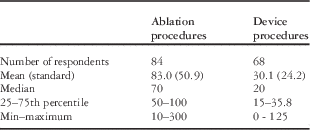
With regard to the number of procedures performed yearly by practicing paedriatic electrophysiologists, the results are presented in Table 1. As there are subgroups of paediatric electrophysiologists who are strictly non-invasive and do not perform any procedures, and an even larger group who do not perform device insertions, we decided to include the numbers of procedures performed of those who are actually performing these procedures (ablations and device insertions).
Number of Paediatric EP procedures performed by practicing paediatric electrophysiologists.
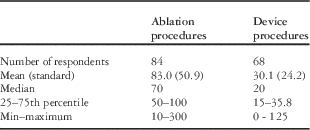
The distribution of the number of ablation and device procedures the respondents perform is illustrated in Figs 1 and 2.
Number of catheter ablation procedures performed by invasive paediatric electrophysiologists. For the purpose of these data, we excluded responses from those paediatric electrophysiologists not performing invasive procedures. The data show a wide variation in responses.

Number of device insertion procedures performed by paediatric electrophysiologists who actually perform these procedures. For the purpose of these data, we excluded responses from those paediatric electrophysiologists not performing invasive procedures. The data show a wide variation in responses.
Our task force was charged to complete paediatric electrophysiology standards whose goals were meant to ensure ongoing quality of services.
One such indicator of quality could be the number of procedures performed. The Society of Thoracic Surgeons database has clearly demonstrated a direct correlation between number of surgeries performed and outcomes.Reference Jacobs, Quintessenza and Burke1 The early experience with paedriatic catheter ablation registries also suggests that there are better outcomes if more procedures are performed by the physician and the institution.Reference Van Hare, Witherell and Lesh10–Reference Hebe, Hansen, Ouyang, Volkmer and Kuck13
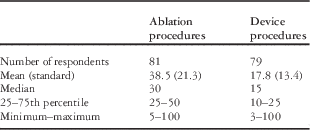
Thus, it was agreed that performing too few paedriatic electrophysiology procedures, whether ablations or devices, would raise concerns. However, there are no data to determine where to set that quality threshold. Consequently, we sought the opinion of the practicing electrophysiologists as to what is the minimum number of procedures that would allow a physician to maintain proficiency. The results are summarised in Table 2.
Minimum number of Paediatric EP procedures necessary for practicing paediatric electrophysiologists to maintain proficiency
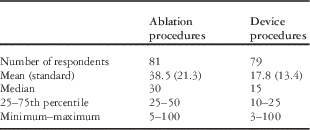
The distribution of the responses regarding their opinions as to the number of ablation and device procedures needed for a practicing electrophysiologist to maintain proficiency is illustrated in Figs 3 and 4.
Number of ablation procedures required for a Paediatric Electrophysiologist to maintain proficiency. For the purpose of this analysis, we included the responses of all paediatric electrophysiologists. The data show a wide variation in the opinions of paediatric electrophysiologists.
Number of device insertion procedures required for a Paediatric Electrophysiologist to maintain proficiency. For the purpose of this analysis, we included the responses of all paediatric electrophysiologists. The data show a wide variation in the opinions of paediatric electrophysiologists.
Similarly, we queried their opinions as to the number of procedures required for the electrophysiology laboratory to maintain proficiency.
The distribution of the responses regarding their opinions as to the number of ablation and device procedures needed for the electrophysiology laboratory to maintain proficiency is illustrated in Figs 5 and 6.
Number of ablation procedures required for a paediatric electrophysiology laboratory to maintain proficiency. For the purpose of this analysis, we included the responses of all paediatric electrophysiologists. The data show a wide variation in the opinions of paediatric electrophysiologists.
Number of device insertion procedures required for a paediatric electrophysiology laboratory to maintain proficiency. For the purpose of this analysis, we included the responses of all paediatric electrophysiologists. The data show a wide variation in the opinions of paediatric electrophysiologists.
Discussion
The responses to these questions illustrate that not only is there a lack of consistency among paedriatic electrophysiologists with regard to the number of invasive procedures they perform, but also there is also a lack of consistency in the opinions regarding the number of procedures an electrophysiologist and the electrophysiology laboratory must perform yearly to maintain proficiency and maintain adequate outcomes.
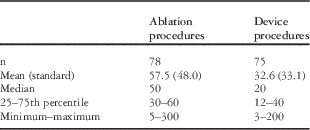
The task force believed that an annual threshold level regarding the number of ablation and device procedures performed yearly should be set. However, the lack of actionable data from the literature and the poll described above generated interesting discussions between the task force members. We sought to achieve a position that took into account basic commonalities of paediatric electrophysiology practices while acknowledging that there is a paucity of data to support, and let alone enforce, that position (Table 3).
Minimum number of Paediatric EP procedures necessary for the Paediatric EP laboratory to maintain proficiency
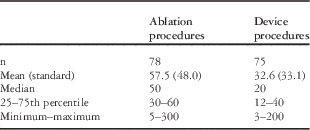
As a result, the taskforce agreed that, as a starting point, the minimum paedriatic electrophysiology studies in an electrophysiology laboratory facility should be 30 per year, of which at least 60% should involve catheter ablation. This number also applies to the individual paedriatic electrophysiologist. For paediatric cardiac electrophysiologists who perform antiarrhythmic device implantation, the task force recommended a minimum of 10 cases per year to maintain a proficiency level by both the physician and the electrophysiology laboratory.
If a threshold is set, then the consequences of not meeting that threshold must be defined. In the absence of actionable data, we agreed on two approaches:
First, the consequences of having lower numbers than those defined would not result in an immediate loss of credentialing of the facility, but their outcomes would be reviewed by members of the task force on a yearly basis.
Second, as the task force decided that currently it is not possible to determine minimum outcome standards or complication rates from the current data published, we recommended that all participating electrophysiolgists to join “MAP-IT™” database program as the first step in collecting nationwide outcome data. Hopefully, by analysing these data in the future, meaningful minimum outcome standards can be reached and volumes requirements justified. The threshold values initially agreed upon will be adjusted in the future as a result of that data. By entering our procedural data consistently, enough outcomes data will be generated that will allow us to fine-tune the threshold levels and also allow us to have a more solid justification for evaluation of the performance of the different paedriatic electrophysiology programmes in the state.
Conclusions
The Florida CMS Paedriatic Electrophysiology Task Force set out to establish Paedriatic Electrophysiology Standards for the different programmes in the state. To provide the highest quality of care to our patients, our goals were to define the training requirements and infrastructure necessary to provide quality paedriatic electrophysiology services for the children of the State of Florida.
We would hope that hospitals that provide paedriatic electrophysiology services, both CMS participating and non CMS participating programmes abide by these standards.
Our task force also realised that there is a lack of data that defines acceptable outcomes for the different procedures paedriatic electrophysiologists perform, as well as data that correlates procedural numbers with outcomes.
In view of this, our members committed to a multi-institutional effort aimed precisely to generate that data. Once that data are generated, the standards document can and will be modified accordingly.
Acknowledgement
Participation in the committee was voluntary and by invitation. All providers of paediatric electrophysiology programmes at CMS participating institutions were invited and all participated. Other committee members were representatives of the Florida CMS programme.
Financial Support
This research received no specific grant from any funding agency, commercial, or not-for-profit sectors.
Conflicts of Interest
None.
Appendix
STANDARDS FOR CMS PEDIATRIC CARDIAC ELECTROPHYSIOLOGY (EP) PROGRAMS
A Pediatric Cardiac Electrophysiology (EP) Program is an integral part of a CMS approved Pediatric Cardiovascular Center. The EP program has two main components: (1) An Interventional program in a Pediatric Cardiac Electrophysiology Laboratory and (2) an outpatient arrhythmia evaluation and management service.
An institution designated by CMS as a pediatric cardiovascular center, may elect not to participate in both components of these EP Standards.
All CMS designated centers must participate in the outpatient arrhythmia evaluation and management services.
If an institution elects not to participate in the EP interventional program in a pediatric cardiology electrophysiology laboratory, it must have a written format establishing an effective triage to another CMS approved EP facility as defined below. Such protocol must include a formal document signed by the CEO’s of both involved institutions and approved by the CMS Deputy Secretary for CMS or designee
Laboratory Component
The Pediatric Cardiac Electrophysiology Laboratory must be co-located within a facility completely equipped to accommodate all aspects of the medical and surgical care of the pediatric patient.
1) Cardiac Team
(1) Physician in Charge:
(a) The physician in charge of the laboratory must be board-certified by the Sub-Board of Pediatric Cardiology of the American Board of Pediatrics and must be a pediatric electrophysiologist as defined below:
(1) Pediatric Electrophysiologist is a Pediatric Cardiology Board Certified physician, whose primary clinical practice is dedicated to pediatric electrophysiology activities.
(2) In addition, the individual to be approved by CMS as a pediatric electrophysiologist must meet the International Board of Heart Rhythm Examiners (IBHRE) board eligibility criteria by meeting or exceeding the requirements outlined by one or both of the tracks outlined below:
International Board of Heart Rhythm Examiners. Eligibility Requirements Policy: IBHRE Board Certification Examination in Cardiac Electrophysiology for the Physician 10.29.2010
Pediatric Electrophysiologist: Credentials
1. Track 1: Training Completed After July 1, 2005
a. Successful completion of a pediatric cardiovascular medicine fellowship program and board-certified in Pediatric Cardiology by the American Board of Pediatrics.
b. Successful completion of a minimum of 1 additional year of cardiac electrophysiology training in a pediatric electrophysiology fellowship program. The training program must meet the minimum criteria set forth by the task force in pediatric cardiology training, detailed in:
ACCF/AHA/AAP Recommendations for Training in Pediatric Cardiology. A Report of the American College of Cardiology Foundation/American Heart Association/American Committee to Develop Training Recommendations for Pediatric Cardiology) College of Physicians Task Force on Clinical CompetenceCirculation. 2005;112:2555-2580
c. If training is completed after July 1, 2014, then the training program must meet the minimum criteria set forth by the Training and Credentials Committee of the Pediatric and Congenital Electrophysiology Society, detailed in:
Recommendations for Advanced Fellowship Training in Clinical Pediatric and Congenital Electrophysiology. A Report from the Training and Credentialing Committee of the Pediatric and Congenital Electrophysiology SocietyHeart Rhythm 2013;10:775-781
d. In addition, the electrophysiologist must monitor on a continuing basis at least 30 patients with implanted devices. However, the involved pediatric electrophysiologist does not necessarily have to perform all such device implantations
2. Track 2: Training Completed Before July 1, 2005
a. Pediatric EP applicants completing training prior to July 1, 2005 may qualify either by satisfying Track 1 requirements above, or by demonstrating a minimum level of practice experience consisting of at least 5 years of active pediatric electrophysiology experience, in which the applicant's primary clinical interest is pediatric electrophysiology. The candidate must be actively involved in the management and care of pediatric arrhythmia patients.
b. PAST EXPERIENCE
i. A minimum 5 year history of practicing pediatric electrophysiology as his or her primary clinical interest
ii. In that 5 year span, performance of a minimum of 150 EP studies of which at least 90 or 60% of the total must have been catheter ablation procedures.
ACCF/AHA/AAP Recommendations for Training in Pediatric Cardiology. A Report of the American College of Cardiology Foundation/American Heart Association/American Committee to Develop Training Recommendations for Pediatric Cardiology) College of Physicians Task Force on Clinical CompetenceCirculation. 2005;112:2555-2580
iii. In addition, the individual must monitor on a continuing basis at least 30 patients with implanted devices. However, the involved pediatric electrophysiologist does not necessarily have to perform any or all such device implantations.
3. Foreign Trainees: Pediatric cardiologists either trained in other countries, or for any other reason not eligible for certification by the Sub-Board of Pediatric Cardiology of the American Board of Pediatrics may be approved as a CMS physician specializing in electrophysiology by the Deputy Secretary for CMS or designee as a special situation after a review and in-depth evaluation by the CMS Cardiac Subcommittee, which may recommend such approval if the candidate has met Track 1 or Track 2 criteria described above.
(2) Consulting Physicians
In addition to the physician listed above, in interventional EP cardiac catheterizations, an anesthesiologist and a thoracic surgeon, each with advanced training in the cardiovascular aspects of their specialty, must be immediately available within the facility, or in close proximity, for consultation, assistance, emergency and elective surgical procedures and peri-operative care.
(3) Nurse
Each laboratory must have a registered nurse, with special training in cardiovascular techniques and in the care of children, as a full time member of the team. This nurse must have special skills in pre and post catheterization evaluation, and management. In addition, this individual must have skills in and be able to coordinate patient and family education and instructions pre and post procedure.
(4) Cardiovascular EP Technologist
Each lab must have a cardiovascular EP technologist or nurse with special training in cardiac EP laboratory techniques.
(5) Dedicated Trained Cardiovascular EP Recorder
(a) Each lab must have a dedicated trained cardiovascular EP recorder who has no other responsibilities during such procedures.
(b) Each lab must have immediate access to personnel trained in equipment repair and maintenance.
(c) Although the above-required functions are well defined, it is not necessary for one person to fulfill each separate job category. Adequate cross training for other personnel classifications permits 24-hour coverage of essential team functions.
(d) All technologists in a cardiovascular laboratory must be certified by the Cardiovascular Credentialing Institute as a Registered Cardiovascular Technologist (RCVT) and licensed by the State of Florida under the Clinical Laboratory law, when applicable.
2) Equipment:
a) Radiological, electronic, and computer-based systems are integral components of the equipment in a catheterization laboratory. These systems all require a program of rigorous maintenance and troubleshooting. In addition, a pediatric electrophysiology laboratory must have:
i) Multi Channel EP recording system
ii) External Defibrillation systems
iii) Cardiopulmonary monitoring systems
iv) Radiofrequency Energy Source
v) It is strongly recommended that Pediatric Electrophysiology laboratories also have:
(1) 3 Dimensional Electro anatomic Mapping System
(2) Cryo- ablation System
b) Electrical Safety and Radiation Protection
i) Electrical safety and radiation protection shall be followed in accordance with the manufacturer's recommendations and applicable State and Federal regulations.
c) In laboratories in which device implantation or replacement procedures will be performed, additional equipment will be required:
(1) Standard surgical electro cautery unit
(2) Surgical suction equipment
(3) Overhead lighting of sufficient brightness for surgery
(4) Reverse airflow to operating room standards
3) Records
a) Permanent record of real time study must include, at a minimum, video, disk, chart, or digital / electronic recordings.
b) Interpretation and final approval of such EP study reports must be performed by a physician who is board certified in pediatric cardiology and meets the standards to be qualified as a pediatric electrophysiologist, as defined previously.
c) Medical records must be retained for a period of no less than seven (7) years in a secure locked area.
4) Initial Site Evaluation
a) On-site Review: When an application requesting approval as a CMS Pediatric Cardiac Electrophysiology Laboratory facility is submitted with attestation of compliance with all these standards, an on-site review by members or designees of the CMS Cardiac Subcommittee will be scheduled as the final component of the application process. An application shall not be deemed complete until the Deputy Secretary for CMS or designee receives the recommendation of the CMS Cardiac Subcommittee.
b) Medical Records Review:
i) A minimum of 12 consecutive pediatric cardiac catheterization electrophysiologic studies within a year must be available to warrant initial inspection of any facility.
ii) A minimum of 7 consecutive pediatric implantable device insertions (pacemakers and / or Implantable Cardioverter Defibrillators) studies within a year must be available to warrant initial inspection of any facility
5) Facility Volume Standards: Facilities shall be evaluated independently for two separate areas of expertise within a pediatric electrophysiology program: EP studies with ablations and Device insertions.
a) EP studies and ablation:
(i) The minimum annual number of pediatric electrophysiologic studies in an applicant facility is recommended to be at least 30 per facility with a minimum of 18 ablations, or 60% of the total number of studies per year.
Source: PACES SURVEY, 2012
b) Device implantations: Pacemaker and / or Implantable Cardioverter Defibrillators (ICD) insertions or implantable loop recorders (ILR). The minimum number of device implantations or replacements in an applicant facility is recommended to be at least 10 per year. For the purpose of facility volume standards, device insertions may be performed by either a CMS accredited pediatric cardiovascular surgeon and /or a CMS accredited pediatric electrophysiologist.
6) Practitioner Volume Standards:
(i) Pediatric electrophysiologists shall be evaluated independently for two separate areas of expertise within a pediatric electrophysiology program: EP Studies with Ablations and Device Insertions
(ii) A practitioner may choose to be credentialed to perform EP Studies /Ablations and Device insertions, or both.
1. The minimum annual number of pediatric cardiac electrophysiologic studies performed by each practitioner in an applicant facility is recommended to be at least 30 per year, of which at least 18, or 60% of the total number of studies per year, are catheter ablation procedures.
2. The minimum annual number of pediatric device implants or replacements (pacemaker, ICD or ILR) performed by each practitioner in an applicant facility is recommended to be at least 10 per year.
Electrophysiology Society Clinical Competency Statement: Training pathways for implantation of cardioverter-defibrillators and cardiac resynchronization therapy devices in pediatric and congenital heart patients. Developed in collaboration with the American College of Cardiology and the American Heart Association.J. Philip Saul, MD, FHRS, Victoria L. Vetter, MD, Heart Rhythm, Vol 5, No 6, June 2008
a. Practitioners whose volume falls below 10 per year must then demonstrate that they have an established working relationship with either a CMS accredited pediatric cardiovascular surgeon or a CMS accredited pediatric electrophysiologist performing device implants or an adult electrophysiologist trained in device implantation, and demonstrate that such physicians are available in case they are needed.
7) OUTCOMES STANDARDS – INTRODUCTION
The members of the CMS Cardiac Subcommittee EP Task Force will develop and recommend all CMS Approved centers participate in a database into which the involved EP physicians would report the outcomes of their EP Studies and Device insertions.
Such database recommendations will be submitted to the CMS Cardiac Subcommittee and implemented if the subcommittee approves.
i) OUTCOMES STANDARDS – INITIAL PHASE:
(1) Initially, CMS Pediatric Electrophysiology programs will be evaluated utilizing existing outcome expectations based on current literature, with the understanding that more data needs to be generated which incorporates modern technologies and expectations.
(2) The presently appointed Florida CMS EP Task Force will create a pilot data-tracking tool, which will serve as a preliminary data repository. This will be implemented after a recommendation by the CMS Cardiac Subcommittee to, and approval by the Director of the Division of Children's Medical Services or his/her designee.
(a) SVT or VT ablations in post surgical or abnormal anatomy substrate
(i) Acceptable success and complication not yet defined, however, will be reported for ongoing analysis
(b) Endocardial Device Insertion Procedures
(i) Acceptable success and complication rates are not yet defined in pediatrics. However, outcomes will be reported for ongoing analysis.
(c) Epicardial Device Insertion procedures are considered cardiac surgeries and outcomes evaluated in the context of cardiac surgical program.
ii) OUTCOMES STANDARDS-SECOND PHASE:
(1) When a national database (MAP-IT) is implemented and incorporated into the existing national cardiac catheterization database (IMPACT), the existing CMS EP data tracking tool is strongly recommended to be incorporated into this national database. All CMS designated pediatric cardiovascular centers are strongly recommended to participate and report their data to the MAP-IT national database when implemented.
(2) When national outcome standards are defined, they will be submitted for approval to the CMS Cardiac Subcommittee as the new outcome standards for Florida CMS pediatric electrophysiology centers.
(3) Once procedural success and complication rates are measured and published, the CMS EP Task force shall recommend that acceptable program and or practitioner volume and outcomes are within two standard deviations from the national mean. This recommendation shall be presented to the CMS Cardiac Subcommittee and submitted for approval by the Director of the Division of Children's Medical Services or his/her designee.
(a) Once these new volume and outcome standards are approved, programs whose volume or outcomes are below the new standard shall be subject to increased surveillance and potential probationary status as defined below.
8) Facility Criteria: Includes all standards in the CMS Pediatric Cardiac Catheterization Laboratory Component section.
9) The CMS Deputy Secretary or designee considers new facilities for approval upon the recommendation of the CMS Cardiac Subcommittee and meeting all the criteria established above for such pediatric cardiac catheterizations. The Deputy Secretary or designee shall make the final decision on whether to approve an applicant.
10) Re-evaluation of Approved Facilities
a) On-site Review: Each CMS approved Pediatric Cardiac Electrophysiology Laboratory Facility must be evaluated on-site by members or designees of the CMS Cardiac Subcommittee at a minimum of once every three (3) years. The reevaluation process is not complete until the Deputy Secretary for CMS or designee receives the recommendation of the CMS Cardiac Subcommittee.
b) Medical Record Review: A minimum of 12 consecutive pediatric cardiac electrophysiologic studies must be available within a specified time period for review at the time of the re-evaluation. Volume Standards are as follows:
(i) Facility Volume Standards: The minimum annual number of pediatric electrophysiologic studies in an applicant facility is recommended to be at least 30 per facility with a minimum of 18 ablations, or 60% of the total number of studies per year.
ii) Practitioner Volume Standards:
1. By the first or subsequent three-year re-approval review, the minimum annual number of pediatric cardiac electrophysiologic studies performed by each practitioner in an applicant facility is recommended to be at least 30 per year, of which at least 18, or 60% of the total number of studies per year are catheter ablation procedures.
2. Pediatric electrophysiologists performing device implantations are recommended to perform at least 10 device implantation procedures per year.
c) During the initial phase of the development of outcomes standards, defined in Section 7 (i) EP facilities will be evaluated by examining their completeness of data submission. During this initial phase, the primary evaluative assessment will be procedural outcomes as deemed acceptable based on existing literature.
d) The second phase of outcomes evaluation (Section 7 (ii)), will be completed once national standards are derived from national databases into which all Florida EP programs are expected to submit their data. National volume and outcome standards, once created, will be recommended by the EP Task force to the CMS Cardiac subcommittee and submitted for approval by the Deputy Secretary for CMS or his / her designee. Once approved, then these will become the volume and outcome standards by which each program is to be evaluated.
i) If the site review team determines the facility meets acceptable standards and has acceptable outcomes then the facility and practitioner will be subject to the three year review cycle of CMS Cardiac facilities.
ii) If the task force determines the facility is below acceptable standards and with less than acceptable outcomes, then the facility will be reviewed by the CMS Cardiac task force which may place the facility on probationary status. Probationary status may be extended one (1) additional year if the facility documents a positive trend in meeting the outcomes standard. If the facility has not achieved the acceptable outcomes standard at the end of a second year of probationary status, the facility shall be provided with a notice of intent to disapprove it as a CMS cardiovascular facility.
Outpatient Clinic Component
1) Facility Criteria: include all standards, as outlined in the outpatient clinic section. In addition, an outpatient electrophysiology program must have the following components:
2) Personnel
a) The physician in charge of this clinic is to be board certified in Pediatric Cardiology and Basic Life Support and have special expertise in arrhythmias and device management
b) The involved Nurse/technician is to have special expertise in device management and be certified in both Basic Life Support and Pediatric Advanced Life Support.
3) Device Management
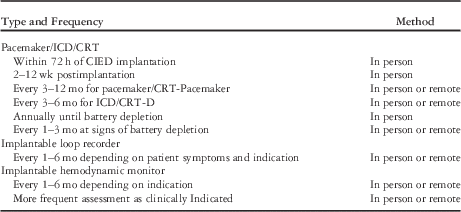
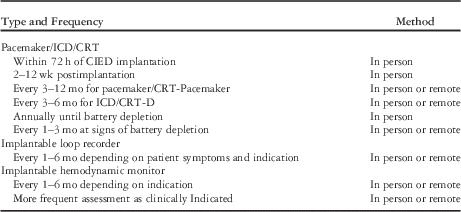
a) Pacemaker, Implantable Cardioverter Defibrillator (ICD) and Cardiac Resynchronization Therapy (CRT ) device monitoring is performed by combining In-clinic AND remote (home) monitoring.
i) Criteria for intervals for Device follow-up must recognize that the complexity of the underlying heart disease dictates the intervals for surveillance. A reasonable guide for in-clinic monitoring is as follows:
(1) Antibradycardia devices: At a minimum, the patient will be seen in the clinic one week and then 3 months post implant, then no less frequently than annually as long as clinic visits are supplemented by remote monitoring from home no less frequently than every three months, and more frequently as may be clinically indicated. Complexity of the issues managed or device related issues may require a more intensive and frequent monitoring schedule. Evaluation of surgical site may be performed by physicians in the patient’s local community when deemed appropriate.
(2) ICD and CRT devices: At a minimum, the patient will be seen in the clinic one week and then 3 months post implant, then no less frequently than biannually as long as clinic visits are supplemented by remote monitoring from home no less frequently than every three months, and more frequently as may be clinically indicated. Complexity of the issues managed or device related issues may require a more intensive and frequent monitoring schedule. Evaluation of surgical site may be performed by physicians in the patient's local community when deemed appropriate.
Table 3Minimum Frequency of CIED In-Person or Remote MonitoringFootnote *

2012 ACCF/AHA/HRS Focused Update of the 2008 Guidelines for Device-Based Therapy of Cardiac Rhythm Abnormalities: A Report of the American College of Cardiology Foundation/American Heart Association Task Force on Practice GuidelinesCynthia M. Tracy, MD et al. J Am Coll Cardiol. 2012;60(14):1297-1313.
4) Equipment
a) For in-clinic monitoring – the following items must be available: Electrocardiographic (ECG) recording machine, External Defibrillator, Device programmers for: Pacemakers, Implantable-Cardioverter Defibrillators (ICD's) and Cardiac Resynchronization Therapy (CRT’s).
b) For remote monitoring, some form of surveillance must be available including traditional Trans-telephonic monitoring (TTM).
5) Volume
a) It is recommended that the involved EP physicians should have managed, in their professional career, at least 75 patients with devices and maintained competence by performing 30 assessments annually.
6) Records A complete database of patients with Devices should be maintained and updated to include all Device models and ID numbers, Lead models and ID numbers.
i) A permanent record of real time study of serial device testing must be maintained and kept for at least 7 years.
7) Arrhythmia Management
a) Pediatric Electrophysiology clinics must be staffed by a pediatric electrophysiologist and at least one skilled nurse. Visit frequency is dictated individually by the severity of the arrhythmia.
i) Visits are recommended to include:
(1) Antiarrhythmic drug management, verification of drug dosages and drugdrug interactions
(2) Surveillance of arrhythmia monitoring tests which may include a12 lead electrocardiogram, Holter monitor electrocardiography, event or memory Loping monitors, and a stress test.
(3) Cardiac channelopathy patients are monitored as frequently as the specific disease requires. Proper management of these syndromes is recommended to include genetic testing of the proband followed by family specific testing, and genotype specific drug management and counseling.
8) EVALUATION OF APPROVED FACILITIES:
a) If the facility is not in compliance with all the required personnel and equipment criteria as described previously, the facility must submit a corrective action plan for approval by the Deputy Secretary for CMS upon the recommendation of the CMS Cardiac Subcommittee. If the plan is approved, the facility shall be granted a one-year probationary status. Probationary status may be extended one (1) additional year if the facility documents improvements toward achieving all the facility criteria.
If the facility is not in compliance with all the facility criteria at the end of a second year of probationary status, the facility shall be provided with a notice of intent to disapprove it as a CMS cardiovascular facility. After the 90-day transition period, the facility will receive formal notice of disapproval.
b) Data Submission: The staff of all CMS approved Pediatric Cardiac Electrophysiology Centers must collect and submit quality assurance data annually in accordance with the following CMS forms:
i) Cardiac Catheterization Procedures (DH-CMS 2057, 4/05); and
ii) Cardiac Catheterization Cases-Primary Cardiac Diagnoses (DH-CMS 2058, 3/05).
iii) CMS EP programs will also participate in outcomes data collection as defined in the following CMS data sheet:
c) In the event that a facility’s participation with CMS is terminated by either the facility or CMS, 90 days’ notice shall be provided to the other involved party and to all CMS patients receiving active treatment at that facility. The 90-day notice is to assure adequate time to transfer care of all the patients to another CMS cardiovascular facility.
d) The CMS Deputy Secretary or designee considers existing facilities for re-approval upon the recommendation of the CMS Cardiac Subcommittee and all the criteria established above. The Deputy Secretary or designee shall make the final decision on whether to approve a facility for re-approval.
PEDIATRIC CARDIAC ELECTROPHYSIOLOGY LABORATORIES
Facility:_______________________________________
For the twelve month period from_________to_________
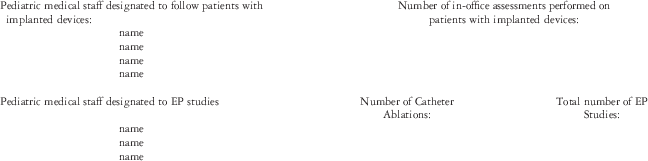
Florida CMS Pediatric EP Task Force
BIBLIOGRAPHY
Training / Competency
1.Guidelines for Pediatric Cardiovascular Centers AMERICAN ACADEMY OF PEDIATRICS. Section on Cardiology and Cardiac Surgery John W. M. Moore, MD, MPH et al PEDIATRICS Vol. 109 No. 3 March 2002
2. ACCF/AHA/AAP Recommendations for Training in Pediatric Cardiology. A Report of the American College of Cardiology Foundation/American Heart Association/American Committee to Develop Training Recommendations for Pediatric Cardiology) College of Physicians Task Force on Clinical Competence Circulation. 2005;112:2555-2580
3. Recommendations for Advanced Fellowship Training in Clinical Pediatric and Congenital Electrophysiology. A Report from the Training and Credentialing Committee of the Pediatric and Congenital Electrophysiology SocietyHeart Rhythm 2013;10:775-781
4. ACCF/AHA/AAP Recommendations for Training in Pediatric Cardiology: A Report of the American College of Cardiology Foundation / American Heart Association/American College of Physicians Task Force on Clinical Competence (ACC/AHA/AAP Writing Committee to Develop Training Recommendations for Pediatric Cardiology) Task Force 4: Recommendations for Training Guidelines in Pediatric Cardiac Electrophysiology Chair: Victoria L. Vetter, MD, FACC, FAHA, Philadelphia, PA, Michael J. Silka, MD, FACC, Los Angeles, CA George F. Van Hare, MD, FACC, FAAP, Palo Alto, CA Edward P. Walsh, MD, FACC, Boston, MA JACC Vol. 46, No. 7, 2005 Vetter et al. 1391
5. Electrophysiology Society Clinical Competency Statement: Training pathways for implantation of cardioverter-defibrillators and cardiac resynchronization therapy devices in pediatric and congenital heart patients. Developed in collaboration with the American College of Cardiology and the American Heart Association. J. Philip Saul, MD, FHRS, Victoria L. Vetter, MD, Heart Rhythm, Vol 5, No 6, June 2008
6. International Board of Heart Rhythm Examiners. Eligibility Requirements Policy: IBHRE Board Certification Examination in Cardiac Electrophysiology for the Physician 10.29.2010
7. 2012 American College of Cardiology Foundation/Society for Cardiovascular Angiography and Interventions: Expert Consensus Document on Cardiac Catheterization Laboratory Standards Update. A Report of the American College of Cardiology Foundation Task Force on Expert Consensus Documents Thomas M. Bashore, MD, FACC, FSCAI, JACC Vol. 59, No. 24, 2012
CATHETER ABLATION
8. Radiofrequency Catheter Ablation of Supraventricular Arrhythmias in Patients with Congenital Heart Disease: Results and Technical Considerations. George F. Van Hare, MD, FACC, Michael D. Lesh, MD, FACC, Paul Stanger, MD, FACC. JACC Vol. 22, No. 3 September 1993:133-90
9. Follow-Up of Radiofrequency Catheter Ablation in Children: Results in 100 Consecutive Patients George F. Van Hare, MD, FACC,* Charles l . Witherell, RN, CS, MSN, Michael D . Lesh, MD, FACCT. IACC VOI. 23, No. 7 June 1994:1651-9
10. Radiofrequency catheter ablation for tachyarrhythmias in children and adolescents. The Pediatric Electrophysiology Society. Kugler JD, Danford DA, Deal BJ, Gillette PC, Perry JC, Silka MJ, Van Hare GF, Walsh EP. N Engl J Med. 1994;330:1481-1487.
11. Radiofrequency catheter ablation for paroxysmal supraventricular tachycardia in children and adolescents without structural heart disease. Pediatric EP Society, Radiofrequency Catheter Ablation Registry. Kugler JD, Danford DA, Houston K, Felix G. Am J Cardiol. 1997 Dec 1;80(11):1438-43.
12. Radiofrequency catheter ablation of tachycardia in patients with congenital heart disease.Hebe J, Hansen P, Ouyang F, Volkmer M, Kuck KH. Pediatr Cardiol. 2000 Nov-Dec;21(6):557-75.
13. Prospective assessment after pediatric cardiac ablation: design and implementation of the multicenter study. Van Hare GF, Carmelli D, Smith WM, Kugler J, Silka M, Friedman R, Atkins D, Saul P, Schaffer M, Byrum C, Dunnigan A, Colan S, Serwer G Pacing Clin Electrophysiol. 2002;25:332-341
14. Prospective assessment after pediatric cardiac ablation: demographics, medical profiles, and initial outcomes. Van Hare GF, Javitz H, Carmelli D, Saul JP, Tanel RE, Fischbach PS, Kanter RJ, Schaffer M, Dunnigan A, Colan S, Serwer G; J Cardiovasc Electrophysiol. 2004 Jul;15(7):759-70.
15.Cryoablation with an 8-mm tip catheter for pediatric atrioventricular nodal reentrant tachycardia is safe and efficacious with a low incidence of recurrence. Silver ES, Silva JN, Ceresnak SR, Chiesa NA, Rhee EK, Dubin AM, Avasarala K, Van Hare GF, Collins KK. Pacing Clin Electrophysiol. 2010 Jun 1;33(6):681-6.
16. Cryoablation of typical atrioventricular nodal reentrant tachycardia in children: six years’ experience and follow-up in a single center. Drago F, Russo MS, Silvetti MS, DE Santis A, Iodice F, Naso Onofrio MT. Pacing Clin Electrophysiol. 2010 Apr;33(4):475-81
DEVICES
17. Twenty years of paediatric cardiac pacing: 515 pacemakers and 480 leads implanted in 292 patients.Silvetti MS, Drago F, Grutter G, De Santis A, Di Ciommo V, Rava L. Europace. 2006 Jul;8(7):530-6
18. ACC/AHA/HRS 2008 Guidelines for Device-Based Therapy of Cardiac Rhythm Abnormalities: Executive Summary. A Report of the American College of Cardiology/American Heart Association Task Force on Practice Guidelines (Writing Committee to Revise the ACC/AHA/NASPE 2002 Guideline Update for Implantation of Cardiac Pacemakers and Antiarrhythmia Devices) Andrew E. Epstein, MD, FACC, FAHA,FHRS, Chair et al. JACC Vol. 51, No. 21, 2008
19.2012 ACCF/AHA/HRS Focused Update of the 2008 Guidelines for Device-Based Therapy of Cardiac Rhythm Abnormalities: A Report of the American College of Cardiology Foundation/American Heart Association Task Force on Practice Guidelines Cynthia M. Tracy, MD et al. J Am Coll Cardiol. 2012;60(14):1297-1313.
20. Heart Rhythm Society/Pediatric and Congenital Electrophysiology Society Clinical Competency Statement: Training pathways for implantation of cardioverter-defibrillators and cardiac resynchronization therapy devices in pediatric and congenital heart patients. J. Philip Saul, MD, FHRS,* Andrew E. Epstein, MD, FHRS,† Michael J. Silka, MD‡Charles I. Berul, MD, FHRS,§ MacDonald Dick II, MD, FHRS,! John P. DiMarco, MD, PhD, FHRS,Richard A. Friedman, MD, MBA, FHRS,** Eric Rosenthal, MD,†† Elizabeth A Stephenson,MD,MSc, Victoria L. Vetter, MD, Heart Rhythm, Vol 5, No 6, June 2008
21. The CONNECT (Clinical Evaluation of Remote Notification to Reduce Time to Clinical Decision) Trial. The Value of Wireless Remote Monitoring With Automatic Clinician Alerts George H. Crossley, MD,* Andrew Boyle, MD,† Holly Vitense, PHD‡, Yanping Chang, MS,§ R. Hardwin Mead, MD,_ for the CONNECT Investigators JACC Vol. 57, No. 10, 2011
22. Complication Rates Associated With Pacemaker or Implantable Cardioverter-Defibrillator Generator Replacements and Upgrade Procedures: Results From the REPLACE Registry. Poole JE, Gleva MJ, Mela T, Chung MK, Uslan DZ, Borge R, Gottipaty V, Shinn T, Dan D, Feldman LA, Seide H, Winston SA, Gallagher JJ, Langberg JJ, Mitchell K, Holcomb R. Circulation. 2010;122:1553-1561
23. Pacemakers and implantable cardioverter-defibrillators in pediatric patients. Michael J. Silka MD, Yani Bar Cohen MD Heart Rhythm Volume 3, Issue 11, Pages 1360-1366, November 2006
24.Pediatric pacemaker infections: Twenty years of experience Mitchell I. Cohen, MDa, David M. Bush, MD, PhDa, J. William Gaynor, MDb, Victoria L. Vetter, MDa, Ronn E. Tanel, MDa, Larry A. Rhodes, MDaJ Thorac Cardiovasc Surg 2002;124:821-827
25. Update on Cardiovascular Implantable Electronic Device Infections and Their Management: A Scientific Statement From the American Heart Association L. M. Baddour, A. E. Epstein, C. C. Erickson, B. P. Knight, M. E. Levison, P. B. Lockhart, F. A. Masoudi, E. J. Okum, W. R. Wilson, L. B. Beerman, et al. Circulation, January 26, 2010; 121(3): 458-477.