INTRODUCTION
In the second half of the sixth millennium BC, pioneering bands of farmers and herders reached the northern part of central Europe and quickly spread over almost the whole area. Shortly after, as the physiography-enhanced demographic and economic independence of separate local groups started to grow, cultural patterns initially common to all the community began to diversify. The process of regionalization advanced for a few centuries, resulting, among other things, in the development of a civilization defined as the Lengyel culture. It evolved from the first quarter of the fifth millennium BC, primarily on the vast area of present-day western Hungary, Slovakia, and eastern Austria. However, cultural patterns generated by this peculiar socio-economic formation were gradually adopted also by the Neolithic communities living in the territories of Moravia, Bohemia, Silesia, and western Lesser Poland, what eventually resulted in a complete transformation of local material identities (see e.g. Pavúk Reference Pavúk2007).
In some of the above-mentioned regions, chronological schemes ordering related cultural and ecological facts, and—ipso facto—structuring prehistoric micro- or macro-narratives on various aspects of this cultural phenomenon, seem to be quite firmly grounded. This is chiefly an outcome of comprehensive, specific targeted studies on absolute chronology with an extensive use of radiocarbon (14C) dates, as best exemplified by the results achieved for the area of Lower Austria and southern Moravia within the research program entitled “Absolute Chronology for Early Civilisations in Central Europe” (Stadler et al. Reference Stadler, Ruttkay, Doneus, Friesinger, Lauermann, Kutschera, Mateiciucová, Neubauer, Neugebauer, Trnka, Weninger and Wild2006; Stadler and Ruttkay Reference Stadler and Ruttkay2007; Ruttkay et al. Reference Ruttkay, Teschler-Nicola and Stadler2014). Still, for a large part of this wide area, no attempts to establish local 14C-based absolute chronologies have been made or their results remain disappointing. This refers to the whole of the northern periphery of the Lengyel culture, and is especially conspicuous in the Upper Odra Basin (cf. Pavelčik Reference Pavelčik2001; Peška Reference Peška2010; Kuča et al. Reference Kuča, Kovář, Nýltová Fišaková, Škrdla, Prokeš, Vaškových and Schenk2012, Reference Kuča, Bartik, Kovář, Nýltová Fišaková, Prokeš and Škrdla2016). The deficiency of chronometric research in the latter area is reflected by serious discrepancies between chronological schemes proposed for the local Lengyel culture by different authors (cf. Kulczycka-Leciejewiczowa Reference Kulczycka-Leciejewiczowa1979; Kamieńska and Kozłowski Reference Kamieńska and Kozłowski1990; Janák Reference Janák1993, 2007; Czarniak Reference Czarniak2012).
Between 2012 and 2015, studies focusing on the Upper Silesian Eneolithic were carried out by one of the present authors (T.J.Ch.). Initially, the project required verification of taxonomical and chronological position of assemblages representing the decline of the Lengyel and advent of the Funnel Beaker cultures’ development in the area. Consequently, obtaining a reliable series of 14C dates became one of crucial tasks to be performed as a part of this undertaking. However, this pursuit met one principal obstacle—the paucity of good datable materials. With some exceptions, due to damaging effects caused by diagenetic factors, both human and animal bones from Neolithic and Eneolithic sites localized in the Upper Odra basin are rarely preserved in a condition qualifying them for 14C age determinations (if any bones can be found at all!). Additionally, since only a few attempts to secure archaeobotanic samples from such sites had been undertaken, charred plant remains could not assist the chronometric research, either. This situation forced us to search for other possibilities.
HYPOTHESIS
Looking for 14C-datable prehistoric material, we turned to charred cereal and weed seeds recovered from chaff binding matrix of architectonic daub. Prehistoric remains of the kind seem to meet all requirements of the highest-quality archaeological samples to be used for 14C dating (cf. e.g. Bayliss et al. Reference Bayliss, van der Plicht, Bronk Ramsey, McCormac, Healy and Whittle2011). What makes us believe them to be so reliable?
Firstly, chaff-tempered daub is used for building purposes by agricultural groups in many parts of the world. In some areas and periods, as it is for instance in the case of the Neolithic and Eneolithic of central and southeastern Europe, wattle-and-daub architecture is simply ubiquitous (cf. e.g. Lichter Reference Lichter1993; Lazarovici and Lazarovici Reference Lazarovici and Lazarovici2006, Reference Lazarovici and Lazarovici2007). Additionally, relics of daub architecture are usually quite well-preserved, commonly collected during excavations, and then kept in archaeological storehouses for decades. Therefore, chaff-tempered daub should be considered as a source of 14C datable plant material that can be used quite systematically and extensively.
Secondly, daub of this kind can often be associated with definable episodes in prehistory, that is (re-)building or renewal of houses and other settlement facilities. No less importantly, even though possible taphonomical dynamics of such architectural remains must be always seriously considered, the position of sole particles of temper embedded into such clay fragments could not be easily changed by random secondary translocations (microbioturbations etc.). From contextual point of view then, if only architectonic remains are found in situ or in another stratigraphically defined position, chaff-temper from daub can be regarded as reliable almost to the same extent as human or animal bones found in articulation.
Thirdly, it can be rather excluded that dating of any such sample would yield a so-called t-type outlier (for definition see Bronk Ramsey Reference Bronk Ramsey2009), that is, a result showing considerable discrepancy between 14C age of the material used for chronometric analysis and the event to be dated. Even if waste from cereal processing was not utilized only when accessible (regarded by some as typical for “chaff economy” of the temperate zone; see van der Veen Reference van der Veen1999), but deliberately kept and then used according to needs (as has been observed even among modern simple agricultural societies in the arid zone; see e.g. Abdalla Reference Abdalla2001, Reference Abdalla2005), in conditions of the first climatic area mentioned they could not be stored for a long time. As barely a few years could have passed between harvesting of crops to be applied as daub-tempering biomass (i.e. death of plant tissues) and the very moment of its use for building purposes (i.e. targeted prehistoric event), this delay would have a negligible effect on the accuracy of 14C dating. At the same time, charred cereal fragments, as they are remains of annual or biennial plants, have also an undeniable advantage over charred wooden elements of architecture. In principle, dating of the latter can result in an old-wood effect (see e.g. Whittle Reference Whittle1990; Staüble Reference Staüble1995; but compare also e.g. Lenneis et al. Reference Lenneis, Stadler and Schlichterle1996, for a different opinion), which might be a concern especially when remains are not identified taxonomically nor properly selected (for an instructive positive example see e.g. Moskal-del Hoyo and Kozłowski Reference Moskal-del Hoyo and Kozłowski2009).
The fourth point is that dates based on chaff-temper particles owe their credibility also to little vulnerability of such organic matter to primary and secondary contaminations from reservoirs of carbon other than those expected (r-type outliers as defined by Bronk Ramsey Reference Bronk Ramsey2009).
As a measurable reservoir effect has been never proven for land plants, even when they had been grown in soil with a high old-carbonate content, it can be taken almost for granted that all the carbon incorporated into the plant is derived exclusively from photosynthesis and represents the atmospheric value. Therefore, as long as the chaff temper was obtained from terrestrial plants, it is more suitable for dating than collagen extracted from bones of non-herbivore animals (including human). In those cases, the 14C age can be strongly biased by the presence of extra amounts of 14C coming from reservoirs at lower trophic levels, and peculiarly from freshwater-settling organisms (see e.g. Eriksson et al. Reference Eriksson, Lõugas and Zagorska2003; Shishlina et al. Reference Shishlina, van der Plicht, Hedges, Zazovskaya, Sevastyanov and Chichagova2007; Olsen et al. Reference Olsen, Heinemeier, Lübke, Lüth and Terberger2010; Pospieszny Reference Pospieszny2015).
For fundamentally the same reason, 14C dates made of daub-tempering chaff are much more reliable than those obtained from carbonized food residues adhering to the interior surfaces of pots/shards (see e.g. Fischer and Heinemeier Reference Fischer and Heinemeier2003; Boudin et al. Reference Boudin, Van Strydonck, Crombé, De Clercq, van Dierendonck, Jongepier, Ervynck and Lentacker2010; Philippsen Reference Philippsen2015), which some authors (e.g. Staüble Reference Staüble1995; Bayliss et al. Reference Bayliss, van der Plicht, Bronk Ramsey, McCormac, Healy and Whittle2011) classify as one of the most valuable categories of 14C samples.
Dating of cereal additive from daub appears also as more credible than dating of a similar admixture from pottery. Even if any freshwater reservoir effect can be ignored, everyday-use earthenware of the kind can be still contaminated primarily with old carbon from clay and secondarily from fuel from the kiln and oven (old fuel effect; Bonsall et al. Reference Bonsall, Cook, Manson and Sanderson2002).
Also in the context of secondary contaminations, charred plant remains are more reliable than bone collagen extracts. As it is commonly known, gelatin is prone to interact and bind with younger exogenous material originating from humic acids, amino acids, or peptides foreign to the bone, as well as micro-organisms and their byproducts (see e.g. van Klinken Reference van Klinken1999). Even though processes leading to such contaminations are still quite poorly understood, the effect they have on 14C chronometry has been long realized and described on a smaller and larger scale (see e.g. Pleslová-Štiková Reference Pleslová-Štiková1985; Denaire Reference Denaire2009).
Finally, it should not be forgotten that use of charred plant remains for 14C dating is much more cost-effective than handling other materials that might yield similarly credible dates. According to different laboratories’ pricelists accessible online, sole extraction and pretreatment of bone collagen raises the price of a single measurement by 15–30%, whereas compulsory examination of bones and food residues in order to exclude, define, or at least detect the presence of unwanted constituents of given sample can be more expensive than 14C measurement itself.
MATERIALS AND METHODS
Materials
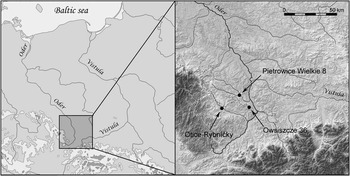
Remains of settlements and cemeteries uncovered in the course of large-scale rescue excavations conducted between 2009 and 2012 at Otice-Rybníčky (see Figure 1 for localization of all archaeological sites mentioned in the text) are of utmost importance for current studies on the evolution of the Lengyel culture in the Głubczyce Plateau and other regions of Upper Silesia. Having realized the potential of the find, however, we had to face serious weaknesses of the archaeological record. One of the main difficulties consisted of the lack of conventional samples suitable for 14C dating, as no well-preserved bones and no sediment samples for recovery of archaeobotanical macroremains have been collected. It was mainly for this reason that studies on finds from Otice became the starting point for the present exercise in 14C dating.
Map of Upper Oder Basin showing location of three major sites discussed in the text

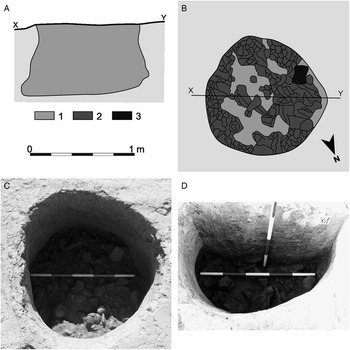
Obviously, application of the tested sampling method would not be possible if there were no remains of daub architecture discovered during excavations. In the case studied, these were layers of rubble covering the bottoms of some pits discovered at Otice. Two such construction clay concentrations, one discovered in pit 518/2011 and another from pit 561/2011 (Figure 2), were chosen for chaff-and-straw temper analyses, sampling, and finally 14C dating. In both the pits under discussion, pottery deposited in lower parts of fillings, just above the daub, had all the characteristics of earthenware typical for the final phase of the Upper Silesian Lengyel culture.
Otice-Rybníčky. Daub debris from wattle and daub structures deposited in the bottom part of feature 561/2011. Crossection (A,D) of the pit and plain view (B,C) of its bottom (1-clayish filling, 2-daub, 3-stone).

Regarding the lack of other datable and chronologically corresponding materials at Otice, the coherence of the obtained 14C dates must be considered as the primary measure of their credibility. To test precision of the 14C measurements, at first it was decided to repeat dating three times for each of the two deposits of daub, every time using different particles of chaff-temper (other seeds).
Additionally, to check the accuracy of the dates obtained, the 14C chronology established for the architectural remains discovered at Otice was compared with the 14C ages of a few other stylistically closely related assemblages (i.e. representing single “pottery phase”) discovered in the Głubczyce Plateau.
Two prehistoric assemblages to be dated for such a purpose come from site 36 in Owsiszcze, comm. Krzyżanowice. In a small area uncovered in 2001, a few deep storage pits connected with the decline of local Lengyel culture were found (preliminary report see Burdukiewicz and Furmanek 2001). Owing to regular archaeobotanical sampling, such chronology of the finds could be confirmed by 14C dating of charred remains of annual plants and wood. Three 14C dates were obtained for each of the pits times in order to check precision of the results.
The other locality that yielded control samples was discovered at site 8 in Pietrowice Wielkie. Here, there was just one substantial assemblage dated to the decline of the Lengyel culture discovered within the whole excavated area—a clay-extraction pit numbered as 118/1964. Reliable dating of the complex was possible due to a unique discovery of big bunch of charred feather grass (Stipa sp.) awns deposited at the bottom of the pit (Chmielewski et al. Reference Chmielewski, Furmanek, Patay and Sady2014). Also in this case, the 14C measurements were repeated three times.
Archaeobotanical Analyses of Daub Temper
During the examination of daub, conventional standardized techniques of preparation, pretreatment, observation and description of plant imprints were applied (see e.g. Lityńska-Zając and Wasylikowa Reference Lityńska-Zając and Wasylikowa2005). All the analyzed surfaces of the daub fragments were first hand-cleaned with the use of a soft brush and rubber pump hand air-blower. Observations of imprints were made with the use of reflected light stereoscopic microscope at low magnification (maximally 20×). After examination and description of all relevant cavities exhibited in outer, primary surfaces, the daub fragments were broken into smaller pieces in the search for more imprints of chaff particles on the fresh fractures. Dimensions important for determination of given species were measured for well-preserved and conveniently located imprints (i.e. these clearly visible in the breaks). To describe in more detail, positive casts of negatives were made with the use of modelling clay (liquid silicones and resins penetrate micro-cavities of daub, as a consequence making it impossible to detach the casts without destroying clay matrix).
Taxonomical identifications, based on morphological (diaspores) or anatomical (charcoal) attributes, were carried out by comparisons with physical reference collections. Some difficulties arose typical of these kinds of studies. When plant imprints observable on the surface being examined occurred separately, finds representing different species could be easily counted and finally presented as precise figures. However, negatives of charred or burnt-away fragments of daub temper usually constitute a tangled mass, within which spikelets or seeds coming from the same spike could not be distinguished; such imprints of plants were difficult or hardly possible to count. Hence, we summarize the results in descriptive form supported using only estimated numbers.
Sampling
As one of the aims of the archaeobotanical examination of daub was to provide material for 14C dating, all potentially suitable charred or dried plant remains embedded in clay matrix were extracted and separated. After specification of the biomass added to bind the daub, only particles of annual plants (cereal and weed grains) that can be considered as intentional components of the tempering additive were selected for 14C age determinations.
14C Dating
Chemical pretreatment of samples generally followed the procedure described by Brock et al. (Reference Brock, Higham, Ditchfield and Bronk Ramsey2010). After mechanical removal of macroscopic contamination visible under binocular, the charred plant fragments were treated with 1M HCl (80°C, 1 hr), 0.1M NaOH (80°C) and then 0.25M HCl (80°C, 1 hr). After treatment with each reagent, the samples were rinsed with deionized water (Millipore) until pH=7. The step of NaOH treatment was repeated a few times until no more coloration of the NaOH solution occurred.
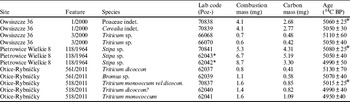
The samples were then combusted in closed quartz tubes, together with CuO and Ag wool, at 900°C for over 10 hr. Combustion yields (measured as the ratio of mass of carbon obtained to the mass of sample combusted) of each sample were high (Table 3), reflecting good purity of the dated samples. The obtained gas CO2 was reduced with hydrogen, using Fe powder as a catalyst, and the resulting mixture of carbon and iron was forwarded to 14C AMS measurement. 14C measurements were performed with the spectrometer Compact Carbon AMS in Poznan (Goslar et al. Reference Goslar, Czernik and Goslar2004). The samples were compared to the values of a modern standard (oxalic acid II). The conventional 14C age was calculated using a correction for isotopic fractionation (Stuiver and Polach Reference Stuiver and Polach1977), based on ratio 13C/12C measured in the AMS spectrometer simultaneously with the ratio 14C/12C. For three samples (marked in Table 3), two separate portions of carbon were prepared for 14C AMS measurements, and weighted averages of the two measured 14C ages were calculated.
RESULTS AND DISCUSSION
Archaeobotanical Analysis of Daub
In the course of our archaeobotanical examination of the fragments of daub discovered at Otice, the organic matter present in the clay matrix could be specified on the basis of
-
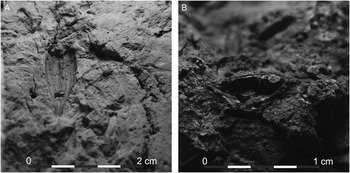
1. imprints of plants, which are empty cavities closely corresponding to shape and size of burnt-out fragments of chaff primarily tempering given piece of daub (Figure 3A);
-
2. imprints of plants with charred remains of organic matter preserved (Figure 3B); and
-
3. imprints of plants with remains of organic matter preserved as semitransparent whitish or brown dried tissue fossils (silica skeletons).
Otice-Rybníčky. Imprints (A) and charred remains (B) of wheat chaff (seed) tempering the daub.

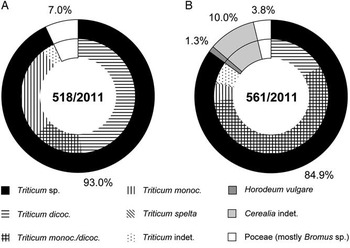
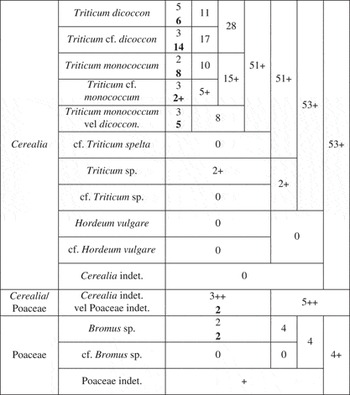
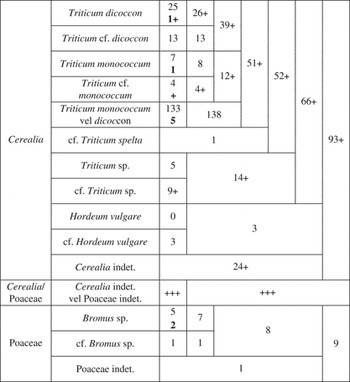
The analysis of the species composition of the plant remains and imprints visible on preexisting surfaces and in freshly made breaks of the daub from Otice demonstrated that the plant temper was made almost exclusively of wheat chaff (Tables 1 and 2; Figure 4).
Otice-Rybníčky. Botanical composition of chaff tempering daub discovered in pits 518/2011 (A) and 561/2011 (B). The huge amount of epidermal layers of imprints and charred remains of chaff is not included.

Results of archaeobotanical analysis of chaff tempering daub discovered at the bottom of feature 518/2011 at Otice-Rybníčky. Regular numbers—imprints, boldface numbers—charred remains.

Results of archaeobotanical analysis of chaff tempering daub discovered at the bottom of feature 561/2011 at Otice-Rybníčky. Regular numbers—imprints, boldface numbers—charred remains.

As clearly proven by examination of daub fragments from central European sites of different ages, at least some prehistoric communities selected plant tempers paying attention both to species and size composition of chaff. Moreover, in many cases, a spectrum of species reconstructed on the basis of charred plant remains found in the samples of sediments differed from what was admixed to the clay. For instance, communities of the Funnel Beaker culture apparently preferred to prepare daub using chaff made of barley, which rather infrequently appears in the archaeobotanical record as charred remains (seeds) deposited in earth sediments (see Chmielewski et al. Reference Chmielewski, Kołodyńska-Gawrysiak, Makowiecki, Sady and Kozak-Zychman2015). Also, the composition of chaff-temper used by Eneolithic builders at Otice does not seem to be incidental. It had been already observed elsewhere in Upper Silesia (e.g. in Bieńkowice, site 56; see Sady Reference Sady2015) that local communities at the stage of the final Lengyel culture—unlike it was in the subsequently developing Funnel Beaker culture—to some extent must have preferred wheat chaff for construction purposes. Regarding such apparent homogenity of building chaff-temper and the fact that the use of peculiar “recipes” appears to correspond to different prehistoric cultural formations, we cannot avoid concluding that “chaff economies” among the early agrarian communities settling central Europe were diverse, each of them depending on somehow different socio-economic circumferences, or perhaps even rooted in other building traditions.
These technological choices (Lemonnier Reference Lemonnier1992) are difficult to explain, but indirectly indicate that at least in the Neolithic, storage of building chaff was quite common not only in in the arid but also in the temperate zone of Old World (contra van der Veen Reference van der Veen1999). Considering basic building techniques used at the time (widespread use of daub), this should be of no surprise. Only in this way, building or repair works with the use of clay-and-chaff matrix prepared in accordance with formula preferred by given community could be undertaken independently from the natural yearly rhythm of works connected with crop production. Also, it cannot be also completely excluded that building clay was generally tempered with material accessible seasonally, and the majority of important constructions or repairs requiring the use of chaff-tempered daub was rather rigidly fixed in prehistoric agrotechnical calendar. However, answering this question is not crucial for successful application of the proposed sampling method. Either way, the limited accuracy of the dating method allows us to regard the 14C age of charred chaff as closely corresponding to the moment of its use for preparation of daub. Even if the chaff was not used ad hoc, but saved for some time in amounts meeting different foreseen needs, the relatively fragile biomass could not be stored too long, especially in the conditions dictated by the temperate climate of central Europe. What remains crucial for the “chronometric hygiene” of the 14C measurements here is to determine the daub-production “recipe” used in the given case and, as a result, select only these charred particles of short-lived plants, which with all likelihood belong to remains of intentional component of the admixture.
14C Chronology of Daub Discovered at Otice
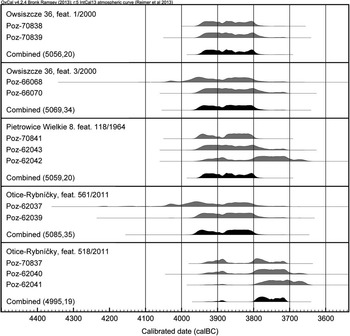
Following the chosen method, charred particles of wheat found in the daub fragments from the two pits discovered at Otice-Rybníčky (i.e. caryopses, spikelets, spikelet forks, and glumes) were used as the basic material for 14C dating. In just a single instance, a measurement was performed for charred remains of brome grass (Bromus sp.). However, as this archaeophyte is the most commonly occurring weed of wheat and barley (Lityńska-Zając Reference Lityńska-Zając2005), it could be securely assumed that the dated grain got into the daub together with cereal chaff from the same harvest (Tables 1 and 2). The dates obtained from the plant remains (Table 3; Figure 5) are both of high precision and accuracy, rather clearly showing the main rationale of the applied sampling strategy to be right.
Calibrated AMS 14C dates obtained for chaff tempering daub discovered in pits 518/2011 and 561/2011at Otice-Rybníčky as well as control samples from Pietrowice Wielkie 8 and Owsiszcze 36. Two dates were published in Chmielewski et al. (Reference Chmielewski, Furmanek, Patay and Sady2014) (see Table 3).

AMS 14C dates for the decline of the Lengyel Culture in Upper Silesia.

* Dates already published in Chmielewski et al. (Reference Chmielewski, Furmanek, Patay and Sady2014).
# Dates with improved precision.
Still, a question of chronological relationships between prehistoric activities or events being actually dated with the use of 14C measurements and the ones we intend to date must be posed. All in all, the resulting 14C dates address preparation of building materials used for raising of some wattle-and-daub constructions somewhere in the surroundings of the pits within which the daub remains were deposited, whereas the matter of our direct concern in the chronological and taxonomical studies on the local Lengyel culture was not so much the absolute age of the prehistoric architecture, as chronology of distinctive portable items. The situation would be quite clear if clay rubble from preexisting facilities were preserved in situ, but appears as peculiarly difficult in such cases as the one studied, where the daub fragments lay just eventually thrown to evidently younger pits and all distinct movable finds were deposited in superimposing layers. Because the fillings of the pits deposited above the architectural debris yielded no material suitable for 14C dating, determination of their age must be independently based on stylistic and technological analysis of movable finds cross-dated with other relevant assemblages.
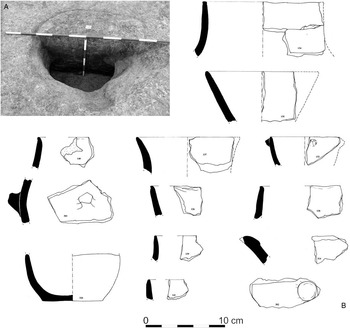
As it is common in the focal area and for sites dated back to the period of our concern in this study, at Otice pottery makes up the most important part of such datable material. Regrettably, examination of these ceramics was not fully conclusive. Although there is no doubt that from a technological and stylistic point of view the shards represent the last stage(s) of the evolution of the local Lengyel pottery-making tradition (Figure 6), the little advancement in the study of ceramics typical for this phase does not allow us to determine the diversity of the pottery assemblages under discussion. It must be seriously considered that chronology of both the daub deposits, as revealed by the obtained 14C dates, might not be reflected by differences in ceramics found within the pits. Such a supposition is based on the extreme simplicity of ceramic forms and almost complete lack of ornamentation on the pottery from the time, which makes it distinct from ceramics characteristic of earlier phases but not really distinctive when dealing with the inner typo-chronology of this period. Obviously, the series of 14C dates provided in this study should encourage further research directed on the question of periodization of the Upper Silesian Eneolithic. For this reason, the more important result of the verification of 14C-based chronology of the finds from Otice-Rybničky was the comparison with reliable 14C dates from other pottery assemblages representing the same “techno-stylistic phase” of the regional Lengyel culture’s development on the Głubczyce Plateau.
Otice-Rybníčky. Typical epi-Lengyel pottery (B) discovered in pit 518/2011 (A).

VERIFICATION
Results of Control Sample Dating
The control series, consisting of three independent measurements each, were made from charred plant remains from three pits unearthed at two sites—Pietrowice Wielkie 8 and Owsiszcze 36. Unfortunately, in none of the mentioned features were concentrations of plant-tempered daub fragments similar to those from Otice found, and so the same sampling procedure could not be applied. Additionally, unfavorable taphonomic conditions caused almost complete dissolution of faunal remains, thereby excluding other possibilities of high-precision 14C dating. Consequently, obtaining credible 14C dates was possible only from archaeobotanical samples taken in the course of the fieldwork.
In the case of Pietrowice Wielkie, all the material subjected to 14C dating came from a bunch of charred awns of feather grass (Stipa sp.) discovered in situ in a fireplace localized at the bottom of clay-extraction pit. Shortly after burning the grass, the depression was apparently filled with garbage consisting of numerous shards, rich lithic production remains, a few fragmented spindle whorls, and loomweights. On the basis of technological and stylistic analysis of the finds, the filling of the pit can be firmly dated to the final stage of the development of the Lengyel culture in the Upper Oder Basin (see Chmielewski et al. Reference Chmielewski, Furmanek, Patay and Sady2014).
The dates for Owsiszcze, in turn, used charred cereal grains recovered from sediments deposited at the bottom parts of two storage pits (Burdukiewicz and Furmanek Reference Burdukiewicz and Furmanek2002). Here, a tight temporal relationship between the plant macro-remains dated by 14C and settlement debris found in the same stratigraphic units is also confirmed by a striking technological and stylistic homogeneity of pottery and lithic finds. This uniformity, along with lack of inter-pit stratigraphy, also indicates that we are looking at a single-phase settlement; and again, comparative analyses of the chronologically diagnostic remains clearly show that the pits belong to the last stage of the evolution of the Lengyel culture in the focal area of our study.
Comparison of 14C dating results obtained for control samples from each of the three pits shows their full concordance. More importantly though, the dates correspond with the chronology of daub remains from Otice-Rybníčky (Table 3; Figure 5).
Chronology of the Epi-Lengyel Culture on the Głubczyce Plateau
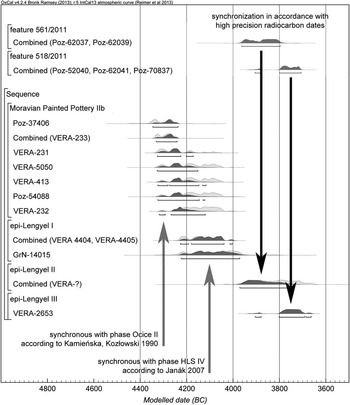
In the light of the series of 14C dates obtained for the sake of this study, the decline of the Lengyel culture (epi-Lengel stage) on the Głubczyce Plateau can be placed in the (95.45%) 3941 and 3787 BC, or (68.27%) 3930 and 3797 BC chronological interval. However, if the somewhat younger chronology of feature 518/2011 discovered at Otice-Rybníčky is accepted, then the last phase of the Lengyel culture in the Upper Odra Basin appears as lasting even to the end of the 38th century BC (3715 or 3707 BC, at respective levels of probability). What can be concluded on this basis?
The final phase of local development of the Lengyel culture (4th phase of the Upper Silesian Lengyel Group according to Vratislav Janák) was considered to be synchronous with early epi-Lengyel formations such as Jordanów Śląski culture in the territory of Moravia, Bohemia and Lower Silesia, early Wyciąże-Złotniki group in western Lesser Poland and the Ludanice culture in western Slovakia (see e.g. Janák Reference Janák1993, Reference Janák2007), or even older (see Kulczycka-Leciejewiczowa Reference Kulczycka-Leciejewiczowa1979; Kamieńska and Kozłowski Reference Kamieńska and Kozłowski1990). The results of 14C dating presented here push the end of the Lengyel culture on the Głubczyce Plateau to a later stage of the Eneolithic (Figure 7). These results suggest that the last stage of Lengyel culture can be synchronized with the Bajč stage of the early stab-and-drag (Germ. Furchenstich) ornamented pottery horizon in the western part of the Carpathian Basin and the beginning of the Funnel Beaker culture in Moravia and Bohemia (phase IA according to Miroslav Šmíd; see Šmíd Reference Šmíd1994), and may have lasted even longer—to the so-called proto-Boleráz phase in western Hungary and Slovakia and phase IB of the Funnel Beaker culture in Moravia with the Retz type of stab-and-drag ornamented pottery (for relevant 14C dates see Görsdorf Reference Görsdorf1995; Stadler et al. Reference Stadler, Ruttkay, Doneus, Friesinger, Lauermann, Kutschera, Mateiciucová, Neubauer, Neugebauer, Trnka, Weninger and Wild2006; Oross et al. Reference Oross, Marton, Whittle, Hedges and Cramp2011; Rajna Reference Rajna2011; Krištuf Reference Krištuf2012; Fera Reference Fera2011; Chmielewski et al. Reference Chmielewski, Furmanek, Patay and Sady2014; Nowak Reference Nowak2014; Ruttkay et al. Reference Ruttkay, Teschler-Nicola and Stadler2014). Therefore, the dates provide a firm ground for reconsideration of the decline of the so-called Danubian cultures in the Upper Silesia.
The decline of the Lengyel culture in the Upper Silesia based on the sequence of 14C dates obtained for remains of wattle and daub architecture discovered at Otice-Rybníčky against the sequence of AMS 14C dates obtained for the late Lengyel and epi-Lengyel culture sites from Lower Austria and Moravia (after Stadler et al Reference Stadler, Ruttkay, Doneus, Friesinger, Lauermann, Kutschera, Mateiciucová, Neubauer, Neugebauer, Trnka, Weninger and Wild2006; Ruttkay et al Reference Ruttkay, Teschler-Nicola and Stadler2014) and traditional (exclusively pottery-based) synchronizations.

CONCLUSIONS
Having obtained such clear results of 14C dating based on cereal chaff-and-straw temper from daub discovered in Otice, we can only regret that similar remains associable with clearly defined settlement horizons occur so rarely in the milieu of the Lengyel culture (see Pavúk Reference Pavúk2012). Nevertheless, central and southeastern Europe teem with prehistoric sites such as the multi-layer tell settlements of the Carpathian Basin and Balkan Peninsula or so-called giant settlements of the Cucuteni-Trypillia complex, which are extremely rich in remains of daub architecture and due to that appear almost as predestinated for implementation of the plant-temper-based sampling procedure presented above. Therefore, one might wonder why the research conducted in this part of the world hardly ever reached for this deep and attractive reservoir of reliable14C samples (cf. e.g. Schier Reference Schier1996, Reference Schier2008; Gulyás et al. Reference Gulyás, Sümegi and Molnár2010; Raczky and Anders Reference Raczky and Anders2011; Rassamakin and Menotti Reference Rassamakin and Menotti2011; Weninger et al. Reference Weninger, Reigruber and Hansen2011). Such sampling procedure has been only occasionally applied in the concurrent projects addressed to the Tripillian site at Nebelivka (Chapman Reference Chapman2014) and to the Funnel Beaker in the region of Osłonki (Mueller-Bieniek Reference Mueller-Bieniek2016). If we were to explain this situation, then—concluding a contrario to what brought us to the use of charred remains of chaff-and-straw admixture to daub for 14C dating of the Lengyel culture in Upper Silesia—we would connect the lack of such plant temper-based dates in other areas with the abundance of alternate datable and reliable materials. Whatever the case, the positive result of our short chronometric exercise invites more common use of plant additives from daub constructions for 14C dating in prehistoric archaeology.
Acknowledgments
The research was conducted under the post-doctoral internship program financed by the National Science Centre (Narodowe Centrum Nauki), based on the decision DEC-2012/04/S/HS3/00269.