Introduction
Acute external otitis is an inflammatory disease of the outer ear canal, which includes the auricle and tympanic membrane. Depending on the extent of inflammation, it may be localised or diffuse, and it is defined as acute or chronic according to the duration.Reference Brook1
External otitis was first described by Thomas Mayer in 1844.Reference Mayer2 External trauma and maceration of the external auditory canal skin because of water or moisture leads to loss of the protective layer of the outer ear canal and the development of infection. It is also called swimmer's ear as it is more common in humid and wet environments.Reference Brook1 Infectious, allergic or dermatological disorders can also cause external otitis. Acute bacterial infections are the most common factor in aetiology followed by fungi.Reference Stone3 The most common species of bacteria are Pseudomonas aeruginosa and Staphylococcus aureus, and the most common fungi isolated are Aspergillus species and Candida species. Single or multiple micro-organisms can coexist in the aetiology.Reference Brook1,Reference ALjaafreha, Tawalbeh and Shehabi4 Acute external otitis affects approximately 1 per cent of the general population annually. The annual prevalence rate in the USA is reported as 0.4 per cent.Reference Taheri P, Rostami and Sadeghi5
Acute external otitis is seen most frequently in the third decade of life.Reference Adegbiji, Aremu, Olatoke, Olajuyin and Ogundipe6,7 It is also very common among the paediatric population; although it can be seen in all paediatric age groups, it mostly affects children over two years of age.Reference Taheri P, Rostami and Sadeghi5 Red lead, resin, olive oil, goose oil, turpentine, camphor and menthol-containing potions have been used for the treatment of acute external otitis in historyReference Beers and Abramo8; however, current treatment involves clearing debris as well as use of antimicrobial drugs, steroid-containing topical drugs and external auditory canal acidifying agents. In some cases, when multidrug-resistant infections are encountered, topical drug use is not sufficient and systemic treatment should be added.Reference Brook1 While S aureus is easier to treat with a single antibiotic, it may be necessary to use antimicrobial drugs in combination in the treatment of P aeruginosa. Reference Brook1
It is well known that resistance to antibiotics occurs. Recent studies conducted in the Arab countries in the Middle East have shown that P aeruginosa develops multiple drug resistance to drugs such as amikacin, aztreonam, gentamicin, piperacillin-tazobactam and ciprofloxacin and is sensitive to imipenem, ceftazidime and colistin B.Reference ALjaafreha, Tawalbeh and Shehabi4
Our aim in this study was to identify microbial pathogens in external otitis cases and to determine the susceptibility and resistance status of topical aminoglycoside and quinolone.
Materials and methods
A total of 168 patients who were admitted to the otorhinolaryngology out-patient clinic between December 2019 and December 2020 with the complaint of external otitis and who had not received topical or systemic treatment previously were included in the study. Patients who had previously received topical or systemic external otitis treatment and those who did not have an ear culture before treatment were excluded from the study.
Gender, age, demographic data and microbiological culture results of the patients were analysed retrospectively using a digital archive.
In patients with fungus as a result of culture, the agents were identified at the species level but antibiotic susceptibility was not studied.
After the debris and crusts were aspirated from the infected ears of the patients, specimens for culture were taken using culture sticks containing Stuart transport medium in sterile conditions.Reference Garcia9 Under laboratory conditions, blood agar, eosin methylene blue agar and chocolate agar were used for the cultures. After 24-hour incubation in the carbon dioxide incubator, petri dishes were evaluated.
The species of bacteria growing were identified by conventional methods (catalase, coagulase, indole, methyl red, Voges-Proskauer, citrate tests, oxidase). Gram-negative microorganisms that cannot be identified by conventional methods were identified using the API 10S identification system (bioMerieux, Craponne, France). Preparations stained with lactophenol cotton blue were analysed microscopically for identifying mould samples. Antibiotic susceptibility status for growing bacteria was determined using the Kirby–Bauer disc diffusion method in accordance with the European Committee on Antimicrobial Susceptibility Testing recommendations.
In order to investigate the seasonal effect on micro-organism distributions, the patients were classified according to their admission dates: spring (March, April, May), summer (June, July, August), autumn (September, October, November) and winter (December, January, February). The period when tourism activities and swimming pool activities are intense in our region is between May and October. In order to see the effects of these activities on micro-organism distributions, patients were divided into two groups: those admitted to the out-patient clinic from May to October and those admitted from November to April.
Statistical analysis
Statistical analyses were performed using the PASS (IBM, Chicago, USA) software program. Variables were investigated using visual (histograms, probability plots) and analytical (Kolmogorov–Smirnov test) methods to determine whether they were normally distributed. Categorical variables were compared with the chi-square test. A total p-value below 0.05 was considered as a statistically significant result.
Results
According to the data of 168 patients whose cultures yielded microbiological growth, the female to male ratio was 1:1. The age range of the patients was 1–97 years; however, the mean age was 40.3 years (± standard deviation (SD), 21.2 years). The mean age of females was 39.05 years (± SD, 17.8 years), and it was 41.45 years (± SD, 21.2 years) in males.
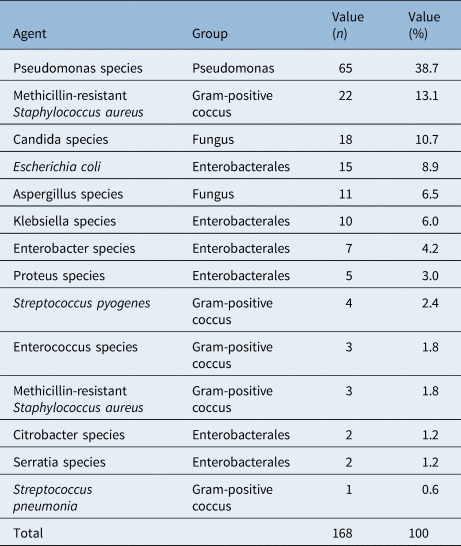
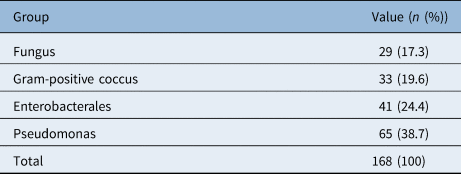
Bacteria were detected in 139 of 168 cases (82.8 per cent) and fungi were detected in 29 cases (17.2 per cent) as causative agents. Bacteria were evaluated in three main groups as gram-positive cocci, enterobacterales and pseudomonas groups. Considering all age groups, the pseudomonas group bacteria were most commonly detected (38.7 per cent), while gram-positive cocci (16.9 per cent) were the least commonly detected bacteria. In a classification made considering the distribution frequency of gram-negative micro-organisms, gram-negative bacteria (63.1 per cent) were found to be the most common causative agents if pseudomonas and enterobacterales groups were gathered under one group. Distribution of causative pathogens is shown in Tables 1 and 2.
Distribution of causative micro-organisms of external otitis according to species

Distribution of external otitis agent micro-organisms by groups

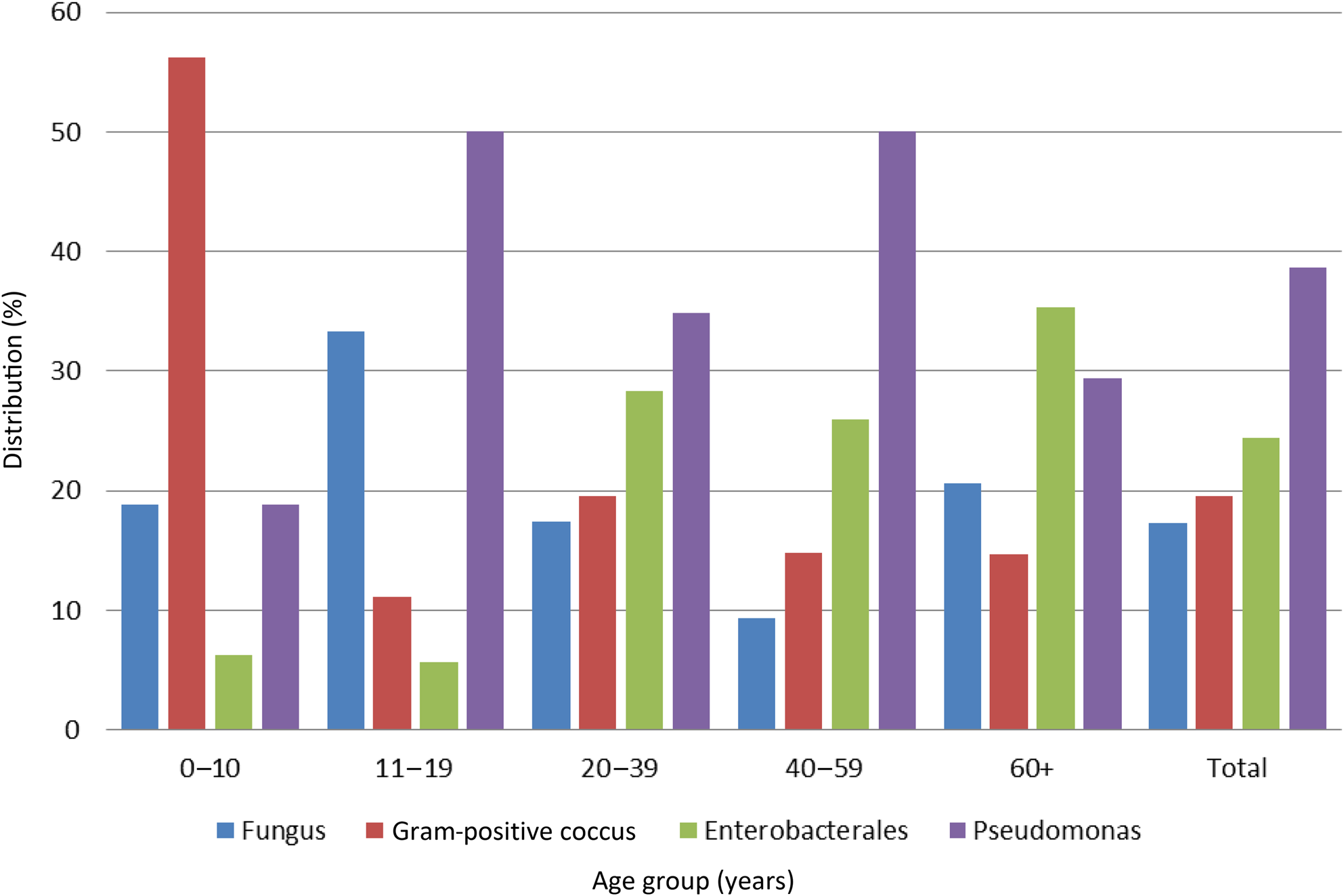
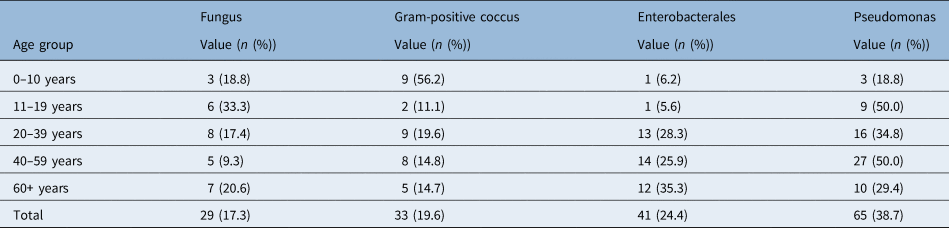
In several studies, the distribution of causative pathogens by age was classified using age ranges with pathogens classified according to these groupings.Reference Taheri P, Rostami and Sadeghi5–7,Reference Kiakojuri, Omran, Jalili, Hajiahmadi, Bagheri and Shahandashti10 In our study, age groups were categorised as 0–10, 11–19, 20–39, 40–59 and equal to or more than 60 years. When pathogens were evaluated in all age groups, gram-positive cocci were detected in the range of 11.1 and 56.2 per cent, enterobacterales group micro-organisms were detected between 6.2 and 35.3 per cent, and pseudomonas group bacteria were detected between 18.8 and 50 per cent. When evaluated according to age groups, the most common pathogen found in the 0–10 years age group was gram-positive cocci (56 per cent), in the 11–59 years age group was pseudomonas (34–50 per cent) and in the equal to or more than 60 years age group was enterobacterales (35.5 per cent). This difference was statistically significant (p = 0.004). The distribution of pathogens by age is shown in Table 3 and Figure 1.
Distribution of causative micro-organisms in external otitis by age group.

Distribution of causative micro-organisms in external otitis by age groups

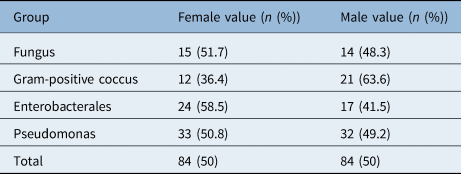
The distribution of fungus, gram-positive bacteria, enterobacterales and pseudomonas group micro-organisms in women and men are summarised in Table 4. No statistically significant difference was found in the distribution of micro-organisms in terms of gender (p = 0.296).
Distribution of causative micro-organisms in external otitis by gender

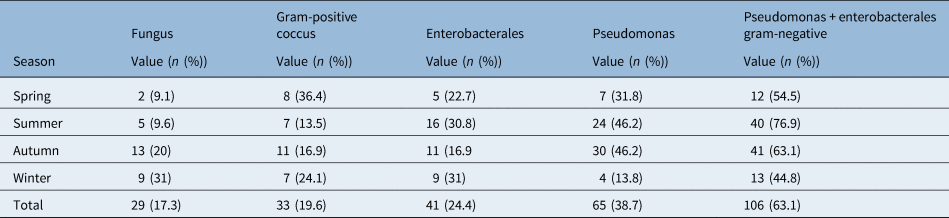
In winter, gram-negative micro-organisms (44.8 per cent; pseudomonas (31 per cent) plus enterobacterales (13.8 per cent)), gram-positive cocci (24.1 per cent) and fungi (31 per cent) were found to be causative pathogens, whereas gram-negative micro-organisms (76.9 per cent; pseudomonas (46.2 per cent) plus enterobacterales (13.8 per cent)), gram-positive cocci (13.5 per cent) and fungi (9.6 per cent) were found to be causative pathogens in summer. This difference was statistically significant (p = 0.016).
When gram-negative bacteria were evaluated as a group, gram-negative micro-organisms (44.8 per cent), gram-positive cocci (24.1 per cent) and fungi (31 per cent) were detected in the winter season, and gram-negative micro-organisms (76.9 per cent), gram-positive cocci (13.5 per cent) and fungi (9.6 per cent) were found in the summer (Table 5). This difference was statistically significant (p = 0.028).
Seasonal distribution of micro-organisms

The most common causative pathogens during the swim season were pseudomonas species (50 per cent), enterobacterales (20.9 per cent), gram-positive cocci (16.4 per cent) and fungi (12.7 per cent), whereas pseudomonas species (17.2 per cent), enterobacterales (31 per cent), gram-positive cocci (25.9 per cent) and fungi (25.9 per cent) were detected as causative factors during the off-season (p = 0.001).
When gram-negative bacteria were evaluated as a group, gram-negative micro-organisms (70.9 per cent), gram-positive cocci (16.4 per cent) and fungi (12.7 per cent) were detected during the swim season, while gram-negative micro-organisms (48.2 per cent), gram-positive cocci (25.9 per cent) and fungi (25.9 per cent) were found as causative pathogens during the off-season (p = 0.013).
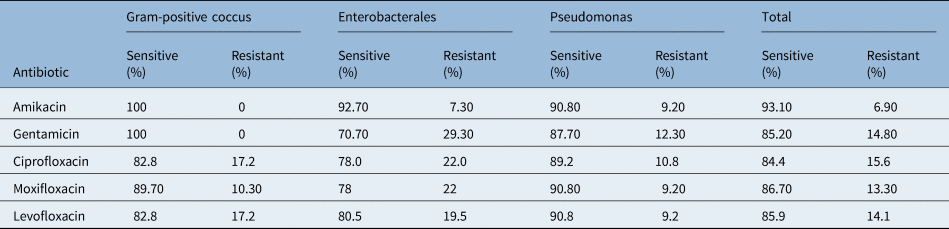
According to the groups of bacteria, antibiogram studies of topical amikacin, gentamicin, ciprofloxacin, levofloxacin and moxifloxacin antibiotics were performed. According to the study, the resistance to the amikacin group antibiotic was lowest (6.9 per cent; Table 6) whereas the resistance to the ciprofloxacin group antibiotic was highest (15.6 per cent). No resistance to aminoglycoside-derived antibiotics was detected in any of the gram-positive micro-organisms. Although 29.3 per cent of the enterobacterales group micro-organisms showed resistance to gentamicin, resistance to amikacin was only detected in 7.3 per cent (Table 6).
Distribution of antibiotic susceptibilities of micro-organisms in external otitis

Discussion
Acute external otitis is a diffuse inflammatory disease of the external auditory canal, auricle or tympanic membrane. The anatomical structure of the external auditory canal, the pilosebaceous structures in the skin structure and cerumen form a barrier against infections. The acidic nature of the cerumen (pH 6.0–6.5) prevents the development of fungal and bacterial infections.Reference Musso, Crews, Valdez and Vallejo11
Hot and humid weather conditions, disruption in cerumen structure, traumatisation of the external auditory canal and impairment of external auditory canal pH lead to development of infection by disrupting the barrier structure of external auditory canal. These factors predispose individuals to infections of endogenous or exogenous bacteria. Exogenous bacteria emerge by inserting mechanical objects into the outer ear canal or by swimming. Many studies have shown that the incidence of this disease increases because of swimming and water activities.Reference Musso, Crews, Valdez and Vallejo11–Reference Wright and Alexander13 A narrow external auditory canal, eczema-like skin diseases, chronic Eustachian tube dysfunction, tympanic membrane perforation, presence of a ventilation tube, diabetes, immunodeficiency and history of previous radiotherapy are other predisposing factors.Reference Russell, Donnelly, McShane, Alun-Jones and Walsh14,Reference Schaefer and Baugh15
Symptoms differ depending on the severity and prevalence of the disease. There is itching, oedema and fullness in the ear in the early stages. In advancing stages, various degrees of pain, itching, tenderness, purulent secretion, oedema, tenderness when touching the tragus or moving the auricle, and hearing loss are observed.Reference Schaefer and Baugh15
A clinical practice guide has been published by the American Academy of Otolaryngology-Head and Neck Surgery for use in the diagnosis and treatment approach for acute external otitis. Since acute external otitis is rarely seen in patients under two years of age, this guideline is for patients two years of age and over.Reference Rosenfeld, Schwartz, Cannon, Roland, Simon and Kumar16 A study in Turkey reported that the mean age for external otitis is 39 years, and the ratio of patients under 18 years of age is 15.1 per cent.Reference Çeviker, Günal, Mehel, Özgür and Kılıç17 In our study, the mean age was 40.3 years, and the ratio of cases under 18 years was 18.4 per cent. When 168 patients were grouped by age, 16 per cent of the cases were in the 0–10 years age group, 18 per cent were in the 11–19 years age group, 46 per cent were in the 20–39 years age group, 54 per cent were in the 40–59 years age group and 34 per cent were in the over 60 years age group.
Gram-positive bacteria are found in the normal flora of the external auditory canal. A study in which flora of 72 healthy children between 3 months and 12 years of age were examined by obtaining swabs from the external auditory canal found mostly Staphylococcus epidermidis (78 per cent), Alpha hemolytic streptococcus (18 per cent) and P aeruginosa (11 per cent) as normal bacterial flora.Reference Brook18
Another study conducted on 124 healthy adults and 40 children examined the normal flora of the external auditory canal and found that gram-positive bacteria were isolated in 93 per cent of the specimens obtained from the external auditory canal, gram-negative bacteria were isolated in 4.5 per cent and fungi were isolated in 2.5 per cent of the specimens.Reference Stroman, Roland, Dohar and Burt19
External auditory canal swab samples of 77 healthy adults yielded coagulase-negative staphylococcus growth in 83 per cent of the normal flora. In 7 per cent of men, S aureus was shown in the normal flora, and it was reported that fungi were seen more frequently in the normal flora of men.Reference Dibb20 In our study, 63.6 per cent of gram-positive cocci were detected in men and 36.4 per cent in women. Furthermore, gram-positive cocci made up 14.3 per cent of micro-organisms found in women and 25 per cent in men. In both cases, the difference was not statistically significant (p = 0.213 and p = 0.296 for women and men, respectively). In our study, no difference was found in terms of the distribution of fungi by gender (p = 0.296).
In a study, it has been reported that flora show a change toward gram-negative bacteria in hot air and humid environments, in individuals under 20 years of age, and during swimming.Reference Calderon and Mood12 It has been reported that swimming leads to a change of pH and loss of cerumen in addition to flora change.Reference Musso, Crews, Valdez and Vallejo11,Reference Wright and Alexander13 Acute external otitis is more common in the summer because of weather conditions and more swimming activities.Reference Calderon and Mood12,Reference Çeviker, Günal, Mehel, Özgür and Kılıç17 The fact that children spend more time swimming and undertaking water activities than adults is considered the main reason for the difference between age groups.
Bacterial infections are largely involved in the aetiology of acute external otitis. The most common pathogens are P aeruginosa and S aureus. Reference Heward, Cullen and Hobson21 In the USA, P aeruginosa has been reported in 38 per cent of acute external otitis cases.Reference Roland and Stroman22 In studies conducted in Turkey, P aeruginosa was shown as the causative pathogen in 17–42 per cent of patientsReference Çeviker, Günal, Mehel, Özgür and Kılıç17,Reference Malçok, Uyanık, Aktaş and Ayyıldız23 and S aureus in 10–24 per cent of the patients.Reference Çeviker, Günal, Mehel, Özgür and Kılıç17,Reference Enoz, Sevinc and Lapeña24 The variation in the ratios of pathogens depends on differences in geographic region and climate.Reference Malçok, Uyanık, Aktaş and Ayyıldız23 In our study, pseudomonas species (38.7 per cent) were found to be the most common causative factor in patients. Of these pseudomonas bacteria, 75.3 per cent were identified as P aeruginosa. When all factors were evaluated, P aeruginosa accounted for 29.16 per cent of the cases.
In a study conducted on 116 patients in Northern Iran, it was shown that external otitis was found most frequently between the ages of 35–45 years, and women were more commonly affected than men. Gram-positive micro-organisms were isolated in 71.54 per cent of the patients.Reference Kiakojuri, Omran, Jalili, Hajiahmadi, Bagheri and Shahandashti10 In our study, gram-negative micro-organisms showed an absolute dominance in patients aged 11 years and older, while gram-positive micro-organisms were dominant in patients aged 10 years and younger. In our study, the difference in the distribution of micro-organisms by age is statistically significant (p = 0.04). Our hospital is located in a touristic area in the Mediterranean region. In addition to numerous hotels in our region, there are many swimming pools in the buildings used as residences. During summer season, the average temperature is about 28°C and the maximum temperature reaches 45°C accompanied by high humidity in our region.
In our study, the difference in causative micro-organisms in terms of the seasons was statistically significant. It was observed that gram-negative micro-organisms were dominant in the summer months, especially when water sport activities were high. Pseudomonas bacteria were also found to increase during the summer months and in the months with intense water activities. It has been shown in a previous study that the external auditory canal flora of the individuals who are constantly in contact with water shifts from gram-positive to gram-negative bacteria. In addition, poor water quality has been shown to increase the risk of external otitis associated with pseudomonas.Reference Hajjartabar25 In our study, we believe that the reason for the seasonal change in causative pathogens may be because of chronic contact with water or poor hygiene of the swimming pools.
In a study evaluating the effects of swimming on the external auditory canal flora, it has been shown that there are normally gram-positive bacteria in the flora, and the flora starts to shift to the gram-negative bacteria beginning at the 5th day of water contact.Reference Wright and Alexander13 We also think that the dominance of gram-negative bacteria in acute external otitis cases in our study is because of the disruption of the pH in the external auditory canal, and the gram-negative shift of the flora is because of increased water activities.
Otomycosis is a fungal infection of the external auditory canal that emerges secondary to bacterial infections. Wearing a headscarf, swimming, having accompanying skin diseases and broad spectrum antibiotic agent use are predisposing factors in the development of otomycosis.Reference Ozcan, Ozcan, Karaarslan and Karaarslan26 A pH change in the outer ear canal, reduction in ear wax, hearing aid or hearing prosthesis use, cleaning the ear canal with use of q-tips, steroid use, and cytostatic medication are the other predisposing factors in the development of otomycosis.Reference Pontes, Silva, Lima Ede, Guerra Mde, Oliveira and Carvalho Mde27 Headscarfs lead to increased humidity and fungus development in the outer ear canal.Reference Ozcan, Ozcan, Karaarslan and Karaarslan26
Otomycosis ranks second as the most common infection after bacterial infections of external auditory canal. Aspergillus and candida are the most common pathogens.Reference Çetinkol, Korkmaz and Yildirim28 In a study conducted in Turkey, otomycosis was detected in 22.1 per cent of acute external otitis cases.Reference Enoz, Sevinc and Lapeña24 In another study, it was shown that otomycosis is more common in summer and autumn when the air is hot and humid and that otomycosis patients are mostly women and individuals who wear headscarfs.Reference Ozcan, Ozcan, Karaarslan and Karaarslan26 In our study, the most frequently detected bacteria were pseudomonas species (38.7 per cent), followed by methicillin-sensitive S aureus (13.1 per cent). Candida (10.7 per cent) infections rank third in development of acute external otitis.
Topical drops containing antimicrobials and steroids are mostly used in the treatment of bacterial acute external otitis. Quinolone and aminoglycoside group drops are the most commonly used topical medications. Quinolones are preferred in the first place because of their good efficacy on gram-negative and gram-positive micro-organisms and have fewer autotoxic and local hypersensitive effects compared with aminoglycoside group antimicrobials.Reference Heward, Cullen and Hobson21
Drops containing aminoglycoside, polymyxin B and steroids can be used along with quinolone group drops.Reference Heward, Cullen and Hobson21 In preventing recurrent acute external otitis, it is important to minimise external auditory canal trauma, eliminate predisposing factors and avoid water exposure. Drops containing topical acid or alcohol are also recommended to prevent infection. Ototoxic drops should be avoided in the presence of tympanic membrane perforation. Surgical intervention may rarely be required for removing debris, eroded soft tissue and bone fragments, and excision of scar tissue in the external auditory canal.Reference Schaefer and Baugh15
Widespread chronic otitis externa resulting from prolonged itching can lead to external ear canal stenosis and irreversible skin changes with scar tissue. Surgical treatment in the form of meatoplasty has been shown to be beneficial in a select group of patients with a narrow or stenosed external auditory canal.Reference Kumar and Smelt29
The increasing antimicrobial resistance problem worldwide emphasises the significance of detecting resistant micro-organisms and appropriate treatment. Use of topical drugs in first-line treatment and systemic antibiotics in severe otitis and skull base osteomyelitis is recommended.Reference Heward, Cullen and Hobson21
In a study performed by taking 302 swab samples from 217 patients, resistance that was not previously reported was shown against aminoglycoside group antibiotics and P aeruginosa, and quinolone group antibiotics were highly effective in treatment.Reference Heward, Cullen and Hobson21 In a study conducted with 2240 swab samples, P aeruginosa was reported to be 78.4 per cent sensitive against gentamicin and 97.7 per cent sensitive against ciprofloxacin.Reference Roland and Stroman22 In another study, it was emphasised that the efficacy and safety of the quinolone group antimicrobials against P aeruginosa is high and that aminoglycosides increase in antibiotic resistance.Reference Rosenfeld, Singer, Wasserman and Stinnett30
• Acute external otitis is inflammation of the external auditory canal
• Bacteria and fungi are the commonest aetiological factors, but cultures should be taken simultaneously with treatment
• If empiric antimicrobial therapy is initiated, antibiotic resistance and other pathogens should be kept in mind
• Resistance to the amikacin group antibiotics was found to be the lowest and the ciprofloxacin group was the highest
• It should be considered that the causative micro-organisms differ according to age in the selection of treatment
In a study conducted in Turkey, it was found that P aeruginosa showed maximum resistance to ciprofloxacin (25 per cent) and least resistance to amikacin (8 per cent). Enterobacterales group bacteria showed maximum resistance to amikacin (7 per cent) and least resistance to netilmicin.Reference Malçok, Uyanık, Aktaş and Ayyıldız23
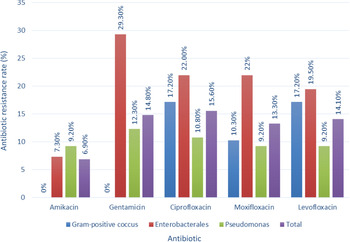
The susceptibility and resistance rates of aminoglycoside group and quinolone group antibiotics against the causative pathogens detected in our study are summarised in Figure 2. Accordingly, the least resistance was seen against amikacin and the most resistance against ciprofloxacin. It has been shown in the literature that there is an increased resistance of bacteria to gentamicin.Reference Heward, Cullen and Hobson21,Reference Rosenfeld, Singer, Wasserman and Stinnett30 In our study, the in vitro resistance of enterobacterales group micro-organisms in particular against gentamicin is evident (29.3 per cent).
Antibiotic resistance status of micro-organisms.

The development of resistance may be caused by not clearing debris before topical treatment and improper use of systemic treatments.Reference Schaefer and Baugh15,Reference Heward, Cullen and Hobson21 Topical medications should be chosen in initial therapy to reduce resistance development. In order for the topical drops to have a high effectiveness, it should be checked that there is no debris left in the external auditory canal.Reference Heward, Cullen and Hobson21
Conclusion
External otitis is an important disease that is manifested by inflammation of the outer ear canal, has a high incidence and concerns family medicine and otolaryngology physicians.Reference Heward, Cullen and Hobson21
In our study, gram-positive cocci were found to be more common in patients under 10 years of age and pseudomonas group micro-organisms were found to be more common in patients between 10 and 60 years of age. Resistance to aminoglycoside was low in these groups. Therefore, it has been shown that aminoglycoside group topical antibiotics are preferred in the first step of treatment. However, in patients over 60 years of age, it is necessary to take into consideration in the treatment selection that enterobacterales are prominent and resistance to gentamicin is significant in this group of micro-organisms.
Seasonal effects should also be taken into consideration in managing the choice of treatment in patients admitted to the clinic, and we believe that empirical treatment should be started by questioning the patient on their chronic exposure to water. Even if empirical treatment is initiated, it should be kept in mind that resistance to antibiotics might be present, fungal micro-organisms other than bacteria might also be causative pathogens in acute external otitis and a culture of the external auditory canal should be taken simultaneously with initiation of empirical treatment. It would be appropriate in terms of case management to isolate the causative pathogen and to determine the resistance status. In the presence of treatment resistance, topical drug replacement and systemic drug combination should be considered depending on the antibiogram results.
Acknowledgement
The authors thank Dr Ayşegül Özalan for analyses of epidemiological data and results of the patient group.
Competing interests
None declared