Introduction
Rice is one of the major staple food crops in hill states of India. Rice germplasm endemic to the Himalayan region has traits conferring resilience to various biotic and abiotic stresses that challenge rice production in hills (Rana et al., Reference Rana, Negi, Wani, Saxena, Pradheep, Kak, Pareek and Sofi2009; Imam et al., Reference Imam, Alam, Mandal, Variar and Shukla2013; Mehta et al., Reference Mehta, Ojha, Negi, Rayal and Tyagi2014; Umakanth et al., Reference Umakanth, Vishalakshi, Sathish Kumar, Rama Devi, Bhadana, Senguttuvel, Kumar, Sharma, Sharma, Prasad and Madhav2017; Husaini and Sofi, Reference Husaini, Sofi and Grillo2018; Najeeb et al., Reference Najeeb, Mahender, Anandan, Hussain, Li, Ali, Ali and Wani2021). Among hill ecologies, the North Eastern (NE) region of India holds special status owing to its rich diversity in rice genetic resources including unique rice landraces (Hore, Reference Hore2005; Choudhury et al., Reference Choudhury, Khan and Dayanandan2013; Choudhury et al., Reference Choudhury, Singh, Singh, Kumar, Srinivasan, Tyagi, Ahmad, Singh and Singh2014; Ngachan et al., Reference Ngachan, Mohanty and Pattanayak2014; Roy et al., Reference Roy, Banerjee, Mawkhlieng, Misra, Pattanayak, Harish, Singh, Ngachan and Bansal2015). In the last decade organic agriculture has increased globally as agriculture develops towards chemical free and ecologically safe methods of food production and biodiversity compared to conventional farming (Gabriel et al., Reference Gabriel, Sait, Hodgson, Schmutz, Kunin and Benton2010; Tuck et al., Reference Tuck, Winqvist, Mota, Ahnstrom, Turnbull and Bengtsson2014).
Hill states in India have been leading the adoption of organic farming. Sikkim, a constituent state of NE region of India, is one of the biodiversity hotspot regions in Eastern Himalayas, and has achieved 100% organic status supported by its agrobiodiversity richness and ecologically sustainable farming systems. Rice production under organic conditions in hills is challenged by low soil fertility, early onset of low temperature and low sunshine hours constituting a complex low production environment. Soils of Sikkim are poor in water holding capacity hence rice cultivation under upland conditions faces low moisture stress at critical stages of growth which finally affects grain yield. Low temperature during flowering and grain filling stage affects rice yields due to spikelet sterility and poor grain filling resulting in chaffy grains.
Breeding specifically for organic and low input conditions is essential for improved productivity (Murphy et al., Reference Murphy, Campbell, Lyon and Jones2007; van Bueren et al., Reference van Bueren, Goldringer, Scholten and Ostegard2007; van Bueren et al., Reference van Bueren, Jones, Tamm, Murphy, Myers, Leifert and Messmer2011; Crespo-Herrera and Ortiz, Reference Crespo-Herrera and Ortiz2015; Huang et al., Reference Huang, Jun, Yang, Zhang, Bai, Sun and Zhuang2016; Nuijten et al., Reference Nuijten, Messmer and Lammerts van Bueren2017). While several studies have proposed that organic farming can provide sufficient yields for food production (Liu et al., Reference Liu, Meng, Bo, Cheng, Li, Guo, Li, Zheng, Liu, Ning, Wu, Yu, Feng, Wuyun, Li, Li, Zeng, Liu Shi and Jiang2016; Muneret et al., Reference Muneret, Mitchell, Seufert, Aviron, Djoudi El, Petillon, Plantegenest, Thiery and Rusch2018; Eyhorn et al., Reference Eyhorn, Muller, Reganold, Frison, Herren, Luttikholt, Mueller, Sanders, Scialabba, Seufert and Smith2019; Krauss et al., Reference Krauss, Berner, Perrochet, Frei, Niggli and Mader2020), others have been sceptical of this premise due to reported lower yields (Kirchmann et al., Reference Kirchmann, Bergstrom, Katterer, Andren, Andersson, Kirchmann and Bergstrom2008; de Ponti et al., Reference de Ponti, Rijk and van Ittersum2012; Seufert et al., Reference Seufert, Ramankutty and Foley2012; Gabriel et al., Reference Gabriel, Sait, Kunin and Benton2013; Ponisio et al., Reference Ponisio, M'Gonigle, Mace, Palomino, de Valpine and Kremen2015). Studies to assess the performance of rice varieties under organic systems have been undertaken (Dubey, Reference Dubey2016; Manjunatha et al., Reference Manjunatha, Vanaja, Naik, Kumar Anil and Vasudevan2016; Singh et al., Reference Singh, Gupta, Nanda, Sharma, Singh and Bisarya2017; Vanaja et al., Reference Vanaja, Neema, Mammootty, Balakrishnan and Jayaprakash2017; Mandi et al., Reference Mandi, Sarkar and Goswami2018; Kumari and Shanmugam, Reference Kumari and Shanmugam2020). However, rice improvement for organic systems is in nascent stage. Currently in India, high yielding rice varieties cultivated in organic farming originate from breeding programmes from conventional agriculture. A breeding programme specifically for organic systems requires separate resources and testing specifically under organic farming conditions
Local rice cultivars dominate rice farming under organic agriculture along with a small share of high yielding varieties (HYVs). Rice HYVs have already proved their potential in conventional systems however their suitability and usefulness under organic conditions in hilly ecologies needs further evaluation for current and future rice improvement programmes. To address this, we carried out studies on local and conventional rice genetic resources to evaluate (i) traits and their associations affecting rice yield under organic conditions and interaction of rice genotypes with system of cultivation and (ii) suitability of genotypes and traits affecting rice yields under low temperature stress in hill ecology.
Materials and methods
Experimental site
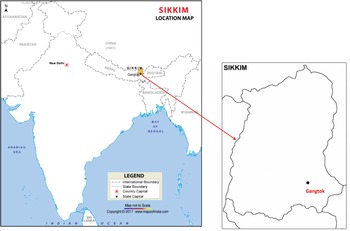
Trials for the study were conducted at research farm of ICAR Research Complex for NEH Region, Sikkim Centre located at Tadong, Gangtok, India at 27°32′ N latitude and 88°60′E at an altitude of 1320 m amsl (Fig. 1). The site represents mid hill temperate type climate. The field experimental site is a certified organic farm and has been under organic management since 2003. The soil of the site is sandy loam in texture and moderately deep with pH of 5.97 and soil organic carbon content of 1.38. Nitrogen content of the site plots is medium i.e. 340 kg N/ha. The site has both irrigated rice fields for lowland rice trials and upland fields for direct sown rice. Weather parameters during the testing years have been shown in online Supplementary Table S1. The experimental site can be categorized as low to medium yielding location among tests sites under hill ecology with mean experimental grain yield of 3249 kg/ha recorded in different All India Coordinated Rice Improvement Programme (AICRIP) trials for medium duration irrigated conditions of hills.
Location of the experimental site at Gangtok, Sikkim.

Experimental material
A total of 420 rice genotypes (online Supplementary Table S2) were included in the study which comprise of local organic rice cultivars of Sikkim, improved varieties of ICAR-VPKAS, Almora, Uttarakhand, Rice & Wheat Research Centre, CSK HPAU, Malan, Himachal Pradesh and ICAR Research Complex for NEH Region Tripura Centre, Lembucherra, Tripura. Local varieties of Sikkim are annotated as ‘organic varieties’ as these have been in cultivation under organic farming and have been adapted to local agro-ecology whereas the lines procured from outside are referred as ‘conventional’ varieties bred for higher grain yield under conventional management using inorganic fertilizers/chemicals.
Trials and layout
A total of 420 rice entries were included under four different research trials (online Supplementary Table S2) to study response of local organic cultivars and conventional varieties under organic system. Data for upland rice trials were taken from experiments conducted during kharif, 2013 and 2014 while for irrigated conditions trials were conducted during kharif, 2018 and 2019. The trials were raised under organic management in which farm yard manure @10 tonnes/ha was applied in the plots before 15 days of transplanting. Organic manure containing Bio-NPK were applied at 30 days post transplanting. Thirty day old seedlings were transplanted for irrigated trials keeping two seedlings per hill while seed was sown directly in lines for upland conditions at plant spacing of 20 × 15 cm. Fields were kept weed free by hand weeding at different crop stages. Trials conducted for different studies were as follows:
Relative performance of local organic cultivars under irrigated and rainfed upland conditions
Fifty local organic rice cultivars commonly cultivated in Sikkim (online Supplementary Table S3) were evaluated for relative performance under irrigated transplanted and direct sown rainfed upland conditions. The entries were tested in augmented block design with four checks following organic practices during kharif 2013 & 2014. Entries were adjusted in five blocks with 14 entries each. A single row of each entry was sown in 3 m row length maintaining plant spacing of 20 × 15 cm. Plant to plant spacing under upland conditions was maintained by thinning the seedlings after two weeks of sowing in each line.
Data were recorded on plant height (cm), days to 50% flowering, number of tillers per plant, panicle length (cm), days to maturity, grain yield per plot (g) and test weight (g).
Yield performance and trait association under low temperature stress
Two hundred and twenty one rice entries comprised of popular local landraces, released varieties and advance breeding lines were tested for low temperature tolerance during kharif 2018 and 2019 under organic conditions. For coinciding with low temperature during flowering and grain filling stage, transplanting was delayed by one month (first week of August) of normal transplanting (first week of July). The entries were tested in a randomized block design with two replications with spacing of 20 × 15 cm. Performance of the entries were assessed for plant height (cm), panicles per m2, yield per panicle (g), yield per hill (g) and yield per m2 (g).
Relative yield performance and trait association under timely and late sown conditions
A total of sixty three entries comprised of local organic cultivars and released HYVs were tested for their relative performance under timely and late sown conditions under organic management. The entries were tested in randomized block design with two replications keeping spacing of 20 × 15 cm. Thirty day old seedlings were transplanted at normal recommended time (first week of July) and also under late conditions (first week of August). Nursery for delayed transplanting was sown one month after the normal nursery sowing time. Data were recorded for plant height (cm), yield per plant (g), yield per hill (g) and yield per m2 (g).
System × variety interaction of traits affecting grain yield
Eighty six rice cultivars were tested at three locations under AICRIP for hills at Gangtok (Sikkim), Almora (Uttarakhand) and Rajouri (J&K) during the year 2018 and 2019. Trials at Gangtok location were conducted under organic conditions while trials at Almora and Rajouri were undertaken following conventional practices. The entries were tested in randomized block design in three replications. Data were recorded for plant height (cm), days to flowering, panicles per m2 (g) and grain yield per ha (kg).
Statistical analysis
ANOVA for randomized block design was calculated using proc glm function of SAS 9.3. Analysis of variance for augmented block design was calculated as per Federer (Reference Federer1956). Associations among the recorded traits were computed using Pearson's product moment correlation using statistical software SAS 9.3. Before carrying out correlation coefficient test for linearity of the data was ascertained by performing regression test using scatter plot.
Results
Mean maximum and minimum temperature under timely sown conditions was 27.17 and 19.34 °C, respectively during flowering while the same averages to 26.08 and 15.09 °C during grain filling and maturity. In comparison, mean maximum and minimum temperature under late sown conditions was 25.15 and 15.86 °C, respectively during flowering while it further lowers to 22.65 and 11.61 °C during grain filling and maturity stage creating a sub-optimal temperature for rice growth (online Supplementary Figs S1a and S1b).
Relative performance of local organic cultivars under irrigated and rainfed upland conditions
Local organic rice cultivars exhibited variable response under irrigated and upland environment. ANOVA for augmented block design for both conditions is shown in online Supplementary Tables S4a, S4b.
The per cent increase or decrease in trait values of seven metric traits under both the production environments is shown in online Supplementary Table S5. Except for cultivars Taichung, Takmaru, Zokub, Takmaru (L), Kalo Dhan and Red Zomu, all other rice cultivars showed reduction in plant height ranging from (−)73.58% reduction in Tulasi to (−)1.35% in Bael Buty. Red Zomu recorded 16.9% increase in plant height under upland conditions. Early flowering was observed in Sano Khamti, Takmaru (L), Zornalli, Chirakey, Tabrey, Ramsaree, Doodhkalam, Pahelo Dalle and Kalo nunia. Days to flower remained unchanged for cultivars Nepal Dhan, Timburey, Kalo Dhan, Anandhi, Marsee, Kataka, Kalsati, Zomu and Bael Buty. Tillers per plant were significantly reduced under upland conditions where forty three cultivars showed reduction in tillers per plant with maximum reduction in cultivar Sijali (−) 151.85% to minimum in Phool patta (−) 1.69%. Conversely, cultivars Tabrey, Takmaru (L), Kataka, Sano Khamti, Kalsati, Sano attey and Chirakey recorded relatively higher number of tillers/plant under upland conditions with maximum gain in cultivar Chirakey (+) 32.73%. Except for Rambhog, Attey, Thulo Attey, Zornalli, Marsee and Takmaru all other cultivars showed reduction in test weight ranged from (−) 24.96% to (−) 0.16%. Out of 50 cultivars, 36 showed more than 10% reduction in grain yield per plant under upland conditions. However yield in cultivars Takmaru (L), Khimti, Sano Khamti, Champey, Kalo nunia and Krishna bhog remained unaffected and showed gain in grain yield by 10% as compared to their relative yield under irrigated environment. On other hand drastic yield reduction was noted in Jhapaka, Bhangeri, Japani, Attey, Phouryal and Musuli. Cultivars recorded numerically higher grain yield per plant under irrigated conditions than the best check (PD-10) were Japani, Taichung, Kaley Bungey, Dudhey Juari and Pahelo Dalle whereas under upland environment Takmaru (L), Champey, Sano Khamti, Takmaru, Taichung, Pahelo Dalle, Zokub, Nepal Dhan, Khimti yielded higher than the best check (Bhalum-3). Mean values for traits under irrigated and upland conditions is shown in online Supplementary Table S6.
Yield performance and trait association under low temperature conditions
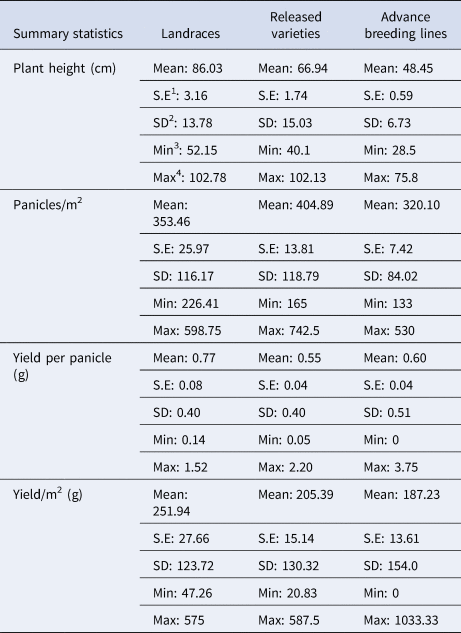
ANOVA of traits for rice genotypes evaluated under timely and late sown conditions is shown in online Supplementary Table S7. Out of 257 rice entries tested for low temperature stress, 36 entries failed to flower under late sown conditions. Local organic cultivars recorded tallest mean plant height of 84.16 cm against 66.94 cm and 48.45 cm recorded for released varieties and breeding lines, respectively. Local cultivars also recorded highest grain yield per panicle, highest yield per hill and yield per m2. Mean values of rice entries under different genotype groups are shown in Table 1. Although released varieties had a relatively high number of panicles per m2 than the local cultivars and breeding lines but the former showed better grain yield under low temperature conditions. Plant height showed significantly positive correlation with panicles per m2 and grain yield per m2, however the magnitude of association was low (online Supplementary Table S8). Grain yield per m2 was significantly associated with yield per hill (0.96), yield per panicle (0.84), panicles per m2 (0.25) and plant height (0.14).However, yield per panicle showed negative correlation with panicles per m2.
Summary statistics of landraces, released varieties and advance lines evaluated under low temperature stress at Gangtok location

1 Standard Error
2 Standard Deviation
3 Minimum
4 Maximum
Relative yield performance and trait association under timely and late sown conditions
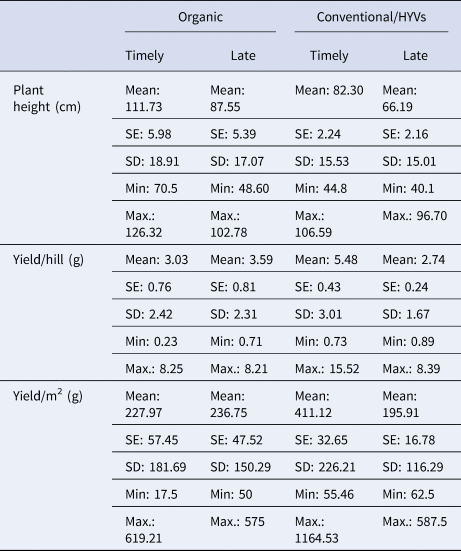
Under timely sown conditions organic cultivars recorded an average grain yield of 227.98 g/m2 as compared to 411.33 g per m2 in conventional varieties (Table 2).
Summary statistics of local organic and conventional rice genotypes under timely and late sown conditions at Gangtok location

ANOVA for both irrigated and upland environment is shown in online Supplementary Tables S9a and S9b. However under late sown conditions the mean grain yield of organic cultivars was 17.28% (236.75 g/m2) higher than the conventional varieties (195.82 g/m2). Organic cultivars attained higher plant height (111.74 cm) as compared to conventional varieties (82.30 cm). Yield per plant in organic cultivars remained unaffected under late sown conditions coinciding with low temperature while the same reduced significantly in HYVs (54.18%). Local cultivar Chirakey Dhan (8.21 g/plant) showed superiority over check VL Dhan 86 (5.93 g) under late sown conditions, whereas among conventional varieties HPU-741 (8.39 g) and VL Dhan- 82 (6.30 g) showed superiority over the check. None of the organic cultivar surpassed best check for grain yield under timely sown conditions.
System × variety interaction of traits affecting grain yield
ANOVA for yield parameters of rice varieties under organic conditions is shown in Table 3. Varieties differ significantly for grain yield, plant height, days to flowering and panicles/m2. The variety × year interaction was significant for grain yield and plant height while no interactions were observed for days to flowering and panicles per m2. ANOVA for yield and its related traits under type of farming (organic/conventional) is shown in Table 4. ANOVA for system type showed significance of varieties for all the four traits whereas variety × system interactions were significant for plant height and days to flowering whereas no interactions was observed for grain yield and panicles/m2. Correlation coefficient of rice varieties under organic and conventional systems under irrigated and upland ecology is shown in online Supplementary Table S10. Grain yield under all four environments showed significantly positive association with panicles per m2. Plant height showed negative correlation with days to flowering under organic upland conditions (−0.50) while the same showed positive correlation (0.38) under conventional upland conditions. Grain yield under organic upland conditions showed positive (0.30) association with plant height. Panicles per m2 were positively associated with days to flowering under organic upland conditions (0.27).
ANOVA for yield parameters of twenty one rice varieties under organic conditions for two years

***Significant at P = 0.001, **: 0.01 and *0.05.
ANOVA for yield traits under type of farming (organic/conventional)

***Significant at P = 0.001, **: 0.01 and *0.05.
Discussion
Sub-optimal weather conditions and low soil fertility create a less productive environment for gaining high grain yields in rice under organic system in hills. This is also evident from the mean grain yield of 3249 kg/ha recorded in coordinated trials over years at organic site (Gangtok) as compared to 4905 kg/ha recorded in other hill locations following conventional practices. Majority of the rice cultivars of Sikkim performed poorly under rainfed upland conditions in which significant reduction recorded in plant height, tillers per plant, panicle length and test weight which ultimately led to decrease in grain yield. Rice cultivars of Sikkim are adapted to optimum soil moisture conditions due to ample rainfall received in the region during kharif season and rarely face moisture deficit. Moreover rice cultivation is done under irrigated transplanted conditions and rarely under direct seeded upland system. Cultivars Taichung and Pahelo Dalle yielded well under both irrigated and upland conditions which need to be further tested at different organic locations for assessing stability in performance under moisture deficit conditions. Following this approach two rice varieties Sikkim Dhan-1 and Sikkim Dhan-3 were released in 2020 for organic conditions of Sikkim with high and stable grain yield under both irrigated and rainfed-upland ecology (https://icar.org.in/content/state-variety-release-committee-releases-new-crop-varieties-icar-nofri-sikkim).
Under timely sown conditions, HYVs yielded significantly higher than the local cultivars signifying role of improved genotypes in gaining high productivity under low input conditions. However, the superior agronomic performance of HYVs could not be realized under late sown conditions encountered by low temperature where local cultivars exhibited superiority in grain yield. This emphasized the importance of local cultivars which otherwise are low yielding than HYVs possess such specific traits which needs to be combined with HYVs for better resilience. Among cultivars Chirakey Dhan and Dharmali displayed higher grain filling and grain yield under late sown conditions coinciding with low temperature are promising genotypes which require further validation for trait superiority at multi-locations. Non-significant interaction between varieties and system of cultivation ruled out specific adaptation of rice varieties to organic systems which performed more or less at par under both organic and conventional system. However varietal variations over years were significant for grain yield which is evident of the heterogenous conditions of the organic farms. Among traits, number of panicles per m2 came out as an important yield deciding trait under both irrigated and upland conditions in organic systems. Along with it plant height too influenced grain yield significantly under organic upland conditions.
Diminishing area under rice cultivation in hills due to conversion of paddy fields to other remunerative organic cash crops pose a serious challenge for attaining self-sufficiency and yield sustainability of rice in hill states. Local cultivars/farmer's varieties dominate traditional farming systems which guarantee grain yields even under hostile environmental conditions. Enhancing acreage under rice HYVs particularly for timely sown conditions under organic management shall be prioritized for increasing productivity. Genetic improvement of rice for organic systems must be in line with the local needs of the farmers. Local rice cultivars of Sikkim need to be evaluated for specific biotic and abiotic stress tolerance and then shall be deployed in rice improvement programme as donor for specific traits in background of elite or high yielding genotypes. Significant variability still exists in local organic rice cultivars which require simple selection followed by generation advancement. Testing conventional rice varieties under organic conditions shall continue to be the best strategy for selection of best performing lines until varieties bred specifically for organic systems are available. Genotypes performing well under both irrigated and rainfed upland environments shall be prioritized under organic conditions. One of the limitations of our study was that we could not conduct trials under conventional inorganic conditions along with organic trials as chemical based fertilizers/inputs are prohibited for agricultural use in Sikkim. Nevertheless, our study substantiates the performance under both organic and conventional environment at locations outside the study site.
Supplementary material
The supplementary material for this article can be found at https://doi.org/10.1017/S1479262123000576.
Acknowledgements
The authors express deep sense of gratitude to The Director, ICAR Research Complex for NEH Region, Umiam, Meghalaya for providing necessary facilities for carrying out the study. We are thankful to The Director ICAR-IIRR, Hyderabad for providing trials for the study. Authors extend special thanks to farmers and officials of the State Agriculture Department of Sikkim for their kind cooperation and support.