Introduction
In magnetoelectric (ME) materials, the application of an electric field (E) and magnetic field (H) induces magnetization (M) and polarization (P), respectively. This effect was discovered for the first time in single phase Cr2O3 in the 1960s[ Reference Folen, Rado and Stalder 1 , Reference ASTROV 2 ]; subsequently, many other ME materials have being discovered to exhibit this effect. Initially, the ME coefficient constant (α) was found to be very low, especially at room temperature. This feature limited the application of these materials and interest in ME materials diminished. ME composite materials consisting of mechanically attached piezoelectric and magnetostrictive layers, have been proposed as an alternative ME material operating at room temperature.[ Reference Fiebig 3 ] Recently, single phase hexaferrite materials have exhibited high ME coupling at room temperature.[ Reference Kitagawa, Hiraoka, Honda, Ishikura, Nakamura and Kimura 4 ]
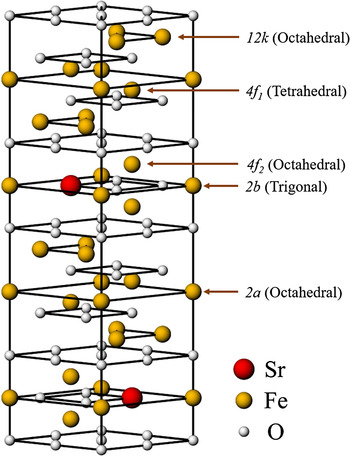
Hexaferrites are a large group of ferrites that are crystalized in a hexagonal structure. They are classified into six different groups (M, W, X, Y, Z and U-types) based on the composition and the sequence of the substructures (also referred to as building blocks); for example, in an M-type, the sequence of the blocks is given by RSR*S* (Fig. 1). R* and S* are the same as R and S, but rotated 180° along the C-axis; In a Z-type, the sequence of the blocks is given by STSRS*T*S*R* in which again T* is defined similarly to R* and S*.
Crystal Structure of M-type hexaferrite.

Recently, magnetoelectric effect at room temperature has been reported for a class of M-type hexaferrite with the composition of SrCo2Ti2Fe8O19.[ Reference Wang, Wang, Cao, Zheng, Xuan, Gao and Du 5 ] Its structure can be compared with BaFe12O19 a well-known non ME M-type; in addition to the substitution of Ba with another large divalent element (i.e., Sr), four Fe3+ ions in the S block (located in the octahedral sites of 12k, 2a and 4f 2 [ Reference Wang, Wang, Cao, Zheng, Xuan, Gao and Du 5 ]) are substituted with two magnetic ions, Co2+, and two non-magnetic ions, Ti4+.
In the technical literature, no investigation has been reported on the relation between cobalt substitution in hexaferrites and the corresponding ME effect. A commonly held notion is that the distortion in atomic structure of hexaferrites is effective in having an ME property. According to this, when Ba2+ is replaced with a smaller ion such as Sr2+, it causes a perturbation in T block of Z-type and Y-type of hexaferrites or R block in M-type. As a result of this strain, the bonding angle of Fe-O-Fe near the Sr increases from 116° (with Ba) to 123° (with Sr).[ Reference Kitagawa, Hiraoka, Honda, Ishikura, Nakamura and Kimura 4 – Reference Tokunaga, Kaneko, Okuyama, Ishiwata, Arima, Wakimoto, Kakurai, Taguchi and Tokura 13 ] In Co-Ti doped M-type, Moriya[ Reference Moriya 14 ] has argued that since the substituted Ti occupies the octahedrally 12k atomic sites, then the spin coupling between the S and R blocks is weakened by inducing a spin-spiral configuration. Due to this, the existence of spin-spiral configuration is the key point of having an ME property in both M- and Z-type hexaferrites; however, there is not yet clear evidence of this relationship. For example, a spin-spiral configuration has been induced in SrFe10Sc2O19 and no ME effect has been observed at room temperature. The authors believe that the spin-spiral configuration facilitates the role of the strain as “mediator” in coupling the magnetic and the electrical systems, in a fashion similar to a “slinky helix”.[ Reference Ebnabbasi, Vittoria and Widom 10 ]
Recently, the proposed thermodynamic theory[ Reference Vittoria, Somu and Widom 15 ] has shown that in hexaferrite, the ME coupling (α) is proportional to the product of the magnetostriction (λ) constant and the piezoelectric strain coefficient (d), so
 $$\alpha = \displaystyle{{d\lambda C\chi} \over M},$$
where C is the Young modulus constant, χ is the magnetic susceptibility tensor and M is the magnetization.
It is well known[
Reference Landolt, Bornstein, Madelung, Hellwege, Pies, Weiss and Pieper
16
] that the substitution of cobalt ions in hexaferrites affects the magnetostriction constant, and therefore, as inferred by Eq. (1), the coupling α should be also affected by the Co substitutions. Therefore, in this paper,
 ${\rm Sr}^{2 +} {\rm Co}_{\rm x}^{2 +} {\rm Ti}_{3 - 0.5{\rm x}}^{4 +} {\rm Fe}_8^{3 +} {\rm O}_{19}^{2 -} \; $
as a family of M-type hexaferrite materials are investigated[
Reference Izadkhah, Zare, Somu and Vittoria
17
] for Co substitution in hexaferrites to assess the coupling at room temperature.
Experimental procedure
Convention ceramic technique was utilized to produce the targets; high purity powders of CoO (99.995%), SrO (99.5%), TiO2 (99.8%) and Fe2O3 (99.8%) were ball milled stochastically twice for 4 h each time. Each time the admixed powder was pressed into a disk at 2000 psi. The pallet was then sintered at 1150 °C for 16 h. In order to increase the density of targets and completing the oxidation, oxygen gas was introduced into the furnace during the sintering process. Also, in the second round, before pressing the powder, PVA (polyvinyl alcohol) was added to the ball milled powder to increase its stickiness All targets for both single target and multiple targets (Alternating Target Laser Ablation Deposition (ATLAD) technique) deposition were made with this procedure. The composition of targets was checked by carrying out the Energy Dispersive Spectroscopy (EDS). The composition of the targets used in ATLAD was FeCo0.5Ti0.5O3 and SrFe4O7 while for the single target it was the same as the desired composition of SrFe8Ti2Co2O19 for the film. The density of the targets was measured to be 4.1 ± 0.12 g/cm3 compared with the density of single crystal materials, which is in the order of 5.3 g/cm3.[ Reference Izadkhah, Zare, Somu and Vittoria 17 ] This value is the typical density to use the targets for depositing a ferrite with Paused Laser Deposition (PLD) technique. The films were then deposited on sapphire single crystals by PLD technique. In both single and multiple targets (ATLAD) methods, a single crystal sapphire was used as substrate and was pre-heated to 600 °C, which is the temperature of deposition. Also, the oxygen was introduced inside the deposition chamber and its pressure was controlled at 200 ± 5 mtorr. In ATLAD, for controlling the composition of the film, the number of the pulses for each target was changed and the correct values were then found by trial and error.
The compositions of the films were checked by EDS measurement (table 1); the surface morphology of each film was studied by Scanning Electron Microscopy (SEM). The crystal structure of films was confirmed by x-ray diffraction (XRD) to establish whether post annealing of the film resulted in its crystallization; moreover, the possibility of having a secondary phase was considered.
Composition of the M-type hexaferrite thin film deposited by ATLAD technique.

Static magnetic parameters were measured with Vibrating Sample Magnetometer (VSM) on films of SrFe8Ti2Co2O19 deposited by either single target or ATLAD. An electric field was applied across the thin film for VSM to measure the ME effect. α was measured for the following two cases with respect to the applied electric field, E: (a) the perpendicularly induced magnetization, α
⊥, and (b) the parallel induced magnetization,
 $\alpha _\parallel$
.
The Ferromagnetic Resonance (FMR) method was utilized to find the resonance condition of the films under the cases in which the magnetic field was applied either parallel or perpendicular (
 $H_\parallel$
or H
⊥ respectively) to the film plane.
Results and discussion
For single target deposition, the range of the cobalt was set between x = 1.2 and 3.5. After the deposition, all films were post-annealed to crystalize them. The best annealing time was experimentally found to be 40 min.[ Reference Mohebbi, Ebnabbasi and Vittoria 6 ] Oxygen was introduced into the furnace to compensate for any possible oxygen loss.
Controlling the deposition of cobalt ions in M-type hexaferrites was accomplished by utilizing the ATLAD technique.[ Reference Karim and Vittoria 18 ] Usually, bulk growth mechanisms require temperatures of ~1200 °C for hexaferrites; it is difficult, however, to prevent the mixing of different ferrite phases (including spinel and hexaferrites) at these high temperatures. ATLAD permits deposition at significantly lower temperatures (600–900 °C) for all classes of hexaferrites. This technique allows to deposit one atomic “block” at a time in the scale of a unit cell; for example, an M-type consists of four spinel blocks, six Y blocks and eight Z blocks. Using ATLAD, extremely high quality films of spinel ferrites, M- and Y-types were deposited at substrate temperatures below 900 °C. This is a very important feature because ATLAD allows substituting cobalt ions in either the S- or R- blocks.
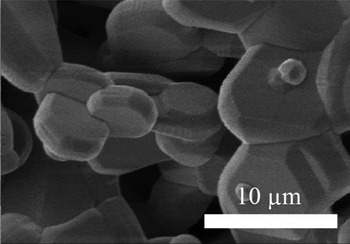
The polycrystalline structure of the deposited film is shown in Fig. 2. The presence of hexagons of the M-type hexaferrite is evident, and nearly the entire deposited film is crystalized. This has been confirmed by VSM. An increase in annealing time up to 50 min caused an increase in crystal formation; again, XRD and VSM measurements confirmed this effect. Post annealing caused mixed phase ferrites at temperature higher than 1050 °C and an increase of the substrate/film mixing layer was confirmed by VSM measurements.
SEM of the film deposited by ATLAD technique and post annealed for 40 min at 1050 °C.[ Reference Izadkhah, Zare, Somu and Vittoria 19 ]

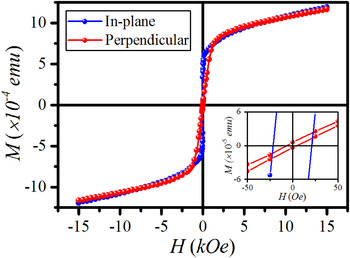
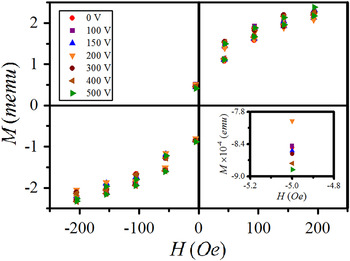
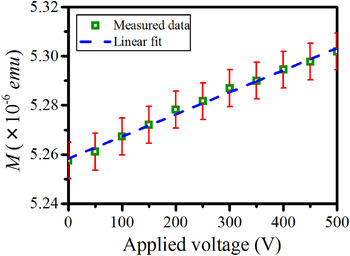
The hysteresis loops (Fig. 3), for either cases of parallel or perpendicular, were in full agreement with the data generated by films with the same composition but deposited by a single target.[ Reference Izadkhah, Zare, Somu and Vittoria 17 ] The film deposited by ATLAD have a measured 4πM s of ~1530 G; this is remarkably higher than for the same film deposited by a single target technique. The coercive field was also measured; values of 23 Oe for the in-plane and 4 Oe for the perpendicular configurations were found (the inset plot of Fig. 3). The magnetic behavior was changed (Fig. 4) by applying the electric field across the film. As shown in Fig. 5, this change was found to be linearly proportional to the value of the applied electric field.
VSM of the Film deposited by ATLAD technique post annealed for 40 min at 1050 °C. The coercivity of the film is shown in the inset plot.

M versus H below magnetic saturation fields.[ Reference Izadkhah, Zare, Somu and Vittoria 17 ]

Magnetization versus applied voltage to the substrate film and ME film.

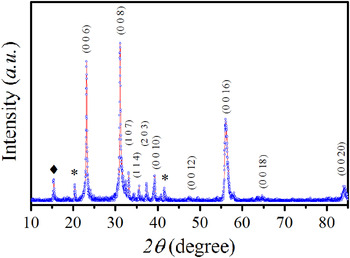
A comparison of the XRD patterns prior and after annealing shows that the film is almost crystalized into the M-type hexaferrite and the remaining amorphous phase is minimal. As shown in Fig. 6, mixed phases of ferrites were present; but these phases were very small because the VSM (Fig. 3) measurements mostly revealed a single phase pattern. In addition, no significant change was observed in the XRD data for the films at different values of cobalt.
XRD of the film deposited by ATLAD technique and annealed for 40 min.

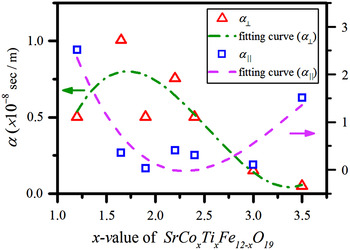
The largest value of α
⊥ = 1.01 × 10⁻⁸ sec/m was measured at x = 1.65 (Fig. 7); this value could be associated with the highest packing density of the cobalt ions in the octahedral atomic sites for which the magnetostriction constant has been enhanced (while still maintaining charge neutrality). On the other hand,
 $\alpha _\parallel $
attained the least value of
 $\alpha _\parallel $
= 2.51 × 10⁻¹⁰ sec/m at x = 1.9. We attribute this difference in the behavior of α to its anisotropic nature.[
Reference Vittoria, Somu and Widom
15
] The film deposited by ATLAD had a measured
 $\alpha _\parallel $
of 5.2 × 10⁻⁹ sec/m.
Variation of α versus Co concentration (x) [adopted from[ Reference Izadkhah, Zare, Somu and Vittoria 17 ]].

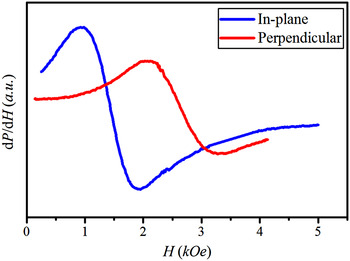
Performing FMR on the film deposited from one target[ Reference Izadkhah, Zare, Somu and Vittoria 17 ] and multiple targets (Fig. 8) gives us the resonance condition of our samples. By including the magnetic anisotropy field, H A, the FMR condition becomes[ Reference Vittoria 20 ]:
 $$f = 1.4 \times g \times 10^6 (H_ \bot - 4\pi M_{\rm s} + H_{\rm A} )$$
 $$f = 1.4 \times g \times 10^6 \sqrt {(H_\parallel + H_{\rm A} )(H_\parallel + 4\pi M_{\rm s} - H_{\rm A} )} $$
where g is the g-factor, M s is the saturation magnetization, H ⊥ and H || are the applied fields at the resonance point for the perpendicular and parallel configurations, respectively.
FMR of the ME film deposited by ATLAD technique.

From the FMR data, Fig. 8, we deduced a uniaxial magnetic anisotropy field (H A ~ 2000 Oe) using Eqs. (2) and (3), and a g value of 2. The value of 4πM s = 1530 G was found from the VSM measurements. To an uniaxial anisotropy field implies that the spin configuration is a spin spiral[ Reference Moriya 14 ] because according to Landau-Lifshitz a spin-spiral configuration may be represented by an uniaxial magnetic anisotropy field.[ Reference Landau and Lifshitz 21 , Reference Vittoria 22 ] Temperature dependence of magnetization on Co-Ti doped M-type has a change in slope of field cooling curve at temperature around 160 K.[ Reference Beevers, Love, Cavill, Izadkhah, Vittoria, Fan, Laan and Dhesi 23 ] This change, which have been seen in other ferrites[ Reference Smit and Wijn 24 ] is attributed to the change between a collinear ferromagnetic to and order with canted spins such as spin spiral.
Conclusion
The substitution of Co in single phase ME films of the family of M-type hexaferrite greatly affects the ME linear coupling. The non-linear coupling is negligible according to Fig. 5. The ME linear coupling was measured as a function of Co ion concentration for two cases of interest: (1) static magnetization (M) direction parallel to the applied electric field, (E), and (2) M perpendicular to E. For either field direction of E relative to M the ME coupling exhibited an extremum point for x = 2, which corresponds to the chemical formula SrFe8Ti2Co2O19. We have also demonstrated that an M-type hexaferrite thin film exhibiting the ME effect can be deposited using the ATLAD technique; ATLAD allows for the deposition of cobalt in the R as well as in the S blocks in the hexaferrite. This means that it may now be possible to deposit Co ions in tetrahedral sites instead of exclusively in octahedral sites. As the ME coupling is proportional to the magnetostriction constant, we expect significant changes in the ME coupling. The magnetostriction constant depends strongly on the ability to occupy tetrahedral sites by the Co ions.[ Reference Dionne 25 ]