Introduction
Marijuana (MJ) is the most commonly used illicit drug, with 42% 12th graders and over 50% of young adults using MJ in their lifetime (Johnston, O'Malley, Bachman, & Schulenberg, Reference Johnston, O'Malley, Bachman and Schulenberg2010; Johnston, O'Malley, Bachman, & Schulenberg, Reference Johnston, O'Malley, Bachman and Schulenberg2009). For most of the world, individuals begin using MJ when they are adolescents and use tends to peak in the emerging adult years of 18–25 (Degenhardt et al., Reference Degenhardt, Chiu, Sampson, Kessler, Anthony, Angermeyer and Wells2008). Due to ongoing neurodevelopment occurring throughout adolescence and emerging adulthood, chronic MJ exposure may result in greater neurocognitive deficits as what is reported in adults.
Several brain regions, including the prefrontal cortex (PFC), parietal cortex, and cerebellum, continue to undergo gray matter synaptic pruning into the mid-20s (Giedd, Snell, et al., Reference Giedd, Snell, Lange, Rajapakse, Casey, Kozuch and Rapoport1996; Gogtay et al., Reference Gogtay, Giedd, Lusk, Hayashi, Greenstein, Vaituzis and Thompson2004; Lenroot & Giedd, Reference Lenroot and Giedd2006; Sowell et al., Reference Sowell, Thompson, Leonard, Welcome, Kan and Toga2004; Sowell, Thompson, Holmes, Jernigan, & Toga, Reference Sowell, Thompson, Holmes, Jernigan and Toga1999; Sowell, Trauner, Gamst, & Jernigan, Reference Sowell, Trauner, Gamst and Jernigan2002). Maturation of white matter, yielding improvements in efficient neural conductivity, appears to continue into the early thirties (Ashtari et al., Reference Ashtari, Cervellione, Hasan, Wu, McIlree, Kester and Kumra2007; Barnea-Goraly et al., Reference Barnea-Goraly, Menon, Eckert, Tamm, Bammer, Karchemskiy and Reiss2005; Giedd, Blumenthal, et al., Reference Giedd, Blumenthal, Jeffries, Castellanos, Liu, Zijdenbos and Rapoport1999; Jernigan & Gamst, Reference Jernigan and Gamst2005; Nagel et al., Reference Nagel, Medina, Yoshii, Schweinsburg, Moadab and Tapert2006; Paus et al., Reference Paus, Zijdenbos, Worsley, Collins, Blumenthal, Giedd and Evans1999). It should also be noted that boys and girls differ in the timing and rate of neurodevelopment (see Lenroot & Giedd, Reference Lenroot and Giedd2010 for review). In girls, substantial gray matter pruning in PFC, parietal and temporal cortices begins earlier than boys, while there are greater age-related white matter increases in males; overall, this results in relatively larger brain volumes in boys compared to girls (Giedd, Vaituzis, et al., Reference Giedd, Vaituzis, Hamburger, Lange, Rajapakse, Kaysen and Rapoport1996; Lenroot et al., Reference Lenroot, Gogtay, Greenstein, Wells, Wallace, Clasen and Giedd2007; Lenroot & Giedd, Reference Lenroot and Giedd2010; Nagel et al., Reference Nagel, Medina, Yoshii, Schweinsburg, Moadab and Tapert2006). The endogenous cannabinoid system is also undergoing developmental changes during the adolescent and emerging adult years, with the CB1 receptor density peaking during the adolescent years (Belue et al., Reference Belue, Howlett, Westlake and Hutchings1995; Howlett et al., Reference Howlett2002). Some have hypothesized that the endocannabinoid system plays a direct role in brain development, moderating neurotransmitter release and neurogenesis (Viveros et al., Reference Viveros, Llorente, Moreno and Marco2005). Given this, it is suggested that exposure to exogenous cannabinoids may disrupt healthy neuronal development and alter the developmental trajectory for boys and girls.
Indeed, the literature has suggested younger animals may be more susceptible to damage caused by exposure to high doses of THC (delta-9-tetrahydrocannabinol), one of the major psychoactive compounds in MJ. Animal studies have found increased cellular changes associated with THC exposure during adolescence compared to adulthood (Cha, White, Kuhn, Wilson, & Swartzwelder, Reference Cha, White, Kuhn, Wilson and Swartzwelder2006; Kang-Park, Wilson, Kuhn, Moore, Swartzwelder, Reference Kang-Park, Wilson, Kuhn, Moore and Swartzwelder2007; Quinn et al., Reference Quinn, Matsumoto, Callaghan, Long, Arnold, Gunasekaran and McGregor2008; Rubino et al., Reference Rubino, Vigano’, Realini, Guidali, Braida, Capurro and Parolaro2008; Schneider & Koch, Reference Schneider and Koch2003), and THC exposure during adolescence has been associated with long-term cognitive impairment and poorer synaptic connections in the hippocampus, lasting into adulthood (Rubino et al., Reference Rubino, Realini, Braida, Guidi, Capurro, Viganò and Parolaro2009). Consistent with gender differences in adolescent brain development, female adolescent rats displayed greater CB1 desensitization in the prefrontal cortex, hippocampus, periaqueductal gray matter, and ventral midbrain following THC exposure compared to males, while no gender effect was noted among adult rats in the same conditions (Burston, Wiley, Craig, Selley, & Sim-Selly, Reference Burston, Wiley, Craig, Selley and Sim-Selly2010). Results suggest a vulnerability of the female adolescent rat brain to THC-associated CB1 receptor signaling changes; however, authors also posited that such increased desensitization could reflect protective adaptation. Taken together, these findings suggest that chronic MJ use during adolescence and emerging adulthood may differentially impact the male and female adolescent or young adult brain compared to exposure during adult years.
Subtle brain structure abnormalities have been found in human adolescent MJ users, including relationships between increased MJ use and larger left hippocampal (Medina, Schweinsburg, et al., Reference Medina, Nagel, McQueeny, Park and Tapert2007) and cerebellar vermis volumes (Jarvis et al., Reference Jarvis, DelBello, Mills, Elman, Strakowski and Adler2008; Medina, Nagel, & Tapert, Reference Medina, Nagel and Tapert2010) and larger PFC volumes that correlated with poorer executive functioning (Medina et al., Reference Medina, McQueeny, Nagel, Hanson, Schweinsburg and Tapert2008). With one exception (Delisi et al., Reference Delisi, Bertisch, Szulc, Majcher, Brown, Bappal and Ardekani2006), reduced white matter integrity has also been found in adolescent and young adult MJ users (Arnone et al., Reference Arnone, Barrick, Chengappa, Mackay, Clark and Abou-Saleh2008; Ashtari et al., Reference Ashtari, Cervellione, Cottone, Ardekani, Sevy and Kumra2009; Bava et al., Reference Bava, Frank, McQueeny, Schweinsburg, Schweinsburg and Tapert2009). Altered white matter metabolite levels in several brain regions have also been observed in MJ-dependent young adult males, suggesting glial cell disruption (Silveri, Jensen, Rosso, Sneider, & Yurgelun-Todd, Reference Silveri, Jensen, Rosso, Sneider and Yurgelun-Todd2011). Young adults that initiate MJ use early (younger than 16 years old) demonstrate greater brain functioning abnormalities compared to late onset users (Becker, Wagner, Gouzoulis-Mayfrank, Spuentrup, & Daumann, Reference Becker, Wagner, Gouzoulis-Mayfrank, Spuentrup and Daumann2010) and adolescent MJ users have shown abnormal PFC, limbic, cerebellar, and parietal activation patterns compared to controls in response to cognitive inhibition (Tapert et al., Reference Tapert, Schweinsburg, Drummond, Paulus, Brown, Yang and Frank2007), verbal working memory (Jacobsen, Pugh, Constable, Westerveld, Mencl, Reference Jacobsen, Pugh, Constable, Westerveld and Mencl2007; Jager, Block, Luijten, & Ramsey, Reference Jager, Block, Luijten and Ramsey2010), and spatial working memory (Schweinsburg et al., Reference Schweinsburg, Nagel, Schweinsburg, Park, Theilmann and Tapert2008, Reference Schweinsburg, Schweinsburg, Medina, McQueeny, Brown and Tapert2010) tasks. Furthermore, our laboratory has reported gender differences in the effects of MJ on brain structure (Medina et al., Reference Medina, McQueeny, Nagel, Hanson, Schweinsburg and Tapert2008; McQueeny et al., Reference McQueeny, Padula, Price, Medina, Logan and Tapert2011). Taken together, these studies suggest that heavy MJ exposure during this neurodevelopmental stage may result in interrupted pruning, especially in girls, reduced white matter myelination and cognitive inefficiency.
Despite the high rate of MJ use during this age period and the aforementioned evidence of subtle neurologic abnormalities, relatively few studies have focused on the long-term neuropsychological consequences of repeated MJ use in otherwise healthy adolescents and young adults without comorbid psychiatric disorders. Two studies thus far have reported more severe cognitive consequences (including attention, verbal memory, overall intelligence and verbal fluency) of MJ exposure if individuals start using MJ regularly before the age of 17 (Ehrenreich et al., Reference Ehrenreich, Rinn, Kunert, Moeller, Poser, Schilling and Hoehe1999; Wilson et al., Reference Wilson, Mathew, Turkington, Hawk, Coleman and Provenzale2000). In a longitudinal study following adolescents with substance use disorders into young adulthood, Tapert and colleagues (Reference Tapert, Baratta, Abrantes and Brown2002) found that greater cumulative MJ use over an 8-year follow-up period was associated with poorer attention. Thus far, studies have reported subtle cognitive deficits associated with MJ use in teens and young adults, including processing speed (Fried, Watkinson, & Gray, Reference Fried, Watkinson and Gray2005; Medina, Hanson, et al., Reference Medina, Hanson, Schweinsburg, Cohen-Zion, Nagel and Tapert2007), attention (Hanson et al., Reference Hanson, Medina, Nagel, Spadoni, Gorlick and Tapert2010; Harvey, Sellman, Porter, & Frampton, Reference Harvey, Sellman, Porter and Frampton2007; Medina, Hanson, et al., Reference Medina, Hanson, Schweinsburg, Cohen-Zion, Nagel and Tapert2007), memory (Fried et al., Reference Fried, Watkinson and Gray2005; Hanson et al., Reference Hanson, Winward, Schweinsburg, Medina, Brown and Tapert2010; Harvey et al., Reference Harvey, Sellman, Porter and Frampton2007; Medina, Hanson, et al., Reference Medina, Hanson, Schweinsburg, Cohen-Zion, Nagel and Tapert2007; Schwartz, Gruenewald, Klitzner, & Fedio, Reference Schwartz, Gruenewald, Klitzner and Fedio1989), Visuospatial (Hanson et al., Reference Hanson, Medina, Padula, Tapert and Brown2011), and executive functioning (Hanson et al., Reference Hanson, Winward, Schweinsburg, Medina, Brown and Tapert2010; Harvey et al., Reference Harvey, Sellman, Porter and Frampton2007; Medina, Hanson, et al., Reference Medina, Hanson, Schweinsburg, Cohen-Zion, Nagel and Tapert2007). For example, our group (Medina, Hanson, et al., Reference Medina, Hanson, Schweinsburg, Cohen-Zion, Nagel and Tapert2007) previously compared neuropsychological functioning in a sample of demographically matched healthy controls and MJ using adolescents (16–19 years old) without comorbid psychiatric disorders who underwent a month of monitored abstinence. During the month of abstinence a subgroup was also administered a small neuropsychological battery at day 1, week 2, and week 3. After only a few days of abstinence, MJ users had poorer initial verbal memory list learning, sustained attention, and working memory (Hanson et al., Reference Hanson, Medina, Nagel, Spadoni, Gorlick and Tapert2010). After 3 weeks of abstinence, only initial verbal learning significantly improved (Hanson et al., Reference Hanson, Medina, Nagel, Spadoni, Gorlick and Tapert2010) and the larger sample of adolescent MJ also showed deficits in complex attention, verbal story learning, sequencing ability, and slower psychomotor speed compared to controls after a month of abstinence (Medina, Hanson, et al., Reference Medina, Hanson, Schweinsburg, Cohen-Zion, Nagel and Tapert2007). Still, relatively few studies have attempted to replicate these findings in a different sample that includes a sufficient number of females to address potential gender differences.
Therefore, the purpose of the current study is to further characterize the effects of chronic MJ use on cognition in a sample of adolescents and young adults (ages 18–26; 53% female) who do not meet criteria for independent Axis I psychiatric disorders (besides substance use disorders). Consistent with adolescent findings (e.g., Medina, Hanson, et al., Reference Medina, Hanson, Schweinsburg, Cohen-Zion, Nagel and Tapert2007), it is hypothesized that increased MJ use will significantly predict slower psychomotor speed and poorer complex attention and executive functioning in a sample of young adults. We will also explore whether these MJ effects are moderated by gender.
Methods
Participants
Participants were chosen from ongoing studies conducted at the University of Cincinnati; one examines the cognitive effects of marijuana and ecstasy use (Medina, Shear, & Corcoran, Reference Medina, Shear and Corcoran2005) and the other is an ongoing imaging genetics study (NIH 1R03 DA027457-01; PI: Lisdahl). All participants were originally recruited through advertisements in a local free newspaper and fliers located around the University of Cincinnati. Inclusion criteria for the current analysis included fluent English, 18–26 years of age and participants had to fit into one of two groups: (1) current marijuana (MJ) users (≥10 joints in past year; ≥50 joints lifetime; ≤10 episodes of any other illicit drug in past year and ≤100 illicit drugs in lifetime) or (2) demographically matched normal controls (NC) (≤10 joints past year, ≤50 joints in lifetime; ≤10 illicit drugs used in past year; ≤20 episodes of any other illicit drugs in lifetime). Exclusion criteria for both groups included body mass index (BMI) <18 (Gunstad et al., Reference Gunstad, Paul, Cohen, Tate, Spitznagel, Grieve and Gordon2008); history of chronic medical or neurologic illness or injury [meningitis, HIV, epilepsy, brain tumor, traumatic head injury with >2 minutes LOC and post-concussive symptoms, stroke, cerebral palsy, Parkinson's disease, high blood pressure or diabetes, migraines, recent (past 2 months) and/or multiple concussions]; history of a learning disability or mental retardation; use of psychoactive medication; <80 on WRAT-4 Reading subtest; and refusal to remain abstinent for 7 days before testing. Individuals who met past year or lifetime diagnostic criteria (independent of their substance use) for any psychotic disorder, bipolar disorder, major depressive disorder, or anxiety disorder (generalized anxiety disorder, panic disorder, and post traumatic stress disorder) were excluded from the current sample. Participants include 23 young adult MJ users (56% female) and 35 healthy controls (50% female).
Procedures
The Institutional Review Board at the University of Cincinnati approved all aspects of this study. To determine eligibility, all participants were screened over the phone by trained research assistants. Past year and lifetime Axis I psychotic, anxiety, and mood disorders were screened by phone using a semi-structured interview based on DSM-IV-TR criteria. Interested participants who had positive responses to the screening questions were discussed in committee; if clear decisions could not be reached then they were re-contacted and administered the additional diagnostic questions based on the SCID I/P (determined by KLM) (First et al., 2002).
Before beginning the study, informed consent was obtained. All participants completed a brief background questionnaire, psychological questionnaires, and were administered a drug use interview. (Those completing the imaging genetics protocol also underwent MRI scanning, although these data are not being used for the current study.) They also completed a brief neuropsychological evaluation focused on memory, attention and executive functioning. At the conclusion of the study, participants were paid $35 if they only completed the behavioral session or $110 for completing the full imaging genetics study and all were reimbursed for parking. Participants were also given drug and alcohol treatment referrals.
Measures
Demographic information
Participants completed a Background Questionnaire (Medina et al., Reference Medina, Shear and Corcoran2005) outlining demographic variables including age, gender, ethnicity, self and biological parents’ educations, incomes, and employments, nicotine smoker status, marital status, confirmed absence of significant medical or neurologic illness, psychological disorders or use of psychiatric medication, and learning disability. Participants weight and heights were collected and standard BMI calculations were made [weight in kilograms/(height in meters+height in meters)].
Mood
Participants completed the Beck Depression Inventory-II (BDI-II; Beck, Reference Beck1996), which contains 21 items measuring levels of depressive symptoms on a 0–3 point scale.
Drug use frequency/quantity
A modified version of the Time-Line Follow-Back (Sobell, Maisto, Sobell, & Cooper, Reference Sobell, Maisto, Sobell and Cooper1979) technique was used, which uses memory cues of common holidays and personal events to measure frequency of drug use over the past year (assessed month-by-month) (Medina et al., Reference Medina, Shear and Corcoran2005). Additionally, a semi-structured interview was administered to measure frequency/quantity of lifetime drug use. For each drug, participants were asked their average weekly use each year that they used. Memory cues appropriate to adolescents and young adults (developmental milestones, school grades, and relationship changes) were used. The following drug categories were assessed: ecstasy, marijuana, alcohol, sedatives (e.g., downers, ketamine, GHB), stimulants (amphetamine, methamphetamine, cocaine, crack cocaine), hallucinogens (mushrooms, PCP, LSD, peyote), opioids (heroin, opium), and inhalants (nitrous oxide, paint, glue, household cleaners, gas). The participant's drug use was measured in standard units (tablets for ecstasy; standard drinks for alcohol; joints for marijuana; grams for stimulants; number of hits for inhalants, hallucinogens, and opioids; and pills or hits for sedatives).
Premorbid intelligence
The Wide Range Achievement Test-4th edition (WRAT-4) Reading subtest (Wilkinson, Reference Wilkinson2006) was used as an estimate of intelligence and quality of education for group comparison purposes (see Manly, Jacobs, & Touradji, Reference Manly, Jacobs and Touradji2002).
Neuropsychological Battery & Composite Scores
To reduce the number of dependent variables, a hybrid method using composite scores was used (Medina et al., Reference Medina, Nagel, McQueeny, Park and Tapert2007); this approach considered both the established categorization of cognitive domains (Lezak, Howieson, & Loring, Reference Lezak, Howieson and Loring2004) as well as the results of reliability analyses (for discussion see Delis, Jacobson, Bondi, Hamilton, & Salmon, Reference Delis, Jacobson, Bondi, Hamilton and Salmon2003). Each individual raw score was first converted to Z-scores based on the whole sample (N = 59). Average Z-scores were calculated for each composite score (if more than one variable was used). Standardized Chronbach's alpha coefficients were examined to determine internal consistency of the composite scores; if <.50 then the composite scores were reevaluated. This resulted in 11 composite scores/individual variables covering six total areas of cognitive functioning:
Verbal memory
Immediate Memory was assessed with Trial 1 and total recall from the California Verbal Learning Test-II (CVLT-II; Delis, Kramer, Kaplan, & Ober, Reference Delis, Kramer, Kaplan and Ober2001). Delayed Memory was measured by Short delay free recall and long delay free recall from the CVLT-II. Recognition Memory was assessed by the recognition discriminability variable from the CVLT-II.
Sequencing ability/psychomotor speed
Delis-Kaplan Executive Functioning Scale (D-KEFS; Delis & Kaplan, Reference Delis and Kaplan2000) Trail Making Test (TMT-B) switching score.
Sustained attention
Sustained attention speed and accuracy measures from the Ruff 2 & 7 were used to assess sustained attention (Ruff & Allen, Reference Ruff and Allen1996).
Verbal fluency
D-KEFS Verbal Fluency FAS subtest total correct.
Design Fluency
D-KEFS Design Fluency total correct and total accuracy score.
Cognitive inhibition
D-KEFS Color Word Interference Test Inhibition and Inhibition Switching combined total correct and total accuracy (errors).
Data Analysis
Analyses of variance (ANOVAs) and χ 2 tests compared groups on important demographic and drug use variables. A series of standard multiple regressions were then run to examine whether past year MJ use independently, or interactively with gender, predicted cognitive functioning after controlling for possible confounds (gender, BMI, WRAT-4 Reading subtest- a verbal IQ estimate, past year alcohol use, past year other drug use, and BDI-2 depressive symptoms). More specifically, the first block included all main effects (past year MJ use, gender, covariates) and the second block included MJ use*gender interactions. Interpretations of statistical significance were made if p < .05.
Results
Demographic, BMI, & Mood Information
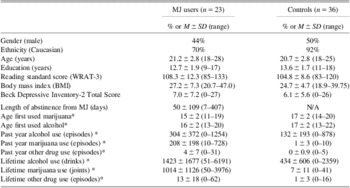
ANOVA and χ 2 tests were conducted to determine whether the MJ users and controls differed (see Table 1). The two groups did not differ in age [F(1,58) = .58; p = .49], gender composition [χ 2(1) = .24; p = .62], ethnicity [χ 2(2) = 5.2; p = .07], WRAT-3 Reading standard score [F(1,58) = 1.67; p = .20] (Wilkinson, Reference Wilkinson1993; Manly et al., Reference Manly, Jacobs and Touradji2002), education [F(1,58) = 3.04; p = .09], BDI-II depressive symptoms [F(1,58) = .29; p = .59], percent of subjects characterized as overweight according to the 25 BMI cut-off [χ 2(1) = 1.5; p = .22], although there was a trend toward MJ users having slightly higher total BMI [F(1,58) = 2.51; p = .11] and their weight was significantly greater compared to controls [F(1,58) = 4.01; p = .05]. Because BMI has been associated with neurocognitive functioning in youth (Bauer, Kaplan, & Hesselbrock, Reference Bauer, Kaplan and Hesselbrock2010; Lisdahl & Price, Reference Lisdahl and Priceunder review) and adults (Ho et al., Reference Ho, Raji, Becker, Lopez, Kuller, Hua and Thompson2011; Volkow et al., Reference Volkow, Wang, Telang, Fowler, Goldstein, Alia-Klein and Pradhan2009), BMI was controlled for in all regressions.
Demographic, mood, BMI, and drug use variables by group

Note. Group differences: *p < .01.
Drug Use Information
Based on self-report, participants were abstinent from MJ for at least 7 days (approximately half of the MJ users did have urine toxicology screens, although they were allowed to be positive for THC as THC-COOH can stay in the system for up to 3 weeks in heavy users; positive results for all other illicit drugs excluded the participant). Participants were not allowed to smoke nicotine within one hour of the neuropsychological battery. The average length of abstinence from any MJ use for MJ-users was 50 days (±109, range: 7–407 days). As expected, MJ-users reported earlier age of first MJ use [F(1,58) = 8.9; p < .005], greater past year [F(1,58) = 39.4; p < .001] and lifetime [F(1,58) = 29.0; p < .001] MJ joints used compared to controls. MJ-users also had more lifetime [F(1,58) = 10.5; p < .002] and past year [F(1,58) = 5.4; p < .03] alcohol drinks than NC. Although MJ users divulged more intake of other drugs (measured by number of hits of stimulants, sedatives, inhalants, opiates, and hallucinogens) than controls [F(1,58) = 7.6; p < .008], such use was limited to 31 past year hits in the MJ users, most commonly recreational use of stimulants (especially prescription) or hallucinogens (see Table 1).
Gender Status & Covariates
In the MJ users, there were no significant differences in demographic or drug use variables between the genders, with the exception of first age of regular MJ use [F(1,58) = 5.23; p < .04]; the female MJ users had an average age of first use of 14.2 years, compared to 16.0 years old in the males.
Neuropsychological Functioning
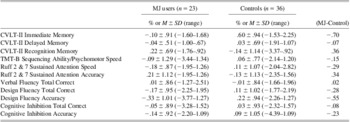
To assist with interpretation of the findings, Table 2 displays the mean composite Z-scores on the individual and composite neuropsychological scores used in the primary analyses. As seen in the table, the MJ users on average performed −.15 standard deviations below the controls across all the cognitive tests.
Neuropsychological composite variables by group

Note. CVLT-2 = California Verbal Learning Test-2nd Edition; WRAT-3 = Wide Range Achievement Test-3rd Edition. (MJ-Control) indicates difference in mean Z-scores between MJ and control groups; average Z-score difference across all composites revealed that MJ users performed −0.15 SD below the controls on the neuropsychological battery.
Multivariate Relationships
Primary regression analysis: Frequency/quantity of past year marijuana use
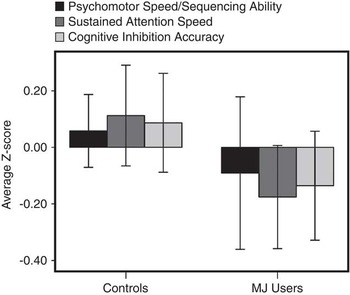
After controlling for gender, WRAT reading ability (verbal IQ estimate), depressive symptoms, BMI, and past year alcohol and other drug use, and increased MJ use significantly predicted poorer sequencing ability/psychomotor speed (beta = −.38; f 2 = .12, p < .01), sustained attention speed (beta = −.28; f 2 = .09; p < .05), and cognitive inhibition accuracy (beta = −.32; f 2 = .12; p < .03). Although the analysis examined the dose-dependent impact of past year MJ use, Figure 1 is included to demonstrate the average Z-scores on these cognitive variables for the MJ users and controls to help with interpretation of the findings. MJ-use did not significantly predict performance on verbal memory, selective attention accuracy, or verbal and design fluency tasks.
Average Z-scores (± 1 standard error) on Trail Making Test-B (psychomotor speed/sequencing ability), Ruff 2 & 7 (sustained attention speed) and D-KEFS Color-Word Interference Test (cognitive inhibition accuracy) by group.

Gender*MJ use interaction
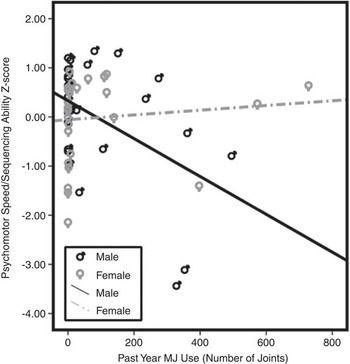
Gender interacted with past year MJ use in predicting sequencing ability/psychomotor speed (beta = .40; f 2 = .20; p < .003). Despite similar levels of past year MJ use, males demonstrated a more robust relationship between increased MJ use and poorer sequencing ability/psychomotor speed compared to females (see Figure 2).
Bivariate scatterplot demonstrating the relationship between past year MJ use and psychomotor speed/sequencing ability separately by gender.

Past year alcohol & other drug use
Independent of MJ use, increased past year alcohol use independently predicted poorer delayed memory (beta = −.30; p < .05) on the CVLT-2. Other drug use did not predict cognitive functioning, although as previously mentioned, other drug use was low in this sample.
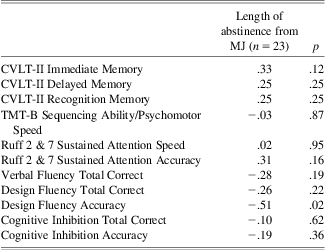
Length of abstinence from marijuana
Pearson correlations were run in the MJ users to examine the relationship between length of abstinence from MJ and cognitive functioning. As shown in Table 3, with the exception of design fluency accuracy, no significant relationships were observed. Still, MJ users demonstrated medium sized correlations between increased MJ abstinence and improved immediate verbal recall (r = .33; p = .12) and sustained attention accuracy (r = .31; p = .16) suggesting preliminary evidence for recovery of cognitive function with abstinence.
Simple relationships between neuropsychological components and length of abstinence from marijuana (MJ users only)
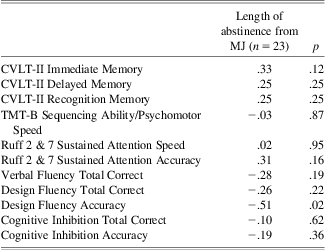
Note. CVLT-2 = California Verbal Learning Test-2nd Edition; TMT-B = Trail Making Test.
Discussion
Approximately one-third of young adults have used MJ within the past year (Johnston et al., Reference Johnston, O'Malley, Bachman and Schulenberg2009) and for the majority of the world, the age of onset of MJ use is during the teenage years (Degenhardt et al., Reference Degenhardt, Chiu, Sampson, Kessler, Anthony, Angermeyer and Wells2008). Animal and human research suggest that adolescence may be a vulnerable period for negative environmental impact on brain health due to critical neurodevelomental processes (see Spear, Reference Spear2010). The primary goal of the current study was to examine whether past year MJ exposure was associated with neuropsychological functioning in a sample of older adolescents and emerging adults following a minimum of 1 week of abstinence. The primary finding was that after controlling for reading ability, gender, depressive symptoms, body mass index, and alcohol and other drug use, increased past year MJ exposure was independently associated with poorer psychomotor speed/sequencing ability, sustained attention efficiency, and cognitive inhibition in a dose-dependent manner in otherwise healthy young adults. The effect sizes were in the medium range (f 2 = .09–.12). Male MJ users demonstrated more robust relationship between increased MJ use and poorer psychomotor speed/sequencing ability (large effect size, f 2 = .20) compared to females.
These results buildings upon previous studies that have reported subtle cognitive deficits associated with MJ use in late adolescence, primarily including processing speed (Fried et al., Reference Fried, Watkinson and Gray2005; Medina, Hanson, et al., Reference Medina, Hanson, Schweinsburg, Cohen-Zion, Nagel and Tapert2007), attention (Hanson et al., Reference Hanson, Winward, Schweinsburg, Medina, Brown and Tapert2010; Harvey et al., Reference Harvey, Sellman, Porter and Frampton2007; Medina, Hanson, et al., Reference Medina, Hanson, Schweinsburg, Cohen-Zion, Nagel and Tapert2007), and executive functioning (Hanson et al., Reference Hanson, Medina, Nagel, Spadoni, Gorlick and Tapert2010; Harvey et al., Reference Harvey, Sellman, Porter and Frampton2007; Medina, Hanson, et al., Reference Medina, Hanson, Schweinsburg, Cohen-Zion, Nagel and Tapert2007). In contrast with previous findings (Fried et al., Reference Fried, Watkinson and Gray2005; Hanson et al., 2010; Harvey et al., Reference Harvey, Sellman, Porter and Frampton2007; Medina, Hanson, et al., Reference Medina, Hanson, Schweinsburg, Cohen-Zion, Nagel and Tapert2007; Schwartz et al., Reference Schwartz, Gruenewald, Klitzner and Fedio1989), the current study did not find a dose-dependent relationship between MJ exposure and memory functioning, which was instead predicted by past year alcohol use. These discrepant results may be due to differences in length of abstinence across the samples or differential levels of alcohol exposure. Hanson and colleagues (2010) found significant improvements in verbal list learning following 2 weeks of abstinence in adolescent MJ users and our sample had an average of 50 days of abstinence (range, 7–407 days based on self-report). Indeed, our study found medium sized correlation between superior immediate verbal memory and length of abstinence, suggesting some evidence for recovery of function. Furthermore, the current study did not include a story memory paradigm, which was shown to be impaired following 1 month of abstinence in adolescent MJ users (Medina, Hanson, et al., Reference Medina, Hanson, Schweinsburg, Cohen-Zion, Nagel and Tapert2007).
The psychomotor speed/sequencing ability deficits were particularly present in the male MJ users, even though they had similar levels of MJ use and had a later age of onset of regular MJ use. Thus, it may be possible that males are particularly vulnerable to white matter changes leading to slower psychomotor speed. This result is somewhat in contrast with our prior studies finding increased PFC and amygdala volumes only in females MJ users, suggesting a disrupting of the pruning process (Medina et al., Reference Medina, McQueeny, Nagel, Hanson, Schweinsburg and Tapert2008; McQueeny et al., Reference McQueeny, Padula, Price, Medina, Logan and Tapert2011). However, Bava and colleagues (Reference Bava, Frank, McQueeny, Schweinsburg, Schweinsburg and Tapert2009) reported reduced white matter integrity in a primarily male sample of adolescent MJ users (Bava et al., Reference Bava, Frank, McQueeny, Schweinsburg, Schweinsburg and Tapert2009); therefore, future research is necessary to examine whether similar findings are seen in female MJ users. Given developmental differences in CB1 sensitivity (Burston et al., 2010) and the timing and rate of neurodevelopment between genders (Lenroot & Giedd, Reference Lenroot and Giedd2010), it is possible that chronic MJ exposure differentially impacts gray and white matter development in males and females.
In general, this neuropsychological profile is consistent with the brain structural findings reported in adolescent and emerging adult MJ users, including abnormal prefrontal cortex (PFC) and cerebellar structure (Jarvis et al., Reference Jarvis, DelBello, Mills, Elman, Strakowski and Adler2008; Medina et al., Reference Medina, McQueeny, Nagel, Hanson, Yang and Tapert2009, Reference Medina, Nagel and Tapert2010), aberrant hippocampal-memory relationships (Medina, Schweinsburg, et al., Reference Medina, Nagel, McQueeny, Park and Tapert2007), reduced frontal-parietal white matter integrity (Bava et al., Reference Bava, Frank, McQueeny, Schweinsburg, Schweinsburg and Tapert2009), and altered white matter metabolite levels suggesting glial cell disruption (Silveri et al., Reference Silveri, Jensen, Rosso, Sneider and Yurgelun-Todd2011). Functional MRI studies on teenage MJ users have primarily reported abnormal PFC, limbic, cerebellar and parietal activation patterns in MJ users compared to controls in response to cognitive inhibition (Tapert et al., Reference Tapert, Schweinsburg, Drummond, Paulus, Brown, Yang and Frank2007), verbal working memory (Jacobsen et al., Reference Jacobsen, Pugh, Constable, Westerveld and Mencl2007; Jager et al., Reference Jager, Block, Luijten and Ramsey2010), and spatial working memory (Schweinsburg et al., Reference Schweinsburg, Nagel, Schweinsburg, Park, Theilmann and Tapert2008) tasks. It is of note that the majority of these studies included primarily males, so further research is needed to examine potential gender differences in these MJ effects. Interestingly, the current study did not report verbal memory deficits, suggesting that the medial temporal lobe and hippocampal regions may be relatively spared compared to the more distributed fronto-cerebellar, fronto-parietal, and fronto-subcortical networks, which is consistent with a recent finding by Schweinsburg and colleagues (Reference Schweinsburg, Schweinsburg, Nagel, Eyler and Tapert2011). Given these neuropsychological findings, longitudinal studies using multimodal imaging techniques with MRI and diffusion tensor imaging are needed to understand the impact of heavy MJ exposure on underlying gray and white matter development in males and females throughout adolescence and young adulthood.
It is important to note some limitations of this research. Risk factors associated with early drug experimentation (such as poor cognitive inhibition, attention problems, conduct disorder, and family history of substance use disorders) are themselves related to subtle cognitive and brain abnormalities (Aronowitz et al., Reference Aronowitz, Liebowitz, Hollander, Fazzini, Durlach-Misteli, Frenkel and DelBene1994; Hanson, Medina, et al., Reference Hanson, Winward, Schweinsburg, Medina, Brown and Tapert2010; Hill, Muddasani, et al., Reference Hill, Muddasani, Prasad, Nutche, Steinhauer, Scanlon and Keshavan2007; Hill, Kostelnik, et al., Reference Hill, Kostelnik, Holmes, Goradia, McDermott, Diwadkar and Keshavan2007; Nigg et al., Reference Nigg, Glass, Wong, Poon, Jester, Fitzgerald and Zucker2004; Ridenour et al., Reference Ridenour, Tarter, Reynolds, Mezzich, Kirisci and Vanyukov2009; Schweinsburg et al., Reference Schweinsburg, Paulus, Barlett, Killeen, Caldwell, Pulido and Tapert2004; Spadoni, Norman, Schweinsburg, & Tapert, Reference Spadoni, Norman, Schweinsburg and Tapert2008; Tapert & Brown, Reference Tapert and Brown2000; Tapert, Baretta et al., Reference Tapert, Granholm, Leedy and Brown2002). Therefore, longitudinal research in youth before MJ exposure is needed to explore the influence of early drug use on adolescent neurodevelopment. Second, results may not generalize to other samples with different lengths of abstinence, patterns of substance use, gender or ethnic distribution, or SES. On balance, the current results may not generalize to heavier users who are unwilling or unable to abstain from MJ use for 7 days. Third, nicotine use was not thoroughly addressed in this sample and nicotine users were required to remain abstinent for at least an hour before the cognitive testing. Because nicotine withdrawal may affect cognitive variables, especially immediate memory and attention (Jacobsen et al., Reference Jacobsen, Pugh, Constable, Westerveld and Mencl2007; Fried, Watkinson, & Gray, Reference Fried, Watkinson and Gray2006), future studies will need to rule out the influence of nicotine use on the current results. Finally, we did not use drug toxicology testing when assessing length of abstinence. Still, every attempt was made to maximize the reliability of the self-reported use and abstinence—including guaranteed confidentiality, privacy, and the fact that the last date of use was assessed on two separate occasions. Furthermore, the Time Line Follow-Back technique which has shown high re-test reliability, high convergent and discriminant validity compared, high agreement with informants and with patient's urine assays (Fals-Stewart, O'Farrell, Freitas, McFarlin, & Rutligliano, Reference Fals-Stewart, O'Farrell, Freitas, McFarlin and Rutligliano2000). Still, future studies will need to incorporate monitored abstinence to rule out potential influence of acute usage and withdrawal on cognitive performance.
Although the cognitive effects of MJ exposure may have been subtle, considering that almost half of high school seniors have tried MJ (Johnston et al., Reference Johnston, O'Malley, Bachman and Schulenberg2010), even small reductions in cognitive functioning are of concern. Furthermore, combined negative impacts of acute drug and alcohol use (such as hangovers), sleep deprivation caused by drug use (Cohen-Zion et al., Reference Cohen-Zion, Drummong, Padula, Winward, Kanady, Medina and Tapert2009), and chronic effects on brain structure may lead to even more pronounced cognitive problems in current MJ using youth. Subtle brain abnormalities and cognitive deficits in adolescents and young adults may lead to important psychosocial consequences. Students may miss information presented in class due to poorer processing speed, sustained attention and executive functioning. This cognitive disadvantage may lead to lower than expected school performance, risky decision-making, and poorer emotional regulation (Kloos, Weller, Chan, & Weller, Reference Kloos, Weller, Chan and Weller2009). Given these concerns, it is critical to disseminate these research findings to clinicians, teachers, school administrators, pediatricians, and parents in an effort to prevent heavy drug use.
In conclusion, the results suggested that, after a minimum of 1 week of abstinence, increased past year MJ use was significantly associated in a dose-dependent manner with poorer sequencing ability/psychomotor speed, sustained attention, and cognitive inhibition in teens and young adults. Males appeared to be more susceptible to MJ-associated cognitive slowing. Further research is necessary to examine the impact of age of onset of regular MJ use and to examine whether recovery of cognitive function occurs with sustained abstinence. Given the current findings, research examining the efficacy of programs aimed at treating marijuana use disorders and improving neurocognition, including approaches such as exercise (Crews, Nixon, & Wilkie, Reference Crews, Nixon and Wilkie2004; Leasure & Nixon, Reference Leasure and Nixon2010; Pereira et al., Reference Pereira, Huddleston, Brickman, Sosunov, Hen, McKhann and Small2007), in MJ using emerging adults needs further development.
Acknowledgments
The information in this manuscript and the manuscript itself has never been published either electronically or in print. This research was supported by NIDA (R03DA027457-01 and R01DA030354; PI: K.M. Lisdahl, aka K.L. Medina) and the University of Cincinnati Center for Environmental Genetics pilot grant (P30 ES006096; PI: K.M. Lisdahl, aka K.L. Medina). The authors thank Tim McQueeny and Claudia Padula for their assistance in running the research protocols. Finally, the authors would like to acknowledge the vast scientific contributions of our collaborators and undergraduate research assistants in the UWM Brain Imaging and Neuropsychology (BraIN) Laboratory. All authors reported no financial interests or potential conflicts of interest.