









1 Introduction
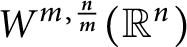
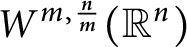
The main content of this paper is concerned with the problem of finding optimal Adams-type inequality for the higher-order Sobolev space
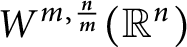 $W^{m,\frac {n}{m}}(\mathbb {R}^n)$
. Sharp Trudinger–Moser inequality and its high-order form (which is called as Adams inequalities) have been a matter of intensive research due to the importance of these inequalities in application to problems in analysis, partial differential equations and differential geometry, and so on. Let us first present a brief history of the main results in this direction.
Trudinger inequality as the critical case of the Sobolev imbedding was obtained by Trudinger [Reference Trudinger23], Pohožaev [Reference Pohožaev20], and Yudovič [Reference Yudovič25] independently. More precisely, Trudinger employed the power series expansion to prove that there exists
 $\alpha>0$
such that
 $$ \begin{align} \sup_{\|\nabla u\|_n^n\leq \alpha, u\in W^{1,p}_0(\Omega)}\int_{\Omega}\exp(|u|^{\frac{n}{n-1}})dx<\infty, \end{align} $$
where
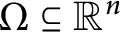 $\Omega \subseteq \mathbb {R}^n$
is smooth bounded domain and
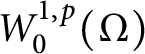 $W^{1,p}_0(\Omega )$
denotes the usual Sobolev space, i.e., the completion of
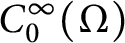 $C_{0}^{\infty }(\Omega )$
with the norm
 $$ \begin{align*}\|u\|_{W^{1,p}_0(\Omega)}=\int_{\Omega}|\nabla u|^p+|u|^pdx.\end{align*} $$
Subsequently, Moser [Reference Moser18] utilized the technique of the symmetrization and rearrangement to obtain the sharp constant
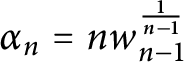 $\alpha _n=nw_{n-1}^{\frac {1}{n-1}}$
of the above inequality. Because Polyá–Szegö inequality on which the technique of the symmetrization and rearrangement depends on is no longer valid on the high-order Sobolev spaces, Adams employed the method of representation formulas and O’Neil’s rearrangement of the convolutions [Reference O’Neil19] to establish the sharp Adams inequalities on bounded domain (see [Reference Adams1]). More precisely, he proved the following result.
Theorem A Let
 $\Omega $
be an open and bounded set in
 $\mathbb {R}^n$
. If m is a positive integer less than n, then there exists a constant
 $C_0=C(n,m)>0$
such that for any
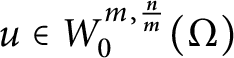 $u\in W_0^{m,\frac {n}{m}}(\Omega )$
and
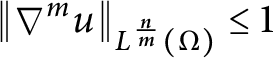 $\|\nabla ^m u\|_{L^{\frac {n}{m}}(\Omega )}\leq 1$
, then
 $$ \begin{align} \frac{1}{|\Omega|}\int_{\Omega}\exp(\beta|u(x)|^{\frac{n}{n-m}})dx\leq C_0, \end{align} $$
for all
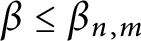 $\beta \leq \beta _{n,m}$
, where
 $$ \begin{align*} \beta_{n, m}= \begin{cases} \frac{n}{\omega_{n-1}}\big[\frac{\pi^{\frac{n}{2}}2^m\Gamma(\frac{m+1}{2})}{\Gamma(\frac{n-m+1}{2})} \big]^{\frac{n}{n-m}}, &\text{where}\ m\ \text{is odd,} \\[8pt] \frac{n}{\omega_{n-1}}\big[\frac{\pi^{\frac{n}{2}}2^m\Gamma(\frac{m}{2})}{\Gamma(\frac{n-m}{2})} \big]^{\frac{n}{n-m}}, &\text{where}\ m\ \text{is even.}\\ \end{cases} \end{align*} $$
Furthermore, the constant
 $\beta _{n,m}$
is best possible in the sense that for any
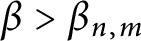 $\beta>\beta _{n,m}$
, the integral can be made as large as possible.
Moser’s results for the first-order derivatives and Adams’ result for the high-order derivatives were extended to unbounded domains. Li and Ruf [Reference Li and Ruf15, Reference Ruf21] established the following result:
 $$ \begin{align} \sup_{\|u\|_{W^{1,n}(\mathbb{R}^n)}\leq 1}\int_{\mathbb{R}^n}\Phi (\alpha_n|u|^{\frac{n}{n-1}})dx\leq C_n. \end{align} $$
Their proofs in [Reference Li and Ruf15, Reference Ruf21] rely on rearrangement arguments and the Polyá–Szegö inequality. Lam and Lu [Reference Lam and Lu9] used a symmetrization-free approach to give a simple proof for the sharp Trudinger–Moser inequalities in
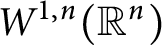 $W^{1,n}(\mathbb {R}^n)$
. It should be noted that this approach is surprisingly simple and can be easily applied to other settings where symmetrization argument does not work. Furthermore, they also develop this new approach to establish the Trudinger–Moser inequalities on the Heisenberg group and Fractional Adams inequalities in
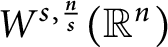 $W^{s,\frac {n}{s}}(\mathbb {R}^n)$
(
 $0<s<n$
) (see [Reference Lam and Lu7, Reference Lam and Lu9, Reference Lam, Lu and Tang10]). For more applications of this symmetrization-free approach in deriving global Trudinger–Moser inequality in unbounded setting, we also refer the reader to [Reference Chen, Lu and Zhu4, Reference Lam, Lu and Zhang11–Reference Li, Lu and Zhu14, Reference Lu and Zhu17, Reference Zhang and Chen26].
Based on the blowing-up analysis method, Adimurthi and Druet [Reference Druet2] obtained an improved Trudinger–Moser-type inequality in
 $\mathbb {R} ^{2}$
on bounded domains
 $\Omega $
, which can be described as follows:
 $$ \begin{align*} \underset{\left\Vert \nabla u\right\Vert _{2}\leq1}{\underset{u\in W_{0} ^{1,2}\left( \Omega\right) }{\sup}}\int_{ \mathbb{R} ^{2}}e^{ 4\pi\left\vert u\right\vert ^{2}\left( 1+\alpha\left\Vert u\right\Vert _{2}^{2}\right)} dx<\infty,\text{iff }\alpha<\underset{ u\in W_{0}^{1,2}\left( \Omega\right) ,u\neq0}{\inf}\frac{\left\Vert \nabla u\right\Vert _{2}^{2}}{\left\Vert u\right\Vert _{2}^{2}}. \end{align*} $$
For a higher-dimensional version of the Adimurthi–Druet-type Trudinger–Moser inequality on bounded domains, see [Reference Yang24]. For Adams inequality of Adimurthi–Druet type, we refer to [Reference Lu and Yang16]. In particular, the following was proved in [Reference Lu and Yang16] using the blow-up analysis:
Let
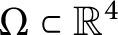 $\Omega \subset \mathbb {R}^4$
be a smooth-oriented bounded domain,
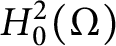 $H_0^2(\Omega )$
be the Sobolev space, and
 $ \lambda (\Omega )=\inf \limits _{u\in H_0^2(\Omega ),\,\,\|u\|_2^2=1}\|\Delta u\|_2^2$
be the first eigenvalue of the bi-Laplacian operator
 $\Delta ^2$
. Then, for any
 $\alpha $
:
 $0\leq \alpha <\lambda (\Omega )$
, we have
 $$ \begin{align*}\sup\limits_{u\in H_0^2(\Omega),\,\,\|\Delta u\|_2^2=1} \int_\Omega e^{32\pi^2 u^2(1+\alpha\|u\|_2^2)}dx<+\infty,\end{align*} $$
and the above supremum is infinity when
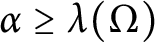 $\alpha \geq \lambda (\Omega )$
. This strengthens Adams’ inequality in dimension 4 [Reference Adams1] where he proved that the above inequality holds for
 $\alpha =0$
.
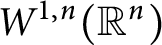
The authors in [Reference Lu and Zhu17] obtained an Adimurthi–Druet-type result for
 $W^{1,n}(\mathbb {R}^n)$
in the entire space
 $\mathbb {R}^n$
, which was in the spirit of the result established on bounded domains in [Reference Druet2]. The method used in [Reference Lu and Zhu17] is using the blow-up analysis of the associated Euler–Lagrange equation of the Trudinger–Moser inequality. Their main results read as follows.
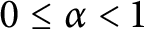
Theorem B For any
 $0\leq \alpha <1$
, there holds
 $$ \begin{align*} S(\alpha):=\sup_{\|\nabla u\|_n^n+\|u\|^n_{n}=1}\int_{\mathbb{R}^n}\Phi\Big(\alpha_{n}(1+\alpha \|u\|^n_{n} )^{\frac{1}{n-1}}|u|^{\frac{n}{n-1}}\Big)dx<\infty, \end{align*} $$
where
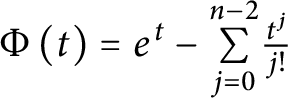
 $\Phi \left ( t\right ) =e^{t}-\underset {j=0}{\overset {n-2}{\sum }} \frac {t^{j}}{j!}$
. Moreover, for any
 $\alpha \geq 1,$
the supremum
 $S(\alpha )$
becomes infinite.
We now recall the higher-order Adams inequalities on the Sobolev spaces
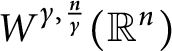 $W^{\gamma , \frac {n}{\gamma }}(\mathbb {R}^n)$
on the entire space
 $\mathbb {R}^n$
. Let
 $$ \begin{align*} p^{\prime} & =\frac{p}{p-1},\, 0<\gamma<n,\\ \beta_{0}\left( n,\gamma\right) & =\frac{n}{\omega_{n-1}}\left[ \frac {\pi^{n/2}2^{\gamma}\Gamma\left( \gamma/2\right) }{\Gamma\left( \frac{n-\gamma}{2}\right) }\right] ^{p^{\prime}}. \end{align*} $$
Theorem C Let
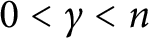 $0<\gamma <n$
be an arbitrary real positive number,
 $p=\frac {n}{\gamma }$
, and
 $\tau>0$
. There holds
 $$ \begin{align*} \underset{u\in W^{\gamma,p}\left( \mathbb{R} ^{n}\right) ,\left\Vert \left( \tau I-\Delta\right) ^{\frac{\gamma}{2} }u\right\Vert _{p}\leq1}{\sup}\int_{ \mathbb{R} ^{n}}\phi\left( \beta_{0}\left( n,\gamma\right) \left\vert u\right\vert ^{p^{\prime}}\right) dx<\infty, \end{align*} $$
where
 $$ \begin{align*} \phi(t) & =e^{t}- {\displaystyle\sum\limits_{j=0}^{j_{p}-2}} \frac{t^{j}}{j!},\\ j_{p} & =\min\left\{ j\in \mathbb{N} :j\geq p\right\} \geq p. \end{align*} $$
Furthermore, this inequality is sharp, i.e., if
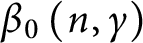 $\beta _{0}\left ( n,\gamma \right ) $
is replaced by any
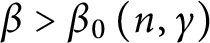 $\beta>\beta _{0}\left ( n,\gamma \right ) $
, then the supremum is infinite.
Remark 1.1 When
 $\gamma =m$
is an even integer, the above theorem was proved in [Reference Ruf and Sani22], and when
 $\gamma =m$
is odd, it was proved in [Reference Lam and Lu8] in a slightly different form. For arbitrary
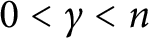 $0<\gamma <n$
, the above theorem for general fractional Sobolev spaces
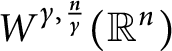 $W^{\gamma , \frac {n}{\gamma }}(\mathbb {R}^n)$
was established in [Reference Lam and Lu9] using harmonic analysis and symmetrization-free method.
We note that the following sharpened Adams inequality on
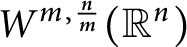 $W^{m, \frac {n}{m}}(\mathbb {R}^n)$
, where
 $m, n$
are positive integers and
 $0<m<n$
, has been proved in the following form, where not the full Sobolev norm is needed to have the Adams inequality. (Though by Sobolev interpolation theorem, these two norms are comparable.)
Theorem D On the Sobolev spaces
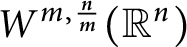 $W^{m, \frac {n}{m}}(\mathbb {R}^n)$
, the following holds:
 $$ \begin{align} \sup_{\|\nabla^mu\|_{\frac{n}{m}}^{\frac{n}{m}}+\|u\|_{\frac{n}{m}}^{\frac{n}{m}}\leq1}\int_{\mathbb{R}^n}\Phi\Big(\beta_{n,m} |u|^{\frac{n}{n-m}}\Big)dx<\infty. \end{align} $$
The above Theorem D was proved in [Reference Lam and Lu9] for
 $m=2$
and in [Reference Cohn and Lu6] for
 $m>2$
.
Recently, the authors established in [Reference Chen, Lu and Zhu3] an Adimurthi–Druet-type Trudinger–Moser inequality on the entire Heisenberg group. This sharpened Trudinger–Moser inequality on the Heisenberg group improved the critical Trudinger–Moser inequality established in [Reference Lam and Lu7], which extended the Trudinger–Moser inequality on any bounded domains in the Heisenberg group first proved by Cohn and the second author in [Reference Fontana and Morpurgo5]. Our argument used in [Reference Chen, Lu and Zhu3] also gives an alternative and much simpler proof of the Trudinger–Moser inequality of Adimurthi–Druet type in the entire Euclidean space obtained in [Reference Lu and Zhu17] (see Theorem B above).
In the spirit of the above works, a natural question arises: Does there exist an analogue of Theorem
 $\mathbb {B}$
for Adams inequalities on higher-order Sobolev spaces
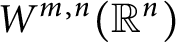 $W^{m,n}(\mathbb {R}^n)$
on the entire space
 $\mathbb {R}^n$
? A natural approach would be using the blow-up analysis as done in [Reference Lu and Yang16] or [Reference Lu and Zhu17]. To use this method, one would need to find a radially maximizing sequence through the symmetrization and rearrangement technique. Obviously, this method is not efficient in dealing with the Adams inequality with higher-order derivatives in
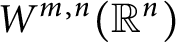 $W^{m,n}(\mathbb {R}^n)$
due to its failure of the symmetrization principle. To this end, we use a completely different method of scaling to overcome this difficulty and develop a surprisingly simple proof in this paper.
Our first main result in this paper is as follows.
Theorem 1.2 For any
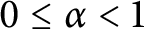 $0\leq \alpha <1$
, there holds
 $$ \begin{align} \sup_{\|\nabla^mu\|_{\frac{n}{m}}^{\frac{n}{m}}+\|u\|_{\frac{n}{m}}^{\frac{n}{m}}\leq1}\int_{\mathbb{R}^n}\Phi\Big(\beta_{n,m} (1+\alpha \|u\|_{\frac{n}{m}}^{\frac{n}{m}} )^{\frac{m}{n-m}}|u|^{\frac{n}{n-m}}\Big)dx<\infty. \end{align} $$
Remark 1.3 At first sight, the inequality (1.5) is stronger than the Adams inequality (1.4):
 $$ \begin{align*} \sup_{\|\nabla^mu\|_{\frac{n}{m}}^{\frac{n}{m}}+\|u\|_{\frac{n}{m}}^{\frac{n}{m}}\leq1}\int_{\mathbb{R}^n}\Phi\Big(\beta_{n,m}|u|^{\frac{n}{n-m}}\Big)dx<\infty. \end{align*} $$
However, through the proof of Theorem 1.2, it is surprising to find that these two inequalities are in fact equivalent.
By constructing a proper test function sequence, we can derive the sharpness of the exponent
 $\alpha $
of the inequality (1.5).
Theorem 1.4 If we assume that
 $\alpha \geq 1$
, then
 $$ \begin{align*}\sup_{\|\nabla^mu\|_{\frac{n}{m}}^{\frac{n}{m}}+\|u\|_{\frac{n}{m}}^{\frac{n}{m}}\leq1}\int_{\mathbb{R}^n}\Phi\Big(\beta_{n,m} (1+ \alpha\|u\|_{\frac{n}{m}}^{\frac{n}{m}} )^{\frac{m}{n-m}}|u|^{\frac{n}{n-m}}\Big)dx=\infty.\end{align*} $$
Slightly modifying the proofs of Theorems 1.2 and 1.4, we can obtain the weighted analogue of the above Adams inequalities.
Theorem 1.5 For any
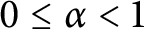 $0\leq \alpha <1$
and
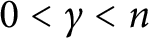 $0<\gamma <n$
, there holds
 $$ \begin{align} \sup_{\|\nabla^mu\|_{\frac{n}{m}}^{\frac{n}{m}}+\|u\|_{\frac{n}{m}}^{\frac{n}{m}}\leq1}\int_{\mathbb{R}^n}\frac{\Phi\Big(\beta_{n,m}(1-\frac{\gamma}{n}) (1+\alpha \|u\|_{\frac{n}{m}}^{\frac{n}{m}} )^{\frac{m}{n-m}}|u|^{\frac{n}{n-m}})}{|x|^{\gamma}}\Big)dx<\infty. \end{align} $$
If we assume that
 $\alpha \geq 1$
, then
 $$ \begin{align*}\sup_{\|\nabla^mu\|_{\frac{n}{m}}^{\frac{n}{m}}+\|u\|_{\frac{n}{m}}^{\frac{n}{m}}\leq1}\int_{\mathbb{R}^n}\frac{\Phi\Big(\beta_{n,m}(1-\frac{\gamma}{n}) (1+\alpha \|u\|_{\frac{n}{m}}^{\frac{n}{m}} )^{\frac{m}{n-m}}|u|^{\frac{n}{n-m}})}{|x|^{\gamma}}\Big)dx=\infty.\end{align*} $$
2 The proof of Theorem 1.2
To prove Theorem 1.2, we first need the following lemma.
Lemma 2.1 For any
 $\tau>0$
and
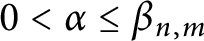 $0<\alpha \leq \beta _{n,m}$
, there exists some constant
 $C_{m,n}$
such that for
 $u\in W^{m,\frac {n}{m}}(\mathbb {R}^{n})$
with
 $\|\nabla ^mu\|_{\frac {n}{m}}^{\frac {n}{m}}+\tau \|u\|_{\frac {n}{m}}^{\frac {n}{m}}\leq 1$
, there holds
 $$ \begin{align} \int_{\mathbb{R}^n}\Phi_{n,m}(\alpha|u|^{\frac{n}{n-m}})dx\leq C_{m,n}. \end{align} $$
Proof. For any
 $\tau>0$
,
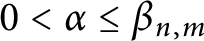 $0<\alpha \leq \beta _{n,m}$
and
 $u\in W^{m,\frac{n}{m}}(\mathbb {R}^{n})$
with
 $$ \begin{align*}\int_{\mathbb{R}^n}|\nabla^mu|^{\frac{n}{m}}+\tau|u|^{\frac{n}{m}}\leq 1.\end{align*} $$
We define a new function
 $v(x)$
given by
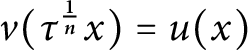 $v(\tau ^{\frac {1}{n}}x)=u(x)$
, then direct computations yield that
 $$ \begin{align*}\int_{\mathbb{R}^n}|\nabla^mv|^{\frac{n}{m}}+|v|^{\frac{n}{m}}dx=\int_{\mathbb{R}^n}|\nabla^mu|^{\frac{n}{m}}+\tau|u|^{\frac{n}{m}}dx\leq 1,\end{align*} $$
and
 $$ \begin{align*}\int_{\mathbb{R}^n}\Phi_{n,m}(\alpha|u|^{\frac{n}{n-m}})dx=\frac{1}{\tau}\int_{\mathbb{R}^n}\Phi_{n,m}(\alpha|v|^{\frac{n}{n-m}})dx.\end{align*} $$
Combining this result with the Adams inequality in [Reference Cohn and Lu6], we obtain
 $$ \begin{align*}&\sup_{\|\nabla^mu\|_{\frac{n}{m}}^{\frac{n}{m}}+\tau\|u\|_{\frac{n}{m}}^{\frac{n}{m}}\leq1}\int_{\mathbb{R}^n}\Phi_{n,m}(\alpha|u|^{\frac{n}{n-m}})dx \\ & \leq \frac{1}{\tau} \sup_{\|\nabla^mv\|_{\frac{n}{m}}^{\frac{n}{m}}+\|v\|_{\frac{n}{m}}^{\frac{n}{m}}\leq1}\int_{\mathbb{R}^n}\Phi_{n,m}(\alpha|v|^{\frac{n}{n-m}})dx \leq C(m,n). \\[-38pt] \end{align*} $$
▪
Now, we start the proof of Theorem 1.2.
Proof. For any
 $u\in W^{m,n}(\mathbb {R}^n)$
with
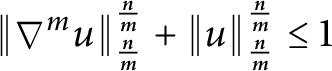 $\|\nabla ^mu\|_{\frac {n}{m}}^{\frac {n}{m}}+\|u\|_{\frac {n}{m}}^{\frac {n}{m}}\leq 1$
, we define a new function
 $v(x)$
as
 $$ \begin{align*}v(x)= (1+\alpha \|u\|_{\frac{n}{m}}^{\frac{n}{m}})^{\frac{m}{n}}u(x).\end{align*} $$
Direct computations lead to
 $$ \begin{align*}\|\nabla^mv\|_{\frac{n}{m}}^{\frac{n}{m}}=(1+\alpha \|u\|_{\frac{n}{m}}^{\frac{n}{m}})\|\nabla^mu\|_{\frac{n}{m}}^{\frac{n}{m}},\end{align*} $$
and
 $$ \begin{align*}\|v\|_{\frac{n}{m}}^{\frac{n}{m}}=(1+\alpha \|u\|_{\frac{n}{m}}^{\frac{n}{m}})\|u\|_{\frac{n}{m}}^{\frac{n}{m}}.\end{align*} $$
Therefore, it follows that
 $$ \begin{align} \|\nabla^mv\|_{\frac{n}{m}}^{\frac{n}{m}}+(1-\alpha)\|v\|_{\frac{n}{m}}^{\frac{n}{m}}&\leq (1+\alpha \|u\|_{\frac{n}{m}}^{\frac{n}{m}})-\alpha(1+\alpha \|u\|_{\frac{n}{m}}^{\frac{n}{m}})\|u\|_{\frac{n}{m}}^{\frac{n}{m}}\nonumber\\[6pt] &=1+\alpha\|u\|_{\frac{n}{m}}^{\frac{n}{m}}-\alpha(1+\alpha \|u\|_{\frac{n}{m}}^{\frac{n}{m}})\|u\|_{\frac{n}{m}}^{\frac{n}{m}}\\[6pt] &\leq 1. \nonumber \end{align} $$
Using Lemma 2.1, we derive that
 $$ \begin{align} &\sup_{\|\nabla^mu\|_{\frac{n}{m}}^{\frac{n}{m}}+\|u\|_{\frac{n}{m}}^{\frac{n}{m}}\leq1}\int_{\mathbb{R}^n}\Phi\Big(\beta_{n,m} (1+\alpha \|u\|_{\frac{n}{m}}^{\frac{n}{m}} )^{\frac{m}{n-m}}|u|^{\frac{n}{n-m}}\Big)dx\nonumber\\[6pt] &\ \ \ \ \leq \sup_{\|\nabla^mv\|_{\frac{n}{m}}^{\frac{n}{m}}+(1-\alpha)\|v\|_{\frac{n}{m}}^{\frac{n}{m}}\leq1}\int_{\mathbb{R}^n}\Phi\Big(\beta_{n,m} |v|^{\frac{n}{n-m}}\Big)dx<\infty, \end{align} $$
which concludes the proof of Theorem 1.2.▪
3 The proof of Theorem 1.4
In this section, we prove the sharpness of the inequality in Theorem 1.2 by constructing proper test functions. Namely, we will show the supremum in (1.5) is infinite if
 $\alpha \geq 1$
.
Proof of Theorem 1.4
We consider the test functions introduced by Adams in [Reference Adams1]. Let
 $\phi \in C_{0}^{\infty }\left ( \left [ 0,1\right ] \right ) $
be such that
 $$ \begin{align*} \phi\left( 0\right) & =\phi^{\prime}\left( 0\right) =\cdots =\phi^{\left( m-1\right) }\left( 0\right) =0,\\[3pt] \phi\left( 1\right) & =\phi^{\prime}\left( 1\right) =1,\phi ^{\prime\prime}\left( 1\right) =\cdots=\phi^{(m-1)}\left( 1\right) =0, \end{align*} $$
and for
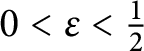 $0<\varepsilon <\frac {1}{2}$
, set
 $$ \begin{align*} H\left( t\right) =\left\{ \begin{array} [c]{ll} \varepsilon\phi\left( \frac{t}{\varepsilon}\right) , & 0\leq t\leq \varepsilon,\\[3pt] t, & \varepsilon<t\leq1-\varepsilon,\\[3pt] 1-\varepsilon\phi\left( \frac{1-t}{\varepsilon}\right) , & 1-\varepsilon <t\leq1,\\[3pt] 1, & t>1, \end{array} \right. \end{align*} $$
and for any fixed
 $r>0$
sufficiently small, we define
 $$ \begin{align*} \psi_{r}\left( \left\vert x\right\vert \right) :=H\left( \frac{\log\frac {1}{\left\vert x\right\vert }}{\log\frac{1}{r}}\right). \end{align*} $$
By construction,
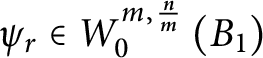 $\psi _{r}\in W_{0}^{m,\frac {n}{m}}\left ( B_{1}\right ) $
, and
 $\psi _{r}=1$
on
 $B_{r}$
, and
 $$ \begin{align*} \left\Vert \nabla^{m}\psi_{r}\right\Vert _{\frac{n}{m}}^{\frac{n}{m}}\leq n^{1-\frac{n}{m}}\beta_{n,m}^{\frac{n}{m}-1}\left( \log\frac{1}{r}\right) ^{1-\frac{n}{m}}A_{r}, \end{align*} $$
where
 $A_{r}=1+2\varepsilon \left ( \left \Vert \phi ^{\prime }\right \Vert _{\infty }+O\left ( \frac {1}{\log \frac {1}{r}}\right ) \right ) ^{\frac {n}{m}}$
. Moreover, one has
 $$ \begin{align*} \left\Vert \psi_{r}\right\Vert _{\frac{n}{m}}^{\frac{n}{m}}\leq O\left( \frac{1}{\log\frac{1}{r}}\right) ^{\frac{n}{m}}. \end{align*} $$
Next, given a sequence
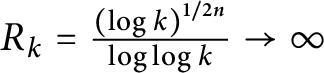 $R_{k}=\frac {\left ( \log k\right ) ^{1/2n} }{\log \log k}\rightarrow \infty $
, we define
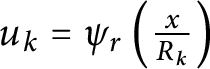 $u_{k}=\psi _{r}\left ( \frac {x}{R_{k}}\right ) $
. Then,
 $$ \begin{align*} \left\Vert \nabla^{m}u_{k}\right\Vert _{\frac{n}{m}}^{\frac{n}{m}}=\left\Vert \nabla^{m}\psi_{r}\right\Vert _{\frac{n}{m}}^{\frac{n}{m}}\leq n^{1-\frac {n}{m}}\beta_{n,m}^{\frac{n}{m}-1}\left( \log\frac{1}{r}\right) ^{1-\frac {n}{m}}A_{r}, \end{align*} $$
and
 $$ \begin{align*} \left\Vert u_{k}\right\Vert _{\frac{n}{m}}^{\frac{n}{m}}=O\left( R_{k} ^{n}\cdot\left( \frac{1}{\log\frac{1}{r}}\right) ^{\frac{n}{m}}\right). \end{align*} $$
Hence, we have
 $$ \begin{align*} \left\Vert u_{k}\right\Vert _{W^{m,\frac{n}{m}}\left( \mathbb{R} ^{n}\right) }^{\frac{n}{m}} & \leq n^{1-\frac{n}{m}}\beta_{n,m}^{\frac{n} {m}-1}\left( \log\frac{1}{r}\right) ^{1-\frac{n}{m}}A_{r}+R_{k}^{n} \cdot\left( \frac{1}{\log\frac{1}{r}}\right) ^{\frac{n}{m}}\\[6pt] & =n^{1-\frac{n}{m}}\beta_{n,m}^{\frac{n}{m}-1}\left( \log\frac{1}{r}\right) ^{1-\frac{n}{m}}A_{r}\left( 1+2R_{k}^{n}\cdot O\left( \frac{1}{\log\frac {1}{r}}\right) \right), \end{align*} $$
and then
 $$ \begin{align*} 1+\frac{\left\Vert u_{k}\right\Vert _{\frac{n}{m}}^{\frac{n}{m}}}{\left\Vert u_{k}\right\Vert _{W^{m,\frac{n}{m}}\left( \mathbb{R} ^{n}\right) }^{\frac{n}{m}}} & \geq1+\frac{\left\Vert u_{k}\right\Vert _{\frac{n}{m}}^{\frac{n}{m}}}{n^{1-\frac{n}{m}}\beta_{n,m}^{\frac{n}{m} -1}\left( \log\frac{1}{r}\right) ^{1-\frac{n}{m}}A_{r}+\left\Vert u_{k}\right\Vert _{\frac{n}{m}}^{\frac{n}{m}}}\\[6pt] & =\frac{n^{1-\frac{n}{m}}\beta_{n,m}^{\frac{n}{m}-1}\left( \log\frac{1} {r}\right) ^{1-\frac{n}{m}}A_{r}+2\left\Vert u_{k}\right\Vert _{\frac{n}{m} }^{\frac{n}{m}}}{n^{1-\frac{n}{m}}\beta_{n,m}^{\frac{n}{m}-1}\left( \log \frac{1}{r}\right) ^{1-\frac{n}{m}}A_{r}+\left\Vert u_{k}\right\Vert _{\frac{n}{m}}^{\frac{n}{m}}}\\[6pt] & =\frac{1+2R_{k}^{n}\cdot O\left( \frac{1}{\log\frac{1}{r}}\right) }{1+R_{k}^{n}\cdot O\left( \frac{1}{\log\frac{1}{r}}\right) }. \end{align*} $$
Therefore, on the ball
 $B_{R_{k}r}$
, we have
 $\left \vert B_{R_{k}r}\right \vert =c\exp \left ( n\log R_{k}+n\log r\right ) $
, and
 $$ \begin{align*} & \frac{\beta_{n.m}\left\vert u_{k}\right\vert ^{\frac{n}{n-m}}}{\left( \left\Vert u_{k}\right\Vert _{W^{m,\frac{n}{m}}\left( \mathbb{R} ^{n}\right) }\right) ^{\frac{n}{n-m}}}\left( 1+\frac{\left\Vert u_{k}\right\Vert _{\frac{n}{m}}^{\frac{n}{m}}}{\left\Vert u_{k}\right\Vert _{W^{m,\frac{n}{m}}\left( \mathbb{R} ^{n}\right) }^{\frac{n}{m}}}\right) ^{\frac{m}{n-m}}\\[6pt] & \geq\frac{\beta_{n.m}}{\left( n^{1-\frac{n}{m}}\beta_{n,m}^{\frac{n}{m} -1}\left( \log\frac{1}{r}\right) ^{1-\frac{n}{m}}A_{r}\left( 1+R_{k} ^{n}\cdot O\left( \frac{1}{\log\frac{1}{r}}\right) \right) \right) ^{\frac{m}{n-m}}}\left( \frac{1+2R_{k}^{n}\cdot O\left( \frac{1}{\log \frac{1}{r}}\right) }{1+R_{k}^{n}\cdot O\left( \frac{1}{\log\frac{1}{r} }\right) }\right) ^{\frac{m}{n-m}}\\[6pt] & =\frac{n\log\frac{1}{r}}{A_{r}^{\frac{m}{n-m}}}\left( \frac{1+2R_{k} ^{n}\cdot O\left( \frac{1}{\log\frac{1}{r}}\right) }{\left( 1+R_{k} ^{n}\cdot O\left( \frac{1}{\log\frac{1}{r}}\right) \right) ^{2}}\right) ^{\frac{m}{n-m}}. \end{align*} $$
Setting
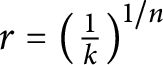 $r=\left (\frac {1}{k}\right )^{1/n}$
, we derive that
 $$ \begin{align} &\frac{\beta_{n.m}\left\vert u_{k}\right\vert ^{\frac{n}{n-m}}}{\left( \left\Vert u_{k}\right\Vert _{W^{m,\frac{n}{m}}\left( \mathbb{R}^{n}\right)}\right)^{\frac{n}{n-m}}}\left( 1+\frac{\left\Vert u_{k}\right\Vert _{\frac{n}{m}}^{\frac{n}{m}}}{\left\Vert u_{k}\right\Vert _{W^{m,\frac{n}{m}}\left(\mathbb{R}^{n}\right)}^{\frac{n}{m}}}\right)^{\frac{m}{n-m}}\nonumber\\[6pt] &\ \ \geq\frac{\log k}{A_{r}^{\frac{m}{n-m}}}\cdot\left( \frac{1+2R_{k} ^{n}\cdot O\left( \frac{1}{\log k}\right) }{1+R_{k}^{2n}\cdot O\left( \frac{1}{\left( \log k\right) ^{2}}\right) +2R_{k}^{n}\cdot O\left( \frac{1}{\log k}\right) }\right) ^{\frac{m}{n-m}}\\[6pt] &\ \ =\frac{\log k}{A_{r}^{\frac{m}{n-m}}}\cdot\left( 1-R_{k}^{2n}\cdot O\left( \frac{1}{\left( \log k\right) ^{2}}\right) +o\left( \frac {R_{k}^{2n}}{\left( \log k\right) ^{2}}\right) \right) ^{\frac{m}{n-m}}\nonumber\\[6pt] &\ \ =\frac{\log k}{A_{r}^{\frac{m}{n-m}}}\left( 1-\frac{m}{n-m}R_{k}^{2n}\cdot O\left( \frac{1}{\left( \log k\right) ^{2}}\right) +o\left( \frac {R_{k}^{2n}}{\left( \log k\right) ^{2}}\right) \right). \nonumber \end{align} $$
Thus, we have
 $$ \begin{align*} & \int_{ \mathbb{R} ^{n}}\exp\left( \frac{\beta_{n.m}\left\vert u_{k}\right\vert ^{\frac{n}{n-m} }}{\left( \left\Vert u_{k}\right\Vert _{W^{m,\frac{n}{m}}\left( \mathbb{R} ^{n}\right) }\right) ^{\frac{n}{n-m}}}\left( 1+\frac{\left\Vert u_{k}\right\Vert _{\frac{n}{m}}^{\frac{n}{m}}}{\left\Vert u_{k}\right\Vert _{W^{m,\frac{n}{m}}\left( \mathbb{R} ^{n}\right) }^{\frac{n}{m}}}\right) ^{\frac{m}{n-m}}\right) \\[6pt] & \geq c\exp\left( n\log R_{k}-\log k\right) \\[6pt] &\qquad \exp\left( \frac{\log k}{A_{r}^{\frac{m}{n-m}}}\left( 1-\frac{m}{n-m}R_{k}^{2n}\cdot O\left( \frac{1}{\left( \log k\right) ^{2}}\right) +o\left( \frac{R_{k}^{2n} }{\left( \log k\right) ^{2}}\right) \right) \right) \\[-14pt] \\ & \geq c\exp\left( n\log R_{k}-\log k+\frac{\log k}{A_{r}^{\frac{m}{n-m}} }\left( 1-\frac{m}{n-m}R_{k}^{2n}\cdot O\left( \frac{1}{\left( \log k\right) ^{2}}\right) +o\left( \frac{R_{k}^{2n}}{\left( \log k\right) ^{2}}\right) \right) \right) \\[6pt] & =c\exp\left( n\log R_{k}+\left( \frac{1}{A_{r}^{\frac{m}{n-m}}}-1\right) \log k-\frac{\log k}{A_{r}^{\frac{m}{n-m}}}\left( R_{k}^{2n}\cdot O\left( \frac{1}{\left( \log k\right) ^{2}}\right) {+}o\left( \frac{R_{k}^{2n} }{\left( \log k\right) ^{2}}\right) \right) \right) \\[6pt] & =c\exp\left( \left( \frac{1}{A_{r}^{\frac{m}{n-m}}}-1\right) \log k+\frac{1}{2}\log\log k-n\log\log\log k\right. \\[6pt] & \left. -\frac{\log k}{A_{r}^{\frac{m}{n-m}}}\left( R_{k}^{2n}\cdot O\left( \frac{1}{\left( \log k\right) ^{2}}\right) +o\left( \frac {R_{k}^{2n}}{\left( \log k\right) ^{2}}\right) \right) \right) \\[6pt] & =c\exp\left( \frac{1}{2}\log\log k-n\log\log\log k+\left( \frac{1} {A_{r}^{\frac{m}{n-m}}}-1\right) \log k+O\left( \frac{1}{\left( \log\log k\right) ^{2n}}\right) \right) \\[6pt] & \rightarrow\infty, \end{align*} $$
provided
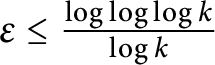 $\varepsilon \leq \frac {\log \log \log k}{\log k}$
. This completes the proof of Theorem 1.4.
Acknowledgment
We would like to thank the referee for his careful reading and his comments.



