




No CrossRef data available.
Making and Keeping Peace
Published online by Cambridge University Press: 17 May 2005
Abstract
Recent efforts to explain why some peace agreements last while others fail have focused on the strength of the agreement itself. Maintaining peace, even if both belligerents want peace, can be difficult if there are temptations to defect or there are reasons to fear that one may be played for the sucker. Strong agreements that can increase the costs of defection, enhance monitoring, or reward cooperation help to solve this enforcement dilemma and generally increase the former belligerents' incentives to remain at peace. Although we agree that such carrots and sticks can facilitate cooperation, we argue in this article that such measures will often be inadequate if the belligerents themselves are no longer committed to keeping the peace. If the belligerents believe that a renewed war can lead to better terms, peace will be precarious. We demonstrate that getting (and keeping) the terms right may be more important than any carrots and sticks incorporated into the document to enforce those terms. In particular, we show that “unnatural” ceasefires that come about as a consequence of third-party pressure are significantly more likely to fail. We also show that ceasefires negotiated after wars with consistent battle outcomes are more likely to last than those where the “right” terms of settlement are less apparent.We would like to thank Virginia Page Fortna, Dani Reiter, Nicholas Sambanis, and the anonymous reviewers and editors of International Organization for their many suggestions and insightful comments on previous versions of this article.
Information
- Type
- Research Article
- Information
- Copyright
- © 2005 The IO Foundation and Cambridge University Press
When does peace last? What conditions encourage belligerents who have agreed to ceasefire to maintain those commitments? What, if anything, can the international community do to enhance the prospects for peace? Recent efforts to explain the durability of peace has placed the agreement itself in a position of primacy. Fortna, for instance, argues that agreements matter because they provide an opportunity to alter the perceived costs and benefits of returning to war. Strong agreements that include mechanisms such as demilitarized zones, confidence-building measures, and monitoring can increase the costs of defection and can foster trust between the former belligerents. By ameliorating the security dilemma that often plagues new peace initiatives, strong agreements can help bolster a fragile peace.1
Fortna 2003; see also Hartzell, Hoddie, and Rothchild 2001; and Hartzell and Hoddie 2003.
Agreements, however, do not merely detail how the peace will be kept or specify the various enforcement mechanisms agreed to by the former belligerents. More fundamentally, agreements detail how the war ended—the terms of settlement. Before any enforcement provisions, agreements specify who gets what and when. The importance of these terms to the belligerents is obvious. Disputes over who gets what are most often the proximate cause of the war. Further, if peace fails, the intent of the new war for at least one of the belligerents is often to change the agreement—the terms of settlement—previously agreed to. It seems surprising therefore that, despite the attention paid to the connection between agreements and the durability of peace, the distributional consequences of agreements are uniformly ignored. Agreements are important in part because they provide an opportunity to specify various enforcement mechanisms that foster trust and increase the costs of defection. More significantly, they are important because they specify who gets what and thereby determine the benefits of peace and the incentives to return to war.
Which agreements or distributional arrangements are most likely to encourage a durable peace? Drawing from the growing literature on bargaining and war,2
See Wagner 2000; Filson and Werner 2002 and 2004; Powell 2004; Slantchev 2003; and Smith and Stam 2004a.
We proceed as follows. First, we summarize recent research relating settlements to peace and argue that this research highlights important enforcement issues but fails to appreciate prior and significant distributional issues. Second, we lay out our argument relating the distributional consequences of peace agreements to the durability of those agreements. We argue that agreements that occur under significant third-party pressure are prone to failure because the terms of agreement are often at odds with the military reality on the ground and because considerable uncertainty about the consequences of continued fighting may remain. We also argue that agreements that occur when military dominance remains in question are much more vulnerable than those made when military dominance has been decisively demonstrated and there is little room for opposing expectations about the future of continued fighting. Third, we present a duration analysis of the durability of ceasefires between states after World War II. The analysis provides support for our argument and raises doubts about the relevance of enforcement mechanisms to keep the peace when at least one of the belligerents is determined to return to war. We conclude with a discussion of the policy implications of this analysis.
Peace and Enforcement Problems
Fearon summarizes succinctly three rationalist explanations for conflict: commitment problems, uncertainty and incentives to misrepresent, and divisibility problems.4
Recent work on war termination and the durability of peace has focused primarily on the problems created by the inability of the belligerents to make credible promises to maintain their commitments.5See Walter 1997; Fearon 1998; and Fortna 2003, 2004.
See Walter 1997; and Fearon 1998.
Even if the belligerents are able to agree to stop fighting, the implementation of the agreement is often mired by similar commitment problems. Former belligerents fear that the other side may not reciprocate their compliance with the provisions of the agreement. Distrust is high, and monitoring compliance is often difficult. Peace may break down not because either side prefers a renewed war to peace, but because they fear that their compliance with the provisions of the agreement leaves them vulnerable to exploitation or to a surprise attack from the opposing side. Strong agreements that improve monitoring capabilities, build trust, and raise the costs of defections can overcome these fears and provide the parties with the confidence to take the measures necessary to secure peace.8
See Fortna 2003 and 2004. As Fortna points out, mechanisms such as demilitarized zones, monitoring, and arms-control limitations are not merely effective in mitigating security fears arising from commitment problems; because such mechanisms increase the costs of returning to war, they generally increase the contract zone and thereby enhance the robustness of the settlement.
These explanations for the failure of peace focus primarily on the inability of the belligerents to credibly commit to implementing the terms of the agreement under conditions of first-strike advantages9
or shifting bargaining leverage.10See Walter 1997; and Fearon 1998.
Peace and Distribution Issues
Although commitment problems are one explanation for the failure of peace, an alternative (but not contradictory) explanation focuses on problems related to distribution and uncertainty. Several formal models that take issues of distribution and uncertainty as their point of departure have recently been published.11
See Wagner 2000; Filson and Werner 2002 and 2004; Powell 2002 and 2004; Slantchev 2003; and Smith and Stam 2004a and 2004b.
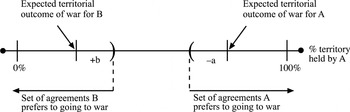
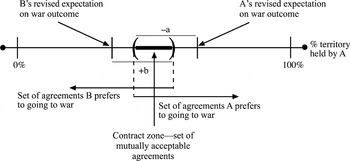
Although the bargaining and war models differ in many details, they all highlight a common dynamic. If wars are costly and the belligerents are able to negotiate a settlement (divisibility or enforcement issues are not acute), then the belligerents should reach an agreement based broadly on their common beliefs about the likely military outcome if fighting were to continue (or start). Negotiations fail, in contrast, if the belligerents' beliefs regarding the consequences of continued fighting diverge sufficiently such that they cannot agree as to which side needs to make concessions or how large the concessions need to be. In these instances, the belligerents' divergent beliefs about the consequences of continuing the war ensure that there is no contract zone, or set of agreements that both sides prefer to continuing the war. In Figure 1, for instance, no contract zone exists because both sides believe that they are likely to win the war and therefore are unwilling to make the concessions the other side demands. Through the course of the war, however, the belligerents' expectations about the consequences of continued fighting converge as a result of the information provided by the war itself. At this point, a contract zone emerges based on these common-enough expectations and the belligerents are able to negotiate terms of settlement that both sides prefer to continuing the war (see Figure 2). Critically, these models suggest that wars end because both sides believe that they can gain nothing more from continuing the war than they have gained from the terms of settlement specified in the agreement. Fighting is costly and the terms of settlement reflect the common expectations of what would have happened if the war were to have continued.

Divergent expectations regarding outcomes of war eliminates contract zone, where a and b indicate A's and B's expected costs of fighting, respectively

Converging expectations regarding outcome of war creates contract zone, where a and b indicate A's and B's costs of fighting, respectively
Several implications regarding the durability of peace and the recurrence of war can be inferred from this general dynamic. Note first that settlements should generally be robust. If the terms of the settlement reflect the belligerents' convergent expectations regarding the consequences of continued fighting, then neither belligerent should have an obvious incentive to return to war because neither should expect to receive a better deal if the war were to resume.12
Significantly, the fact that the belligerents were able to reach an agreement suggests that any informational problems that had previously precluded a settlement were resolved at least enough to create a contract zone. Otherwise, the belligerents would not have been able to reach an agreement. This same analysis led Werner to conclude that changes that occurred after the settlement, particularly changes in the distribution of power, would be central to understanding the recurrence of war.13Ibid.
Although the bargaining and war models suggest that settlements generally should be robust and that no particular distributional agreement should be inherently superior to another, certain settlements are expected to be more prone to failure than others. This expectation may seem contrary to the two previous expectations. Recall that a settlement will only be reached if both sides believe that the benefits from accepting the terms exceed the expected benefits from continuing to fight. The fact that the war ended suggests that a contract zone existed and the agreement, regardless of its terms, was contained within this contract zone. Any informational or distributional problems that remained at the time of the settlement were clearly not sufficient to thwart an agreement.
However, conditions and expectations can change. It is possible that an agreement that was initially acceptable to both sides may subsequently fall outside of the set of mutually acceptable agreements as the contract zone either shrinks or shifts. This “obsolete agreement” then is subject to challenge because at least one belligerent no longer prefers peace on the terms initially negotiated to a renewed war. If the changes subsequent to the agreement eliminate the contract zone altogether, then efforts to renegotiate the obsolete agreement peacefully will be unsuccessful, and war will resume. We maintain that certain settlements or settlements negotiated under certain conditions are more vulnerable to obsolescence than others. We also maintain that the same reasons that make these settlements prone to obsolescence ensure that these settlements will be more difficult than others to renegotiate peacefully.
What types of settlements are particularly prone to obsolescence? First, settlements negotiated when considerable uncertainty regarding the consequences of continued fighting remains are more likely to become obsolete than settlements negotiated when the consequences of continuing to fight are more evident.14
See Smith and Stam 2004b. As with Smith and Stam, we do not provide a formal model of the implementation of a peace agreement and its subsequent failure. Instead, as they do, we use existing bargaining and war models to inform our analysis of the recurrence of war. Our analysis builds on and extends their logic by elaborating on the logic by which two belligerents could sign an agreement and then rationally choose to challenge it and by providing an empirical test of the argument.
We test this expectation by considering the effect of the pattern of conflict on the durability of peace. Battle outcomes are a key source of information regarding the capabilities and the resolve of the opponent; trends in battle outcomes can tell a lot about the amount of uncertainty regarding the consequences of continuing to fight that may remain at the end of the war. On the one hand, consistent battle outcomes provide consistent information and encourage the belligerents' expectations about the future of the war to converge. Wars in which one side consistently defeats the other in battle, for instance, demonstrate clearly and with little room for conflicting interpretations the relative superiority of the first belligerent over the second.15
See Smith and Stam 2004a; and Filson and Werner 2002.
On the other hand, inconsistent battle outcomes can ensure that considerable uncertainty remains and increase the chance that the agreement becomes obsolete and the contract zone eliminated. First, inconsistent battle outcomes can provide conflicting information to the belligerents and can thereby sustain a considerable amount of “observer uncertainty” about the consequences of continuing the war or renewing the war at a later date. A war in which the tide of war turns often, for instance, could easily be subject to alternative interpretations and could sustain divergent beliefs regarding the consequences of renewing the war. Although the uncertainty regarding the consequences of continuing this war may be sufficient to create a contract zone and allow the belligerents to negotiate a settlement, the fact that both sides can find evidence of success in the war may ultimately create considerable uncertainty about the consequences of renewing the war. Under these conditions, the belligerents can successfully agree to end the war but subsequently choose to challenge the negotiated agreement and renew the war with the expectation that the war will turn out differently.
Second, inconsistent battle outcomes may in some instances also encourage the belief that the probability of victory for either side is equal and can thereby create considerable “inherent risk.” Although the belligerents may share common expectations about the expected value of continuing or renewing the war, the variance over the belligerents' beliefs regarding the capabilities or resolve of their opponent is likely higher if the belligerents appear evenly matched than if the distribution of power is more skewed.16
See particularly Wittman 2001; and Reed 2003.
Ibid.
These arguments lead us to expect that the more consistent the battle trend at the time of the ceasefire, the more durable that settlement will be. These expectations are summarized in Hypothesis 1.
Hypothesis 1: Ceasefires that follow a war with a consistent pattern of battle outcomes are at a decreased risk of failure.
A second type of settlement that is prone to obsolescence are agreements that specify terms that do not correspond well with the expected military outcome of renewed fighting. The divergence between the political and the expected military outcome provides an incentive for at least one side to challenge the settlement to secure better terms. In contrast, if the political and expected military outcomes were similar, neither side would expect to be able to secure better terms by returning to war. How could such a divergence exist or be created? As the bargaining and war model highlights, the belligerents should only accept the settlement in the first place if the terms at least roughly reflect the expected military outcome of continuing the war. If the terms did not, at least one side would have an incentive to continue fighting. Although changes in power or resolve after the settlement may be one reason for the emergence of a divergence between the terms of settlement specified in the agreement and the expected military outcome of renewed fighting,20
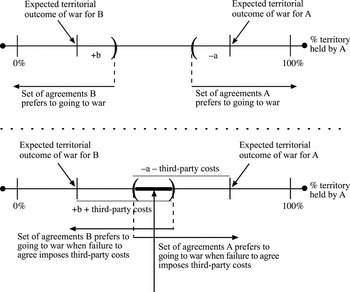
we focus here on the effects of third-party intervention. We argue that third-party intervention can often create conditions and settlements that are sustainable only so long as the third-party remains an active participant in the belligerents' conflict. Once third-party attention wanes, the settlement becomes obsolete as a divergence between the settlement agreed to and the belligerents' expectations about what they could gain by renewing the war emerges.Motivated in some instances by humanitarian concerns and in other instances by selfish, strategic concerns, pressure by third parties to ceasefire is increasingly commonplace. Although third parties occasionally become active belligerents in the dispute, more common is for third parties to place heavy diplomatic pressure on the disputants to stop fighting by threatening one or both sides with economic, military, or political repercussions. Such pressure has the immediate and seemingly positive effect of enlarging the contract zone for the belligerents. Because failing to agree will evoke the displeasure of outside actors (often quite powerful states), a wider range of settlements becomes preferable to the belligerents than nonagreement. Given enough pressure, a contract zone can emerge where none previously existed. In Figure 3, for instance, the belligerents were initially unable to reach a mutually acceptable agreement because they had different expectations about the military outcome of the war. Nonagreement becomes more costly and the range of acceptable agreements increases, however, when third parties pressure the disputants to stop fighting. In the bottom half of Figure 3, the expected costs of invoking the displeasure of a third party is sufficient to create a contract zone that allows the belligerents to reach an agreement even though the belligerents' expectations about the outcome of the war have not changed.

The impact of third-party intervention on the contract zone, where a and b indicate A's and B's costs of fighting, respectively
Over the longer run, however, such “unnatural settlements” are unlikely to last. Significantly, the agreement is only acceptable to both belligerents because they believe that failure to accept the agreement will result in penalties imposed by the third party. In the absence of third-party pressure, no agreement existed that was acceptable to both sides. If and when third-party attention wanes, not only is the agreement likely to become obsolete, but efforts to renegotiate the agreement are unlikely to be successful as well because considerable uncertainty remains regarding the consequences of continuing the war.
Further, third parties may also pressure the disputants to accept a settlement that differs from the terms that the belligerents themselves would have ultimately negotiated. In some instances, the desire of outside actors to end the fighting ensures that the de facto settlement in such “unnatural” ceasefires is simply the military status quo at that particular time. Although the expected repercussions of failing to accept the military status quo as the de facto settlement may encourage the belligerents to accept such terms initially, the ceasefire line may not reflect well one or both of the belligerents' expectations of where the ultimate line would have been if fighting were to have continued. In this case, the agreement is even more likely to become obsolete as third-party attention wanes because the terms of the agreement as initially agreed to do not correspond well with the belligerents' expectations of what the “natural” settlement would have been. In other instances, third parties do not simply pressure for a ceasefire along current battle lines, but instead pressure the belligerents to return either to the antebellum status quo or to accept a compromise agreement that meets current perceptions of fairness or justice. Given that third parties often intervene when one side is decisively defeating the other,21
such settlements, although potentially “better” on several normative dimensions, may differ from what would have been the expected military outcome of the conflict. Because the settlement is unlikely to reflect at least one of the belligerent's beliefs about what settlement could have occurred if the third party had not forced a ceasefire, it is likely that at least one side will prefer to return to war rather than maintain that settlement once third-party pressure wanes.In short, settlements that are viable in the face of heavy third-party pressure are unlikely to remain so absent such pressure. Ironically, if such agreements had been acceptable to both sides absent third-party pressure, intervention by third parties would not have been needed. If the agreement is based on criteria (such as fairness or precedent) that has little to do with the military balance between the belligerents, then at least one side will believe that better terms may be realized through renewed military action. Efforts to renegotiate the settlement short of war, however, are unlikely to be successful. If a contract zone only emerged because of third-party pressure, then considerable uncertainty regarding the capabilities or resolve likely still remains. Such settlements, then, are particularly precarious, because the imposed peace may not reflect either side's expectation of what gains they could or should have received from the war. Additionally, because belligerents' expectations still differ, postwar attempts to revise the settlement may be particularly difficult.
We thus expect that “unnatural” ceasefires that come about as a consequence of third-party pressure are particularly likely to fail. Note that this negative assessment of the consequences of third-party involvement does not contradict the positive expectations about third-party involvement put forward by Walter or Hartzell, Hoddie, and Rothchild.22
The key distinction between these approaches is the role third parties assume. In some instances, third parties help to secure or guarantee an agreement that the belligerents have agreed is mutually preferable to war. Third parties can be essential to solving enforcement problems. In other instances, third parties coerce the belligerents into a ceasefire that the parties are not yet convinced is in their best interests. Here, third parties often encourage a settlement that has little to do with the belligerents' expectations about how the war would have played out if it had continued. The distinction often comes down to timing. Third parties that attempt to “keep peace” can help to secure agreements that might otherwise be at risk. Third parties that attempt to “make peace” can create “false” ceasefires that are prone to fail. These expectations are summarized in Hypothesis 2.Hypothesis 2: Ceasefires that follow wars “interrupted” by third-party pressure are at increased risk of failure.
Enforcement issues clearly affect the durability of peace. As such, efforts to enhance the belligerents' ability to credibly commit to enforcing the terms of settlement will enhance peace efforts. An exclusive focus on enforcement issues, however, may be overly optimistic. The enforcement dilemma assumes that the belligerents prefer peace to war but are caught in something like a prisoner's dilemma. We suggest, in contrast, that in some instances, war resumes because the belligerents actually prefer a renewed war to peace. False settlements or a failure to reconcile past uncertainty completely can create conditions in which one or both parties believe that a renewed war will lead to a better settlement than currently exists. In the following section, we evaluate these expectations to determine whether distributional arguments, such as enforcement arguments, can help to explain why some ceasefires last while others do not.
Empirical Evaluation
Research Design
To evaluate our hypotheses, we make use of Fortna's ceasefire data set.23
We very much appreciate her willingness to share her data with us. Available at 〈http://www.columbia.edu/∼vpf4/research.htm〉. Accessed 18 January 2005.
See Fortna 2003, 348, for a more detailed analysis of how the data set was constructed.
See Werner 1999; and Fortna 2003.
See Hosmer and Lemeshow 1999 for more details on hazard models. The research designs of Werner 1999 and Fortna 2003 differ in one significant way. Fortna considers the duration of peace after each ceasefire, while Werner considers the duration of peace after the end of the war.
When the change in relative capabilities variable is included in the analysis, the number of observations drops to 770.
Measurement
To test the two additional hypotheses derived from distributional arguments, we operationalize two variables: interrupted war and battle consistency. The variable interrupted war identifies ceasefires that occurred only as a consequence of third-party pressure to do so; without such pressure, the war would have continued. Of course, one cannot know for certain what would have happened in the counterfactual case of no third-party pressure. Instead, we consider ceasefires to be “interrupted wars” when (1) there is clear evidence of significant third-party pressure to ceasefire, and (2) the ceasefire is invoked before the parties negotiate the final settlement. Evidence of significant third-party pressure indicates first that such pressure existed. We also verify with the historical record that the belligerents were aware of such pressure and that it mattered to them. This pressure, coupled with evidence that the ceasefire preceded a final settlement, suggests that the ceasefire occurred not because the belligerents were ready and able to settle on a compromise to end the war, but as a consequence of outside pressure to stop fighting.29
As Pillar 1983 demonstrates, the timing between ceasefires and settlements can vary. Ceasefires have preceded settlements in some instances and followed settlement in others. In still other instances, the settlement and the ceasefire occur simultaneously.
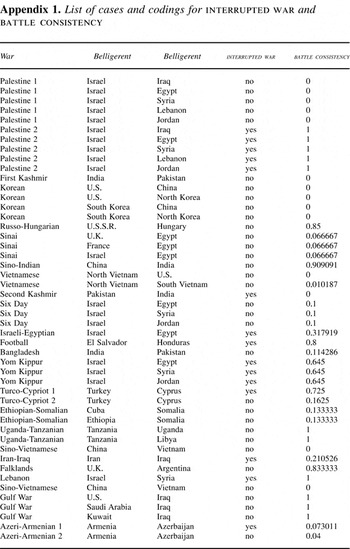
The variable battle consistency identifies whether or not the war revealed consistent information to the belligerents. We measure battle consistency as the duration of the last tide of the war before the ceasefire as a proportion of the total duration of the war. By “tide” we mean a period in which one side is consistently winning battles. The “tide turns” or ends, when and if the other side enjoys a period of victory. To determine the duration of the last tide of the war, we measured from the last known date of a new offensive to the end of the war. In cases in which an organized offensive was not used, we assessed the outcomes of the final battles of the war to determine the duration of the last tide of the war. Zeros denote wars that reached a stalemate, meaning neither side was making significant progress in battle. An example would be the Korean War, which eventually reached a stalemate so long-lived that the status quo battle line has prevailed, even to the present day. Wars coded 1 mean that one side consistently won battles from the beginning to the end of the war, such as in the first Gulf War in which the United States successfully expelled Iraq from Kuwait. Values of battle consistency that are between 0 and 1 suggest that some change in battle conditions (for example, military strategy, capability, leadership, and so on) led one side to gain an advantage and begin winning battles consistently enough to precipitate negotiations. For example, in the Yom Kippur War (coded 0.645), Israel, after a surprise attack, managed to turn the tide of battle in its favor, forcing Egypt, Syria, and Jordan to settle. If the duration of the last tide as a proportion of the total duration of the war was long, then both “observer uncertainty” and “inherent risk” are low. Not only is it less likely for two observers to come away from the war with different conclusions regarding its ultimate outcome, but the perception of the probability of ultimate victory is also heavily skewed toward one side avoiding the inherent risk associated with perceptions of power parity and the greater variance over possible outcomes. The coding for the interrupted war and battle consistency variables for each case are provided in Appendix 1.31
The source list for each war used to code the interrupted war and battle consistency variables is available from the authors on request.
We also include a variable that marks the change in relative capabilities between the belligerents during the peace.32
See Werner 1999.
change in capabilities at time

. In future analyses, we intend to formulate alternative measures of power in order to address more directly the concern expressed by Fortna 2003 that the war may be creating the change in capabilities, rather than vice versa.
In order to evaluate and compare the importance of agreement strength to the durability of peace, we also include Fortna's index of agreement strength variable. Her index of agreement strength measures the number of mechanisms incorporated into the peace agreement to facilitate enforcement. The index varies from 0, which indicates that no agreement was in place at that time, to 10, which indicates that all of the following mechanisms were incorporated into the agreement: provisions for a demilitarized zone, arms control agreements, peacekeeping forces, confidence building measures, dispute resolution mechanisms, a formal agreement, specific provisions, provisions for internal control, external involvement, and withdrawal of forces.34
See Fortna 2003 for specific details and sources.
Following Fortna, we also include several variables identified by others as important to the durability of peace to control for the degree of difficulty of the case.35
Ibid.
Results
Weibull Analysis
Note first that in the Weibull analyses that follow positive coefficients suggest that the variable increases the risk that peace fails with a renewed war, while negative coefficients suggest that the variable decreases the risk that peace fails. To ensure consistency with Fortna's analysis,36
Ibid.
Ibid. See tab. 2, col. 2.
Ibid.
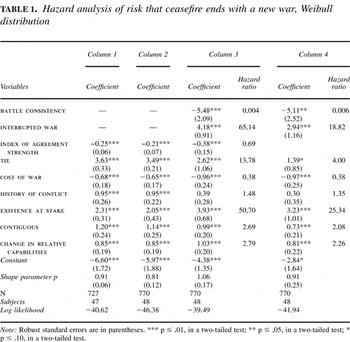
Hazard analysis of risk that ceasefire ends with a new war, Weibull distribution

As one can see from these results, the strength of the agreement significantly reduces the risk that ceasefires fail. One can well imagine that in a time rife with distrust, mechanisms that help secure the agreement by reducing incentives to defect and fears of duplicity would be extremely important. These results are consistent with results presented by Hartzell, Hoddie, and Rothchild.39
They find, in a study of civil conflict, that third-party enforcement and territorial autonomy increase the durability of peace by mitigating the former belligerents' security fears.The results also replicate Werner's result that changes in relative capabilities after the ceasefire increase the risk that the agreement fails.40
Note that here we did not include the lag of change in relative capabilities, as Fortna does.41 She argues that it is possible that the positive association between changes in relative capabilities and the renewal of war may be because the renewed war caused the change in relative capabilities rather than the reverse. Although we appreciate this argument, we are not entirely persuaded. First, we are not convinced that lagging the change variable is appropriate. Analyzing the lagged variable prevents one from considering large shocks to a relationship that may fundamentally alter the belligerents' assessment of the value of the peace agreement relative to war. The war between India and Pakistan in 1971, for example, was a direct result of an attempted revolt and secession of East Pakistan. West Pakistan used military force against the secessionists, and India entered the conflict in part because the domestic chaos within Pakistan created a strategic opportunity for India to further weaken Pakistan.42 Lagging the change variable assumes that belligerents typically wait a year when an opportunity arises to take advantage of a newly vulnerable opponent.Further, lagging the change variable creates some data issues as it ensures that the first year of every new peace agreement is dropped from the analysis. Given that there are only forty-eight cases in the data set and several agreements die in the first year, this loss is not insignificant. In fact, when the relative capabilities variable is lagged, eight cases are dropped from the analysis. Significantly, when we include a lagged relative capabilities variable in the data set created by Werner43
that spans a longer time period (1816–1992 rather than 1945–97), the lagged variable is positive and statistically significant, albeit at p = 0.08 in a two-tailed test.44Analysis available from the authors on request.
With regard to the control variables, the results show that ceasefires that follow ties are more likely to fail, as are ceasefires between belligerents that share a conflict-ridden history. Ceasefires that follow wars in which a belligerent's existence was threatened are also more likely to fail. In contrast, ceasefires that follow particularly costly wars are less likely to fail and more likely to endure. These results replicate those produced by Fortna and are largely consistent with those reported by Werner,46
who also finds that costly wars are less likely to be repeated.In column 3 of Table 1, we duplicate this analysis but add the interrupted war and battle consistency variables. The results provide strong support for both hypotheses one and two. First, the results show that battle consistency significantly decreases the risks of another war. When the war sends a consistent and incontrovertible message regarding the relative superiority of one side over another, then the peace is much more likely to last than if the information from the war is more subject to interpretation.47
Note that this variable is significant despite a relatively strong, negative correlation with the variable tie. As expected, as the consistently of the battle outcomes in the war increase, it becomes less likely that the war ends in a tie. If we drop the tie variable from the analysis, the coefficient of the battle consistency variable becomes larger and more significant, but several other variables including the index of agreement strength become statistically insignificant at conventional levels.
Second, the results show that ceasefires that come about under intense third-party pressure before any agreement being reached were significantly more likely to fail than ceasefires that occurred at what, one might argue, would be the “natural” end of the war. The ceasefires that follow these “interrupted wars” took place without the belligerents necessarily agreeing on the likely future course of the war. As a result, there is no reason to expect that the de facto settlement—often the ceasefire line or antebellum division—resembled in any fashion the settlement either party expected they would or could have received if the war had continued. Once third-party pressure wanes, it is unsurprising that at least one side would prefer to renew the war rather than maintain the ceasefire and the de facto settlement it represents. This failure does not come about because the belligerents cannot enforce a mutually desirable settlement. Instead, at least one belligerent wants war because it believes that it will lead to a better settlement than previously realized.48
See Toft 2002/03 for a discussion of this logic in terms of territorial issues.
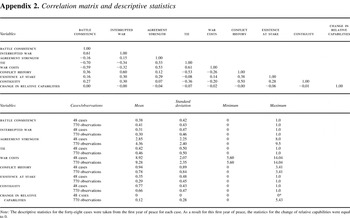
It is also interesting to note that there is a positive correlation (0.61) between the battle consistency variable and the interrupted war variable. In fact, of the fifteen cases where the third party pressured for ceasefire without an agreement in hand, eleven occurred when the battle consistency variable exceeded 0.5.49
These cases include the Second Palestine War, the Football War, the Yom Kippur War, the First Turco-Cypriot War, and the Lebanon War. There are a total of eleven cases because each war is broken into its respective dyads.
In column 4 of Table 1, we reanalyze the same model but drop Fortna's index of agreement strength variable. Interestingly, although this change does not affect the sign or statistical significance of either the battle consistency or the interrupted war variable, the hazard ratio for the interrupted war variable falls considerably. When agreement strength is not controlled for, the hazard ratio drops from 65.14 to 18.82. Although this effect is still quite considerable, suggesting that ceasefires following “interrupted wars” are eighteen times more likely to fail than otherwise, its magnitude is much lower than suggested in the full model.
We interpret this change in the following way. In the analysis where we control for strength of the agreement (column 3), we may in some ways be controlling for continued third-party interest and engagement in the conflict and ensuing peace. If the third parties pressure the belligerents to ceasefire but then follow up that pressure with a strong agreement that defends and enforces the ceasefire, the ceasefire is at less, albeit still considerable, risk. Much more dangerous, however, are instances where third parties put considerable pressure on the belligerents to ceasefire but then neither help the parties to institutionalize the agreement nor maintain sufficient pressure to ensure that the parties do so themselves. As Luttwak argues, “partial interventions” are particularly dangerous.50
The humanitarian impulse to stop the fighting without the commitment to enforce the peace may have the paradoxical consequence of prolonging rather than shortening the conflict.We also consider the substantive effects of the variables by considering the change in the log likelihoods. Because our model simply adds two additional variables, we can compare the fit of our model to any model that is “nested” within it to see which model fits better.51
See Clarke 2001 for more on nested and nonnested models.
Tests were done with and without robust standard errors and clustering to ensure that the results were not affected by variance controls.
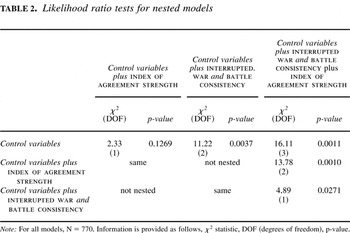
Likelihood ratio tests for nested models

Although these initial results suggest that the inclusion of our two distributional variables improve the fit of the model more so than does the inclusion of the index of agreement strength variable, the results do not suggest that Fortna's focus on agreement strength is misplaced. As can be seen in Table 2, if one compares the fit of the model that only includes the control variables and the interrupted war and battle consistency variables with the full model that includes these variables plus Fortna's index of agreement strength variable, the inclusion of Fortna's agreement variable significantly improves the fit of that model, at a significance level of 0.0271. This suggests that once the distributional issues are controlled for, the strength of the agreement is particularly important. Further, if one compares the fit of the full model that includes all of the variables with the base model that only includes the control variables, it is obvious that recognition of both distributional and enforcement problems is critical. The full model improves on the fit of the base model at a significance level just shy of 0.001.
Alternative Model Specifications
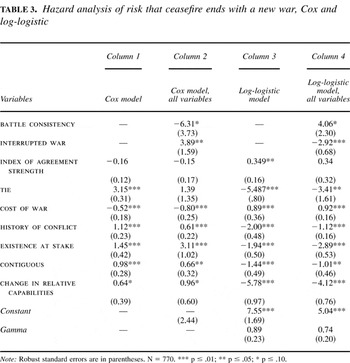
The analysis to this point follows Fortna's lead and makes use of a Weibull model. This model, however, assumes that the hazard rate is monotonic, either always increasing or always decreasing. To ensure that our results were not affected by this assumption, we also employed a Cox model and recovered the baseline hazard rate. The results for Fortna's index model and for the full model that includes the battle consistency and interrupted war variables are presented in columns 1 and 2 of Table 3. Positive coefficients should again be interpreted as increasing the risk that peace fails, while negative coefficients suggest that the variable reduces the risk that peace fails. Note first that the index of agreement strength variable is no longer statistically significant in either column 1 or 2 of Table 3. In contrast, the battle consistency and interrupted war variables do retain their significance, albeit at a lower level of confidence.53
As noted in fn. 47, the battle consistency variable and the tie variable are highly correlated as one might expect. When the tie variable is dropped from this analysis, the battle consistency variable is significant at the 0.005 level.
Hazard analysis of risk that ceasefire ends with a new war, Cox and log-logistic


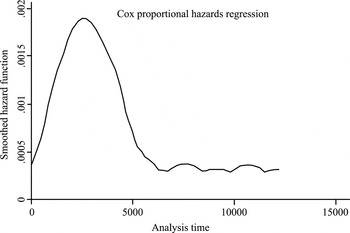
Estimated hazard for the full model
Given the nonlinear shape of the hazard function, a Weibull model appears inappropriate. Although the Cox model has the advantage of not imposing any restriction on the shape of the hazard function, because it does not do so it is also not efficient and can overestimate the standard errors. In order to ensure that we have not falsely rejected the hypothesis that the strength of peace agreements matters, we also analyzed the data using a log-logistic model that assumes an increasing and then decreasing hazard rate, similar to what is seen in Figure 4. These results are available in columns 3 and 4 of Table 3. In the log-logistic model, interpretation of the coefficients differs as the coefficients are reported in the accelerated-failure time metric. Positive coefficients thus suggest that the variable increases the time until failure while negative coefficients suggest that the variable decreases the time until failure or that the variable makes peace more precarious.
The results from the log-logistic models also cast some doubts on the importance of the strength of the peace agreement for the durability of peace. Although the strength of the peace agreement is significant in column 3, it is not significant when the full model is specified in column 4. In contrast, the interrupted war variable retains its significance in all cases, as does the battle consistency variable albeit at lower levels than first seen in the Weibull models. Note also that if the index of agreement strength variable is dropped from the analysis (not shown), the statistical significance of the battle consistency variable improves to the 0.01 level.
Substantive Effects
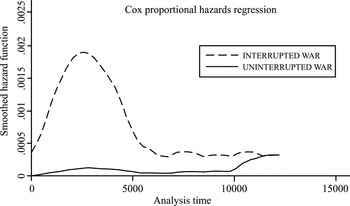
We can also provide a better perspective on the substantive effects of the interrupted war, battle consistency, and agreement strength variables by graphing the hazard function under different scenarios.54
To estimate the hazard functions under different parameter values for the variables of interest, we must hold the other variables at constant values. In the estimates that follow, we set the conflict history, existence at stake, contiguity, and tie variables at 1.0, and the war costs, agreement strength, and change in relative capabilities variables at their mean values. This represents a fairly typical dyad within the data set. We varied these values for all estimates to ensure that the relationships between hazard estimates remained stable across different scenarios. While the estimated hazards were higher when we changed the values such that the dyad became more dangerous (that is, existence at stake = 1 rather than 0), the relationships between the hazard functions in each graph remained the same.

Estimated hazard functions for interrupted war and uninterrupted war
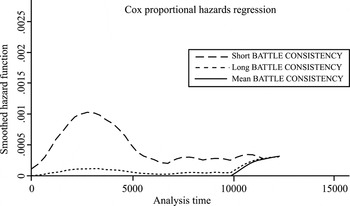
In Figure 6, we present the estimated hazard functions for settlements of uninterrupted wars that emerged when battle consistency was high, low, and at mean (0.42) levels. Recall that high levels of battle consistency suggest that there was one dominant battle trend in the war—one side won consistently throughout the war. Low levels imply that the war ended without a clear tide emerging for either side. Mean levels suggest that at the war's end, one side had secured consistent victories for more than half of the total duration of the war. For the uninterrupted wars portrayed in Figure 6, the possibility of a recurrent conflict is significantly higher for wars with short battle consistency than for those where a clear battle trend existed at the end of the war. There appears to be little difference, however, between the hazard rates for wars where the battle consistency variable was at mean or high levels. Although the substantive effects of battle consistency appear smaller than the effects for third-party intervention, an ambiguous military ending seems particularly dangerous, leaving open the possibility of different lessons from the war and the particular risks associated with perceptions of power parity.

Estimated hazard functions for low, mean, and high levels of battle consistency (uninterrupted war cases)
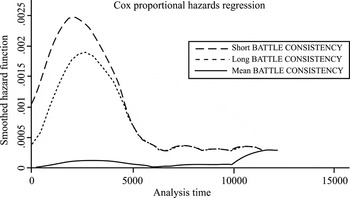
We explore the joint effects of battle consistency and third-party intervention in Figure 7. Here, we present the estimated hazard functions for low, mean, and high levels of battle consistency for the cases of interrupted wars. As in Figure 6, the highest risk occurs for those cases where battle consistency is low. Note, however, that high battle consistency cases are also at considerable risk—much higher than those cases at mean levels of battle consistency.55
Note that for all of these estimates, the variable tie is set at 1.0. However, as previously noted, there is a strong negative correlation between the variables tie and battle consistency—if battle consistency is high, it is unlikely that the war ends in a tie. Varying the battle consistency variable while holding the variable tie constant is thus somewhat misleading. To ensure that the different patterns that emerge in Figure 7 are not dependent on the value of the tie variable, we also ran estimates where the tie value also changed with the battle consistency variable, assuming a value of 1.0 when battle consistency was low and a value of 0 when battle consistency was high. Although the estimated hazard function for the high battle consistency was not as large in the first postwar decade as in the original scenario, the difference remained stark with interrupted wars with high battle consistency being at significantly greater risk of repeating than uninterrupted wars with high battle consistency.

Estimated hazard functions for low, mean, and high levels of battle consistency (interrupted war cases)
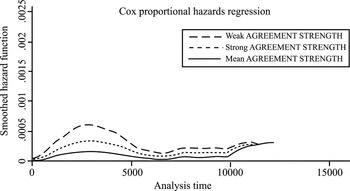
Finally, we consider the substantive effects of the agreement strength variable in Figure 8. Two things are readily apparent. First, the substantive effect of the agreement strength variable is significantly less than the substantive effect of the other variables of interest. Second, while weak agreements are at the greatest risk of failure, Figure 8 suggests that agreements with average levels of enforcement mechanisms or confidence-building measures are at the lowest risk of failure, not strong agreements, although the difference is fairly small. This suggests to us that selection effects may continue to plague the analysis of peace duration. As Fortna explains well, strong agreements are likely to be put in place in the very cases where they are needed most.56
Unless we are able to control for all of the factors that make certain cases particularly risky, it is difficult to discern the true effects that mechanisms within the agreement may have.
Estimated hazard functions for low, mean, and high levels of agreement strength
Discussion
Although our conclusions are not definitive given the relatively small number of cases, the analysis suggests that peace depends heavily on the distributional consequences of the settlement and convergent expectations that better terms cannot be achieved by renewing the war. If the terms of agreement do not reflect the belligerents' common beliefs of the military consequences of continuing to fight, at least one belligerent will have an incentive to revisit the settlement. In these cases, returning to war may lead to better terms, providing a compelling motive for challenging the peace. If considerable uncertainty remains regarding the consequences of fighting either because the lessons from the previous war were unclear or because third parties intervened and ended the war before the uncertainty was resolved, efforts to renegotiate the settlement are unlikely to succeed. When considerable uncertainty remains and the settlement does not reflect at least one of the belligerents' expectations about what could be achieved via war, the risk of recurrent conflict will be high.
In contrast, mechanisms that increase the costs of renewing the war or that help to build trust between the belligerents seem to have less impact. Although the index of agreement strength variable was significant in the Weibull model, it did not improve the fit of the model over a model that simply contained the control variables except when the interrupted war and battle consistency variables were added. Further, the statistical significance of the index of agreement strength variable fell considerably when more appropriate hazard models were analyzed. The substantive effect of the index of agreement strength variable was also relatively small. Despite these results, we believe that enforcement mechanisms can make a difference. The poor results may in part be a consequence of our inability to appropriately identify the “hard cases” through the control variables. As Fortna notes, if strong agreements are more likely to be put in place in the most difficult cases, it will be hard to demonstrate that such mechanisms matter.57
Ibid.
Implications and Conclusions
The implications of this analysis are significant. We have extended recent discussions of the durability of peace by considering the recurrence of war as a distributional problem rather than solely as a problem of enforcement. Although it is clear that in many instances the belligerents struggle with enforcement problems and may often fall back into war because they cannot trust each other to keep the terms of the agreement, in other instances, the belligerents deliberately choose war because they believe that a new war will lead to a better settlement than previously realized.
Whether the problem the belligerents confront is one best characterized by enforcement dilemmas or distributional problems suggests different strategies to help ensure the peace. If the problem is an enforcement problem—a mutually acceptable settlement exists but the belligerents struggle with credibly committing to its terms—then mechanisms such as those highlighted by Fortna should help to institutionalize the peace.58
Ibid.
The analysis also suggests that third parties must be careful when they pressure belligerents to ceasefire that they are not encouraging a de facto settlement that is not at all consistent with the belligerents' beliefs about the likely course of the war. Encouraging, for instance, a ceasefire line along the antebellum division is unlikely to survive if one side was making significant advances during the course of the war. In such instances, although the belligerents may agree to the ceasefire temporarily to appease powerful third parties, at least one of the belligerents is going to resist pressures to institutionalize the peace. Rather than accept provisions such as demilitarized zones or monitors that could create roadblocks for a renewed conflict, the belligerents bow to the pressure to ceasefire but anticipate the opportunity to renew the conflict.
An important caveat to this pessimistic analysis of third-party intervention, however, exists. If the belligerents know that any renewed war will ultimately end the same as the first because the third party will again intervene and prevent a decisive victory by the stronger side, then there will be no expectation that a renewed war will lead to better terms and no incentive to break the peace. In this instance, the third party may be able to end the war without increasing the risk of recurrence. The problem is that in many instances third parties pressure the belligerents to ceasefire and then quickly lose interest leaving open the real possibility that a renewed war will turn out differently. In these instances, long-term success will depend not only on the initial will to stop the fighting but the perception that the resolve will last. We believe that these considerations are particularly relevant to the understanding of the termination and postwar stability of civil conflicts. Although our analysis is currently restricted to interstate conflicts, the impact of third-party intervention on intrastate conflict may be even greater. Increasingly, powerful third parties attempt to make peace in intrastate conflicts. Our analysis suggests that their ability to create a lasting peace is in serious question given that the long-term commitment of third parties is often highly questionable.
As a final note, it is important to recognize that even if ceasefires that come about as a consequence of third-party pressure are significantly more likely to fail, it is not necessarily clear that such pressure does not serve the interests of the belligerents or humanitarian interests more generally. On the one hand, our results suggest that ceasefires that come about as a consequence of third-party pressure are significantly more likely to fail than ceasefires that come about without such external intervention. This implies that third-party pressure to stop fighting can actually increase conflict and the associated costs by increasing the risks that the belligerents experience multiple conflicts. On the other hand, third-party pressure to ceasefire can significantly shorten the original conflict. As a result, the costs the belligerents endure may be less for each conflict. It is not clear whether a single, lengthy conflict or several, shorter conflicts are more costly for the belligerents. What trade-offs third parties or the international community are willing to make will clearly depend on the details of each individual conflict.
Appendix 1.
List of cases and codings for interrupted war and battle consistency

Appendix 2.
Correlation matrix and descriptive statistics

References
REFERENCES
Arnold, Guy.
1991.
Wars in the Third World Since 1945.
London:
Cassell.
Clarke, Kevin A.
2001.
Testing Nonnested Models of International Relations: Reevaluating
Realism.
American Journal of Political Science
45 (3):724–44.Google Scholar
Fearon, James.
1995.
Rationalist Explanations for War.
International Organization
49 (3):379–414.Google Scholar
Fearon, James.
1998.
Commitment Problems and the Spread of Ethnic Conflict. In
The International Spread of Ethnic Conflict: Fear, Diffusion and
Escalation, edited by
David Lake and
Donald Rothchild,
107–26.
Princeton, N.J.:
Princeton University Press.
Filson, Darren, and
Suzanne Werner.
2002.
A Bargaining Model of War and Peace: Anticipating the Onset,
Duration, and Outcome of War.
American Journal of Political Science
46 (4):819–37.Google Scholar
Filson, Darren, and
Suzanne Werner.
2004.
Bargaining and Fighting: The Impact of Regime Type on War Onset,
Duration, and Outcomes.
American Journal of Political Science
48 (2):296–313.Google Scholar
Fortna, Virginia Page.
2003.
Scraps of Paper? Agreements and the Durability of Peace.
International Organization
57 (2):337–72.Google Scholar
Fortna, Virginia Page.
2004.
Peace Time: Cease-Fire Agreements and the Durability of
Peace.
Princeton, N.J.:
Princeton University Press.
Hartzell, Caroline, and
Matthew Hoddie.
2003.
Institutionalizing Peace: Power Sharing and Post–Civil War
Conflict Management.
American Journal of Political Science
47 (2):318–32.Google Scholar
Hartzell, Caroline,
Matthew Hoddie, and
Donald Rothchild.
2001.
Stabilizing the Peace After Civil War: An Investigation of Some Key
Variables.
International Organization
55 (1):183–208.Google Scholar
Hosmer, David W., Jr., and
Stanley Lemeshow.
1999.
Applied Survival Analysis: Regression Modeling of Time to Event
Data.
New York:
John Wiley.
Pillar, Paul.
1983.
Negotiating Peace: War Termination as a Bargaining Process.
Princeton, N.J.:
Princeton University Press.
Posen, Barry.
1993.
The Security Dilemma and Ethnic Conflict. In
Ethnic Conflict and International Security, edited by
Michael E. Brown,
103–24.
Princeton, N.J.:
Princeton University Press.
Powell, Robert.
2002.
Bargaining Theory and International Conflict.
Annual Review of Political Science
5:1–30.Google Scholar
Powell, Robert.
2004.
Bargaining and Learning While Fighting.
American Journal of Political Science
48 (2):344–61.Google Scholar
Reed, William.
2003.
Information, Power, and War.
American Political Science Review
97 (4):633–41.Google Scholar
Slantchev, Branislav L.
2003.
The Principle of Convergence in Wartime Negotiations.
American Political Science Review
97 (4):621–32.Google Scholar
Smith, Alastair, and
Allan C. Stam III
2004a.
Mediation and Peacekeeping in a Random Walk Model of Civil and
Interstate War. In
Dissolving Boundaries, edited by
Suzanne Werner,
David Davis, and
Bruce Bueno de Mesquita,
115–36.
New York:
Blackwell.
Smith, Alastair, and
Allan C. Stam III
2004b.
Bargaining and the Nature of War.
Journal of Conflict Resolution
48 (6):783–813.Google Scholar
Toft, Monica Duffy.
2002/03.
Indivisible Territory, Geographic Concentration and Ethnic
War.
Security Studies
12 (2):82–119.Google Scholar
Wagner, R. Harrison.
2000.
Bargaining and War.
American Journal of Political Science
44 (3):469–84.Google Scholar
Walter, Barbara.
1997.
The Critical Barrier to Civil War Settlement.
International Organization
51 (3):335–64.Google Scholar
Werner, Suzanne.
1999.
The Precarious Nature of Peace: Resolving the Issues, Enforcing the
Settlement, and Renegotiating the Terms.
American Journal of Political Science
43 (3):912–34.Google Scholar
Wilkenfeld, Jonathan, and
Michael Brecher.
1984.
International Crises, 1945–1975: The UN Dimension.
International Studies Quarterly
28 (1):45–67.Google Scholar
Wittman, Donald.
2001.
War or Peace?
Paper presented at the Political Economy of Conflict Conference,
March, Yale University, New Haven, Conn.
Divergent expectations regarding outcomes of war eliminates contract zone, where a and b indicate A's and B's expected costs of fighting, respectively
Converging expectations regarding outcome of war creates contract zone, where a and b indicate A's and B's costs of fighting, respectively
The impact of third-party intervention on the contract zone, where a and b indicate A's and B's costs of fighting, respectively
Hazard analysis of risk that ceasefire ends with a new war, Weibull distribution
Likelihood ratio tests for nested models
Hazard analysis of risk that ceasefire ends with a new war, Cox and log-logistic
Estimated hazard for the full model
Estimated hazard functions for interrupted war and uninterrupted war
Estimated hazard functions for low, mean, and high levels of battle consistency (uninterrupted war cases)
Estimated hazard functions for low, mean, and high levels of battle consistency (interrupted war cases)
Estimated hazard functions for low, mean, and high levels of agreement strength
List of cases and codings for interrupted war and battle consistency
Correlation matrix and descriptive statistics
 You have
Access
- 132
- Cited by